Paragraph 35 · 50% changed
Every version of it
Screener
/
SEC EDGAR
/CIK 0001018963
/10-K filed Feb 20, 2026, compared with Feb 21, 2025
/Numbers from the XBRL of the 10-Ks
NYSE
Materials · Steel Pipe & Tubes
ATI Inc ATI
The 10-K against last year's
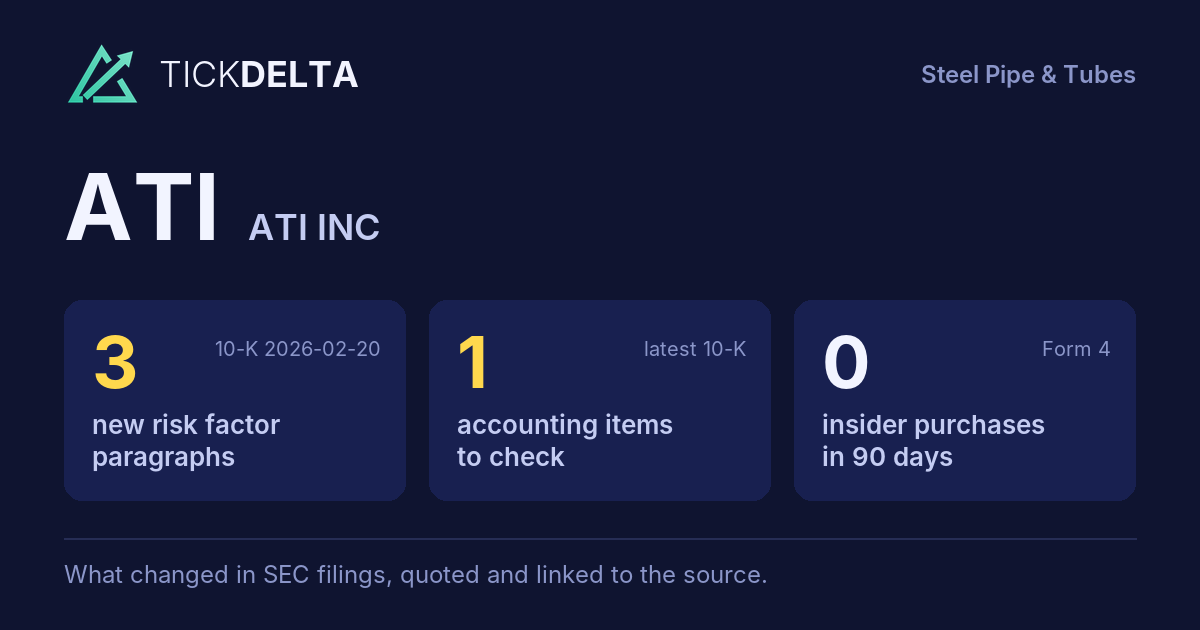
23 changes: 3 added, 1 removed, 18 reworded, 1 quiet changes
10-K Feb 20, 2026 vs Feb 21, 2025
Risk Factors
8.9%
of the text changed · 6,972 words now · 3 new paragraphs, 1 gone
MD&A
0.0%
of the text changed · 198 words now · 0 new paragraphs, 0 gone
Legal Proceedings
15.5%
of the text changed · 428 words now
Accounting Policies
14.7%
of the text changed · 4,188 words now
10-K 0001628280-26-010140 (Feb 20, 2026) vs 10-K 0001628280-25-007092 (Feb 21, 2025)
Every paragraph, and how much of it changed
One bar per paragraph, in the order of the 10-K. Height and colour show the share of its words not in the closest paragraph a year earlier; the tallest bars are new paragraphs.
Risk Factors
57 paragraphs · 3 new · 28 reworded · 1 gone · 10-K Feb 20, 2026 against Feb 21, 2025
New paragraph
Reworded (5% of its words or more)
Same or nearly
Paragraph 41 · 49% changed
Every version of it
Paragraph 8 · 39% changed
Every version of it
Dependence on Critical Supplies Raw Materials Subject to Price and Availability Fluctuations. We rely to a substantial extent on third parties for to supply certain supplies, such as graphite electrodes and industrial gases including helium and argon raw materials that are critical to the manufacture of our products. Purchase prices and availability of these critical items are subject to volatility. volatility, and in some cases, we have supply arrangements with only a limited number of suppliers for a given material. At any given time, we may be unable to obtain an adequate supply of these critical raw materials on a timely basis, on price and other terms acceptable to us, or at all. If suppliers increase the price of critical raw materials, we
Paragraph 19 · 20% changed
Every version of it
Labor Matters. We have approximately 7,700 7,600 active employees, of which approximately 15% are located outside the U.S. Approximately 35% of our workforce is covered by various CBAs, predominantly with the USW. At various times, our CBAs expire and are subject to renegotiation. Generally, CBAs that expire may be terminated after notice by the union. After termination, the union may authorize a strike. A labor dispute, which could lead to a strike, lockout, or other work stoppage by the employees covered by one or more of the collective bargaining agreements, could have a material adverse effect on production at one or more of our facilities and, depending upon the length of such dispute or work stoppage, on our operating results. Additionally, labor organizations may from time to time attempt to organize groups of additional employees who are not currently covered by any of the CBAs to which we are a party. The outcome of any such efforts may be influenced by many factors and is difficult to predict. There can be no assurance that we will succeed in obtaining CBAs to replace those that expire or in negotiating new CBAs on terms acceptable to us or at all.
Paragraph 11 · 15% changed
Every version of it
Dependence on Critical Supplies Subject to Price and Availability Fluctuations. We rely on third parties for certain supplies, such as graphite electrodes and industrial gases including helium and argon, that are critical to the manufacture of our products. Purchase prices and availability of these critical items are subject to volatility. At any given time, we may be unable to obtain an adequate supply of these critical supplies on a timely basis, on price and other terms acceptable to us, or at all. If suppliers increase the price of these items, we may not have alternative sources of supply. The manufacture of some of our products is a complex process and requires long lead times. If suppliers increase the price of these critical supplies, we may not have alternative sources of supply. As a result, we may experience delays or shortages of critical supplies. If unable to obtain adequate and timely deliveries of required supplies, we may be unable to timely manufacture sufficient quantities of products. This could cause us to lose sales, incur additional costs, delay new product introductions, or suffer harm to our reputation.
Paragraph 4 · 14% changed
Every version of it
Risks Associated with Cyclicality in General Industrial Markets. Our exposure to general industrial markets is primarily in our AA&S segment, where we have sales to the oil and gas industry, automotive, food equipment & appliances and construction and mining markets. These markets tend to be highly cyclical and subject to volatility as a result of fluctuations in worldwide economic activity and associated demand, changes in applicable regulation, global geopolitical conditions and numerous other factors. Demand for our products, particularly within the AA&S segment, is subject to these trends, and in recent years, our business has at times been negatively impacted by depressed demand from general industrial markets. We expect that these end markets will remain highly cyclical. Future downturns in these markets could have an adverse effect on the prices at which we are able to sell our products, and our results of operations, business and financial condition could be materially adversely affected.
Paragraph 26 · 14% changed
Every version of it
Regulatory and Other Transition Risks. Worldwide focus on climate change has led to legislative and regulatory efforts to combat both potential causes and adverse impacts of climate change. New or more stringent laws and regulations related to greenhouse gas emissions, water usage and other climate change related concerns may adversely affect us, our suppliers and our customers. We have publicly disclosed efforts to reduce certain environmental impacts, including greenhouse gas (GHG) emissions of our operations, and provide for our compliance with applicable environmental regulations. Nevertheless, new and evolving laws and regulations could mandate different or more restrictive standards; increase operating costs; require (or cause customers to require that we make) capital investments to transition to low carbon technologies or purchase carbon credits; or otherwise adversely impact our ongoing operations. Our suppliers may face similar challenges and incur additional compliance costs that are passed on to us. These direct and indirect costs may adversely impact our results.
Paragraph 9 · 13% changed
Every version of it
Paragraph 35 · 50% changed
Every version of it
10-K Feb 21, 2025Risks Associated with Strategic Capital Projects and Maintenance Activities. From time to time, we undertake strategic capital projects in order to enhance, expand and/or upgrade our facilities and operational capabilities. Our ability to achieve the anticipated increased revenues or otherwise realize acceptable returns on these investments or other strategic capital projects that we may undertake is subject to a number of risks, many of which are beyond our control, including a variety of market, operational, permitting, and labor-related factors. In addition, the cost to implement any given strategic capital project ultimately may prove to be greater than originally anticipated. If we are not able to achieve the anticipated results from the implementation of any of our strategic capital projects, or if we incur unanticipated implementation costs or delays, our results of operations and financial position may be materially adversely affected. Additionally, we periodically undertake maintenance activities, routine or otherwise, involving facilities and pieces of equipment that are key to our operations, and it is possible that unanticipated maintenance needs, or unanticipated circumstances arising in connection with planned maintenance activities could result in equipment outages that are longer, or costs that exceed, those originally anticipated. Significant repair delays or unanticipated costs associated with these activities could have a negative impact on our results of operations and financial condition.
10-K Feb 20, 2026
unanticipated maintenance needs, or unanticipated circumstances arising in connection with planned maintenance activities could result in equipment outages that are longer, or costs that exceed, those originally anticipated. Significant repair delays or unanticipated costs associated with these activities could have a negative impact on our results of operations and financial condition.
Paragraph 41 · 49% changed
Every version of it
10-K Feb 21, 2025Risks Associated with Government Contracts. Some of our operating units perform contractual work directly or indirectly for the U.S. Government, which requires compliance with laws and regulations relating to the performance of Government contracts. Various claims (whether based on U.S. Government or Company audits and investigations or otherwise) could be asserted against us related to our U.S. Government contract work. Depending on the circumstances and the outcome, such proceedings could result in fines, penalties, compensatory and treble damages or the cancellation or suspension of payments under one or more U.S. Government contracts. Under government regulations, a company, or one or more of its operating divisions or units, can also be suspended or debarred from government contracts based on the results of investigations.
10-K Feb 20, 2026
under one or more U.S. Government contracts. Under government regulations, a company, or one or more of its operating divisions or units, can also be suspended or debarred from government contracts based on the results of investigations.
Paragraph 8 · 39% changed
Every version of it
10-K Feb 21, 2025
Dependence on Critical Supplies Subject to Price and Availability Fluctuations. We rely on third parties for certain supplies, such as graphite electrodes and industrial gases including helium and argon that are critical to the manufacture of our products. Purchase prices and availability of these critical items are subject to volatility. At any given time, we may be unable to obtain
10-K Feb 20, 2026
Dependence on Critical Raw Materials Subject to Price and Availability Fluctuations. We rely to a substantial extent on third parties to supply certain raw materials that are critical to the manufacture of our products. Purchase prices and availability of these critical items are subject to volatility, and in some cases, we have supply arrangements with only a limited number of suppliers for a given material. At any given time, we may be unable to obtain an adequate supply of these critical raw materials on a timely basis, on price and other terms acceptable to us, or at all. If suppliers increase the price of critical raw materials, we
Paragraph 19 · 20% changed
Every version of it
10-K Feb 21, 2025
Labor Matters. We have approximately 7,700 active employees, of which approximately 15% are located outside the U.S. Approximately 35% of our workforce is covered by various CBAs, predominantly with the USW. At various times, our CBAs expire and are subject to renegotiation. Generally, CBAs that expire may be terminated after notice by the union. After termination, the union may authorize a strike. A labor dispute, which could lead to a strike, lockout, or other work stoppage by the employees covered by one or more of the collective bargaining agreements, could have a material adverse effect on production at one or more of our facilities and, depending upon the length of such dispute or work stoppage, on our operating
10-K Feb 20, 2026
Labor Matters. We have approximately 7,600 active employees, of which approximately 15% are located outside the U.S. Approximately 35% of our workforce is covered by various CBAs, predominantly with the USW. At various times, our CBAs expire and are subject to renegotiation. Generally, CBAs that expire may be terminated after notice by the union. After termination, the union may authorize a strike. A labor dispute, which could lead to a strike, lockout, or other work stoppage by the employees covered by one or more of the collective bargaining agreements, could have a material adverse effect on production at one or more of our facilities and, depending upon the length of such dispute or work stoppage, on our operating results. Additionally, labor organizations may from time to time attempt to organize groups of additional employees who are not currently covered by any of the CBAs to which we are a party. The outcome of any such efforts may be influenced by many factors and is difficult to predict. There can be no assurance that we will succeed in obtaining CBAs to replace those that expire or in negotiating new CBAs on terms acceptable to us or at all.
Paragraph 11 · 15% changed
Every version of it
10-K Feb 21, 2025
an adequate supply of these critical supplies on a timely basis, on price and other terms acceptable to us, or at all. If suppliers increase the price of these items, we may not have alternative sources of supply. The manufacture of some of our products is a complex process and requires long lead times. As a result, we may experience delays or shortages of critical supplies. If unable to obtain adequate and timely deliveries of required supplies, we may be unable to timely manufacture sufficient quantities of products. This could cause us to lose sales, incur additional costs, delay new product introductions, or suffer harm to our reputation.
10-K Feb 20, 2026
Dependence on Critical Supplies Subject to Price and Availability Fluctuations. We rely on third parties for certain supplies, such as graphite electrodes and industrial gases including helium and argon, that are critical to the manufacture of our products. Purchase prices and availability of these critical items are subject to volatility. At any given time, we may be unable to obtain an adequate supply of these critical supplies on a timely basis, on price and other terms acceptable to us, or at all. The manufacture of some of our products is a complex process and requires long lead times. If suppliers increase the price of these critical supplies, we may not have alternative sources of supply. As a result, we may experience delays or shortages of critical supplies. If unable to obtain adequate and timely deliveries of required supplies, we may be unable to timely manufacture sufficient quantities of products. This could cause us to lose sales, incur additional costs, delay new product introductions, or suffer harm to our reputation.
Paragraph 4 · 14% changed
Every version of it
10-K Feb 21, 2025
economic activity and associated demand, changes in applicable regulation, global geopolitical conditions and numerous other factors. Demand for our products, particularly within the AA&S segment, is subject to these trends, and in recent years, our business has at times been negatively impacted by depressed demand from general industrial markets. We expect that these end markets will remain highly cyclical. Future downturns in these markets could have an adverse effect on the prices at which we are able to sell our products, and our results of operations, business and financial condition could be materially adversely affected.
10-K Feb 20, 2026
Risks Associated with Cyclicality in General Industrial Markets. Our exposure to general industrial markets is primarily in our AA&S segment, where we have sales to the oil and gas industry, automotive, food equipment & appliances and construction and mining markets. These markets tend to be highly cyclical and subject to volatility as a result of fluctuations in worldwide economic activity and associated demand, changes in applicable regulation, global geopolitical conditions and numerous other factors. Demand for our products, particularly within the AA&S segment, is subject to these trends, and in recent years, our business has at times been negatively impacted by depressed demand from general industrial markets. We expect that these end markets will remain highly cyclical. Future downturns in these markets could have an adverse effect on the prices at which we are able to sell our products, and our results of operations, business and financial condition could be materially adversely affected.
Paragraph 26 · 14% changed
Every version of it
10-K Feb 21, 2025
suppliers and our customers. We have publicly disclosed efforts to reduce certain environmental impacts, including greenhouse gas (GHG) emissions of our operations, and provide for our compliance with applicable environmental regulations. Nevertheless, new and evolving laws and regulations could mandate different or more restrictive standards; increase operating costs; require (or cause customers to require that we make) capital investments to transition to low carbon technologies or purchase carbon credits; or otherwise adversely impact our ongoing operations. Our suppliers may face similar challenges and incur additional compliance costs that are passed on to us. These direct and indirect costs may adversely impact our results.
10-K Feb 20, 2026
Regulatory and Other Transition Risks. Worldwide focus on climate change has led to legislative and regulatory efforts to combat both potential causes and adverse impacts of climate change. New or more stringent laws and regulations related to greenhouse gas emissions, water usage and other climate change related concerns may adversely affect us, our suppliers and our customers. We have publicly disclosed efforts to reduce certain environmental impacts, including greenhouse gas (GHG) emissions of our operations, and provide for our compliance with applicable environmental regulations. Nevertheless, new and evolving laws and regulations could mandate different or more restrictive standards; increase operating costs; require (or cause customers to require that we make) capital investments to transition to low carbon technologies or purchase carbon credits; or otherwise adversely impact our ongoing operations. Our suppliers may face similar challenges and incur additional compliance costs that are passed on to us. These direct and indirect costs may adversely impact our results.
Paragraph 9 · 13% changed
Every version of it
10-K Feb 21, 2025Dependence on Critical Raw Materials Subject to Price and Availability Fluctuations. We rely to a substantial extent on third parties to supply certain raw materials that are critical to the manufacture of our products. Purchase prices and availability of these critical items are subject to volatility, and in some cases, we have supply arrangements with only a limited number of suppliers for a given material. At any given time, we may be unable to obtain an adequate supply of these critical raw materials on a timely basis, on price and other terms acceptable to us, or at all. If suppliers increase the price of critical raw materials, we may not have alternative sources of supply. In addition, to the extent that we have quoted prices to customers and accepted customer orders for products prior to purchasing necessary raw materials, or have existing contracts, we may be unable to raise the price of products to cover all or part of the increased cost of the raw materials. We source some of these materials from China, which has and may in the future continue to impose export controls that could limit or significantly delay our access to such materials and could compel us to identify alternative sources, which we may not be able to do in a timely fashion or at all. The prices for many of the raw materials we use have been volatile during the past several years. Due to the long lead times required to manufacture many of our products, volatility in raw material prices exposes us to cash costs that may not be fully recovered through surcharge and index pricing mechanisms. Recently, due to inflationary trends, certain critical raw material costs, such as nickel, hafnium, titanium sponge, cobalt, chromium, and molybdenum and scrap containing iron, nickel, titanium, chromium, and molybdenum have been volatile and they may continue to be so in the future, including as a result of changes in international trade policy. While we have been able to mitigate some of the adverse impact of volatile raw material costs through various means, including the application of raw material surcharges or pricing indices to customers, rapid changes in raw material costs cause volatility in, and may adversely affect, our results of operations.
10-K Feb 20, 2026
may not have alternative sources of supply. In addition, to the extent that we have quoted prices to customers and accepted customer orders for products prior to purchasing necessary raw materials, or have existing contracts, we may be unable to raise the price of products to cover all or any part of the increased cost of the raw materials. We source some of these materials from China, which has imposed, and may in the future continue to impose, export controls that could limit or significantly delay our access to such materials and could compel us to identify alternative sources, which we may not be able to do in a timely fashion or at all. The prices for many of the raw materials we use have been volatile during the past several years. Due to the long lead times required to manufacture many of our products, volatility in raw material prices exposes us to cash costs that may not be fully recovered through surcharge and index pricing mechanisms. Recently, due to inflationary trends, certain critical raw material costs, such as for nickel, hafnium, titanium sponge, cobalt, chromium, molybdenum, and scrap containing iron, nickel, titanium, chromium and molybdenum, have been volatile, and they may continue to be so in the future, including as a result of changes in international trade policy. While we have been able to mitigate some of the adverse impact of volatile raw material costs through various means, including the application of raw material surcharges or pricing indices to customers, rapid changes in raw material costs cause volatility in, and may adversely affect, our results of operations.
MD&A
1 paragraphs · 0 new · 0 reworded · 0 gone · 10-K Feb 20, 2026 against Feb 21, 2025
New paragraph
Reworded (5% of its words or more)
Same or nearly
A paragraph is matched with the one last year that shares the most of its words; under half in common makes it new. The paragraphs shown are the 8 reworded the most in each section.
The paragraph that changed most in each section
The redline
Marked against last year's 10-K: cut words struck through, new words highlighted.
Accounting Policies202 words changed in this paragraph; it is 33% similar to last year's version.
Source: Item 8, Note 1 – Summary of Significant Accounting Policies, 10-K 0001628280-26-010140 vs Item 8, Note 1 – Summary of Significant Accounting Policies, 10-K 0001628280-25-007092
Risk Factors122 words changed in this paragraph; it is 81% similar to last year's version.
Source: Item 1A, 10-K 0001628280-26-010140 vs Item 1A, 10-K 0001628280-25-007092
Legal Proceedings85 words changed in this paragraph; it is 81% similar to last year's version.
In August 2024, the Company received notice that it and certain of its affiliates are parties to two lawsuits captioned (1) William L. Schoen, Mary J. Nesbit, Robin L. Rosewicz, George E. Poole and James E. Swartz, Jr., individually and as representatives of a class of participants and beneficiaries of the Allegheny Technologies Incorporated Pension Plan v. ATI Inc., The Allegheny Technologies Incorporated Pension Plan Administrative Committee, State Street Global Advisors Trust Co., and John Does 1-5 (Case No. 2:24-cv-01109) and (2) John Souza and Karen Souza, individually and as representatives on behalf of a class of similarly situated persons v. ATI Inc. and State Street Global Advisors Trust Co. (Case No. 2:24-cv-01214), both of which are filed in federal district court for the Western District of Pennsylvania. These lawsuits, which were consolidated in late 2024, assert various claims associated with the Company’s October 2023 purchase of group annuity contracts to transfer a portion of its U.S. qualified defined benefit pension plan obligations to Athene Annuity and Life Company and Athene Annuity & Life Assurance of New York. We filed a Motion to Dismiss the consolidated claims in January 2025. Following an August 2025 hearing on January 27, 2025. the Motion to Dismiss, the magistrate judge covering the Motion issued a report recommending that all the plaintiffs’ claims be dismissed for lack of standing. The recommendation remains subject to review and disposition by the presiding judge. We dispute and intend to vigorously defend against these claims, but given the preliminary nature of these matters, cannot predict their outcome or estimate any range of reasonably possible loss at this time.
Source: Item 3, 10-K 0001628280-26-010140 vs Item 3, 10-K 0001628280-25-007092
Sentences and paragraphs added, removed or reworded
Every change, by type
Sentences and paragraphs of ATI's Risk Factors and MD&A, 10-K Feb 20, 2026 against 10-K Feb 21, 2025. Each links to the text at sec.gov.
Quiet changes are sentences kept from last year with one to four words changed, at least one of them a hedge, a modal or a qualifier (may, could, will, not, significant, material…). A year or date rolling forward is not counted.
The full word list
adverse, adversely, all, although, anticipate, anticipates, any, approximately, believe, believes, can, cannot, certain, could, expect, expects, generally, however, if, intend, intends, largely, likely, many, material, materially, may, might, most, must, never, no, not, possible, primarily, probable, should, significant, significantly, some, substantial, substantially, unlikely, will, would
AddedRisk Factors
the loss of customers, and remediation costs and other losses or liabilities, which in turn could adversely affect our reputation, competitiveness and results of operations.
Read it in 10-K Feb 20, 2026 at sec.gov
AddedRisk Factors
escrow or trust account their share of anticipated site-related costs. In addition, the Federal government, through various agencies, is a party to several such arrangements.
Read it in 10-K Feb 20, 2026 at sec.gov
AddedRisk Factors
on the timing and amount, a requirement that we fund the U.S. qualified defined benefit pension plan could have a material adverse effect on our results of operations and financial condition.
Read it in 10-K Feb 20, 2026 at sec.gov
RemovedRisk Factors
RewordedRisk Factors
RewordedRisk Factors
While the outcome of litigation cannot be predicted with certainty, and some of these lawsuits, claims or proceedings may be determined adversely to us, we do not believe that the disposition of any such pending matters is likely to have a material adverse effect on our financial condition or liquidity, although the resolution in any reporting period of one or more of these matters could have a material adverse effect on our results of operations for that period. liquidity.
Read it in 10-K Feb 20, 2026 at sec.gov
RewordedRisk Factors
Additionally, we periodically undertake maintenance activities, routine or otherwise, involving facilities and pieces of equipment that are key to our operations, and it is possible that unanticipated maintenance needs, or unanticipated circumstances arising in connection with planned maintenance activities could result in equipment outages that are longer, or costs that exceed, those originally anticipated.
Read it in 10-K Feb 20, 2026 at sec.gov
RewordedRisk Factors
We rely to a substantial extent on third parties for to supply certain supplies, such as graphite electrodes and industrial gases including helium and argon raw materials that are critical to the manufacture of our products.
Read it in 10-K Feb 20, 2026 at sec.gov
Show the other 9
RewordedRisk Factors
Purchase prices and availability of these critical items are subject to volatility. volatility, and in some cases, we have supply arrangements with only a limited number of suppliers for a given material.
Read it in 10-K Feb 20, 2026 at sec.gov
RewordedRisk Factors
We also had the ability to borrow approximately $525 $569 million under our Asset Based Lending (ABL) credit facility facility, and up to $100 million of availability under the Delayed-Draw Term Loan as of December 29, 2024. 28, 2025.
Read it in 10-K Feb 20, 2026 at sec.gov
RewordedRisk Factors
Using our long-term weighted average expected rate of return on pension plan assets and other actuarial assumptions, we do not expect to have any significant approximately $40 million of minimum cash funding requirements to our the defined benefit pension plan for at least over the next ten years.
Read it in 10-K Feb 20, 2026 at sec.gov
RewordedRisk Factors
Strategies we employ to accomplish this may include seeking new or expanding existing specialty market niches for our products, expanding our global presence, acquiring businesses complementary to existing strengths, and continually evaluating the performance and strategic fit of our existing business units and their components. components, as a result of which we may choose to dispose of any such business or related assets.
Read it in 10-K Feb 20, 2026 at sec.gov
RewordedRisk Factors
RewordedRisk Factors
Our involvement is limited or de minimis at approximately 19 of these sites, the and potential loss exposure with respect to 14 13 individual sites is not considered to be material, and the potential loss exposure on the remaining 8 sites could be material.
Read it in 10-K Feb 20, 2026 at sec.gov
RewordedRisk Factors
Further, increases in energy costs, or changes in costs relative to energy costs paid by competitors, has in the past adversely affected our profitability and may continue to adversely affect our profitability. do so in the future.
Read it in 10-K Feb 20, 2026 at sec.gov
RewordedRisk Factors
A significant security breach could lead to unanticipated disclosure, modification or destruction of proprietary and other key information, production downtimes, operational disruptions, and remediation costs, which in turn could adversely affect our reputation, competitiveness and results of operations.
Read it in 10-K Feb 20, 2026 at sec.gov
Quiet changesRisk Factors
In addition, to the extent that we have quoted prices to customers and accepted customer orders for products prior to purchasing necessary raw materials, or have existing contracts, we may be unable to raise the price of products to cover all or any part of the increased cost of the raw materials.
Read it in 10-K Feb 20, 2026 at sec.gov
Sources
The two latest 10-Ks on EDGAR, section by section. Each change links to the text at sec.gov.
Also
New risk factors: paragraphs with nothing like them last year, quoted in full.
Work with it
Excel workbook · CSV. Google Sheet that stays up to date: paste =IMPORTDATA("https://tickdelta.com/company/ATI/export.csv") into a cell.