Screener / SEC EDGAR /CIK 0001921963 /10-K filed Feb 13, 2026, compared with Feb 21, 2025 /Numbers from the XBRL of the 10-Ks
NYSE Consumer discretionary · Auto Parts

Atmus Filtration Technologies Inc. ATMU

Compare with peers Embed
The 10-K against last year's

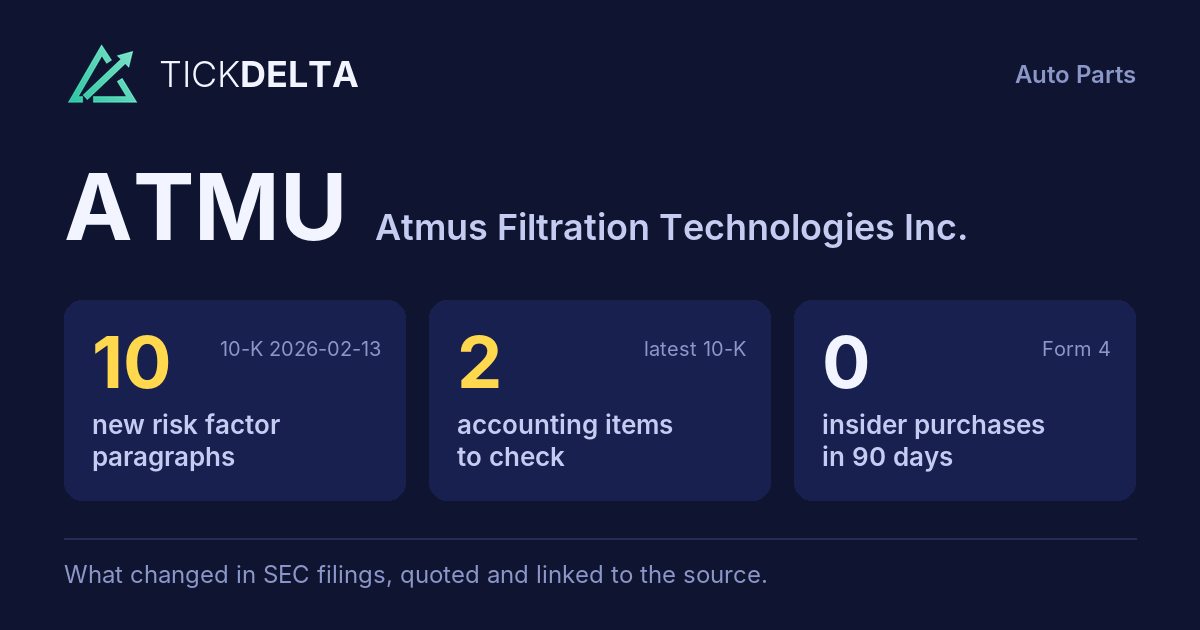
138 changes: 18 added, 43 removed, 76 reworded, 1 quiet changes

10-K Feb 13, 2026 vs Feb 21, 2025

10-K 0001921963-26-000015 (Feb 13, 2026) vs 10-K 0001921963-25-000029 (Feb 21, 2025)

Every paragraph, and how much of it changed

One bar per paragraph, in the order of the 10-K. Height and colour show the share of its words not in the closest paragraph a year earlier; the tallest bars are new paragraphs.

Risk Factors

165 paragraphs · 10 new · 62 reworded · 34 gone · 10-K Feb 13, 2026 against Feb 21, 2025
New paragraph Reworded (5% of its words or more) Same or nearly
Paragraph 30 · 49% changed Every version of it
We earn equity, royalty and interest income from our joint venture in China — Shanghai Fleetguard Filter Co. Ltd., where we indirectly hold 50% of the economic interest. We also earn equity, royalty and interest income from our joint ventures in India — Fleetguard Filter Private Ltd. (“FFPL”), where we directly hold 49.491% of the economic interest (and 50% of the voting interest), and Filtrum Fibretechnologies Pvt. Ltd., where we hold, directly or indirectly, 49.75% of the economic interests (25% directly and 24.75% indirectly through our proportionate ownership of FFPL’s 50% ownership interest). For the year ended December 31, 2024, we recognized $34.3 million of equity, royalty and interest income from investees, compared to $33.6 million for the year ended December 31, 2023 and $28.0 million for the year ended December 31, 2022. Of these amounts, $21.8 million, $21.5 million and $17.1 million, respectively, were from our joint venture in India — FFPL. Although a significant percentage of our net income is derived from these unconsolidated entities (which were approximately 18.5% for the year ended December 31, 2024, approximately 19.6% for the year ended December 31, 2023 and 16.4% for the year ended December 31, 2022, of which approximately 11.7%, approximately 12.6% and approximately 10.0% were from FFPL for the year ended December 31, 2024, 2023 and 2022, respectively), we do not unilaterally control their management or their operations, which puts a substantial portion of our net income and cash flow through dividend payments at risk from the actions or inactions of these entities. A significant reduction in the level of contribution by these entities to our net income would likely have a material adverse effect on our business, financial condition, results of operations or cash flows.
Paragraph 118 · 42% changed Every version of it
Our business is sensitive to global macroeconomic conditions. Future macroeconomic downturns may have an adverse effect on our business, financial condition, results of operations or cash flows, as well as on our distributors, customers, end-users and suppliers, and on activity in many of the industries and markets we serve. Among the economic factors which may have such an effect are: public health crises such as pandemics and epidemics, currency exchange rates, difficulties entering new markets, tariffs and governmental trade and monetary policies, and general economic conditions such as inflation, deflation, interest rates and credit availability.
Paragraph 139 · 40% changed Every version of it
In connection with the revolving credit facility and term loan, we signed a pledge and security agreement, whereby all of our assets, subject to certain exceptions, are pledged as collateral to secure borrowings thereunder. If we default on our obligations under such facilities, the lenders may have the right to foreclose upon and sell, or otherwise transfer, the collateral subject to their security interests or their superior claim. In such event, we may be forced to sell our investments to raise funds to repay our outstanding borrowings in order to avoid foreclosure and these forced sales may be at times and at prices we would not consider advantageous. Moreover, such deleveraging of us could significantly impair our ability to effectively operate our business in the manner in which we intend to operate. As a result, we could be forced to curtail or cease new investment activities and lower or eliminate any dividends that we may pay to our shareholders in the future.
Paragraph 84 · 39% changed Every version of it
Our continued expansion outside the United States, including in China, India and developing countries, and our development of new partnerships worldwide, could increase the risk of FCPA, OFAC or Bribery Act violations in the future. Despite our policies, procedures and compliance programs, our internal control and compliance systems may not be able to protect from prohibited acts willfully committed by our employees, agents or business partners that would violate such applicable laws and regulations. Additionally, there can be no assurance that our policies and procedures will effectively prevent us from violating these regulations in every transaction in which we may engage or provide a defense to any alleged violation. For example, actions taken by OFAC in response to the Russia-Ukraine War have included the imposition of export controls and broad financial and economic sanctions against Russia, Belarus and specific areas of Ukraine. Any violation or alleged violation of these laws and regulations, even if prohibited by our policies, could result in criminal or civil sanctions, reputational damage or other substantial costs and penalties, any of which could adversely affect our business, financial condition, results of operations or cash flows. In particular, we may be held liable for actions that our joint venture partners take inside or outside of the United States, even though our partners may not be subject to these laws. Any such improper acts could damage our reputation, subject us to civil or criminal judgments, fines or penalties, and could otherwise disrupt our business.
Paragraph 121 · 39% changed Every version of it
The separation agreement and other agreements entered into executed in connection with the IPO determined the allocation of assets and liabilities between Cummins and us following the IPO for those respective areas and include certain indemnifications related to liabilities and obligations. The transition services agreement provides for the performance of certain services by Cummins and us for the benefit of the other for a period of time after the IPO. We will rely on Cummins to satisfy Cummins’ performance and payment obligations under these agreements. If Cummins is unable to satisfy its obligations under these agreements, including its indemnification obligations, we could incur operational difficulties or losses. If we do not losses that could have in place our own systems and services, or if we do not have agreements with other providers of these services once certain transaction agreements expire, we may not be able to operate our businesses effectively and an adverse effect on our business, financial condition, results of operations or cash flows could be materially adversely affected. We are in the process of creating our own, or engaging third parties to provide, systems and services to replace many of the systems and services that Cummins currently provides to us. However, we may not be successful in implementing these systems and services or in transitioning data from Cummins’ systems to us. In addition, we have historically received certain informal support from Cummins, including customer relationship management, marketing, communications, technical support, market intelligence and market data, which may not be addressed in our transition services agreement. The level of this informal support may be eliminated following the Separation. flows.
Paragraph 44 · 38% changed Every version of it
certain of those opportunities. For example, in 1987 and 1994, our filtration business established our joint ventures in India and China, respectively, for our entry into those two markets, and has continued to explore additional joint ventures since then. Acquisitions, joint ventures and strategic investments could negatively impact our profitability and financial condition due to operating and integration inefficiencies, the incurrence of debt, contingent liabilities and amortization of expenses related to intangible assets. There are also a number of other risks inherent to acquisitions, including the potential loss of key customers and suppliers of the acquired businesses or adverse effects on relationships with existing customers and suppliers; the inability to identify all issues or potential liabilities during due diligence; difficulties or delays in integrating and assimilating the acquired operations and products or in realizing projected efficiencies, growth prospects, cost savings and synergies; the loss of key employees; the potential increase in exposure to more onerous or costly legal and regulatory requirements and the diversion of management’s time and attention away from other business matters, which may prevent us from realizing the anticipated return on our investment. Additionally, we may require substantial additional capital, which could be raised pursuant to debt or equity financings, to pursue acquisitions and other business ventures, if any, in the future. We cannot assure you that we will be able to raise such additional capital on commercially reasonable terms, or at all. Divestitures may involve significant challenges and risks, such as difficulty separating out portions of our business or the potential loss of revenue or negative impacts on margins. Divestitures may also result in ongoing financial or legal proceedings, such as retained liabilities, which could have an adverse impact on our business, financial condition, results of operations and cash flows. Further, during the pendency of a proposed transaction, we may be subject to risks related to a decline in the business, loss of employees, customers or suppliers and the risk that the transaction may not close, any of which could adversely impact our business. Additionally, because acquisitions, divestitures, joint ventures, strategic partnerships and other similar arrangements are inherently risky, any such transaction may not be successful and may, in some cases, harm our business, financial condition, results of operations or cash flows. Failure to complete any such planned transaction may adversely impact our business, financial condition, results of operations or cash flows.
Paragraph 17 · 38% changed Every version of it
We, •Atmus or Cummins, may Cummins fail to perform under various transaction agreements that were executed as part of the IPO or we may fail to have necessary systems and services in place when certain of the transaction agreements expire. IPO.
Paragraph 70 · 36% changed Every version of it
customers or suppliers customers’ requirements. The discovery of noncompliance issues could result in slowdowns or closures that would have a material adverse effect impact on our reputation, brand, business, financial condition, results of operations or cash flows.

MD&A

96 paragraphs · 8 new · 31 reworded · 9 gone · 10-K Feb 13, 2026 against Feb 21, 2025
New paragraph Reworded (5% of its words or more) Same or nearly
Paragraph 41 · 38% changed
We have incurred, and expect to continue to incur, incurred additional costs associated with becoming a standalone public company. During the year ended December 31, 2024, 2025, we incurred approximately $25.2 $15.5 million related to one-time separation costs including $14.5 $11.2 million within Cost of Sales and $4.3 million within Selling, general and administrative expenses and $10.7 million within Cost of sales. We expect to incur one-time expenses of approximately $5 million to $10 million in 2025 in connection with becoming a standalone public company. expenses. In addition, we expect to incur have incurred capital expenditures in connection with the Separation of approximately $5 million to $10 million in 2025. $9.5 million. These expenses and capital expenditures primarily relate to the establishment of functions previously co-mingled with Cummins, such as information technologies, distribution centers, manufacturing and human resources. The actual amount one-time costs incurred during the year ended December 31, 2025, were primarily associated with establishing our own distribution network and our technology transformation and modernization project. The transition services agreement under which Cummins had continued to provide certain services related primarily to administrative services ended in September 2025. With the conclusion of the this agreement, we do not expect to incur any additional one-time expenses and or capital expenditures we will incur as in future periods in connection with becoming a stand-alone standalone public company may be higher, perhaps significantly, from our current estimates for a number of reasons, including, among others, the final terms we are able to negotiate with service providers, as well as additional costs we may incur that we have not currently anticipated. Additionally, the actual timing of when we incur these incremental expenses may be different, perhaps significantly, from our current estimates for a number of reasons, including, among others, unforeseen events that may cause delays or interruptions in our plans or our service providers’ ability to provide their services. company.
Paragraph 26 · 35% changed
We are one of the global leaders of filtration products for on-highway commercial vehicles and off-highway agriculture, construction, mining and power generation vehicles and equipment. We design and manufacture advanced filtration products, principally under the Fleetguard brand, that provide superior asset protection and enable lower emissions. We estimate that approximately 14% of our net sales in 2024 were generated through first-fit sales to OEMs, where our products are installed as components for new vehicles and equipment. We estimate that approximately 86% of our net sales in 2024 were generated in the aftermarket, where our products are installed as replacement or repair parts, leading to a strong recurring revenue base. Building on our more than 65-year history, we continue to grow and differentiate ourselves through our global footprint, comprehensive offering of premium products, technology leadership and multi-channel path to market.
Paragraph 48 · 35% changed
Equity, royalty and interest income from investees was $34.3 million generally consistent for the year ended December 31, 2024, an increase of $0.7 million 2025 compared to $33.6 million for the year ended December 31, 2023. The increase was primarily due to higher earnings of $0.5 million from our joint ventures in India and China. 2024.
Paragraph 53 · 34% changed
Our facilities under the Credit Agreement provide for $1.0 billion in total capacity, which includes a $600 million term loan and a $400 million revolving credit facility. As of December 31, 2024, 2025, we have outstanding borrowings of $592.5 $570.0 million on the term loan and zero on the revolving credit facility. As a result, we had capacity under our revolving credit facility of $400 million as of December 31, 2024. 2025. Subsequent to current year end, on January 7, 2026, the Company entered into an Amended and Restated Credit Agreement which provided for a term loan facility of $1.0 billion and $500 million revolving credit facility, both of which mature on January 7, 2031. The term loan facility was drawn on fully for the amount of $1.0 billion with proceeds used to refinance the outstanding term loan facility and to finance in part the acquisition of Koch Filter Corporation. Refer to Note 21, Subsequent Events, to the Consolidated Financial Statements for more information.
Paragraph 4 · 34% changed
The following is the discussion and analysis of changes in the financial condition and results of operations for the year ended December 31, 2025 compared to the year ended December 31, 2024. A discussion of the changes in the financial condition and results of operations for the year ended December 31, 2024 compared to the year ended December 31, 2023 can be found in Part II, “Item 7. Management’s Discussion and Analysis of Financial Condition and Results of Operations” of the Company’s Annual Report on Form 10-K for the year ended December 31, 2023 compared to 2024, which was filed with the year ended December 31, 2022. SEC on February 21, 2025.
Paragraph 51 · 32% changed
Other income, net was $3.8 $0.6 million for the year ended December 31, 2023, 2025, a decrease of $5.0 $8.6 million compared to $8.8 $9.2 million for the year ended December 31, 2022. 2024. The decrease in Other income, net was primarily due to an increase in the net loss on foreign exchange rate hedging, partially hedging which offset by higher interest income as a result of cash balances held in interest-bearing accounts which we did not have prior to IPO. that remained stable between the comparable periods.
Paragraph 49 · 32% changed
Other operating expense, net was $8.1 million for the year ended December 31, 2025, an increase of $6.1 million compared to $2.0 million for the year ended December 31, 2024, an increase of $1.3 million compared to $0.7 million for the year ended December 31, 2023. 2024. The increase in Other operating expense, net was primarily due to inventory write-offs related to warehouse transitions made during the year. long-lived asset impairment charges on idled machinery, equipment and fixtures.
Paragraph 37 · 32% changed
While overall Overall supply chain conditions continue to affect inventory and backlog levels, they have remained largely stabilized stable during 2025 with minimal disruptions now being experienced experienced. Logistics costs increased during 2025, primarily due to the transition to a standalone distribution network as part of the Separation and backorders largely recovered. the impact of tariffs. Our management team continues to monitor and evaluate all of these factors and the related impacts of our business and operations, and we are diligently working to continue to minimize any supply chain impacts to our business and to our customers.

A paragraph is matched with the one last year that shares the most of its words; under half in common makes it new. The paragraphs shown are the 8 reworded the most in each section.

The paragraph that changed most in each section

The redline

Marked against last year's 10-K: cut words struck through, new words highlighted.

MD&A231 words changed in this paragraph; it is 42% similar to last year's version.
We have incurred, and expect to continue to incur, incurred additional costs associated with becoming a standalone public company. During the year ended December 31, 2024, 2025, we incurred approximately $25.2 $15.5 million related to one-time separation costs including $14.5 $11.2 million within Cost of Sales and $4.3 million within Selling, general and administrative expenses and $10.7 million within Cost of sales. We expect to incur one-time expenses of approximately $5 million to $10 million in 2025 in connection with becoming a standalone public company. expenses. In addition, we expect to incur have incurred capital expenditures in connection with the Separation of approximately $5 million to $10 million in 2025. $9.5 million. These expenses and capital expenditures primarily relate to the establishment of functions previously co-mingled with Cummins, such as information technologies, distribution centers, manufacturing and human resources. The actual amount one-time costs incurred during the year ended December 31, 2025, were primarily associated with establishing our own distribution network and our technology transformation and modernization project. The transition services agreement under which Cummins had continued to provide certain services related primarily to administrative services ended in September 2025. With the conclusion of the this agreement, we do not expect to incur any additional one-time expenses and or capital expenditures we will incur as in future periods in connection with becoming a stand-alone standalone public company may be higher, perhaps significantly, from our current estimates for a number of reasons, including, among others, the final terms we are able to negotiate with service providers, as well as additional costs we may incur that we have not currently anticipated. Additionally, the actual timing of when we incur these incremental expenses may be different, perhaps significantly, from our current estimates for a number of reasons, including, among others, unforeseen events that may cause delays or interruptions in our plans or our service providers’ ability to provide their services. company.

Source: Item 7, 10-K 0001921963-26-000015 vs Item 7, 10-K 0001921963-25-000029

Risk Factors219 words changed in this paragraph; it is 38% similar to last year's version.
We earn equity, royalty and interest income from our joint venture in China — Shanghai Fleetguard Filter Co. Ltd., where we indirectly hold 50% of the economic interest. We also earn equity, royalty and interest income from our joint ventures in India — Fleetguard Filter Private Ltd. (“FFPL”), where we directly hold 49.491% of the economic interest (and 50% of the voting interest), and Filtrum Fibretechnologies Pvt. Ltd., where we hold, directly or indirectly, 49.75% of the economic interests (25% directly and 24.75% indirectly through our proportionate ownership of FFPL’s 50% ownership interest). For the year ended December 31, 2024, we recognized $34.3 million of equity, royalty and interest income from investees, compared to $33.6 million for the year ended December 31, 2023 and $28.0 million for the year ended December 31, 2022. Of these amounts, $21.8 million, $21.5 million and $17.1 million, respectively, were from our joint venture in India — FFPL. Although a significant percentage of our net income is derived from these unconsolidated entities (which were approximately 18.5% for the year ended December 31, 2024, approximately 19.6% for the year ended December 31, 2023 and 16.4% for the year ended December 31, 2022, of which approximately 11.7%, approximately 12.6% and approximately 10.0% were from FFPL for the year ended December 31, 2024, 2023 and 2022, respectively), we do not unilaterally control their management or their operations, which puts a substantial portion of our net income and cash flow through dividend payments at risk from the actions or inactions of these entities. A significant reduction in the level of contribution by these entities to our net income would likely have a material adverse effect on our business, financial condition, results of operations or cash flows.

Source: Item 1A, 10-K 0001921963-26-000015 vs Item 1A, 10-K 0001921963-25-000029

Accounting Policies180 words changed in this paragraph; it is 33% similar to last year's version.
In November 2023, the Financial Accounting Standards Board (“FASB”) issued Accounting Standard Update (“ASU”) No. 2023-07, Segment Reporting (Topic 280): Improvements eliminates certain existing disclosure requirements related to Reportable Segment Disclosures, which requires a public entity to disclose significant segment expenses uncertain tax positions and other segment items on an annual and interim basis and provide in interim periods all disclosures about a reportable segment’s profit or loss and assets that are currently required annually. Additionally, it requires a public entity to disclose the title and position of the Chief Operating Decision Maker (“CODM”). unrecognized deferred tax liabilities. The ASU does not change how a public entity identifies its operating segments, aggregates them, or applies the quantitative thresholds to determine its reportable segments. The new standard guidance is effective for our fiscal years beginning after year ending December 15, 2023, and interim periods within fiscal years beginning after December 15, 2024, 31, 2025, with early adoption permitted. A public entity should apply the amendments The guidance does not affect recognition or measurement in this ASU retrospectively to all prior periods presented in the our consolidated financial statements. We adopted this standard in the fourth quarter of 2024 2025 on a prospective basis and it did not have a material impact on our disclosures and no impacts to our results of operations, cash flows and financial condition.

Source: Item 8, Note 3 – SUMMARY OF SIGNIFICANT ACCOUNTING POLICIES, 10-K 0001921963-26-000015 vs Item 8, Note 3 – SUMMARY OF SIGNIFICANT ACCOUNTING POLICIES, 10-K 0001921963-25-000029

Legal Proceedings10 words changed in this paragraph; it is 97% similar to last year's version.
The Company is subject to lawsuits and claims arising out of the ordinary course of its business. The Company does not have any currently pending lawsuits or claims or litigation that the Company believes, individually or in the aggregate, will have a material adverse effect on its financial position, results of operations, cash flows, liquidity or capital resources. Atmus The Company carries various forms of commercial, property and casualty, product liability and other forms of insurance; however, such insurance may not be applicable or adequate to cover the costs associated with a judgment against Atmus the Company with respect to these lawsuits, claims and proceedings. While the Company believes it has established adequate accruals for our expected future liability with respect to pending lawsuits, claims and proceedings, where the nature and extent of any such liability can be reasonably estimated based upon presently available information, there can be no assurance that the final resolution of any existing or future lawsuits, claims or proceedings will not have a material adverse effect on Atmus’ business, results of operations, financial condition or cash flows.

Source: Item 3, via Note 14 – COMMITMENTS AND CONTINGENCIES, 10-K 0001921963-26-000015 vs Item 3, via Note 14 – COMMITMENTS AND CONTINGENCIES, 10-K 0001921963-25-000029

Sentences and paragraphs added, removed or reworded

Every change, by type

Sentences and paragraphs of ATMU's Risk Factors and MD&A, 10-K Feb 13, 2026 against 10-K Feb 21, 2025. Each links to the text at sec.gov.

Quiet changes are sentences kept from last year with one to four words changed, at least one of them a hedge, a modal or a qualifier (may, could, will, not, significant, material…). A year or date rolling forward is not counted.

The full word list

adverse, adversely, all, although, anticipate, anticipates, any, approximately, believe, believes, can, cannot, certain, could, expect, expects, generally, however, if, intend, intends, largely, likely, many, material, materially, may, might, most, must, never, no, not, possible, primarily, probable, should, significant, significantly, some, substantial, substantially, unlikely, will, would

AddedRisk Factors
content for those technologies, will prove to be accurate. Such disruptive innovation could create new markets for others and displace existing companies and products. If we are unsuccessful in adapting our technologies or expanding into adjacent markets, these disruptions could result in significant negative consequences for us. Our future growth is dependent on properly addressing future customer and end-user needs and adapting our products in line with global technology trends.
Read it in 10-K Feb 13, 2026 at sec.gov
AddedRisk Factors
Our long-term performance targets assume certain ongoing productivity improvements as a key component of our business strategy to, among other things, contain operating expenses, increase operating efficiencies
Read it in 10-K Feb 13, 2026 at sec.gov
AddedRisk Factors
A substantial portion of our sales is tied to customers that serve highly cyclical end markets, including on‑highway and off‑highway industries such as truck and bus, construction, agriculture, mining, oil and gas, power generation and recreational vehicles. Demand in these industries is affected by macroeconomic factors such as freight activity, infrastructure investment, commodity prices, and interest rates. As these industries experience fluctuations, our customers’ production schedules and purchasing patterns may vary significantly, which exposes our business to additional risk based on the economic conditions in the markets our customers serve. Any downturn or prolonged softness in the industries in which our customers operate could reduce demand for our products and materially and adversely impact our business, financial condition, results of operations or cash flows.
Read it in 10-K Feb 13, 2026 at sec.gov
AddedRisk Factors
We are subject to income taxes in the U.S. and numerous international jurisdictions. Our income tax provision and cash tax liability in the future could be adversely affected by the adoption of new tax legislation,
Read it in 10-K Feb 13, 2026 at sec.gov
AddedRisk Factors
imposed or defense costs incurred. We also cannot be certain that we will be able to maintain insurance coverage, on acceptable terms or in amounts sufficient to cover the potentially significant losses that may result from a security incident or breach, or that the insurer will not deny coverage of any future claim.
Read it in 10-K Feb 13, 2026 at sec.gov
AddedRisk Factors
Changes to trade protection measures and import or export licensing requirements; the imposition of new, additional, or retaliatory tariffs, quotas, exchange controls, sanctions, trade barriers or other restrictions; and the withdrawal from or modification of trade agreements or the negotiation of new trade agreements, in countries
Read it in 10-K Feb 13, 2026 at sec.gov
Show the other 56
AddedRisk Factors
For example, since February 2025, the U.S. presidential administration has announced new and substantial tariff increases on imports to the United States from China, Mexico, Canada and India. Since then, various modifications and delays to these tariffs have been implemented, with further changes anticipated. These modifications include additional sector-specific tariffs or other measures. These actions have prompted a variety of tariff responses by countries, which have the potential to affect our business. Several tariff announcements have been followed by announcements of temporary pauses and limited exemptions, such as the temporary exemption for goods that enter the U.S. as qualifying goods under the United States-Mexico-Canada Agreement (“USMCA”), for which the majority of our products from Mexico for the U.S. market are certified compliant, or expected to be certified compliant. These temporary exemptions, including those we are availing ourselves to under the USMCA, may be reduced or eliminated in the future. The ongoing trade disputes associated with these tariff measures and the potential escalation of trade disputes would pose a significant risk to our business and would affect our revenue and cost of goods sold. For instance, we have raised the prices of certain of our products in response to cost increases we have incurred on purchases of finished and other goods and some raw materials due to tariffs. The extent and duration of the tariffs and the resulting impact on general economic conditions and our business are uncertain and depend on various factors, such as negotiations between the U.S. and affected countries, the responses of other countries or regions, exemptions or exclusions that may be granted, availability and cost of alternative sources of supply, and demand for our products in affected markets. Further, actions we take to adapt to new tariffs or trade restrictions, including raising the prices of our products or shifting supply sourcing or production locations, may cause us to modify our operations, lose customers, experience increased costs, or forgo business opportunities.
Read it in 10-K Feb 13, 2026 at sec.gov
RemovedRisk Factors
In addition, our association with Cummins has contributed to the relationships we have with certain significant customers due to the relationship those customers had with Cummins. We may not be able to attract new customers of Cummins, or retain existing customers, without Cummins’ support.
Read it in 10-K Feb 21, 2025 at sec.gov
RemovedRisk Factors
We are actively evaluating potential strategic acquisitions or investment opportunities and consider divestitures of non-strategic business lines, and the filtration business has historically pursued and undertaken
Read it in 10-K Feb 21, 2025 at sec.gov
RemovedRisk Factors
We are vulnerable to raw material, transportation and labor price increases and supply shortages, which have adversely impacted and could continue to adversely impact our operations.
Read it in 10-K Feb 21, 2025 at sec.gov
RemovedRisk Factors
Although we have taken a number of actions to mitigate these impacts, including, but not limited to, adding new supply sources, moving production among our facilities or outsourcing production to third-party manufacturers, adapting product design to reduce reliance on constrained materials, and investing in additional tooling and equipment, these mitigating actions may not be sufficient to overcome these impacts.
Read it in 10-K Feb 21, 2025 at sec.gov
RemovedRisk Factors
While we have not experienced significant global surges or declines in demand, for much of 2022, overall demand exceeded our ability to fully meet such demand, resulting in an elevated level of backlog. During 2023 and 2024, the level of backlog reduced and stabilized from peak level.
Read it in 10-K Feb 21, 2025 at sec.gov
RemovedRisk Factors
Three customers each accounted for 10% or more of our net sales in 2024, 2023 and 2022. Cummins is one of our key customers and accounted for approximately 17.6% of our net sales in 2024. While our relationship with Cummins has been secured through our first-fit supply agreement and aftermarket supply agreement, both of which have an initial term of five years from the date of our IPO (except with respect to certain new products under the first-fit supply agreement, for which a five-year term commences from the date of the start of production), Cummins operates in both global off-highway and on-highway industries and is subject to the cyclicality of those industries. A number of our other customers, including PACCAR and the Traton Group, are also concentrated in similar cyclical industries, including off-highway industries such as construction, agriculture, mining, oil and gas and power generation, as well as on-highway industries such as truck, bus, vocational and recreational vehicles. This exposes our business to additional risk based on our customers’ respective economic conditions. Our success is also dependent on retaining key customers, which requires us to successfully manage relationships and anticipate the needs of our customers in the channels in which we sell our products. Changes in economic conditions could materially and adversely impact our business, financial condition, results of operations or cash flows.
Read it in 10-K Feb 21, 2025 at sec.gov
RemovedRisk Factors
Because we have limited experience operating as a standalone company following the Separation, we may encounter difficulties doing so in the future. For example, if we do not accurately estimate the level of resources required to operate as a standalone company, we may need to acquire additional assets and resources, which could be costly, and in connection with the Separation, may also face difficulty in separating certain aspects of our business from Cummins, including incurring accounting, tax, legal and other professional services costs, recruiting and relocation costs associated with hiring or reassigning our personnel, costs related to establishing a new brand identity in the marketplace and costs to separate information systems and creating standalone administrative units or distribution centers in our business post-separation. For example, we established our own standalone warehouse in Belgium in November 2024, and we have not yet realized normal operating levels. Our business, financial condition, results of operations or cash flows could be materially adversely affected if we have difficulty operating as a standalone company.
Read it in 10-K Feb 21, 2025 at sec.gov
RewordedRisk Factors
Although a significant percentage of our net income is derived from these unconsolidated entities (which were approximately 18.5% for the year ended December 31, 2024, approximately 19.6% for the year ended December 31, 2023 and 16.4% for the year ended December 31, 2022, of which approximately 11.7%, approximately 12.6% and approximately 10.0% were from FFPL for the year ended December 31, 2024, 2023 and 2022, respectively), entities, we do not unilaterally control their management or their operations, which puts a substantial portion of our net income and cash flow through dividend payments at risk from the actions or inactions of these entities.
Read it in 10-K Feb 13, 2026 at sec.gov
RewordedRisk Factors
For example, instance, in 2026 we closed the acquisition of a business in the industrial filtration market and in 1987 and 1994, our filtration business we established our joint ventures in India and China, respectively, for our entry into those two markets, and has continued to explore additional joint ventures since then. markets.
Read it in 10-K Feb 13, 2026 at sec.gov
RewordedRisk Factors
Such an event could result in physical damage to and complete or partial closure of one or more of our headquarters, manufacturing facilities or distribution centers, temporary or long-term disruption in the supply of component products from some local and international suppliers, disruption in as well as disruptions to the transport of our products to customers and disruption of to our information systems.
Read it in 10-K Feb 13, 2026 at sec.gov
RewordedRisk Factors
For the year ended December 31, 2024, 2025, we recognized $34.3 $33.8 million of equity, royalty and interest income from investees, compared to $34.3 million for the year ended December 31, 2024 and $33.6 million for the year ended December 31, 2023 and $28.0 million for the year ended December 31, 2022. 2023.
Read it in 10-K Feb 13, 2026 at sec.gov
RewordedRisk Factors
Among Cummins’ new For example, Cummins, our largest customer, has established 2030 environmental sustainability goals for 2030 is reducing to, among other things, reduce its Scope 3 absolute lifetime GHG emissions from newly sold products, and partnering partner with its customers to reduce its indirect GHG emissions from its products.
Read it in 10-K Feb 13, 2026 at sec.gov
RewordedRisk Factors
Although While those inflationary pressures began to abate towards the end of 2023 and stabilize by the end of 2024, have stabilized, we are still subject to the risk of material and commodity cost increases and there can be no assurances that such cost increases do not return in 2025 and beyond. return.
Read it in 10-K Feb 13, 2026 at sec.gov
RewordedRisk Factors
Our board of directors’ decisions regarding the payment of dividends will depend on many factors, such as our financial condition, earnings, capital requirements, debt service obligations, restrictive covenants in the agreements governing our indebtedness, general economic business conditions, industry practice, legal requirements and other factors that our board of directors may deem relevant.
Read it in 10-K Feb 13, 2026 at sec.gov
RewordedRisk Factors
As of December 31, 2024, 47% 2025, we employed approximately 355 total technical employees and 51% of our technical employees were employed outside the United States, in India, China and France, many of whom we consider key employees. France.
Read it in 10-K Feb 13, 2026 at sec.gov
RewordedRisk Factors
We, or Cummins, may fail to perform under various transaction agreements that were executed as part of the IPO or we may fail to have necessary systems and services in place when certain of the transaction agreements expire. IPO.
Read it in 10-K Feb 13, 2026 at sec.gov
RewordedRisk Factors
Applicable laws, laws and provisions of our amended Charter and restated certificate of incorporation and bylaws and certain contractual provisions under the separation agreement that Bylaws may delay, deter, prevent or render more difficult a takeover attempt that our shareholders might consider in their best interests.
Read it in 10-K Feb 13, 2026 at sec.gov
RewordedRisk Factors
In the future, we expect that Cummins will continue to seek competitive bids for new filtration products and, while While we will have a preferred supplier relationship with Cummins, we will have to successfully win bids through Cummins’ bidding process in order to maintain or grow our current level of sales to Cummins and cannot guarantee that Cummins will always select our products.
Read it in 10-K Feb 13, 2026 at sec.gov
RewordedRisk Factors
If we are unable to successfully defend against claims that we have infringed the intellectual property rights of others, we may be prevented from using certain intellectual property or offering certain products, or may be liable for substantial damages, which in turn could materially adversely affect our business, financial condition, results of operations or cash flows. damages.
Read it in 10-K Feb 13, 2026 at sec.gov
Quiet changesRisk Factors
Any disruption in our operations could have an adverse impact on our ability to meet our customer needs or may require us to incur additional expenses in order to produce sufficient inventory.
Read it in 10-K Feb 13, 2026 at sec.gov
AddedMD&A
Following full separation, Cummins continued to provide certain services to Atmus under the transition services agreement. The transition services agreement related primarily to administrative services for which Atmus paid Cummins mutually agreed upon fees. These services were provided through and ended in September 2025.
Read it in 10-K Feb 13, 2026 at sec.gov
AddedMD&A
Aftermarket demand remained soft throughout 2025. We continue to be in a period of slow growth in global aftermarkets, and this trend is expected to continue into 2026. First-fit experienced reduced demand in 2025 reflecting depressed market conditions. First-fit demand is expected to remain at reduced levels in 2026 based on overall market cyclicality.
Read it in 10-K Feb 13, 2026 at sec.gov
AddedMD&A
We have experienced general variability in direct material costs during 2025. While the costs of our principal materials fluctuate, generally we believe there will continue to be an adequate supply of the materials we use and they will remain available.
Read it in 10-K Feb 13, 2026 at sec.gov
AddedMD&A
(a)During 2025, Atmus recognized fixed asset impairment charges on idled machinery, equipment and fixtures. We do not expect the idling of the assets to have a material adverse effect on our financial position, results of operations, cash flows, liquidity or capital resources.
Read it in 10-K Feb 13, 2026 at sec.gov
AddedMD&A
(a)During 2025, Atmus recognized fixed asset impairment charges on idled machinery, equipment and fixtures. The tax impact of the impairment charges for the year ended December 31, 2025, was $1.9 million.
Read it in 10-K Feb 13, 2026 at sec.gov
RemovedMD&A
Aftermarket demand remained depressed in 2024 reflecting soft market conditions and first-fit demand softened across many of our key markets during the second half of 2024. It is uncertain when a recovery can be expected.
Read it in 10-K Feb 21, 2025 at sec.gov
RemovedMD&A
We have seen inflationary impacts largely subside in the second half of 2024. Direct material cost pressures, driven largely by steel, resin and other petrochemical products, have stabilized, but we continue to see impacts from labor.
Read it in 10-K Feb 21, 2025 at sec.gov
RemovedMD&A
In connection with the Separation, the Company entered into a Tax Matters Agreement with Cummins that, among other things, formalized our agreement related to the responsibility for historical tax positions for the period prior to the IPO for jurisdictions where our business was included in the consolidated or combined tax returns of Cummins.
Read it in 10-K Feb 21, 2025 at sec.gov
RewordedMD&A
The increase in Gross margin was mainly due to approximately $26.3 million of favorable pricing impacts of $50.0 million as described above, higher favorable volumes of approximately $7.8 $21.0 million, favorable variable compensation of $7.2 a $7.7 million and favorable materials costs of $7.0 million, partially offset by higher decrease in manufacturing and other costs of $9.0 million, higher and a $0.9 million reduction in one-time restructuring and separation costs, partially offset by unfavorable logistics and duties costs of $36.2 million, $5.8 million, million in unfavorable currency impacts of $2.7 and a $1.4 million and higher one-time restructuring costs of $1.4 million. increase in warranty costs.
Read it in 10-K Feb 13, 2026 at sec.gov
RewordedMD&A
Our capital expenditures were $53.9 million (of which approximately $9.5 million related to one-time separation costs) and $48.6 million (of which approximately $15.0 million related to one-time separation costs), $45.8 million (of which approximately $9.2 million related to one-time separation costs) and $37.5 million for the years ended December 31, 2024, 2025 and December 31, 2023,and December 31, 2022, 2024, respectively, corresponding to approximately 2.9%, 2.8% 3.1% and 2.4% 2.9% of Net sales in 2025 and 2024, 2023 and 2022, respectively.
Read it in 10-K Feb 13, 2026 at sec.gov
RewordedMD&A
The increase in the effective tax rate was driven by a change unfavorable changes in the mix of earnings among and lower U.S. credits and incentives following cash tax jurisdictions and changes in discrete planning around recent U.S. tax items. law changes, partially offset by a valuation allowance release on foreign deferred tax assets.
Read it in 10-K Feb 13, 2026 at sec.gov
RewordedMD&A
The decrease in Other income, net was primarily due to an increase in the net loss on foreign exchange rate hedging, partially hedging which offset by higher interest income as a result of cash balances held in interest-bearing accounts which we did not have prior to IPO. that remained stable between the comparable periods.
Read it in 10-K Feb 13, 2026 at sec.gov
RewordedMD&A
Selling, general and administrative expenses as a percentage of Net sales were 10.4% for the year ended December 31, 2025, a decrease of 0.8 percentage points compared to 11.2% for the year ended December 31, 2024, an increase of 0.5 percentage points compared to 10.7% for the year ended December 31, 2023. 2024.
Read it in 10-K Feb 13, 2026 at sec.gov
RewordedMD&A
The increase was driven primarily by lower a favorable change in working capital requirements of $26.1 million and $40.1 million, a favorable change in other liabilities deferred taxes of $6.0 million, partially offset by an unfavorable change in $26.4 million and higher net income from equity method investees of $8.2 $21.8 million.
Read it in 10-K Feb 13, 2026 at sec.gov
RewordedMD&A
The following is A discussion of the discussion and analysis of changes in the financial condition and results of operations for the year ended December 31, 2024 compared to the year ended December 31, 2023 and the year ended December 31, 2023 compared to the year ended December 31, 2022. can be found in Part II, “Item 7.
Read it in 10-K Feb 13, 2026 at sec.gov
RewordedMD&A
During the year ended December 31, 2023, lower 2025, higher working capital requirements resulting resulted in a cash inflow outflow of $11.3 $63.2 million compared to a cash outflow of $14.8 $103.3 million for the year ended December 31, 2022, 2024, mainly due to higher other accrued expenses, trade accounts payable and lower prepaids, partially offset by higher trade accounts and other receivables including VAT receivables.
Read it in 10-K Feb 13, 2026 at sec.gov
RewordedMD&A
While overall Overall supply chain conditions continue to affect inventory and backlog levels, they have remained largely stabilized stable during 2025 with minimal disruptions now being experienced and backorders largely recovered. experienced.
Read it in 10-K Feb 13, 2026 at sec.gov
RewordedMD&A
Tax impact of one-time restructuring costs(a) impairment charges(a) $ 0.01 0.02 $ — $ — Tax impact of one-time restructuring costs(b) — 0.01 — Tax impact of one-time separation costs(a) costs(b) 0.04 0.06 0.08 0.02 Adjusted earnings per share (non-GAAP) $ 2.73 $ 2.50 $ 2.31 $ 2.13
Read it in 10-K Feb 13, 2026 at sec.gov
RewordedMD&A
During the year ended December 31, 2024, 2025, we incurred approximately $25.2 $15.5 million related to one-time separation costs including $14.5 $11.2 million within Cost of Sales and $4.3 million within Selling, general and administrative expenses and $10.7 million within Cost of sales. expenses.
Read it in 10-K Feb 13, 2026 at sec.gov
RewordedMD&A
Years Ended December 31, Favorable Favorable (Unfavorable) (Unfavorable) 2025 vs. 2024 2024 vs. 2023 2023 vs. 2022 Percent of Net sales 2025 2024 2023 2022 Percentage Points Percentage Points Gross margin 28.2% 27.7% 26.6% 23.0% 0.5% 1.1% 3.6% Selling, general and administrative expenses 10.4% 11.2% 10.7% 8.9% 0.8% (0.5)% (1.8)% Research, development and engineering expenses 2.3% 2.4% 2.6% 2.5% 0.1% 0.2% (0.1)%
Read it in 10-K Feb 13, 2026 at sec.gov

Sources

The two latest 10-Ks on EDGAR, section by section. Each change links to the text at sec.gov.

Also

New risk factors: paragraphs with nothing like them last year, quoted in full.

Work with it

Excel workbook · CSV. Google Sheet that stays up to date: paste =IMPORTDATA("https://tickdelta.com/company/ATMU/export.csv") into a cell.

Next:Related parties
Esc

Type a ticker such as AAPL, a name, an investor such as Buffett, or a topic such as tariffs. ↑ ↓ to move, Enter to open.