Paragraph 67 · 44% changed
Every version of it
Screener
/
SEC EDGAR
/CIK 0000883948
/10-K filed Feb 26, 2026, compared with Feb 27, 2025
/Numbers from the XBRL of the 10-Ks
NYSE
Financials · Banks
Atlantic Union Bankshares Corp AUB
The 10-K against last year's
257 changes: 39 added, 71 removed, 146 reworded, 1 quiet changes
10-K Feb 26, 2026 vs Feb 27, 2025
Risk Factors
26.8%
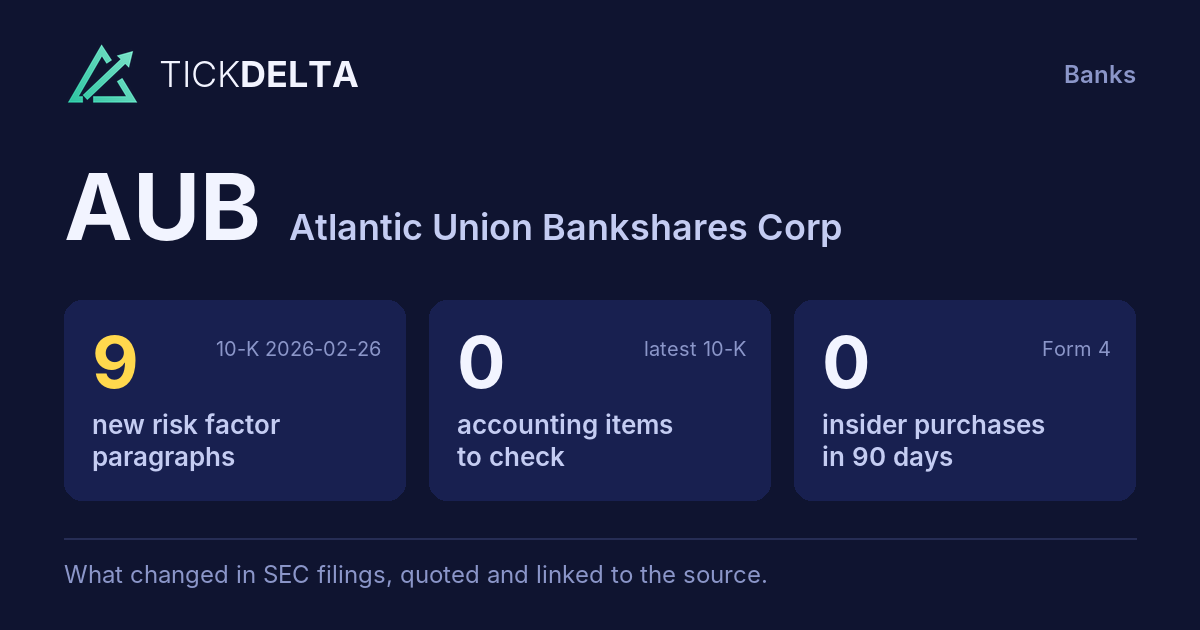
of the text changed · 16,458 words now · 9 new paragraphs, 49 gone
MD&A
35.3%
of the text changed · 16,715 words now · 30 new paragraphs, 22 gone
Legal Proceedings
40.2%
of the text changed · 821 words now
Accounting Policies
14.1%
of the text changed · 12,520 words now
10-K 0000883948-26-000021 (Feb 26, 2026) vs 10-K 0000883948-25-000021 (Feb 27, 2025)
Every paragraph, and how much of it changed
One bar per paragraph, in the order of the 10-K. Height and colour show the share of its words not in the closest paragraph a year earlier; the tallest bars are new paragraphs.
Risk Factors
169 paragraphs · 9 new · 63 reworded · 49 gone · 10-K Feb 26, 2026 against Feb 27, 2025
New paragraph
Reworded (5% of its words or more)
Same or nearly
Paragraph 60 · 41% changed
Every version of it
Cybersecurity risks for banking organizations have significantly increased in recent years, in part because of the proliferation of new technologies and the use of the internet and telecommunications technologies to conduct financial transactions. Cybersecurity risks have also significantly increased in recent years in part due to the increased sophistication and activities of organized crime affiliates, terrorist organizations, hostile foreign governments, disgruntled employees or service providers, activists, and other external parties, including those involved in corporate espionage. Targeted social engineering attacks and “spear phishing” attacks are becoming more sophisticated and are extremely difficult to prevent. In such an attack, an attacker will attempt to fraudulently induce employees, customers, or other users of our systems to disclose sensitive information in order to gain access to its data or that of its clients. In addition, our customers access our products and services using personal devices that are necessarily external to our security control systems. There has also been a significant proliferation of consumer information available on the internet resulting from breaches of third-party entities, including personal information, log-in credentials, and authentication data. While we were not directly involved in these third-party breach events, the stolen information can create a threat for our customers if their Bank log-in credentials are the same as or similar to the credentials that have been compromised on other internet sites. This threat could include the risk of unauthorized account access, data loss and fraud. The use of artificial intelligence, “bots” or other automation software can increase the velocity and efficacy of these types of attacks. As our employees are generally continuing to operate under our hybrid work model, our remote interaction with service providers, partners and other third parties on systems, networks, and environments over which we have less control increases our cybersecurity risk exposure. We will likely face an increasing number of attempted cyber-attacks as we expand our mobile and other internet-based products and services, as well as our usage of mobile and cloud technologies and as we provide more of these services to a greater number of retail banking customers. Persistent attackers may succeed in penetrating defenses given enough resources, time, and motive. The techniques used by cyber criminals change frequently, may not be recognized until launched and may not be recognized until well after a breach has occurred. The risk of a security breach caused by a cyber-attack at a service provider or by unauthorized service provider access has also increased in recent years. Additionally, the existence of cyber-attacks or security breaches at third-party service providers with access to our data may not be disclosed to us in a timely manner.
Paragraph 42 · 39% changed
Every version of it
Technology and other changes are allowing parties to complete financial transactions through alternative methods that have historically involved banks. For example, consumers can now maintain funds that would have historically been held as bank deposits in brokerage accounts, mutual funds, or general-purpose reloadable prepaid cards. Consumers can also complete transactions such as paying bills and/or transferring funds directly without the assistance of banks. We face increasing competition from fintech companies, as trends toward digital financial transactions have accelerated. The process There has also been a significant increase in digital asset adoption globally over the past several years. For example, the Guiding and Establishing National Innovation for U.S. Stablecoins Act of eliminating banks as intermediaries, known as “disintermediation,” 2025 (the “GENIUS Act”), which was enacted in July 2025, provides a legal framework for stablecoins and their issuers in the United States. Depending on consumer and business interest in payment stablecoins, and the characteristics and utility of payment stablecoins, the passage of the GENIUS Act could result in increased competition with respect to our deposit products. However, the loss GENIUS Act requires the U.S. Treasury Department and federal regulators to issue regulations on numerous topics to interpret and implement the statute, so the effect of fee income, as well as the loss of customer deposits and the related income generated from GENIUS Act will depend on what those deposits. The loss of these revenue regulations provide.
Paragraph 145 · 39% changed
Every version of it
Paragraph 40 · 38% changed
Every version of it
Paragraph 17 · 38% changed
Every version of it
underwritten, or result in an increased rate our inability to continue originating loans under such programs, either of delinquencies in, and increased losses from, this portfolio, which could have a material adverse effect on our business, financial condition, and or results of operations.
Paragraph 81 · 37% changed
Every version of it
Paragraph 45 · 37% changed
Every version of it
Our income and cash flows depend to a great extent on the difference between the interest rates earned on interest-earning assets, such as loans and investment securities, and the interest rates paid on interest-bearing liabilities, such as deposits and borrowings. These rates are highly sensitive to many factors beyond our control, including general economic conditions and the policies of the Federal Reserve and other governmental and regulatory agencies. In late 2024, the Federal Reserve’s interest rate policy shifted as inflationary pressure began to ease and economic growth moderated. Following The FOMC reduced the target range for the Federal Funds rate by a period total of aggressive 100 bps from September 2024 to December 2024 and by another 75 bps from September 2025 to December 2025, resulting in a target range of 3.50% to 3.75%. In January 2026, the FOMC held the target range for the Federal Funds rate hikes at 3.50% to 3.75%, but noted that uncertainty about the economic outlook remains elevated. We are currently operating in 2022 and 2023 aimed at curbing inflation, an environment in which the Federal Reserve lowered rates in 2024 by 100 bps, compared has shifted toward reducing interest rates, although modestly. However, the economic and inflationary outlook continues to 2023, resulting remain uncertain, and if the Federal Reserve were to reverse course and rapidly increase the target Federal Funds rate, the increase could constrain our interest rate spread and may adversely affect our business forecasts. Alternatively, an acceleration in the current Federal Funds target rate range of 4.25% to 4.50%. While decreases may negatively impact our net interest margin or may result in a change in the FOMC foreshadowed additional decreases to the target rates in 2025, it also noted it will continue to assess additional information mix of noninterest and implications for the economic outlook in determining future actions with respect to target rates. interest-bearing accounts.
Paragraph 67 · 44% changed
Every version of it
10-K Feb 27, 2025Following the merger with Sandy Spring, the size of the business of the combined company will increase significantly beyond the current size of either our or Sandy Spring’s business. The combined company’s future success will depend, in part, upon its ability to manage this expanded business, which may pose challenges for management, including challenges related to the management and monitoring of new operations and associated increased costs and complexity. The combined company may also face increased scrutiny from governmental authorities as a result of the significant increase in the size of its business.
10-K Feb 26, 2026
company increased significantly, and our continued success will depend, in part, upon our ability to manage this expanded business. This may pose challenges for management related to managing and monitoring the acquired operations, the cost and complexity of the acquired operations, and increased regulatory scrutiny related to our expanded business, increased complexity or rate of growth.
Paragraph 60 · 41% changed
Every version of it
10-K Feb 27, 2025
Cybersecurity risks for banking organizations have significantly increased in recent years, in part because of the proliferation of new technologies and the use of the internet and telecommunications technologies to conduct financial transactions. Cybersecurity risks have also significantly increased in recent years in part due to the increased sophistication and activities of organized crime affiliates, terrorist organizations, hostile foreign governments, disgruntled employees or service providers, activists, and other external parties, including those involved in corporate espionage. Targeted social engineering attacks and “spear phishing” attacks are becoming more sophisticated and are extremely difficult to prevent. In such an attack, an attacker will attempt to fraudulently induce employees, customers, or other users of our systems to disclose sensitive information in order to gain access to its data or that of its clients. In addition, our customers access our products and services using personal devices that are necessarily external to our security control systems. There has also been a significant proliferation of consumer information available on the internet resulting from breaches of third-party entities, including personal information, log-in credentials, and authentication data. While we were not directly involved in these third-party breach events, the stolen information can create a threat for our customers if their Bank log-in credentials are the same as or similar to the credentials that have been compromised on other internet sites. This threat could include the risk of unauthorized account access, data loss and fraud. The use of artificial intelligence, “bots” or other automation software can increase the velocity and efficacy of these types of attacks. As our employees are generally continuing to operate under our hybrid work model, our remote interaction with service providers, partners and other third parties on systems, networks, and environments over which we have less control increases our cybersecurity risk exposure. We will likely face an increasing number of attempted cyber-attacks as we expand our mobile and other internet-based products and services, as well as our usage of mobile and cloud technologies and as we provide more of these services to a greater number of retail banking customers. Persistent attackers may succeed in penetrating defenses given enough resources, time, and motive. The techniques used by cyber criminals change frequently, may not be recognized until launched and may not be recognized until well after a breach has occurred. The risk of a security breach caused by a cyber-attack at a service provider or by unauthorized service provider access has also increased in recent years. Additionally, the existence of cyber-attacks or security breaches at third-party service providers with access to our data may not be disclosed to us in a timely manner.
10-K Feb 26, 2026
Cybersecurity risks for banking organizations have significantly increased in recent years, in part because of the proliferation of new technologies and the use of the internet and telecommunications technologies to conduct financial transactions. Cybersecurity risks have also significantly increased in recent years in part due to the increased sophistication and activities of organized crime affiliates, terrorist organizations, hostile foreign governments, disgruntled employees or service providers, activists, and other external parties, including those involved in corporate espionage. Targeted social engineering attacks and “spear phishing” attacks are becoming more sophisticated and are extremely difficult to prevent. In such an attack, an attacker will attempt to fraudulently induce employees, customers, or other users of our systems to disclose sensitive information in order to gain access to its data or that of its clients. In addition, our customers access our products and services using personal devices that are necessarily external to our
Paragraph 42 · 39% changed
Every version of it
10-K Feb 27, 2025
Technology and other changes are allowing parties to complete financial transactions through alternative methods that have historically involved banks. For example, consumers can now maintain funds that would have historically been held as bank deposits in brokerage accounts, mutual funds, or general-purpose reloadable prepaid cards. Consumers can also complete transactions such as paying bills and/or transferring funds directly without the assistance of banks. We face increasing competition from fintech companies, as trends toward digital financial transactions have accelerated. The process of eliminating banks as intermediaries, known as “disintermediation,” could result in the loss of fee income, as well as the loss of customer deposits and the related income generated from those deposits. The loss of these revenue
10-K Feb 26, 2026
Technology and other changes are allowing parties to complete financial transactions through alternative methods that have historically involved banks. For example, consumers can now maintain funds that would have historically been held as bank deposits in brokerage accounts, mutual funds, or general-purpose reloadable prepaid cards. Consumers can also complete transactions such as paying bills and/or transferring funds directly without the assistance of banks. We face increasing competition from fintech companies, as trends toward digital financial transactions have accelerated. There has also been a significant increase in digital asset adoption globally over the past several years. For example, the Guiding and Establishing National Innovation for U.S. Stablecoins Act of 2025 (the “GENIUS Act”), which was enacted in July 2025, provides a legal framework for stablecoins and their issuers in the United States. Depending on consumer and business interest in payment stablecoins, and the characteristics and utility of payment stablecoins, the passage of the GENIUS Act could result in increased competition with respect to our deposit products. However, the GENIUS Act requires the U.S. Treasury Department and federal regulators to issue regulations on numerous topics to interpret and implement the statute, so the effect of the GENIUS Act will depend on what those regulations provide.
Paragraph 145 · 39% changed
Every version of it
10-K Feb 27, 2025Future capital needs could result in shareholder dilution and may adversely affect the market price of our common stock and preferred stock (or depositary shares representing a fractional interest in our preferred stock).
10-K Feb 26, 2026
common stock, preferred stock (or depositary shares representing a fractional interest in our preferred stock) and could have a material negative effect on the market price of such securities and could be dilutive to shareholders.
Paragraph 40 · 38% changed
Every version of it
10-K Feb 27, 2025We operate in a competitive market for financial services and face intense competition from other financial institutions both in making loans and attracting deposits, which can greatly affect pricing for our products and services and could adversely affect our cost of funds. Our primary competitors include community, regional, national and internet banks, as well as credit unions and mortgage companies. Many of these financial institutions are significantly larger and have established customer bases, greater financial resources, and higher lending limits. In addition, credit unions are exempt from corporate income taxes, providing a significant competitive pricing advantage compared to banks. In addition, as customer preferences and expectations continue to evolve, technology has lowered barriers to entry and made it possible for nonbanks to offer products and services traditionally provided by banks, such as automatic transfer and automatic payment systems. In addition, many of these nonbank competitors are not subject to the same extensive federal regulations that govern bank holding companies and federally insured banks. As a result, some of our competitors have the ability to offer products and services that we are unable to offer or to offer such products and services at more competitive rates.
10-K Feb 26, 2026
for nonbanks to offer products and services traditionally provided by banks, such as automatic transfer and automatic payment systems. In addition, many of these nonbank competitors are not subject to the same extensive federal regulations that govern bank holding companies and federally insured banks. As a result, some of our competitors can offer products and services that we are unable to offer or to offer such products and services at more competitive rates.
Paragraph 17 · 38% changed
Every version of it
10-K Feb 27, 2025
result in an increased rate of delinquencies in, and increased losses from, this portfolio, which could have a material adverse effect on our business, financial condition, and results of operations.
10-K Feb 26, 2026
underwritten, or result in our inability to continue originating loans under such programs, either of which could have a material adverse effect on our business, financial condition, or results of operations.
Paragraph 81 · 37% changed
Every version of it
10-K Feb 27, 2025There is no assurance that, following any future mergers or acquisitions, including our proposed merger with Sandy Spring, our integration efforts will be successful or that we, after giving effect to the acquisition, will achieve the strategic objectives, operating efficiencies, increased revenues comparable to or better than our historical experience, or other benefits expected in the acquisition, and failure to realize such strategic objectives, operating efficiencies, expected revenue increases, cost savings, increases in market presence or other benefits could have a material adverse effect on our business, financial condition, and results of operations.
10-K Feb 26, 2026
such strategic objectives, operating efficiencies, expected revenue increases, cost savings, increases in market presence or other benefits could have a material adverse effect on our business, financial condition, and results of operations.
Paragraph 45 · 37% changed
Every version of it
10-K Feb 27, 2025
Our income and cash flows depend to a great extent on the difference between the interest rates earned on interest-earning assets, such as loans and investment securities, and the interest rates paid on interest-bearing liabilities, such as deposits and borrowings. These rates are highly sensitive to many factors beyond our control, including general economic conditions and the policies of the Federal Reserve and other governmental and regulatory agencies. In 2024, the Federal Reserve’s interest rate policy shifted as inflationary pressure began to ease and economic growth moderated. Following a period of aggressive rate hikes in 2022 and 2023 aimed at curbing inflation, the Federal Reserve lowered rates in 2024 by 100 bps, compared to 2023, resulting in the current Federal Funds target rate range of 4.25% to 4.50%. While the FOMC foreshadowed additional decreases to the target rates in 2025, it also noted it will continue to assess additional information and implications for the economic outlook in determining future actions with respect to target rates.
10-K Feb 26, 2026
Our income and cash flows depend to a great extent on the difference between the interest rates earned on interest-earning assets, such as loans and investment securities, and the interest rates paid on interest-bearing liabilities, such as deposits and borrowings. These rates are highly sensitive to many factors beyond our control, including general economic conditions and the policies of the Federal Reserve and other governmental and regulatory agencies. In late 2024, the Federal Reserve’s interest rate policy shifted as inflationary pressure began to ease and economic growth moderated. The FOMC reduced the target range for the Federal Funds rate by a total of 100 bps from September 2024 to December 2024 and by another 75 bps from September 2025 to December 2025, resulting in a target range of 3.50% to 3.75%. In January 2026, the FOMC held the target range for the Federal Funds rate at 3.50% to 3.75%, but noted that uncertainty about the economic outlook remains elevated. We are currently operating in an environment in which the Federal Reserve has shifted toward reducing interest rates, although modestly. However, the economic and inflationary outlook continues to remain uncertain, and if the Federal Reserve were to reverse course and rapidly increase the target Federal Funds rate, the increase could constrain our interest rate spread and may adversely affect our business forecasts. Alternatively, an acceleration in the rate of decreases may negatively impact our net interest margin or may result in a change in the mix of noninterest and interest-bearing accounts.
MD&A
208 paragraphs · 30 new · 108 reworded · 22 gone · 10-K Feb 26, 2026 against Feb 27, 2025
New paragraph
Reworded (5% of its words or more)
Same or nearly
Paragraph 110 · 50% changed
At December 31, 2024, 2025, our consolidated balance sheet includes the impact of the American National Sandy Spring acquisition, which closed April 1, 2024, and includes preliminary 2025. Preliminary goodwill of $288.8 associated with the Sandy Spring acquisition totaled $519.2 million at December 31, 2024 associated with 2025, inclusive of $22.4 million measurement period adjustment increases during the American National third and fourth quarters of 2025, primarily related to fair values of certain loans, other assets, and other liabilities. See Note 2 “Acquisitions” in the “Notes to Consolidated Financial Statements” contained in Item 8 “Financial Statements and Supplementary Data” of this Form 10-K for more information on the Sandy Spring acquisition.
Paragraph 93 · 48% changed
Paragraph 161 · 48% changed
The increase in the ALLL from the prior year for the Commercial segment is primarily due to a specific reserve on an impaired loan, the American National acquisition, loan growth during 2024, Sandy Spring acquisition and the impact of continued uncertainty in macroeconomic forecasts, partially offset by the economic outlook on certain portfolios. charge-off of two individually assessed commercial and industrial loans. The increase in the ALLL from the prior year for the Consumer segment is primarily reflects due to the impact from Sandy Spring acquisition, partially offset by the American National acquisition. run-off of the third-party lending and auto portfolios.
Paragraph 65 · 47% changed
Paragraph 108 · 46% changed
Our effective tax rate for the years ended December 31, 2025, 2024, 2023, and 2022 2023 was 18.8%, 19.5%, and 15.9%, and 16.2%, respectively. The effective tax rate for 2025 includes a $7.7 million tax benefit in the second quarter of 2025 related to revaluation of our state net deferred tax assets as a result of the Sandy Spring acquisition. The effective tax rate for 2024 included a $4.8 million state deferred valuation allowance established during the second quarter of 2024 due to the American National acquisition and other business changes. Other than the aforementioned items, we experienced higher state income tax expense during 2025 due to the Sandy Spring acquisition and an overall increase in the effective rate for 2024 compared to 2023 is primarily due to the valuation allowance established in 2024, which resulted in a 170 bps increase in the effective tax rate, and the proportionality proportion of tax-exempt taxable income to pre-tax tax-exempt income.
Paragraph 102 · 46% changed
Paragraph 25 · 43% changed
Paragraph 96 · 43% changed
Paragraph 110 · 50% changed
10-K Feb 27, 2025
At December 31, 2024, our consolidated balance sheet includes the impact of the American National acquisition, which closed April 1, 2024, and includes preliminary goodwill of $288.8 million at December 31, 2024 associated with the American National acquisition.
10-K Feb 26, 2026
At December 31, 2025, our consolidated balance sheet includes the impact of the Sandy Spring acquisition, which closed April 1, 2025. Preliminary goodwill associated with the Sandy Spring acquisition totaled $519.2 million at December 31, 2025, inclusive of $22.4 million measurement period adjustment increases during the third and fourth quarters of 2025, primarily related to fair values of certain loans, other assets, and other liabilities. See Note 2 “Acquisitions” in the “Notes to Consolidated Financial Statements” contained in Item 8 “Financial Statements and Supplementary Data” of this Form 10-K for more information on the Sandy Spring acquisition.
Paragraph 93 · 48% changed
10-K Feb 27, 2025Years Ended December 31, 2024 and 2023Consumer Banking income before income taxes increased $20.8 million to $100.2 million for 2024 compared to $79.4 million for 2023. The increase was primarily driven by an increase in net interest income primarily driven by the impact of the American National acquisition and favorable funding credits on deposits, partially offset by an increase in the provision for credit losses, which includes initial provision expense on non-PCD loans and unfunded commitments acquired from American National. Consumer Banking’s noninterest income also increased in 2024 compared to 2023, primarily due to the impact of the American National acquisition, which drove the majority of the increases in interchange fee income, fiduciary and asset management fees, and service charges on deposit accounts. The increases discussed above were partially offset by an increase in noninterest expense primarily due to the impact of the American National acquisition, which drove the majority of the increase in salaries and benefits and occupancy expense.
10-K Feb 26, 2026
The increases discussed above were partially offset by an increase in noninterest expense primarily due to the impact of the American National acquisition, which drove the majority of the increase in salaries and benefits expense.
Paragraph 161 · 48% changed
10-K Feb 27, 2025
The increase in the ALLL for the Commercial segment is primarily due to a specific reserve on an impaired loan, the American National acquisition, loan growth during 2024, and the impact of continued uncertainty in the economic outlook on certain portfolios. The increase in the ALLL from the prior year for the Consumer segment primarily reflects the impact from the American National acquisition.
10-K Feb 26, 2026
The increase in the ALLL from the prior year for the Commercial segment is primarily due to the Sandy Spring acquisition and the impact of macroeconomic forecasts, partially offset by the charge-off of two individually assessed commercial and industrial loans. The increase in the ALLL from the prior year for the Consumer segment is primarily due to the Sandy Spring acquisition, partially offset by the run-off of the third-party lending and auto portfolios.
Paragraph 65 · 47% changed
10-K Feb 27, 2025For 2024, our net interest income was $698.5 million, an increase of $87.5 million from 2023. Net interest income (FTE)(+) for 2024 was $713.8 million, an increase of $87.8 million from 2023. The increases in both net interest income and net interest income (FTE)(+) were primarily the result of a $3.0 billion increase in average interest-earning assets, higher yields on interest-earning assets, and higher net accretion income, partially offset by a $2.8 billion increase in average interest-bearing liabilities and higher cost of funds. The increase in average interest-earning assets and interest-bearing liabilities were primarily related to the acquisition of American National. In 2024, our net interest margin decreased 6 bps to 3.27% from 3.33% in 2023, and our net interest margin (FTE)(+) decreased 7 bps to 3.34% in 2024 from 3.41% in 2023. The decreases in net interest margin and net interest margin (FTE)(+) were primarily driven by the increase in the cost of funds, reflecting higher deposit rates and changes in deposit mix as depositors moved to higher yielding deposit products, partially offset by an increase in yield on interest-earning assets, primarily due to the increase in loan balances and accretion income, primarily due to the acquisition of American National, as well as the impact of higher market interest rates.
10-K Feb 26, 2026
In 2025, our net interest margin increased 47 bps to 3.74% from 3.27% in 2024, and our net interest margin (FTE)(+) increased 46 bps to 3.80% in 2025 from 3.34% in 2024. The increases in net interest margin and net interest margin (FTE)(+) were primarily driven by lower cost of funds, reflecting the impact of the Federal Reserve lowering the Federal Funds rates as discussed above, and higher earning asset yields, which increased due to higher loan accretion, primarily driven by the Sandy Spring acquisition. Our cost of funds decreased 33 bps to 2.15% in 2025 from 2.48% in 2024, due to lower cost of deposits, primarily due to the Federal Funds rate cuts discussed above, partially offset by an increase in net amortization related to acquisition accounting and an increase in long-term subordinated debt with higher borrowing costs, both related to the Sandy Spring acquisition.
Paragraph 108 · 46% changed
10-K Feb 27, 2025
Our effective tax rate for the years ended December 31, 2024, 2023, and 2022 was 19.5%, 15.9%, and 16.2%, respectively. The increase in the effective rate for 2024 compared to 2023 is primarily due to the valuation allowance established in 2024, which resulted in a 170 bps increase in the effective tax rate, and the proportionality of tax-exempt income to pre-tax income.
10-K Feb 26, 2026
Our effective tax rate for the years ended December 31, 2025, 2024, and 2023 was 18.8%, 19.5%, and 15.9%, respectively. The effective tax rate for 2025 includes a $7.7 million tax benefit in the second quarter of 2025 related to revaluation of our state net deferred tax assets as a result of the Sandy Spring acquisition. The effective tax rate for 2024 included a $4.8 million state deferred valuation allowance established during the second quarter of 2024 due to the American National acquisition and other business changes. Other than the aforementioned items, we experienced higher state income tax expense during 2025 due to the Sandy Spring acquisition and an overall increase in the proportion of taxable income to tax-exempt income.
Paragraph 102 · 46% changed
10-K Feb 27, 2025Years Ended December 31, 2024 and 2023Consumer Banking income before income taxes increased $20.8 million to $100.2 million for 2024 compared to $79.4 million for 2023. The increase was primarily driven by an increase in net interest income primarily driven by the impact of the American National acquisition and favorable funding credits on deposits, partially offset by an increase in the provision for credit losses, which includes initial provision expense on non-PCD loans and unfunded commitments acquired from American National. Consumer Banking’s noninterest income also increased in 2024 compared to 2023, primarily due to the impact of the American National acquisition, which drove the majority of the increases in interchange fee income, fiduciary and asset management fees, and service charges on deposit accounts. The increases discussed above were partially offset by an increase in noninterest expense primarily due to the impact of the American National acquisition, which drove the majority of the increase in salaries and benefits and occupancy expense.
10-K Feb 26, 2026
The increases discussed above were partially offset by an increase in noninterest expense primarily due to the impact of the American National acquisition, which drove the majority of the increase in salaries and benefits expense and occupancy expense.
Paragraph 25 · 43% changed
10-K Feb 27, 2025We evaluate acquired loans at the acquisition date and classify them as either (1) loans that have experienced a more-than insignificant amount of credit deterioration since origination (“PCD” loans) or (2) loans that have not experienced a more-than an insignificant amount of credit deterioration since origination (“non-PCD” loans). The fair value for acquired loans is estimated using a discounted cash flow analysis that considers factors including loan type, interest rate type, prepayment speeds, duration, and current discount rates. These cash flow evaluations are inherently subjective as they require material estimates, all of which may be susceptible to significant change. The fair value adjustment is recorded as a premium or discount to the unpaid principal balance of each acquired loan. PCD loans are recorded at the amount paid. An ALLL on PCD loans is determined using the same methodology as other LHFI, however, there is no initial impact to net income to record the allowance at acquisition. The sum of the PCD loan’s purchase price and ALLL becomes its initial amortized cost basis. The difference between the initial amortized cost basis and the par value of the PCD loan is a noncredit discount or premium, which is amortized into interest income over the life of the loan under ASC 310-20, Receivables – Nonrefundable Fees and Other Costs. If the PCD loan has revolving privileges, the discount/premium is amortized/accreted using the straight-line method; otherwise, the effective interest method is used. Subsequent changes to the ALLL on PCD loans are recorded through provision expense. The allowance for credit losses for non-PCD loans is recognized as provision expense upon acquisition using the Company’s existing ACL methodology. For further information, refer to Note 2 “Acquisitions” in the “Notes to Consolidated Financial Statements” contained in Item 8 “Financial Statements and Supplementary Data” of this Form 10-K.
10-K Feb 26, 2026
The Company records PCD loans at the amount paid and establishes an initial ALLL using the same methodology as other LHFI. The sum of the PCD loan’s purchase price and initial ALLL becomes its initial amortized cost basis. The difference between the initial amortized cost basis and the par value of the loan is a noncredit discount or premium, which is amortized into interest income over the life of the loan under ASC 310-20, Receivables – Nonrefundable Fees and Other Costs. If the loan has revolving privileges, the discount/premium is amortized/accreted using the straight-line method; otherwise, the effective interest method is used. Subsequent changes to the ALLL are recorded through provision expense.
Paragraph 96 · 43% changed
10-K Feb 27, 2025Total deposits at December 31, 2024 were $20.4 billion, an increase of $3.6 billion or 21.3% from December 31, 2023. Average deposits at December 31, 2024 were $19.5 billion, an increase of $2.9 billion or 17.3% from December 31, 2023. Total deposits increased from the prior year primarily due to increases in interest-bearing customer deposits of $2.6 billion and demand deposits of $313.9 million, primarily due to the American National acquisition, as well as a $669.5 million increase in brokered deposits.
10-K Feb 26, 2026
Wholesale Banking deposits increased $4.1 billion to $11.3 billion at December 31, 2025 compared to December 31, 2024, primarily due to increases in interest-bearing customer deposits and demand deposits, primarily related to the addition of the Sandy Spring acquired deposits.
A paragraph is matched with the one last year that shares the most of its words; under half in common makes it new. The paragraphs shown are the 8 reworded the most in each section.
The paragraph that changed most in each section
The redline
Marked against last year's 10-K: cut words struck through, new words highlighted.
MD&A319 words changed in this paragraph; it is 34% similar to last year's version.
Source: Item 7, 10-K 0000883948-26-000021 vs Item 7, 10-K 0000883948-25-000021
Risk Factors288 words changed in this paragraph; it is 51% similar to last year's version.
Cybersecurity risks for banking organizations have significantly increased in recent years, in part because of the proliferation of new technologies and the use of the internet and telecommunications technologies to conduct financial transactions. Cybersecurity risks have also significantly increased in recent years in part due to the increased sophistication and activities of organized crime affiliates, terrorist organizations, hostile foreign governments, disgruntled employees or service providers, activists, and other external parties, including those involved in corporate espionage. Targeted social engineering attacks and “spear phishing” attacks are becoming more sophisticated and are extremely difficult to prevent. In such an attack, an attacker will attempt to fraudulently induce employees, customers, or other users of our systems to disclose sensitive information in order to gain access to its data or that of its clients. In addition, our customers access our products and services using personal devices that are necessarily external to our security control systems. There has also been a significant proliferation of consumer information available on the internet resulting from breaches of third-party entities, including personal information, log-in credentials, and authentication data. While we were not directly involved in these third-party breach events, the stolen information can create a threat for our customers if their Bank log-in credentials are the same as or similar to the credentials that have been compromised on other internet sites. This threat could include the risk of unauthorized account access, data loss and fraud. The use of artificial intelligence, “bots” or other automation software can increase the velocity and efficacy of these types of attacks. As our employees are generally continuing to operate under our hybrid work model, our remote interaction with service providers, partners and other third parties on systems, networks, and environments over which we have less control increases our cybersecurity risk exposure. We will likely face an increasing number of attempted cyber-attacks as we expand our mobile and other internet-based products and services, as well as our usage of mobile and cloud technologies and as we provide more of these services to a greater number of retail banking customers. Persistent attackers may succeed in penetrating defenses given enough resources, time, and motive. The techniques used by cyber criminals change frequently, may not be recognized until launched and may not be recognized until well after a breach has occurred. The risk of a security breach caused by a cyber-attack at a service provider or by unauthorized service provider access has also increased in recent years. Additionally, the existence of cyber-attacks or security breaches at third-party service providers with access to our data may not be disclosed to us in a timely manner.
Source: Item 1A, 10-K 0000883948-26-000021 vs Item 1A, 10-K 0000883948-25-000021
Accounting Policies209 words changed in this paragraph; it is 32% similar to last year's version.
Source: Item 8, Note 1 – SUMMARY OF SIGNIFICANT ACCOUNTING POLICIES, 10-K 0000883948-26-000021 vs Item 8, Note 1 – SUMMARY OF SIGNIFICANT ACCOUNTING POLICIES, 10-K 0000883948-25-000021
Legal Proceedings82 words changed in this paragraph; it is 58% similar to last year's version.
Source: Item 3, via Note 10 – COMMITMENTS AND CONTINGENCIES, 10-K 0000883948-26-000021 vs Item 3, via Note 10 – COMMITMENTS AND CONTINGENCIES, 10-K 0000883948-25-000021
Sentences and paragraphs added, removed or reworded
Every change, by type
Sentences and paragraphs of AUB's Risk Factors and MD&A, 10-K Feb 26, 2026 against 10-K Feb 27, 2025. Each links to the text at sec.gov.
Quiet changes are sentences kept from last year with one to four words changed, at least one of them a hedge, a modal or a qualifier (may, could, will, not, significant, material…). A year or date rolling forward is not counted.
The full word list
adverse, adversely, all, although, anticipate, anticipates, any, approximately, believe, believes, can, cannot, certain, could, expect, expects, generally, however, if, intend, intends, largely, likely, many, material, materially, may, might, most, must, never, no, not, possible, primarily, probable, should, significant, significantly, some, substantial, substantially, unlikely, will, would
AddedRisk Factors
assurance that we will not experience increases in our nonperforming assets in the future, or that our nonperforming assets will not result in losses in the future.
Read it in 10-K Feb 26, 2026 at sec.gov
AddedRisk Factors
Certain characteristics of digital asset transactions, such as the speed with which such transactions can be conducted, the ability to transact without the involvement of regulated intermediaries, the ability to engage in transactions across multiple jurisdictions, and the anonymous nature of the transactions, are appealing to certain consumers notwithstanding the various risks posed by such transactions. Accordingly, digital asset service providers, which, at present, are not subject to the same degree of scrutiny and oversight as bank holding companies and federally insured banks, are becoming active competitors, and customers could move their deposits from traditional federal insured banks into digital currencies, which would have a negative effect on our liquidity, results of operations and financial condition.
Read it in 10-K Feb 26, 2026 at sec.gov
AddedRisk Factors
We have an enterprise-wide model risk management program designed to identify, measure, monitor and manage model risk (including model governance and validation, model inventory and establishing model control standards and risk metrics). This model risk management program may not function effectively or as intended and, if our strategies for managing the risks associated with our use of models are not effective or reliable, our business, financial condition, results of operations and risk exposure may be adversely affected.
Read it in 10-K Feb 26, 2026 at sec.gov
AddedRisk Factors
Recently, the financial services industry has experienced rapid developments in artificial intelligence, including agentic artificial intelligence. The use of artificial intelligence models developed by third parties introduces risks related to how those models are developed, trained, and deployed, including unauthorized material in training data and limited visibility into risk mitigation steps. The legal and regulatory environment for artificial intelligence is uncertain and rapidly involving, potentially increasing compliance costs and risks of noncompliance. We may be exposed to the risk that generative artificial intelligence models may produce incorrect outputs, release confidential information, reflect biases, or otherwise cause harm. Their complexity may make it challenging to understand all outputs and comply with documentation or explanation requirements. Any of these risks could adversely affect our business, expose us to liability or other adverse legal or regulatory consequences, or otherwise adversely affect our financial results.
Read it in 10-K Feb 26, 2026 at sec.gov
AddedRisk Factors
From time to time, we, our directors, and our management are, or may become, the subject of various claims and legal actions by customers, employees, shareholders and others. Whether such claims and legal actions are legitimate or
Read it in 10-K Feb 26, 2026 at sec.gov
AddedRisk Factors
We are subject to federal and applicable state and local tax laws and regulations. Tax laws and regulations are often complex and require significant judgment, including with respect to the allocation of income among tax jurisdictions, intercompany allocations, and the application of federal, state and local tax credits. For example, we may have exposure to certain state income tax filing obligations where we potentially have established a nexus, but do not currently file income tax returns. Our determination of our tax liability is subject to review by applicable tax authorities, who have in the past and may in the future challenge our tax positions. The challenges made by taxing authorities may result in adjustments to the timing or amount of taxable income or deductions, or the allocation of income among tax jurisdictions. Any such challenges that are not resolved in our favor could result in us being required to pay additional taxes, interest and penalties and may adversely affect our effective tax rate, tax payments or financial condition. We continue to monitor state tax developments and filing requirements for compliance and to manage related risks.
Read it in 10-K Feb 26, 2026 at sec.gov
AddedRisk Factors
federal, state, and local levels—particularly in connection with business and other practices that may harm or appear to harm consumers or affect the financial system more broadly. In addition, financial institutions often are less inclined to litigate with governmental authorities because of the regulatory and supervisory framework.
Read it in 10-K Feb 26, 2026 at sec.gov
AddedRisk Factors
The CFPB has examination and enforcement authority over us and has broad rulemaking authority to administer and carry out the purposes and objectives of federal consumer financial protection laws. Among other things, the CFPB is
Read it in 10-K Feb 26, 2026 at sec.gov
Show the other 62
AddedRisk Factors
to climate change, including our or our customers’ involvement in certain industries or projects. In recent years, the federal banking regulators have focused on the physical and financial risks to financial institutions associated with climate change, although, expectations with respect to these matters has been changing, and it is difficult to predict changes in priorities and requirements with respect to these matters, including any changes in compliance costs relating to such changes.
Read it in 10-K Feb 26, 2026 at sec.gov
RemovedRisk Factors
RemovedRisk Factors
RemovedRisk Factors
RemovedRisk Factors
RemovedRisk Factors
RemovedRisk Factors
RemovedRisk Factors
RemovedRisk Factors
RemovedRisk Factors
RemovedRisk Factors
RemovedRisk Factors
RemovedRisk Factors
RewordedRisk Factors
There is no assurance that, following any future mergers or acquisitions, including our proposed merger with Sandy Spring, acquisitions our integration efforts will be successful or that we, after giving effect to the acquisition, will achieve the strategic objectives, operating efficiencies, increased revenues comparable to or better than our historical experience, or other benefits expected in the acquisition, and failure to realize such strategic objectives, operating efficiencies, expected revenue increases, cost savings, increases in market presence or other benefits could have a material adverse effect on our business, financial condition, and results of operations.
Read it in 10-K Feb 26, 2026 at sec.gov
RewordedRisk Factors
If we choose to raise capital by selling shares of our common stock, preferred stock (or depositary shares representing a fractional interest in our preferred stock) or securities convertible into common stock for any reason, the issuance would have a dilutive effect on the holders of our common stock, preferred stock (or depositary shares representing a fractional interest in our preferred stock) and could have a material negative effect on the market price of such securities and could be dilutive to shareholders.
Read it in 10-K Feb 26, 2026 at sec.gov
RewordedRisk Factors
If we fail to follow any applicable regulations, guidelines or policies associated with a particular guarantee program, these loans may lose the associated guarantee, exposing us to credit risk we would not otherwise be exposed to or have underwritten, or result in our inability to continue originating loans under such programs, either of which could have a material adverse effect on our business, financial condition, or results of operations.
Read it in 10-K Feb 26, 2026 at sec.gov
RewordedRisk Factors
Furthermore, failures in our risk management policies, procedures and controls could adversely affect our ability to manage this portfolio going forward and could result in an increased rate of delinquencies in, and increased losses from, this portfolio, which could have a material adverse effect on our business, financial condition, and results of operations.
Read it in 10-K Feb 26, 2026 at sec.gov
RewordedRisk Factors
The financial services industry also faces stricter and more aggressive enforcement of laws at federal, state, and local levels—particularly in connection with business and other practices that may harm or appear to harm consumers or affect the financial system more broadly.
Read it in 10-K Feb 26, 2026 at sec.gov
RewordedRisk Factors
Like all financial institutions, we are exposed to the risk that our borrowers may not repay their loans according to their terms, and the collateral securing the payment of these loans may be insufficient to fully compensate us for the outstanding balance of the loan plus the costs to dispose of the collateral.
Read it in 10-K Feb 26, 2026 at sec.gov
RewordedRisk Factors
RewordedRisk Factors
Under regulatory rules, if the Bank ceases to be a “well capitalized” institution for bank regulatory purposes, the interest rates that it pays and its ability to accept brokered deposits may be restricted.
Read it in 10-K Feb 26, 2026 at sec.gov
RewordedRisk Factors
In addition, our reputation and customer relationships could be damaged due to our practices related to climate change, including our or our customers’ involvement in certain industries or projects associated with causing or exacerbating climate change.
Read it in 10-K Feb 26, 2026 at sec.gov
RewordedRisk Factors
In addition, as customer preferences and expectations continue to evolve, technology has lowered barriers to entry and made it possible for nonbanks to offer products and services traditionally provided by banks, such as automatic transfer and automatic payment systems.
Read it in 10-K Feb 26, 2026 at sec.gov
RewordedRisk Factors
Moreover, bankruptcy law provides that claims based on any such commitment will be entitled to a priority of payment over the claims of the holding company’s general unsecured creditors, including the holders of its note obligations.
Read it in 10-K Feb 26, 2026 at sec.gov
RewordedRisk Factors
Additionally, shareholders may not be able to sell a substantial number of our common stock shares for the same price at which shareholders could sell a smaller number of shares.
Read it in 10-K Feb 26, 2026 at sec.gov
Quiet changesRisk Factors
As client, public, and regulatory expectations regarding operational and information security have increased, we must continue to safeguard and monitor our operational systems and infrastructure for potential failures, disruptions, and breakdowns.
Read it in 10-K Feb 26, 2026 at sec.gov
AddedMD&A
We provide additional information about our critical accounting estimates below in “Critical Accounting Estimates” in this Item 7 “Management’s Discussion and Analysis of Financial Condition and Results of Operations” of this Form 10-K.
Read it in 10-K Feb 26, 2026 at sec.gov
AddedMD&A
We account for income taxes in accordance with income tax accounting guidance (ASC 740, Income Taxes). Deferred income tax assets and liabilities are determined using the asset and liability (or balance sheet) method. Under this method, the net deferred tax asset or liability is determined based on the tax effects of the temporary differences between the book and tax basis of the various balance sheet assets and liabilities. Deferred income tax assets are also recorded for any tax attributes, such as net operating loss and tax credit carryforwards. Any changes in tax rates and laws are reflected
Read it in 10-K Feb 26, 2026 at sec.gov
AddedMD&A
in the period of the enactment date. A valuation allowance against the deferred tax assets is recorded when evidence supports it is more likely than not that some or all of the deferred tax assets will not be realized.
Read it in 10-K Feb 26, 2026 at sec.gov
AddedMD&A
We determine the realization of deferred tax assets by considering all relevant information, including the impact of recent operating results, future reversals of taxable temporary differences, future taxable income exclusive of reversing temporary differences and carryforwards and tax planning strategies. Determining whether deferred tax assets are realizable is subjective and requires the use of significant judgment.
Read it in 10-K Feb 26, 2026 at sec.gov
AddedMD&A
Goodwill is generally determined as the excess of the fair value of the consideration transferred, plus the fair value of any noncontrolling interests in the acquiree over the fair value of the net assets acquired and liabilities assumed as of the acquisition date. Goodwill and intangible assets determined to have an indefinite useful life are not amortized and are tested for impairment at least annually or more frequently if events and circumstances exist that indicate that a goodwill impairment test should be performed. Goodwill is the only intangible asset with an indefinite life included on the Company’s Consolidated Balance Sheets.
Read it in 10-K Feb 26, 2026 at sec.gov
AddedMD&A
The Company performs its goodwill impairment analysis annually on April 30th at the reporting unit level whereby the Company compares the estimated fair value of the reporting unit to its carrying value. If the estimated fair value of a reporting unit exceeds its carrying value, goodwill is not considered impaired. To determine the fair value of a reporting unit, the Company utilizes a combination of two separate quantitative methods, the market value approach, which considers comparable publicly-traded companies, and the income approach which estimates future cash flows. Critical assumptions that are used as part of these calculations include: the selection of comparable publicly-traded companies and selection of market comparable acquisition transactions, the discount rate, the forecast of future earnings and cash flows of the reporting unit, economic conditions, which impact the assumptions related to interest, growth rates, loss rates, the cost savings expected to be realized by a market participant, the control premium associated with the reporting unit and a relative weight given to the valuations derived by the two valuation methods. In the normal course of business, the Company routinely monitors the impact of the changes in the financial markets and includes these assessments in our impairment process.
Read it in 10-K Feb 26, 2026 at sec.gov
AddedMD&A
Acquired intangible assets represent purchased assets that lack physical substance but can be differentiated from goodwill. Acquired intangible assets are primarily comprised of customer deposit intangibles and customer relationship intangibles, which are amortized over their useful lives. Core deposit intangibles are amortized using an accelerated method and other amortizable intangible assets are amortized using various methods. Long-lived assets, including intangible assets subject to amortization, are reviewed for impairment whenever events or changes in circumstances indicate that the carrying amount of an asset may not be recoverable.
Read it in 10-K Feb 26, 2026 at sec.gov
AddedMD&A
Acquired loans are recorded at their fair value at the acquisition date without carryover of the acquiree’s previously established ALLL. The fair value for acquired loans is determined using a discounted cash flow analysis that considers factors including loan type, interest rate type, prepayment speeds, duration and current discount rates. During evaluation
Read it in 10-K Feb 26, 2026 at sec.gov
AddedMD&A
upon acquisition, acquired loans are also classified as either – (1) loans that have experienced a more-than insignificant amount of credit deterioration since origination (“PCD” loans) or (2) loans that have not experienced a more-than insignificant amount of credit deterioration since origination (“non-PCD” loans). Acquired loans are subject to the Company’s ALLL policy upon acquisition.
Read it in 10-K Feb 26, 2026 at sec.gov
AddedMD&A
For loans that have not experienced a more-than an insignificant amount of credit deterioration since origination, the difference between the fair value and unpaid principal balance of the loans at the acquisition date (premium or discount) is amortized or accreted into interest income over the life of the loans in accordance with ASC 310-20, Receivables – Nonrefundable Fees and Other Costs. If the acquired performing loan has revolving privileges, the discount/premium is accounted for using the straight-line method; otherwise, the Company uses the effective interest rate method.
Read it in 10-K Feb 26, 2026 at sec.gov
AddedMD&A
When determining the initial ALLL on PCD loans, the Company considers charge offs necessary at acquisition to comply with the Company’s charge off policy. For PCD loans that are subject to write-off under the Company’s charge-off policy at acquisition, the initial ALLL on PCD loans is included as part of the loan balance at the time of acquisition and is immediately written off with no impact on net income. See also Note 4 “Loans and Allowance for Loan and Lease Losses” in the “Notes to Consolidated Financial Statements” contained in Item 8 “Financial Statements and Supplementary Data” of this Form 10-K for additional detail regarding the ALLL on PCD loans.
Read it in 10-K Feb 26, 2026 at sec.gov
AddedMD&A
In September 2025, the FASB issued ASU No. 2025-07 Derivatives and Hedging (Topic 815) and Revenue from Contracts with Customers (Topic 606): Derivatives Scope Refinements and Scope Clarification for Share-Based Noncash Consideration from a Customer in a Revenue Contract. The update to Topic 815 outlined the addition of derivative scope exceptions with underlyings that are based on the operations or activities of one of the parties to the contract. The update to Topic 606 clarified the applicability of Topic 606 and its interaction with other Topics. The amendments are effective for fiscal years beginning after December 15, 2026, and interim reporting periods within those annual reporting periods. ASU No. 2025-07 is not expected to have an impact on our financial condition or results of operations.
Read it in 10-K Feb 26, 2026 at sec.gov
RemovedMD&A
RemovedMD&A
RemovedMD&A
RemovedMD&A
RemovedMD&A
RemovedMD&A
RemovedMD&A
RemovedMD&A
RemovedMD&A
RemovedMD&A
RemovedMD&A
RemovedMD&A
RewordedMD&A
The increases in both net interest income and net interest income (FTE)(+) were primarily the result of a $3.0 $9.5 billion increase in average interest-earning assets, higher yields as well as an increase in the yield on interest-earning assets, interest-bearing assets and higher net accretion income, partially offset by a $2.8 $6.9 billion increase in average interest-bearing liabilities liabilities, in each case primarily related to the Sandy Spring acquisition, as well as organic loan growth and higher lower cost of funds. funds, driven by lower deposit costs, reflecting the impact of the Federal Reserve lowering the Federal Funds rates by 100 bps from September 2024 to December 2024 and by another 75 bps from September 2025 to December 2025.
Read it in 10-K Feb 26, 2026 at sec.gov
RewordedMD&A
The increase in adjusted operating noninterest expense(+) was primarily due to the impact of the American National Sandy Spring acquisition, which drove the majority of the $37.3 $130.9 million increase in salaries and benefits, benefits expense, the $5.1 million increase in occupancy expenses, the $5.0 $24.4 million increase in technology and data processing, and the $2.9 $18.9 million increase in other expenses, the $17.9 million increase in occupancy expenses, the $12.5 million increase in professional services, the $10.6 million increase in FDIC assessment premiums and other insurance. insurance, the $7.5 million increase in furniture and equipment expenses, and the $6.7 million increase in marketing and advertising expense.
Read it in 10-K Feb 26, 2026 at sec.gov
RewordedMD&A
Adjusted operating measures exclude, as applicable, expenses related to merger-related costs, CECL Day 1 non-PCD loans and RUC provision expense, gain on CRE loan sale, deferred tax asset write-down, FDIC special assessments, strategic cost saving initiatives (principally composed of severance charges related to headcount reductions and charges for exiting certain leases), legal reserves associated with our previously disclosed settlement with the CFPB, strategic branch closing and related facility consolidation costs (principally composed of real estate, leases and other assets write downs, as well as severance and expense reduction initiatives), loss on sale of securities, gain on sale-leaseback transaction, sale of equity interest in CSP, and gain on sale of DHFB. sale-leaseback transaction.
Read it in 10-K Feb 26, 2026 at sec.gov
RewordedMD&A
Held to maturity securities are carried at cost and totaled $884.2 million at December 31, 2025, an increase of $80.3 million from $803.9 million at December 31, 2024, a decrease of $33.5 million from $837.4 million at December 31, 2023 2024 with net unrealized losses of $27.4 million at December 31, 2025, a decrease of $17.1 million from $44.5 million at December 31, 2024, an increase of $15.2 million from $29.3 million at December 31, 2023. 2024.
Read it in 10-K Feb 26, 2026 at sec.gov
RewordedMD&A
At December 31, 2024, 2025, we had total liabilities of $21.4 $32.6 billion, an increase of $2.8 $11.1 billion or 15.2% 51.9% from December 31, 2023, 2024, which was primarily driven by an increase growth in deposits of $3.6 billion, deposits, primarily due to the American National assumed deposits, as well as increased usage of brokered deposits, partially offset by a decrease in total borrowings of $777.3 million due to paydowns during 2024. Sandy Spring acquisition.
Read it in 10-K Feb 26, 2026 at sec.gov
RewordedMD&A
Net income available to common shareholders was $197.3 $261.8 million for 2024, 2025, an increase of $7.3 $64.5 million or 3.8% 32.7% and represented both basic and diluted EPS of $2.03, compared to net income of $197.3 million and basic and diluted EPS of $2.29 and $2.24, respectively, compared to net income of $190.0 million and basic and diluted EPS of $2.53 for 2023. 2024.
Read it in 10-K Feb 26, 2026 at sec.gov
RewordedMD&A
For 2024, 2025, net income available to common shareholders was $261.8 million and basic and diluted EPS were both $2.03, compared to net income of $197.3 million and basic and diluted EPS were of $2.29 and $2.24, respectively, compared to net income of $190.0 million and basic and diluted EPS of $2.53 for 2023. 2024.
Read it in 10-K Feb 26, 2026 at sec.gov
RewordedMD&A
The increase in net interest income was primarily the result of an increase in average interest-earning assets, higher yield on interest-earning assets, assets and higher net accretion income, partially offset by an increase in average interest-bearing liabilities, in each case primarily related to the impact of higher interest-bearing liabilities and higher cost of funds. Sandy Spring acquisition.
Read it in 10-K Feb 26, 2026 at sec.gov
RewordedMD&A
Adjusted operating noninterest expense excludes, as applicable, expenses related to the amortization of intangible assets, merger-related costs, FDIC special assessments, strategic cost saving initiatives (principally composed of severance charges related to headcount reductions and charges for exiting certain leases), and legal reserves associated with our previously disclosed settlement with the CFPB, and strategic branch closing and related facility consolidation costs (principally composed of real estate, leases and other assets write downs, as well as severance and expense reduction initiatives). CFPB.
Read it in 10-K Feb 26, 2026 at sec.gov
RewordedMD&A
The increase in adjusted operating noninterest income(+) was primarily due to the impact of the American National Sandy Spring acquisition, which drove the majority of the $7.8 $37.3 million increase in fiduciary and asset management fees, due to assets under management increasing approximately 123%, the $4.0 $9.2 million increase in service charges on deposit accounts, the $5.4 million increase in BOLI income, the $4.5 million increase in mortgage banking income, and the $2.5 $2.3 million increase in interchange fees.
Read it in 10-K Feb 26, 2026 at sec.gov
RewordedMD&A
RewordedMD&A
Sources
The two latest 10-Ks on EDGAR, section by section. Each change links to the text at sec.gov.
Also
New risk factors: paragraphs with nothing like them last year, quoted in full.
Work with it
Excel workbook · CSV. Google Sheet that stays up to date: paste =IMPORTDATA("https://tickdelta.com/company/AUB/export.csv") into a cell.