Paragraphs with nothing like them in last year's 10-K
Quoted exactly
9 paragraphs in Risk Factors of the 10-K filed Feb 26, 2026
with nothing like them in the 10-K filed Feb 27, 2025. Quoted exactly.
Paragraphs that were only edited are under 10-K change.
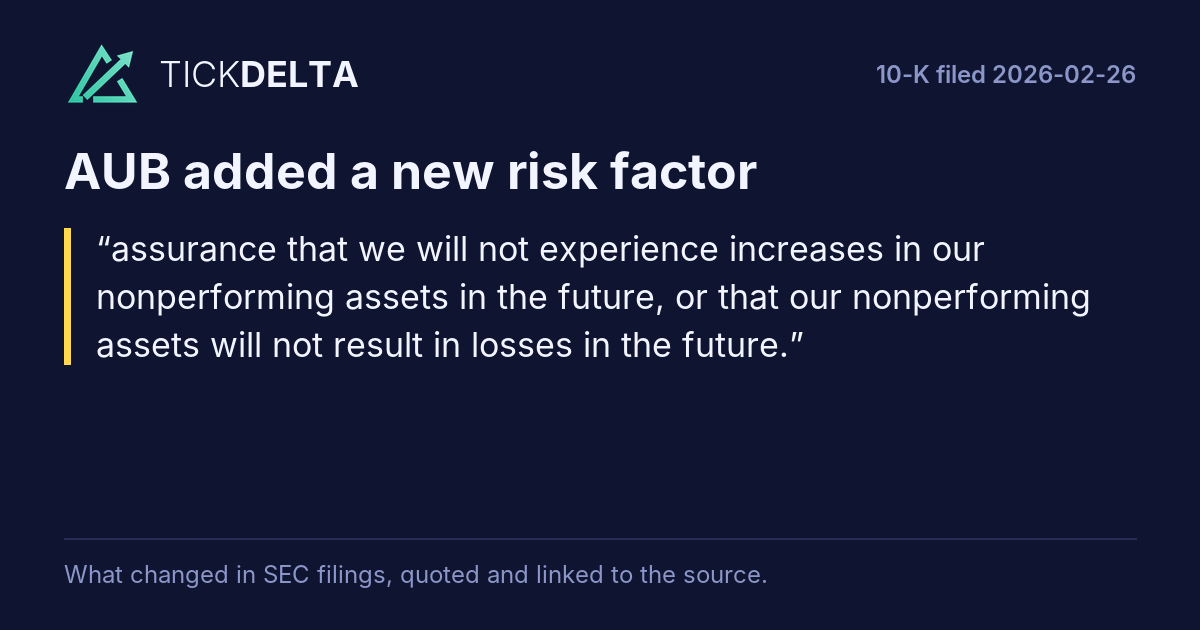
assurance that we will not experience increases in our nonperforming assets in the future, or that our nonperforming assets will not result in losses in the future.
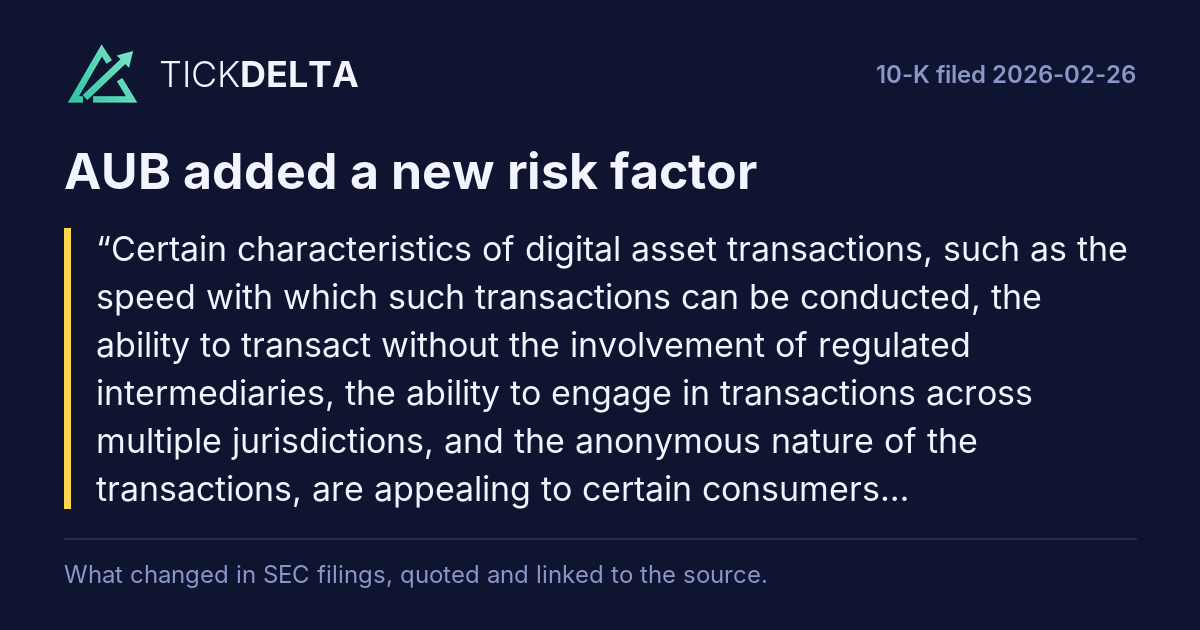
Certain characteristics of digital asset transactions, such as the speed with which such transactions can be conducted, the ability to transact without the involvement of regulated intermediaries, the ability to engage in transactions across multiple jurisdictions, and the anonymous nature of the transactions, are appealing to certain consumers notwithstanding the various risks posed by such transactions. Accordingly, digital asset service providers, which, at present, are not subject to the same degree of scrutiny and oversight as bank holding companies and federally insured banks, are becoming active competitors, and customers could move their deposits from traditional federal insured banks into digital currencies, which would have a negative effect on our liquidity, results of operations and financial condition.
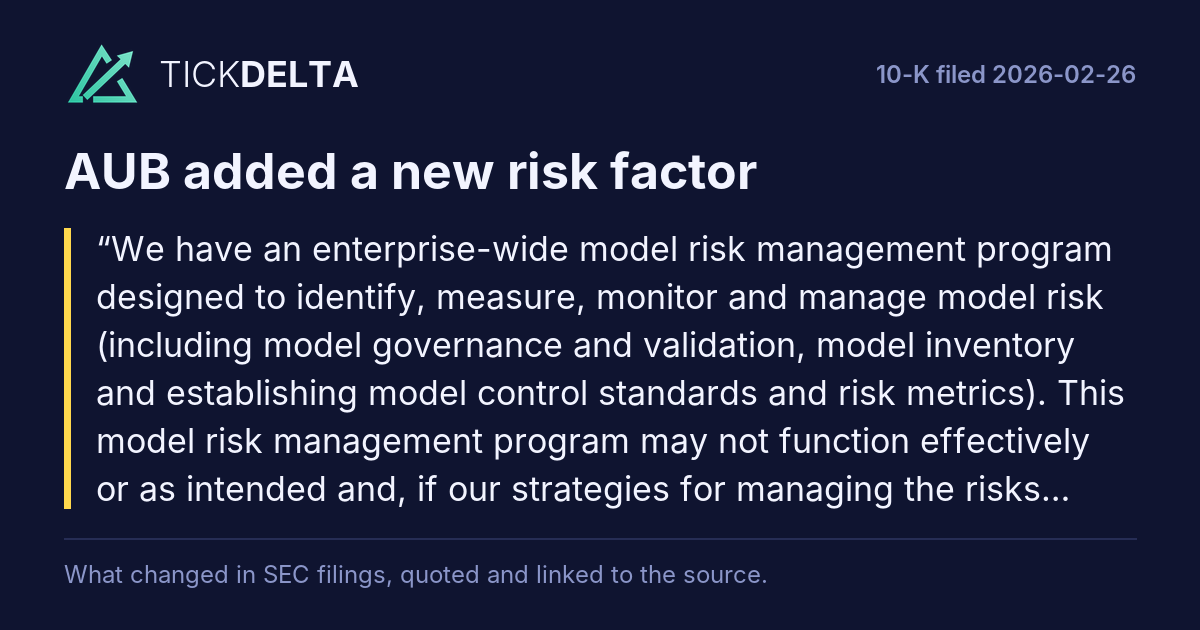
We have an enterprise-wide model risk management program designed to identify, measure, monitor and manage model risk (including model governance and validation, model inventory and establishing model control standards and risk metrics). This model risk management program may not function effectively or as intended and, if our strategies for managing the risks associated with our use of models are not effective or reliable, our business, financial condition, results of operations and risk exposure may be adversely affected.
Recently, the financial services industry has experienced rapid developments in artificial intelligence, including agentic artificial intelligence. The use of artificial intelligence models developed by third parties introduces risks related to how those models are developed, trained, and deployed, including unauthorized material in training data and limited visibility into risk mitigation steps. The legal and regulatory environment for artificial intelligence is uncertain and rapidly involving, potentially increasing compliance costs and risks of noncompliance. We may be exposed to the risk that generative artificial intelligence models may produce incorrect outputs, release confidential information, reflect biases, or otherwise cause harm. Their complexity may make it challenging to understand all outputs and comply with documentation or explanation requirements. Any of these risks could adversely affect our business, expose us to liability or other adverse legal or regulatory consequences, or otherwise adversely affect our financial results.
From time to time, we, our directors, and our management are, or may become, the subject of various claims and legal actions by customers, employees, shareholders and others. Whether such claims and legal actions are legitimate or
Show the other 4
We are subject to federal and applicable state and local tax laws and regulations. Tax laws and regulations are often complex and require significant judgment, including with respect to the allocation of income among tax jurisdictions, intercompany allocations, and the application of federal, state and local tax credits. For example, we may have exposure to certain state income tax filing obligations where we potentially have established a nexus, but do not currently file income tax returns. Our determination of our tax liability is subject to review by applicable tax authorities, who have in the past and may in the future challenge our tax positions. The challenges made by taxing authorities may result in adjustments to the timing or amount of taxable income or deductions, or the allocation of income among tax jurisdictions. Any such challenges that are not resolved in our favor could result in us being required to pay additional taxes, interest and penalties and may adversely affect our effective tax rate, tax payments or financial condition. We continue to monitor state tax developments and filing requirements for compliance and to manage related risks.
federal, state, and local levels—particularly in connection with business and other practices that may harm or appear to harm consumers or affect the financial system more broadly. In addition, financial institutions often are less inclined to litigate with governmental authorities because of the regulatory and supervisory framework.
The CFPB has examination and enforcement authority over us and has broad rulemaking authority to administer and carry out the purposes and objectives of federal consumer financial protection laws. Among other things, the CFPB is
to climate change, including our or our customers’ involvement in certain industries or projects. In recent years, the federal banking regulators have focused on the physical and financial risks to financial institutions associated with climate change, although, expectations with respect to these matters has been changing, and it is difficult to predict changes in priorities and requirements with respect to these matters, including any changes in compliance costs relating to such changes.
Paragraphs in the 10-Q filed Nov 3, 2026 that were not in the one before
New in the latest 10-Q
7 paragraphs in the 10-Q filed Nov 3, 2026 with nothing like
them in the 10-Q filed Aug 6, 2026 (at least half the words must differ; new numbers alone do not count).
Quoted exactly, grouped by the item heading above them. This is text that changed, not a judgement of how serious it is.
Financial statements and notes
Common stock purchased under share repurchase program (264,961 shares) (352) (9,653) (10,005)
Read in the 10-Qopen_in_new
Common stock purchased under share repurchase program (1,511,255 shares) (2,010) (60,520) (62,530)
Read in the 10-Qopen_in_new
Reclassifications - The accompanying consolidated financial statements and notes reflect certain reclassifications in prior periods to conform to the current presentation.
Read in the 10-Qopen_in_new
During the third quarter of 2026, the Company issued $ 250.0 million in aggregate principal amount of its 6.25 % Fixed-to-Floating Rate Subordinated Notes due August 1, 2036 (the “2036 Subordinated Notes”). The 2036 Subordinated Notes convert to a floating rate equal to Three-Month Term Secured Overnight Financing Rate (“SOFR”), plus a spread of 213 bps on August 1, 2031. Net proceeds from the issuance, after underwriting discounts and offering expenses, were approximately $ 246.8 million.
Read in the 10-Qopen_in_new
The Company used the net proceeds from the issuance of the 2036 Subordinated Notes to redeem the $ 168.0 million principal amount of its previously outstanding 4.25 % Fixed-to-Floating Rate Subordinated Notes due 2029 (the “2029 Subordinated Notes”), plus accrued interest, and for general corporate purposes. The 2029 Subordinated Notes transitioned to a floating interest rate on November 15, 2024, and had a rate of 6.53 % at the time of redemption. As a result of the redemption, the Company recognized a $ 2.7 million pre-tax loss on debt extinguishment in the third quarter of 2026, recorded within noninterest expense, reflecting the acceleration of acquisition-related fair value marks associated with the 2029 Subordinated Notes.
Read in the 10-Qopen_in_new
Show the other 2
We used the net proceeds to redeem the $168.0 million principal amount of our previously outstanding 4.25% Fixed-to-Floating Rate Subordinated Notes due in 2029, plus accrued interest, and for general corporate purposes. The 2029 Subordinated Notes transitioned to a floating interest rate on November 15, 2024, and had a rate of 6.53% at the time of redemption. As a result of the redemption, we recognized a $2.7 million pre-tax loss on debt extinguishment in the third quarter of 2026, recorded within noninterest expense, reflecting the acceleration of acquisition-related fair value marks associated with the 2029 Subordinated Notes.
Read in the 10-Qopen_in_new
Outside of the Day 1 initial provision expense recorded on non-PCD loans and unfunded commitments, the provision for credit losses decreased compared to the same period in the prior year, primarily attributable to the charge-offs of two commercial and industrial loans that were recorded in the third quarter of 2025 and had been partially reserved for previously, as discussed above.
Read in the 10-Qopen_in_new
The 10-Q's risk factors against the 10-K
Item 1A of the 10-Q filed Nov 3, 2026 against Item 1A of the 10-K filed Feb 26, 2026.
A 10-Q repeats only the risks that changed, so a 10-K paragraph that is missing from it is not counted as removed.
Added is a paragraph with nothing like it in the 10-K, Reworded a sentence that is in both with several words changed,
Quiet changes a sentence in both where one to four words changed and one is a hedge or a modal
(cut words struck through, new words highlighted).
Text on the page, not a score; each links to the filing at sec.gov.
What the 10-Q itself says about its risk factors:During the quarter ended September 30, 2026, there have been no material changes from the risk factors previously disclosed under Part I, Item 1A. “Risk Factors” in our 2025 Form 10-K.
Read in the 10-Qopen_in_new
Reworded10-Q Nov 3, 2026 vs 10-K Feb 26, 2026
In addition to the other information set forth in this Form 10-K, Quarterly Report, including the information addressed under “Forward-Looking Statements,” investors in our securities should carefully consider the risk factors discussed below. in our 2025 Form 10-K.
Read it in the 10-Q at sec.govopen_in_newThe 10-K sentenceopen_in_new
Phrases used for the first time
Two-word phrases in Risk Factors of the 10-K filed Feb 26, 2026 that are in none of the 1 earlier 10-Ks stored, back to Feb 27, 2025
genius act ×4digital asset ×3target range ×3funds rate ×3model risk ×3payment stablecoins ×2digital assets ×2intelligence models ×2local tax ×2tax laws ×2income among ×2among tax ×2tax jurisdictions ×2
Where each one is used
- genius act: Technology and other changes are allowing parties to complete financial transactions through alternative methods that have historically involved banks. For example, consumers can now maintain funds that would have historically been held as bank deposits in brokerage accounts, mutual funds, or general-purpose...
- digital asset: Technology and other changes are allowing parties to complete financial transactions through alternative methods that have historically involved banks. For example, consumers can now maintain funds that would have historically been held as bank deposits in brokerage accounts, mutual funds, or general-purpose...
- target range: Our income and cash flows depend to a great extent on the difference between the interest rates earned on interest-earning assets, such as loans and investment securities, and the interest rates paid on interest-bearing liabilities, such as deposits and borrowings. These rates are highly sensitive to many factors...
- funds rate: Our income and cash flows depend to a great extent on the difference between the interest rates earned on interest-earning assets, such as loans and investment securities, and the interest rates paid on interest-bearing liabilities, such as deposits and borrowings. These rates are highly sensitive to many factors...
- model risk: We have an enterprise-wide model risk management program designed to identify, measure, monitor and manage model risk (including model governance and validation, model inventory and establishing model control standards and risk metrics). This model risk management program may not function effectively or as intended...
- payment stablecoins: Technology and other changes are allowing parties to complete financial transactions through alternative methods that have historically involved banks. For example, consumers can now maintain funds that would have historically been held as bank deposits in brokerage accounts, mutual funds, or general-purpose...
- digital assets: The financial services industry is continually undergoing technological change with frequent introductions of new technology-driven products and services, including digital assets and payment systems, and we anticipate that new technologies will continue to emerge. Our continued success depends, in part, on our...
- intelligence models: Recently, the financial services industry has experienced rapid developments in artificial intelligence, including agentic artificial intelligence. The use of artificial intelligence models developed by third parties introduces risks related to how those models are developed, trained, and deployed, including...
The 10-K at sec.govopen_in_new
Used at least twice, small words left out. Counted, not picked: a phrase can be new because the company renamed something.
Upon completion of the transactions contemplated by the merger agreement, we will be subject to risks related to Sandy Spring’s business and will take on its loans, investments and other obligations. This will increase our credit risk and, if such obligations are not repaid or losses are incurred on such obligations, there could be material and adverse effects on our business. Additionally, where our businesses overlap, any risks we face may be increased. For example, we and Sandy Spring each have significant credit exposure in CRE. At December 31, 2024, Sandy Spring’s CRE loan portfolio...
In the 10-K filed Feb 27, 2025open_in_new
We expect to physically settle the Forward Sale Agreements (by the delivery of shares of our common stock) and receive proceeds from the sale of those shares of our common stock upon one or more forward settlement dates within approximately eighteen (18) months from the date of the Forward Sale Agreements. We may also elect cash settlement or net share settlement for all or a portion of our obligations under the Forward Sale Agreements. Upon physical settlement or, if we so elect, net share settlement of the Forward Sale Agreements, delivery of shares of our common stock in connection with...
In the 10-K filed Feb 27, 2025open_in_new
If the transactions contemplated by the merger agreement with Sandy Spring, including the merger, are not completed for any reason, we and/or Sandy Spring may experience negative reactions from the financial markets and from our respective customers and employees. For example, our business may have been impacted adversely by the failure to pursue other beneficial opportunities due to the focus of our management on the merger, without realizing any of the anticipated benefits of completing the merger. Moreover, our stock price may decline because costs related to such transactions, such as...
In the 10-K filed Feb 27, 2025open_in_new
Further, we entered into the merger agreement to acquire Sandy Spring with the expectation that the acquisition will result in various benefits including, among other things, benefits relating to enhanced revenues, a strengthened market position for the combined company, cross selling opportunities, technological efficiencies, cost savings and operating efficiencies. Achieving the anticipated benefits of the transactions contemplated by the merger agreement is subject to a number of uncertainties, including whether we integrate Sandy Spring in an efficient, effective and timely manner, and...
In the 10-K filed Feb 27, 2025open_in_new
Sources
Item 1A of each 10-K and 10-Q on EDGAR, quoted exactly. Each paragraph links to the filing at sec.gov.
Also
10-K change: what was reworded or cut, section by section.
Work with it
Excel workbook · CSV. Google Sheet that stays up to date: paste =IMPORTDATA("https://tickdelta.com/company/AUB/export.csv") into a cell.