Paragraph 51 · 37% changed
Every version of it
Screener
/
SEC EDGAR
/CIK 0000104918
/10-K filed Feb 25, 2026, compared with Feb 26, 2025
/Numbers from the XBRL of the 10-Ks
NYSE
Utilities · Electric & Gas Utilities
Avista Corp AVA
The 10-K against last year's
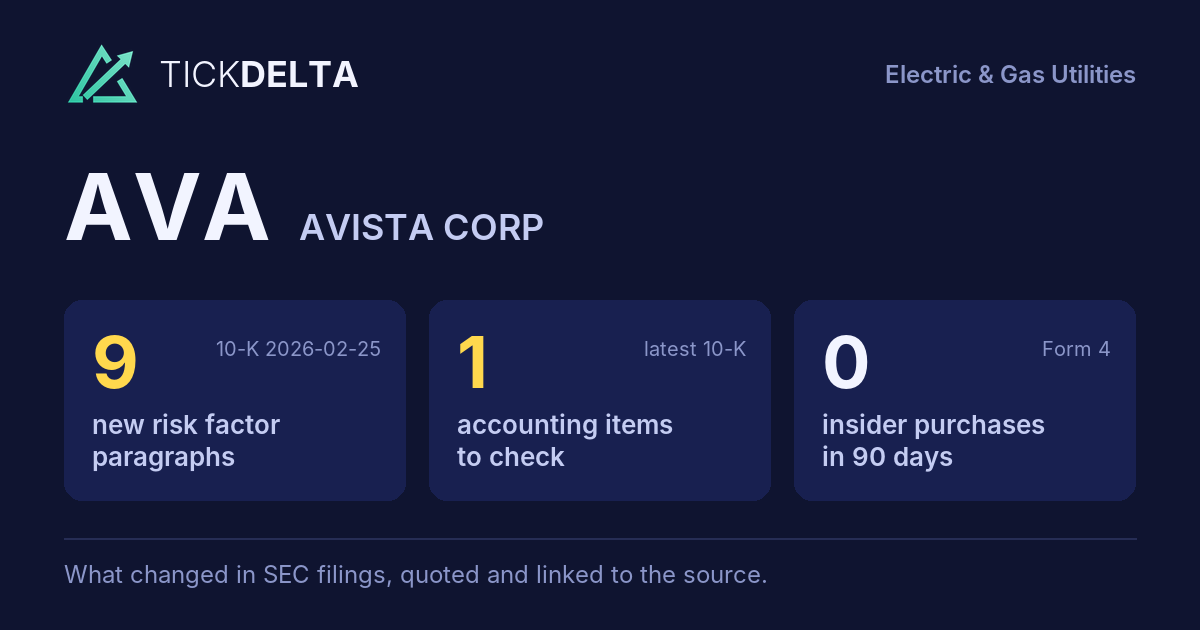
172 changes: 63 added, 41 removed, 68 reworded
10-K Feb 25, 2026 vs Feb 26, 2025
Risk Factors
12.5%
of the text changed · 6,246 words now · 9 new paragraphs, 0 gone
MD&A
26.5%
of the text changed · 17,665 words now · 54 new paragraphs, 41 gone
Legal Proceedings
37.7%
of the text changed · 1,997 words now
Accounting Policies
7.2%
of the text changed · 3,629 words now
10-K 0001193125-26-067872 (Feb 25, 2026) vs 10-K 0000950170-25-027077 (Feb 26, 2025)
Every paragraph, and how much of it changed
One bar per paragraph, in the order of the 10-K. Height and colour show the share of its words not in the closest paragraph a year earlier; the tallest bars are new paragraphs.
Risk Factors
106 paragraphs · 9 new · 20 reworded · 0 gone · 10-K Feb 25, 2026 against Feb 26, 2025
New paragraph
Reworded (5% of its words or more)
Same or nearly
Paragraph 55 · 29% changed
Every version of it
Legislative, regulatory and advocacy efforts at the local, state, national and international levels concerning climate change and other environmental issues could have significant impacts on our operations. The electric and natural gas utility industries are frequently affected by proposals to curb greenhouse gas and other air emissions. Various regulatory and legislative proposals have been made to limit or further restrict byproducts of combustion, including that those resulting from the use of natural gas by our customers. In addition, there are regulatory and legislative initiatives that have been passed which are designed to limit greenhouse gas emissions and increase the use of renewable sources of energy. In addition, regulatory and legislative initiatives may restrict customers' access to natural gas and/or require or limit natural gas infrastructure in buildings. Other initiatives may seek to promote social interests expressed as energy equity, environmental justice or similar frameworks. Such legislation could direct and/or restrict the operation and raise the costs of our power generation resources and energy delivery infrastructure as well as the distribution of natural gas to our customers.
Paragraph 31 · 26% changed
Every version of it
Cyberattacks, ransomware, terrorism or other malicious acts could damage, destroy or disrupt these systems for an extended period of time. The energy sector, including electric and natural gas utility companies have become the subject of cyberattacks with increased frequency. Our administrative and operating networks are targeted by hackers on a regular basis. Additionally, the facilities and systems of clients, suppliers and third party service providers could be vulnerable to the same cyber or terrorism risks as our facilities and systems and such third party systems may be interconnected to our systems both physically and technologically. Therefore, an event caused by cyberattacks, ransomware or other malicious act at an interconnected third party could impact our business and facilities similarly. Any failure, unexpected, or unauthorized use of technology systems could result in the unavailability of such systems, and could result in a loss of operating revenues, an increase in operating expenses and costs to repair or replace damaged assets. Any of the above could also result in the loss or release of confidential customer and/or employee information or other proprietary data that could adversely affect our reputation and competitiveness, could result in costly litigation and negatively impact our results of operations. These cyberattacks have become more common and sophisticated and, as such, we could be required to incur costs to strengthen our systems and respond to emerging concerns.
Paragraph 32 · 26% changed
Every version of it
Paragraph 21 · 24% changed
Every version of it
Our generation, transmission and distribution assets and the systems that monitor and operate these assets are critical infrastructure for providing service to our customers. Security threats are continuing to evolve, and our industry has been is subject to, and will likely continue to be subject to, attempts to disrupt operations. Significant destruction or interruption of
Paragraph 56 · 22% changed
Every version of it
Paragraph 64 · 20% changed
Every version of it
Tariffs and other restrictions on trade with foreign countries could significantly increase the prices of energy commodities (electricity and natural gas) and equipment and materials that are critical to our business. In addition, tariffs and trade restrictions could have a similar impact on our suppliers and certain customers, which could have a negative impact on our financial condition, results of operations and cash flows.
Paragraph 70 · 12% changed
Every version of it
The price of power in the wholesale energy markets tends to be higher during periods of high regional demand, such as occurs with temperature extremes. Climate change may increase the frequency and magnitude of temperature extremes. We may need to purchase power in the wholesale market during peak price periods. The price of natural gas as fuel for natural gas-fired electric generation tends to increase during periods of high demand which are often related to temperature extremes. We may need to purchase natural gas fuel in these periods of high prices to meet electric demands. The cost of power supply during peak usage periods may be higher than the retail sales price or the amount allowed in retail rates by our regulators. To the extent that power supply costs are above the amount allowed currently in retail rates, the difference is partially absorbed by the Company in current expense and is partially deferred or shared with customers through regulatory mechanisms. However, these deferred costs require cash outflows from the time of power purchases until the costs are later recovered through retail rates.
Paragraph 51 · 37% changed
Every version of it
10-K Feb 26, 2025•non-regulated investments in businesses outside of our core utilities operations may increase earnings volatility,
10-K Feb 25, 2026
Non-regulated investments in businesses outside of our core utilities operations may increase earnings volatility and can be difficult to sell due to their illiquid nature.
Paragraph 55 · 29% changed
Every version of it
10-K Feb 26, 2025
Legislative, regulatory and advocacy efforts at the local, state, national and international levels concerning climate change and other environmental issues could have significant impacts on our operations. The electric and natural gas utility industries are frequently affected by proposals to curb greenhouse gas and other air emissions. Various regulatory and legislative proposals have been made to limit or further restrict byproducts of combustion, including that resulting from the use of natural gas by our customers. In addition, there are regulatory and legislative initiatives that have been passed which are designed to limit greenhouse gas emissions and increase the use of renewable sources of energy. In addition, regulatory and legislative initiatives may restrict customers' access to natural gas and/or require or limit natural gas infrastructure in buildings. Other initiatives may seek to promote social interests expressed as energy equity, environmental justice or similar frameworks. Such legislation could direct and/or restrict the operation and raise the costs of our power generation resources and energy delivery infrastructure as well as the distribution of natural gas to our customers.
10-K Feb 25, 2026
Legislative, regulatory and advocacy efforts at the local, state, national and international levels concerning climate change and other environmental issues could have significant impacts on our operations. The electric and natural gas utility industries are frequently affected by proposals to curb greenhouse gas and other air emissions. Various regulatory and legislative proposals have been made to limit or further restrict byproducts of combustion, including those resulting from the use of natural gas by
Paragraph 31 · 26% changed
Every version of it
10-K Feb 26, 2025
Cyberattacks, ransomware, terrorism or other malicious acts could damage, destroy or disrupt these systems for an extended period of time. The energy sector, including electric and natural gas utility companies have become the subject of cyberattacks with increased frequency. Our administrative and operating networks are targeted by hackers on a regular basis. Additionally, the facilities and systems of clients, suppliers and third party service providers could be vulnerable to the same cyber or terrorism risks as our facilities and systems and such third party systems may be interconnected to our systems both physically and technologically. Therefore, an event caused by cyberattacks, ransomware or other malicious act at an interconnected third party could impact our business and facilities similarly. Any failure, unexpected, or unauthorized use of technology systems could result in the unavailability of such systems, and could result in a loss of operating revenues, an increase in operating expenses and costs to repair or replace damaged assets. Any of the above could also result in the loss or release of confidential customer and/or employee information or other proprietary data that could adversely affect our reputation and competitiveness, could result in costly litigation and negatively impact our results of operations. These cyberattacks have become more common and sophisticated and, as such, we could be required to incur costs to strengthen our systems and respond to emerging concerns.
10-K Feb 25, 2026
Cyberattacks, ransomware, terrorism or other malicious acts could damage, destroy or disrupt these systems for an extended period of time. The energy sector, including electric and natural gas utility companies have become the subject of cyberattacks with increased frequency. Our administrative and operating networks are targeted by hackers on a regular basis. Additionally, the facilities and systems of clients, suppliers and third party service providers could be vulnerable to the same cyber or terrorism risks as our facilities and systems and such third party systems may be interconnected to our systems both physically and technologically. Therefore, an event caused by cyberattacks, ransomware or other malicious act at an interconnected third
Paragraph 32 · 26% changed
Every version of it
10-K Feb 26, 2025Cyberattacks, ransomware, terrorism or other malicious acts could damage, destroy or disrupt these systems for an extended period of time. The energy sector, including electric and natural gas utility companies have become the subject of cyberattacks with increased frequency. Our administrative and operating networks are targeted by hackers on a regular basis. Additionally, the facilities and systems of clients, suppliers and third party service providers could be vulnerable to the same cyber or terrorism risks as our facilities and systems and such third party systems may be interconnected to our systems both physically and technologically. Therefore, an event caused by cyberattacks, ransomware or other malicious act at an interconnected third party could impact our business and facilities similarly. Any failure, unexpected, or unauthorized use of technology systems could result in the unavailability of such systems, and could result in a loss of operating revenues, an increase in operating expenses and costs to repair or replace damaged assets. Any of the above could also result in the loss or release of confidential customer and/or employee information or other proprietary data that could adversely affect our reputation and competitiveness, could result in costly litigation and negatively impact our results of operations. These cyberattacks have become more common and sophisticated and, as such, we could be required to incur costs to strengthen our systems and respond to emerging concerns.
10-K Feb 25, 2026
party could impact our business and facilities similarly. Any failure, unexpected, or unauthorized use of technology systems could result in the unavailability of such systems, and could result in a loss of operating revenues, an increase in operating expenses and costs to repair or replace damaged assets. Any of the above could also result in the loss or release of confidential customer and/or employee information or other proprietary data that could adversely affect our reputation and competitiveness, could result in costly litigation and negatively impact our results of operations. These cyberattacks have become more common and sophisticated and, as such, we could be required to incur costs to strengthen our systems and respond to emerging concerns.
Paragraph 21 · 24% changed
Every version of it
10-K Feb 26, 2025
Our generation, transmission and distribution assets and the systems that monitor and operate these assets are critical infrastructure for providing service to our customers. Security threats are continuing to evolve, and our industry has been subject to, and will likely continue to be subject to, attempts to disrupt operations. Significant destruction or interruption of
10-K Feb 25, 2026
Our generation, transmission and distribution assets and the systems that monitor and operate these assets are critical infrastructure for providing service to our customers. Security threats are continuing to evolve, and our industry is subject to
Paragraph 56 · 22% changed
Every version of it
10-K Feb 26, 2025Legislative, regulatory and advocacy efforts at the local, state, national and international levels concerning climate change and other environmental issues could have significant impacts on our operations. The electric and natural gas utility industries are frequently affected by proposals to curb greenhouse gas and other air emissions. Various regulatory and legislative proposals have been made to limit or further restrict byproducts of combustion, including that resulting from the use of natural gas by our customers. In addition, there are regulatory and legislative initiatives that have been passed which are designed to limit greenhouse gas emissions and increase the use of renewable sources of energy. In addition, regulatory and legislative initiatives may restrict customers' access to natural gas and/or require or limit natural gas infrastructure in buildings. Other initiatives may seek to promote social interests expressed as energy equity, environmental justice or similar frameworks. Such legislation could direct and/or restrict the operation and raise the costs of our power generation resources and energy delivery infrastructure as well as the distribution of natural gas to our customers.
10-K Feb 25, 2026
our customers. In addition, there are regulatory and legislative initiatives that have been passed which are designed to limit greenhouse gas emissions and increase the use of renewable sources of energy. In addition, regulatory and legislative initiatives may restrict customers' access to natural gas and/or require or limit natural gas infrastructure in buildings. Other initiatives may seek to promote social interests expressed as energy equity, environmental justice or similar frameworks. Such legislation could direct and/or restrict the operation and raise the costs of our power generation resources and energy delivery infrastructure as well as the distribution of natural gas to our customers.
Paragraph 64 · 20% changed
Every version of it
10-K Feb 26, 2025
Tariffs and other restrictions on trade with foreign countries could significantly increase the prices of energy commodities (electricity and natural gas) and equipment and materials that are critical to our business. In addition, tariffs and trade
10-K Feb 25, 2026
Tariffs and other restrictions on trade with foreign countries could significantly increase the prices of energy commodities (electricity and natural gas) and equipment and materials that are critical to our business. In addition, tariffs and trade restrictions could have a similar impact on our suppliers and certain customers, which could have a negative impact on our financial condition, results of operations and cash flows.
Paragraph 70 · 12% changed
Every version of it
10-K Feb 26, 2025
The price of power in the wholesale energy markets tends to be higher during periods of high regional demand, such as occurs with temperature extremes. Climate change may increase the frequency and magnitude of temperature extremes. We may need to purchase power in the wholesale market during peak price periods. The price of natural gas as fuel for natural gas-fired electric generation tends to increase during periods of high demand which are often related to temperature extremes. We may need to purchase natural gas fuel in these periods of high prices to meet electric demands. The cost of power supply during peak usage periods may be higher than the retail sales price or the amount allowed in retail rates by our regulators. To the extent that power supply costs are above the amount allowed currently in retail rates, the difference is partially absorbed by the
10-K Feb 25, 2026
The price of power in the wholesale energy markets tends to be higher during periods of high regional demand, such as occurs with temperature extremes. Climate change may increase the frequency and magnitude of temperature extremes. We may need to purchase power in the wholesale market during peak price periods. The price of natural gas as fuel for natural gas-fired electric generation tends to increase during periods of high demand which are often related to temperature extremes. We may need to purchase natural gas fuel in these periods of high prices to meet electric demands. The cost of power supply during peak usage periods may be higher than the retail sales price or the amount allowed in retail rates by our regulators. To the extent that power supply costs are above the amount allowed currently in retail rates, the difference is partially absorbed by the Company in current expense and is partially deferred or shared with customers through regulatory mechanisms. However, these deferred costs require cash outflows from the time of power purchases until the costs are later recovered through retail rates.
MD&A
320 paragraphs · 54 new · 108 reworded · 41 gone · 10-K Feb 25, 2026 against Feb 26, 2025
New paragraph
Reworded (5% of its words or more)
Same or nearly
Paragraph 165 · 50% changed
In July 2025, AEL&P has entered into a $25 term loan agreement in the amount of $20 million with an interest rate of 5.49 percent and a maturity date of July 2030. AEL&P borrowed the entire $20 million available under the agreement, and used the net proceeds to repay borrowings outstanding under AEL&P's committed line of credit with an expiration date in June 2028. As of December 31, 2024, there was $12 million outstanding at an average interest rate of 6.13 percent, and $13 million of available liquidity under this line of credit. credit, as well as fund capital expenditures.
Paragraph 64 · 49% changed
Paragraph 60 · 46% changed
Paragraph 254 · 46% changed
The AOC requires MDEQ to review Remedy and Closure plans for all parts of the Colstrip plant through an ongoing public process. The AOC also requires the Colstrip owners to provide financial assurance, primarily in the form of surety bonds, to secure each owner’s pro rata share of various anticipated closure and remediation obligations. We are responsible for our share of two major areas: the Plant Site Area and the Effluent Holding Pond Area. Generally, the plans include the removal of boron, chloride, and sulfate from the groundwater, closure of the existing ash storage ponds, and installation of a new water treatment system to convert the facility to a dry ash storage. Our share of the posted surety bonds is $16 million. This amount is updated
Paragraph 217 · 45% changed
Paragraph 51 · 43% changed
To mitigate the overall impact of the revenue increases on customers, part $5 million of the 2022 base rate increase was offset with tax customer credits. The total estimated benefits of these credits, $28 million for electric credits will be accelerated and returned to customers and $13 million for natural gas customers, were returned over a two-year period from December 2022 to December 2024. three-year period.
Paragraph 126 · 43% changed
Paragraph 25 · 42% changed
Paragraph 165 · 50% changed
10-K Feb 26, 2025
AEL&P has a $25 million committed line of credit with an expiration date in June 2028. As of December 31, 2024, there was $12 million outstanding at an average interest rate of 6.13 percent, and $13 million of available liquidity under this line of credit.
10-K Feb 25, 2026
In July 2025, AEL&P entered into a term loan agreement in the amount of $20 million with an interest rate of 5.49 percent and a maturity date of July 2030. AEL&P borrowed the entire $20 million available under the agreement, and used the net proceeds to repay borrowings outstanding under AEL&P's committed line of credit, as well as fund capital expenditures.
Paragraph 64 · 49% changed
10-K Feb 26, 2025Our other businesses had a net loss of $7 million for 2024 compared to a net loss of $5 million for 2023. The fluctuation in results is primarily related to higher net investment losses due to changes in fair value and recognizing our portion of equity investment losses.
10-K Feb 25, 2026
The decrease in earnings related to other is primarily due to increased net investment losses compared to the prior year. In addition, non-utility operating expenses increased due to updated estimates for an existing environmental remediation liability at one of our subsidiaries, which resulted in a pre-tax expense of $3 million in 2025.
Paragraph 60 · 46% changed
10-K Feb 26, 2025•a $116 million increase in other costs, primarily due to a decrease in deferred costs during the period, largely a result of lower natural gas prices, as well as the amortization of costs associated with the CCA that were recovered from customers, resulting in no impact to utility margin.
10-K Feb 25, 2026
Electric utility resource costs decreased primarily due to decreased purchased power costs associated with decreased wholesale prices, as well as decreased amortizations of previously deferred costs. Electric utility resource costs also decreased due to the effects of the Washington general rate case and a lower level of authorized power supply costs resulting in increased deferrals of power supply costs. Natural gas utility resource costs decreased due to decreased commodity prices, as well as decreased amortization of previously deferred PGA costs. These decreases were offset by an increase in the amortization of costs associated with the CCA that are being recovered from customers.
Paragraph 254 · 46% changed
10-K Feb 26, 2025
The AOC requires MDEQ to review Remedy and Closure plans for all parts of the Colstrip plant through an ongoing public process. The AOC also requires the Colstrip owners to provide financial assurance, primarily in the form of surety bonds, to secure each owner’s pro rata share of various anticipated closure and remediation obligations. We are responsible for our share of two major areas: the Plant Site Area and the Effluent Holding Pond Area. Generally, the plans include the removal of boron, chloride, and sulfate from the groundwater, closure of the existing ash storage ponds, and installation of a new water treatment system to convert the facility to a dry ash storage. Our share of the posted surety bonds is $16 million. This amount is updated
10-K Feb 25, 2026
The AOC requires MDEQ to review Remedy and Closure plans for all parts of the Colstrip plant through an ongoing public process. The AOC also requires the Colstrip owners to provide financial assurance, primarily in the form of surety bonds, to
Paragraph 217 · 45% changed
10-K Feb 26, 2025Washington applies a GHG emissions performance standard to electric generation facilities used to serve retail loads, whether the facilities are located within Washington or elsewhere. The emissions performance standard prevents utilities from constructing or purchasing generation facilities, or entering into power purchase agreements of five years or longer duration to purchase energy produced by plants that have emission levels higher than 925 pounds of GHG per MWh. The Washington State Department of Commerce reviews the standard every five years. We intend to seek recovery of costs related to ongoing and new requirements through the ratemaking process.
10-K Feb 25, 2026
per MWh. The Washington State Department of Commerce reviews the standard every five years. We intend to seek recovery of costs related to ongoing and new requirements through the ratemaking process.
Paragraph 51 · 43% changed
10-K Feb 26, 2025
To mitigate the overall impact of the revenue increases on customers, part of the 2022 base rate increase was offset with tax customer credits. The total estimated benefits of these credits, $28 million for electric customers and $13 million for natural gas customers, were returned over a two-year period from December 2022 to December 2024.
10-K Feb 25, 2026
To mitigate the overall impact of the revenue increases on customers, $5 million of tax customer credits will be accelerated and returned to customers over a three-year period.
Paragraph 126 · 43% changed
10-K Feb 26, 2025We make estimates and assumptions as to many of these factors. In accordance with accounting standards, changes in pension plan obligations associated with these factors may not be immediately recognized as pension costs in our Consolidated Statements of Income, but we generally recognize the change in future years over the remaining average service period of pension plan participants. As such, our cost recorded in a period may not reflect the actual level of cash benefits provided to pension plan participants.
10-K Feb 25, 2026
pension plan participants. As such, our cost recorded in a period may not reflect the actual level of cash benefits provided to pension plan participants.
Paragraph 25 · 42% changed
10-K Feb 26, 2025We are not expecting the adoption of accounting standards to have a material impact on our financial condition, results of operations and cash flows in 2025. For more information on accounting standards expected to be adopted in future periods, see "Note 2 of the Notes to the Consolidated Financial Statements".
10-K Feb 25, 2026
The OBBB did not have a material impact on our results of operations and financial condition in 2025. We continue to monitor ongoing guidance. Any future impacts will be recognized in the period in which they become known. See "Note 13 of the Notes to Consolidated Financial Statements" for further discussion of the impact of OBBB.
A paragraph is matched with the one last year that shares the most of its words; under half in common makes it new. The paragraphs shown are the 8 reworded the most in each section.
The paragraph that changed most in each section
The redline
Marked against last year's 10-K: cut words struck through, new words highlighted.
MD&A152 words changed in this paragraph; it is 36% similar to last year's version.
Source: Item 7, 10-K 0001193125-26-067872 vs Item 7, 10-K 0000950170-25-027077
Legal Proceedings138 words changed in this paragraph; it is 42% similar to last year's version.
Eleven lawsuits have been were filed in connection with the Babb Road fire. Asplundh Tree Company and Fire. CN Utility Consulting, which both perform performs vegetation management services as an independent contractors contractor to the Company, are was also named as defendants in each of the lawsuits. The lawsuits include included six subrogation actions filed by 51 insurance companies seeking to recover approximately $21 million purportedly paid to insureds to date; and five actions on behalf of 128 individual plaintiffs. One of the private plaintiff actions was originally filed as a class action lawsuit, but has since been amended to assert direct claims on behalf of 10 individual plaintiffs. In the course of discovery, approximately 80 private plaintiffs have provided information about their alleged damages. Based on information received to date, the 80 private plaintiffs claim damages of approximately $60 million. $21 million of this claim is alleged noneconomic damages (i.e. emotional distress). The Company does not believe non-economic damages are applicable in this case and will vigorously dispute such claims. Approximately $6 million of private plaintiffs' claimed damages have been covered by insurance or other forms of reimbursement.
Source: Item 3, via Note 22 – COMMITMENTS AND CONTINGENCIES, 10-K 0001193125-26-067872 vs Item 3, via Note 22 – COMMITMENTS AND CONTINGENCIES, 10-K 0000950170-25-027077
Risk Factors116 words changed in this paragraph; it is 66% similar to last year's version.
Cyberattacks, ransomware, terrorism or other malicious acts could damage, destroy or disrupt these systems for an extended period of time. The energy sector, including electric and natural gas utility companies have become the subject of cyberattacks with increased frequency. Our administrative and operating networks are targeted by hackers on a regular basis. Additionally, the facilities and systems of clients, suppliers and third party service providers could be vulnerable to the same cyber or terrorism risks as our facilities and systems and such third party systems may be interconnected to our systems both physically and technologically. Therefore, an event caused by cyberattacks, ransomware or other malicious act at an interconnected third party could impact our business and facilities similarly. Any failure, unexpected, or unauthorized use of technology systems could result in the unavailability of such systems, and could result in a loss of operating revenues, an increase in operating expenses and costs to repair or replace damaged assets. Any of the above could also result in the loss or release of confidential customer and/or employee information or other proprietary data that could adversely affect our reputation and competitiveness, could result in costly litigation and negatively impact our results of operations. These cyberattacks have become more common and sophisticated and, as such, we could be required to incur costs to strengthen our systems and respond to emerging concerns.
Source: Item 1A, 10-K 0001193125-26-067872 vs Item 1A, 10-K 0000950170-25-027077
Accounting Policies92 words changed in this paragraph; it is 71% similar to last year's version.
Deferred income tax assets represent future income tax deductions the Company expects to utilize in future tax returns to reduce taxable income. Deferred income tax liabilities represent future taxable income the Company expects to recognize in future tax returns. Deferred tax assets and liabilities arise when there are temporary differences resulting from differing treatment of items for tax and accounting purposes. A deferred income tax asset or liability is determined based on the enacted tax rates that will be in effect when the temporary differences between the financial statement carrying amounts and tax basis of existing assets and liabilities are expected to be reported in the Company’s consolidated income tax returns. The effect on deferred income taxes from a change in tax rates is recognized in income in the period that includes the date of the enactment unless a regulatory order specifies deferral of the effect of the change in tax rates over a longer period of time. The Company establishes a valuation allowance when it is more likely than not that all, or a portion, of a deferred tax asset will not be realized. Deferred income tax assets and liabilities and regulatory assets and liabilities are established for income tax benefits flowed through to customers.
Source: Item 8, Note 1 – SUMMARY OF SIGNIFICANT ACCOUNTING POLICIES, 10-K 0001193125-26-067872 vs Item 8, Note 1 – SUMMARY OF SIGNIFICANT ACCOUNTING POLICIES, 10-K 0000950170-25-027077
Sentences and paragraphs added, removed or reworded
Every change, by type
Sentences and paragraphs of AVA's Risk Factors and MD&A, 10-K Feb 25, 2026 against 10-K Feb 26, 2025. Each links to the text at sec.gov.
Quiet changes are sentences kept from last year with one to four words changed, at least one of them a hedge, a modal or a qualifier (may, could, will, not, significant, material…). A year or date rolling forward is not counted.
The full word list
adverse, adversely, all, although, anticipate, anticipates, any, approximately, believe, believes, can, cannot, certain, could, expect, expects, generally, however, if, intend, intends, largely, likely, many, material, materially, may, might, most, must, never, no, not, possible, primarily, probable, should, significant, significantly, some, substantial, substantially, unlikely, will, would
AddedRisk Factors
Generating facilities not owned by us, whose output we acquire under a PPA, could be foreclosed on by creditors of the owner, even though we are performing under the terms of the PPA. This could result in either an increase in the price to be paid by us, or the output of the facilities being diverted from us and sold to other parties.
Read it in 10-K Feb 25, 2026 at sec.gov
AddedRisk Factors
Problems with the transition, design or implementation of our new enterprise resource planning system could interfere with our business and operations, and adversely affect our financial condition.
Read it in 10-K Feb 25, 2026 at sec.gov
AddedRisk Factors
We are in the process of planning for the implementation of a new cloud-based enterprise resource planning system, which will take multiple years to complete. See further information on the enterprise resource planning system within “Item 7. Management's Discussion and Analysis – Executive Overview”. There are transitional risks associated with the implementation, which may include loss of data in the conversion from on-premises systems to the cloud, difficulty compiling data for external reporting requirements, costs increasing throughout the project, or other challenges in our business operations. Difficulties faced during the transition could have a material adverse effect on our business, financial condition, and results of operations.
Read it in 10-K Feb 25, 2026 at sec.gov
AddedRisk Factors
The expanded adoption of artificial intelligence has the potential to increase exposure to cyberattacks and negatively impact business operations.
Read it in 10-K Feb 25, 2026 at sec.gov
AddedRisk Factors
The adoption of artificial intelligence (AI) is driving demand for energy while also presenting opportunities and unique risks to the utility business. AI enabled tools are proving to increase efficiency and add value to daily work processes as the use and adoption continues to expand. While use cases to drive efficiencies through AI develop, cyber attackers are targeting the tools and systems used to create the efficiencies, requiring enhanced analytics and monitoring. Reliance on AI generated information and data may enhance the exposure risk over time.
Read it in 10-K Feb 25, 2026 at sec.gov
AddedRisk Factors
AI driven solutions will be essential to compete in the marketplace, whether it be for material or energy procurement, or financial transactions, AI will accelerate data driven decision making. Therefore, AI literacy is essential. Not advancing the understanding and use of AI may compromise the operational and financial progress of the Company.
Read it in 10-K Feb 25, 2026 at sec.gov
AddedRisk Factors
The fair values of our respective equity investments fluctuate from period to period, and such changes in fair value directly affect our net income. While we make these investments after prudent analysis and with the expectation of eventual financial gains, there is no assurance these investments will ultimately be successful. A significant portion of our investment portfolio consists of equity interests in privately held companies, which are inherently illiquid due to a lack of established market. Liquidity events are largely outside of our control, and may not occur on a timely basis (or may never occur). In addition, it is likely the value of these investments will continue to fluctuate as the businesses continue to mature, causing corresponding changes in our net income. The risks faced by these businesses may differ from the risks faced by our utility operations.
Read it in 10-K Feb 25, 2026 at sec.gov
AddedRisk Factors
Multiple factors are influencing the ability to source and deliver adequate energy to meet customer demand, which could lead to power and gas market liquidity risks.
Read it in 10-K Feb 25, 2026 at sec.gov
Show the other 42
AddedRisk Factors
Local and regional factors may occur and impact our ability to meet energy needs during periods of high demand or unplanned events. Locally, some combination of factors such as unanticipated load growth, unforeseen localized climatic changes, decreases in water availability for hydro generation, and prolonged unplanned generation outages could result in being short the energy we need to meet customer demand. External to localized conditions and events, the regional wholesale market, to which we would turn to purchase energy to meet short-term shortfalls, has become strained during regional events. If the northwest region does not build sufficient new generation capacity and additional transmission and gas transport, there is a risk that we will not be able to depend on excess energy market purchases to meet customer demand during extreme weather events. These factors are increasing the risk of potential regional energy supply shortages and the ability for us to access additional energy during periods of high demand or unplanned events.
Read it in 10-K Feb 25, 2026 at sec.gov
RewordedRisk Factors
Security threats are continuing to evolve, and our industry has been is subject to, and will likely continue to be subject to, attempts to disrupt operations.
Read it in 10-K Feb 25, 2026 at sec.gov
RewordedRisk Factors
To the extent that power supply costs are above the amount allowed currently in retail rates, the difference is partially absorbed by the Company in current expense and is partially deferred or shared with customers through regulatory mechanisms.
Read it in 10-K Feb 25, 2026 at sec.gov
RewordedRisk Factors
Therefore, an event caused by cyberattacks, ransomware or other malicious act at an interconnected third party could impact our business and facilities similarly.
Read it in 10-K Feb 25, 2026 at sec.gov
RewordedRisk Factors
This also includes costs (including replacement of lost generation) associated with our transfer of Colstrip ownership to NorthWestern as of January 1, 2026.
Read it in 10-K Feb 25, 2026 at sec.gov
RewordedRisk Factors
If regulators do not grant rate increases or grant substantially lower rate increases than our requests in the future or if recovery of deferred expenses is disallowed, or if regulators do not allow us to recover costs associated with assets required to be retired or divested, such as Colstrip, divested to comply with emerging laws and regulations, it could have a negative effect on our financial condition, results of operations or cash flows.
Read it in 10-K Feb 25, 2026 at sec.gov
AddedMD&A
Due to precipitation and warm weather, our hydroelectric generation in January and February (to date) has been above normal. Due to the warm weather, the average current level of snowpack in the areas serving our hydroelectric facilities is below normal. The amount of hydroelectric generation over the rest of the year will be affected not only by current snowpack levels but also by prevailing temperatures (which affect the timing and speed of run-off) and the volume, timing and form of precipitation. On balance, we expect the amount of hydroelectric generation for the entire year will be approximately at the normal level. While our current hydro forecast shows normal levels of generation, even if we were above or below normal, there would be no material change to our position in the ERM.
Read it in 10-K Feb 25, 2026 at sec.gov
AddedMD&A
Our 2025 electric IRP was filed with the WUTC and IPUC in December 2024, and identified needs for additional generating capacity. In May 2025, we issued a request for proposal to add energy and capacity to meet projected resource needs. We selected a list of projects and will begin contract negotiations for the following:
Read it in 10-K Feb 25, 2026 at sec.gov
AddedMD&A
•a self-build upgrade of our existing Natural Gas Combustion Turbines at Rathdrum CT to add 14 MW of capacity without increasing carbon emissions. This upgrade will occur in two stages with the first occurring in 2027 and the second in 2029,
Read it in 10-K Feb 25, 2026 at sec.gov
AddedMD&A
•a project for 100 MW, 4-hour Battery Energy Storage System, to be built and transferred to the Company in eastern Washington with a target date in 2028,
Read it in 10-K Feb 25, 2026 at sec.gov
AddedMD&A
•a PPA for approximately 200 MW of wind power from Montana that utilizes our share of the Colstrip Transmission System with a target date in 2029, and
Read it in 10-K Feb 25, 2026 at sec.gov
AddedMD&A
•the addition of approximately 40 MW of Demand Response Programs that will recruit residential, commercial and industrial customers within our service territory, beginning in 2026.
Read it in 10-K Feb 25, 2026 at sec.gov
AddedMD&A
See “Part 1 – Item 1. Business – Future Electric Resource Needs” for further discussion of regional resource adequacy.
Read it in 10-K Feb 25, 2026 at sec.gov
AddedMD&A
We expect a decrease in customer load from 2025 to 2026 to have a negative impact on our 2026 results. This decrease in load is associated with a large industrial customer with their own transmission rights and access to procure their own energy independently. We were notified of this customer’s intent to return to procuring their power independently in the power markets effective April 2026, which is earlier than we had expected. Net income is expected to decrease $9 million compared to if we had served their load through December 2026.
Read it in 10-K Feb 25, 2026 at sec.gov
AddedMD&A
In December 2025, the WUTC issued a final order for our filed tariff rider for Colstrip and on January 1, 2026, the transaction to transfer our 15 percent ownership in Colstrip Units 3 and 4 to NorthWestern closed. See “Colstrip” section and “Note 22 of the Notes to Consolidated Financial Statements” for further details on the exit of Colstrip through an agreement with NorthWestern and "Regulatory Matters" for further details regarding the Colstrip final order.
Read it in 10-K Feb 25, 2026 at sec.gov
AddedMD&A
The President of the United States of America has imposed tariffs on certain imported goods. The imposition of tariffs may impact the cost of other equipment and materials that are critical to our business, increasing capital and operating expenses, and could create supply chain disruptions. The tariffs have not had a material impact on our operations or financial performance to date. At this time, we do not expect the impact of tariffs to be material and have not made any adjustments to our capital or operating budget to account for increased costs resulting from tariffs.
Read it in 10-K Feb 25, 2026 at sec.gov
AddedMD&A
We import a significant amount of natural gas from Canada, both to serve our retail natural gas customers and as fuel for electric generation. We do not expect these imports to be impacted by the current trade tariffs as they are covered by the
Read it in 10-K Feb 25, 2026 at sec.gov
AddedMD&A
U.S.-Mexico-Canada Agreement, but the future of trade tariffs on energy commodity imports is uncertain. The impact of an increase in resource costs on our results of operations (directly or indirectly resulting from tariffs) would be substantially mitigated by various deferral and recovery mechanisms (ERM, PCA, and PGAs), but there could be an immediate impact on our cash flow.
Read it in 10-K Feb 25, 2026 at sec.gov
RemovedMD&A
RemovedMD&A
RemovedMD&A
RemovedMD&A
RemovedMD&A
RemovedMD&A
RemovedMD&A
RemovedMD&A
RemovedMD&A
RemovedMD&A
RemovedMD&A
RemovedMD&A
RewordedMD&A
In addition, the CETA establishes the policy of Washington State that retail sales of electricity to Washington customers must be carbon-neutral by January 1, 2030 and requires that each electric utility demonstrate compliance with this standard by using electricity from renewable and other non-emitting resources for 100 percent of the utility’s retail electric load over consecutive multi-year compliance periods; provided, however, that through December 31, 2044 the 2030, however a utility may satisfy up to 20 percent of this requirement with specified payments, emitting resources paired with either renewable offsets, credits and/or investments in qualifying energy transformation projects.
Read it in 10-K Feb 25, 2026 at sec.gov
RewordedMD&A
The increase decrease in net cash provided by operating activities primarily relates to a $97 $158 million increase decrease in net power and natural gas cost deferrals and amortizations compared to 2023 2024, primarily due to decreases in commodity prices and recovery of previously increased deferred costs from customers. power supply costs, as well as decreased amortizations associated with our PGAs.
Read it in 10-K Feb 25, 2026 at sec.gov
RewordedMD&A
For example, in addition to limiting our ability to conduct transactions, if our credit ratings were lowered to below “investment grade” based on positions outstanding at December 31, 2024 2025 (including contracts that are considered derivatives and those that are considered non-derivatives), we would potentially be required to post meet the following additional collateral (dollars in millions): definition of a derivative under U.S.
Read it in 10-K Feb 25, 2026 at sec.gov
RewordedMD&A
RewordedMD&A
The increase in other revenues is was offset by decreased retail rates, resulting in no impact to utility margin. margin, and a provision for earnings sharing related to natural gas operations in Washington, which resulted in a refund to be issued to customers.
Read it in 10-K Feb 25, 2026 at sec.gov
RewordedMD&A
Due to the enactment of CETA in Washington, in January 2023 we entered into an agreement with NorthWestern under which, subject to the terms and conditions specified in the agreement, which we will transfer transferred our ownership of Colstrip. Colstrip, effective midnight on January 1, 2026.
Read it in 10-K Feb 25, 2026 at sec.gov
RewordedMD&A
(1)Physical transactions represent commodity transactions where in which we will take or make delivery of either electricity or natural gas; financial transactions represent financial derivative instruments with delivery of that are settled in cash in the amount of the benefit or cost but with no physical delivery of the underlying commodity, such as futures, swap derivatives, options, or forward options contracts.
Read it in 10-K Feb 25, 2026 at sec.gov
RewordedMD&A
RewordedMD&A
To mitigate the overall impact of the revenue increases on customers, part $5 million of the 2022 base rate increase was offset with tax customer credits. credits will be accelerated and returned to customers over a three-year period.
Read it in 10-K Feb 25, 2026 at sec.gov
RewordedMD&A
Purchases Sales Electric Derivatives Gas Derivatives Electric Derivatives Gas Derivatives Year Physical (1) Financial (1) Physical (1) Financial (1) Physical (1) Financial (1) Physical (1) Financial (1) 2025 2026 $ $ $ (23) (17) $ (19) (10) $ 10 8 $ 7 4 $ (3) $ 2026 (9) 2027 (3) (1) — — — 2027 (2) (4) 2028 — — — — (3)
Read it in 10-K Feb 25, 2026 at sec.gov
RewordedMD&A
The OPUC approved settlement was based on an ROR ROE of 7.24 percent, 9.5 percent with a common equity ratio of 50 percent, percent and an ROE ROR of 9.5 7.22 percent.
Read it in 10-K Feb 25, 2026 at sec.gov
RewordedMD&A
Sources
The two latest 10-Ks on EDGAR, section by section. Each change links to the text at sec.gov.
Also
New risk factors: paragraphs with nothing like them last year, quoted in full.
Work with it
Excel workbook · CSV. Google Sheet that stays up to date: paste =IMPORTDATA("https://tickdelta.com/company/AVA/export.csv") into a cell.