Reworded10-Q Nov 4, 2026 vs 10-K Feb 25, 2026
Screener
/
SEC EDGAR
/CIK 0000104918
/10-K filed Feb 25, 2026, compared with Feb 26, 2025
/Numbers from the XBRL of the 10-Ks
NYSE
Utilities · Electric & Gas Utilities
Avista Corp AVA
New risk paragraphs, branching off last year
Each branch is a paragraph in Risk Factors with nothing like it in the 10-K filed Feb 26, 2025. A box jumps to the paragraph as filed, below.
Paragraphs with nothing like them in last year's 10-K
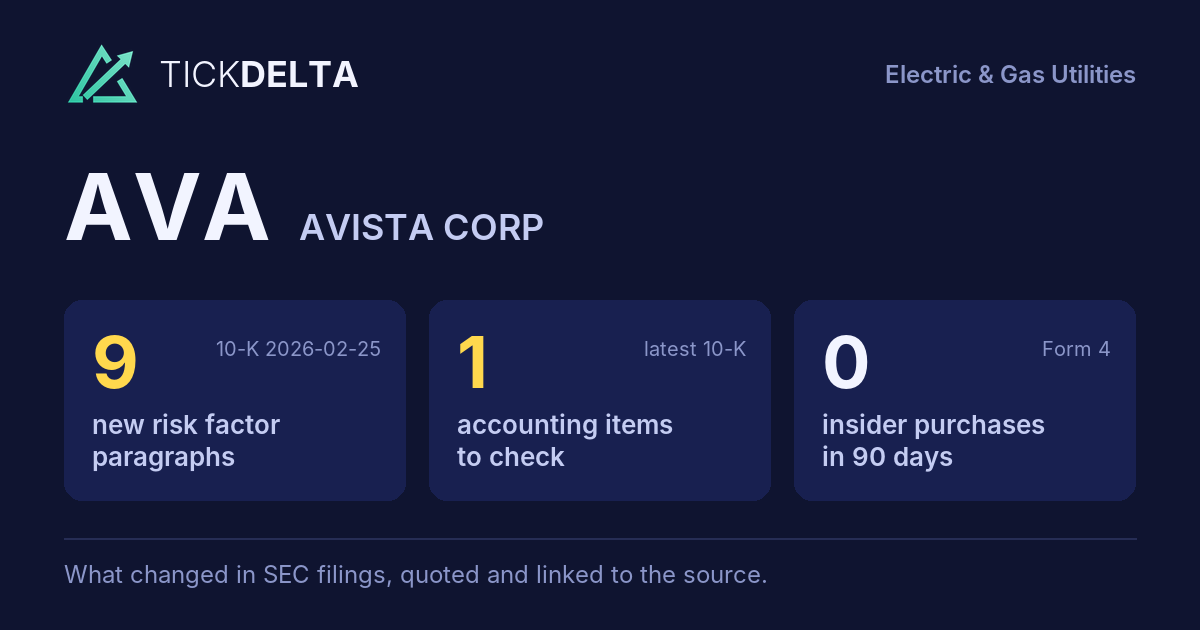
9 paragraphs in Risk Factors of the 10-K filed Feb 25, 2026 with nothing like them in the 10-K filed Feb 26, 2025. Quoted exactly. Paragraphs that were only edited are under 10-K change.
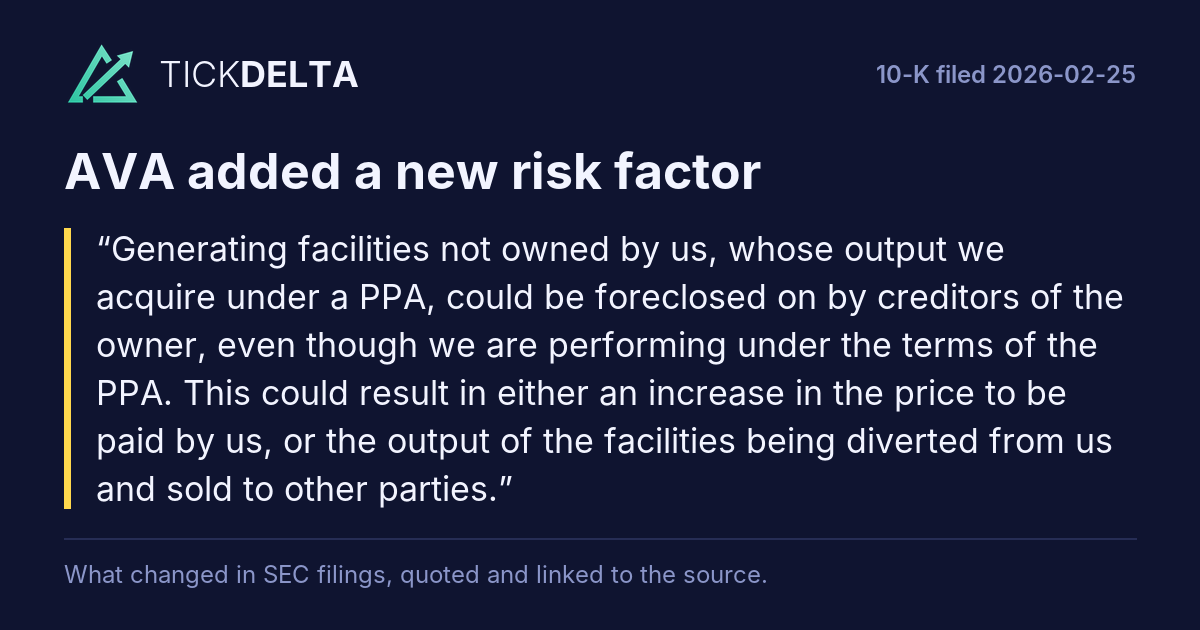
Generating facilities not owned by us, whose output we acquire under a PPA, could be foreclosed on by creditors of the owner, even though we are performing under the terms of the PPA. This could result in either an increase in the price to be paid by us, or the output of the facilities being diverted from us and sold to other parties.
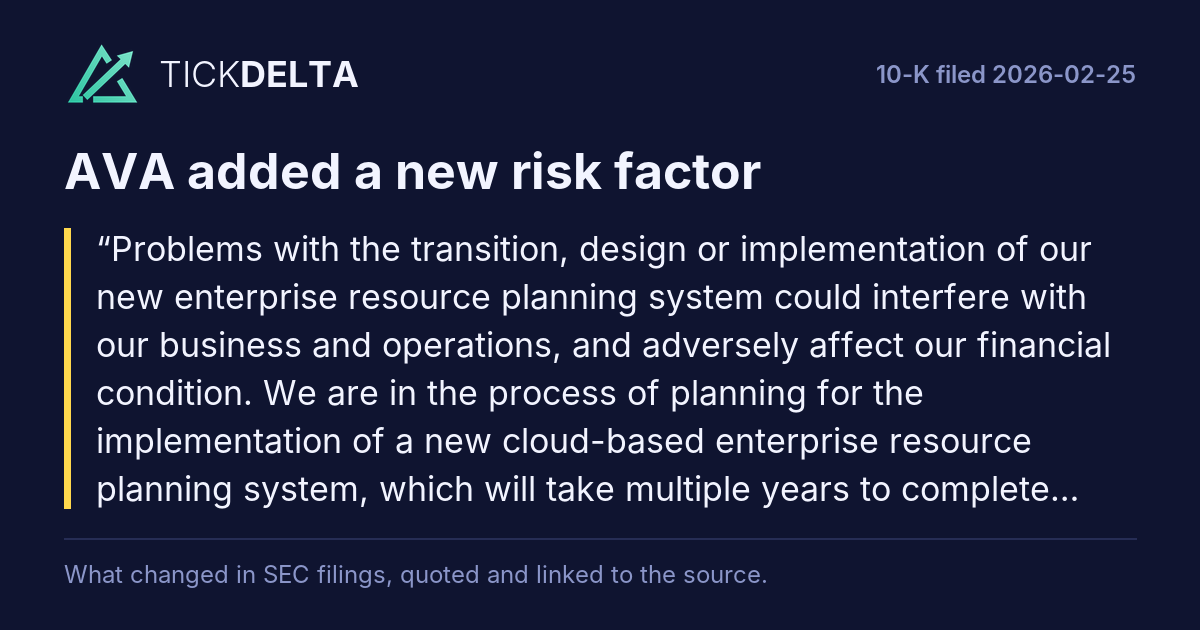
Problems with the transition, design or implementation of our new enterprise resource planning system could interfere with our business and operations, and adversely affect our financial condition.
We are in the process of planning for the implementation of a new cloud-based enterprise resource planning system, which will take multiple years to complete. See further information on the enterprise resource planning system within “Item 7. Management's Discussion and Analysis – Executive Overview”. There are transitional risks associated with the implementation, which may include loss of data in the conversion from on-premises systems to the cloud, difficulty compiling data for external reporting requirements, costs increasing throughout the project, or other challenges in our business operations. Difficulties faced during the transition could have a material adverse effect on our business, financial condition, and results of operations.
The expanded adoption of artificial intelligence has the potential to increase exposure to cyberattacks and negatively impact business operations.
The adoption of artificial intelligence (AI) is driving demand for energy while also presenting opportunities and unique risks to the utility business. AI enabled tools are proving to increase efficiency and add value to daily work processes as the use and adoption continues to expand. While use cases to drive efficiencies through AI develop, cyber attackers are targeting the tools and systems used to create the efficiencies, requiring enhanced analytics and monitoring. Reliance on AI generated information and data may enhance the exposure risk over time.
AI driven solutions will be essential to compete in the marketplace, whether it be for material or energy procurement, or financial transactions, AI will accelerate data driven decision making. Therefore, AI literacy is essential. Not advancing the understanding and use of AI may compromise the operational and financial progress of the Company.
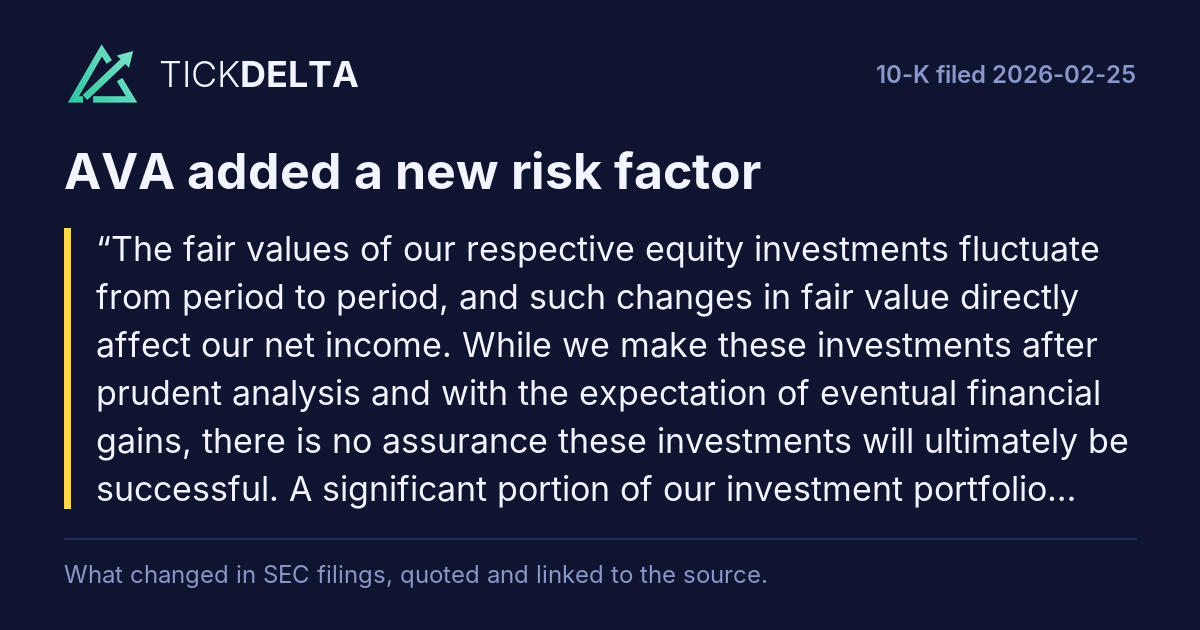
The fair values of our respective equity investments fluctuate from period to period, and such changes in fair value directly affect our net income. While we make these investments after prudent analysis and with the expectation of eventual financial gains, there is no assurance these investments will ultimately be successful. A significant portion of our investment portfolio consists of equity interests in privately held companies, which are inherently illiquid due to a lack of established market. Liquidity events are largely outside of our control, and may not occur on a timely basis (or may never occur). In addition, it is likely the value of these investments will continue to fluctuate as the businesses continue to mature, causing corresponding changes in our net income. The risks faced by these businesses may differ from the risks faced by our utility operations.
Multiple factors are influencing the ability to source and deliver adequate energy to meet customer demand, which could lead to power and gas market liquidity risks.
Local and regional factors may occur and impact our ability to meet energy needs during periods of high demand or unplanned events. Locally, some combination of factors such as unanticipated load growth, unforeseen localized climatic changes, decreases in water availability for hydro generation, and prolonged unplanned generation outages could result in being short the energy we need to meet customer demand. External to localized conditions and events, the regional wholesale market, to which we would turn to purchase energy to meet short-term shortfalls, has become strained during regional events. If the northwest region does not build sufficient new generation capacity and additional transmission and gas transport, there is a risk that we will not be able to depend on excess energy market purchases to meet customer demand during extreme weather events. These factors are increasing the risk of potential regional energy supply shortages and the ability for us to access additional energy during periods of high demand or unplanned events.
Paragraphs in the 10-Q filed Nov 4, 2026 that were not in the one before
New in the latest 10-Q
30 paragraphs in the 10-Q filed Nov 4, 2026 with nothing like them in the 10-Q filed Aug 3, 2026 (at least half the words must differ; new numbers alone do not count). Quoted exactly, grouped by the item heading above them. This is text that changed, not a judgement of how serious it is.
Financial statements and notes
In the third quarter of 2026, the Company completed a time study which supports the capitalization of certain employee compensation to Utility Property, which was previously included in other operating expenses. The Company allocated $5 million of certain employee compensation to Utility Property in the third quarter of 2026, resulting in a net income impact of $4 million (considering the impact of income taxes), which represents an increase of $0.05 earnings per diluted share. This change is treated as a change in accounting estimate and has been applied prospectively.
Read in the 10-Q
NOTE 7. PENSION PLANS AND OTHER POSTRETIREMENT BENEFIT PLANS Avista Utilities The Company contributed $10 million in cash to the pension plan during the nine months ended September 30, 2026, and does not expect further contributions in 2026.
Read in the 10-Q
4.60x Average Market multiple exit reduction 50% Discount rate 20% Annual revenues $12 - 104 Terminal date 2031 The following table presents activity for assets and liabilities measured at fair value using significant unobservable inputs (Level 3) for the three and nine months ended September 30 (dollars in millions): Natural Gas Exchange Agreement Equity Investments Total Three Months Ended September 30, 2026: ─────────────────────────────────────────────────────────────────────────────────────────────────────────────────────────────────── Beginning balance $ (8) $46 $38 Total gains or (losses) (realized/unrealized): Included in regulatory assets/liabilities 1 - 1 Ending balance as of September 30, 2026 $ (7) $46 $39 Three Months Ended September 30, 2025: Beginning balance $ (15) $49 $34 Total gains or (losses) (realized/unrealized): Included in regulatory assets/liabilities 1 - 1 Ending balance as of September 30, 2025 $ (14) $49 $35 Nine Months Ended September 30, 2026: Beginning balance $ (10) $49 $39 Total gains or (losses) (realized/unrealized): Included in regulatory assets/liabilities 3 - 3 Recognized in net income - (3) (3) Ending balance as of September 30, 2026 $ (7) $46 $39 Nine Months Ended September 30, 2025: Beginning balance $ (3) $53 $50 Total gains or (losses) (realized/unrealized): Included in regulatory assets/liabilities (10) - (10) Recognized in net income - (4) (4) Settlements (1) - (1) Ending balance as of September 30, 2025 $ (14) $49 $35 There were no transfers into or out of Level 3 fair value measurements during the period.
Read in the 10-Q
lawsuit filed by the owners of the adjacent property, seeking damages for personal injury and emotional distress from having witnessed the incident. On motions for summary judgment, the Court dismissed the party that had originally contracted for the excavation work, as well as claims brought on behalf of the children of the property owners whose home was damaged. In July 2026, the Company entered into a settlement agreement with the remaining parties in the case for $1.3 million, which was paid in August 2026.
Read in the 10-Q
Complaint of Consumers for Independent Regional Transmission Planning for All FERC-Jurisdictional Transmission Facilities at 100kV and Above
Read in the 10-Q
Show the other 25
In February 2024, a proposed class action was filed in the U.S. District Court for the District of Oregon, Pendleton Division against the Port of Morrow and other defendants. The plaintiffs allege they have suffered adverse effects from the defendants' discharge of nitrogen-laden wastewater. Subsequently, Portland General Electric (PGE) was added as a defendant. The Company is the owner of Unit 2 of the Coyote Springs Natural Gas Plant and has contracted with PGE, the owner of Unit 1, to operate its plant. The Plants are customers of the Port of Morrow, which provides water for non-contact cooling as part of the Plants' operations. The Company and PGE dispute that the use of water from the Port of Morrow for non-contact cooling, which does not add nitrates to the water, contributes to the alleged groundwater contamination at issue in the case. Under the operating agreement between the Company and PGE, the Company would be responsible for its share of associated costs and liability relating to the Plant.
Read in the 10-Q
Plaintiffs are primarily seeking injunctive relief, medical monitoring, and unspecified monetary damages. The trial date is currently scheduled for September 2027, however, in September 2026, the plaintiffs filed a "Notice of Global Mediation Session" for November 2026. The Company is unable to predict the likelihood of an adverse outcome or estimate a range of potential loss in the event of such outcome.
Read in the 10-Q
In the normal course of business, the Company has various other legal claims and contingent matters outstanding. The Company believes any liability arising from these actions will not have a material impact on its financial condition, results of operations or cash flows. It is possible a change could occur in the Company’s estimates of the probability or amount of a liability being incurred. Such a change, should it occur, could be significant. See "Note 22 of the Notes to Consolidated Financial Statements" in the 2025 Form 10-K for additional discussion regarding other contingencies.
Read in the 10-Q
consultation with other members of management, as appropriate, and are subject to the general oversight and strategic direction of the Board of Directors.
Read in the 10-Q
Other segment items include taxes other than income tax, AFUDC equity, and other miscellaneous expenses.
Read in the 10-Q
The capital expenditures for the other businesses are included in other investing activities on the Condensed Consolidated Statements of Cash Flows.
Read in the 10-Q
The effects of our general rate cases at Avista Utilities also increased net income in 2026.
Read in the 10-Q
On August 1, 2026, multiple fires started in the Spokane, Washington area, within our service territory, forming the Spokane Complex Fires. We are confident that our facilities were not involved in starting these fires.
Read in the 10-Q
Electric and natural gas operating costs associated with the fires were less than $3 million and we will not seek incremental recovery for those items. The fires caused damage to Company infrastructure, and costs associated with rebuilding this infrastructure are expected to be included in our future capital expenditure plans. Costs associated with vegetation management from the aftermath of the wildfires will flow through the wildfire expense balancing deferral and recovery mechanism.
Read in the 10-Q
A number of other wildfires have occurred within our service territory in 2026, impacting our operations. In June 2026, two fires ignited near our facilities. One fire damaged a small storage facility near Kellogg, Idaho. No structures were impacted by the other fire, near Coulee City, Washington. In the case of the fire near Kellogg, Idaho, the Idaho Department of Lands issued an investigative report asserting the fire originated with the Company’s facilities. The Company believes that it was substantially in compliance with its approved Wildfire Mitigation Plan, triggering protection under the Idaho Standard of Care Act. We believe any potential losses related to these events, individually and in the aggregate, would not be material.
Read in the 10-Q
In September 2026, we paused the processing of large data center applications. The pause applies to projects that require significant new transmission or generation infrastructure. The pause is expected to last at least 12 months while statutory guidelines are debated and established. Within our service territory, certain local government agencies have instituted moratoriums or pauses restricting data centers. During this time, we will be a participant with others in community, local government and state-level discussions to help shape the policies and the regulatory framework that may guide future development for large data centers.
Read in the 10-Q
The MYRP is continuing through the normal regulatory process, which has involved several rounds of testimony and an evidentiary hearing, followed by post-hearing briefs filed by the Company, the staff of the WUTC and various intervenors. While the Company continues to support the MYRP as proposed, there is significant disagreement among the other parties. The WUTC has up to eleven months to review general rate case filings and issue a decision, which we expect to be issued in December 2026.
Read in the 10-Q
• A $3 million decrease in sales of fuel as part of thermal generation resource optimization activities.
Read in the 10-Q
• A $7 million decrease in sales of fuel as part of our thermal generation resource optimization activities.
Read in the 10-Q
For the first three quarters of 2026 and 2025, net income for AEL&P was $5 million and $4 million, respectively. The increase in net income was primarily the result of increased operating revenues from increases to rates associated with AEL&P's general rate case and increased usage, partially offset by increased resource costs and operating expenses.
Read in the 10-Q
EPA Endangerment Finding Revocation and Rescission of Carbon Pollution Standards
Read in the 10-Q
In February 2026, the EPA formally revoked its 2009 Endangerment Finding, which was a landmark determination that six key greenhouse gases, including carbon dioxide and methane, threaten the public health and welfare of current and future generations. The Endangerment Finding provided the scientific and legal foundation for federal regulation of those identified greenhouse gases, including regulation of the release of greenhouse gases from power plants and other significant emissions sources.
Read in the 10-Q
In September 2026, the EPA issued a final rule, repealing most provisions of the 2024 Carbon Pollution Standards for greenhouse gas emissions from fossil fuel-fired electric generating units, eliminating most carbon capture and storage-based requirements and emissions guidelines established in 2024.
Read in the 10-Q
The EPA’s decision and rulemaking have been the subject of future legal challenges, the outcome of which cannot be predicted. The precise extent of that deregulation, as well as any potential impact on the Company’s operations, cannot be determined at this time.
Read in the 10-Q
In April 2022, the Washington State Building Code Council (SBCC) approved a revised energy code requiring most new commercial buildings and large multifamily buildings to install all-electric space heating. An amendment to the code allows for natural gas to supplement electric heat pumps. In addition, in November 2022, the SBCC approved new building and energy codes for residential housing, requiring new residential buildings in Washington to use electricity as the primary heat source.
Read in the 10-Q
Both the commercial and residential building and energy codes were the subject of legal challenges in both Washington State Superior Court (the State Action) and in the Federal District Court for the Eastern District of Washington (the Federal Action). The State
Read in the 10-Q
Action remains pending and the plaintiffs in the Federal Action subsequently dismissed the action, without prejudice to their ability to refile after the SBCC rulemaking process is complete.
Read in the 10-Q
In May 2024, we, along with Cascade Natural Gas Corporation, Northwest Natural Gas Company, and a coalition of homebuilders, heating unit dealers and other parties, filed a lawsuit challenging the approved building codes on the grounds that they are preempted by the Energy Policy and Conservation Act (EPCA). The lawsuit was filed in the United States District Court for the Western District of Washington. In September 2026, the Court ruled that the SBCC is immune from suit because it is not responsible for directly the codes and ordered dismissal of the litigation.
Read in the 10-Q
In November 2024, Washington voters approved Initiative 2066, which would prohibit state and local governments from restricting access to natural gas, prohibit the SBCC from discouraging or penalizing the use of natural gas, and prohibit the WUTC from approving any multi-year rate plan that requires or incentivizes natural gas companies to terminate or limit natural gas service. Opponents of the Initiative filed suit in Washington state court challenging the validity of the Initiative, while proponents of the Initiative filed suit in Washington state court to require the SBCC to comply with the new law. In July 2026, the Washington Supreme Court resolved both lawsuits by ruling that Initiative 2066 violated the single subject rule and was therefore unconstitutional.
Read in the 10-Q
Over time, the building code changes, if ultimately upheld, would likely have an adverse impact on our natural gas business and natural gas customers but could also have a positive effect on our electric business. While we are in the process of studying the implications of the changes on our business, at this time we are not able to quantify the likely net effect, positive or negative, on our overall results of operations over the long term. However, the changes would require that additional generating capacity be available to utilities and customers in Washington state.
Read in the 10-Q
The 10-Q's risk factors against the 10-K
Item 1A of the 10-Q filed Nov 4, 2026 against Item 1A of the 10-K filed Feb 25, 2026.
A 10-Q repeats only the risks that changed, so a 10-K paragraph that is missing from it is not counted as removed.
Added is a paragraph with nothing like it in the 10-K, Reworded a sentence that is in both with several words changed,
Quiet changes a sentence in both where one to four words changed and one is a hedge or a modal
(cut words struck through, new words highlighted).
Text on the page, not a score; each links to the filing at sec.gov.
Phrases used for the first time
Two-word phrases in Risk Factors of the 10-K filed Feb 25, 2026 that are in none of the 1 earlier 10-Ks stored, back to Feb 26, 2025
enterprise resource ×3resource planning ×3planning system ×3meet customer ×3market liquidity ×2risks faced ×2unplanned events ×2
Where each one is used
- enterprise resource: Problems with the transition, design or implementation of our new enterprise resource planning system could interfere with our business and operations, and adversely affect our financial condition.
- resource planning: Problems with the transition, design or implementation of our new enterprise resource planning system could interfere with our business and operations, and adversely affect our financial condition.
- planning system: Problems with the transition, design or implementation of our new enterprise resource planning system could interfere with our business and operations, and adversely affect our financial condition.
- meet customer: Multiple factors are influencing the ability to source and deliver adequate energy to meet customer demand, which could lead to power and gas market liquidity risks.
- market liquidity: The fair values of our respective equity investments fluctuate from period to period, and such changes in fair value directly affect our net income. While we make these investments after prudent analysis and with the expectation of eventual financial gains, there is no assurance these investments will ultimately be...
- risks faced: The fair values of our respective equity investments fluctuate from period to period, and such changes in fair value directly affect our net income. While we make these investments after prudent analysis and with the expectation of eventual financial gains, there is no assurance these investments will ultimately be...
- unplanned events: Local and regional factors may occur and impact our ability to meet energy needs during periods of high demand or unplanned events. Locally, some combination of factors such as unanticipated load growth, unforeseen localized climatic changes, decreases in water availability for hydro generation, and prolonged...
Used at least twice, small words left out. Counted, not picked: a phrase can be new because the company renamed something.
Sources
Item 1A of each 10-K and 10-Q on EDGAR, quoted exactly. Each paragraph links to the filing at sec.gov.
Also
10-K change: what was reworded or cut, section by section.
Work with it
Excel workbook · CSV. Google Sheet that stays up to date: paste =IMPORTDATA("https://tickdelta.com/company/AVA/export.csv") into a cell.