Form 10-K
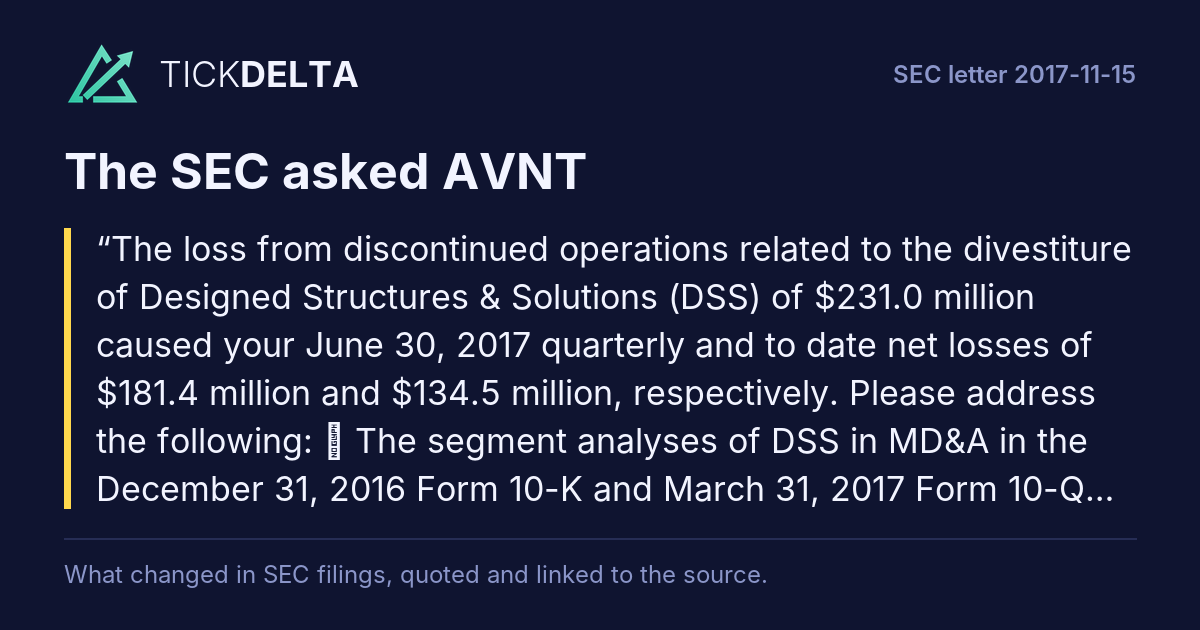
The loss from discontinued operations related to the divestiture of Designed Structures & Solutions (DSS) of $231.0 million caused your June 30, 2017 quarterly and to date net losses of $181.4 million and $134.5 million, respectively.Rest of the question
Please address the following: The segment analyses of DSS in MD&A in the December 31, 2016 Form 10-K and March 31, 2017 Form 10-Q do not appear to adequately convey that DSS was operating so poorly, unlike the commentary made in the earnings call transcripts for those periods, which indicate, among other things, your “disappointment” with DSS results. For example, DSS was not mentioned as a Key Challenge in the Form 10-K nor did the segment explanations indicate there were any longer term concerns with these operations. As a contrast, you commented in the transcript of the December 31, 2016 earnings call that you were “working hard to rebuild trust and credibility with customers”, which suggests certain issues within this business have been longstanding. Please explain how the disclosures in your filed documents adequately reflect the situation portrayed by management in the transcripts. You have classified the DSS assets and liabilities as held-for-sale for the periods presented and the DSS operating results and the loss on the sale as discontinued operations. Please explain to us the factors considered in determining whether the disposal of DSS represented a strategic shift in your operations pursuant to ASC 205-20-45-1B for which discontinued operations accounting is permissible. We note that most of the loss on sale has resulted from the impairment of DSS property and goodwill (page 8). Please explain to us the facts and circumstances you considered such that management was able to appropriately conclude that goodwill impairment was not warranted prior to June 30, 2017. We note from page 8 of the March 31, 2017 Form 10-Q your disclosure that there were no goodwill impairment triggering events for Custom Engineered Solutions as of that date.
We appreciate the background and timeline of events you have provided regarding the former DesignedRead in the reply
Structures & Solutions (DSS) segment and note in particular your response to the third bullet of comment 1 in our letter dated November 15, 2017. You have told us that for the quarters ended December 31, 2016 and March 31,
2017, your assessments of the CES reporting unit included reviewing and closely monitoring actual and forecasted results and by comparing CES’s actual operating results to the projections used in the October 1, 2016 annual impairment test, noting that they were in line withRest of the answer
your expected results. As a result, no impairment of goodwill was identified as a result of those two quarterly assessments. However,
Securities and Exchange Commission
Page based on your provided timeline of events, it appears you knew as of March 31, 2017 that an eventual sale of DSS may have been more likely than not, since, among other things, you had engaged an outside consultant to “assist with gauging outside interest in buying all or parts of the DSS segment.” Thus, within the context of ASC
350-20-35-3C, particularly item f therein, please explain to us how your March 31, 2017 goodwill impairment assessment could appropriately continue to include comparisons to forecasted or projected results that were as of October 1, 2016, when those projected results were not likely to have contemplated a future sale and so may no longer represent reliable estimates on which to form a proper goodwill impairment conclusion.
In reference to the Staff’s follow-up comment relating to the sale of the Designed Structures & Solutions (“DSS”) segment, ASC
350-20-35-3C, particularly item f therein, notes that a more likely than not expectation of selling or disposing all, or a portion, of a reporting unit could be an event that triggers an evaluation of whether it is more likely than not that the fair value of a reporting unit is less than its carrying amount. As of March 31, 2017, the eventual sale of the DSS segment was not more likely than not as outlined below, and accordingly, we continued to compare actual results to projections incorporated in our strategic and annual operating plan.
At the meeting of PolyOne’s Board of Directors (the “Board”) on March 10, 2017, management for the first time discussed strategic alternatives including executing on the approved strategic plan, a potential divestment of all or parts of the DSS segment and possible restructuring scenarios. Since cost estimates and timelines had not been prepared for such restructurings, management asked the Board for more time to complete its assessment.
During the March 10 meeting, the Board supported management’s recommendations to do two things in parallel: (1) complete a more thorough restructuring analysis and (2) more formally explore the possibility of selling all or parts of the DSS segment. Although this included the engagement of a third-party advisor on March 31, 2017, the advisor’s initial purpose was to gauge interest with outside parties who may want to acquire all or parts of the DSS segment.
Management agreed with the Board to review its findings and updated analysis at its regularly scheduled meeting on May 11, 2017, and no further discussion with the Board on the strategic alternatives occurred until the Board meeting in May. While management was completing the additional analysis, we continued to run the business in accordance with our strategic and annual operating plan. This included installing and starting new equipment to improve quality and operating efficiency, and we note that first quarter 2017 results for DSS were in line with our plan expectations.
Given the series of events and process as outlined above, as of March 31, 2017, the eventual sale of the DSS segment was not more likely than not.
Regarding the divestiture of DSS, you indicated in the March 31, 2017 earnings call transcript conducted in early May that you intended to keep DSS in your long-term portfolio, as that concern was brought up by the analysts. Please explain how management was able to make these assertions and then announce at the end of June the agreement to divest DSS.Rest of the question
In this regard, please provide to us a detailed chronology of events that culminated in the sale of this business. As part of your response, please tell us: the date management determined it would first consider strategic alternatives for DSS; the date management initiated efforts to sell the business; the date the Board was advised that management was exploring options to dispose of the business; the date management initiated contact with the ultimate buyer; and the date the Board approved the sale.
No numbered answer found in the reply. Read the reply ↗
We appreciate the background and timeline of events you have provided regarding the former Designed Structures & Solutions (DSS) segment and note in particular your response to the third bullet of comment 1 in our letter dated November 15, 2017.Rest of the question
You have told us that for the quarters ended December 31, 2016 and March 31, 2017, your assessments of the CES reporting unit included reviewing and closely monitoring actual and forecasted results and by comparing CES’s actual operating results to the projections used in the October 1, 2016 annual impairment test, noting that they were in line with your expected results. As a result, no impairment of goodwill was identified as a result of those two quarterly assessments. However, based on your provided timeline of events, it appears you knew as of March 31, 2017 that an eventual sale of DSS may have been more likely than not, since, among other things, you had engaged an outside consultant to “assist with gauging outside interest in buying all or parts of the DSS segment.” Thus, within the context of ASC 350-20-35-3C, particularly item f therein, please explain to us how your March 31, 2017 goodwill impairment assessment could appropriately continue to include comparisons to forecasted or projected results that were as of October 1, 2016, when those projected results were not likely to have contemplated a future sale and so may no longer represent reliable estimates on which to form a proper goodwill impairment conclusion.
No reply letter found.
Also in this review: company letter, Nov 21, 2017, closing letter, 2017-12-15