Avient Corp AVNT
New risk paragraphs, branching off last year
Each branch is a paragraph in Risk Factors with nothing like it in the 10-K filed Feb 18, 2025. A box jumps to the paragraph as filed, below.
Paragraphs with nothing like them in last year's 10-K
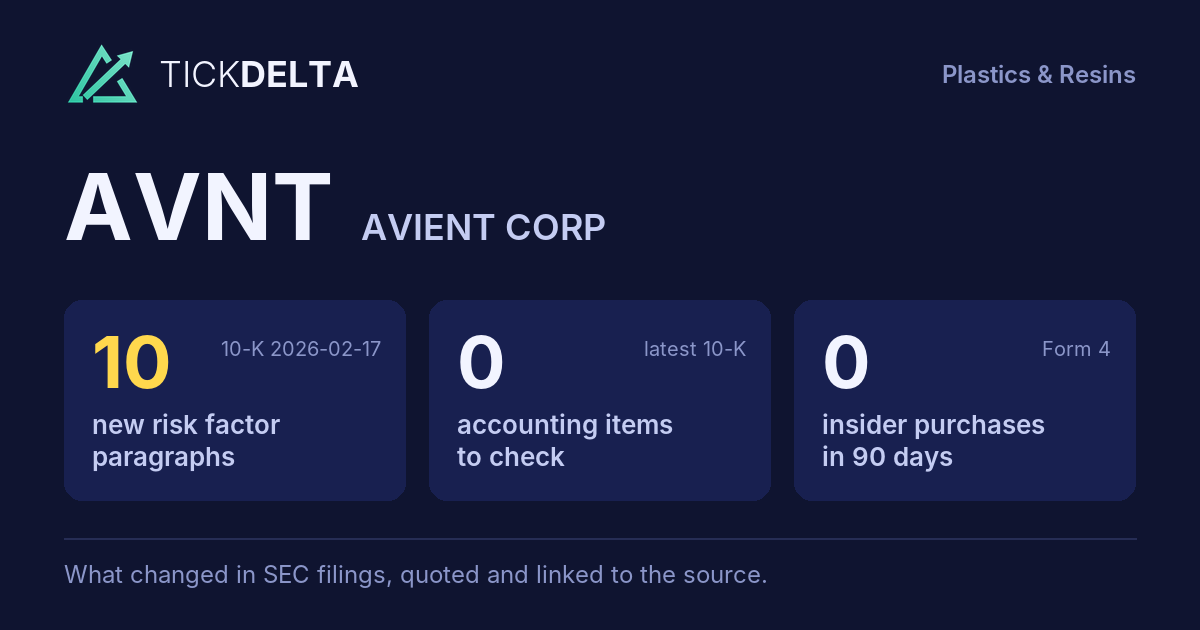
10 paragraphs in Risk Factors of the 10-K filed Feb 17, 2026 with nothing like them in the 10-K filed Feb 18, 2025. Quoted exactly. Paragraphs that were only edited are under 10-K change.
Changes to foreign trade policy, including new or increased tariffs and changing import/export regulations, could adversely affect our operating results, and the impacts could be material.
Changes in foreign trade policy, regulatory or economic conditions or in laws governing international trade could materially adversely affect our business. The U.S. has instituted certain changes, and may propose additional changes, in trade policies that include the negotiation or termination of trade agreements, the imposition of higher tariffs on goods exported from the U.S. or imported into the U.S., and other government regulations affecting trade between the U.S. and other countries (such as Canada, Mexico, China, and the European Union) where we conduct our business. Global trade disruption or significant introduction of trade barriers, together with any future downturns in the global economy, could further materially and adversely affect our financial performance.
As a result of policy changes and government proposals, there may be greater restrictions and economic disincentives on international trade. The new tariffs and other changes in U.S. trade policy have triggered retaliatory actions by affected countries, and foreign governments have instituted or are considering imposing tariffs and trade sanctions. Such changes have the potential to adversely impact the global economy, our industry and the global demand for our products, and as a result, could have a negative impact on our business, financial condition and results of operations.
Our accruals for such costs and associated liabilities are subject to changes in estimates on which the accruals are based. For example, any amounts accrued for environmental matters reflect the best information available and our assumptions about remediation requirements at the applicable site, the nature of the remedy, the outcome of discussions with regulatory agencies and other potentially responsible parties at multi-party sites. Changes in estimates on which accruals are based, unanticipated government actions, or changes in health, safety, environmental or chemical control regulations could result in higher costs.
We are currently involved in various legal proceedings, and may be subject to future claims or other liability that could negatively impact our business and results of operations.
From time to time, we are involved in various legal proceedings or in commercial disputes and other legal and regulatory proceedings related to our business. Additionally, our development, manufacture and sale of specialty materials, including those sold to medical, automotive, consumer packaging, and construction end markets, involves risk of exposure to product liability claims, warranty claims, product recalls and related adverse publicity. While management establishes reserves based on assessments of the contingencies related to legal claims asserted against the Company, subsequent developments may affect such assessments and our estimates of the loss contingency and require payments in excess of the Company's reserves. An adverse judgment or significant product liability, warranty, or recall action could result in substantial expenditures, affect consumer confidence in our products and divert management's attention from other matters. While we maintain product liability insurance, insurance coverage may not be adequate.
Failure to develop new products and protect our intellectual property could negatively impact our future performance and growth.
Innovation and product development are foundational to our strategy and important to our future growth. Failure to create or acquire new technologies and new products could negatively impact our ability to deliver strong financial results. We may face challenges in customer qualification and adoption of new technologies, and failure of our products to work as predicted could lead to liability and damage to customer relationships and our reputation. We continually apply for and obtain U.S. and foreign patents to protect the results of our research and development efforts. Failure to protect our intellectual property could negatively affect our future performance and growth.
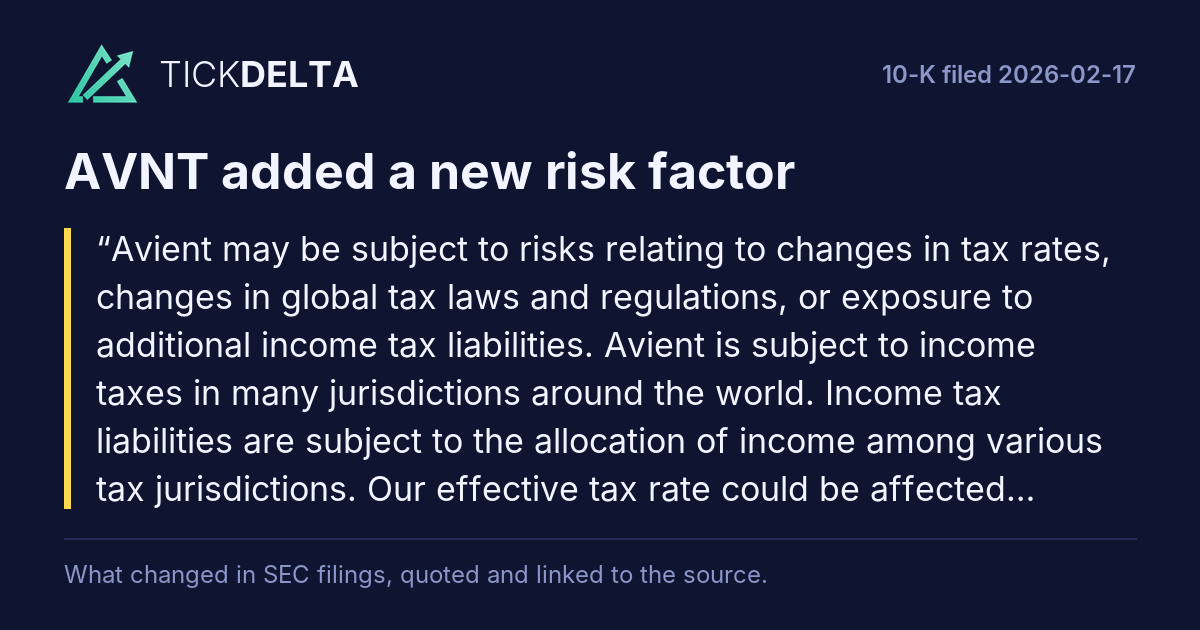
Avient may be subject to risks relating to changes in tax rates, changes in global tax laws and regulations, or exposure to additional income tax liabilities.
Avient is subject to income taxes in many jurisdictions around the world. Income tax liabilities are subject to the allocation of income among various tax jurisdictions. Our effective tax rate could be affected materially by changes in the mix among earnings in countries with differing statutory tax rates, changes in the valuation allowance of deferred tax assets, or changes in tax legislation, regulations, and policies. The amount of income taxes paid is subject to ongoing audits and litigation by tax authorities in the countries in which we operate. If these audits and/or litigation result in assessments different from amounts reserved, future financial results may include material unfavorable adjustments to our tax liabilities and cash taxes.
Paragraphs in the 10-Q filed Nov 4, 2026 that were not in the one before
New in the latest 10-Q
17 paragraphs in the 10-Q filed Nov 4, 2026 with nothing like them in the 10-Q filed Aug 6, 2026 (at least half the words must differ; new numbers alone do not count). Quoted exactly, grouped by the item heading above them. This is text that changed, not a judgement of how serious it is.
Financial statements and notes
Adjustments to reconcile net income to net cash provided by operating activities:
Read in the 10-Q
In September 2026, the Company received a draft Notice of Proposed Adjustment (NOPA) from the IRS related to a capital loss taken by the Company on its 2022 tax return. The Company is currently engaged in discussions with the IRS regarding this matter and the audit examination is still ongoing. Based on the Company's evaluation of the relevant facts and applicable tax law, the Company continues to believe that its tax positions are appropriate and no reserve has been recorded related to this matter; however, there can be no assurance that this dispute will be resolved favorably, and an unfavorable resolution could have an adverse material impact on our effective tax rate and result in a cash tax payment.
Read in the 10-Q
Three months ended September 30, 2026 Color, Additives and Inks Specialty Engineered Materials Total (In millions) ───────────────────────────────────────────────────────────────────────────────────────────────────────────────────────────────────────────────────────────────────────────────────────────────────────── Sales to external customers $ 550.7 $ 340.5 $ 891.2 Intercompany sales 0.8 0.1 0.9 Segment sales 551.5 340.6 892.1 Reconciliation to Consolidated Net sales Elimination of intercompany sales (0.9) Net sales $ 891.2 Less: (a) Cost of sales 362.4 233.6 Selling and administrative expense 100.4 57.3 Segment operating income $ 88.7 $ 49.7 $ 138.4 Reconciliation of segment operating income to consolidated income before income taxes Environmental remediation costs, net (18.3) Restructuring costs, net (5.8) Unallocated corporate costs (b) (29.8) Interest expense, net (22.7) Other, net (3.3) Income before income taxes $ 58.5
Read in the 10-Q
Three months ended September 30, 2025 Color, Additives and Inks Specialty Engineered Materials Total (In millions) ───────────────────────────────────────────────────────────────────────────────────────────────────────────────────────────────────────────────────────────────────────────────────────────────────────── Sales to external customers $ 508.9 $ 297.6 $ 806.5 Intercompany sales 1.0 0.1 1.1 Segment sales 509.9 297.7 807.6 Reconciliation to Consolidated Net sales Elimination of intercompany sales (1.1) Net sales $ 806.5 Less: (a) Cost of sales 341.1 206.7 Selling and administrative expense 95.0 53.7 Segment operating income $ 73.8 $ 37.3 $ 111.1 Reconciliation of segment operating income to consolidated income before income taxes Environmental remediation costs, net (12.7) Restructuring costs, net (6.0) Unallocated corporate costs (b) (24.6) Interest expense, net (24.2) Other, net (0.7) Income before income taxes $ 42.9
Read in the 10-Q
Nine months ended September 30, 2026 Color, Additives and Inks Specialty Engineered Materials Total (In millions) ─────────────────────────────────────────────────────────────────────────────────────────────────────────────────────────────────────────────────────────────────────────────────────────────────────────────── Sales to external customers $ 1,651.2 $ 1,004.4 $ 2,655.6 Intercompany sales 2.6 0.3 2.9 Segment sales 1,653.8 1,004.7 2,658.5 Reconciliation to Consolidated Net sales Elimination of intercompany sales (2.9) Net sales $ 2,655.6 Less: (a) Cost of sales 1,080.8 687.8 Selling and administrative expense 301.1 167.1 Segment operating income $ 271.9 $ 149.8 $ 421.7 Reconciliation of segment operating income to consolidated income before income taxes Environmental remediation costs, net (26.6) Restructuring costs, net (12.1) Unallocated corporate costs (b) (86.6) Interest expense, net (67.0) Other, net (9.5) Income before income taxes $ 219.9
Read in the 10-Q
Show the other 12
Nine months ended September 30, 2025 Color, Additives and Inks Specialty Engineered Materials Total (In millions) ───────────────────────────────────────────────────────────────────────────────────────────────────────────────────────────────────────────────────────────────────────────────────────────────────────────── Sales to external customers 1,564.0 935.6 2,499.6 Intercompany sales 4.2 0.2 4.4 Segment sales 1,568.2 935.8 2,504.0 Reconciliation to Consolidated Net sales Elimination of intercompany sales (4.4) Net sales $ 2,499.6 Less: (a) Cost of sales 1,038.3 653.2 Selling and administrative expense 287.2 158.0 Segment operating income $ 242.7 $ 124.6 $ 367.3 Reconciliation of segment operating income to consolidated income before income taxes Environmental remediation costs, net (17.5) Restructuring costs, net (20.5) Cloud computing impairment & related charges (86.3) Unallocated corporate costs (b) (77.5) Interest expense, net (75.8) Other, net (2.5) Income before income taxes $ 87.2
Read in the 10-Q
(a) The significant expense categories and amounts align with the segment-level information that is regularly provided to the chief operating decision maker. Segment expense allocations are included within the amounts shown.
Read in the 10-Q
(b) Unallocated corporate costs are primarily comprised of corporate administrative expenses (e.g., legal, human
Read in the 10-Q
resources, finance, technology) that are not included in the measure of segment profit or loss.
Read in the 10-Q
(c) Corporate includes cash, pension assets, certain prepaid expenses and tax assets.
Read in the 10-Q
(d) Capital expenditures and depreciation and amortization are related to corporate administrative functions.
Read in the 10-Q
Sales increased $84.7 million, or 10.5%, for the three months ended September 30, 2026 compared with the prior-year quarter, primarily driven by increased demand for our growth vectors, favorable sales mix and pricing actions to offset inflation in input costs, including raw materials, wages, freight and energy. Sales growth was broad-based across our end markets. Packaging, our largest end market, contributed 2.5% to total company sales growth while building & construction, industrial and consumer each contributed approximately 1.5% and energy contributed 1.0%. Sales increases in our growth vectors was primarily driven by demand for high-performance computing and electronic applications and functional additives, which contributed to growth in packaging and consumer applications. Growth in building & construction and energy was driven by demand associated with commercial infrastructure investment, while growth in industrial applications reflected favorable pricing and mix.
Read in the 10-Q
sales, which more than offset the impacts of increased environmental and restructuring costs which were $9.2 million higher in 2026.
Read in the 10-Q
We are monitoring pending legislative developments in Luxembourg, including the Draft Budget Law currently before parliament, which would eliminate the 17-year limitation on tax loss carryforwards and reduce the corporate income tax rate. Because the legislation had not been enacted as of September 30, 2026, no impact has been reflected in our financial statements. As of September 30, 2026, we had $39.8 million of valuation allowance in Luxembourg attributable to the 17-year loss carryforward period, which would be reassessed if the 17-year limitation were eliminated. Any accounting impact from the proposed legislation would be recognized in the period of enactment.
Read in the 10-Q
Sales increased $41.6 million, or 8.2%, in the three months ended September 30, 2026 compared with the prior-year quarter, with growth across all end markets primarily driven by favorable sales mix and pricing. Our packaging and consumer end markets contributed 3.4% and 1.0%, respectively, to the segment’s sales growth, driven by demand for functional additives and color solutions used in food, beverage and personal care applications. Building & construction contributed 1.5%, driven by commercial infrastructure investment.
Read in the 10-Q
Sales increased $85.6 million, or 5.5%, in the nine months ended September 30, 2026 compared with the prior-year period. Excluding a favorable foreign currency impact of 2.3%, organic sales increased 3.2%, primarily driven by favorable sales mix and pricing actions to offset inflation. Packaging contributed 2.2% to the segment’s sales growth driven by demand for functional additives and color solutions used in food, beverage and personal care applications. Building and construction contributed 0.7% to the segment’s sales growth driven by commercial infrastructure investment.
Read in the 10-Q
Sales increased $42.9 million, or 14.4%, in the three months ended September 30, 2026 compared with the prior-year quarter, primarily driven by increased demand for our growth vectors, favorable sales mix and pricing actions to offset inflation in input costs. Defense, the segment’s largest end market, contributed 2.5% to sales growth amid higher government defense spending. Industrial and consumer contributed 2.4% and 1.7%, respectively, reflecting new business wins and favorable pricing and mix. Telecommunications contributed 2.2% driven by high-performance computing applications. Energy and building & construction contributed 2.1% and 1.8%, respectively, driven by commercial infrastructure investment, while healthcare contributed 1.7%, driven by demand for remote monitoring and drug delivery applications.
Read in the 10-Q
The 10-Q's risk factors against the 10-K
Item 1A of the 10-Q filed Nov 4, 2026 against Item 1A of the 10-K filed Feb 17, 2026.
A 10-Q repeats only the risks that changed, so a 10-K paragraph that is missing from it is not counted as removed.
Added is a paragraph with nothing like it in the 10-K, Reworded a sentence that is in both with several words changed,
Quiet changes a sentence in both where one to four words changed and one is a hedge or a modal
(cut words struck through, new words highlighted).
Text on the page, not a score; each links to the filing at sec.gov.
What the 10-Q itself says about its risk factors:We face a number of risks that could adversely affect our business, results of operations, financial position or cash flows. A discussion of our risk factors can be found in Item 1A, Risk factors, in our Annual Report on Form 10-K for the fiscal year ended December 31, 2025. During the three months ended September 30, 2026, there have been no material changes to the risk factors that were previously disclosed.
Read in the 10-Q
1 paragraph in the 10-Q's Item 1A, and none of them adds, rewords or quietly edits a paragraph of the 10-K's.
Phrases used for the first time
Two-word phrases in Risk Factors of the 10-K filed Feb 17, 2026 that are in none of the 1 earlier 10-Ks stored, back to Feb 18, 2025
Where each one is used
- trade policy: Changes to foreign trade policy, including new or increased tariffs and changing import/export regulations, could adversely affect our operating results, and the impacts could be material.
- product liability: From time to time, we are involved in various legal proceedings or in commercial disputes and other legal and regulatory proceedings related to our business. Additionally, our development, manufacture and sale of specialty materials, including those sold to medical, automotive, consumer packaging, and construction...
- tax liabilities: Avient may be subject to risks relating to changes in tax rates, changes in global tax laws and regulations, or exposure to additional income tax liabilities.
- foreign trade: Changes to foreign trade policy, including new or increased tariffs and changing import/export regulations, could adversely affect our operating results, and the impacts could be material.
- global economy: Changes in foreign trade policy, regulatory or economic conditions or in laws governing international trade could materially adversely affect our business. The U.S. has instituted certain changes, and may propose additional changes, in trade policies that include the negotiation or termination of trade agreements,...
- legal proceedings: We are currently involved in various legal proceedings, and may be subject to future claims or other liability that could negatively impact our business and results of operations.
- new technologies: Innovation and product development are foundational to our strategy and important to our future growth. Failure to create or acquire new technologies and new products could negatively impact our ability to deliver strong financial results. We may face challenges in customer qualification and adoption of new...
- tax rates: Avient may be subject to risks relating to changes in tax rates, changes in global tax laws and regulations, or exposure to additional income tax liabilities.
Used at least twice, small words left out. Counted, not picked: a phrase can be new because the company renamed something.
Sources
Item 1A of each 10-K and 10-Q on EDGAR, quoted exactly. Each paragraph links to the filing at sec.gov.
Also
10-K change: what was reworded or cut, section by section.
Work with it
Excel workbook · CSV. Google Sheet that stays up to date: paste =IMPORTDATA("https://tickdelta.com/company/AVNT/export.csv") into a cell.