Paragraph 82 · 49% changed
Every version of it
Screener
/
SEC EDGAR
/CIK 0001722482
/10-K filed Feb 11, 2026, compared with Feb 7, 2025
/Numbers from the XBRL of the 10-Ks
NYSE
Technology · Lab Instruments
Avantor, Inc. AVTR
The 10-K against last year's
108 changes: 23 added, 36 removed, 49 reworded
10-K Feb 11, 2026 vs Feb 7, 2025
Risk Factors
26.6%
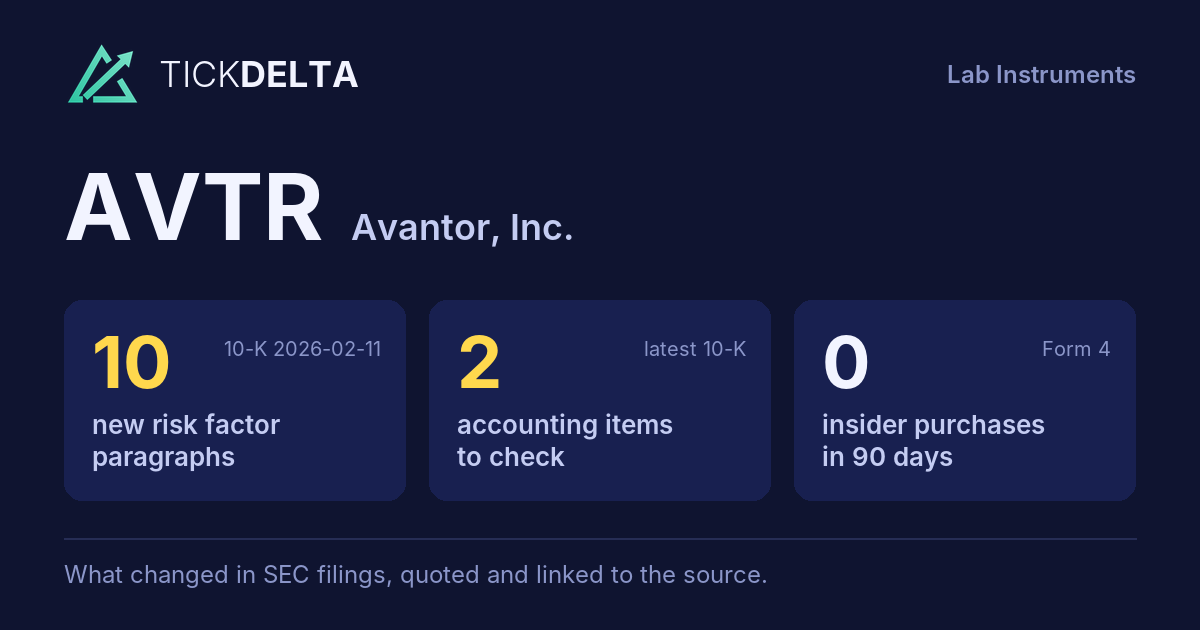
of the text changed · 9,229 words now · 10 new paragraphs, 18 gone
MD&A
30.7%
of the text changed · 6,183 words now · 13 new paragraphs, 18 gone
Legal Proceedings
9.0%
of the text changed · 1,116 words now
Accounting Policies
7.8%
of the text changed · 4,537 words now
10-K 0001628280-26-007118 (Feb 11, 2026) vs 10-K 0001722482-25-000015 (Feb 7, 2025)
Every paragraph, and how much of it changed
One bar per paragraph, in the order of the 10-K. Height and colour show the share of its words not in the closest paragraph a year earlier; the tallest bars are new paragraphs.
Risk Factors
101 paragraphs · 10 new · 46 reworded · 18 gone · 10-K Feb 11, 2026 against Feb 7, 2025
New paragraph
Reworded (5% of its words or more)
Same or nearly
Paragraph 94 · 47% changed
Every version of it
Effective internal controls are necessary for us to provide reliable and accurate financial statements and to effectively prevent fraud. We devote significant resources and time to comply with the internal control over financial reporting requirements of the Sarbanes Oxley Act of 2002 and continue to enhance our controls. However, we cannot be certain that we will be able to prevent future significant deficiencies or material weaknesses. Inadequate internal controls could cause investors to lose confidence in our reported financial information, which could have a negative effect on investor confidence in our financial statements, the trading price of our stock and our access to capital.
Paragraph 52 · 46% changed
Every version of it
Paragraph 25 · 35% changed
Every version of it
Paragraph 13 · 34% changed
Every version of it
Many of the customers we serve have experienced, and are expected to continue to experience, significant industry-related changes, including reductions in governmental funding or payments for biopharmaceutical products, expirations of significant patents, adverse changes in legislation or regulations regarding the delivery or pricing of general healthcare services or mandated benefits, and increased requirements on quality. General industry changes include: (i) development of large and sophisticated group purchasing organizations and on-line auction sites that increase competition for, and reduce spending on, laboratory products; (ii) consolidation of biopharmaceutical companies resulting in a rationalization of research expenditures; (iii) increased regulatory scrutiny over drug production requiring safer raw materials; (iv) customers’ purchasing the products that we supply directly from our suppliers; and (v) significant reductions in development and production activities.
Paragraph 31 · 33% changed
Every version of it
While we have implemented cybersecurity and data protection measures, our efforts to minimize the risks and impacts of cyberattacks and protect our information systems may be insufficient and we may experience significant breaches or other failures or disruptions that could compromise our systems and data and, ultimately, affect our business operations and our financial position or results of operations. New technology that could result in greater operational efficiency, such as the development and adoption of AI and machine learning technology, may further exposure expose our systems and businesses to the risk of cyberattacks. Like other companies, the systems and networks we maintain and third-party third party systems and networks we use have in the past been, and will likely in the future be, subject to or targets of unauthorized or fraudulent access, including physical or electronic break-ins or unauthorized tampering, as well as attempted cyber and other security threats and other attacks such as “denial of service” attacks, phishing, untargeted but sophisticated and automated attacks, ransomware, and other disruptive software. For example, as AI continues to evolve, cyber-attackers could also use AI to develop malicious code and sophisticated phishing attempts. We are also exposed to similar risks resulting from cyber-attacks that are experienced by our third-party service providers. For example, we and many of the third-party service providers we rely on use generative AI, which increases the risk that our confidential or proprietary information or personal data could be inadvertently or maliciously exposed. Security breaches can also occur as a result of intentional or inadvertent actions by our employees, third-party service providers or their personnel or other parties.
Paragraph 65 · 32% changed
Every version of it
We believe that for certain of our businesses, success in penetrating target markets depends in part on their ability to develop and maintain collaborative relationships with other companies. Relying on collaborative relationships is risky because, among other things, our collaborative partners may (i) not devote sufficient resources to the success of our collaborations; (ii) fail to obtain regulatory approvals necessary to continue the collaborations in a timely manner; (iii) be acquired by other companies and terminate our collaborative partnership or become insolvent; (iv) compete with us; (v) disagree with us on key details of the collaborative relationship; (vi) have insufficient capital resources; and (vii) decline to renew existing collaborations on acceptable terms. Because these and other factors may be beyond our control, the development or commercialization of our products involved in collaborative partnerships may be delayed or otherwise adversely affected. If we or any of our collaborative partners terminate a collaborative arrangement, we may be required to devote additional resources to product development and commercialization or we may need to cancel some development programs, which could adversely affect our business and financial statements.
Paragraph 11 · 32% changed
Every version of it
Paragraph 82 · 49% changed
Every version of it
10-K Feb 7, 2025We compete in highly competitive markets. Failure to compete successfully could adversely affect our business, financial condition and results of operations.
10-K Feb 11, 2026
Changes to trade policy, including new or increased tariffs and changing import/export regulations, may adversely affect our business, financial condition and results of operations.
Paragraph 94 · 47% changed
Every version of it
10-K Feb 7, 2025
Effective internal controls are necessary for us to provide reliable and accurate financial statements and to effectively prevent fraud. We devote significant resources and time to comply with the internal control over financial reporting requirements of the Sarbanes Oxley Act of 2002 and continue to enhance our controls. However, we cannot be certain that we will be able to prevent future significant deficiencies or material weaknesses. Inadequate internal controls could cause investors to lose confidence in our reported financial information, which could have a negative effect on investor confidence in our financial statements, the trading price of our stock and our access to capital.
10-K Feb 11, 2026
Effective internal controls are necessary for us to provide reliable and accurate financial statements and to effectively prevent fraud. We devote significant resources and time to comply with the internal control
Paragraph 52 · 46% changed
Every version of it
10-K Feb 7, 2025In addition, the manufacturing, use, storage, and distribution of chemicals are subject to threats including terrorism. We have several high-risk chemical facilities that contain materials that could be stolen and used to make weapons. We could also be subject to an attack on our high-risk facilities that could cause a significant number of deaths and injuries. Such an occurrence could also harm the environment, our reputation and disrupt our operations.
10-K Feb 11, 2026
significant number of deaths and injuries. Such an occurrence could also harm the environment, our reputation and disrupt our operations.
Paragraph 25 · 35% changed
Every version of it
10-K Feb 7, 2025We have global operations and derive a substantial portion of our net sales from customers outside of the United States. Accordingly, our international operations or those of our international customers could be substantially affected by a number of risks arising from operating an international business, including: (i) limitations on repatriation of earnings; (ii) taxes on imports; (iii) the possibility that unfriendly nations or groups could boycott our products; (iv) general economic and political conditions in the markets where we operate, including changes in inflation and interest rates, instability in the global banking industry, rising energy prices, potential energy shortages and actual or anticipated military or political conflicts, such as the ongoing Ukraine/Russia or Israel/Hamas conflicts; (v) foreign currency exchange rate fluctuations; (vi) potential changes in diplomatic and trade relationships, including potential changes under the second Trump administration and political and trade uncertainty in China; (vii) a global health crisis; (viii) potential increased costs associated with overlapping tax structures; (ix) potential increased reliance on third parties within less developed markets; (x) potential changes in trade restrictions, tariffs and exchange controls, such as tariffs that may be proposed by the second Trump administration and potential retaliatory tariffs by other countries; (xi) more limited protection for intellectual property rights in some countries; (xii) difficulties and costs associated with staffing and managing foreign operations; (xiii) difficulties in complying with a wide variety of foreign laws and regulations and unexpected changes thereto; (xiv) expanded enforcement of laws related to data protection and personal privacy; (xv) the risk that certain governments may adopt regulations or take other actions that would have a direct adverse impact on our business and market opportunities, including nationalization of private enterprise; (xvi) violations of anti-bribery and anti-corruption laws, such as the FCPA; (xvii) violations of economic sanctions laws, such as the regulations enforced by OFAC; (xviii) longer accounts receivable cycles in certain foreign countries, whether due to cultural differences, exchange rate fluctuation or other factors; (xix) the credit risk of local customers and distributors; (xx) limitations on our ability to enforce legal rights and remedies with third parties or partners outside of the United States; (xxi) import and export licensing requirements and other restrictions, such as those imposed by OFAC, BIS, DDTC and comparable regulatory agencies and policies of foreign governments; and (xxii) changes to our distribution networks.
10-K Feb 11, 2026
enforcement of laws related to data protection and personal privacy; (xiv) the risk that certain governments may adopt regulations or take other actions that would have a direct adverse impact on our business and market opportunities, including nationalization of private enterprise; (xv) violations of anti-bribery and anti-corruption laws, such as the FCPA; (xvi) violations of economic sanctions laws, such as the regulations enforced by OFAC; (xvii) longer accounts receivable cycles in certain foreign countries, whether due to cultural differences, exchange rate fluctuation or other factors; (xviii) the credit risk of local customers and distributors; (xix) limitations on our ability to enforce legal rights and remedies with third parties or partners outside of the United States; (xx) import and export licensing requirements and other restrictions, such as those imposed by OFAC, BIS, DDTC and comparable regulatory agencies and policies of foreign governments; and (xxi) changes to our distribution networks.
Paragraph 13 · 34% changed
Every version of it
10-K Feb 7, 2025
Many of the customers we serve have experienced, and are expected to continue to experience, significant industry-related changes, including reductions in governmental payments for biopharmaceutical products, expirations of significant patents, adverse changes in legislation or regulations regarding the delivery or pricing of general healthcare services or mandated benefits, and increased requirements on quality. General industry changes include:
10-K Feb 11, 2026
Many of the customers we serve have experienced, and are expected to continue to experience, significant industry-related changes, including reductions in governmental funding or payments for biopharmaceutical products, expirations of significant patents, adverse changes in legislation or regulations regarding the delivery or pricing of general healthcare services or mandated benefits, and increased requirements on quality. General industry changes include: (i) development of large and sophisticated group purchasing organizations and on-line auction sites that increase competition for, and reduce spending on, laboratory products; (ii) consolidation of biopharmaceutical companies resulting in a rationalization of research expenditures; (iii) increased regulatory scrutiny over drug production requiring safer raw materials; (iv) customers’ purchasing the products that we supply directly from our suppliers; and (v) significant reductions in development and production activities.
Paragraph 31 · 33% changed
Every version of it
10-K Feb 7, 2025
While we have implemented cybersecurity and data protection measures, our efforts to minimize the risks and impacts of cyberattacks and protect our information systems may be insufficient and we may experience significant breaches or other failures or disruptions that could compromise our systems and data and, ultimately, affect our business operations and our financial position or results of operations. New technology that could result in greater operational efficiency, such as the development and adoption of AI and machine learning technology, may further exposure our systems and businesses to the risk of cyberattacks. Like other companies, the systems and networks we maintain and third-party systems and networks we use have in the past been, and will likely in the future be, subject to or targets of unauthorized or fraudulent access, including physical or electronic break-ins or unauthorized tampering, as well as attempted cyber and other security threats and other attacks such as “denial of service” attacks, phishing, untargeted but sophisticated and automated attacks, ransomware, and other disruptive software. For example, as AI continues to evolve, cyber-attackers could also use AI to develop malicious code and sophisticated phishing attempts. We are also exposed to similar risks resulting from cyber-attacks that are experienced by our third-party service providers. For example, we and many of the third-party service providers we rely on use generative AI, which increases the risk that our confidential or proprietary information or personal data could be inadvertently or maliciously exposed. Security breaches can also occur as a result of intentional or inadvertent actions by our employees, third-party service providers or their personnel or other parties.
10-K Feb 11, 2026
While we have implemented cybersecurity and data protection measures, our efforts to minimize the risks and impacts of cyberattacks and protect our information systems may be insufficient and we may experience significant breaches or other failures or disruptions that could compromise our systems and data and, ultimately, affect our business operations and our financial position or results of operations. New technology that could result in greater operational efficiency, such as the development and adoption of AI and machine learning technology, may further expose our systems and businesses to the risk of cyberattacks. Like other companies, the systems and networks we maintain and third party systems and networks we use have in the past been, and will likely in the future be, subject to or targets of
Paragraph 65 · 32% changed
Every version of it
10-K Feb 7, 2025
We believe that for certain of our businesses, success in penetrating target markets depends in part on their ability to develop and maintain collaborative relationships with other companies. Relying on collaborative relationships is risky because, among other things, our collaborative partners may (i) not devote sufficient resources to the success of our collaborations; (ii) fail to obtain regulatory approvals necessary to continue the collaborations in a timely manner; (iii) be acquired by other companies and terminate our collaborative partnership or become insolvent; (iv) compete with us; (v) disagree with us on key details of the collaborative relationship; (vi) have insufficient capital resources; and (vii) decline to renew existing collaborations on acceptable terms. Because these and other factors may be beyond our control, the development or commercialization of our products involved in collaborative partnerships may be delayed or otherwise adversely affected. If we or any of our collaborative partners terminate a collaborative arrangement, we may be required to devote additional resources to product development and commercialization or we may need to cancel some development programs, which could adversely affect our business and financial statements.
10-K Feb 11, 2026
We believe that for certain of our businesses, success in penetrating target markets depends in part on their ability to develop and maintain collaborative relationships with other companies. Relying on collaborative relationships is risky because, among other things, our collaborative partners may (i) not devote sufficient resources to the success of our collaborations; (ii) fail to obtain regulatory approvals necessary to continue the collaborations in a timely manner; (iii) be acquired by other companies and
Paragraph 11 · 32% changed
Every version of it
10-K Feb 7, 2025As part of our business strategy, we intend to continue to review, pursue and complete selective acquisition opportunities. There can be no assurances that we will be able to complete suitable acquisitions for a variety of reasons, including the identification of, and competition for, acquisition targets, the need for regulatory approvals, the inability of the parties to agree to the structure or purchase price of the transaction and the inability to finance the transaction on commercially acceptable terms. In addition, any completed acquisition will subject us to a variety of other risks, including: (i) potential adverse effects on our business relationships with existing or future suppliers and other business partners (in particular, to the extent we consummate acquisitions that vertically integrate portions of our business); (ii) the assumption of substantial actual or contingent liabilities, known or unknown, including environmental liabilities; (iii) failure to meet expectations of future financial performance; (iv) delays or reductions in realizing expected synergies; (v) substantial unanticipated costs or other problems associated with acquired businesses or devoting time and capital to investigate a potential acquisition that is not completed; (vi) failure to achieve intended objectives for a transaction; (vii) failure to retain key personnel, customers and suppliers of the acquired business; and (viii) adverse impacts resulting from impairment charges on goodwill, other intangible assets and tangible assets. These factors related to our acquisition strategy, among others, could have an adverse effect on our business, financial condition and results of operations.
10-K Feb 11, 2026
expectations of future financial performance; (iv) delays or reductions in realizing expected synergies; (v) substantial unanticipated costs or other problems associated with acquired businesses or devoting time and capital to investigate a potential acquisition that is not completed; (vi) failure to achieve intended objectives for a transaction; (vii) failure to retain key personnel, customers and suppliers of the acquired business; and (viii) adverse impacts resulting from impairment charges on goodwill, other intangible assets and tangible assets. These factors related to our acquisition strategy, among others, could have an adverse effect on our business, financial condition and results of operations.
MD&A
117 paragraphs · 13 new · 55 reworded · 18 gone · 10-K Feb 11, 2026 against Feb 7, 2025
New paragraph
Reworded (5% of its words or more)
Same or nearly
Paragraph 29 · 49% changed
Paragraph 52 · 46% changed
Paragraph 60 · 46% changed
Paragraph 94 · 46% changed
The preparation of financial statements in conformity with GAAP requires us to make estimates and assumptions that affect the amounts reported throughout the financial statements. Those estimates and assumptions are based on our best estimates and judgment. We evaluate our estimates and assumptions on an ongoing basis using historical experience and known facts and circumstances. We adjust our estimates and assumptions when we believe the facts and circumstances warrant an adjustment. As future events and their effects cannot be determined with precision, actual results could differ significantly from those estimates.
Paragraph 50 · 45% changed
Paragraph 73 · 45% changed
Cash flows from operating activities provided $29.2 $217.0 million less cash in 2024 2025. The change was primarily due to higher cash costs net working capital requirements, increased customer rebate payments and higher incentive compensation payments made in 2025 related to our cost transformation initiative and higher cash taxes paid in the current year, partially offset by improved working capital. fiscal year 2024.
Paragraph 44 · 43% changed
In Corporate, Adjusted Operating Income decreased $8.0 $4.0 million driven primarily by increased stock-based compensation expense. due to various immaterial factors.
Paragraph 61 · 42% changed
We fund short-term cash requirements primarily from operating cash flows, while most flows and credit facilities. The majority of our long-term financing is from indebtedness, which we use to finance transactions outside of our normal operations. indebtedness.
Paragraph 29 · 49% changed
10-K Feb 7, 2025In 2024, operating income increased primarily from the gain on sale of our Clinical Services business and the absence of impairment charges in 2024, partially offset by lower gross profit as previously discussed, higher operating expenses driven by restructuring and severance charges, transformation expenses, and annual incentive compensation expenses.
10-K Feb 11, 2026
gain on sale of the Clinical Services business recognized in the prior year. The reduction in gross profit, partially offset by lower SG&A expenses, resulted in contraction of Adjusted EBITDA and Adjusted Operating Income margins.
Paragraph 52 · 46% changed
10-K Feb 7, 20258.As described in note 4 to our consolidated financial statements beginning on F-1 of this report.
10-K Feb 11, 2026
6.The amount reported in 2024 reflects the gain on the sale of our Clinical Services business. The amount reported in 2025 reflects post‑closing purchase price adjustments related to that sale. The sale of the Clinical Services business is further described in note 4 to our consolidated financial statements beginning on page F‑1 of this report.
Paragraph 60 · 46% changed
10-K Feb 7, 20258.As described in note 4 to our consolidated financial statements beginning on F-1 of this report.
10-K Feb 11, 2026
6.The amount reported in 2024 reflects the gain on the sale of our Clinical Services business. The amount reported in 2025 reflects post‑closing purchase price adjustments related to that sale. The sale of the Clinical Services business is further described in note 4 to our consolidated financial statements beginning on page F‑1 of this report.
Paragraph 94 · 46% changed
10-K Feb 7, 2025
The preparation of financial statements in conformity with GAAP requires us to make estimates and assumptions that affect the amounts reported throughout the financial statements. Those estimates and assumptions are based on our best estimates and judgment. We evaluate our estimates and assumptions on an ongoing basis using historical experience and known facts and circumstances. We adjust our estimates and assumptions when we believe the facts and circumstances warrant an adjustment. As future events and their effects cannot be determined with precision, actual results could differ significantly from those estimates.
10-K Feb 11, 2026
The preparation of financial statements in conformity with GAAP requires us to make estimates and assumptions that affect the amounts reported throughout the financial statements. Those estimates and
Paragraph 50 · 45% changed
10-K Feb 7, 20256.Represents net foreign currency (gain) loss from financing activities and other stock-based compensation expense (benefit).
10-K Feb 11, 2026
4.Represents net foreign currency (gain) loss from financing activities, other stock-based compensation expense (benefit), $6.7 million of severance and transition costs associated with the replacement of our Chief Executive Officer in 2025, and other costs.
Paragraph 73 · 45% changed
10-K Feb 7, 2025
Cash flows from operating activities provided $29.2 million less cash in 2024 due to higher cash costs related to our cost transformation initiative and higher cash taxes paid in the current year, partially offset by improved working capital.
10-K Feb 11, 2026
Cash flows from operating activities provided $217.0 million less cash in 2025. The change was primarily due to higher net working capital requirements, increased customer rebate payments and higher incentive compensation payments made in 2025 related to fiscal year 2024.
Paragraph 44 · 43% changed
10-K Feb 7, 2025
In Corporate, Adjusted Operating Income decreased $8.0 million driven primarily by increased stock-based compensation expense.
10-K Feb 11, 2026
In Corporate, Adjusted Operating Income decreased $4.0 million due to various immaterial factors.
Paragraph 61 · 42% changed
10-K Feb 7, 2025
We fund short-term cash requirements primarily from operating cash flows, while most of our long-term financing is from indebtedness, which we use to finance transactions outside of our normal operations.
10-K Feb 11, 2026
We fund short-term cash requirements primarily from operating cash flows and credit facilities. The majority of our long-term financing is from indebtedness.
A paragraph is matched with the one last year that shares the most of its words; under half in common makes it new. The paragraphs shown are the 8 reworded the most in each section.
The paragraph that changed most in each section
The redline
Marked against last year's 10-K: cut words struck through, new words highlighted.
Risk Factors217 words changed in this paragraph; it is 65% similar to last year's version.
We have global operations and derive a substantial portion of our net sales from customers outside of the United States. Accordingly, our international operations or those of our international customers could be substantially affected by a number of risks arising from operating an international business, including: (i) limitations on repatriation of earnings; (ii) taxes on imports; (iii) the possibility that unfriendly nations or groups could boycott our products; (iv) general economic and political conditions in the markets where we operate, including changes in inflation and interest rates, instability in the global banking industry, rising energy prices, potential energy shortages and actual or anticipated military or political conflicts, such as the ongoing Ukraine/Russia or Israel/Hamas conflicts; (v) foreign currency exchange rate fluctuations; (vi) escalation of geopolitical tensions or potential changes in diplomatic and trade relationships, including potential changes under the second Trump administration to trade restrictions, tariffs and exchange controls and political and trade uncertainty in China; China along with potential retaliatory tariffs by other countries; (vii) a global health crisis; (viii) potential increased costs associated with overlapping tax structures; (ix) potential increased reliance on third parties within less developed markets; (x) potential changes in trade restrictions, tariffs and exchange controls, such as tariffs that may be proposed by the second Trump administration and potential retaliatory tariffs by other countries; (xi) more limited protection for intellectual property rights in some countries; (xii) (xi) difficulties and costs associated with staffing and managing foreign operations; (xiii) (xii) difficulties in complying with a wide variety of foreign laws and regulations and unexpected changes thereto; (xiv) thereto and costs associated with compliance; (xiii) expanded enforcement of laws related to data protection and personal privacy; (xv) the risk that certain governments may adopt regulations or take other actions that would have a direct adverse impact on our business and market opportunities, including nationalization of private enterprise; (xvi) violations of anti-bribery and anti-corruption laws, such as the FCPA; (xvii) violations of economic sanctions laws, such as the regulations enforced by OFAC; (xviii) longer accounts receivable cycles in certain foreign countries, whether due to cultural differences, exchange rate fluctuation or other factors; (xix) the credit risk of local customers and distributors; (xx) limitations on our ability to enforce legal rights and remedies with third parties or partners outside of the United States; (xxi) import and export licensing requirements and other restrictions, such as those imposed by OFAC, BIS, DDTC and comparable regulatory agencies and policies of foreign governments; and (xxii) changes to our distribution networks.
Source: Item 1A, 10-K 0001628280-26-007118 vs Item 1A, 10-K 0001722482-25-000015
Accounting Policies125 words changed in this paragraph; it is 46% similar to last year's version.
We measure the expense of stock options and RSUs based on their grant-date fair values. These awards typically Awards that vest with continuing service, so based on continued service are recognized as compensation expense is recognized on a straight-line basis from the date of grant through the end of over the requisite service period. When For awards that are contingent upon the achievement of a performance condition, we record compensation expense is recognized over the life of the awards in accordance with performance period based on the probability of achievement. We measure Awards with market conditions are measured at grant‑date fair value using valuation techniques that incorporate the expense of awards with a market condition based on the grant-date fair value, which includes the probability likelihood of achieving the market condition. We recognize forfeitures condition, and the resulting expense is recognized over the requisite service period regardless of unvested awards as they occur by reversing any expense previously recorded in whether the period of forfeiture. We issue new shares of common stock upon exercise or vesting of awards. market condition is ultimately
Source: 10-K text, Note 2 – Summary of significant accounting policies, 10-K 0001628280-26-007118 vs 10-K text, Note 2 – Summary of significant accounting policies, 10-K 0001722482-25-000015
Legal ProceedingsNew paragraph this year (113 words), with no similar paragraph last year.
The Company and certain current and former officers and directors have been named as defendants in two putative securities class action lawsuits filed in the United States District Court for the Eastern District of Pennsylvania on October 30, 2025, and November 25, 2025, respectively. The complaints allege violations of Sections 10(b) and 20(a) of the Securities Exchange Act and Rule 10b-5 related to alleged misleading or false statements concerning Avantor’s competitive position and the purported effects of increased competition, as well as other aspects of the Company’s business, operations, and management. The lawsuits seek unspecified damages, attorneys’ fees, and other relief. The Company disputes the claims and intends to vigorously defend against them.
Source: Item 3, via Note 13 – Commitments and contingencies, 10-K 0001628280-26-007118 vs Item 3, via Note 13 – Commitments and contingencies, 10-K 0001722482-25-000015
MD&A106 words changed in this paragraph; it is 69% similar to last year's version.
Expense for stock options without performance or market conditions is determined on the grant date and recognized ratably over their vesting term. We estimate the grant date fair value of stock options using the Black-Scholes model. This model requires us to make various assumptions, with the most significant assumption currently being the volatility of our stock price. A public quotation was first established for our common stock Through the year ended December 31, 2024, due to limited trading history, we estimated volatility using a peer group approach. Beginning in May 2019, which does not provide adequate 2025, after sufficient trading history became available, we adopted a blended volatility methodology that combines Avantor’s historical basis to reasonably estimate the expected volatility of our common stock over their more than six-year expected life. Instead, we estimate volatility based on historical stock price trends with that of a peer company set. group to provide a more stable and representative input. This approach is consistent with ASC 718 and SEC guidance for companies with evolving trading history. The fair value of our awards would have differed had we selected different peer companies or used a different technique to estimate volatility. Increasing our expected volatility assumption by 5 percentage points for all stock options at the date of grant would have increased our 2024 2025 stock-based compensation expense by $1.1 $0.9 million.
Source: Item 7, 10-K 0001628280-26-007118 vs Item 7, 10-K 0001722482-25-000015
Sentences and paragraphs added, removed or reworded
Every change, by type
Sentences and paragraphs of AVTR's Risk Factors and MD&A, 10-K Feb 11, 2026 against 10-K Feb 7, 2025. Each links to the text at sec.gov.
Quiet changes are sentences kept from last year with one to four words changed, at least one of them a hedge, a modal or a qualifier (may, could, will, not, significant, material…). A year or date rolling forward is not counted.
The full word list
adverse, adversely, all, although, anticipate, anticipates, any, approximately, believe, believes, can, cannot, certain, could, expect, expects, generally, however, if, intend, intends, largely, likely, many, material, materially, may, might, most, must, never, no, not, possible, primarily, probable, should, significant, significantly, some, substantial, substantially, unlikely, will, would
AddedRisk Factors
Reductions in customers’ research budgets or government funding may adversely affect our business.
Read it in 10-K Feb 11, 2026 at sec.gov
AddedRisk Factors
Many of our customers are universities, government research laboratories, private foundations and other institutions that are dependent on grants from government agencies, such as the NIH, for funding. R&D spending by our customers may fluctuate based on spending priorities and general economic conditions. The level of government funding for R&D is unpredictable. Reductions or delays in governmental spending could cause customers to delay or forego purchases of our products. If government funding necessary for the purchase of our products were to decrease, our business and results of operations could be adversely affected. Spending by some of these customers fluctuates based on budget allocations and the timely passage of the annual federal budget. An impasse in federal government budget decisions could lead to substantial delays or reductions in federal spending.
Read it in 10-K Feb 11, 2026 at sec.gov
AddedRisk Factors
We also face increasing attention from investors, regulators, and other stakeholders, who may have conflicting views related to our positions, performance, and disclosures relating to sustainability and corporate responsibility-related matters, and the legal and regulatory landscape continues to evolve and may result in conflicting requirements and expectations. If we draw scrutiny for the positions we take or do not take on these matters (or for altering any such position) or receive unfavorable ratings from third-party organizations that provide information to investors on such matters, it could be used by investors, lenders, customers, employees and other stakeholders to inform their investment, financing, purchasing or employment decisions, which could have a negative impact on our business. Additionally, a failure to adequately meet regulatory expectations may result in non-compliance, the loss of business and reputational impacts, and we may become the target of litigation or investigations initiated by government authorities or private actors alleging that our activities related to these matters are anti-competitive, discriminatory or otherwise unlawful.
Read it in 10-K Feb 11, 2026 at sec.gov
AddedRisk Factors
and give rise to additional environmental liabilities, business interruptions, compliance costs or penalties, which could have an adverse effect on our business, financial condition and results of operations.
Read it in 10-K Feb 11, 2026 at sec.gov
AddedRisk Factors
Changes in U.S. or international laws and policies governing foreign trade could materially and adversely affect our business. The U.S. has instituted certain changes, and has proposed additional changes, in trade policies that include the negotiation or termination of trade agreements, the imposition of higher tariffs on imports into the U.S., and other government regulations affecting trade between the U.S. and other countries where we conduct our business. The new tariffs and other changes in U.S. trade policy have triggered retaliatory actions by affected countries, and foreign governments have instituted or are considering imposing trade sanctions on U.S. goods.
Read it in 10-K Feb 11, 2026 at sec.gov
AddedRisk Factors
The imposition of tariffs and other trade restrictions, as well as the escalation of trade disputes and any downturns in the global economy resulting therefrom, could materially and adversely affect our business, financial condition and results of operations. The extent and duration of the tariffs and other trade restrictions and the resulting impact on general economic conditions and on our business are uncertain and depend on various factors, such as negotiations between the U.S. and affected countries, the responses of other countries or regions, exemptions or exclusions that may be granted, availability and cost of alternative sources of supply, and demand for our products in affected markets. Further, actions we take to adapt to new tariffs or other trade restrictions may cause us to modify our operations, which could be time-consuming and expensive, impact pricing of our products, which could impact our sales and profitability, or cause us to forgo business opportunities.
Read it in 10-K Feb 11, 2026 at sec.gov
AddedRisk Factors
contractual obligations; (ii) exposing us to the risk of increased interest rates as certain of our borrowings, including borrowings under our senior secured credit facilities, are at variable rates of interest; (iii) restricting us from making strategic acquisitions or causing us to make non-strategic divestitures; (iv) requiring us to dedicate a substantial portion of our cash flow from operations to payments on our indebtedness, which would reduce the funds available for working capital, capital expenditures, investments, acquisitions and other general corporate purposes; (v) limiting our flexibility in planning for, or reacting to, changes in our business, future business opportunities and the industry in which we operate; (vi) placing us at a competitive disadvantage compared to any of our less leveraged competitors; (vii) increasing our vulnerability to a downturn in our business and both general and industry-specific adverse economic conditions; and (viii) limiting our ability to obtain additional financing.
Read it in 10-K Feb 11, 2026 at sec.gov
AddedRisk Factors
Our business could be impacted as a result of actions by activist shareholders or others.
Read it in 10-K Feb 11, 2026 at sec.gov
Show the other 62
AddedRisk Factors
We have in the past and may in the future be the focus of shareholder activism, which has become increasingly prevalent. Shareholder activism, particularly with respect to matters that our Board, in exercising its fiduciary duties, disagrees with, or has determined not to pursue, may adversely affect our business because responding to activist shareholders can be costly and time-consuming, disruptive to operations and divert the attention of our Board and management. Our ability to execute our strategic plan could also be impaired as a result. Responding to an activist campaign could cause us to incur substantial fees and expenses and could also lead to litigation, which could be a further distraction to our Board and management and require us to incur significant additional costs.
Read it in 10-K Feb 11, 2026 at sec.gov
AddedRisk Factors
Perceived uncertainties as to our future direction, strategy or leadership created as a consequence of activist shareholders may result in the loss of potential business opportunities, harm our ability to attract new or retain existing investors, lenders, customers, directors, employees, or other partners, and negatively affect or create volatility in our stock price.
Read it in 10-K Feb 11, 2026 at sec.gov
RemovedRisk Factors
RemovedRisk Factors
RemovedRisk Factors
RemovedRisk Factors
RemovedRisk Factors
RemovedRisk Factors
RemovedRisk Factors
RemovedRisk Factors
RemovedRisk Factors
RemovedRisk Factors
RemovedRisk Factors
RemovedRisk Factors
RewordedRisk Factors
Like other companies, the systems and networks we maintain and third-party third party systems and networks we use have in the past been, and will likely in the future be, subject to or targets of unauthorized or fraudulent access, including physical or electronic break-ins or unauthorized tampering, as well as attempted cyber and other security threats and other attacks such as “denial of service” attacks, phishing, untargeted but sophisticated and automated attacks, ransomware, and other disruptive software.
Read it in 10-K Feb 11, 2026 at sec.gov
RewordedRisk Factors
Our subsidiaries may be required to register for permits and/or licenses with, and may be required to comply with, the laws and regulations of the FDA, the DHHS, the DEA, foreign agencies including the EMA, and other various state health departments and/or comparable state and foreign agencies as well as certain accrediting bodies depending upon the types of operations and locations of distribution and sale of the products manufactured or services provided by those subsidiaries.
Read it in 10-K Feb 11, 2026 at sec.gov
RewordedRisk Factors
We cannot be certain that identification of presently unidentified environmental, health and safety conditions, new regulations, more vigorous enforcement by regulatory authorities or other unanticipated events will not arise in the future and give rise to additional environmental liabilities, business interruptions, compliance costs or penalties, which could have an adverse effect on our business, financial condition and results of operations.
Read it in 10-K Feb 11, 2026 at sec.gov
RewordedRisk Factors
(vi) escalation of geopolitical tensions or potential changes in diplomatic and trade relationships, including potential changes under the second Trump administration to trade restrictions, tariffs and exchange controls and political and trade uncertainty in China; China along with potential retaliatory tariffs by other countries;
Read it in 10-K Feb 11, 2026 at sec.gov
RewordedRisk Factors
We also rely on our suppliers to adhere to our supplier standards of conduct, and material violations of such standards could occur that could have a material effect on our business, reputation and financial statements.
Read it in 10-K Feb 11, 2026 at sec.gov
RewordedRisk Factors
Our exclusive forum provision shall not relieve the company of its duties to comply with the federal securities laws and the rules and regulations thereunder, and our stockholders will not be deemed to have waived our compliance with these laws, rules and regulations.
Read it in 10-K Feb 11, 2026 at sec.gov
RewordedRisk Factors
RewordedRisk Factors
Our ability to maintain an adequate supply of such materials could be impacted by the availability and price of those raw materials and maintaining relationships with key suppliers.
Read it in 10-K Feb 11, 2026 at sec.gov
RewordedRisk Factors
The failure inability to identify, attract, retain and properly motivate members of our senior management team and other key employees, or to find suitable replacements for them in the event of death, illness or their desire to pursue other professional opportunities, could have a negative effect on our operating results.
Read it in 10-K Feb 11, 2026 at sec.gov
RewordedRisk Factors
RewordedRisk Factors
We devote significant resources and time to comply with the internal control over financial reporting requirements of the Sarbanes Oxley Act of 2002 and continue to enhance our controls.
Read it in 10-K Feb 11, 2026 at sec.gov
RewordedRisk Factors
Failure to comply with these ISO standards can lead to observations of non-compliance or even suspension of ISO or Aerospace Standard (AS) certifications or European Community (EC) Declarations of Conformity Certificates by the registrar.
Read it in 10-K Feb 11, 2026 at sec.gov
AddedMD&A
In the fourth quarter of 2025, we issued €400.0 million and €550.0 million of senior secured term loans, maturing in October 2030 and October 2032, respectively. These loans bear interest at EURIBOR plus 150 basis points and EURIBOR plus 250 basis points, respectively. The proceeds from these issuances, along with cash on hand, were used to repay our outstanding U.S. dollar term loans B-6, Euro term loans B-4, Euro term loans B-5, the remaining 2.625% secured notes, and the receivables facility.
Read it in 10-K Feb 11, 2026 at sec.gov
AddedMD&A
In connection with the refinancing, we amended our revolving credit facility to obtain an additional $425.0 million in available funding, increasing the total availability under the facility to $1,400.0 million.
Read it in 10-K Feb 11, 2026 at sec.gov
AddedMD&A
The imposition of tariffs and other trade restrictions by the U.S., as well as reciprocal trade restrictions imposed by other countries, could adversely affect global economies, financial markets and the overall environment in which we do business.
Read it in 10-K Feb 11, 2026 at sec.gov
AddedMD&A
In the third quarter of 2025, we recorded a goodwill impairment charge of $785.0 million related to our Distribution reporting unit, formerly referred to as our Buy Sell reporting unit. This impairment was primarily driven by sustained decreases in our publicly quoted share price and market capitalization, as well as changes in operating results. While the impairment is a non-cash charge, it reflects underlying business conditions that may continue to affect our future results. We are actively implementing initiatives and evaluating strategic actions to mitigate these pressures.
Read it in 10-K Feb 11, 2026 at sec.gov
AddedMD&A
For the year ended December 31, 2025, net sales declined primarily due to the divestiture of our Clinical Services business within our Advanced Lab Services business and reduced customer demand in the Total Science Solutions business, both of which impacted the Laboratory Solutions segment. Gross margin and gross profit decreased, reflecting lower sales volume, inflationary pressures, the divestiture of our Clinical Services business and higher freight costs. Operating income declined largely due to a non‑cash goodwill impairment charge recorded in the Distribution reporting unit in the current year and the absence of the
Read it in 10-K Feb 11, 2026 at sec.gov
AddedMD&A
The following table presents the reconciliation of net (loss) income and net (loss) income margin to Adjusted EBITDA and Adjusted EBITDA margin, respectively:(dollars in millions, % based on net sales) Year ended December 31, 2025 2024 $ % $ % Net (loss) income $ (530.2) (8.1)% $ 711.5 10.5% Interest expense, net 169.8 2.5% 218.8 3.2% Income tax expense 88.9 1.3% 142.4 2.1% Depreciation and amortization 410.2 6.3% 405.5 6.0% Loss on extinguishment of debt 4.6 0.1% 10.9 0.2% Restructuring and severance charges1 29.8 0.5% 82.8 1.2% Transformation expenses2 61.7 1.0% 58.9 0.9% Reserve for certain legal matters, net3 7.3 0.1% 9.2 0.2% Other4 20.9 0.3% (3.9) (0.2)% Impairment charges5 785.0 12.0% — —% Gain on sale of business6 5.1 0.1% (446.6) (6.6)% Pension termination charges7 16.3 0.2% 9.3 0.2% Adjusted EBITDA $ 1,069.4 16.3% $ 1,198.8 17.7%
Read it in 10-K Feb 11, 2026 at sec.gov
AddedMD&A
4.Represents other stock-based compensation expense (benefit), $6.7 million of severance and transition costs associated with the replacement of our Chief Executive Officer in 2025, and other costs.
Read it in 10-K Feb 11, 2026 at sec.gov
AddedMD&A
In October 2025, our Board of Directors authorized the repurchase of up to $500.0 million of our common stock. Repurchases may be funded through available cash, borrowings under existing credit facilities, or other financing arrangements. The program may be modified, suspended, or terminated at any time.
Read it in 10-K Feb 11, 2026 at sec.gov
AddedMD&A
In November 2025, we repurchased $75.0 million of our common stock. As of December 31, 2025, $425.0 million remained available for repurchase under the program. Refer to Note 15 to the Consolidated Financial Statements included in this Annual Report for additional discussion of our common stock repurchase program.
Read it in 10-K Feb 11, 2026 at sec.gov
AddedMD&A
As a result of sustained decreases in our publicly quoted share price and market capitalization as well as changes in the operating results of our Distribution reporting unit, we conducted an interim test of our goodwill as of September 30, 2025.
Read it in 10-K Feb 11, 2026 at sec.gov
AddedMD&A
Based on the results of the impairment test, the carrying amount of our Distribution reporting unit exceeded its fair value, resulting in a non-deductible, non-cash goodwill impairment charge of $785.0 million, which was recorded in the consolidated statement of operations for the three months ended September 30, 2025. We did not identify impairment of any other long-lived assets in this reporting unit. The remaining reporting units tested were not impaired, as their estimated fair values exceeded their respective carrying amounts as of the interim testing date.
Read it in 10-K Feb 11, 2026 at sec.gov
AddedMD&A
Following the impairment charge, the carrying value of the Distribution reporting unit is equal to its estimated fair value. Recognition of additional impairment charges may be required in future periods if market conditions, projected results, or other valuation assumptions deteriorate further.
Read it in 10-K Feb 11, 2026 at sec.gov
RemovedMD&A
RemovedMD&A
RemovedMD&A
RemovedMD&A
RemovedMD&A
RemovedMD&A
RemovedMD&A
RemovedMD&A
RemovedMD&A
RemovedMD&A
RemovedMD&A
RemovedMD&A
RewordedMD&A
RewordedMD&A
Financing activities used $437.5 provided $871.8 million more cash in 2024 2025, primarily due to higher lower net debt repayments in during the current year, partially offset by higher payments for the repurchase of common stock in 2025 and a decrease in proceeds received from stock option exercises in 2024. compared to the prior year.
Read it in 10-K Feb 11, 2026 at sec.gov
RewordedMD&A
The remaining decline of $113.6 $145.8 million or 8.7% 12.1% was primarily driven primarily by the divestiture of our Clinical Services business and lower gross profit and higher annual incentive compensation expenses, profit, as previously discussed, partially offset by savings from our cost transformation initiative. initiative and lower annual incentive compensation expense.
Read it in 10-K Feb 11, 2026 at sec.gov
RewordedMD&A
RewordedMD&A
RewordedMD&A
Capacity $ 247.6 $975.0 $ 1,222.6 $1,400.0 Undrawn letters of credit outstanding (15.3) (3.1) (18.4) Outstanding borrowings (125.0) — (125.0) (19.5) Unused availability $ 107.3 $971.9 1,079.2 $1,380.5 Cash and cash equivalents 261.9 365.4 Total liquidity $ 1,341.1 $1,745.9
Read it in 10-K Feb 11, 2026 at sec.gov
RewordedMD&A
The decrease was primarily driven primarily by the divestiture of our Clinical Services business, lower sales volume and higher annual incentive compensation expenses, inflationary pressures, partially offset by savings from our cost transformation initiative. initiative and lower annual incentive compensation expense.
Read it in 10-K Feb 11, 2026 at sec.gov
RewordedMD&A
The decrease was primarily driven primarily by lower sales volume volume, unfavorable manufacturing variances and higher annual incentive compensation expenses, freight costs, partially offset by commercial excellence, savings from our cost transformation initiative. initiative and lower annual incentive compensation expense.
Read it in 10-K Feb 11, 2026 at sec.gov
RewordedMD&A
(in millions) Year ended December 31, Change 2025 2024 2023 Net cash provided by operating activities $ 623.8 $ 840.8 $ 870.0 $ (29.2) (217.0) Capital expenditures (128.8) (148.8) (146.4) (2.4) 20.0 Divestiture-related transaction expenses and taxes paid 1.4 76.3 — 76.3 (74.9) Free cash flow $ 496.4 $ 768.3 $ 723.6 $ 44.7 (271.9)
Read it in 10-K Feb 11, 2026 at sec.gov
RewordedMD&A
These valuation methods require management to make various assumptions, including, but not limited to, future profitability, cash flows, including revenues, gross margin, SG&A expenses, capital expenditures, and investments in debt free net working capital, current market assumptions for the discount rates, weighting of valuation methods and the selection of comparable publicly traded companies.
Read it in 10-K Feb 11, 2026 at sec.gov
RewordedMD&A
We have experienced inventory fluctuations and build up at customers as a result of global supply chain disruptions and have experienced inflationary pressures across all of our cost categories.
Read it in 10-K Feb 11, 2026 at sec.gov
RewordedMD&A
For those income tax positions where it is not more likely than not that a tax benefit will be sustained, no tax benefit has been recognized in the financial statements.
Read it in 10-K Feb 11, 2026 at sec.gov
Sources
The two latest 10-Ks on EDGAR, section by section. Each change links to the text at sec.gov.
Also
New risk factors: paragraphs with nothing like them last year, quoted in full.
Work with it
Excel workbook · CSV. Google Sheet that stays up to date: paste =IMPORTDATA("https://tickdelta.com/company/AVTR/export.csv") into a cell.