Added10-Q Oct 28, 2026 vs 10-K Feb 11, 2026
Our VWR Distribution reporting unit is at risk of goodwill impairment, which could result in a material non‑cash charge.
Each branch is a paragraph in Risk Factors with nothing like it in the 10-K filed Feb 7, 2025. A box jumps to the paragraph as filed, below.
10 paragraphs in Risk Factors of the 10-K filed Feb 11, 2026 with nothing like them in the 10-K filed Feb 7, 2025. Quoted exactly. Paragraphs that were only edited are under 10-K change.
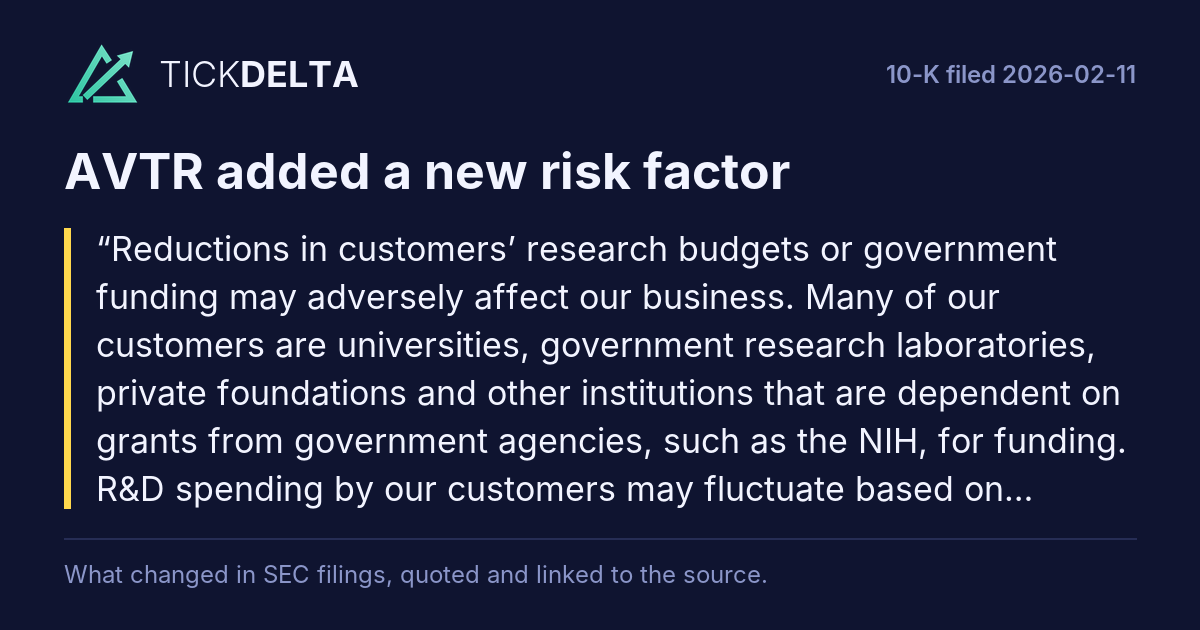
Reductions in customers’ research budgets or government funding may adversely affect our business.
Many of our customers are universities, government research laboratories, private foundations and other institutions that are dependent on grants from government agencies, such as the NIH, for funding. R&D spending by our customers may fluctuate based on spending priorities and general economic conditions. The level of government funding for R&D is unpredictable. Reductions or delays in governmental spending could cause customers to delay or forego purchases of our products. If government funding necessary for the purchase of our products were to decrease, our business and results of operations could be adversely affected. Spending by some of these customers fluctuates based on budget allocations and the timely passage of the annual federal budget. An impasse in federal government budget decisions could lead to substantial delays or reductions in federal spending.
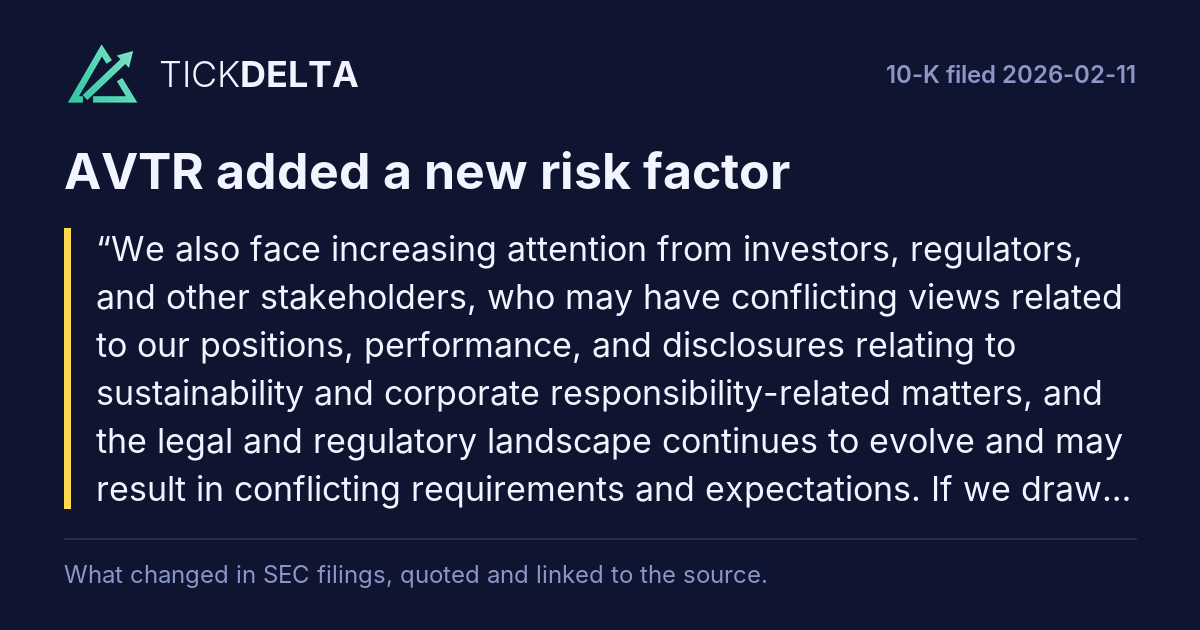
We also face increasing attention from investors, regulators, and other stakeholders, who may have conflicting views related to our positions, performance, and disclosures relating to sustainability and corporate responsibility-related matters, and the legal and regulatory landscape continues to evolve and may result in conflicting requirements and expectations. If we draw scrutiny for the positions we take or do not take on these matters (or for altering any such position) or receive unfavorable ratings from third-party organizations that provide information to investors on such matters, it could be used by investors, lenders, customers, employees and other stakeholders to inform their investment, financing, purchasing or employment decisions, which could have a negative impact on our business. Additionally, a failure to adequately meet regulatory expectations may result in non-compliance, the loss of business and reputational impacts, and we may become the target of litigation or investigations initiated by government authorities or private actors alleging that our activities related to these matters are anti-competitive, discriminatory or otherwise unlawful.
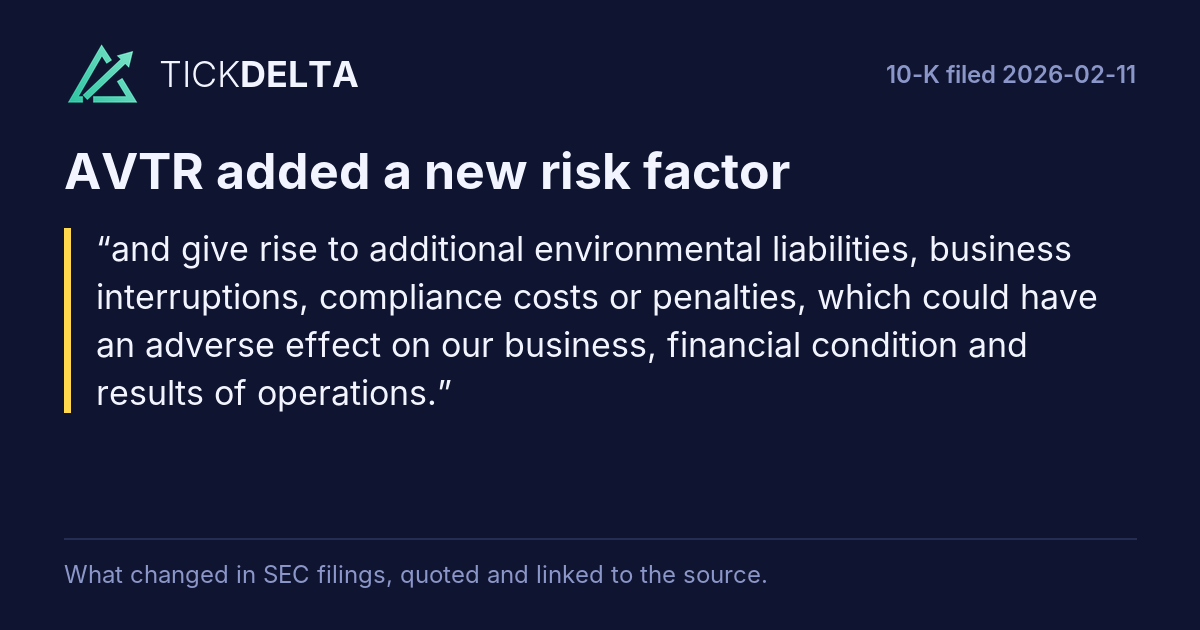
and give rise to additional environmental liabilities, business interruptions, compliance costs or penalties, which could have an adverse effect on our business, financial condition and results of operations.
Changes in U.S. or international laws and policies governing foreign trade could materially and adversely affect our business. The U.S. has instituted certain changes, and has proposed additional changes, in trade policies that include the negotiation or termination of trade agreements, the imposition of higher tariffs on imports into the U.S., and other government regulations affecting trade between the U.S. and other countries where we conduct our business. The new tariffs and other changes in U.S. trade policy have triggered retaliatory actions by affected countries, and foreign governments have instituted or are considering imposing trade sanctions on U.S. goods.
The imposition of tariffs and other trade restrictions, as well as the escalation of trade disputes and any downturns in the global economy resulting therefrom, could materially and adversely affect our business, financial condition and results of operations. The extent and duration of the tariffs and other trade restrictions and the resulting impact on general economic conditions and on our business are uncertain and depend on various factors, such as negotiations between the U.S. and affected countries, the responses of other countries or regions, exemptions or exclusions that may be granted, availability and cost of alternative sources of supply, and demand for our products in affected markets. Further, actions we take to adapt to new tariffs or other trade restrictions may cause us to modify our operations, which could be time-consuming and expensive, impact pricing of our products, which could impact our sales and profitability, or cause us to forgo business opportunities.
contractual obligations; (ii) exposing us to the risk of increased interest rates as certain of our borrowings, including borrowings under our senior secured credit facilities, are at variable rates of interest; (iii) restricting us from making strategic acquisitions or causing us to make non-strategic divestitures; (iv) requiring us to dedicate a substantial portion of our cash flow from operations to payments on our indebtedness, which would reduce the funds available for working capital, capital expenditures, investments, acquisitions and other general corporate purposes; (v) limiting our flexibility in planning for, or reacting to, changes in our business, future business opportunities and the industry in which we operate; (vi) placing us at a competitive disadvantage compared to any of our less leveraged competitors; (vii) increasing our vulnerability to a downturn in our business and both general and industry-specific adverse economic conditions; and (viii) limiting our ability to obtain additional financing.
Our business could be impacted as a result of actions by activist shareholders or others.
We have in the past and may in the future be the focus of shareholder activism, which has become increasingly prevalent. Shareholder activism, particularly with respect to matters that our Board, in exercising its fiduciary duties, disagrees with, or has determined not to pursue, may adversely affect our business because responding to activist shareholders can be costly and time-consuming, disruptive to operations and divert the attention of our Board and management. Our ability to execute our strategic plan could also be impaired as a result. Responding to an activist campaign could cause us to incur substantial fees and expenses and could also lead to litigation, which could be a further distraction to our Board and management and require us to incur significant additional costs.
Perceived uncertainties as to our future direction, strategy or leadership created as a consequence of activist shareholders may result in the loss of potential business opportunities, harm our ability to attract new or retain existing investors, lenders, customers, directors, employees, or other partners, and negatively affect or create volatility in our stock price.
New in the latest 10-Q
8 paragraphs in the 10-Q filed Oct 28, 2026 with nothing like them in the 10-Q filed Jul 29, 2026 (at least half the words must differ; new numbers alone do not count). Quoted exactly, grouped by the item heading above them. This is text that changed, not a judgement of how serious it is.
(in millions, except per share data) Three months ended September 30, Nine months ended September 30,
Read in the 10-Q
In May 2026, the FASB issued ASU 2026-02, Environmental Credits and Environmental Credit Obligations. The new standard provides recognition, measurement, presentation, and disclosure guidance for environmental credits and environmental credit obligations. The accounting for environmental credits depends on how the credits are obtained and their intended use, while the measurement of environmental credit obligations depends in part on whether the entity holds and expects to use environmental credits to settle the obligation.
Read in the 10-Q
5. Represents the $ 785.0 million non-cash goodwill impairment charge recognized in the third quarter of 2025 related to the former Distribution reporting unit. Refer to note 7.
Read in the 10-Q
During the third quarter of 2025, we recognized a non-deductible, non-cash goodwill impairment charge of $ 785.0 million related to the former Distribution reporting unit. Effective January 1, 2026, the operations that previously comprised the Distribution reporting unit are included within the VWR Distribution reporting unit. No goodwill impairment charges were recognized during the nine months ended September 30, 2026.
Read in the 10-Q
Income margin, respectively, are included in the section entitled “Reconciliations of non-GAAP measures”;
Read in the 10-Q
specialty procurement offering, while sales across the remaining product categories were generally consistent with the prior year.
Read in the 10-Q
6. Represents the $785.0 million non-cash goodwill impairment charge recognized in the third quarter of 2025 related to the former Distribution reporting unit. Refer to note 7.
Read in the 10-Q
5. Represents the $785.0 million non-cash goodwill impairment charge recognized in the third quarter of 2025 related to the former Distribution reporting unit. Refer to note 7.
Read in the 10-Q
Item 1A of the 10-Q filed Oct 28, 2026 against Item 1A of the 10-K filed Feb 11, 2026.
A 10-Q repeats only the risks that changed, so a 10-K paragraph that is missing from it is not counted as removed.
Added is a paragraph with nothing like it in the 10-K, Reworded a sentence that is in both with several words changed,
Quiet changes a sentence in both where one to four words changed and one is a hedge or a modal
(cut words struck through, new words highlighted).
Text on the page, not a score; each links to the filing at sec.gov.
What the 10-Q itself says about its risk factors:For information regarding factors that could affect the Company's results of operations, financial condition and liquidity, see the risk factors discussed in Part I, Item 1A “Risk Factors” in our Annual Report and the following risk factor, which supplements and should be read in conjunction with the risk factors discussed in Part I, Item 1A “Risk Factors” in our Annual Report.
Read in the 10-Q
Two-word phrases in Risk Factors of the 10-K filed Feb 11, 2026 that are in none of the 1 earlier 10-Ks stored, back to Feb 7, 2025
Used at least twice, small words left out. Counted, not picked: a phrase can be new because the company renamed something.
18 paragraphs of last year's Risk Factors with nothing like them now. The longest are quoted.
Item 1A of each 10-K and 10-Q on EDGAR, quoted exactly. Each paragraph links to the filing at sec.gov.
10-K change: what was reworded or cut, section by section.
Excel workbook · CSV. Google Sheet that stays up to date: paste =IMPORTDATA("https://tickdelta.com/company/AVTR/export.csv") into a cell.