Form 10-K for the Fiscal Year ended December 31, 2021
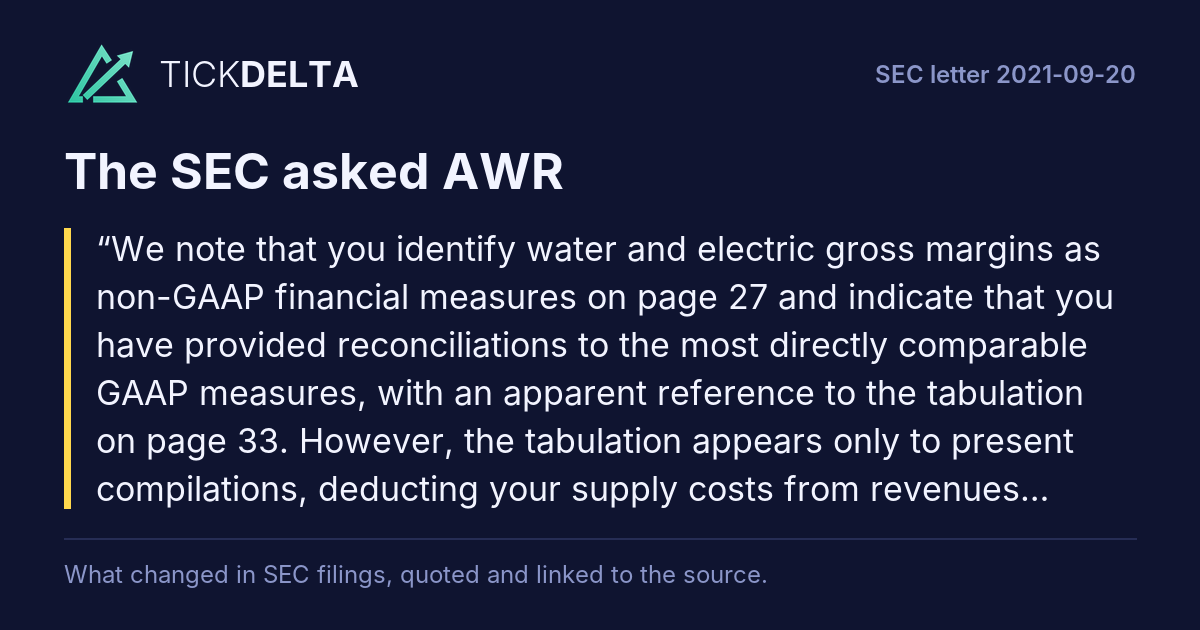
We note that you identify water and electric gross margins as non-GAAP financial measures on page 27 and indicate that you have provided reconciliations to the most directly comparable GAAP measures, with an apparent reference to the tabulation on page 33. However, the tabulation appears only to present compilations, deducting your supply costs from revenues, with no reconciliation to a comparable GAAP measure.Rest of the question
We believe that you should present gross margin in accordance with GAAP, as defined in the FASB Master Glossary, as the most directly comparable GAAP measure, and provide reconciliations from these measure to your non-GAAP measures to comply with Item 10(e)(1)(i)(B) of Regulation S-K. Please also modify the labeling of your non-GAAP measures as necessary to adhere to Item 10(e)(1)(ii)(E) of Regulation S-K.
The Company respectfully acknowledges the Staff’s comment. As noted by the Staff, the Company historically has identified water and electric gross margins as non-GAAP financial measures in its filings. In consideration of the Staff’s comment and Item 10(e)(1)(ii)(E) of Regulation S-K, to avoid the use of titles or descriptions of non-GAAP financial measures that are the same as, or confusingly similar to, titles or descriptions used for GAAP financial measures, the Company will modify, in future filings, the labeling of this non-GAAP measure.Read in the replyRest of the answer
In future filings, the descriptions will be changed to either water or electric “Operating Revenues, less Supply Costs (non-GAAP)”.
The supplemental information that the Company discloses with respect to water and electric gross margins is calculated exclusively from amounts presented in accordance with GAAP (i.e., recorded operating revenues and supply costs). For the reasons discussed below, the Company does not believe that a reconciliation to GAAP gross margin is warranted, as the purpose of the disclosure is not to provide an adjusted GAAP measure of profitability, but rather to remove the effects of pass-through costs that, because of regulatory mechanisms in place, do not impact profitability, as further described below under “Rate-Regulated Environment and Regulatory Mechanisms”. In this case, the most directly comparable GAAP measure is Operating Revenues, which is what drives the operating results in our rate-regulated environment and provides for the recovery of our operating costs and return on rate base. The reconciliation table on page 33 reconciles Water Gross Margin (non-GAAP) to Water Operating Revenues (GAAP) and Electric Gross Margin (non-GAAP) to Electric Operating Revenues (GAAP). Accordingly, the required reconciliation table already appears in the filing. Furthermore, we do not believe that GAAP gross margin, which is defined in the FASB Master Glossary as “the excess of sales over costs of goods sold” and which does not consider all operating expenses, is the most directly comparable and relevant GAAP measure.
The presentation and discussion of our renamed non-GAAP measure “Operating Revenues, less Supply Costs (non-GAAP)” in Management’s Discussion & Analysis (MD&A) is intended to provide supplemental information for our regulated utilities that removes the effect of fluctuations in pass-through supply costs that are subject to significant volatility, but do not affect a segment’s profitability due to the regulatory mechanisms in place. More specifically, as described below, because of existing regulatory mechanisms, a change in supply costs from what is incorporated and recovered in customer rates has no impact on earnings nor does it prevent any of the Company’s regulated utilities from earning its authorized rate of return approved by its regulator. We believe this supplemental information is important to the readers of our financial statements because water and electric supply costs, without the regulatory mechanisms, are subject to significant volatility due to, among other things, consumption patterns, drought conditions, increases in wholesale water prices, changes in the volume of purchased water versus pumped water, and changes in purchased power costs. By providing “Operating Revenues, less Supply Costs (non-GAAP)” as supplemental information and not as an adjusted GAAP measure of profitability, we eliminate the “noise” that is created by fluctuations in these significant costs that have no impact on earnings, and provide assistance to our investors and other interested parties in understanding real changes in the Company’s profitability from period to period (e.g., increases in operating revenues not derived from supply costs, but instead higher customer rates to cover the utility’s return on its increasing rate base, and other operating costs that do not have similar regulatory mechanisms). Unlike supply costs, other operating costs that deviate from what is incorporated in customer rates will have an earnings impact and result in earnings above or below the utilities’ authorized rate of return. We have disclosed the effects of regulation within our financial statements, and we believe readers of our financial statements who understand our regulated environment, find that the supplemental information provides greater transparency with respect to our results of operations.
Rate-Regulated Environment and Regulatory Mechanisms
The Company’s water and electric utility business segments are regulated by the California Public Utilities Commission (“CPUC”). The transaction prices for water and electric revenues are based on tariff rates authorized by the CPUC. Tariff revenues represent the adopted revenue requirement authorized by the CPUC that is intended to provide the Company’s regulated utilities with an opportunity to recover their operating costs (dollar-for-dollar) and earn a reasonable return/profit on their rate base. Operating costs are passed through to customers on a dollar-for-dollar basis by way of the tariffs and are comprised of water and electric supply costs, other operation and maintenance costs, administrative and general costs, depreciation, and various taxes. Total supply costs comprise the largest component of total operating expenses, accounting for almost 30% of the Company’s consolidated operating expenses and, more relevant, about 40% of the Company’s water and electric segment’s operating expenses for the year ended December 31, 2020. Supply costs at the Company’s water segment consist of purchased water, purchased power for pumping, groundwater production assessments and changes in the water supply cost balancing accounts. Supply costs for the electric segment consist primarily of purchased power for resale, the cost of natural gas used by our generating unit, the cost of renewable energy credits and changes in the electric supply cost balancing account.
Unlike other operating costs (e.g., other operation and maintenance costs), the Company tracks the differences between CPUC-adopted supply costs and actual supply costs (including the effects of changes in both rates and volume) using regulatory mechanisms authorized by the CPUC in the form of full-cost balancing accounts. The Company’s water and electric businesses track adopted and actual expense levels for all of their supply costs, and record the variances between adopted and actual supply costs in the full-cost balancing accounts, which are reflected as regulatory assets or liabilities on the Company’s balance sheets in accordance with ASC 980 (Regulated Operations). The regulated utilities will then recover from, or refund to, customers the amount of such recorded variances. As a result, the supply costs recognized in our GAAP financial statements equal the authorized supply cost amounts adopted by the CPUC, and which are reflected and being recovered in our revenues as a pass-through cost. Therefore, from an accounting result standpoint, a change in supply costs from what is adopted in rates has no earnings impact.
In summary, management believes that supplying supplemental information regarding “Operating Revenues, less Supply Costs (non-GAAP)” provides investors and other interested parties with useful and relevant information to analyze the Company’s financial performance and specifically, top line Operating Revenues in our rate-regulated environment. In consideration of the Staff’s comment, the Company will modify, in future filings, the labeling of its non-GAAP measures to either water or electric “Operating Revenues, less Supply Costs (non-GAAP)”. Management also believes that the most directly comparable
GAAP measure is Operating Revenues, which is already included in our now renamed “Operating Revenues, less Supply Costs (non-GAAP)” table. Accordingly, we believe the required reconciliation table already appears in our filings.
First report after the company's reply of Oct 14, 2021: 10-Q filed Nov 1, 2021 ↗, against the 10-Q filed Aug 2, 2021 ↗.
Tickdelta does not hold the text of both reports, so they are not compared here.
We note that you identify business segment earnings per share as a non-GAAP financial measure that is equal to segment earnings divided by the weighted average number of diluted common shares, with one exception for the 2019 Electric segment measure.Rest of the question
Please expand your disclosure in MD&A to include a tabulation of segment earnings utilized in your computations, and reconciliations from the measures of operating income or loss reported for the segments in Note 17 to your financial statements.
The Company notes the Staff’s comment and, in future filings, the Company will expand its disclosures in MD&A to include a tabulation of segment earnings utilized in its computations and reconciliations from the profitability measure of operating income or loss reported in the segment footnote to the financial statements to earnings per share by business segment.Read in the reply
The following is a sample reconciliation table for the years ended December 31, 2020 and 2019.Rest of the answer
The Company plans to include an analogous table in future filings.
Water Electric Contracted Services AWR (Parent) Consolidated
In 000's except per share amounts 2020 2019 2020 2019 2020 2019 2020 2019 2020 2019
Operating income (Note 10) $ 97,896 $ 93,895 $ 10,303 $ 11,197 $ 22,309 $ 21,990 $ (9) $ (9) $ 130,499 $ 127,073
Other income and expense 15,817 17,047 336 1,206 (357) (497) 81 305 15,877 18,061
Income tax expense (benefit) 20,515 17,295 2,689 2,882 5,201 5,202 (208) (709) 28,197 24,670
Net income $ 61,564 $ 59,553 $ 7,278 $ 7,109 $ 17,465 $ 17,285 $ 118 $ 395 $ 86,425 $ 84,342
Weighted Average Number of Diluted Shares 36,995 36,964 36,995 36,964 36,995 36,964 36,995 36,964 36,995 36,964
First report after the company's reply of Oct 14, 2021: 10-Q filed Nov 1, 2021 ↗, against the 10-Q filed Aug 2, 2021 ↗.
Tickdelta does not hold the text of both reports, so they are not compared here.
We note that you report activity using non-GAAP measures in earnings releases furnished on Form 8-K. There are instances where you quantify a change without also disclosing the result, and where you do not identify or present with equal prominence the most directly comparable GAAP measures, or provide the required reconciliations.Rest of the question
Please adhere to §244.100(a) of Regulation G whenever you publicly disclose material information that includes non-GAAP financial measures. Please also refer to the guidance on content in §244.100(b) and the guidance on presenting GAAP measures with equal or greater prominence in the Answer to Question 102.10 of our Compliance and Disclosure Interpretations on Non-GAAP Financial Measures. If you compare a non-GAAP result for the period to a prior period by quantifying the change, we believe that you should also quantify the result for the period and provide the corresponding GAAP information for adequate context.
The Company notes the Staff’s comment and advises the Staff that, in the future, whenever the Company publicly discloses material information that includes non-GAAP measures, it will comply with the applicable requirements of Regulation G. The Company will present the most directly comparable GAAP measure with equal or greater prominence and will provide the required reconciliations for adequate context. This will include not presenting in headlines or captions to future earnings releases, a non-GAAP measure that precedes the most directly comparable GAAP measure.Read in the replyRest of the answer
Furthermore, if the Company presents a non-GAAP result for the period compared to a prior period by quantifying the change (i.e. excluding certain items from the periods’ results), the Company will quantify the results of the period(s) (i.e. the adjusted earnings per share for the period(s)) as a result of the exclusion, and provide the corresponding GAAP information for adequate context.
We trust that you will find the foregoing responsive to the Staff’s comments. If you have any further questions or comments, please direct them to the undersigned by email at [email protected] or by phone at (909) 394-3600 extension 707.
First report after the company's reply of Oct 14, 2021: 10-Q filed Nov 1, 2021 ↗, against the 10-Q filed Aug 2, 2021 ↗.
Tickdelta does not hold the text of both reports, so they are not compared here.
We note that you have proposed to re-label your non-GAAP measures of Water Gross Margin and Electric Gross Margin in response to prior comment one, to replace the term Gross Margin with "Operating Revenues, less Supply Costs (non-GAAP)," and we see that you have made this change in your third quarter interim report.Rest of the question
However, you propose to retain your compilation of the measure, deducting supply costs from revenues, in lieu of providing a reconciliation using Gross Margin in accordance with GAAP, as you believe the most directly comparable GAAP measure is Operating Revenues. You indicate that you do not believe a reconciliation to GAAP gross margin is warranted because the purpose of your measure is to remove the effects of "pass-through costs" that do not impact profitability, although you have historically presented your measures using the gross margin GAAP terminology and disclose that the company "uses these gross margins and related percentages as an important measure in evaluating its operating results..., [and] believes these measures are useful internal benchmarks in evaluating the utility business performance within its water and electric segments..., [and] provide investors with clarity surrounding the performance of its segments." We continue to believe that you should present gross margin in accordance with GAAP, as defined in the FASB Master Glossary, as the most directly comparable measure for use in the reconciliation that is required by Item 10(e) of Regulation S-K. Unless you are able to show how a measure that is unburdened by any expense would be more comparable than gross margin to your Water and Electric non-GAAP measures, please further revise your non-GAAP disclosures as requested in prior comment one. Please also revise your various disclosures pertaining to rate cases having references to margin-based measures or changes therein, such as "authorized water gross margin" and "adopted electric gross margin," to clarify how the authorized or adopted measures correspond to the pass-through costs and your non-GAAP measures.
The Company respectfully acknowledges the Staff’s comment. In consideration of the Staff’s comment and how disclosures have evolved over time in this area, the Company intends to no longer present “Operating Revenues, Less Supply Costs (non-GAAP)” when discussing its financial results in future filings.Read in the replyRest of the answer
As such, the Company will remove references to “Operating Revenues, Less Supply Costs (non-GAAP)” when discussing its financial results in all future Form 10-K and 10-Q filings and in all future earnings releases furnished as exhibits to Form 8-K filings, beginning with its earnings release and Annual Report on Form 10-K for the fiscal year ended December 31, 2021.
Furthermore, the Company will revise its various disclosures in future SEC filings regarding rate cases to remove references to the adopted and/or authorized margin-based measures or changes therein.
We trust that you will find the foregoing responsive to the Staff’s comments. If you have any further questions or comments, please direct them to the undersigned by email at [email protected] or by phone at (909) 394-3600 extension 707.
First report after the company's reply of Dec 15, 2021: 10-K filed Feb 22, 2022 ↗, against the 10-K filed Feb 22, 2021 ↗.
Tickdelta does not hold the text of both reports, so they are not compared here.
Also in this review: closing letter, 2021-12-28