American States Water Co AWR
New risk paragraphs, branching off last year
Each branch is a paragraph in Risk Factors with nothing like it in the 10-K filed Feb 19, 2025. A box jumps to the paragraph as filed, below.
Paragraphs with nothing like them in last year's 10-K
3 paragraphs in Risk Factors of the 10-K filed Feb 18, 2026 with nothing like them in the 10-K filed Feb 19, 2025. Quoted exactly. Paragraphs that were only edited are under 10-K change.
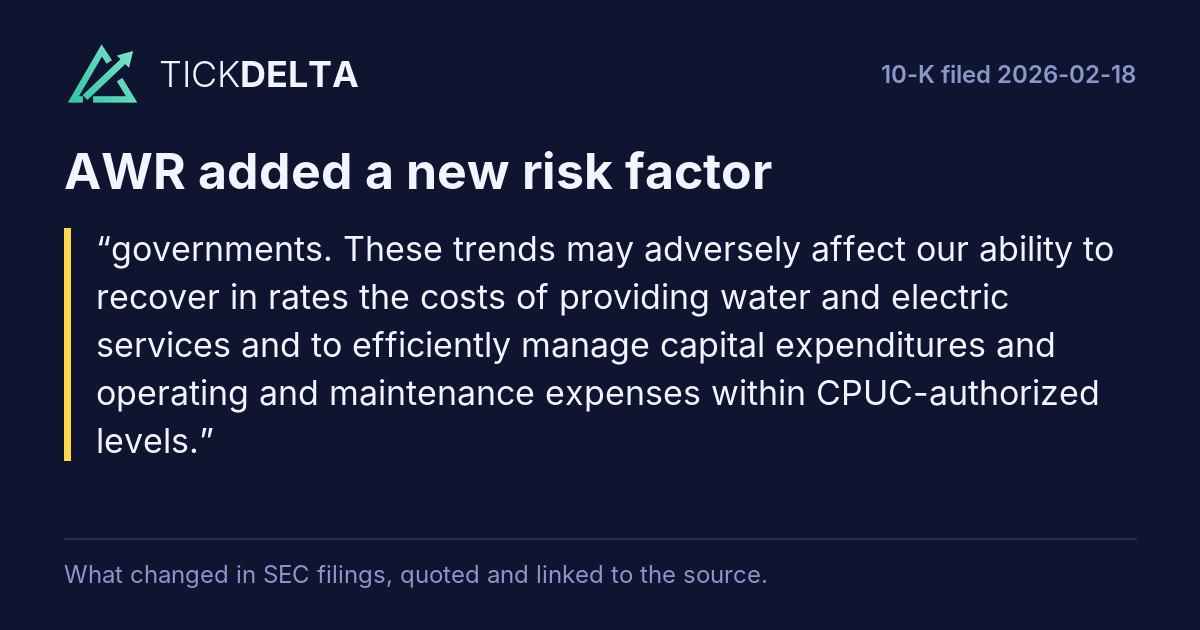
governments. These trends may adversely affect our ability to recover in rates the costs of providing water and electric services and to efficiently manage capital expenditures and operating and maintenance expenses within CPUC-authorized levels.
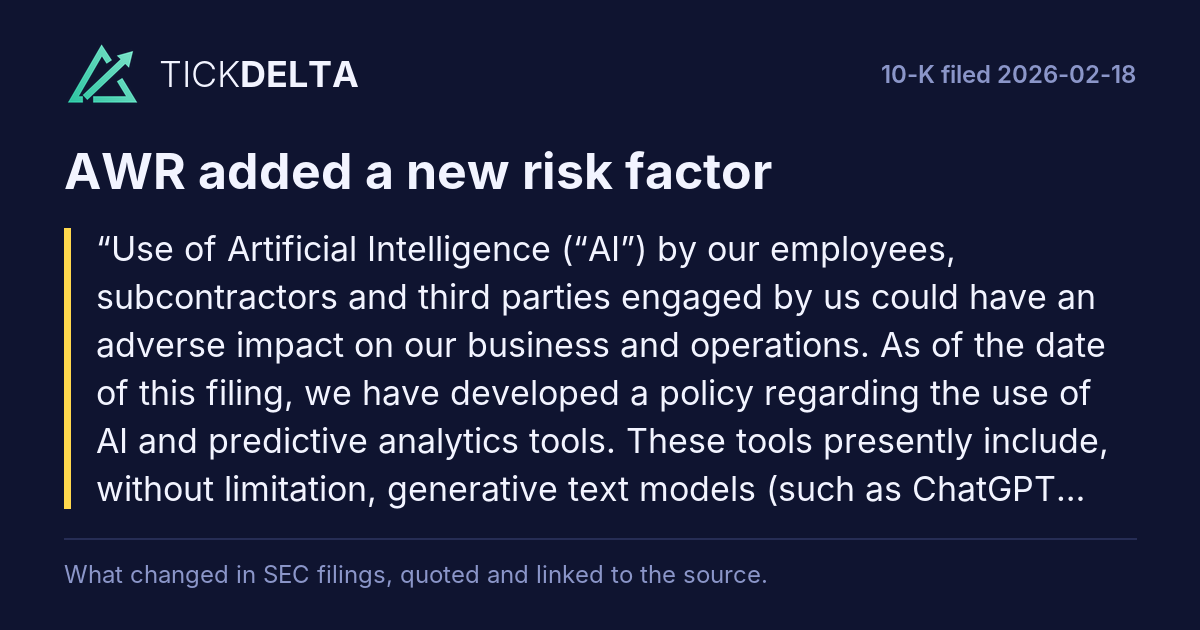
Use of Artificial Intelligence (“AI”) by our employees, subcontractors and third parties engaged by us could have an adverse impact on our business and operations.
As of the date of this filing, we have developed a policy regarding the use of AI and predictive analytics tools. These tools presently include, without limitation, generative text models (such as ChatGPT, Claude, and Co-Pilot). There is a risk that such AI tools (or AI tools used without Company approval) will be used in a manner that does not adhere to our AI policy and/or may be misused by our employees, subcontractors, or other third parties engaged by us. This, in turn, could result in the loss of confidential or proprietary information and subject us to competitive or reputational harm, as well as potential regulatory investigations/actions and/or legal liability. Additionally, we may not be able to control, and may lack visibility into, how third-party AI tools, or AI features incorporated into third-party products, are developed or maintained, or how such tools use, disclose and/or protect the data we input, even where we have sought contractual protections with respect to these matters. Further, AI algorithms may be flawed, and the data used to train AI tools may be inaccurate, incomplete, or biased. As a result, the content, analysis or recommendations that these tools produce may be inaccurate, incomplete, or biased, and the use of this information by our employees, subcontractors, or other third parties engaged by us may have a material adverse effect on our business, results of operations and financial condition.
Paragraphs in the 10-Q filed Nov 4, 2026 that were not in the one before
New in the latest 10-Q
5 paragraphs in the 10-Q filed Nov 4, 2026 with nothing like them in the 10-Q filed Aug 5, 2026 (at least half the words must differ; new numbers alone do not count). Quoted exactly, grouped by the item heading above them. This is text that changed, not a judgement of how serious it is.
Financial statements and notes
In December 2025, the FASB issued ASU No. 2025-10, (Accounting for Government Grants Received by Business Entities). The ASU establishes guidance on the recognition, measurement, and presentation of government grants received by business entities. The guidance is effective for annual and interim periods beginning January 1, 2029 with early adoption permitted. Adoption of this ASU can be applied on a modified prospective basis, a modified retrospective basis, or a full retrospective basis. Registrant is currently evaluating the impact of this new guidance.
Read in the 10-Q
In May 2026, the FASB issued ASU No. 2026-02, (Environmental Credits and Environmental Credit Obligations). The ASU establishes guidance for the recognition, measurement, presentation and disclosure requirements of environmental credits and environmental credit obligations. The guidance is effective for annual and interim periods beginning January 1, 2028 with early adoption permitted. Registrant is currently evaluating the impact of this new guidance.
Read in the 10-Q
Included in the following analysis is a discussion of Registrant’s operations in terms of earnings per share by business segment and AWR (parent), which equals each business segment’s earnings divided by AWR’s weighted average number of diluted Common Shares. This analysis also includes adjusted diluted earnings per share information for the three and nine months ended September 30, 2026 and 2025. Beginning in the third quarter of 2026, we will exclude gains and losses on investments held to fund one of the company’s retirement plans from adjusted earnings per share. These amounts fluctuate with financial markets, are not indicative of core operating performance, and are expected to be more consistently material as the trust assets have grown. We believe that the exclusion of these gains and losses from adjusted earnings per share for the third quarter and year-to-date facilitates comparisons of results between periods. Management uses adjusted earnings per share internally in evaluating Registrant’s overall business performance and making comparisons between periods. In previous 2026 quarters, we did not present adjusted earnings per share because the per share impact of fluctuating gains and losses on investments was not material.
Read in the 10-Q
plus AFUDC of certain advice letter capital projects. The increase in revenues was partially offset by an increase in electric supply costs, which consist of power purchased for resale costs and changes in the electric supply cost balancing account.
Read in the 10-Q
Fluctuations in maintenance expense are driven by the timing and requirements of our maturing infrastructure at each of our business segments. During the third quarter of 2026, there were increases in maintenance activities at our water and contracted services segments compared to the same period in 2025, while maintenance activities decreased at our electric segment.
Read in the 10-Q
The 10-Q's risk factors against the 10-K
Item 1A of the 10-Q filed Nov 4, 2026 against Item 1A of the 10-K filed Feb 18, 2026.
A 10-Q repeats only the risks that changed, so a 10-K paragraph that is missing from it is not counted as removed.
Added is a paragraph with nothing like it in the 10-K, Reworded a sentence that is in both with several words changed,
Quiet changes a sentence in both where one to four words changed and one is a hedge or a modal
(cut words struck through, new words highlighted).
Text on the page, not a score; each links to the filing at sec.gov.
What the 10-Q itself says about its risk factors:There have been no material changes to the risk factors from what was previously disclosed in Registrant’s Annual Report on Form 10-K for the year ended December 31, 2025 filed with the SEC.
Read in the 10-Q
1 paragraph in the 10-Q's Item 1A, and none of them adds, rewords or quietly edits a paragraph of the 10-K's.
Phrases used for the first time
Two-word phrases in Risk Factors of the 10-K filed Feb 18, 2026 that are in none of the 1 earlier 10-Ks stored, back to Feb 19, 2025
Where each one is used
- decoupling balancing: Lastly, with extreme weather events and conditions comes volatility in water demand and usage of our customers. Without the continuation of a full revenue decoupling mechanism such as the WRAM and a full supply cost decoupling balancing account such as the MCBA as discussed further later, Registrant may be subject...
- employees subcontractors: Use of Artificial Intelligence (“AI”) by our employees, subcontractors and third parties engaged by us could have an adverse impact on our business and operations.
- parties engaged: Use of Artificial Intelligence (“AI”) by our employees, subcontractors and third parties engaged by us could have an adverse impact on our business and operations.
- enhance plans: Drought conditions have contributed to increases in wildfires, which has resulted in new California legislation requiring electric utilities to adopt and implement wildfire mitigation plans and water utilities to enhance plans to ensure water infrastructure remains functional during wildfire events. GSWC and BVES...
- ensure water: Drought conditions have contributed to increases in wildfires, which has resulted in new California legislation requiring electric utilities to adopt and implement wildfire mitigation plans and water utilities to enhance plans to ensure water infrastructure remains functional during wildfire events. GSWC and BVES...
- water infrastructure: Drought conditions have contributed to increases in wildfires, which has resulted in new California legislation requiring electric utilities to adopt and implement wildfire mitigation plans and water utilities to enhance plans to ensure water infrastructure remains functional during wildfire events. GSWC and BVES...
- infrastructure remains: Drought conditions have contributed to increases in wildfires, which has resulted in new California legislation requiring electric utilities to adopt and implement wildfire mitigation plans and water utilities to enhance plans to ensure water infrastructure remains functional during wildfire events. GSWC and BVES...
- remains functional: Drought conditions have contributed to increases in wildfires, which has resulted in new California legislation requiring electric utilities to adopt and implement wildfire mitigation plans and water utilities to enhance plans to ensure water infrastructure remains functional during wildfire events. GSWC and BVES...
Used at least twice, small words left out. Counted, not picked: a phrase can be new because the company renamed something.
What was taken out
3 paragraphs of last year's Risk Factors with nothing like them now. The longest are quoted.
Sources
Item 1A of each 10-K and 10-Q on EDGAR, quoted exactly. Each paragraph links to the filing at sec.gov.
Also
10-K change: what was reworded or cut, section by section.
Work with it
Excel workbook · CSV. Google Sheet that stays up to date: paste =IMPORTDATA("https://tickdelta.com/company/AWR/export.csv") into a cell.