Screener / SEC EDGAR /CIK 0001144215 /10-K filed Oct 23, 2026, compared with Oct 27, 2025 /Numbers from the XBRL of the 10-Ks
NYSE Consumer discretionary · Electric Lighting & Wiring Equipment

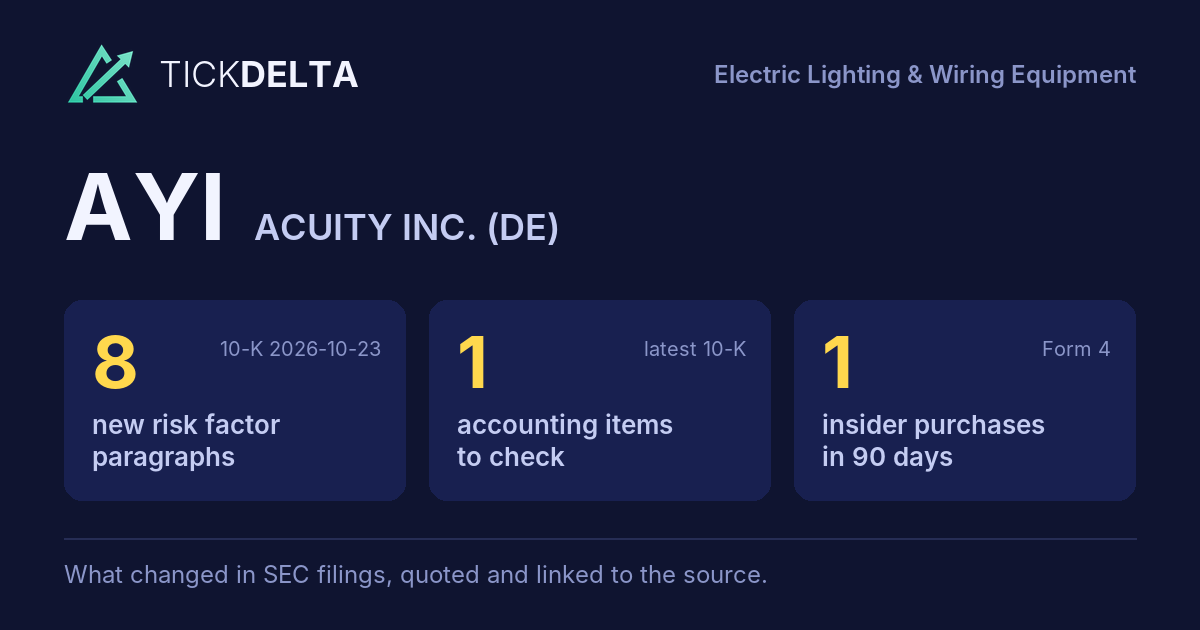
DE Acuity Inc. AYI

Compare with peers Embed
SEC comment letters, last 20 years

2 reviews of AYI's filings by SEC staff

UPLOAD and CORRESP
Reviews 2 latest letter Feb 13, 2020
Questions asked 9 each answered in the company's own letter
No closing letter 0 reviews without a letter saying the staff completed it

When the SEC's staff reviews a filing, it writes to the company with numbered questions, and the company answers each one in a letter. SEC publishes the exchange once the review is over, at least 20 business days later. A question is not an accusation; most reviews end with the company adding detail to its next filing.

How the reviews went

Every review on EDGAR, from the first staff letter to the letter that closes it

  1. 1. Staff letters 3 UPLOAD
  2. 2. Questions in them 9 numbered comments
  3. 3. Company replies 3 CORRESP
  4. 4. Reviews closed 2 of 2 closing letter

Half the closed reviews took 56 days or less from the first letter to the closing letter.

Form 10-K for the Fiscal Year Ended August 31, 2019

2020-02-13 to 2020-02-25 · 2 questions · 1 letter from the SEC, 1 from the company
Review closed 2020-02-25
Non-GAAP measuresResults discussion (MD&A)Legal and contingenciesReserves and insurance
Management's Discussion and Analysis of Financial Condition and Results of Operations · Results of Operations, page 23
SEC asked (1)
We note that on page 24 and in your earnings releases you present certain non-GAAP measures, such as Adjusted SD&A expenses and Adjusted operating profit, as a percentage of net sales without also presenting the most directly comparable GAAP measures. In addition, you discuss Adjusted operating profit margin in your earnings releases without providing a discussion of GAAP operating profit margin.
Rest of the question

When presenting or discussing non-GAAP measures in your future filings, please present and discuss the most directly comparable GAAP measures with equal or greater prominence. Refer to Item 10(e)(i)(A) of Regulation S-K and Question 102.10 of the updated Compliance & Disclosure Interpretations on Non-GAAP Financial Measures.

AYI answered
#1: We acknowledge that page 24 of our Form 10-K, which contains our reconciliation of non-GAAP financial measures to the most directly comparable GAAP measure, does not show the reconciliation of "adjusted SD&A expenses as a percentage of net sales" to "SD&A expenses as a percentage of net sales." While operating profit as a percentage of net sales is presented on page 23 of our Form 10-K, we acknowledge that there is no clear reconciliation to adjusted operating profit as a percentage of net sales on page 24.
Rest of the answer

We will revise our reconciliation schedule in future filings to clearly present these two additional reconciliations. Regarding our earnings releases, we acknowledge that we have discussed adjusted operating profit margin without first discussing GAAP operating profit margin. We will ensure future earnings releases give equal or greater prominence to our GAAP results.

Read in the reply
In its next report

First report after the company's reply of Feb 20, 2020: 10-Q filed Apr 2, 2020 ↗, against the 10-Q filed Jan 9, 2020 ↗.

Tickdelta does not hold the text of both reports, so they are not compared here.

Notes to Consolidated Financial Statements · Note 11 - Commitments and Contingencies, page 70
SEC asked (2)
Tell us how your use of the terms "reserve", "reserves" and "reserved" when referring to your accruals for loss contingencies is consistent with the guidance in ASC 450-20-50-1, or revise your disclosures in future filings to comply with the guidance.
Rest of the question

We remind you that the company and its management are responsible for the accuracy and adequacy of their disclosures, notwithstanding any review, comments, action or absence of action by the staff.

AYI answered
#2: The terms "reserve," "reserves," and "reserved" are improperly used in our footnote to refer to liabilities related to loss contingencies. We are recording liabilities in accordance with ASC 450-20-25-2; however, we have not properly characterized these accruals as "estimated liabilities" or terminology descriptive of the nature of the accrual in accordance with ASC 450-20-50-1. We will revise our disclosures in future filings to comply with the guidance.
Read in the reply
In its next report

First report after the company's reply of Feb 20, 2020: 10-Q filed Apr 2, 2020 ↗, against the 10-Q filed Jan 9, 2020 ↗.

Tickdelta does not hold the text of both reports, so they are not compared here.

Also in this review: closing letter, 2020-02-25

Form 10-K for the Fiscal Year Ended August 31, 2013

2014-04-30 to 2014-06-25 · 7 questions · 2 letters from the SEC, 2 from the company
Review closed 2014-06-25
RevenueResults discussion (MD&A)Reserves and insuranceInventory
Form 10-K for the fiscal year ended August 31, 2013 · Notes to Consolidated Financial Statements
SEC asked
Description of Business and Basis of Presentation Revenue Recognition, page 42 Please tell us your consideration of the guidance in ASC 605-15-25-1 through 4 regarding your product return rights. Please tell us and expand your disclosure regarding the terms of the limited return rights. For each period presented, please tell us your actual returns and your provision for the estimated amount of future returns.
AYI answered

No numbered answer found in the reply. Read the reply ↗

Form 10-K for the fiscal year ended August 31, 2013 · Notes to Consolidated Financial Statements
SEC asked (1)
Description of Business and Basis of Presentation Revenue Recognition, page 42 1. We note your response to our prior comment. Please tell us the products for which you offer a four month unlimited right of return. Please tell us the amount of sales revenue that was recognized for these products subject to this right of return for each quarter for the periods presented.
Rest of the question

Please quantify the amount of the returns for each period. Also show us your provision for the estimated amount of future returns for each of these periods.

AYI answered

No numbered answer found in the reply. Read the reply ↗

Form 10-K for the fiscal year ended August 31, 2013 · Notes to Consolidated Financial Statements
SEC asked (2)
Please tell us in detail about the procedures that you employ to estimate future sales returns. We note that ASC 605-15-25-3 states that the ability to make a reasonable estimate of the amount of future returns may be impaired by many factors and circumstances, including, but not limited to: changes in demand; relatively long periods in which a particular product may be returned; absence of historical experience
Rest of the question

with similar types of sales of similar products, or inability to apply such experience because of changing circumstances, for example, changes in the selling entity's marketing policies or relationships with its customers; and, absence of a large volume of relatively homogeneous transactions. Please explain in detail why these factors did not preclude your ability to make a reasonable estimate of the amount of future returns.

AYI answered
#1: Products sold by the Company under its standard terms and conditions are subject to a four month right of return. The Company's standard terms and conditions allow for returns of stock products with the following primary limitations: the product must be in salable condition, the return must be authorized by a representative of the Company, and notification of the return must occur within four months of shipment. Stock products are generally defined by the Company as non-customized products available to be shipped to customers from inventory.
Rest of the answer

Non-returnable merchandise under the Company's standard terms and conditions includes special, custom made or modified products, all stock products containing time-sensitive components that have reached the end of their warranty or shelf life, and outdated or phase-out stock products. The Company follows a robust process to review and approve all requests for returns to ensure they meet the standard terms and conditions or have proper authorization before accepting the return. Exceptions to the Company’s standard terms and conditions are made depending on the facts and circumstances of an individual request for return. As a result and for the reasons described in Response #2 below, the Company’s product return estimation process does not make a distinction between stock products or other products. Accordingly, the table below reflects sales revenue that was recognized for all products subject to return under the Company's various return programs less sales revenue associated with products sold for resale to the Company’s largest customer that has a contractual agreement that provides for a deduction in the invoice amount in lieu of product returns which is more fully described in Response #6 below. The table also includes total product returns and gross and net reserves for total product returns for each quarter during the three-year period ended August 31, 2013.

($ in millions)

Fiscal 2011 Quarter ended

Fiscal 2012 Quarter ended

Fiscal 2013 Quarter ended

Nov 30

Feb 28

May 31

Aug 31

Feb 29

Gross revenue on products subject to return

$

379.4

372.8

413.5

440.2

413.3

403.5

434.9

468.5

432.6

437.5

494.4

531.2

Product returns*

5.9

5.2

5.3

5.6

4.4

5.0

4.8

6.2

6.5

Reserve for total product returns at end of period, gross**

3.7

3.6

3.8

3.9

4.1

4.3

Reserve for total product returns at end of period, net***

1.3

1.4

1.5

* The provision for estimated product returns approximates product returns presented herein.

** Amounts presented herein represent the "revenue value" of total estimated product returns prior to consideration of estimated recoveries. See Response #5 below.

*** Amounts presented herein represent the "gross margin value" of total estimated product returns, which equals the revenue value of total estimated product returns minus their estimated recoveries. See Response #5 below.

Staff Comment #2: Please tell us in detail about the procedures that you employ to estimate future sales returns. We note that ASC 605-15-25-3 states that the ability to make a reasonable estimate of the amount of future returns may be impaired by many factors and circumstances, including, but not limited to: changes in demand; relatively long periods in which a particular product may be returned; absence of historical experience with similar types of sales of similar products, or inability to apply such experience because of changing circumstances, for example, changes in the selling entity's marketing policies or relationships with its customers; and, absence of a large volume of relatively homogeneous transactions. Please explain in detail why these factors did not preclude your ability to make a reasonable estimate of the amount of future returns.

Response #2: The Company estimates future product returns primarily based on the historical relationship of total product returns to gross sales adjusted for the expected time interval between the initial delivery of the product and the subsequent product return. Each year the Company computes the estimated time period differential between the delivery of the product and the subsequent product return ("product return lag") based on product return data during the respective fiscal year period. The Company then computes a product return rate by dividing total product returns by gross sales during each of the most recent eight quarters. Total product returns and, therefore, the product return rate consider all product returns, including stock products and other products. Other product returns not subject to the Company's standard terms and conditions include custom made or modified products returned to the Company for reasons such as order entry errors. On an annual basis, the average of the computed quarterly product return rates in each of the most recent eight quarters is applied to gross sales during the historical periods to estimate the amount of total gross product returns. Given the consistent relationship of product returns to gross sales over time, the Company believes that including a greater or lesser number of historical quarters in this analysis would not materially alter the Company's estimate of future product returns. When the product return rate is applied to gross sales during historical periods, the Company adjusts the estimated gross product returns in each of the historical periods by the product return lag to estimate the amount of estimated future gross product returns as of the reporting period date. The estimated future gross product returns as of the reporting date are then reduced by estimated recoveries, primarily the cost of the inventory expected to be returned, related to the future product returns. The estimated future gross product returns less estimated recoveries related to the future product returns equals the net reserve for estimated product returns. Finally, the Company performs additional analysis to evaluate the sensitivity of this model to reasonable fluctuations in the product return lag to determine the potential impact on the reserve required. For quarterly reporting periods, the Company completes analytical procedures to confirm the net reserve for estimated product returns is materially adequate.

In regards to the estimated product return lag, a majority of product returns are recorded within the first four months following delivery. For example, in fiscal 2013 the product return lag analysis indicated that approximately 40% of product returns occur within 30 days of delivery--many of which are within the same month as delivery--and approximately 80% of product returns occur within four months of delivery.

The Company does not believe its ability to reasonably estimate future returns has been precluded by the factors listed in ASC 605-15-25-3, specifically:

Changes in demand - During the years presented, the primary change in demand experienced by the Company related to a modest cyclical recovery in the Company's served market and an increase in sales of light-emitting diode ("LED") products. From the Company's perspective, LED products simply incorporate another type of light source. For many decades, the Company has integrated various light sources (such as fluorescent and high intensity discharge) with other components to produce products that achieve specific visual effects and optimize energy efficiency. LED products are used in applications identical to the Company's other products. This change in demand has not resulted in a material change in the rate of product returns. Therefore, we do not believe the change in demand represents a change in circumstances impacting our ability to estimate future product returns.

Relatively long periods in which a particular product may be returned - Consistent with the Company's standard return policy described above, the vast majority (approximately 80%) of the Company's product returns occur within the four-month return period following delivery of the product. This short product return lag enables the Company to make reasonable estimates of future product returns. Although the Company maintains a limited number of special return programs that extend beyond the standard terms and conditions, these programs incorporate limitations that minimize the impact of product returns, such as returned product generally must have been purchased within the prior twelve months, the products must be stock products in salable condition, and at times product returns require a replacement order of equal or greater value. See Response #3 below.

Absence of historical experience with similar types of sales of similar products - The Company has a long history of selling lighting and lighting related products to a consistent customer base through similar sales channels.

Inability to apply such experience because of changing circumstances, for example, changes in the selling entity's marketing policies or relationships with its customers - The Company's marketing practices and significant customer relationships have remained substantially consistent over time. As noted above, the Company has been selling to a consistent customer base through similar sales channels for many decades. Therefore, the Company believes there has not been a change in circumstances that would impact our ability to apply our historical experience.

Absence of a large volume of relatively homogeneous transactions - The Company believes our sales of lighting and lighting related products represent a large volume of relatively homogeneous transactions.

Based on the procedure described above, the Company believes that our reserve for product returns is materially adequate.
Read in the reply
Form 10-K for the fiscal year ended August 31, 2013 · Notes to Consolidated Financial Statements
SEC asked (3)
We note that you also provide for limited product return rights to certain distributors and other customers, primarily for slow moving or damaged items subject to certain defined criteria. Please tell us in detail about the defined criteria and how these defined criteria are capable of being estimated.
AYI answered
#3: The Company provides certain customers limited product return rights for slow moving or damaged items under the following two primary arrangements:

***

The product returns associated with these limited product return rights are included in the historical average product return rate described in Response #2 above. In addition, the Company does not believe its ability to reasonably estimate future product returns for these arrangements has been precluded by the factors listed in ASC 605-15-25-3.
Rest of the answer

Management believes these arrangements have been appropriately considered in the Company's product return liability estimation process described in Response #2 above.

Read in the reply
Form 10-K for the fiscal year ended August 31, 2013 · Notes to Consolidated Financial Statements
SEC asked (4)
Please tell us in detail about the contractual terms regarding returns that you have with respective customers as disclosed in your response.
AYI answered
#4: The contractual terms regarding product returns as disclosed in our response primarily refer to certain allowances given in lieu of product returns discussed below in Response #6.
Read in the reply
Form 10-K for the fiscal year ended August 31, 2013 · Notes to Consolidated Financial Statements
SEC asked (5)
We note that the schedule to which you referred us did not isolate the sales return activity. Your response discloses material return activity of $23.9 million, $18.6 million, and $22.0 million during fiscal 2013, 2012, and 2011, respectively. The reserve for product returns was $1.5 million, $1.3 million, and $1.4 million at August 31, 2013, 2012, and 2011, respectively.
Rest of the question

Please tell us how you believe that you have adequately reserved for sales returns when your sales return allowance at year seems so small when compared to your actual sales returns. Please tell us in detail about the certain other deductions provided to customers that are included within the "Reserve for estimated returns and allowances" disclosed in Schedule II to Form 10-K.

AYI answered
#5: As noted above in Response #2, the Company's estimate for future product returns as disclosed in Schedule II to Form 10-K is net of estimated recoveries, primarily the cost of the inventory expected to be returned. The table below shows the gross and net amounts of the reserve estimates for future product returns for each of the three years ending August 31, 2013.
Rest of the answer

The activity disclosed above and in Schedule II represents the amount of product returns prior to any recovery.

As of August 31,

2013

2012

2011

Estimated gross product returns

Estimated recoveries

(2.8

)

(2.3

(2.5

Net reserve

Based on the estimation methodology described in Response #2 above, the level of historical product returns of the Company, the typically short amount of time between delivery and the subsequent product return, and the satisfaction of the criteria to be able to estimate future product returns as outlined in Response #2 above, management believes that our estimates for future product returns and recoveries are materially adequate.

The other deductions included within the "Reserve for estimated returns and allowances" disclosed in Schedule II to Form 10-K consist primarily of our reserve for cash discounts and, to a much lesser extent, a reserve for various other deductions such as expected future claims for damages, pricing errors, or billing errors. Reserves for cash discounts and other deductions are calculated in a manner similar to product returns, consistently using rolling-eight-quarter rates to compute estimated rates of future cash discounts and other deductions. These estimated rates are multiplied by outstanding accounts receivable at the end of each reporting period to estimate future cash discounts and other deductions related to historical periods. Similar to product returns, the relationships of these discounts and deductions to gross sales have been relatively consistent over time.

The following table reflects a breakout of the "Reserve for estimated returns and allowances" disclosed in Schedule II to Form 10-K by the reserve for estimated product returns, net, reserve for estimated cash discounts, and reserve for estimated other deductions.

Balance at Beginning of Year

Additions Charged to Expense

Deductions

Balance at End of Year

Year Ended August 31, 2013:

Reserve for estimated product returns, net

24.1

23.9

Reserve for estimated cash discounts

1.8

17.4

17.0

2.2

Reserve for estimated other deductions

0.8

7.4

7.2

1.0

Reserve for estimated returns and allowances

48.9

48.1

4.7

Year Ended August 31, 2012:

18.5

18.6

15.4

1.7

5.7

6.6

4.9

39.6

40.6

Year Ended August 31, 2011:

Read in the reply
Form 10-K for the fiscal year ended August 31, 2013 · Notes to Consolidated Financial Statements
SEC asked (6)
Please note that ASC 605-15-25-1 states that if an entity sells its product but gives the buyer the right to return the product, revenue from the sales transaction shall be recognized at time of sale only if all of the conditions in the paragraph are met. A few conditions would seem problematic in the ability to reasonably estimate returns.  ASC 605-15-25-1b.
Rest of the question

provides that if the buyer does not pay at time of sale and the buyer's obligation to pay is implicitly excused until the buyer resells the product, then this condition is not met. Your largest customer’s inventory turns in less time than your standard return period. It would appear that unsold inventory can always be returned by this customer and perhaps by other customers whose specific situations are unknown to us.  ASC 605-15-25-1f. provides that if the amount of future returns can be reasonably estimated. This Subtopic permits reasonable aggregations and approximations of product returns. However for an exchange to be excluded from treatment as a product return, it must be an exchange of one item for another of the same kind, quality, and price (for example, one color or size for another). We note the disclosure in your response that the limited product return rights generally allow customers to return resalable products purchased within a specified time period and subject to certain limitations when accompanied by a replacement order of equal or greater value. Please tell us whether you have considered these products as exchanges that have been excluded from the disclosed product returns for purposes of your disclosure and estimate of returns. Please respond to this letter within ten business days by providing the requested information or by advising us when you will provide the requested response. If you do not believe our comments apply to your facts and circumstances, please tell us why in your response. After reviewing the information you provide in response to these comments, we may have additional comments.

AYI answered
#6: The Company has no sales terms with any customer that implicitly or explicitly excuse the customer from payment until our products are resold by the customer. ***

The Company's sales to our largest customer include both products for resale as well as for lighting its facilities. Sales of product for resale ranged from *** of total sales to this customer during the three years ended August 31, 2013. Sales of product for resale have *** payment terms irrespective of the timing of the subsequent resale of the product by this customer.
Rest of the answer

The Company's contract with this customer does not provide for the return of products sold to this customer for resale except for unusual circumstances such as a product recall. *** Thus, except in unusual circumstances, the Company has no ongoing obligation for product returns related to sales of product for resale by this customer. Sales of product to be installed for use in the facilities operated by this customer are subject to our standard terms and conditions.

In regards to the limited product returns requiring a replacement order, the Company does not consider the replacement order of equal or greater value to be an exchange. Returns under this program are considered in the evaluation of our estimate of future product returns described in Response #2 above.

Read in the reply

Also in this review: closing letter, 2014-06-25

Letters without questions

Other letters

UPLOAD and CORRESP
1 other letter: notices that a filing will not be reviewed, requests to declare a registration effective, and the like
  • Feb 8, 2012 · SEC: review completed · Acuity Brands, Inc. · Form 10-K for the Year Ended August 31, 2011 · Filed October 28,...

From the SEC's correspondence on EDGAR: staff letters (form UPLOAD) and company letters (form CORRESP), 9 letters filed since 2012-02-08. Questions and answers are matched by their numbers; topics come from words in each question. The reports are compared word for word (same form, before the first SEC letter against the first report after the company's reply). No AI.

Sources

The SEC's correspondence on EDGAR: staff letters (form UPLOAD) and company letters (form CORRESP), matched question by question. No AI.

Also

Filings: the letters in the filing list.

Work with it

Excel workbook · CSV. Google Sheet that stays up to date: paste =IMPORTDATA("https://tickdelta.com/company/AYI/export.csv") into a cell.

Next in Owners and insiders:Insider trades
Esc

Type a ticker such as AAPL, a name, an investor such as Buffett, or a topic such as tariffs. ↑ ↓ to move, Enter to open.