DE Acuity Inc. AYI
New risk paragraphs, branching off last year
Each branch is a paragraph in Risk Factors with nothing like it in the 10-K filed Oct 27, 2025. A box jumps to the paragraph as filed, below.
Paragraphs with nothing like them in last year's 10-K
8 paragraphs in Risk Factors of the 10-K filed Oct 23, 2026 with nothing like them in the 10-K filed Oct 27, 2025. Quoted exactly. Paragraphs that were only edited are under 10-K change.
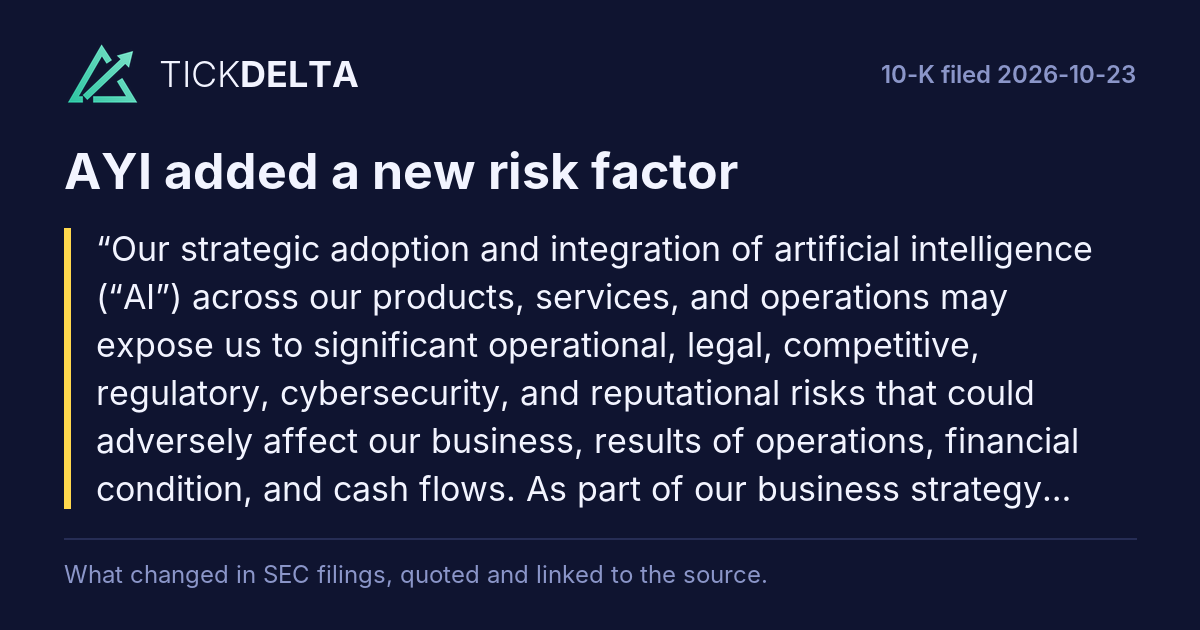
Our strategic adoption and integration of artificial intelligence (“AI”) across our products, services, and operations may expose us to significant operational, legal, competitive, regulatory, cybersecurity, and reputational risks that could adversely affect our business, results of operations, financial condition, and cash flows.
As part of our business strategy, we are increasingly incorporating AI and machine learning technologies into our product offerings, customer-facing solutions, and internal operations to enhance innovation, efficiency, decision-making, and the value we deliver to customers and other stakeholders. We expect AI capabilities to become an increasingly important component of our long-term growth strategy and competitive positioning. However, the development, deployment, adoption, and oversight of AI technologies involve numerous risks and uncertainties. Our competitors may develop, acquire, or deploy AI technologies more rapidly, effectively, or cost-efficiently than we do, which could reduce the competitiveness of our products and services and adversely affect our market position. In addition, AI technologies may not perform as intended and could generate inaccurate, misleading, incomplete, biased, or otherwise unreliable outputs. If AI-assisted content, analyses, recommendations, or decisions are defective or are perceived to be defective, we could experience diminished customer trust, reputational damage, competitive harm, litigation, regulatory scrutiny, or other liabilities.
The use of AI technologies also presents risks relating to intellectual property ownership and infringement, data privacy, data protection, data provenance, cybersecurity, model transparency, ethical use, workforce management, employee relations, and compliance with evolving legal and regulatory requirements. The development and deployment of AI capabilities may require significant investments in technology infrastructure, third-party software, cloud computing resources, data management, and specialized talent, and these investments may not achieve the anticipated benefits or returns. AI systems may increase the complexity of our cybersecurity environment and could introduce new vulnerabilities, including risks associated with unauthorized access to sensitive information, inadvertent disclosure of confidential data, malicious manipulation of AI models, or other cybersecurity incidents. Any such incidents could result in business disruption, legal liability, regulatory penalties, reputational harm, and increased costs.
Further, governments, regulatory bodies, and industry organizations worldwide are actively developing and implementing laws, regulations, standards, and guidance governing the development and use of AI technologies. Existing and future regulatory requirements may impose additional compliance obligations, increase costs, restrict our ability to develop or deploy AI solutions, or expose us to enforcement actions, penalties, or litigation. Failure to effectively manage the risks associated with our strategic adoption of AI, or to realize the anticipated benefits of our AI initiatives, could adversely affect our business, results of operations, financial condition, and cash flows.
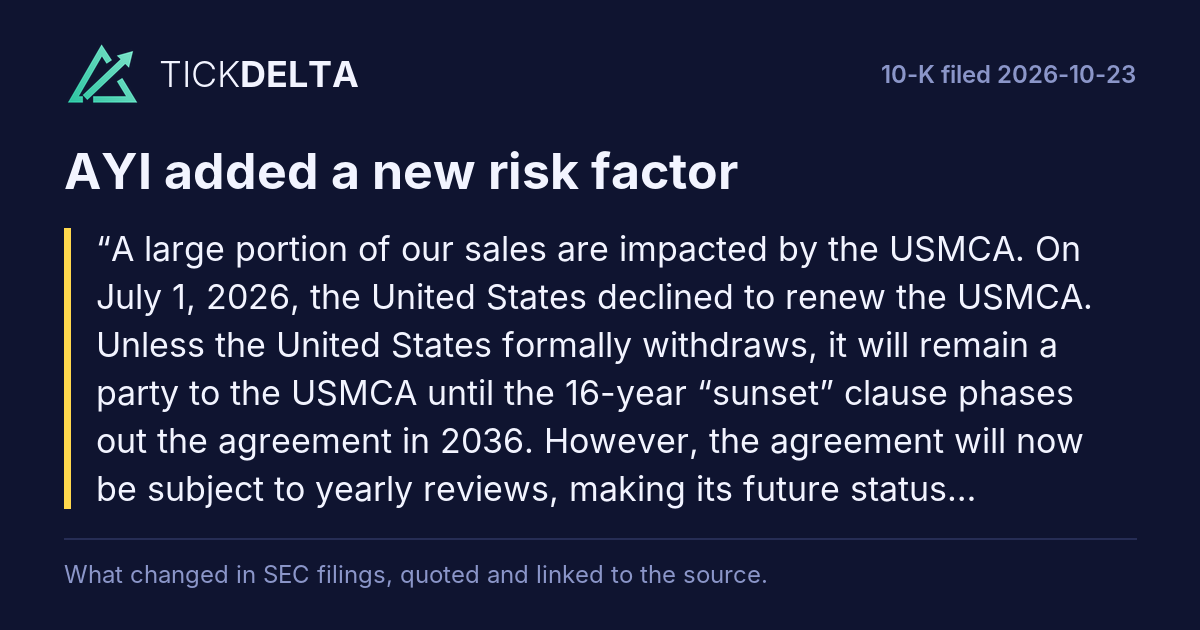
A large portion of our sales are impacted by the USMCA. On July 1, 2026, the United States declined to renew the USMCA. Unless the United States formally withdraws, it will remain a party to the USMCA until the 16-year “sunset” clause phases out the agreement in 2036. However, the agreement will now be subject to yearly reviews, making its future status uncertain.
In addition, the U.S. government has initiated or is considering imposing tariffs on certain foreign goods, including steel, copper, and aluminum, and certain foreign countries. Increased and/or proposed tariffs by the United States have led, and may continue to lead, to the imposition of retaliatory tariffs by other countries.
On February 20, 2026, the United States Supreme Court issued a ruling addressing the validity of certain tariffs implemented under the International Emergency Economic Powers Act (“IEEPA”). In March 2026, the U.S. Court of International Trade issued an additional ruling that importers that paid tariffs under IEEPA are due refunds. While we are entitled to and have received refunds under this ruling, the timing and receipt of future refunds is uncertain.
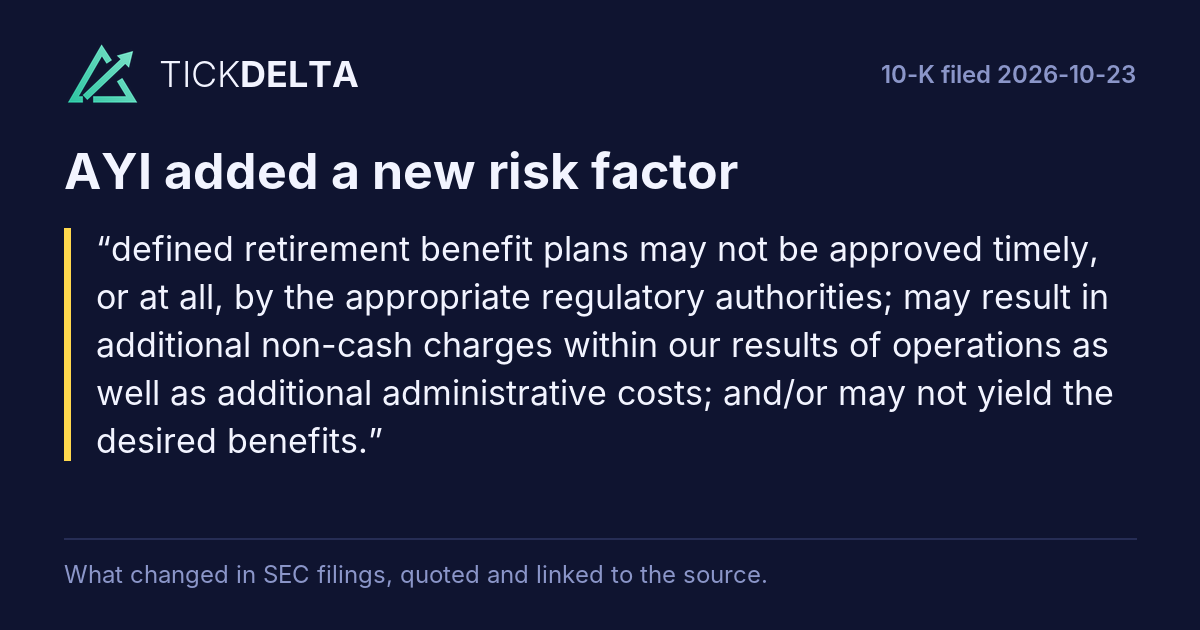
defined retirement benefit plans may not be approved timely, or at all, by the appropriate regulatory authorities; may result in additional non-cash charges within our results of operations as well as additional administrative costs; and/or may not yield the desired benefits.
Paragraphs in the 10-Q filed Jun 25, 2026 that were not in the one before
New in the latest 10-Q
5 paragraphs in the 10-Q filed Jun 25, 2026 with nothing like them in the 10-Q filed Apr 2, 2026 (at least half the words must differ; new numbers alone do not count). Quoted exactly, grouped by the item heading above them. This is text that changed, not a judgement of how serious it is.
Financial statements and notes
Nine Months Ended May 31, 2026 May 31, 2025 ─────────────────────────────────────────────────────────────────────────────────────────────────────────────────────────────────────────────────── Cash flows from operating activities: Net income $ 358.3 $ 282.6 Adjustments to reconcile net income to cash flows from operating activities: Depreciation and amortization 117.8 86.7 Share-based payment expense 39.2 34.0 Asset impairments — 16.7 Changes in operating assets and liabilities, net of acquisitions: Accounts receivable (16.6) 10.4 Inventories 66.9 5.1 Accounts payable (82.5) 38.1 Other operating activities 37.1 (74.7) Net cash provided by operating activities 520.2 398.9 Cash flows from investing activities: Purchases of property, plant, and equipment (58.5) (43.6) Acquisition of business, net of cash acquired — (1,189.4) Other investing activities 0.3 (16.3) Net cash used for investing activities (58.2) (1,249.3) Cash flows from financing activities: Borrowings on credit agreement 200.0 — Borrowings from term loan — 600.0 Repayments of term loan borrowings (400.0) (100.0) Repurchases of common stock (229.9) (91.3) Proceeds from stock option exercises and other 2.9 17.5 Payments of taxes withheld on net settlement of equity awards (28.4) (24.0) Dividends paid (17.7) (15.3) Other financing activities (3.6) (9.3) Net cash (used for) provided by financing activities (476.7) 377.6 Effect of exchange rate changes on cash and cash equivalents 4.1 (1.2) Net change in cash and cash equivalents (10.6) (474.0) Cash and cash equivalents at beginning of period 422.5 845.8 Cash and cash equivalents at end of period $ 411.9 $ 371.8 Supplemental cash flow information: Income taxes paid during the period $ 44.2 $ 118.3 Interest paid during the period $ 27.3 $ 27.5
Read in the 10-Q
Additionally, we will pay a quarterly facility fee based on the average daily amount of the revolving credit facility (regardless of usage), which will be determined, at the Company’s option, by the Company’s leverage ratio or credit rating level.
Read in the 10-Q
We had borrowings outstanding under our credit agreements of $ 200.0 million and $ 400.0 million at May 31, 2026 and August 31, 2025, respectively.
Read in the 10-Q
The Credit Agreement contains a leverage ratio covenant (“Maximum Leverage Ratio”) requiring the ratio of (a) the Company’s consolidated debt (subject to certain adjustments), less unrestricted cash and cash equivalents of the Company and its subsidiaries, to (b) the sum of the Company’s consolidated adjusted earnings before interest, tax, depreciation, and amortization (“EBITDA”) as of the last day of any fiscal quarter to be 3.75 to 1.00 or less, subject to the Company’s right to temporarily increase the maximum leverage ratio to up to 4.25 to 1.00 in connection with certain acquisitions.
Read in the 10-Q
On January 1, 2025, we acquired all of the equity interests of QSC, LLC (“QSC”), a leader in the design,
Read in the 10-Q
The 10-Q's risk factors against the 10-K
Item 1A of the 10-Q filed Jun 25, 2026 against Item 1A of the 10-K filed Oct 27, 2025.
A 10-Q repeats only the risks that changed, so a 10-K paragraph that is missing from it is not counted as removed.
Added is a paragraph with nothing like it in the 10-K, Reworded a sentence that is in both with several words changed,
Quiet changes a sentence in both where one to four words changed and one is a hedge or a modal
(cut words struck through, new words highlighted).
Text on the page, not a score; each links to the filing at sec.gov.
What the 10-Q itself says about its risk factors:There have been no material changes in our risk factors from those disclosed in Part I, Item 1A. Risk Factors of our Form 10-K.
Read in the 10-Q
1 paragraph in the 10-Q's Item 1A, and none of them adds, rewords or quietly edits a paragraph of the 10-K's.
Phrases used for the first time
Two-word phrases in Risk Factors of the 10-K filed Oct 23, 2026 that are in none of the 1 earlier 10-Ks stored, back to Oct 27, 2025
Where each one is used
- strategic adoption: Our strategic adoption and integration of artificial intelligence (“AI”) across our products, services, and operations may expose us to significant operational, legal, competitive, regulatory, cybersecurity, and reputational risks that could adversely affect our business, results of operations, financial condition,...
- regulatory requirements: The use of AI technologies also presents risks relating to intellectual property ownership and infringement, data privacy, data protection, data provenance, cybersecurity, model transparency, ethical use, workforce management, employee relations, and compliance with evolving legal and regulatory requirements. The...
Used at least twice, small words left out. Counted, not picked: a phrase can be new because the company renamed something.
What was taken out
6 paragraphs of last year's Risk Factors with nothing like them now. The longest are quoted.
Sources
Item 1A of each 10-K and 10-Q on EDGAR, quoted exactly. Each paragraph links to the filing at sec.gov.
Also
10-K change: what was reworded or cut, section by section.
Work with it
Excel workbook · CSV. Google Sheet that stays up to date: paste =IMPORTDATA("https://tickdelta.com/company/AYI/export.csv") into a cell.