Form 10-K for the Fiscal Year Ended December 31, 2020
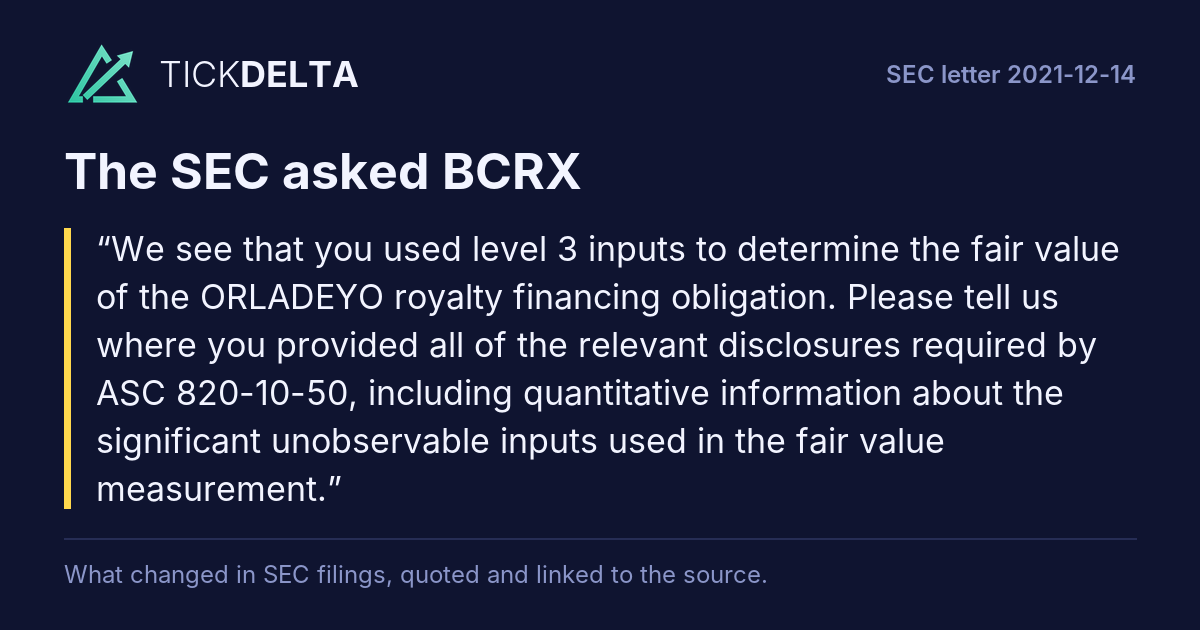
We see that you used level 3 inputs to determine the fair value of the ORLADEYO royalty financing obligation. Please tell us where you provided all of the relevant disclosures required by ASC 820-10-50, including quantitative information about the significant unobservable inputs used in the fair value measurement.
The Company acknowledges the Staff’s comment and respectfully informs the Staff that the ORLADEYO® royalty financing obligation was recorded at fair value as of the transaction date but is then recorded at its carrying value in subsequent periods. As the disclosure requirements in ASC 820 are focused solely on fair value measurements recorded subsequent to the initial recognition, we determined the relevant disclosures of ASC 820-10-50 are not applicable.Read in the reply
As disclosed in
Note 3, the Company recorded the ORLADEYO financing obligation at fair value at the time of the transaction (December 7,Rest of the answer
2020) based on estimated future royalties due, which were based on level 3 unobservable inputs. However, the financing obligation is subsequently recorded at its carrying value in accordance with ASC 470 based on the application of the effective interest method. ASC 470 requires amounts recorded as debt to be amortized under the interest method, and accordingly, the Company determines the effective interest rate based on future royalty payments to be made to the counterparty. In applying the effective interest method, if there is a change in estimated cash flows from future revenue, the Company utilizes the prospective method to periodically assess and adjust the carrying value based on estimated future cash payments. At December 31, 2020, there were no changes to the estimated future cash royalty payments used in the initial estimate to record the fair value as of the transaction date of December 7, 2020.
For clarity, the
Company will revise future filings to include the following enhanced disclosure relative to the ongoing accounting treatment:
The fair value for the royalty financing obligation at the time of the transaction was based on the Company’s estimates of future royalties expected to be paid to the counterparty over the life of the arrangement. The Company subsequently records the obligation at its carrying value using the effective interest method. In order to amortize the royalty financing obligation, the Company utilizes the prospective method to estimate the future royalties to be paid by the Company to the counterparty over the life of the arrangement. Under the prospective method, a new effective interest rate is determined based on the revised estimate of remaining cash flows. The new rate is the discount rate that equates the present value of the revised estimate of remaining cash flows with the carrying amount of the debt, and it will be used to recognize interest expense for the remaining periods. The Company periodically assesses the amount and timing of expected royalty payments using a combination of internal projections and forecasts from external sources. To the extent such payments are greater or less than our initial estimates or the timing of such payments is materially different than its original estimates, the Company will prospectively adjust the amortization of the royalty financing obligation and the effective interest rate.
If you have any additional questions or comments or require further information with respect to the foregoing, please call the undersigned at (919) 859-7930 or Brian
Lane of Gibson, Dunn & Crutcher LLP at (202) 887-3646.
First report after the company's reply of Jan 14, 2022: 10-K filed Feb 28, 2022 ↗, against the 10-K filed Mar 1, 2021 ↗.
Tickdelta does not hold the text of both reports, so they are not compared here.
Also in this review: closing letter, 2022-01-18