Screener / SEC EDGAR /CIK 0000882796 /10-K filed Feb 26, 2026, compared with Feb 25, 2025 /Numbers from the XBRL of the 10-Ks
Nasdaq Health care · Biotechnology

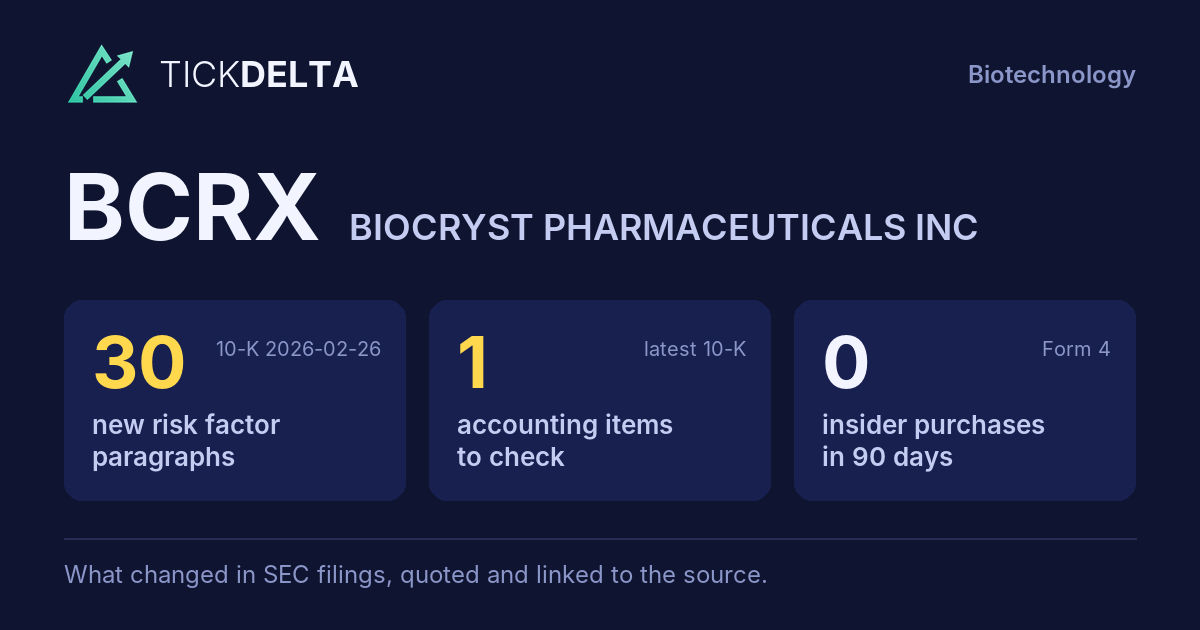
Biocryst Pharmaceuticals Inc BCRX

Compare with peers Embed
New in the 10-K 30 paragraphs with nothing like them in the 10-K filed Feb 25, 2025 New in the 10-Q 29 paragraphs not in the 10-Q filed Aug 5, 2026 10-Q against the 10-K 71 risk factor paragraphs and sentences added or reworded

New risk paragraphs, branching off last year

Each branch is a paragraph in Risk Factors with nothing like it in the 10-K filed Feb 25, 2025. A box jumps to the paragraph as filed, below.

30 new

Paragraphs with nothing like them in last year's 10-K

Quoted exactly

30 paragraphs in Risk Factors of the 10-K filed Feb 26, 2026 with nothing like them in the 10-K filed Feb 25, 2025. Quoted exactly. Paragraphs that were only edited are under 10-K change.

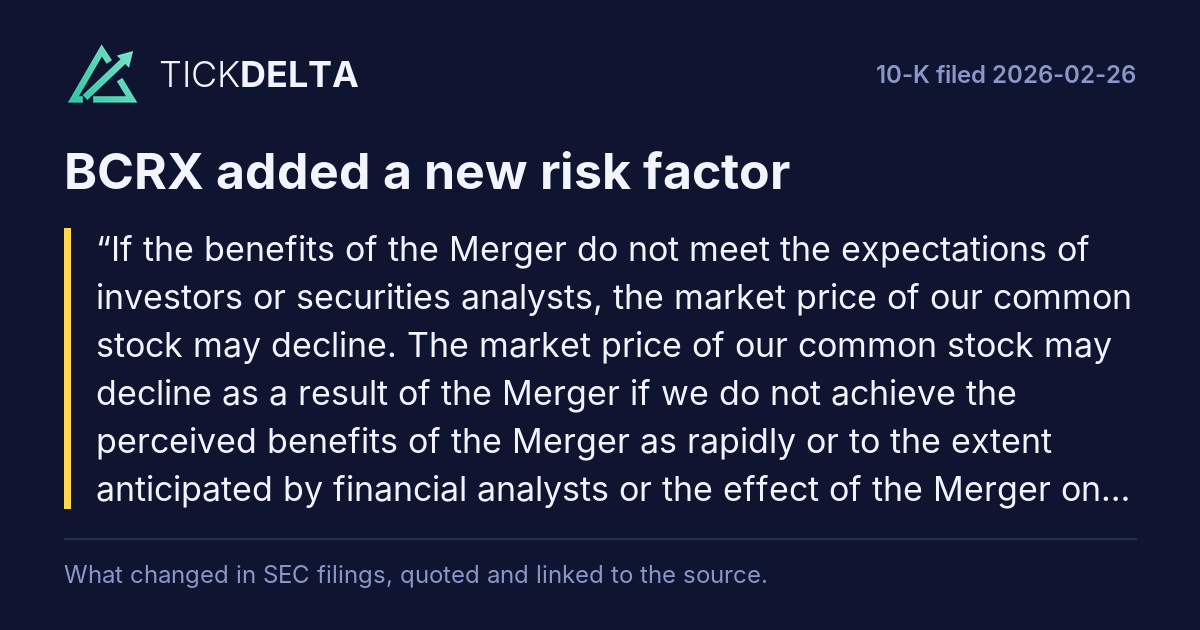
If the benefits of the Merger do not meet the expectations of investors or securities analysts, the market price of our common stock may decline.

The market price of our common stock may decline as a result of the Merger if we do not achieve the perceived benefits of the Merger as rapidly or to the extent anticipated by financial analysts or the effect of the Merger on our financial results is not consistent with the expectations of financial analysts. Accordingly, holders of our common stock following the consummation of the Merger may experience a loss as a result of a decline in the market price of such common stock. In addition, a decline in the market price of our common stock following the consummation of the Merger could adversely affect our ability to issue additional securities if needed and to obtain additional financing in the future.

Combining Astria with our business may be more difficult, costly or time consuming than expected and the combined company may fail to realize the anticipated benefits and synergies of the Merger.

The success of the Merger will depend, in part, on the ability to realize the anticipated benefits and cost savings from combining our business and Astria’s business. To realize the anticipated benefits and synergies from the Merger, we must successfully integrate and combine our businesses in a manner that permits those benefits and synergies to be realized. If we are not able to successfully achieve these objectives, the anticipated benefits of the Merger may not be realized fully or

at all or may take longer to realize than expected. In addition, the actual cost savings and anticipated benefits of the Merger could be less than anticipated, and integration may result in additional unforeseen expenses.

An inability to realize the full extent of the anticipated benefits of the Merger, as well as any delays encountered in the integration process, could have an adverse effect on the revenues, levels of expenses and operating results of the combined company, which may adversely affect the value of our common stock.

Prior to completion of the Merger, we and Astria have operated independently. It is possible that the integration process could result in the loss of key employees, the disruption of our business or inconsistencies in standards, controls, procedures and policies that adversely affect our ability to maintain relationships with employees and counterparties or to achieve the anticipated benefits and cost savings of the Merger. Integration efforts may also divert management attention during this transition period, which may have an adverse effect on our Company.

We are in the early stages of integrating Astria into our business, and unknown or unanticipated risks associated with Astria’s business or product candidates could adversely affect us.

Although we conducted due diligence on Astria prior to consummation of the Merger, we are still relatively new to Astria’s business and its operations, including its product candidates. As a result, we may not yet be aware of all material risks, liabilities, or challenges associated with Astria’s business or product candidates (in particular, navenibart), including risks that were not identified or fully appreciated during our due diligence process. There can be no assurance that our due diligence identified all risks, liabilities, or other material matters, that all material issues that could be uncovered through a customary level of due diligence were identified, or that factors outside of our control will not later arise. Even where due diligence successfully identifies certain risks, unexpected risks may arise, and previously known risks may materialize in a manner that is inconsistent with our preliminary risk assessments or assumptions.

We expect that we will incur substantial expenses in connection with completion of the Merger and combining the business, operations, networks, systems, technologies, policies and procedures of the two companies. Although we have assumed that a certain level of transaction and combination expenses will be incurred, there are a number of factors beyond our control that could affect the total amount or the timing of our combination expenses. There can be no assurance that the anticipated benefits related to the integration of Astria with our business will be realized to offset these transaction and integration expenses over time.

Issuance of shares of our common stock in connection with the Merger may adversely affect the market price of our common stock.

In connection with the payment of the merger consideration, we issued 17.5% of the shares of our common stock issued and outstanding immediately prior to the effective time of the Merger. The issuance of these new shares of our common stock may result in fluctuations in the market price of our common stock, including a stock price decrease. In addition, former Astria stockholders or holders of other Astria securities may decide not to hold the shares of our common stock that they have received in connection with the Merger, and our stockholders may decide to reduce their investment in us as a result of the changes to our investment profile as a result of the Merger, which may result in further fluctuations in the market price of our common stock, including a stock price decrease.

Read in the 10-K

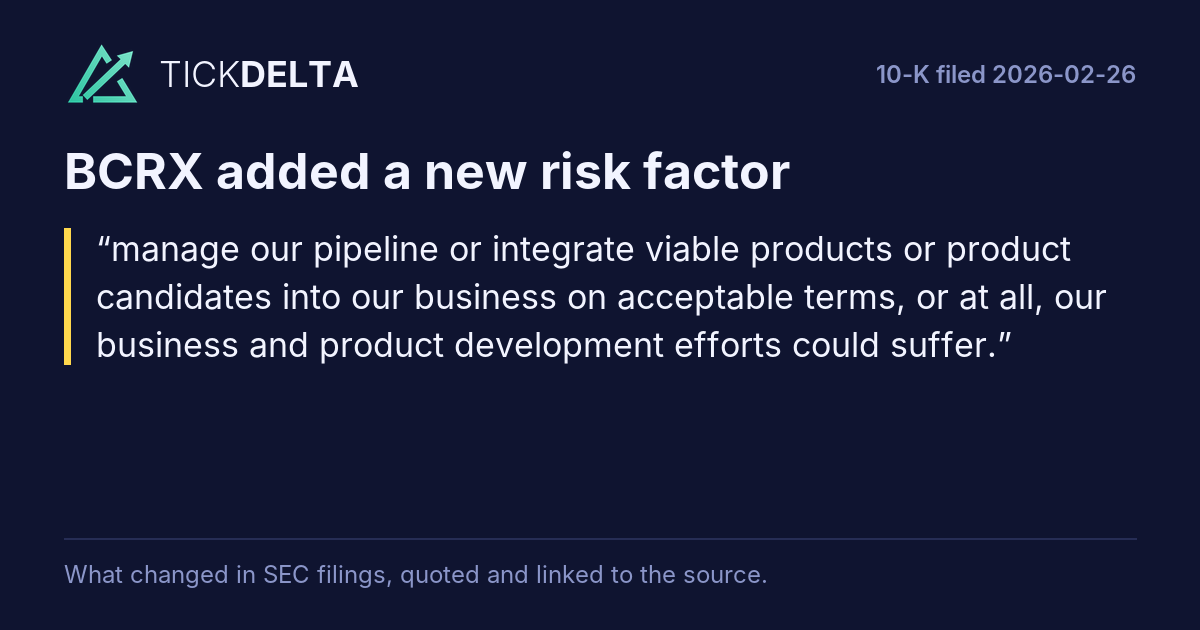
manage our pipeline or integrate viable products or product candidates into our business on acceptable terms, or at all, our business and product development efforts could suffer.

Read in the 10-K

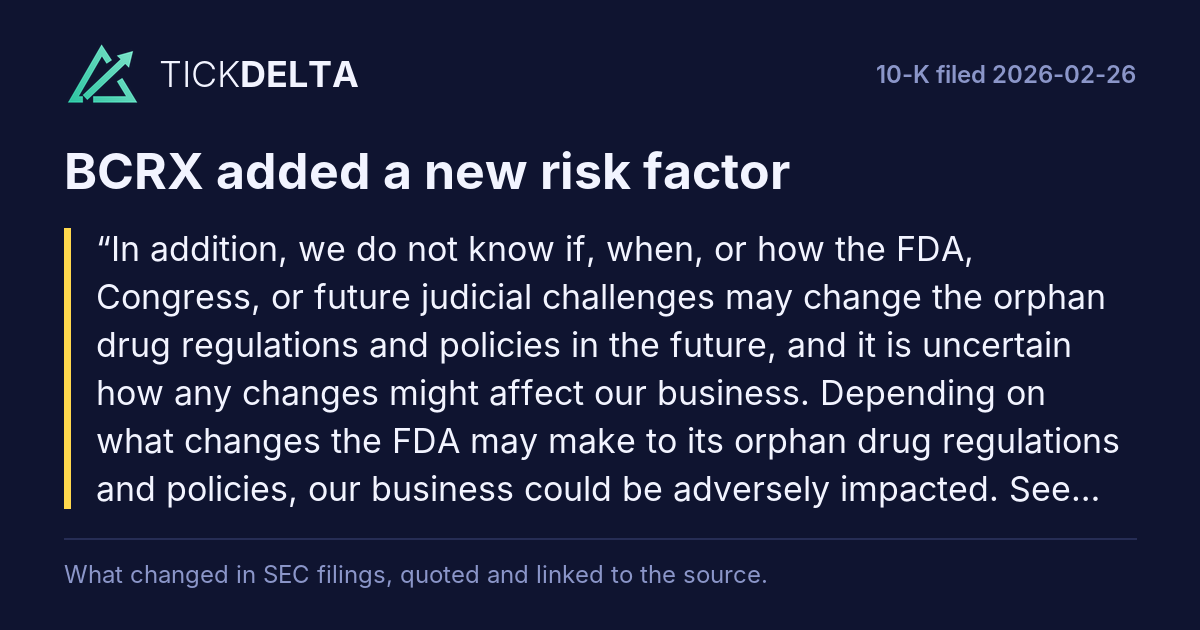
In addition, we do not know if, when, or how the FDA, Congress, or future judicial challenges may change the orphan drug regulations and policies in the future, and it is uncertain how any changes might affect our business. Depending on what changes the FDA may make to its orphan drug regulations and policies, our business could be adversely impacted. See “Business—Government Regulation—FDA Regulation—Orphan Drugs” in Part 1, Item 1 of this report.

Read in the 10-K

reference to all of the nonclinical studies and adequate and well-controlled clinical trials necessary to demonstrate safety and effectiveness. Manufacturers may seek to launch generic drugs following the expiration of the marketing exclusivity period, even if we still have patent protection for such drugs.

Read in the 10-K

We may face competition from biosimilars, which may have a material adverse impact on the future commercial prospects of our biological products and product candidates.

Even if we are successful in achieving regulatory approval to commercialize a biological product candidate faster than our competitors, we may face competition from biosimilars with respect to our biological product candidates. In the United States, the BPCIA was included in the ACA and created an abbreviated approval pathway for biological products that are demonstrated to be “highly similar,” or biosimilar, to or “interchangeable” with an FDA-approved biological product. The BPCIA prohibits the FDA from approving a biosimilar or interchangeable product that references a brand biological product until 12 years after the licensure of the reference product, but permits submission of an application for a biosimilar or interchangeable product to the FDA four years after the reference product was first licensed. The BPCIA does not prevent another company from developing a product that is highly similar to the innovative product, generating its own data, and seeking approval. The law is complex and continues to evolve through ongoing FDA implementation and judicial interpretation. As a result, its ultimate impact, implementation and meaning are subject to uncertainty. Modification of the BPCIA, or changes to the interpretation or implementation of the BPCIA, could have a material adverse effect on the future commercial prospects for our biological products and product candidates.

If competitors are able to obtain marketing approval for biosimilars referencing our biological products, our biological products may become subject to competition from such biosimilars, with the attendant competitive pressure and consequences which could adversely affect our business and financial results.

Read in the 10-K
Show the other 9

•our partners may declare bankruptcy or face other financial distress that could put our partnership or collaborative arrangements at risk, such as Clearside’s recent filing for Chapter 11 bankruptcy; and

Read in the 10-K

The process of manufacturing pharmaceutical products, devices and, in particular, biologics, is complex, highly regulated, and subject to multiple risks. Manufacturing biologics is highly susceptible to product loss due to contamination, equipment failure, improper installation or operation of equipment, vendor or operator error, inconsistency in yields, variability in product characteristics, difficulties in scaling the production process and use of excipients which may, among other things, impact shelf life and present concerns with process controls. Even minor deviations from normal manufacturing processes could result in reduced production yields, product defects, other supply disruptions and higher costs. If microbial, viral or other contaminations are discovered at the facilities of our third-party contract manufacturers, such facilities may need to be closed for an extended period of time to investigate and remedy the contamination, which could delay clinical trials, result in higher costs of drug product and adversely affect our business.

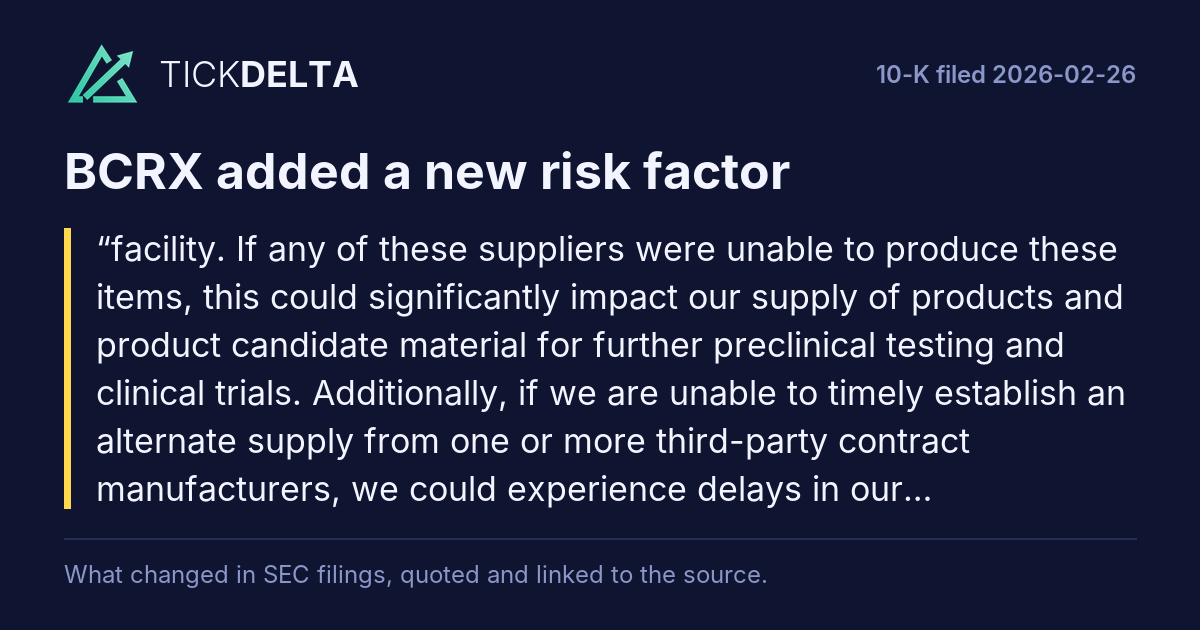
Read in the 10-K

facility. If any of these suppliers were unable to produce these items, this could significantly impact our supply of products and product candidate material for further preclinical testing and clinical trials. Additionally, if we are unable to timely establish an alternate supply from one or more third-party contract manufacturers, we could experience delays in our development efforts as we seek to locate and qualify new or additional manufacturers. For particular products, product candidates, services or particular regions where we rely on a single vendor, these and other related risks are exacerbated for us.

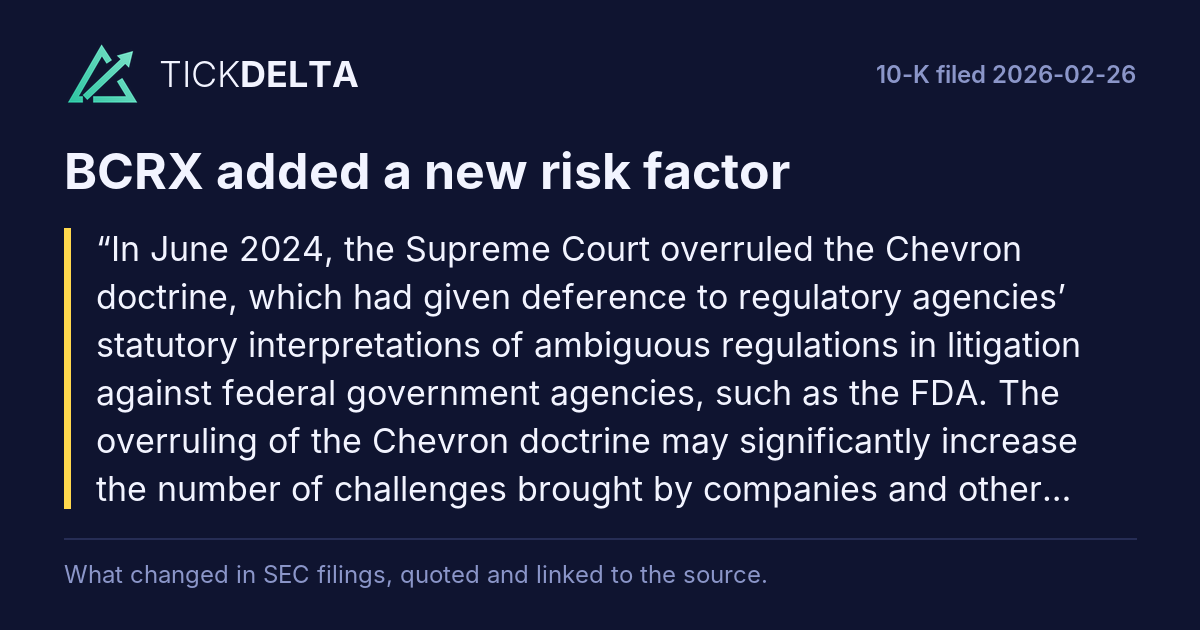
Read in the 10-K

In June 2024, the Supreme Court overruled the Chevron doctrine, which had given deference to regulatory agencies’ statutory interpretations of ambiguous regulations in litigation against federal government agencies, such as the FDA. The overruling of the Chevron doctrine may significantly increase the number of challenges brought by companies and other stakeholders against federal agencies such as the FDA and its longstanding decisions and policies, including the FDA’s statutory interpretations of market exclusivities and the “substantial evidence” requirements for drug approvals, which could undermine the FDA’s authority, lead to uncertainties in the industry, and disrupt the FDA’s normal operations, any of which could delay the FDA’s review of regulatory submissions. We cannot predict the full impact of this decision, future judicial challenges brought against the FDA, or the nature or extent of government regulation that may arise from future legislation or administrative action.

Further, under the new leadership at HHS under the current administration, agency reorganization, mass layoffs due to the reduction in force initiative and other measures may impact the normal operations of the FDA as well as other federal agencies. FDA may lack adequate staff and resources to meet current review, approval, and inspection schedules, which could delay our anticipated timelines. Recent developments at the FDA include announcement of a plan to phase out animal testing for monoclonal antibodies and certain other drugs, the proposed rare disease evidence principles (RDEP) program to facilitate approval of drugs to treat rare diseases with very small patient populations with significant unmet medical need and with a known genetic defect that is the major driver of the pathophysiology, and the announcement of a new Commissioner’s National Priority Voucher program for companies supporting certain U.S. national health priorities and interests. To the extent our competitors are selected for this new voucher pilot program, or are otherwise able to participate in any of these initiatives intended to accelerate drug development and application review, and obtain faster approval than us, our competitive position may be harmed. The FDA has also increased its scrutiny of foreign drug manufacturing facilities and other contractors based in China, especially with respect to the transfer of biological materials, genetic data, and other sensitive data of U.S. patients to parties located in China. It is unclear how our industry and our clinical programs will be impacted by policies and regulations implemented under the current administration and FDA

leadership, or other executive orders. There is significant uncertainty in the industry and how federal agencies like the FDA will change in the coming years under the current administration. To the extent the agency reorganization and other agency changes lead to disruptions in the FDA’s operations, our correspondence and regulatory review processes with the FDA may be materially delayed.

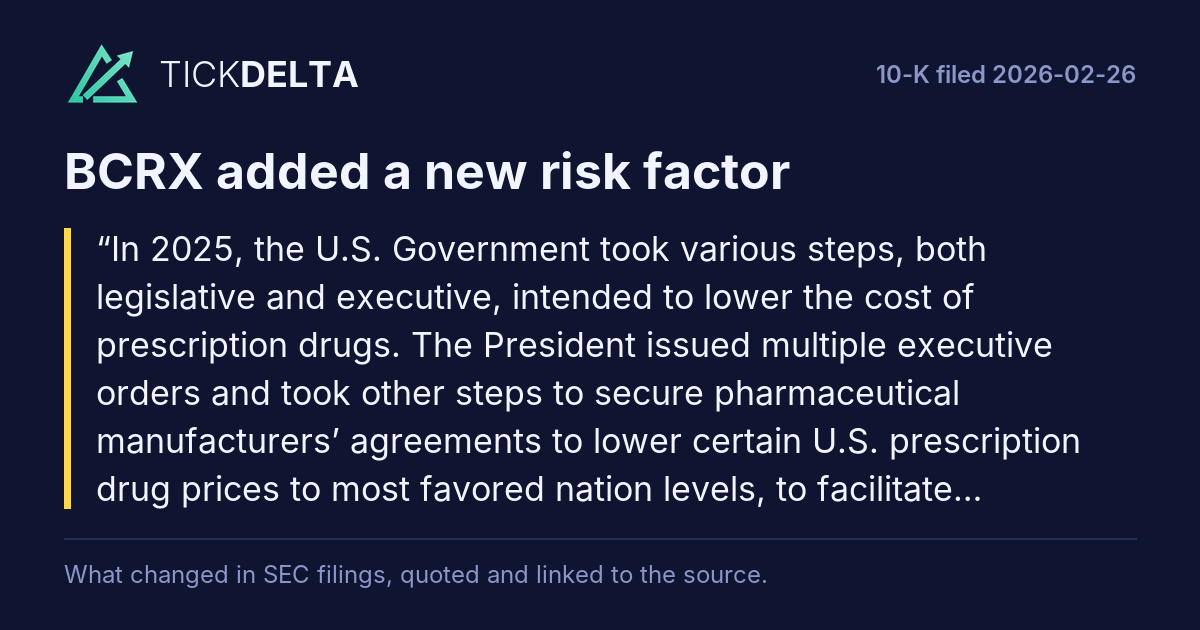
Read in the 10-K

In 2025, the U.S. Government took various steps, both legislative and executive, intended to lower the cost of prescription drugs. The President issued multiple executive orders and took other steps to secure pharmaceutical manufacturers’ agreements to lower certain U.S. prescription drug prices to most favored nation levels, to facilitate direct-to-patient sales of certain U.S. prescription drugs, and to secure agreements to repatriate increased ex-U.S. revenues generated as a result of U.S. Government action that increases drug prices outside the United States. On July 4, 2025, the One Big Beautiful Bill Act (“OBBBA”) was signed into law in the United States. The OBBBA contains a variety of provisions that could impact our business and results of operations. On January 15, 2026, the White House proposed that Congress enact the Great Healthcare Plan Act, which seeks to lower prescription drug and insurance prices. Multiple U.S. states have also enacted legislation intended to decrease the price of prescription drugs.

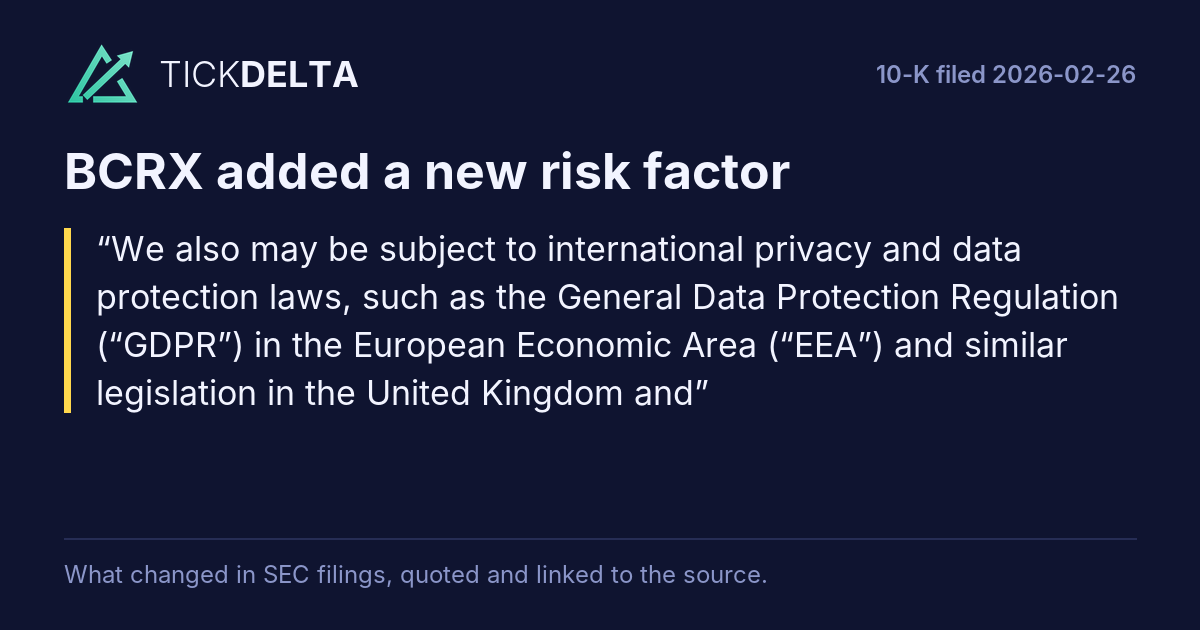
Read in the 10-K

We also may be subject to international privacy and data protection laws, such as the General Data Protection Regulation (“GDPR”) in the European Economic Area (“EEA”) and similar legislation in the United Kingdom and

Read in the 10-K

On January 23, 2026, we entered into a Loan Agreement (the “Blackstone Loan Agreement”) with Blackstone Alternative Credit Advisors LP and Blackstone Life Science Advisors L.L.C., (together, “Blackstone”), as the Blackstone representatives thereunder, the guarantors from time to time party thereto, the lenders from time to time party thereto, and Wilmington Trust, National Association, as agent, pursuant to which the lenders funded initial term loans in the aggregate principal amount of $400.0 million. Subject to the mutual agreement between the Company, Blackstone and the lenders, we may request additional term loans up to an aggregate amount not exceeding $150.0 million. Under the Blackstone Loan Agreement, we will be required to pay to the lenders a prepayment premium or a make-whole premium, as applicable in the event that, prior to the fourth anniversary of the closing date of the Blackstone Loan Agreement, we prepay or repay, or are required to prepay or repay, voluntarily or pursuant to a mandatory prepayment obligation under the Blackstone Loan

Read in the 10-K

healthcare system upon which our business relies could adversely affect our business if such disruption is widespread and continues for an extended period of time.

Read in the 10-K

Our ability to maintain global brand uniformity for ORLADEYO may be impacted by the sale of our European ORLADEYO business.

In connection with the sale of our European ORLADEYO business, we entered into the Global Brand and Support Agreement, which provides for coordination of brand and regulatory activities regarding ORLADEYO products. While this agreement is intended to promote alignment on brand and related activities with Neopharmed, we do not have sole control over how ORLADEYO is positioned, supported or communicated in Europe, and we may not be able to maintain global brand uniformity with respect to ORLADEYO. This risk may be heightened given that ORLADEYO is indicated for a rare disease with a limited number of key opinion leaders and relatively few scientific publications or forums that reach a broad global audience. If we are unable to maintain a consistent and effective global brand presence for ORLADEYO, our ability to maximize the anticipated benefits of the sale, support future growth and realize the expected long‑term value of ORLADEYO could be adversely affected.

Read in the 10-K

Paragraphs in the 10-Q filed Nov 4, 2026 that were not in the one before

New in the latest 10-Q

29 paragraphs in the 10-Q filed Nov 4, 2026 with nothing like them in the 10-Q filed Aug 5, 2026 (at least half the words must differ; new numbers alone do not count). Quoted exactly, grouped by the item heading above them. This is text that changed, not a judgement of how serious it is.

10-Q

• plans, programs, progress and potential success of our collaborations and license agreements;

Read in the 10-Q

Financial statements and notes

The Company classifies its long-lived assets to be sold as held for sale when the six criteria in Accounting Standards Codification (“ASC”) Topic 360, Property, Plant and Equipment (“Topic 360”) are met. This generally occurs when an agreement to sell exists, or when management has committed to a plan to sell the assets within one year. Assets and liabilities to be disposed of together as a group in a single transaction (a “disposal group”) are classified as held for sale if their carrying amounts are principally expected to be recovered through a sale transaction rather than through continuing use.

Read in the 10-Q

The long-lived assets included in a disposal group are reported at the lower of their carrying value or fair value less cost to sell, beginning in the period the held for sale criteria are met. Prior to disposal, losses are recognized for any initial or subsequent write-down to fair value less cost to sell. Any gains or losses not previously recognized that result from the sale of a disposal group shall be recognized at the date of sale. Upon designation as an asset held for sale, the Company stops recording depreciation and amortization expense on long-lived assets. The Company assesses the fair value of a long-lived asset less any costs to sell at each reporting period and until the asset is no longer classified as held for sale.

Read in the 10-Q

Revenues from product sales are recorded at the net selling price (transaction price), which includes estimates of variable consideration, including government and managed care rebates, chargebacks, co-payment and patient assistance, quick starts, and product returns. Variable consideration is estimated using the expected value method and is included in

Read in the 10-Q

net product revenues only to the extent that it is probable that a significant reversal of cumulative revenue recognized will not occur. Estimates are reassessed each reporting period, and adjustments are recognized in the period identified.

Read in the 10-Q
Show the other 24

Chargebacks. Chargebacks represent the Company's estimated obligations arising from contractual commitments to provide products to government agencies at prices lower than those charged to the Company's specialty pharmacy. The specialty pharmacy submits chargeback claims for the difference between the price paid to the Company and the applicable government-mandated price. The Company estimates chargebacks and records such amounts as reductions of gross product revenues and trade receivables at the time revenue is recognized.

Read in the 10-Q

Product returns. The Company generally does not accept returns from end customers and will accept returns from its specialty pharmacy only in limited circumstances including product defects, recalls, shipment damage, and certain other specified situations. The Company estimates expected returns and records a reserve at the time product revenue is recognized. Based on historical experience and the limited nature of allowable returns, the reserve has not been material.

Read in the 10-Q

of this standard did not have a material effect on the Company’s Condensed Consolidated Balance Sheet, Condensed Consolidated Statement of Comprehensive Income (Loss), or Condensed Consolidated Statement of Cash Flows.

Read in the 10-Q

administrative expense in the Condensed Consolidated Statement of Comprehensive Income (Loss) for the nine months ended September 30, 2026.

Read in the 10-Q

The Company expects activities related to the Birmingham Closure Plan to be substantially completed by December 31, 2026, except for ongoing obligations under the Birmingham facility lease.

Read in the 10-Q

In addition, the Company recognized incremental stock-based compensation expense of $ 997 during the three and nine months ended September 30, 2026 related to modifications of equity awards for certain impacted employees.

Read in the 10-Q

In connection with the Birmingham Closure Plan, the Company entered into agreements to sell the owned property and equipment associated with the Birmingham facility. As of September 30, 2026, the related disposal group met the criteria for classification as held for sale under Topic 360. Accordingly, an impairment charge of $ 1,526 was recognized in research and development expense in the Condensed Consolidated Statements of Comprehensive Income (Loss) during the three and nine months ended September 30, 2026 to reduce the carrying value of the disposal group to its fair value less costs to sell. As of September 30, 2026, the property and equipment disposal group was classified as held for sale in the Condensed Consolidated Balance Sheet.

Read in the 10-Q

The Company has lease arrangements associated with its Birmingham facility and certain equipment. As part of the Birmingham Closure Plan, the Company committed to a plan to vacate the Birmingham facility and cease use of the leased equipment. As a result of the decision to vacate the facility, the Company was no longer reasonably certain to exercise the optional extension periods under the facility lease. In accordance with Topic 842, the Company reassessed the facility lease term to exclude the optional extension periods and remeasured the related lease liability using the revised lease term and discount rate, resulting in a $ 2,827 reduction to both the right of use asset and lease liability as of September 30, 2026.

Read in the 10-Q

Following the lease remeasurement, the planned actions were also determined to be indicators of impairment under Topic 360. Accordingly, the Company evaluated the facility asset group, which included the facility right of use asset and related leasehold improvements, for recoverability and concluded that its carrying amount was not recoverable. The carrying amounts of the assets were therefore reduced to their estimated fair values of zero. The Company also evaluated the right of use assets associated with the leased equipment for impairment and reduced their carrying amounts to their estimated fair values of zero. As a result, the Company recognized impairment charges of $ 3,279 related to right of use assets and $ 4,733 related to leasehold improvements in research and development expense in the Condensed Consolidated Statements of Comprehensive Income (Loss) during the three and nine months ended September 30, 2026.

Read in the 10-Q

The Company considers events or transactions that occur after the balance sheet date but prior to the issuance of the condensed consolidated financial statements to provide additional evidence for certain estimates or to identify matters that require additional disclosure. The Company has concluded that no subsequent events have occurred that require disclosure.

Read in the 10-Q

On August 25, 2026, we announced that Japan’s Ministry of Health, Labor and Welfare granted marketing approval for ORLADEYO for prophylactic therapy in pediatric patients with HAE aged 2 to <12 years.

Read in the 10-Q

On October 21, 2026, we announced that the FDA approved the supplemental new drug application for use of the 150 mg oral pellet formulation of once-daily ORLADEYO for prophylactic therapy in adults and adolescents aged 12 years and older.

Read in the 10-Q

On October 5, 2026, we announced the formation of a Scientific Advisory Board (“SAB”) comprising seven accomplished scientific and industry leaders with deep expertise across rare disease research and drug development. The SAB will provide independent scientific and strategic guidance as we aim to advance our research and development strategy and build a high value novel drug pipeline.

Read in the 10-Q

• $29.6 million increase in ORLADEYO revenue, excluding revenues associated with our European ORLADEYO business, primarily due to the transition to a new sole source specialty pharmacy for ORLADEYO shipments to patients in the United States in the third quarter of 2026, as well as growth in the underlying U.S. business (reflecting an increase in net price and higher volume of oral pellets for pediatric patients, partially offset by lower capsule shipments). Unlike the previous specialty pharmacy arrangement, the new specialty pharmacy takes title to and maintains inventory of ORLADEYO prior to dispensing to patients and is required to maintain 7-21 days of inventory on hand. In connection with the transition, the new specialty pharmacy established its initial inventory position in the third quarter of 2026, and the related purchases contributed favorably to revenues during the period in an amount in the upper teens of millions of dollars. As of September 30, 2026, inventory levels at the new specialty pharmacy were at the lower end of the required range; and

Read in the 10-Q

• $69.9 million increase in ORLADEYO revenue, excluding revenues associated with our European ORLADEYO business, primarily due to the transition to a new sole source specialty pharmacy for ORLADEYO shipments to patients in the United States in the third quarter of 2026, as well as growth in the underlying U.S. business (reflecting an increase in net price and higher volume of capsules and oral pellets for pediatric patients). Unlike the previous specialty pharmacy arrangement, the new specialty pharmacy takes title to and maintains inventory of ORLADEYO prior to dispensing to patients and is required to maintain 7-21 days of inventory on hand. In connection with the transition, the new specialty pharmacy established its initial inventory position in the third quarter of 2026, and the related purchases contributed favorably to revenues during the period in an amount in the upper teens of millions of dollars. As of September 30, 2026, inventory levels at the new specialty pharmacy were at the lower end of the required range; and

Read in the 10-Q

These increases were partially offset by $3.3 million decrease in manufacturing support related costs.

Read in the 10-Q

For the three months ended September 30, 2026, income tax expense was $0.7 million compared to an income tax benefit of $0.8 million for the three months ended September 30, 2025. The increase in income tax expense was primarily due to the tax benefit recognized in the third quarter of 2025 resulting from the enactment of the One Big Beautiful Bill Act (“OBBBA”) during the three months ended September 30, 2025 which allowed additional taxable deductions for domestic research and development expenditures.

Read in the 10-Q

As of September 30, 2026, our principal sources of liquidity consisted of cash, cash equivalents and available-for-sale investments totaling $375.0 million, cash generated from ORLADEYO sales, the potential for additional term loans

Read in the 10-Q

Revenues from product sales are recorded at the net selling price (transaction price), which includes estimates of variable consideration including government and managed care rebates, chargebacks, co-payment and patient assistance, quick starts, and product returns. Variable consideration is estimated using the expected value method and is included in product sales, net only to the extent that it is probable that a significant reversal of cumulative revenue recognized will not occur. Estimates are reassessed each reporting period. If actual results vary from estimates, adjustments are recognized, which would affect net product revenue and earnings in the period identified.

Read in the 10-Q

Risk Factors

• pricing and availability of imports or alternative products, including the potential for parallel importing;

Read in the 10-Q

leadership, or other executive orders. There is significant uncertainty in the industry and how federal agencies like the FDA will change in the coming years under the current administration. To the extent the agency reorganization and other agency changes lead to disruptions in the FDA’s operations, our correspondence and regulatory review processes with the FDA may be materially delayed.

Read in the 10-Q

litigation; fines and penalties; disruptions of our business operations; reputational harm; loss of revenue or profits; and other adverse business consequences.

Read in the 10-Q

attend. The risk management committee, along with the other sub-committees in the Company, identifies key risks and mitigation strategies which are reported directly to our senior management, the Audit Committee and to the full Board of Directors on a regular basis.

Read in the 10-Q

expenses, related to activist stockholder matters. Our stock price could be subject to significant fluctuation or otherwise be adversely affected by the events, risks and uncertainties of any stockholder activism.

Read in the 10-Q

The 10-Q's risk factors against the 10-K

Item 1A of the 10-Q filed Nov 4, 2026 against Item 1A of the 10-K filed Feb 26, 2026. A 10-Q repeats only the risks that changed, so a 10-K paragraph that is missing from it is not counted as removed. Added is a paragraph with nothing like it in the 10-K, Reworded a sentence that is in both with several words changed, Quiet changes a sentence in both where one to four words changed and one is a hedge or a modal (cut words struck through, new words highlighted). Text on the page, not a score; each links to the filing at sec.gov.

Added10-Q Nov 4, 2026 vs 10-K Feb 26, 2026
which, if severe and sustained, could have a material and adverse impact on our results of operations and cash flows and limit our ability to continue development and commercialization of our products and product candidates.

Read it in the 10-Q at sec.gov

Added10-Q Nov 4, 2026 vs 10-K Feb 26, 2026
The anticipated benefits and synergies of the Merger may not be realized, and risks associated with Astria’s business, including the navenibart program, could adversely affect our business and financial results.

Read it in the 10-Q at sec.gov

Added10-Q Nov 4, 2026 vs 10-K Feb 26, 2026
The success of the Merger depends, in part, on our ability to realize the anticipated benefits, cost savings and synergies of the transaction. While we have generally completed the integration of Astria with our business, the benefits may not be realized fully or at all, may take longer to realize than expected, or may not offset transaction and integration expenses over time. An inability to realize the full extent of the anticipated benefits of the Merger could have an adverse effect on our revenues and expenses.

Read it in the 10-Q at sec.gov

Added10-Q Nov 4, 2026 vs 10-K Feb 26, 2026
any of the foregoing risks is realized, our business, financial condition and results of operations could be materially adversely affected.

Read it in the 10-Q at sec.gov

Added10-Q Nov 4, 2026 vs 10-K Feb 26, 2026
• delays in regulatory approvals, product launches, initial shipments, or ongoing supply arising from manufacturing, formulation, or supply chain issues could impede our ability to meet commercial expectations; and

Read it in the 10-Q at sec.gov

Show the other 24
Added10-Q Nov 4, 2026 vs 10-K Feb 26, 2026
We have experienced significant changes in the scope of our operations and capabilities. In addition, we may continue to change certain aspects of our business in connection with acquisitions, licenses, collaborations or other strategic business development activities. As a result, we may encounter difficulties in managing such changes, which could disrupt our operations.

Read it in the 10-Q at sec.gov

Added10-Q Nov 4, 2026 vs 10-K Feb 26, 2026
While Royalty Sub continues to pay the holders of the PhaRMA Notes any royalty payments received from Shionogi, which are immaterial, we wrote off the balance due under the PhaRMA Notes to other income as a debt extinguishment as of December 31, 2021.

Read it in the 10-Q at sec.gov

Added10-Q Nov 4, 2026 vs 10-K Feb 26, 2026
litigation; fines and penalties; disruptions of our business operations; reputational harm; loss of revenue or profits; and other adverse business consequences.

Read it in the 10-Q at sec.gov

Added10-Q Nov 4, 2026 vs 10-K Feb 26, 2026
attend. The risk management committee, along with the other sub-committees in the Company, identifies key risks and mitigation strategies which are reported directly to our senior management, the Audit Committee and to the full Board of Directors on a regular basis.

Read it in the 10-Q at sec.gov

Added10-Q Nov 4, 2026 vs 10-K Feb 26, 2026
Our strategic shift to focus on external innovation, including in connection with the Birmingham Closure Plan, may increase our reliance on acquisitions, strategic investments, partnerships or other business development transactions to expand our product candidate pipeline. We may not identify suitable opportunities, complete transactions on acceptable terms or at all, or realize the anticipated operational, financial or strategic benefits of any such transactions or related initiatives on the expected timeline or at all. Additionally, actual costs of the Birmingham Closure Plan may exceed our estimates, anticipated savings may not be realized or may be offset by costs associated with external innovation, business development, acquired or licensed programs or other strategic priorities, and the closure of our Birmingham facility and related workforce reduction may result in the loss of institutional knowledge or technical expertise, adversely affect employee morale or retention, divert management attention or disrupt our operations. If we do not execute this strategy effectively, our business, financial condition, results of operations, liquidity and ability to execute our strategic priorities could be adversely affected.

Read it in the 10-Q at sec.gov

Added10-Q Nov 4, 2026 vs 10-K Feb 26, 2026
expenses, related to activist stockholder matters. Our stock price could be subject to significant fluctuation or otherwise be adversely affected by the events, risks and uncertainties of any stockholder activism.

Read it in the 10-Q at sec.gov

Reworded10-Q Nov 4, 2026 vs 10-K Feb 26, 2026
Under the Blackstone Loan Agreement, we will be required to pay to the lenders a prepayment premium or a make-whole premium, as applicable applicable, in the event that, prior to the fourth anniversary of the closing date of the Blackstone Loan Agreement, we prepay or repay, or are required to prepay or repay, voluntarily or pursuant to a mandatory prepayment obligation under the Blackstone Loan Agreement (e.g., upon certain asset sales, a change of control of the Company and specified other events, subject to certain exceptions), all or part of the then-outstanding term loans under the Blackstone Loan Agreement, in each case, subject to certain exceptions as set forth in the Blackstone Loan Agreement.

Read it in the 10-Q at sec.govThe 10-K sentence

Reworded10-Q Nov 4, 2026 vs 10-K Feb 26, 2026
On January 23, 2026, we entered into a Loan Agreement (the “Blackstone Loan Agreement”) with Blackstone Alternative Credit Advisors LP and Blackstone Life Science Advisors L.L.C., (together, “Blackstone”), as the Blackstone representatives thereunder, the guarantors from time to time party thereto, the lenders from time to time party thereto, and Wilmington Trust, National Association, as agent, Loan Agreement, pursuant to which the lenders funded initial term loans in the aggregate principal amount of $400.0 million.

Read it in the 10-Q at sec.govThe 10-K sentence

Reworded10-Q Nov 4, 2026 vs 10-K Feb 26, 2026
As a result, Although we conducted due diligence on Astria before completing the Merger, we may not yet be aware of all material risks, liabilities, liabilities or challenges associated with Astria’s business or product candidates (in particular, navenibart), business, including risks that were not identified or fully appreciated during our due diligence process. the navenibart program.

Read it in the 10-Q at sec.govThe 10-K sentence

Reworded10-Q Nov 4, 2026 vs 10-K Feb 26, 2026
Identifying, selecting, and in-licensing or acquiring products or product candidates requires substantial expense and technical and financial expertise, and if we are unable to effectively manage our pipeline, expand our portfolio of product candidates through acquisitions or in-licensing, or integrate viable products or product candidates into our business on acceptable terms, or at all, our business and product development efforts could suffer.

Read it in the 10-Q at sec.govThe 10-K sentence

Reworded10-Q Nov 4, 2026 vs 10-K Feb 26, 2026
Any such unfavorable outcomes in our current programs or unfavorable economic conditions have in the past and could again place severe downward pressure on the price of our common stock and may decrease opportunities to raise capital in the capital or credit markets, and further could reduce the return available on invested corporate cash, which, if severe and sustained, could have a material and adverse impact on our results of operations and cash flows and limit our ability to continue development and commercialization of our products and product candidates.

Read it in the 10-Q at sec.govThe 10-K sentence

Reworded10-Q Nov 4, 2026 vs 10-K Feb 26, 2026
Due to our limited financial resources and the limited experience of our management team in managing a company challenges associated with such growth, integrating and supporting new programs, technologies, personnel or business activities, we may not be able to effectively manage such expansion of any future changes to our operations, implement appropriate systems and processes in a timely manner or at all, or recruit, train, and retain qualified personnel.

Read it in the 10-Q at sec.govThe 10-K sentence

Reworded10-Q Nov 4, 2026 vs 10-K Feb 26, 2026
Currently, we have established collaborative relationships, relationships including with, among others, third-party distributors for ORLADEYO in certain markets, with Torii for ORLADEYO in Japan, with Neopharmed for the commercialization of ORLADEYO and navenibart in Europe, and with each of Shionogi and Green Cross for the development and commercialization of peramivir, and with Clearside for the development of avoralstat with Clearside’s SCS Microinjector®. & Co., Ltd.

Read it in the 10-Q at sec.govThe 10-K sentence

Reworded10-Q Nov 4, 2026 vs 10-K Feb 26, 2026
In December 2025, the FDA approved the use of an oral pellet formulation of once-daily ORLADEYO for prophylactic therapy in pediatric patients with HAE aged 2 to <12 years. years, and in October 2026, the FDA approved the 150 mg oral pellet formulation of once-daily ORLADEYO for prophylactic therapy in adults and adolescents aged 12 years and older.

Read it in the 10-Q at sec.govThe 10-K sentence

Reworded10-Q Nov 4, 2026 vs 10-K Feb 26, 2026
In December 2025, the FDA approved the use Additionally, in August 2026, Japan’s Ministry of an oral pellet formulation of once-daily Health, Labor and Welfare granted marketing approval for ORLADEYO for prophylactic therapy in pediatric patients with HAE aged 2 to <12 years.

Read it in the 10-Q at sec.govThe 10-K sentence

Reworded10-Q Nov 4, 2026 vs 10-K Feb 26, 2026
Even if we are successful in obtaining any such designations for our product candidates, such designations may not lead to faster development or regulatory review or approval and do not increase the likelihood that our product candidates will receive marketing approval.

Read it in the 10-Q at sec.govThe 10-K sentence

Reworded10-Q Nov 4, 2026 vs 10-K Feb 26, 2026
From time to time, we adopt We have adopted and integrate integrated certain AI solutions into our systems for specific use cases reviewed by legal and information security, ecosystem, and applications of AI may become increasingly more important in our operations over time.

Read it in the 10-Q at sec.govThe 10-K sentence

Reworded10-Q Nov 4, 2026 vs 10-K Feb 26, 2026
We may be unable to complete any such divestiture or license on terms favorable to us, within the expected timeframes, or at all. all, in which case we may not realize any return on our investment in these programs and may incur costs associated with their termination.

Read it in the 10-Q at sec.govThe 10-K sentence

Quiet changes10-Q Nov 4, 2026 vs 10-K Feb 26, 2026
If In addition, if we are unable to maintain current third-party relationships, or enter into new agreements with additional third parties on commercially reasonable terms, or at all, or if there is poor manufacturing or distribution performance or failure to comply with any regulatory agency on the part of any of our third-party vendors, we may not be able to complete development of, obtain timely approval of, or commercialize our products and product candidates.

Read it in the 10-Q at sec.govThe 10-K sentence

The first 29 of 71 are shown (at most 12 of each type).

Phrases used for the first time

Two-word phrases in Risk Factors of the 10-K filed Feb 26, 2026 that are in none of the 1 earlier 10-Ks stored, back to Feb 25, 2025

blackstone loan ×19anticipated benefits ×9due diligence ×5biological products ×5biological product ×5global brand ×4cost savings ×3federal agencies ×3current administration ×3stock following ×2integration process ×2risks liabilities ×2combination expenses ×2price decrease ×2product development ×2judicial challenges ×2
Where each one is used
  • blackstone loan: We have sustained operating losses for the majority of our corporate history. Even if we achieve sustained profitability, in order to continue future operations, progress our drug discovery and development programs, engage in strategic business development activities and commercialize our products and product...
  • anticipated benefits: Combining Astria with our business may be more difficult, costly or time consuming than expected and the combined company may fail to realize the anticipated benefits and synergies of the Merger.
  • due diligence: Although we conducted due diligence on Astria prior to consummation of the Merger, we are still relatively new to Astria’s business and its operations, including its product candidates. As a result, we may not yet be aware of all material risks, liabilities, or challenges associated with Astria’s business or...
  • biological products: We may face competition from biosimilars, which may have a material adverse impact on the future commercial prospects of our biological products and product candidates.
  • biological product: We may face competition from biosimilars, which may have a material adverse impact on the future commercial prospects of our biological products and product candidates.
  • global brand: Our ability to maintain global brand uniformity for ORLADEYO may be impacted by the sale of our European ORLADEYO business.
  • cost savings: The success of the Merger will depend, in part, on the ability to realize the anticipated benefits and cost savings from combining our business and Astria’s business. To realize the anticipated benefits and synergies from the Merger, we must successfully integrate and combine our businesses in a manner that permits...
  • federal agencies: In June 2024, the Supreme Court overruled the Chevron doctrine, which had given deference to regulatory agencies’ statutory interpretations of ambiguous regulations in litigation against federal government agencies, such as the FDA. The overruling of the Chevron doctrine may significantly increase the number of...

The 10-K at sec.gov

Used at least twice, small words left out. Counted, not picked: a phrase can be new because the company renamed something.

What was taken out

16 paragraphs of last year's Risk Factors with nothing like them now. The longest are quoted.

Across all companies
The cumulative effects of the disruption to the regulatory framework may add considerably to the development lead time to marketing authorization and commercialization of products in the European Union and/or the United Kingdom. It is possible that there will be increased regulatory complexities, which can disrupt the timing of our clinical trials and regulatory approvals. In addition, changes in, and legal uncertainty with regard to, national and international laws and regulations may present difficulties for our clinical and regulatory strategy. Any delay in obtaining, or an inability to...
In the 10-K filed Feb 25, 2025
In September 2024, we entered into a contract with ASPR for the procurement of up to 95,625 doses over a five-year period of RAPIVAB for the treatment of influenza. The contract is structured with a 12-month base ordering period and four optional 12-month ordering periods, which the U.S. Government can exercise on an annual basis. While ASPR executed the first ordering period, there is no guarantee that the U.S. Government will exercise any additional ordering periods. In addition, changes in U.S. Government budgets and agendas may result in the reduction, delay or elimination of funding...
In the 10-K filed Feb 25, 2025
The United Kingdom’s exit from the European Union, or Brexit, has caused political and economic uncertainty, including in the regulatory framework applicable to our operations and product candidates, and this uncertainty may persist for years. Brexit could, among other outcomes, disrupt the free movement of goods, services and people between the United Kingdom and the European Union, and result in increased legal and regulatory complexities, as well as potential higher costs of conducting business in Europe. The long-term effects of Brexit will depend in part on how the current and
In the 10-K filed Feb 25, 2025
On April 17, 2023, we entered into the $450.0 million Pharmakon Loan Agreement (the “Pharmakon Loan Agreement”) with BioPharma Credit Investments V (Master) LP and BPCR Limited Partnership, as lenders, and BioPharma Credit PLC, as collateral agent for the lenders, and closed on an initial term loan thereunder in the principal amount of $300.0 million. As of December 31, 2024, we had an outstanding principal balance under the Pharmakon Loan Agreement of $323.7 million, inclusive of the Pharmakon PIK Interest Payments (as defined in “Note 9—Debt—
In the 10-K filed Feb 25, 2025

Sources

Item 1A of each 10-K and 10-Q on EDGAR, quoted exactly. Each paragraph links to the filing at sec.gov.

Also

10-K change: what was reworded or cut, section by section.

Work with it

Excel workbook · CSV. Google Sheet that stays up to date: paste =IMPORTDATA("https://tickdelta.com/company/BCRX/export.csv") into a cell.

Next:10-K change
Esc

Type a ticker such as AAPL, a name, an investor such as Buffett, or a topic such as tariffs. ↑ ↓ to move, Enter to open.