Screener / SEC EDGAR /CIK 0001745999 /10-K filed Feb 24, 2026, compared with Feb 25, 2025 /Numbers from the XBRL of the 10-Ks
Nasdaq Health care · Biotechnology

Beam Therapeutics Inc. BEAM

Compare with peers Embed
The 10-K against last year's

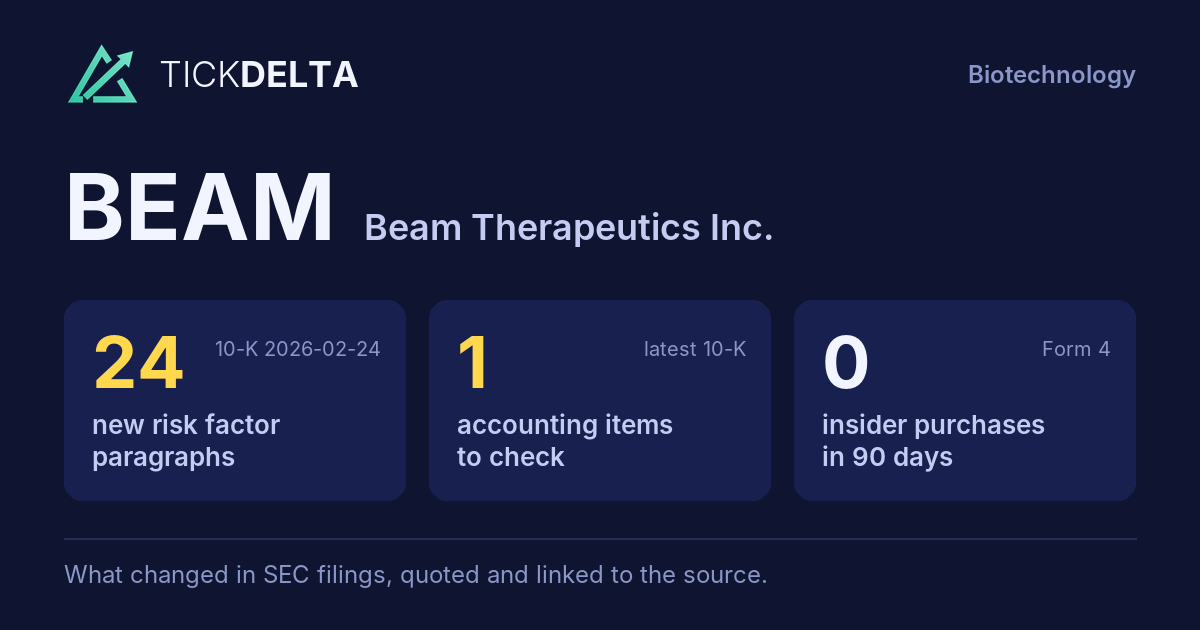
153 changes: 46 added, 10 removed, 96 reworded, 1 quiet changes

10-K Feb 24, 2026 vs Feb 25, 2025

10-K 0001193125-26-065194 (Feb 24, 2026) vs 10-K 0000950170-25-026076 (Feb 25, 2025) Not compared: Legal Proceedings, Accounting Policies.

Every paragraph, and how much of it changed

One bar per paragraph, in the order of the 10-K. Height and colour show the share of its words not in the closest paragraph a year earlier; the tallest bars are new paragraphs.

Risk Factors

588 paragraphs · 24 new · 87 reworded · 5 gone · 10-K Feb 24, 2026 against Feb 25, 2025
New paragraph Reworded (5% of its words or more) Same or nearly
Paragraph 410 · 50% changed Every version of it
Additionally, we could face heightened risks with respect to obtaining marketing authorization in the U.K. as a result of the withdrawal of the U.K. from the EU, commonly referred to as Brexit. The U.K. is no longer part of the European Single Market and EU Customs Union. As of January 1, 2025, the Medicines and Healthcare Products Regulatory Agency, or MHRA, is responsible for approving all medicinal products destined for the U.K. market (i.e., Great Britain, or GB, Britain and Northern Ireland). At On April 28, 2025, the U.K. Parliament adopted amendments to improve and strengthen the U.K.’s clinical trials regulatory regime, and such amendments will take effect on April 28, 2026. These changes were needed since the current U.K. requirements are based upon the now-repealed EU Clinical Trials Directive (2001/20/EC), which has been replaced by the European Clinical Trials Regulation (Regulation EU No 536/2014). Since the U.K. left the EU prior to the date on which the EU CTR took effect, the U.K. legal framework did not benefit from the same time, a new international recognition procedure, or IRP, will apply, which intends to facilitate approval of pharmaceutical products in the U.K. The IRP is open to applicants that have already received an authorization for the same product from one of the MHRA’s specified Reference Regulators, or RRs. The RRs notably include the EMA and regulators in the EU/European Economic Area, or EEA, member states for approvals in revisions as occurred at the EU centralized procedure and mutual recognition procedure, as well as the FDA for product approvals granted in the U.S. However, the concrete functioning of the IRP is currently unclear. Any delay in obtaining, or an inability to obtain, any marketing approvals may force us to restrict or delay efforts to seek regulatory approval in the U.K. for our product candidates, which could significantly and materially harm our business. level.
Paragraph 438 · 49% changed Every version of it
Disruptions at the FDA, EMA and other agencies may also slow the time necessary for new drugs to be reviewed and/or approved by necessary government agencies, which would adversely affect our business. For example, in recent years, including in 2018 and 2019, the U.S. government shut down several times and certain regulatory agencies, such as the FDA and the SEC, had to furlough critical employees and stop critical activities. In addition, disruptions may also result from events similar to the COVID-19 pandemic. During the COVID-19 pandemic, a number of companies announced receipt of complete response letters due to the FDA’s inability to complete required inspections for their applications. In the event of a similar public health emergency in the future, the FDA may not be able to continue its current pace and review timelines could be extended. Regulatory authorities outside the United States facing similar circumstances may adopt similar restrictions or other policy measures in response to a similar public health emergency and may also experience delays in their regulatory activities.
Paragraph 512 · 48% changed Every version of it
In October 2022, President Biden signed an executive order to implement the EU-U.S. Data Privacy Framework, which serves as a replacement to the EU-U.S. Privacy Shield. The EC adopted the adequacy decision on July 10, 2023. The adequacy decision permits U.S. companies who self-certify to the EU-U.S. Data Privacy Framework to rely on it as a valid data transfer mechanism for data transfers from the EU to the U.S. However, some Some privacy advocacy groups have already suggested that they will be challenging the EU-U.S. Data Privacy Framework. DPF, and there is currently one pending litigation against the DPF before the Court of Justice of the European Union (CJEU), C-703/25 P – Latombe v Commission. If these challenges are successful, they may not only impact the EU-U.S. Data Privacy Framework, DPF, but also further limit the viability of the so-called standard contractual clauses and other data transfer mechanisms. The uncertainty around this
Paragraph 447 · 47% changed Every version of it
The FDA may further reevaluate the Orphan Drug Act and its regulations and policies. This may be particularly true in light of a decision from the Court of Appeals for the 11th Circuit in September 2021 finding that, for the purpose of determining the scope of exclusivity, the term “same disease or condition” means the designated “rare disease or condition” and could not be interpreted by the agency FDA to mean the “indication or use.” Thus, the court concluded, orphan drug exclusivity applies to the entire designated disease or condition rather than the “indication or use.” Although there have been legislative proposals to overrule this decision, they have not been enacted into law. On January 23, 2023, the FDA announced that, in matters beyond the scope of that the Catalyst court order, the FDA will continue to apply its existing regulations tying orphan-drug exclusivity to the uses or indications for which the orphan drug was is approved. We do not know if, when, or how More recently however, on February 14, 2025, a federal district court in Washington, D.C., fully embraced the reasoning of the Catalyst decision in another decision challenging the scope of orphan drug exclusivity. On April 17, 2025, the FDA or Congress may change appealed this decision to the orphan drug regulations U.S. Court of Appeals for the D.C. Circuit. The implications of this decision, and policies in its impact on the future, and it is uncertain how any changes might affect our business. Depending on what changes FDA’s implementation of the FDA may make to its orphan drug regulations and policies, our business could be adversely impacted. Orphan Drug Act, are unclear at this point.
Paragraph 440 · 45% changed Every version of it
Further, with while the change FDA’s review of marketing applications and other activities for new drugs and biologics is largely funded through the user fee program established under PDUFA, it remains unclear how the current administration’s reduction in force and budget cuts will impact this program and the presidential administration in 2025, there is substantial uncertainty as to how, if at all, the new administration will seek to modify or revise the requirements and policies ability of the FDA to provide guidance and other regulatory agencies with jurisdiction over review our product candidates. candidates in a timely manner. There is also continues to be uncertainty as to how other measures being implemented by the Trump Administration current administration across the government will impact our activities and those of the FDA and its operations. For example, the potential loss of FDA personnel could lead to further disruptions and delays in FDA review of our product candidates. Similarly, efforts by the new administration to substantially reduce research funding by the NIH of medical research could have substantial direct or indirect impacts on our research activities and clinical trials.
Paragraph 577 · 45% changed Every version of it
In addition Income, sales, use or other tax laws, statutes, rules, or regulations could be enacted or amended at any time, which could affect our business or financial condition, including causing potentially adverse impacts to our effective tax rate, tax liabilities and cash tax obligations. For example, the Tax Act, as part of Congress’ response to the COVID-19 pandemic, economic relief legislation was enacted in 2020 and 2021 containing tax provisions, including the CARES Act and the Inflation Reduction Act, or the IRA, which IRA was signed into law in August 2022, and the One Big Beautiful Bill Act, or OBBBA, was signed into law in July 2025. The IRA introduced a number of new tax provisions. The IRA in particular includes provisions, including a one percent excise tax imposed on certain stock repurchases by publicly traded companies, which companies. The one percent excise tax generally applies to any acquisition of stock by the publicly traded company (or certain of its affiliates) from a stockholder of the company in exchange for money or other property (other than stock of the company itself), subject to a de minimis exception. certain exceptions. Thus, the excise tax could apply to certain transactions that are not traditional stock repurchases. Regulatory guidance The OBBBA contains numerous tax provisions which may significantly affect our business or financial condition. The recent changes under the Tax Act OBBBA include tax rate extensions and such additional legislation is and continues to be forthcoming, and such guidance could ultimately increase or lessen the impact of these laws on our business and financial condition. Additional tax legislation may also be enacted in the future, which could have an impact on us. In addition, it is uncertain if and to what extent various states will conform changes to the Tax Act business interest deduction limitation, the expensing of domestic research and additional development expenditures (in contrast to the continued capitalization and amortization of foreign research and development expenditures), the bonus depreciation deduction rules, and the international tax legislation. framework.
Paragraph 339 · 43% changed Every version of it
In patent litigation in the United States, defendant counterclaims alleging invalidity and/or unenforceability are commonplace, and there are numerous grounds upon which a third party can assert invalidity or unenforceability of a patent. Third parties may also raise similar claims before administrative bodies in the United States or abroad, even outside the context of litigation. These types of mechanisms include re-examination, post-grant review, inter partes review, interference proceedings, derivation proceedings, and equivalent proceedings in foreign jurisdictions (e.g., opposition proceedings). These types of proceedings could result in revocation or amendment to our patents such that they no longer cover our product candidates. The outcome for any particular patent following legal assertions of invalidity and unenforceability is unpredictable. With respect to the validity question, for example, we cannot be certain that there is no invalidating prior art, of which we, our licensors, our patent counsel and the patent examiner were unaware during prosecution. If a defendant were to prevail on a legal assertion of invalidity and/or unenforceability, or if we are otherwise unable to adequately protect our rights, we would lose at least part, and perhaps all, of the patent protection on our technology and/or product candidates. Defense of these types of claims, regardless of their merit, would involve substantial litigation expense and would be a substantial diversion of employee resources from our business.
Paragraph 508 · 43% changed Every version of it
In addition to California, at least eighteen other states have passed comprehensive privacy laws similar to the CCPA and CPRA. These laws are either in effect or will go into effect over the next few years. Like the CCPA and CPRA, these laws create obligations related to the processing of personal information, as well as special obligations for the processing of “sensitive” data, which includes health data in some cases. Some of the provisions of these laws may apply to our business activities. There are also states that are strongly considering or have already passed comprehensive privacy laws during the 2024 legislative sessions that will go into effect in 2025 and beyond, including New Hampshire and New Jersey. Other states will be considering these laws in the future, and Congress has also been debating passing a federal privacy law. There are also states that are specifically regulating health information that may affect our business. For example, Washington state passed a health privacy law in 2023 that regulates is not otherwise regulated by the collection and sharing of health information, HIPAA rules, and the law also has a private right of action, which further increases the relevant compliance risk. Connecticut and Nevada have also passed similar laws regulating consumer health data, and more states are considering such legislation. These laws may impact our business activities, including our identification of research subjects, relationships with business partners and ultimately the marketing and distribution of our products.

MD&A

139 paragraphs · 22 new · 48 reworded · 5 gone · 10-K Feb 24, 2026 against Feb 25, 2025
New paragraph Reworded (5% of its words or more) Same or nearly
Paragraph 76 · 48% changed
We did not record an income tax provision for the year ended December 31, 2025 and recorded an income tax provision of less than $0.1 million for the year ended December 31, 2024 and a provision of $1.4 million for the year ended December 31, 2023, which reflects that we generated taxable income that was not fully offset by the use of tax operating loss carryforwards and tax credits. Our taxable income includes income recognized related to our license and collaboration agreements with Apellis, Pfizer, Lilly, Sana and Orbital in the year ended December 31, 2024. Taxable income in the year ended December 31, 2023 included income recognized related to the Lilly Agreement.
Paragraph 65 · 47% changed
•An increase •A decrease of $15.7 $17.4 million in stock-based compensation from driven by additional one-time stock options awards granted to employees in 2024; and restricted stock units granted during the year; and
Paragraph 70 · 46% changed
•An increase •A decrease of $15.7 $9.0 million in stock-based compensation from driven by additional stock options awards granted to employees in 2024; and restricted stock units granted during the year; and
Paragraph 19 · 45% changed
We are conducting a Phase 1/2 open label, dose escalation exploration and dose expansion clinical trial of BEAM-302 at sites located in the United Kingdom for the treatment of AATD. The trial will evaluate the safety, tolerability, pharmacodynamics, pharmacokinetics and efficacy of BEAM-302 initially in BEAM-302. Part A of the trial is designed to evaluate AATD patients with AATD-associated lung disease, and Part B will evaluate AATD patients with mild to moderate liver disease with or without lung disease. The study design includes a dose exploration portion followed by a dose expansion portion to identify the optimal dose to take forward in a pivotal study. We continue to progress enrollment and global site activation and expect to report initial clinical data from multiple cohorts in the trial in the first half of 2025.
Paragraph 9 · 42% changed
We are using base editing to pursue the development of BEAM-101 for the treatment of sickle cell disease. BEAM-101 is a patient-specific, autologous HSC investigational therapy designed to offer a potentially best-in-class profile, incorporating base edits that are intended to mimic single nucleotide polymorphisms seen in individuals with hereditary persistence of fetal hemoglobin, or HbF. BEAM-101 Risto-cel aims to alleviate the effects of sickle cell disease by increasing HbF, which is expected to increase functional hemoglobin production and, in the case of sickle cell disease, inhibit hemoglobin hemoglobins S, or HbS, polymerization.
Paragraph 54 · 40% changed
•Change in fair value of contingent consideration liabilities consists of remeasurement of the fair market value of the technology and product milestone payments associated with our contingent consideration liabilities related to the acquisition of Guide. from acquisitions.
Paragraph 91 · 39% changed
For the year ended December 31, 2024, 2025, cash provided by used in investing activities of $185.0 $121.4 million was primarily the result of driven by net maturities purchases of marketable securities partially offset by purchases of marketable securities, in addition to $367.3 million, purchases of property and equipment of $8.9 $15.0 million and the payment of $0.1 million of equity issuance costs associated with our acquisition of an early-stage life sciences company. These uses of cash were partially offset by proceeds from sale of our equity method investment in Orbital totaling $255.1 million and proceeds from sales of marketable securities of $5.7 million.
Paragraph 122 · 38% changed
In addition, we agreed to pay Guide’s former stockholders and optionholders may owe up to an additional $100.0 $89.0 million in technology milestone development, clinical and commercial milestones to former stockholders of an early-stage life sciences company acquired during the year ended December 31, 2025. Milestone payments and $220.0 million are payable at our sole discretion in product milestone payments, payable cash or in our common stock valued using the volume-weighted average price shares of our common stock over the ten-day trading period ending two trading days prior to the date on which the applicable milestone is received. (valued using a volume-weighted average price). These payments are contingent upon the occurrence of future events and the timing and likelihood of such potential obligations are not known with certainty.

A paragraph is matched with the one last year that shares the most of its words; under half in common makes it new. The paragraphs shown are the 8 reworded the most in each section.

The paragraph that changed most in each section

The redline

Marked against last year's 10-K: cut words struck through, new words highlighted.

Risk Factors321 words changed in this paragraph; it is 74% similar to last year's version.
Numerous third-party U.S. and foreign issued patents and pending patent applications exist in the fields in which we are developing product candidates. Our product candidates make use of CRISPR-based technology, which is a field that is highly active for patent filings. The extensive patent filings related to CRISPR and Cas make it difficult for us to assess the full extent of relevant patents and pending applications that may cover our base editing platform technology and product candidates and their use or manufacture. There may be third-party patents or patent applications with claims to materials, formulations, methods of manufacture or methods for treatment related to the use or manufacture of our base editing platform technology and product candidates. For example, we are aware of a patent portfolio that is co-owned by the University of California, University of Vienna and Emmanuelle Charpentier, or the University of California Portfolio, which contains multiple patents and pending applications directed to gene editing. The University of California portfolio includes, for example, U.S. Patent Nos. 10,266,850; 10,227,611; 10,000,772; 10,113,167; 10,301,651; 10,308,961; 10,337,029; 10,351,878; 10,407,697; 10,358,659; 10,358,658; 10,385,360; 10,400,253; 10,421,980; 10,415,061; 10,428,352; 10,443,076; 10,487,341; 10,513,712; 10,519,467; 10,526,619; 10,533,190; 10,550,407; 10,563,227; 10,570,419; 10,577,631; 10,597,680; 10,612,045; 10,626,419; 10,640,791; 10,669,560; 10,676,759; 10,752,920; 10,774,344; 10,793,878; 10,900,054; 10,982,230; 10,982,231; 10,988,780; 10,988,782; 11,001,863; 11,008,589; 11,008,590; 11,028,412; 11,186,849; 11,242,543; 11,274,318; 11,293,034; 11,332,761; 11,401,532; 11,473,108; 11,479,794; 11,549,127; 11,634,730; 11,674,159; 11,814,645; 11,970,711; 12,123,015; 12,180,503; 12,180,504; 12,215,343, which are expected to expire around March 2033, excluding any additional term for patent term adjustment, or PTA, or patent term extension, or PTE, and any disclaimed term for terminal disclaimers. The University of California portfolio also includes numerous additional pending patent applications. If these patent applications issue as patents, they are expected to expire around March 2033, excluding any PTA, PTE, and any disclaimed term for terminal disclaimers. As discussed above, certain applications in the University of California Portfolio are currently subject to U.S. Interference No. 106,115 with certain U.S. patents and one U.S. patent application that are co-owned by the Boston Licensing Parties to which we have an option under the Editas License Agreement. Although we have an option to exclusively license certain patents and patent applications directed to Cas9 and Cas12a from Editas, who in turn has licensed such patents from various academic institutions including Broad Institute, we do not currently have a license to such patents and patent applications. Certain members of the University of California Portfolio have been or are being opposed in Europe by multiple parties. For example, European Patent Nos. EP2,800,811 B1, and EP3,241,902 B1, EP3,401,400 B1 and EP3,401,400 EP3,597,749 B1 have been opposed, and notices of opposition have been filed by several third parties against European Patent No. EP3,597,749 B1, which patents are estimated to expire in March 2033 (excluding any patent term adjustments or extensions). The opposition procedure before the EPO allows one or more third parties to challenge the validity of a granted European patent within nine months after grant date of the European patent. Opposition proceedings may involve issues including, but not limited to, priority, patentability of the claims involved, and procedural formalities related to the filing of the patent application. As a result of the opposition proceedings, the Opposition Division can revoke a patent, maintain the patent as granted, or maintain the patent in an amended form. In April 2021, the claims of European patent EP3,241,902 B1 were revoked in their entirety by the Opposition Division, and that decision was not appealed. In November 2024, European patents EP2,800,811 B1 and EP3,401,400 B1 were revoked by the Boards of Appeal of the European Patent Office. In November 2025, the claims of European patent EP3,597,749 B1 were revoked in their entirety by the Opposition Division, and that decision is being appealed. It is uncertain how oppositions filed against EP3,597,749 B1 will be resolved. If this patent is maintained by the Opposition Division Boards of Appeal with claims similar to those that were opposed, our ability to commercialize our product candidates may be adversely affected if we do not obtain a license to these patents. We may not be able to obtain any required license on commercially reasonable terms or at all. Even if we were able to obtain a license, it could be nonexclusive, thereby giving our competitors and other third parties access to the same technologies licensed to us, and it could require us to make substantial licensing and royalty payments. If we are unable to obtain a necessary license to a third-party patent on commercially reasonable terms, we may be unable to commercialize our base editing platform technology or product candidates or such commercialization efforts may be significantly delayed, which could in turn significantly harm our business.

Source: Item 1A, 10-K 0001193125-26-065194 vs Item 1A, 10-K 0000950170-25-026076

MD&A125 words changed in this paragraph; it is 32% similar to last year's version.
Years Year Ended December 31, 2025 2024 2023 Change External research License and collaboration revenue $ 139,743 $ 63,518 $ 76,225 Operating expenses: Research and development 409,618 367,561 42,057 General and administrative 113,818 111,525 2,293 Total operating expenses 523,436 479,086 44,350 Loss from operations (383,693) (415,568) 31,875 Other income (expense): Change in fair value of derivative liabilities 700 2,272 (1,572) Change in fair value of non-controlling equity investments 3,942 (14,093) 18,035 Change in fair value of contingent consideration liabilities 180 1,592 (1,412) Gain on sale of equity method investment 255,146 — 255,146 Interest and other income (expense), net 43,733 49,094 (5,361) Total other income (expense) 303,701 38,865 264,836 Net loss before income taxes (79,992) (376,703) 296,711 Provision for income taxes — (39) 39 Net loss $ 114,473 (79,992) $ 154,178 (376,742) $ (39,705) Employee related expenses 98,796 109,878 (11,082) Facility and information technology related expenses 73,387 69,339 4,048 Stock-based compensation expense 73,522 57,812 15,710 Other expense (income) 7,383 46,174 (38,791) Total research and development expenses $ 367,561 $ 437,381 $ (69,820) 296,750

Source: Item 7, 10-K 0001193125-26-065194 vs Item 7, 10-K 0000950170-25-026076

Sentences and paragraphs added, removed or reworded

Every change, by type

Sentences and paragraphs of BEAM's Risk Factors and MD&A, 10-K Feb 24, 2026 against 10-K Feb 25, 2025. Each links to the text at sec.gov.

Quiet changes are sentences kept from last year with one to four words changed, at least one of them a hedge, a modal or a qualifier (may, could, will, not, significant, material…). A year or date rolling forward is not counted.

The full word list

adverse, adversely, all, although, anticipate, anticipates, any, approximately, believe, believes, can, cannot, certain, could, expect, expects, generally, however, if, intend, intends, largely, likely, many, material, materially, may, might, most, must, never, no, not, possible, primarily, probable, should, significant, significantly, some, substantial, substantially, unlikely, will, would

AddedRisk Factors
The terms of our financing agreement with Sixth Street Lending Partners and our indebtedness could adversely affect our operations and limit our ability to plan for or respond to changes in our business. If we are unable to comply with restrictions in the financing agreement, the repayment of our existing indebtedness could be accelerated.
Read it in 10-K Feb 24, 2026 at sec.gov
AddedRisk Factors
On February 24, 2026, we entered into a financing agreement with Sixth Street Lending Partners as the administrative agent and collateral agent for several lenders, or the Financing Agreement. The Financing Agreement establishes a senior secured term loan facility of $500.0 million, or the Credit Facility, consisting of $100.0 million funded on the closing date; up to $300 million available upon the achievement of certain clinical, regulatory and commercial milestones for risto-cel; and an additional $100 million available at our option, subject to mutual agreement between the parties, during the seven-year term of the Financing Agreement.
Read it in 10-K Feb 24, 2026 at sec.gov
AddedRisk Factors
The Financing Agreement contains customary representations and warranties and affirmative and negative covenants. For example, it requires us to make certain payments over time and, subject to certain exceptions, restricts our ability to incur additional indebtedness, grant liens, make investments (including acquisitions), effectuate mergers or consolidations, engage in asset sales and licensing transactions, pay dividends, modify material agreements, pay subordinated indebtedness, and undertake other matters customarily restricted in such agreements. Among other requirements of the Financing Agreement, we and our subsidiaries party to the Financing Agreement must maintain certain minimum liquidity requirements if our market capitalization falls below an agreed threshold. We are also subject to restrictions on sales and licensing transactions with respect to our core intellectual property and product assets, including, but not limited to, risto-cel and BEAM-302, subject to certain exceptions. These and other terms in the Financing Agreement could restrict our ability to grow our business or enter into transactions that we believe would be beneficial to our business. Additionally, if we fail to comply with the covenants under the Financing Agreement, it will result in an event of default. Upon the occurrence of an event of default, and subject to any specified cure periods, all amounts owed under the Financing Agreement may be declared immediately due and payable by the lenders, and the lenders may foreclose on the collateral, which could have a material adverse effect on our business, financial condition and results of operations.
Read it in 10-K Feb 24, 2026 at sec.gov
AddedRisk Factors
Our current and potential indebtedness could affect our business in the following ways, among other things: make it more difficult for us to satisfy our contractual and commercial commitments; require us to use a substantial portion of our cash flow subject to mandatory prepayments to pay interest and principal when due, which would reduce funds available for working capital, capital expenditures and other general corporate purposes; limit our ability to obtain additional financing for working capital, capital expenditures, acquisitions and other investments or general corporate purposes; heighten our vulnerability to downturns in our business, our industry or in the general economy; place us at a disadvantage compared to our competitors that may have
Read it in 10-K Feb 24, 2026 at sec.gov
AddedRisk Factors
proportionately less debt; limit management’s discretion in operating our business; and limit our flexibility in planning for, or reacting to, changes in our business, the industry in which we operate or the general economy.
Read it in 10-K Feb 24, 2026 at sec.gov
AddedRisk Factors
Our business may not generate cash flows from operations in the future that are sufficient to service our debt and support our growth strategies. In addition, our ability to generate sufficient cash flows to meet our debt obligations depends upon several factors, such as the ability of us and our licensees to timely complete clinical trials and obtain marketing approval for our clinical-stage product candidates, to successfully commercialize our clinical-stage product candidates, our receipt of regulatory approval for risto-cel and our other product candidates, and our future performance, which is subject to financial, business, and other impacts on our operations, many of which are beyond our control. If we are unable to generate sufficient cash flows, we may be required to adopt one or more alternatives, such as obtaining additional equity capital on terms that may be onerous or highly dilutive, selling assets, or restructuring debt. Our ability to refinance our indebtedness will depend on the capital markets and our financial condition at such time. We may not be able to engage in any of these activities or engage in these activities on desirable terms, which could result in a default on our debt obligations.
Read it in 10-K Feb 24, 2026 at sec.gov
AddedRisk Factors
The patent prosecution process is expensive, time-consuming, and complex, and we may not be able to file, prosecute, maintain, enforce, or license all necessary or desirable patent applications at a reasonable cost or in a timely manner. In addition, we may not
Read it in 10-K Feb 24, 2026 at sec.gov
AddedRisk Factors
from other aspects of our business. Accordingly, our efforts to enforce our intellectual property and proprietary rights around the world may be inadequate to obtain a significant commercial advantage from the intellectual property that we develop or license.
Read it in 10-K Feb 24, 2026 at sec.gov
Show the other 51
AddedRisk Factors
As we are initially seeking to identify and develop product candidates to treat diseases using novel technologies, there is heightened risk that the FDA, the EMA or other regulatory authority may not consider the clinical trial endpoints that we propose to provide clinically meaningful results. Even if the endpoints are deemed clinically meaningful, we may not achieve these endpoints to a degree
Read it in 10-K Feb 24, 2026 at sec.gov
AddedRisk Factors
For example, on September 9, 2025, the President issued a memorandum directing HHS to “ensure transparency and accuracy in DTC prescription drug advertising, including by increasing the amount of information regarding any risks associated with the use of any
Read it in 10-K Feb 24, 2026 at sec.gov
AddedRisk Factors
such prescription drug required to be provided in prescription drug advertisements.” To that end, the FDA announced that it is initiating a rulemaking process “to eliminate the ‘adequate provision’ loophole that allows pharmaceutical advertisements to hide safety information by placing it in another format or location.” In this context, the FDA declared that it will no longer tolerate what it characterized as “deceptive practices” in prescription drug advertising and that the FDA would “aggressively deploy” its available enforcement tools, with “heightened scrutiny” of fair balance and disclosures in social media promotions. The FDA also issued a generic “notice letter” directing companies to “remove any noncompliant advertising and bring all promotional communications into compliance.”
Read it in 10-K Feb 24, 2026 at sec.gov
AddedRisk Factors
promotion and advertising of prescription drugs may lead to investigations or allegations of violations of federal and state health care fraud and abuse laws and state consumer protection laws.
Read it in 10-K Feb 24, 2026 at sec.gov
RemovedRisk Factors
In September 2022, we helped launch Orbital Therapeutics Inc., or Orbital, in collaboration with ARCH Venture Partners, with a goal of advancing ribonucleic acid, or RNA, medicines. In connection with the Orbital launch, we entered into a license and collaboration agreement, or the Orbital Agreement, with Orbital pursuant to which we and Orbital each granted the other licenses to certain technology controlled by it necessary or reasonably useful for the non-viral delivery or the design or manufacture of RNA for the prevention, treatment or diagnosis of human disease. In addition, concurrently with our entry into the Orbital Agreement, Orbital issued us 75 million shares of its common stock. ARCH Venture Partners is also a stockholder of Orbital, one of our directors affiliated with ARCH Venture Partners, John Maraganore, as well as John Evans, our Chief Executive Officer, are members of the board of directors of Orbital.
Read it in 10-K Feb 25, 2025 at sec.gov
RemovedRisk Factors
We have a lesser degree of control over its business operations, thereby potentially subjecting us to additional financial, legal, operational and compliance risks. In addition, the controlling shareholders or management of Orbital may have business interests, strategies or goals that are inconsistent with ours. These risks include the possibility that Orbital or such other stockholders have economic or business interests or goals that are or become inconsistent with our economic or business interests or goals; are in a position to take action contrary to our instructions, requests, policies or objectives; subject us to unexpected liabilities or risks; take actions that reduce our return on investment; act in a manner that compromises our key licensed rights, or important intellectual or other rights that we own or license; or take actions that harm our reputation or restrict our ability to run our business. Furthermore, as a result of our ownership in Orbital, we may in the future be required to include Orbital’s financial information in our consolidated financial results. We have not previously included a minority-owned subsidiary in our financial statements and we would therefore be subject to increased risk in accurately representing and incorporating Orbital financial statements into our own, which could result in delayed filings with the SEC and the finding of a material or significant weakness, among others. This could result in harmful consequences to our business, including an adverse reaction in the financial markets due to a loss of confidence in the reliability of our consolidated financial statements.
Read it in 10-K Feb 25, 2025 at sec.gov
RemovedRisk Factors
additional uncertainty into the regulatory process and may result in additional legal challenges to actions taken by federal regulatory agencies, including the FDA and CMS, that we rely on. In addition to potential changes to regulations as a result of legal challenges, these decisions may result in increased regulatory uncertainty and delays and other impacts, any of which could adversely impact our business and operations.
Read it in 10-K Feb 25, 2025 at sec.gov
RemovedRisk Factors
Accordingly, while it is currently unclear how the IRA will be effectuated, we cannot predict with certainty what impact any federal or state health reforms will have on us, but such changes could impose new or more stringent regulatory requirements on our activities or result in reduced reimbursement for our products, any of which could adversely affect our business, results of operations and financial condition.
Read it in 10-K Feb 25, 2025 at sec.gov
RemovedRisk Factors
Recent changes or future changes in tax law may adversely affect our business or financial condition. On December 22, 2017, the Tax Act was signed into law. The Tax Act, as amended by the CARES Act, among other things, contains significant changes to corporate taxation, including the reduction of the corporate tax rate from a top marginal rate of 35% to a flat rate of 21% and, for taxable years beginning after December 31, 2020, the limitation of the deduction for net operating losses to 80% of current year taxable income in respect of net operating losses generated during or after 2018. Any federal net operating loss incurred in 2018 and in future years may now be carried forward indefinitely pursuant to the Tax Act, but can no longer be carried back. Similar rules and limitations may apply for state income tax proposes. In addition, beginning in 2022, the Tax Act eliminates the option to deduct research and development expenditures currently and generally requires corporations to capitalize and amortize them over five years (or 15 years for expenditures attributable to foreign research).
Read it in 10-K Feb 25, 2025 at sec.gov
RewordedRisk Factors
If any product candidates we develop are associated with serious adverse events, undesirable side effects, or unexpected characteristics, we may need to abandon their development or limit development to certain uses or subpopulations in which the serious adverse events, undesirable side effects or other characteristics are less prevalent, less severe, or more acceptable from a risk-benefit perspective, any of which would have a material adverse effect on our business, financial condition, results of operations, and prospects.
Read it in 10-K Feb 24, 2026 at sec.gov
RewordedRisk Factors
Failure to comply with any of these laws and regulations could result in enforcement action against us, including fines, imprisonment of company officials and public censure, claims for damages by affected individuals, damage to our reputation and loss of goodwill, any of which could have a material adverse effect on our business, financial condition, results of operations or prospects.
Read it in 10-K Feb 24, 2026 at sec.gov
RewordedRisk Factors
In addition, if patients are unwilling to participate in our base editing trials because of negative publicity from adverse events related to the biotechnology, gene therapy, or gene editing fields, competitive clinical trials for similar patient populations, clinical trials in competing products, or for other reasons, the timeline for recruiting patients, conducting studies, and obtaining regulatory approval of any product candidates we may develop
Read it in 10-K Feb 24, 2026 at sec.gov
RewordedRisk Factors
Even after we receive and incorporate guidance from these regulatory authorities, the FDA, European national competent authority, or other regulatory authorities could disagree that we have satisfied their requirements to commence our clinical trial or change their position on the acceptability of our data, trial design or the clinical endpoints selected, which may require us to complete additional preclinical studies or clinical trials or impose stricter requirements for approval than we currently expect.
Read it in 10-K Feb 24, 2026 at sec.gov
RewordedRisk Factors
If we or our licensors are unsuccessful in any interference proceedings or other priority, validity (including any patent oppositions), or inventorship disputes to which we or they are subject, we may lose valuable intellectual property rights through the loss of one or more of our owned, licensed, or optioned patents, or such patent claims may be narrowed, invalidated, or held unenforceable, or through loss of exclusive ownership of or the exclusive right to use our owned or in-licensed patents. patents (for example, European Patent No.
Read it in 10-K Feb 24, 2026 at sec.gov
RewordedRisk Factors
Violation of the FDCA and other statutes, including the False Claims Act, relating to the promotion and advertising of prescription drugs may lead to investigations or allegations of violations of federal and state health care fraud and abuse laws and state consumer protection laws.
Read it in 10-K Feb 24, 2026 at sec.gov
RewordedRisk Factors
For example, Washington state passed a health privacy law the My Health My Data Act in 2023 that specifically regulates the collection and sharing of health information, and the law also has a private right of action, which further increases the relevant compliance risk.
Read it in 10-K Feb 24, 2026 at sec.gov
RewordedRisk Factors
Debt financing, if available, may involve agreements that include Our financing agreement with Sixth Street Lending Partners includes covenants limiting or restricting our ability to take specific actions, such as incurring additional debt, making capital expenditures, declaring dividends, and possibly other restrictions, and future debt financings may contain similar restrictions.
Read it in 10-K Feb 24, 2026 at sec.gov
RewordedRisk Factors
For example, in October 2023, we implemented a strategic restructuring to prioritize development of our ex vivo and in vivo sickle cell disease programs, including BEAM-101, our ESCAPE conditioning strategy, and in vivo delivery to hematopoietic stem cells program, as well as our in vivo base editor BEAM-302 in development for the treatment of alpha-1 antitrypsin deficiency. BEAM-302.
Read it in 10-K Feb 24, 2026 at sec.gov
RewordedRisk Factors
Failure to comply with laws regarding data protection would expose us to risk of enforcement actions taken by data protection authorities in the EEA and elsewhere and carries with it the potential for significant penalties if we are found to be non-compliant.
Read it in 10-K Feb 24, 2026 at sec.gov
RewordedRisk Factors
Changes in marketing approval policies during the development period, changes in or the enactment of additional statutes or regulations, or changes in regulatory review for each submitted product application, may cause delays in the approval or rejection of an application.
Read it in 10-K Feb 24, 2026 at sec.gov
RewordedRisk Factors
Even if we were able to obtain a license, it could be nonexclusive, thereby giving our competitors and other third parties access to the same technologies licensed to us, and it could require us to make substantial licensing and royalty payments.
Read it in 10-K Feb 24, 2026 at sec.gov
AddedMD&A
December 2025. The U.S. Food and Drug Administration, or the FDA, has granted orphan drug designation and regenerative medicine advanced therapy designation to risto-cel. Risto-cel has also been accepted into the FDA’s Chemistry, Manufacturing, and Controls Development and Readiness pilot program.
Read it in 10-K Feb 24, 2026 at sec.gov
AddedMD&A
In December 2025, we presented updated data from the BEACON trial at the American Society of Hematology 2025 Annual Meeting, or ASH. The presentation contained preliminary data as of August 6, 2025, from 31 patients in the trial, with follow up ranging from 0.3 to 20.4 months. The presentation data included the following:
Read it in 10-K Feb 24, 2026 at sec.gov
AddedMD&A
•Patients achieved mean HbF levels above 60% and a mean durable reduction in corresponding HbS below 40%. A pancellular distribution of HbF, reflecting expression across most of the circulating red blood cells, was observed, with mean per-cell HbF levels maintained above the sickling threshold throughout follow-up. Durable, high editing efficiency was observed in peripheral blood and bone marrow following treatment with risto-cel. Mean peripheral blood editing was 67.4% at Month 6 and 72.8% by Month 12
Read it in 10-K Feb 24, 2026 at sec.gov
AddedMD&A
•Patients required a median of one (range: 1-5) stem cell collection cycle, comprising a median of three (range: 1–13) total collection days for the risto-cel manufacturing process and back-up cell collection. The median time to neutrophil engraftment was 17.5 days (range: 12-30), with a median duration of severe neutropenia of seven days (range: 1-17). The median time to platelet engraftment was 19 days (range: 11-53). In addition, 29% of patients did not require any platelet transfusions following risto-cel treatment.
Read it in 10-K Feb 24, 2026 at sec.gov
AddedMD&A
•Total Hb levels increased rapidly with all patients experiencing resolution of anemia after elimination of the transfused blood. Key markers of hemolysis, including indirect bilirubin, haptoglobin, lactate dehydrogenase, and reticulocytes, normalized or improved in all patients following risto-cel treatment. Erythropoietin levels also trended toward normal, indicating significant improvement in oxygen delivery to tissues. Sickling parameters all decreased in the blood following risto-cel treatment to levels comparable to those seen in individuals with sickle cell trait.
Read it in 10-K Feb 24, 2026 at sec.gov
AddedMD&A
•The initial safety profile of risto-cel was consistent with busulfan conditioning, autologous HSCT and underlying sickle cell disease. The most common treatment-emergent adverse events were consistent with busulfan conditioning, including febrile neutropenia, stomatitis and decreased appetite. As previously reported, one patient died four months after risto-cel infusion due to respiratory failure that was determined by the investigator to be likely related to busulfan conditioning and deemed unrelated to risto-cel. No patients experienced any investigator-reported severe vaso-occlusive crises post-engraftment.
Read it in 10-K Feb 24, 2026 at sec.gov
AddedMD&A
We continue to develop targeted LNPs for the in vivo delivery of gene editing payloads to HSCs. Based on recent advancements in this technology, we are now prioritizing in vivo delivery for our next wave approach to treating sickle cell disease. We have identified multiple targeted LNPs that have the potential for HSC delivery and are currently engaged in lead optimization. In parallel, we are also continuing development of our proprietary ESCAPE platform, which combines antibody-based conditioning with multiplex gene edited HSCs. ESCAPE has the potential to enable non-genotoxic treatment strategies that can be delivered either ex vivo or in vivo, including as part of any future in vivo program for sickle cell disease. We are conducting a Phase 1 healthy volunteer clinical trial of BEAM-103, an anti-CD117 monoclonal antibody that enables ESCAPE, and expect to complete dosing in the trial in the first half of 2026.
Read it in 10-K Feb 24, 2026 at sec.gov
AddedMD&A
Updated clinical data from the dose-escalation portions of Part A and Part B are expected to be shared in the first quarter of 2026, along with an updated clinical development plan for BEAM-302 in patients with AATD. We expect to finalize dose selection for registrational development based on the totality of data from the BEAM-302 trial. We have reached alignment with the FDA on a potential accelerated approval pathway for BEAM-302 based on AAT biomarkers evaluated over 12 months. To support a future BLA submission, we anticipate enrolling approximately 50 additional patients to be treated with the selected optimal biological dose of BEAM-302 in an expansion of the ongoing Phase 1/2 clinical trial.
Read it in 10-K Feb 24, 2026 at sec.gov
AddedMD&A
BEAM-304 is a newly announced liver-targeting LNP formulation of base editing reagents designed to correct disease-causing mutations responsible for phenylketonuria, or PKU. PKU is an autosomal recessive disorder caused by mutations in the phenylalanine hydroxylase, or PAH, gene that prevents the body from metabolizing the amino acid phenylalanine, or Phe. Elevated levels of Phe may result in severe neurological and neurocognitive impairments. Patients are generally identified via newborn screening, with the standard of care involving a Phe-restricted diet, as well as medicines that manage Phe levels. Initially, we plan to develop BEAM-304 for the treatment of the two most prevalent variants found in PKU patients in the United States, with ongoing research effort to address the majority of the remaining mutations. In preclinical studies, administration of BEAM-304 resulted in the normalization of Phe levels in mice at therapeutically relevant doses, even when consuming a standard diet. In 2026, we plan to submit a regulatory application for authorization to initiate an open-label, dose-ascending, Phase 1/2 trial of BEAM-304 in PKU patients with the R408W mutation. We believe that learnings from this trial have the potential to provide a predictable path to accelerated development of BEAM-304 for additional mutations, including as a result of novel FDA frameworks for platform medicines.
Read it in 10-K Feb 24, 2026 at sec.gov
AddedMD&A
On February 24, 2026, or the Closing Date, we entered into a financing agreement, or the Financing Agreement, with certain of our subsidiaries as guarantors party thereto, the lenders party thereto, or the Lenders, and Sixth Street Lending Partners, as the administrative agent and collateral agent for the Lenders. The Financing Agreement provides for a senior secured term loan facility of up to $500 million, or the Credit Facility, consisting of (i) an initial draw of $100 million on the Closing Date, (ii) a potential additional $100 million draw upon the acceptance by the FDA of our BLA submission for risto-cel prior to a certain date, or the Delayed Draw A, (iii) a potential additional $100 million draw at the Company’s option upon the FDA’s approval of the risto-cel BLA prior to a certain date, or the Delayed Draw B, (iv) a potential additional $100 million draw at the Company’s option upon achieving a revenue target from sales of risto-cel prior to a certain date and (v) a potential additional $100 million draw subject to agreement among us and the Lenders. The Credit Facility matures on February 24, 2033, or the Maturity Date, and bears interest at an annual rate equal to the 3-month Secured Overnight Financing Rate (SOFR) plus 6.50% (subject to a 1.00% floor) or permits interest on a base rate plus a margin. Certain additional commitment, administrative, undrawn amount and facility fees are also payable in connection with the Credit Facility.
Read it in 10-K Feb 24, 2026 at sec.gov
AddedMD&A
The Credit Facility requires quarterly interest payments, but does not provide for scheduled amortization payments during the term. All principal will be due on the Maturity Date. We will have the right to prepay loans under the Credit Facility at any time. We are required to repay loans under the Credit Facility with proceeds from certain asset sales and licensing transactions, condemnation events and extraordinary receipts, subject, in some cases, to reinvestment rights. Repayments are subject, in some cases, to prepayment premiums.
Read it in 10-K Feb 24, 2026 at sec.gov
AddedMD&A
All obligations under the Financing Agreement will be secured on a first-priority basis, subject to certain exceptions, by security interests in substantially all assets of us and our material subsidiaries, including our intellectual property, and will be guaranteed by our material subsidiaries, subject to certain exceptions.
Read it in 10-K Feb 24, 2026 at sec.gov
RemovedMD&A
In parallel with Wave 1 development, we also aim to improve the transplant conditioning regimen for patients undergoing HSCT, thereby reducing toxicity challenges associated with HSCT. Conditioning is a critical component necessary to prepare a patient’s body to receive the ex vivo edited cells that must engraft in the patient’s bone marrow in order to be effective. However, current conditioning regimens rely on nonspecific chemotherapy or radiation, which are associated with significant toxicities. As a potential alternative to genotoxic conditioning regimens in HSCT, we are advancing our ESCAPE program. ESCAPE aims to avoid toxicity challenges associated with currently available conditioning regimens for patients with sickle cell disease and beta-thalassemia ahead of autologous HSCT, by combining antibody-based conditioning with multiplex gene edited HSCs. ESCAPE may also have applications in other diseases of the blood and immune system where HSCT could deliver potential benefits but has been limited by toxicities associated with current standard of care conditioning regimens.
Read it in 10-K Feb 25, 2025 at sec.gov
RemovedMD&A
We have nominated a development candidate for our ESCAPE technology comprised of two investigational drug products: BEAM-103, an anti-CD117 monoclonal antibody, and BEAM-104, a cell therapy that includes the same therapeutic edit as BEAM-101 (editing the HBG1/2 genes to elevate fetal hemoglobin), plus an additional edit to CD117 designed to block binding of BEAM-103, allowing the edited cells to evade suppression by the antibody. We intend to advance BEAM-103 and BEAM-104 for development in sickle cell disease and beta-thalassemia, potentially building on the same regulatory, manufacturing, clinical and commercial foundations being established with BEAM-101. We expect to initiate a Phase 1 healthy volunteer clinical trial of BEAM-103 by the end of 2025.
Read it in 10-K Feb 25, 2025 at sec.gov
RemovedMD&A
We are also exploring the potential for in vivo base editing programs for sickle cell disease, in which base editors would be delivered to the patient through an infusion of LNPs targeted to HSCs, eliminating the need for transplantation altogether. This approach could provide a more accessible option for patients, particularly in regions where ex vivo treatment is challenging.
Read it in 10-K Feb 25, 2025 at sec.gov
RewordedMD&A
These uses of cash were partially offset by increases in other liabilities of $7.7 million and accounts payable of $1.8 million $6.0 million, a decrease in prepaid expenses and other long-term liabilities current assets of $0.5 $4.5 million, as well as noncash items, including stock-based compensation expense of $120.7 $94.2 million, depreciation and amortization expense of $21.9 $22.3 million, a decrease in the fair value of non-controlling equity investments of $14.1 million and a decrease in operating lease right-of-use, or ROU, assets of $9.7 million. $10.4 million and a realized loss of $0.4 million on our sale of marketable securities.
Read it in 10-K Feb 24, 2026 at sec.gov
RewordedMD&A
For the year ended December 31, 2024, 2025, cash provided by used in investing activities of $185.0 $121.4 million was primarily the result of driven by net maturities purchases of marketable securities partially offset by purchases of marketable securities, in addition to $367.3 million, purchases of property and equipment of $8.9 million. $15.0 million and the payment of $0.1 million of equity issuance costs associated with our acquisition of an early-stage life sciences company.
Read it in 10-K Feb 24, 2026 at sec.gov
RewordedMD&A
Years Year Ended December 31, 2025 2024 2023 Change External research and development expenses $ 142,376 $ 114,473 $ 154,178 $ (39,705) 27,903 Employee related expenses 117,366 98,796 109,878 (11,082) 18,570 Facility and information technology related expenses 77,146 73,387 69,339 4,048 3,759 Stock-based compensation expense expenses 56,123 73,522 57,812 15,710 (17,399) In-process research and development expenses 14,507 — 14,507 Other expense (income) expenses 2,100 7,383 46,174 (38,791) (5,283) Total research and development expenses $ 409,618 $ 367,561 $ 437,381 $ (69,820) 42,057
Read it in 10-K Feb 24, 2026 at sec.gov
RewordedMD&A
Net cash provided by financing activities for the year ended December 31, 2024 2025 of $7.7 $478.0 million consisted of $470.5 million of proceeds from the March 2025 issuance of common stock and pre-funded warrants, $4.7 million of proceeds from the exercise of stock options of $5.6 million and $2.6 $2.8 million of proceeds from the issuance of common stock under our Employee Stock Purchase Plan, or ESPP, offset in part by net repayments of equipment financing liabilities of $0.5 million. ESPP.
Read it in 10-K Feb 24, 2026 at sec.gov
RewordedMD&A
During the years ended December 31, 2024 2025 and 2023, 2024, we recorded $1.6 $0.2 million and $9.7 $1.6 million, respectively, of other income related to the change in fair value of the Guide technology and product milestone payments related to our contingent consideration liabilities as a result of an update in project timelines and the expected probability of achievement of the milestones. from acquisitions.
Read it in 10-K Feb 24, 2026 at sec.gov
RewordedMD&A
Net cash used in operating activities for the year ended December 31, 2024 2025 was $347.2 $345.1 million, including our net loss of $376.7 $80.0 million, decreases in accrued expenses and other liabilities of $57.7 million, deferred revenue of $36.5 million and $135.4 million, operating lease liabilities of $13.0 million, and an increase in prepaid expenses $13.5 million and other current assets long-term liabilities of $5.4 $0.3 million.
Read it in 10-K Feb 24, 2026 at sec.gov
RewordedMD&A
In addition, noncash items, including the gain on sale of equity method investment of $255.1 million, amortization of investment discounts and premiums of $22.8 $16.0 million, decreases an increase in the fair value of non-controlling equity investments of $3.9 million, a decrease in the fair value of derivative liabilities of $2.3 $0.7 million and a change in the fair value of contingent consideration liabilities of $1.6 $0.2 million, also contributed to net cash used in operating activities.
Read it in 10-K Feb 24, 2026 at sec.gov
RewordedMD&A
License and collaboration revenue was approximately $139.7 million for the year ended December 31, 2025, compared to approximately $63.5 million for the year ended December 31, 2024, compared to approximately $377.7 million for the year ended December 31, 2023, a decrease an increase of $314.2 $76.2 million.
Read it in 10-K Feb 24, 2026 at sec.gov
RewordedMD&A
License and collaboration revenue recorded in 2024 2025 represents revenue recorded under the Pfizer, Apellis and Orbital Agreements, as well as $27.0 million of revenue recognized from development and regulatory milestones achieved under our agreements with Lilly and Sana. Agreements.
Read it in 10-K Feb 24, 2026 at sec.gov
RewordedMD&A
Debt financing, if available, may involve agreements that include The Financing Agreement includes covenants limiting or restricting our ability to take specific actions, such as incurring additional debt, making capital expenditures, or declaring dividends. dividends, and future debt financings, if available, may include similar restrictions.
Read it in 10-K Feb 24, 2026 at sec.gov
RewordedMD&A
During the year ended December 31, 2024, 2025, we recorded $2.3 $0.7 million of other income related to the change in fair value of the derivative liabilities as compared to $7.5 $2.3 million for the year ended December 31, 2023, 2024, driven primarily by the decline in the price of our common stock. a declining interest rate enviornment.
Read it in 10-K Feb 24, 2026 at sec.gov
RewordedMD&A
The decrease increase in revenue is driven primarily by $216.4 $109.1 million of up-front revenue recognized in the year ended December 31, 2023, from 2025, due to the transaction completion of our collaboration deal with Lilly (see Note 10) Pfizer and the net change in activity amongst our other collaboration agreements.
Read it in 10-K Feb 24, 2026 at sec.gov

Sources

The two latest 10-Ks on EDGAR, section by section. Each change links to the text at sec.gov.

Also

New risk factors: paragraphs with nothing like them last year, quoted in full.

Work with it

Excel workbook · CSV. Google Sheet that stays up to date: paste =IMPORTDATA("https://tickdelta.com/company/BEAM/export.csv") into a cell.

Next:Related parties
Esc

Type a ticker such as AAPL, a name, an investor such as Buffett, or a topic such as tariffs. ↑ ↓ to move, Enter to open.