Beam Therapeutics Inc. BEAM
New risk paragraphs, branching off last year
Each branch is a paragraph in Risk Factors with nothing like it in the 10-K filed Feb 25, 2025. A box jumps to the paragraph as filed, below.
Paragraphs with nothing like them in last year's 10-K
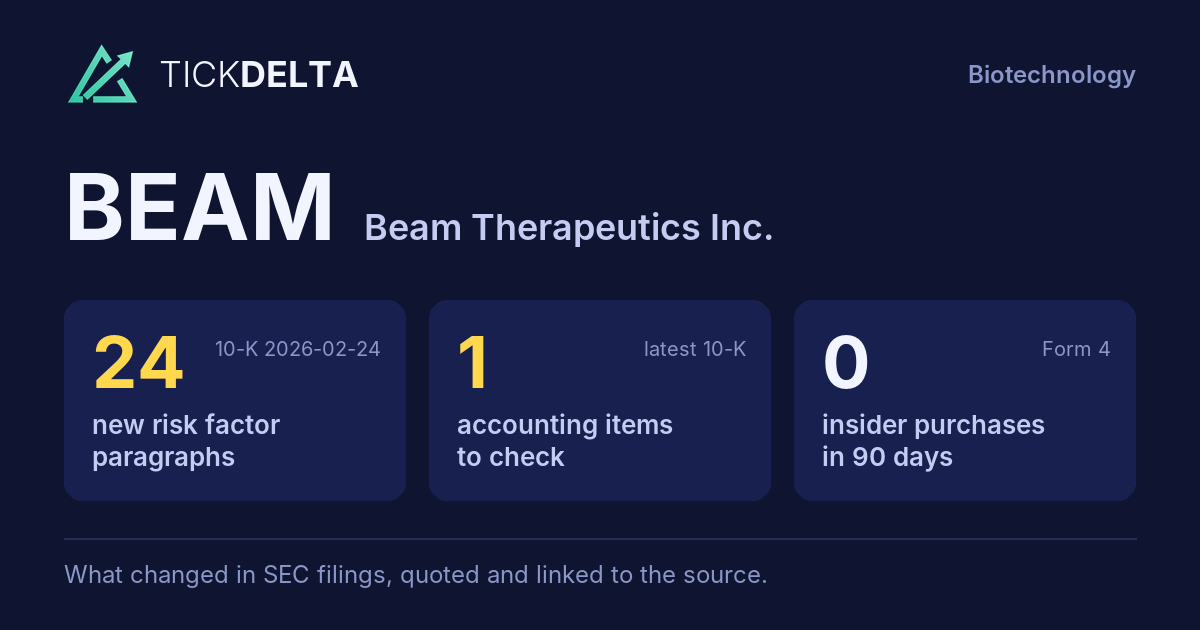
24 paragraphs in Risk Factors of the 10-K filed Feb 24, 2026 with nothing like them in the 10-K filed Feb 25, 2025. Quoted exactly. Paragraphs that were only edited are under 10-K change.
The terms of our financing agreement with Sixth Street Lending Partners and our indebtedness could adversely affect our operations and limit our ability to plan for or respond to changes in our business. If we are unable to comply with restrictions in the financing agreement, the repayment of our existing indebtedness could be accelerated.
On February 24, 2026, we entered into a financing agreement with Sixth Street Lending Partners as the administrative agent and collateral agent for several lenders, or the Financing Agreement. The Financing Agreement establishes a senior secured term loan facility of $500.0 million, or the Credit Facility, consisting of $100.0 million funded on the closing date; up to $300 million available upon the achievement of certain clinical, regulatory and commercial milestones for risto-cel; and an additional $100 million available at our option, subject to mutual agreement between the parties, during the seven-year term of the Financing Agreement.
The Financing Agreement contains customary representations and warranties and affirmative and negative covenants. For example, it requires us to make certain payments over time and, subject to certain exceptions, restricts our ability to incur additional indebtedness, grant liens, make investments (including acquisitions), effectuate mergers or consolidations, engage in asset sales and licensing transactions, pay dividends, modify material agreements, pay subordinated indebtedness, and undertake other matters customarily restricted in such agreements. Among other requirements of the Financing Agreement, we and our subsidiaries party to the Financing Agreement must maintain certain minimum liquidity requirements if our market capitalization falls below an agreed threshold. We are also subject to restrictions on sales and licensing transactions with respect to our core intellectual property and product assets, including, but not limited to, risto-cel and BEAM-302, subject to certain exceptions. These and other terms in the Financing Agreement could restrict our ability to grow our business or enter into transactions that we believe would be beneficial to our business. Additionally, if we fail to comply with the covenants under the Financing Agreement, it will result in an event of default. Upon the occurrence of an event of default, and subject to any specified cure periods, all amounts owed under the Financing Agreement may be declared immediately due and payable by the lenders, and the lenders may foreclose on the collateral, which could have a material adverse effect on our business, financial condition and results of operations.
Our current and potential indebtedness could affect our business in the following ways, among other things: make it more difficult for us to satisfy our contractual and commercial commitments; require us to use a substantial portion of our cash flow subject to mandatory prepayments to pay interest and principal when due, which would reduce funds available for working capital, capital expenditures and other general corporate purposes; limit our ability to obtain additional financing for working capital, capital expenditures, acquisitions and other investments or general corporate purposes; heighten our vulnerability to downturns in our business, our industry or in the general economy; place us at a disadvantage compared to our competitors that may have
proportionately less debt; limit management’s discretion in operating our business; and limit our flexibility in planning for, or reacting to, changes in our business, the industry in which we operate or the general economy.
Our business may not generate cash flows from operations in the future that are sufficient to service our debt and support our growth strategies. In addition, our ability to generate sufficient cash flows to meet our debt obligations depends upon several factors, such as the ability of us and our licensees to timely complete clinical trials and obtain marketing approval for our clinical-stage product candidates, to successfully commercialize our clinical-stage product candidates, our receipt of regulatory approval for risto-cel and our other product candidates, and our future performance, which is subject to financial, business, and other impacts on our operations, many of which are beyond our control. If we are unable to generate sufficient cash flows, we may be required to adopt one or more alternatives, such as obtaining additional equity capital on terms that may be onerous or highly dilutive, selling assets, or restructuring debt. Our ability to refinance our indebtedness will depend on the capital markets and our financial condition at such time. We may not be able to engage in any of these activities or engage in these activities on desirable terms, which could result in a default on our debt obligations.
The patent prosecution process is expensive, time-consuming, and complex, and we may not be able to file, prosecute, maintain, enforce, or license all necessary or desirable patent applications at a reasonable cost or in a timely manner. In addition, we may not
from other aspects of our business. Accordingly, our efforts to enforce our intellectual property and proprietary rights around the world may be inadequate to obtain a significant commercial advantage from the intellectual property that we develop or license.
As we are initially seeking to identify and develop product candidates to treat diseases using novel technologies, there is heightened risk that the FDA, the EMA or other regulatory authority may not consider the clinical trial endpoints that we propose to provide clinically meaningful results. Even if the endpoints are deemed clinically meaningful, we may not achieve these endpoints to a degree
For example, on September 9, 2025, the President issued a memorandum directing HHS to “ensure transparency and accuracy in DTC prescription drug advertising, including by increasing the amount of information regarding any risks associated with the use of any
such prescription drug required to be provided in prescription drug advertisements.” To that end, the FDA announced that it is initiating a rulemaking process “to eliminate the ‘adequate provision’ loophole that allows pharmaceutical advertisements to hide safety information by placing it in another format or location.” In this context, the FDA declared that it will no longer tolerate what it characterized as “deceptive practices” in prescription drug advertising and that the FDA would “aggressively deploy” its available enforcement tools, with “heightened scrutiny” of fair balance and disclosures in social media promotions. The FDA also issued a generic “notice letter” directing companies to “remove any noncompliant advertising and bring all promotional communications into compliance.”
Show the other 6
promotion and advertising of prescription drugs may lead to investigations or allegations of violations of federal and state health care fraud and abuse laws and state consumer protection laws.
If the FDA determines that a product candidate is intended to treat a serious disease or condition and, if approved, would provide a significant improvement in the safety or effectiveness of the treatment, prevention, or diagnosis of such disease or condition, the FDA
The FDA may further reevaluate the Orphan Drug Act and its regulations and policies. This may be particularly true in light of a decision from the Court of Appeals for the 11th Circuit in September 2021. In Catalyst Pharms, Inc. v. Becerra, or Catalyst, the court held that, for the purpose of determining the scope of orphan drug exclusivity, the term “same disease or condition” in the statute
We are exposed to the risk of fraud or other misconduct by our employees, consultants, principal investigators and any commercial partners we may have. Misconduct by these parties could include intentional failures to comply with FDA regulations or the regulations applicable in the EU and other jurisdictions, provide accurate information to the FDA, the EMA, and other regulatory
Changes in and uncertainty surrounding U.S. and international trade policies may adversely impact our business and operating results.
In the spring of 2025, the U.S. government initiated a series of tariff-related actions against U.S. trading partners. On April 2, 2025, President Trump issued an executive order announcing a “baseline” reciprocal tariff of 10% on all U.S. trading partners effective April 5, 2025, and higher individualized reciprocal tariffs on 57 countries (with certain product exemptions for pharmaceutical-related products, among others). Previously, the Trump Administration had imposed a 25% tariff on Canada and Mexico for goods not covered by the United States-Mexico-Canada Agreement, or USMCA, and tariffs due to drug trafficking equaling 20% on imports from China. In response, several countries threatened retaliatory measures, including Canada and China, which then imposed retaliatory tariffs. Prior to when the country-specific reciprocal tariffs were scheduled to take effect, the Trump Administration delayed the effective date of such tariffs for all countries except China to August 1, 2025. Later, the United States and China reached a framework agreement that ultimately resulted in the suspension of the higher reciprocal tariffs on China until November 10, 2025.
Shortly before that expiration date, the United States and China reached a one-year agreement with an expiration of November 10, 2026, that includes the continued suspension of the heightened reciprocal tariffs on China and delayed enforcement of new U.S. export rules targeting affiliates of blacklisted firms.
Since the April 2025 reciprocal tariffs announcement, the European Union, Japan, South Korea, Switzerland and the United Kingdom, among others, have reached deals with the United States that include reduced tariff rates to varying levels and other measures. On July 31, 2025, President Trump issued an Executive Order detailing new reciprocal tariff rates for individual countries that took effect on August 7, 2025. The new reciprocal rates, which are consistent with the rates reflected in the trade deals already announced, range from 10% to 41%. The new rates do not apply to Canada, China, Mexico and a few other countries. For China, the 10% baseline reciprocal tariff announced in April remains in effect, in addition to a minimum of a 10% tariff due to drug trafficking. Regarding Canada and Mexico, the rate remains 25% for goods that are not covered by the USMCA for Mexico and, effective August 1, 2025, was increased to 35% on imports from Canada that are not covered by the USMCA. President Trump also announced a further 10% increase on non-USMCA goods from Canada, but it is unclear when such increase will take effect. The European Union, Japan, South Korea, Switzerland (and Liechtenstein), the United Kingdom and others have reached agreements with the United States that cap pharmaceutical tariffs at 15%. In addition, an agreement with Malaysia provides a zero percent tariff exemption for pharmaceutical products that are not patented in the United States and are used in pharmaceutical applications and an agreement with Switzerland and Liechtenstein caps tariffs on pharmaceuticals imported from Switzerland and Liechtenstein at 15%. Finally, the United States signed an agreement with Taiwan on January 15, 2026 that eliminates U.S. tariffs on generic pharmaceuticals, and their active ingredients, imported from Taiwan.
The reciprocal tariffs and the drug trafficking tariffs were imposed by President Trump pursuant to the International Emergency Economic Powers Act, or IEEPA. These tariffs were found to be unconstitutional by multiple federal courts in the spring and summer of 2025. The U.S. Supreme Court agreed to review those decisions on an expedited schedule and is expected to issue its ruling in early 2026. In the meantime, the lower court decisions were stayed, which means that the tariffs remain in effect pending the U.S. Supreme Court’s decision.
Sustained uncertainty about, or the further escalation of, trade and political tensions between the United States and China could result in a disadvantageous research and manufacturing environment in China, particularly for U.S.-based companies, including retaliatory restrictions that hinder or potentially inhibit our ability to rely on CMOs and other service providers that operate in China.
Separately, in April 2025, the Department of Commerce initiated an investigation under Section 232 of the Trade Expansion Act of 1962 into the impact on U.S. national security of the imports of pharmaceuticals and pharmaceutical ingredients, including finished drug products, medical countermeasures, critical inputs such as active pharmaceutical ingredients, and key starting materials, and derivative products of those items. On September 25, 2025 President Trump announced, via a post on Truth Social, that, beginning on October 1, 2025, all branded or patented drugs imported into the United States would face a 100% tariff. At the same time, President Trump indicated that these tariffs could be avoided by building pharmaceutical manufacturing facilities in the United States. Thereafter, President Trump delayed the October 1, 2025 effective date of the tariffs on branded or patented pharmaceutical products, announcing that the administration had now “begun preparing” tariffs on manufacturers that do not build in the United States or enter into an MFN drug pricing agreement with the Trump Administration.
As a result of changes in tariffs that have been announced and/or implemented, and the underlying uncertainty currently surrounding international trade, we could experience a negative impact on our costs of materials and production processes, and supply chain disruptions and delays due to new or revised tariff policies or trade restrictions. If we are unable to obtain necessary raw materials or product components in sufficient quantities and in a timely manner due to disruptions in the global supply chain caused by macroeconomic events and conditions, the development, testing and clinical trials of our product candidates may be delayed or infeasible, and regulatory approval or commercial launch of any resulting product may be delayed or not obtained, which could significantly harm our business. We cannot yet predict the effect of the U.S. tariffs on imports, or the extent to which other countries will impose quotas, duties, tariffs, taxes or other similar restrictions upon imports or exports in the future, nor can we predict future trade policy or the terms of any renegotiated trade agreements and their impact on our business.
Regulatory guidance under the IRA, the OBBBA, and other tax-related legislation is and continues to be forthcoming, and such guidance could ultimately increase or lessen the impact of these laws on our business and financial condition. In addition, it is uncertain if and to what extent various states will conform to changes to federal tax legislation.
Paragraphs in the 10-Q filed Nov 3, 2026 that were not in the one before
New in the latest 10-Q
9 paragraphs in the 10-Q filed Nov 3, 2026 with nothing like them in the 10-Q filed Aug 4, 2026 (at least half the words must differ; new numbers alone do not count). Quoted exactly, grouped by the item heading above them. This is text that changed, not a judgement of how serious it is.
Financial statements and notes
contingent obligations and non-royalty sublicense fees included in research and development expenses in the statement of operations and comprehensive loss for the three and nine months ended September 30, 2025.
Read in the 10-Q
14. Segment data The Company defines its segments on the basis of the way in which internally reported financial information is regularly reviewed by the chief operating decision maker, or CODM, to analyze financial performance, make decisions, and allocate resources. The Company’s CODM is John Evans, its Chief Executive Officer. The Company manages its operations as a single operating and
Read in the 10-Q
• A single dose of 60 mg of BEAM-302 led to sustained increases in total AAT above the 11 µM protective threshold. After treatment with a single dose of BEAM-302 in Part A, the steady-state circulating total AAT mean and median were 14.4 µM and 15.2 µM, respectively, compared to 5.0 µM at baseline. In the Part B 60 mg cohort, the post-treatment steady-state circulating total AAT mean and median were 13.5 µM and 13.8 µM, respectively, compared to 4.7 µM at baseline. Steady state is defined as the period beginning on a patient’s day 28 visit and lasting until that patient’s last visit. Circulating total AAT levels were measured using turbidimetry.
Read in the 10-Q
• Increased total AAT in circulation was functional. Functional AAT levels increased in a dose-dependent manner up to 60 mg and were durable through follow-up.
Read in the 10-Q
• Human neutrophil elastase activity levels, another measure of AAT function, decreased in a dose proportionate manner with BEAM-302 treatment, with more than 80% of patients in the Part A 60 mg cohort having at least one human neutrophil elastase activity measurement below the lower limit of quantification.
Read in the 10-Q
Show the other 4
• BEAM-302 also led to a significant decrease in circulating Z-AAT protein aggregates, referred to as Z-polymers, from baseline in the 60 mg cohort. Circulating Z-polymers have been shown to correlate with liver disease severity and to amplify lung inflammation by inducing neutrophil recruitment.
Read in the 10-Q
In October 2026, we announced initial safety and efficacy data from the trial. As of the August 17, 2026 data cutoff date, six patients had been treated with a single intravenous infusion of BEAM-301, including three patients treated with 20 mg and three patients treated with 40 mg. BEAM-301 demonstrated an acceptable safety profile that was consistent with known risks associated with LNP-based therapies, with no dose-limiting toxicities, Grade 4 or 5 TEAEs or treatment discontinuations due to TEAEs reported. Dose-dependent improvements in time to fasting hypoglycemia were observed. Median time to fasting hypoglycemia increased from 2.9 hours at baseline to 4.3 hours at Day 36 in the 20 mg cohort, and from 2.5 hours at baseline to 15.0 hours at Day 36 in the 40 mg cohort. Two of three patients in the 40 mg cohort achieved the protocol-defined maximum controlled fasting duration of 15 hours, consistent with restored endogenous glucose production. During the 15-hour fasting challenges, blood glucose levels were generally maintained within the euglycemic range. The patient in the 40 mg cohort who did not reach the 15-hour maximum was compound heterozygous for R83C and had a higher body mass index. Reductions in prescribed daily starch intake were also observed following treatment with BEAM-301, with two of three patients in the 40 mg cohort achieving a 100% reduction in daily starch requirements and no longer requiring starch supplementation at their latest reported assessments.
Read in the 10-Q
Based on the safety and clinical findings observed to date, we are enrolling patients in a 60 mg cohort of the ongoing open-label Phase 1/2 dose-exploration study and plan to engage with the FDA regarding a potential path to a regulatory approval submission.
Read in the 10-Q
• A decrease of $14.5 million of in-process research and development expenses; and
Read in the 10-Q
The 10-Q's risk factors against the 10-K
Item 1A of the 10-Q filed Nov 3, 2026 against Item 1A of the 10-K filed Feb 24, 2026.
A 10-Q repeats only the risks that changed, so a 10-K paragraph that is missing from it is not counted as removed.
Added is a paragraph with nothing like it in the 10-K, Reworded a sentence that is in both with several words changed,
Quiet changes a sentence in both where one to four words changed and one is a hedge or a modal
(cut words struck through, new words highlighted).
Text on the page, not a score; each links to the filing at sec.gov.
What the 10-Q itself says about its risk factors:The risk factors set forth below represent new risk factors or those containing changes to the similarly titled risk factor included in “Item 1. A Risk Factors” of the 2025 Form 10-K.
Read in the 10-Q
Show the other 2
Phrases used for the first time
Two-word phrases in Risk Factors of the 10-K filed Feb 24, 2026 that are in none of the 1 earlier 10-Ks stored, back to Feb 25, 2025
Where each one is used
- financing agreement: Until such time, if ever, as we can generate substantial product revenues, we expect to finance our cash needs through a combination of equity offerings, debt financings, collaborations, strategic alliances, and licensing arrangements. Other than our credit facility with Sixth Street Lending Partners, we do not...
- sixth street: Since inception, we have incurred significant operating losses. Our net loss was $80.0 million, $376.7 million and $132.5 million for the years ended December 31, 2025, 2024 and 2023, respectively. As of December 31, 2025, we had an accumulated deficit of $1.6 billion. We have financed our operations primarily...
- street lending: Since inception, we have incurred significant operating losses. Our net loss was $80.0 million, $376.7 million and $132.5 million for the years ended December 31, 2025, 2024 and 2023, respectively. As of December 31, 2025, we had an accumulated deficit of $1.6 billion. We have financed our operations primarily...
- lending partners: Since inception, we have incurred significant operating losses. Our net loss was $80.0 million, $376.7 million and $132.5 million for the years ended December 31, 2025, 2024 and 2023, respectively. As of December 31, 2025, we had an accumulated deficit of $1.6 billion. We have financed our operations primarily...
- reciprocal tariffs: In the spring of 2025, the U.S. government initiated a series of tariff-related actions against U.S. trading partners. On April 2, 2025, President Trump issued an executive order announcing a “baseline” reciprocal tariff of 10% on all U.S. trading partners effective April 5, 2025, and higher individualized...
- cash flows: Our business may not generate cash flows from operations in the future that are sufficient to service our debt and support our growth strategies. In addition, our ability to generate sufficient cash flows to meet our debt obligations depends upon several factors, such as the ability of us and our licensees to...
- yoltech therapeutics: There are several other companies utilizing base editing technology, including Life Edit (an ElevateBio company), Metagenomi, Revvity, Aurora Therapeutics, Mammoth Biosciences, YolTech Therapeutics, HuidaGene Therapeutics and Intellia Therapeutics. In addition, we face competition from companies utilizing other...
- take effect: Additionally, we could face heightened risks with respect to obtaining marketing authorization in the U.K. as a result of the withdrawal of the U.K. from the EU, commonly referred to as Brexit. The U.K. is no longer part of the European Single Market and EU Customs Union. As of January 1, 2025, the Medicines and...
Used at least twice, small words left out. Counted, not picked: a phrase can be new because the company renamed something.
What was taken out
5 paragraphs of last year's Risk Factors with nothing like them now. The longest are quoted.
Sources
Item 1A of each 10-K and 10-Q on EDGAR, quoted exactly. Each paragraph links to the filing at sec.gov.
Also
10-K change: what was reworded or cut, section by section.
Work with it
Excel workbook · CSV. Google Sheet that stays up to date: paste =IMPORTDATA("https://tickdelta.com/company/BEAM/export.csv") into a cell.