Paragraph 20 · 49% changed
Every version of it
Screener
/
SEC EDGAR
/CIK 0001666134
/10-K filed Feb 26, 2026, compared with Feb 21, 2025
/Numbers from the XBRL of the 10-Ks
Nasdaq
Technology · Software
Blackline, Inc. BL
The 10-K against last year's
168 changes: 21 added, 20 removed, 121 reworded, 6 quiet changes
10-K Feb 26, 2026 vs Feb 21, 2025
Risk Factors
14.5%
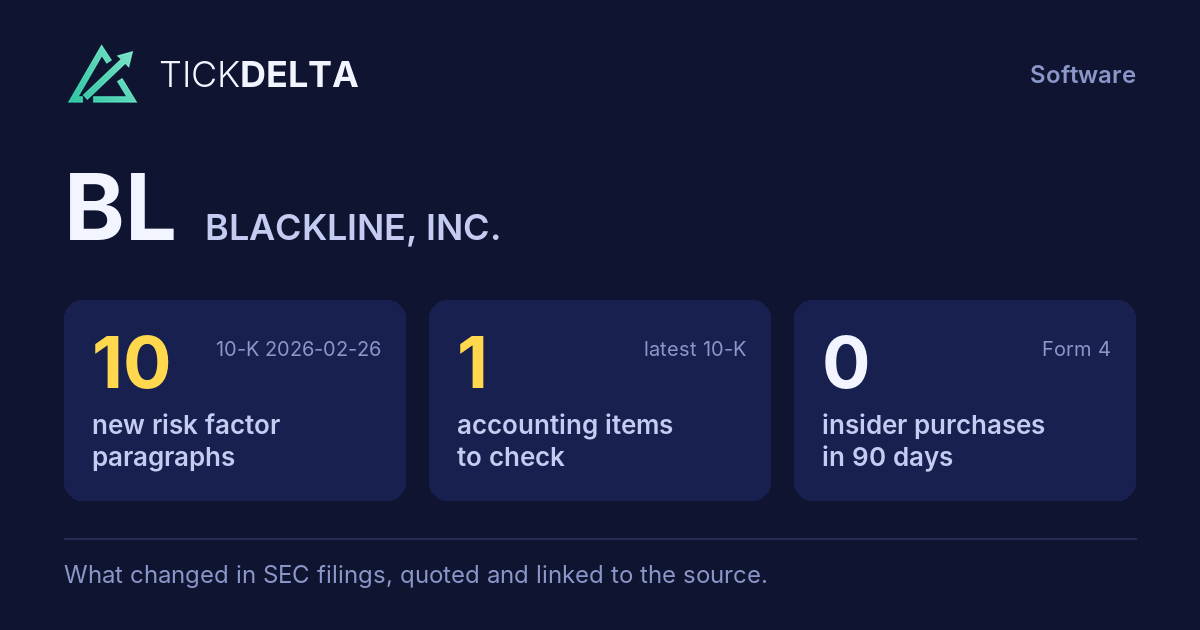
of the text changed · 21,041 words now · 10 new paragraphs, 7 gone
MD&A
24.5%
of the text changed · 8,273 words now · 11 new paragraphs, 13 gone
Legal Proceedings
12.9%
of the text changed · 241 words now
Accounting Policies
15.0%
of the text changed · 6,871 words now
10-K 0001628280-26-011915 (Feb 26, 2026) vs 10-K 0001666134-25-000003 (Feb 21, 2025)
Every paragraph, and how much of it changed
One bar per paragraph, in the order of the 10-K. Height and colour show the share of its words not in the closest paragraph a year earlier; the tallest bars are new paragraphs.
Risk Factors
247 paragraphs · 10 new · 74 reworded · 7 gone · 10-K Feb 26, 2026 against Feb 21, 2025
New paragraph
Reworded (5% of its words or more)
Same or nearly
Paragraph 118 · 49% changed
Every version of it
Paragraph 170 · 46% changed
Every version of it
Paragraph 135 · 39% changed
Every version of it
Paragraph 47 · 38% changed
Every version of it
Paragraph 174 · 36% changed
Every version of it
Any changes in the U.S. or global taxation of our activities may increase our worldwide effective tax rate and adversely affect our financial position and results of operations. For example, the Inflation Reduction Act includes, among other provisions, an alternative minimum tax on adjusted financial statement income and a 1% excise tax on stock buybacks. Further, beginning in 2022, Section 174 On July 4, 2025, H.R. 1, also known as the “One Big Beautiful Bill Act,” was enacted into law, making a number of changes to U.S. federal income tax law, including permanently suspending the Code eliminates the right requirement to deduct capitalize and amortize domestic research and development expenditures and requires taxpayers to capitalize and amortize U.S. and foreign research and development expenditures over five and fifteen years, respectively. permitting such deductions on a current basis. In addition, the Organization for Economic Cooperation and Development has proposed a global minimum tax of 15%, 15% (“Pillar 2”), which has been adopted by or is being considered by EU member states and certain other jurisdictions. On January 5, 2026, the OECD announced a “side-by-side” elective safe harbor that exempts U.S.-parented multinational entities from certain provisions of Pillar 2 for fiscal years beginning on or after January 1, 2026. These and other proposed or implemented changes in the U.S. and global taxation could adversely impact our financial position and results of operations.
Paragraph 26 · 35% changed
Every version of it
Our operating results may vary based on the impact of changes in our industry or the global economy on us or our customers. The revenue growth and potential profitability of our business depend on demand for business software applications and services generally, and for accounting and finance systems in particular. We have been operating in a period of economic uncertainty and cannot predict the timing, strength, or duration of any economic recovery. The global economy has been, and may in the future be adversely affected by concerns of inflation and fluctuating interest rates, the imposition of tariffs and non-tariff trade barriers, as well as reciprocal actions, adverse business conditions and liquidity concerns, as well as along with macroeconomic volatility and uncertainty. Such general macroeconomic conditions have contributed to a more restrained and selective IT spending environment that could adversely affect demand for our products and make it difficult to accurately forecast and plan our future business activities. For example, since the second quarter of 2022, If we have observed certain customers delaying are unable to maintain pipeline growth or if our win rates decline, our ability to grow our revenue and deferring purchasing decisions, which has resulted in the deterioration of near-term demand. profitability could be adversely affected. A failure to continue our shift toward platform-priced solutions could also negatively impact our future financial performance. In addition, professional services revenue may decrease as new implementation projects are delayed. To the extent that there are unfavorable conditions in the national and global economy, our business could be negatively impacted. Current and potential customers may reduce their budgets for accounting, finance, and technology, or they may postpone or decide not to purchase or renew subscriptions to our products, which they might view as discretionary. This would limit our ability to grow and negatively affect our operating results. Additionally, corporate cost-cutting and tighter budgets could reduce the rate of spending on accounting, finance, and information technology. This could affect our customers’ ability or willingness to purchase our cloud platform, delay purchasing decisions, reduce the value or duration of their subscription contracts, or increase attrition rates, all of which would adversely affect our operating results. The occurrence of a natural disaster, global public health crisis, geopolitical uncertainty or war has caused, and in the future may cause, customers to request concessions, including extended payment terms, free modules or better pricing. Uncertain economic conditions may also adversely affect third parties with which we have entered into relationships and upon which we depend in order to grow our business, such as technology vendors and public cloud providers. Prolonged economic uncertainties relating to macroeconomic trends could limit our ability to grow our business and negatively affect our operating results.
Paragraph 32 · 34% changed
Every version of it
If we are unable to provide enhancements and new features for our existing solutions or new solutions that achieve market acceptance or that keep pace with rapid technological developments, our business could be adversely affected. For example, advancements in technology and the introduction of products by our competitors or others incorporating new technologies, such as AI/ML, the emergence of new industry standards, or changes in customer requirements, may alter the market for our products, and businesses that are slow to adopt or fail to adopt these new technologies may face a competitive disadvantage. The success of enhancements, new products and solutions depends on several factors, including timely completion, introduction and market acceptance. We must continue to meet changing expectations and requirements of our customers and, because our platform is designed to operate on a variety of systems, we need to continuously modify and enhance our solutions to keep pace with changes in internet-related hardware, AI/ML advancements, and other software, communication, browser and database technologies. Customers may increasingly expect greater control over their data, including specific requirements for data residency and cloud sovereignty, and limitations on data sharing, portability, and cross-border transfers. If we fail to meet these evolving expectations, which may be more restrictive than current legal obligations, customers may be unwilling to use our services. Adapting our platform to meet these demands could
Paragraph 20 · 49% changed
Every version of it
10-K Feb 21, 2025Our growth also depends upon our ability to add users and sell additional products to our existing customers. It is important for the growth of our business that our existing customers make additional significant purchases of our products and add additional users to our platform. Although our customers, users, and revenue have grown rapidly in the past, in recent periods our slower growth rates have reflected the size and scale of our business. In addition, our growth rates may be impacted by changing customer preferences, such as customer preference for platform offerings that unify upstream and downstream activities versus less broadly-focused solutions, increased competition across many of our product offerings, and diversion of IT budgets toward other technologies and priorities. We cannot be assured that we will achieve similar growth rates in future periods as our customers, users, and revenue could decline, or grow more slowly than we expect. Our business also depends on retaining existing customers. If we do not retain customers, including due to the acquisition of our customers by other companies, or our customers downgrade or fail to renew their agreements with us, or move to our competitors, or if our customers do not purchase additional products, our revenues may grow more slowly than expected, may not grow at all or may decline. Additionally, increasing incremental sales to our current customer base may require additional sales efforts that are targeted at senior management of such customers, which efforts are often associated with complex customer requirements and additional time to evaluate and test our products, and can lead to long and unpredictable sales cycles. There can be no assurance that our efforts will result in increased sales to existing customers or additional revenues.
10-K Feb 26, 2026
As we move to a platform model, our growth depends upon our ability to sell additional products and increase usage from our existing customers. It is important for the growth of our business that our existing customers make additional significant purchases of our products through our platform. Although our revenue has continued to grow, the rate of growth has slowed in recent periods, and we have experienced a decline in the number of our customers and users. The decline in revenue growth is attributable, in part, to strategic business decisions made in response to the maturation of the market for our financial close products. Specifically, our refined commercial focus on enterprise and large mid-market customers has resulted in an increased rate of churn among smaller customers. In addition, we are moving to a platform pricing model that is not based on the number of users, which may increase our user attrition rate as customers migrate to the platform pricing model. In addition, our growth rates may be impacted by changing customer preferences, such as customer preference for solutions that unify upstream and downstream activities versus less broadly-focused solutions, increased competition across many of our product offerings, customer insourcing of functionality, and diversion of IT budgets toward other technologies and priorities. Our sales and marketing efforts have been and may continue to be impacted by geopolitical developments and other events beyond our control, including economic volatility and macroeconomic trends. Such events have resulted in increased price sensitivity on the part of certain current and prospective customers, and could negatively impact sales for certain of our premium-priced offerings.
Paragraph 118 · 49% changed
Every version of it
10-K Feb 21, 2025The market price of our common stock may be volatile, and you could lose all or part of your investment.
10-K Feb 26, 2026
differ from our expectations or the expectations of our investors, the trading price of our common stock could be adversely affected.
Paragraph 170 · 46% changed
Every version of it
10-K Feb 21, 2025Changes in laws or regulations that adversely affect the growth, popularity, or use of the internet, including laws impacting net neutrality or requiring payment of network access fees, could decrease the demand for our service and increase our cost of doing business. Certain laws intended to prevent network operators from discriminating against the legal traffic that traverse their networks have been implemented in many countries, including across the European Union. Furthermore, favorable laws may change, including for example, in the United States where net neutrality regulations were recently repealed. Given uncertainty around these rules, including changing interpretations, amendments, or repeal, coupled with potentially significant political and economic power of local network operators, we could experience discriminatory or anti-competitive practices that could impede our growth, cause us to incur additional expense, or otherwise negatively affect our business.
10-K Feb 26, 2026
interpretations, amendments, or repeal, coupled with potentially significant political and economic power of local network operators, we could experience discriminatory or anti-competitive practices that could impede our growth, cause us to incur additional expense, or otherwise negatively affect our business.
Paragraph 135 · 39% changed
Every version of it
10-K Feb 21, 2025If we do not accurately predict our infrastructure capacity requirements, our customers could experience service shortfalls. The provisioning of additional cloud hosting capacity requires lead time. As we continue to restructure our data management plans, and increase our cloud hosting capacity, we have and expect to in the future move or transfer our data and our customers’ data. Despite precautions taken during such processes and procedures, any unsuccessful data transfers may impair the delivery of our service, and we may experience costs or downtime in connection with the transfer of data to other facilities which may lead to, among other things, customer dissatisfaction and non-renewals. Our public cloud providers have no obligations to renew their agreements with us on commercially reasonable terms, or at all. If any of our public cloud providers increases pricing terms, terminates or seeks to terminate our contractual relationship, establishes more favorable relationships with our competitors, or changes or interprets their terms of service or policies in a manner that is unfavorable with respect to us, we may be required to transfer to other providers. If we are required to transfer to other providers, we would incur significant costs and experience possible service interruption in connection with doing so.
10-K Feb 26, 2026
pricing terms, terminates or seeks to terminate our contractual relationship, establishes more favorable relationships with our competitors, or changes or interprets their terms of service or policies in a manner that is unfavorable with respect to us, we may be required to transfer to other providers. If we are required to transfer to other providers, we would incur significant costs and experience possible service interruption in connection with doing so.
Paragraph 47 · 38% changed
Every version of it
10-K Feb 21, 2025We have incorporated and may continue to incorporate AI/ML solutions and features into our platform, and otherwise within our business, and these solutions and features may become more important to our operations or to our future growth over time. There can be no assurance that we will realize the desired or anticipated benefits from AI/ML, or at all, and we may fail to properly implement or market our AI/ML solutions and features. Our competitors or other third parties may incorporate AI/ML into their products, offerings, and solutions more quickly or more successfully than we do, which could impair our ability to compete effectively, and adversely affect our results of operations. Additionally, our AI/ML solutions and features may expose us to additional claims, demands, and proceedings by private parties and regulatory authorities and subject us to legal liability as well as brand and reputational harm. For example, the AI/ML models that we use are trained using various data sets, and if our models are incorrectly designed, the data we use to train them is incomplete or inadequate, or we do not have sufficient rights to use the data on which our models rely, the performance of our AI/ML solutions and features, as well as our reputation, could suffer or we could incur liability through the violation of contractual or regulatory obligations. The legal, regulatory, and policy environments around AI/ML are evolving rapidly. For example, the EU AI Act (the “AI Act”), which achieved approval by the European Council on February 2, 2024, and the European Parliament on March 13, 2024, will impose obligations on providers and users of artificial intelligence technologies. The AI Act may impact the development and adoption of our AI/ML solutions in Europe. Additionally, several U.S. states have proposed, and in certain cases have enacted, legislation imposing obligations in connection with the development or use of, or otherwise regulating, AI/ML technologies. Other countries also are contemplating laws regulating AI/ML technologies. We may become subject to new legal and other obligations in connection with our use of AI/ML, which could require us to make significant changes to our policies and practices, necessitating expenditure of significant time, expense, and other resources.
10-K Feb 26, 2026
Furthermore, the legal, regulatory, and policy environments around AI/ML are evolving rapidly. For example, the EU AI Act (“AI Act”), which was approved by the European Council on February 2, 2024, and the European Parliament on March 13, 2024, imposes obligations on providers and users of artificial intelligence technologies. The AI Act may impact the development and adoption of our AI/ML solutions in Europe. Additionally, several U.S. states have proposed, and in certain cases have enacted, legislation imposing obligations in connection with the development or use of, or otherwise regulating, AI/ML technologies. Other countries also are contemplating laws regulating AI/ML technologies. We may become subject to new legal and other obligations in connection with our use of AI/ML, which could require us to make significant changes to our policies and practices, necessitating expenditure of significant time, expense, and other resources.
Paragraph 174 · 36% changed
Every version of it
10-K Feb 21, 2025
Any changes in the U.S. or global taxation of our activities may increase our worldwide effective tax rate and adversely affect our financial position and results of operations. For example, the Inflation Reduction Act includes, among other provisions, an alternative minimum tax on adjusted financial statement income and a 1% excise tax on stock buybacks. Further, beginning in 2022, Section 174 of the Code eliminates the right to deduct research and development expenditures and requires taxpayers to capitalize and amortize U.S. and foreign research and development expenditures over five and fifteen years, respectively. In addition, the Organization for Economic Cooperation and Development has proposed a global minimum tax of 15%, which has been adopted by or is being
10-K Feb 26, 2026
Any changes in the U.S. or global taxation of our activities may increase our worldwide effective tax rate and adversely affect our financial position and results of operations. For example, the Inflation Reduction Act includes, among other provisions, an alternative minimum tax on adjusted financial statement income and a 1% excise tax on stock buybacks. On July 4, 2025, H.R. 1, also known as the “One Big Beautiful Bill Act,” was enacted into law, making a number of changes to U.S. federal income tax law, including permanently suspending the requirement to capitalize and amortize domestic research and development expenditures and permitting such deductions on a current basis. In addition, the Organization for Economic Cooperation and Development has proposed a global minimum tax of 15% (“Pillar 2”), which has been adopted by or is being considered by EU member states and certain other jurisdictions. On January 5, 2026, the OECD announced a “side-by-side” elective safe harbor that exempts U.S.-parented multinational entities from certain provisions of Pillar 2 for fiscal years beginning on or after January 1, 2026. These and other proposed or implemented changes in the U.S. and global taxation could adversely impact our financial position and results of operations.
Paragraph 26 · 35% changed
Every version of it
10-K Feb 21, 2025
recovery. The global economy has been, and may in the future be adversely affected by concerns of inflation and fluctuating interest rates, adverse business conditions and liquidity concerns, as well as macroeconomic volatility and uncertainty. Such general macroeconomic conditions have contributed to a more restrained and selective IT spending environment that could adversely affect demand for our products and make it difficult to accurately forecast and plan our future business activities. For example, since the second quarter of 2022, we have observed certain customers delaying and deferring purchasing decisions, which has resulted in the deterioration of near-term demand. In addition, professional services revenue may decrease as new implementation projects are delayed. To the extent that there are unfavorable conditions in the national and global economy, our business could be negatively impacted. Current and potential customers may reduce their budgets for accounting, finance, and technology, or they may postpone or decide not to purchase or renew subscriptions to our products, which they might view as discretionary. This would limit our ability to grow and negatively affect our operating results. Additionally, corporate cost-cutting and tighter budgets could reduce the rate of spending on accounting, finance, and information technology. This could affect our customers’ ability or willingness to purchase our cloud platform, delay purchasing decisions, reduce the value or duration of their subscription contracts, or increase attrition rates, all of which would adversely affect our operating results. The occurrence of a natural disaster, global public health crisis, geopolitical uncertainty or war has caused, and in the future may cause, customers to request concessions, including extended payment terms, free modules or better pricing. Uncertain economic conditions may also adversely affect third parties with which we have entered into relationships and upon which we depend in order to grow our business, such as technology vendors and public cloud providers. Prolonged economic uncertainties relating to macroeconomic trends could limit our ability to grow our business and negatively affect our operating results.
10-K Feb 26, 2026
Our operating results may vary based on the impact of changes in our industry or the global economy on us or our customers. The revenue growth and potential profitability of our business depend on demand for business software applications and services generally, and for accounting and finance systems in particular. We have been operating in a period of economic uncertainty and cannot predict the timing, strength, or duration of any economic recovery. The global economy has been, and may in the future be adversely affected by concerns of inflation and fluctuating interest rates, the imposition of tariffs and non-tariff trade barriers, as well as reciprocal actions, adverse business conditions and liquidity concerns, along with macroeconomic volatility and uncertainty. Such general macroeconomic conditions have contributed to a more restrained and selective IT spending environment that could adversely affect demand for our products and make it difficult to accurately forecast and plan our future business activities. If we are unable to maintain pipeline growth or if our win rates decline, our ability to grow our revenue and profitability could be adversely affected. A failure to continue our shift toward platform-priced solutions could also negatively impact our future financial performance. In addition, professional services revenue may decrease as new implementation projects are delayed. To the extent that there are unfavorable conditions in the national and global economy, our business could be negatively impacted. Current and potential customers may reduce their budgets for accounting, finance, and technology, or they may postpone or decide not to purchase or renew subscriptions to our products, which they might view as discretionary. This would limit our ability to grow and negatively affect our
Paragraph 32 · 34% changed
Every version of it
10-K Feb 21, 2025
If we are unable to provide enhancements and new features for our existing solutions or new solutions that achieve market acceptance or that keep pace with rapid technological developments, our business could be adversely affected. For example, advancements in technology and the introduction of products by our competitors or others incorporating new technologies, such as AI/ML, the emergence of new industry standards, or changes in customer requirements, may alter the market for our products, and businesses that are slow to adopt or fail to adopt these new technologies may face a competitive disadvantage. The success of enhancements, new products and
10-K Feb 26, 2026
If we are unable to provide enhancements and new features for our existing solutions or new solutions that achieve market acceptance or that keep pace with rapid technological developments, our business could be adversely affected. For example, advancements in technology and the introduction of products by our competitors or others incorporating new technologies, such as AI/ML, the emergence of new industry standards, or changes in customer requirements, may alter the market for our products, and businesses that are slow to adopt or fail to adopt these new technologies may face a competitive disadvantage. The success of enhancements, new products and solutions depends on several factors, including timely completion, introduction and market acceptance. We must continue to meet changing expectations and requirements of our customers and, because our platform is designed to operate on a variety of systems, we need to continuously modify and enhance our solutions to keep pace with changes in internet-related hardware, AI/ML advancements, and other software, communication, browser and database technologies. Customers may increasingly expect greater control over their data, including specific requirements for data residency and cloud sovereignty, and limitations on data sharing, portability, and cross-border transfers. If we fail to meet these evolving expectations, which may be more restrictive than current legal obligations, customers may be unwilling to use our services. Adapting our platform to meet these demands could
MD&A
142 paragraphs · 11 new · 79 reworded · 13 gone · 10-K Feb 26, 2026 against Feb 21, 2025
New paragraph
Reworded (5% of its words or more)
Same or nearly
Paragraph 70 · 50% changed
Paragraph 61 · 48% changed
Paragraph 109 · 44% changed
Paragraph 79 · 42% changed
Paragraph 108 · 42% changed
Paragraph 9 · 42% changed
Professional services. We offer our customers services consist primarily of implementation and consulting services. With the exception of our intercompany accounting solutions acquired from the FourQ Acquisition, our product offerings Our products are available for immediate use on our platform after upon granting access to a new customer. customer access. We typically help assist customers implement our solutions, with implementation and we also provide consulting and training services to help customers them optimize the use of our products. solutions. We invoice customers for our consulting services
Paragraph 57 · 42% changed
Paragraph 83 · 40% changed
Paragraph 70 · 50% changed
10-K Feb 21, 2025•$4.5 million increase due to net foreign currency losses resulting from the weakening of multiple currencies against the U.S. Dollar; and
10-K Feb 26, 2026
•$8.2 million decrease primarily due to a favorable change in foreign currency, net of the impact of foreign currency forward contracts; and
Paragraph 61 · 48% changed
10-K Feb 21, 2025•$1.1 million decrease in marketing expenses due to streamlined marketing efforts; and
10-K Feb 26, 2026
•$1.0 million increase in digital marketing expenses, partially offset by streamlined marketing efforts; partially offset by
Paragraph 109 · 44% changed
10-K Feb 21, 2025•$0.6 million increase in other assets due to increased prepaid commissions, partially offset by related amortization.
10-K Feb 26, 2026
•$3.7 million increase in other assets primarily due to net increase in prepaid commissions and capitalization related to strategic IT projects and software upgrades.
Paragraph 79 · 42% changed
10-K Feb 21, 2025The increase in interest expense during the year ended December 31, 2024, compared to the year ended December 31, 2023, was primarily due to the amortization of debt issuance costs and cash interest expense related to our 2029 Notes issued in May 2024, partially offset by a decrease in interest expense resulting from the partial repurchase of our 2026 Notes and the repayment of our 2024 Notes in August 2024. Refer to “Note 11 - Convertible Senior Notes” for additional information. We do not expect interest expense to fluctuate significantly over the next 12 months as the interest rates on our Notes are fixed.
10-K Feb 26, 2026
Notes” for additional information. We do not expect interest expense to fluctuate significantly over the next 12 months as the interest rates on our Notes are fixed.
Paragraph 108 · 42% changed
10-K Feb 21, 2025•$7.6 million increase in accounts receivable primarily due to increased sales, partially offset by customer payments;
10-K Feb 26, 2026
•$38.2 million increase in accounts receivable primarily due to billings outpacing cash collections from customers;
Paragraph 9 · 42% changed
10-K Feb 21, 2025
Professional services. We offer our customers implementation and consulting services. With the exception of our intercompany accounting solutions acquired from the FourQ Acquisition, our product offerings are available for immediate use on our platform after granting access to a new customer. We typically help customers implement our solutions, and we also provide consulting and training services to help customers optimize the use of our products.
10-K Feb 26, 2026
Professional services consist primarily of implementation and consulting services. Our products are available for immediate use upon granting customer access. We typically assist customers with implementation and provide consulting services to help them optimize the use of our solutions. We invoice customers for our consulting services
Paragraph 57 · 42% changed
10-K Feb 21, 2025•$1.0 million decrease in depreciation and amortization due to certain assets being fully amortized; and
10-K Feb 26, 2026
•$2.2 million decrease in depreciation and amortization due to certain assets becoming fully amortized in prior periods and an overall operational shift from traditional data centers to a cloud environment.
Paragraph 83 · 40% changed
10-K Feb 21, 2025We are subject to federal and state income taxes in the U.S. and taxes in foreign jurisdictions. During the quarter ended December 31, 2024, we determined that our U.S. deferred tax asset valuation allowance was no longer required. This determination was based on an evaluation of positive and negative factors, including, but not limited to, our achievement of pre-tax income during the quarter ended June 30, 2023 and each subsequent quarter since, our full utilization of our federal net operating loss carryforward during 2024, and our projections of future pre-tax income. For the year ended December 31, 2024, our annual estimated effective tax rate differed from the U.S. federal statutory rate of 21% primarily as a result of the $89.1 million release of our U.S. valuation allowance, along with state and foreign taxes. For the years ended December 31, 2024 and 2023, we recorded $43.1 million in income tax benefit and $1.5 million in income tax expense, respectively. The decrease in income taxes for the year ended December 31, 2024, compared to the year ended December 31, 2023, resulted primarily from the 2024 release of $89.1 million of the 2023 U.S. valuation allowance, partially offset by our 2024 current and deferred federal and state income taxes of $44.6 million, and changes in the mix of profitable foreign jurisdictions.
10-K Feb 26, 2026
For the year ended December 31, 2025, our annual estimated effective tax rate differed from the U.S. federal statutory rate of 21% primarily as a result of non-deductible officer compensation, stock-based compensation shortfalls, changes in the mix of profitable foreign jurisdictions, and changes in our valuation allowance for income taxes. For the years ended December 31, 2025 and 2024, we recorded $21.0 million in income tax expense and $43.1 million in income tax benefit, respectively. The increase in income taxes for the year ended December 31, 2025, compared to the year ended December 31, 2024, resulted primarily from the 2024 release of the $89.1 million U.S. valuation allowance, as compared with the 2025 release of $2.3 million of the BlackLine K.K. valuation allowance, increases in non-deductible officer compensation and stock-based compensation shortfalls, and changes in the mix of profitable foreign jurisdictions.
A paragraph is matched with the one last year that shares the most of its words; under half in common makes it new. The paragraphs shown are the 8 reworded the most in each section.
The paragraph that changed most in each section
The redline
Marked against last year's 10-K: cut words struck through, new words highlighted.
Risk Factors405 words changed in this paragraph; it is 39% similar to last year's version.
We have incorporated and may continue to incorporate AI/ML solutions and features into our platform, such as AI agents, and otherwise within our business, and these solutions and features may become more important to our operations or to our future growth over time. There can be no assurance that we will realize the desired or anticipated benefits from AI/ML, or at all, and we may fail to properly effectively implement or market our AI/ML solutions and features. Our competitors or other third parties may incorporate AI/ML into their products, offerings, and solutions more quickly or more successfully than we do, which could impair our ability to compete effectively, and adversely affect our results of operations. Additionally, We may also face greater competition from non-specialist solutions relying on generic large language models (“LLMs”), generative AI and general-purpose agents to address a broad range of business needs. We must effectively demonstrate to customers and prospects that our AI/ML solutions and features may expose us are superior to additional claims, demands, other solutions available to their organizations, including generic LLMs, software created using natural language prompts and proceedings by private parties generative AI, and regulatory authorities other emerging technologies. If we are unable to continue to innovate and subject us demonstrate a compelling value proposition that exceeds what customers believe they can create on their own with AI/ML tools, and/or what ERPs are able to legal liability as well as brand integrate directly in their offerings, our ability to attract and reputational harm. For example, the AI/ML models that we use are trained using various data sets, and retain customers could be diminished, which would adversely affect our business. In addition, if our models are incorrectly designed, the data we use to train them is incomplete current and potential competitors develop products with similar or inadequate, or we do not have sufficient rights to use the data on which our models rely, the performance of our AI/ML solutions and features, as well as our reputation, could suffer or we could incur liability through the violation of contractual or regulatory obligations. The legal, regulatory, and policy environments around AI/ML are evolving rapidly. For example, the EU AI Act (the “AI Act”), which achieved approval by the European Council on February 2, 2024, and the European Parliament on March 13, 2024, will impose obligations on providers and users of artificial intelligence technologies. The AI Act may impact the development and adoption of our AI/ML solutions in Europe. Additionally, several U.S. states have proposed, and in certain cases have enacted, legislation imposing obligations in connection with the development or use of, or otherwise regulating, AI/ML technologies. Other countries also are contemplating laws regulating AI/ML technologies. We may become subject to new legal and other obligations in connection with our use of AI/ML, which could require us to make significant changes superior functionality to our policies platform, we may need to decrease the prices or accept less favorable terms for our platform subscriptions in order to remain competitive. If we are unable to maintain our pricing due to competitive pressures, our margins will be reduced and practices, necessitating expenditure of significant time, expense, and other resources. our operating results will be negatively affected.
Source: Item 1A, 10-K 0001628280-26-011915 vs Item 1A, 10-K 0001666134-25-000003
MD&A165 words changed in this paragraph; it is 54% similar to last year's version.
Source: Item 7, 10-K 0001628280-26-011915 vs Item 7, 10-K 0001666134-25-000003
Accounting Policies156 words changed in this paragraph; it is 45% similar to last year's version.
In November 2024, September 2025, the FASB issued ASU No. 2024-03, Income Statement 2025-06, Intangible - Reporting Comprehensive Income Goodwill and Other - Expense Disaggregation Disclosures Internal-Use Software (Subtopic 220-40): Disaggregation of Income Statement Expenses 350-40): Targeted Improvements to the Accounting for Internal-Use Software (“ASU 2024-03”), 2025-06”). ASU 2025-06 removes all references to prescriptive and in January 2025, sequential software development stages. ASU 2025-06 requires entities to begin capitalizing software costs when management authorizes and commits to funding the FASB issued Income Statement - Reporting Comprehensive Income - Expense Disaggregation Disclosures (Subtopic 220-40): Clarifying software project, and it is probable that the Effective Date ("ASU 2025-01"). ASU 2024-03 requires public companies to disclose, in interim project will be completed and reporting periods, additional information about certain expenses in the financial statements. software will be used for its intended purpose. For public business entities, ASU 2024-03, as clarified by ASU 2025-01, 2025-06 is effective for the first annual reporting period fiscal years beginning after December 15, 2026, 2027, and interim reporting periods within those annual reporting periods beginning after December 15, 2027. periods. Early adoption of ASU 2024-03 is permitted. The Company is currently evaluating the impact that the updated standard will have of ASU 2025-06 on our disclosures within our its consolidated financial statements. statements and related disclosures. The Company does not intend to early adopt.
Source: Item 8, Note 2 – Basis of Presentation, Significant Accounting Policies, and Recently-Issued Accounting Pronouncements, 10-K 0001628280-26-011915 vs Item 8, Note 2 – Basis of Presentation, Significant Accounting Policies, and Recently-Issued Accounting Pronouncements, 10-K 0001666134-25-000003
Legal Proceedings31 words changed in this paragraph; it is 70% similar to last year's version.
Litigation—From time to time, the Company may become subject to legal proceedings, claims, and litigation arising in the ordinary course of business. The Company is not currently a party to any legal proceedings, nor is it aware of any pending or threatened litigation that would have a material adverse effect on the Company’s business, operating results, cash flows, or financial condition should such litigation be resolved unfavorably.
Source: Item 3, via Note 16 – Commitments and Contingencies, 10-K 0001628280-26-011915 vs Item 3, via Note 17 – Commitments and Contingencies, 10-K 0001666134-25-000003
Sentences and paragraphs added, removed or reworded
Every change, by type
Sentences and paragraphs of BL's Risk Factors and MD&A, 10-K Feb 26, 2026 against 10-K Feb 21, 2025. Each links to the text at sec.gov.
Quiet changes are sentences kept from last year with one to four words changed, at least one of them a hedge, a modal or a qualifier (may, could, will, not, significant, material…). A year or date rolling forward is not counted.
The full word list
adverse, adversely, all, although, anticipate, anticipates, any, approximately, believe, believes, can, cannot, certain, could, expect, expects, generally, however, if, intend, intends, largely, likely, many, material, materially, may, might, most, must, never, no, not, possible, primarily, probable, should, significant, significantly, some, substantial, substantially, unlikely, will, would
AddedRisk Factors
We have incorporated and may continue to incorporate AI/ML solutions and features into our platform, such as AI agents, and otherwise within our business, and these solutions and features may become more important to our operations or to our future growth over time. There can be no assurance that we will realize the desired or anticipated benefits from AI/ML, or at all, and we may fail to effectively implement or market our AI/ML solutions and features. Our competitors or other third parties may incorporate AI/ML into their products, offerings, and solutions more quickly or more successfully than we do, which could impair our ability to compete effectively, and adversely affect our results of operations. We may also face greater competition from non-specialist solutions relying on generic large language models (“LLMs”), generative AI and general-purpose agents to address a broad range of business needs. We must effectively demonstrate to customers and prospects that our solutions and features are superior to other solutions available to their organizations, including generic LLMs, software created using natural language prompts and generative AI, and other emerging technologies. If we are unable to continue to innovate and demonstrate a compelling value proposition that exceeds what customers believe they can create on their own with AI/ML tools, and/or what ERPs are able to integrate directly in their offerings, our ability to attract and retain customers could be diminished, which would adversely affect our business. In addition, if our current and potential competitors develop products with similar or superior functionality to our platform, we may need to decrease the prices or accept less favorable terms for our platform subscriptions in order to remain competitive. If we are unable to maintain our pricing due to competitive pressures, our margins will be reduced and our operating results will be negatively affected.
Read it in 10-K Feb 26, 2026 at sec.gov
AddedRisk Factors
Additionally, our AI/ML solutions and features may expose us to additional claims, demands, and proceedings by private parties and regulatory authorities and subject us to legal liability as well as brand and reputational harm. For example, the AI/ML models that we use are trained using various data sets, and if our models are incorrectly designed, the data we use to train them is incomplete or inadequate, or we do not have sufficient rights to use the data on which our models rely, the performance of our AI/ML solutions and features, as well as our reputation, could suffer or we could incur liability through the violation of contractual or regulatory obligations. Moreover, the use of AI/ML capabilities or tools to improve internal functions and operations may also introduce other legal, financial, and strategic risks. We may overestimate the ability of such capabilities and tools to yield these benefits, and we may be required to make additional investments in technology and systems. We may also need to make changes to our business and operating model in light of changes in our industry, which could cause disruptions to our business. We have implemented policies, guidelines, and procedures specifically directed at the use of AI/ML tools in the workplace to address these risks, but the use of AI/ML tools by our workforce may nonetheless result in exposure of our proprietary information to unauthorized recipients, exposure to or misuse by unauthorized recipients of our or third-party data or intellectual property, or failure to comply with open source software requirements. Our efforts to mitigate these risks, including through training, monitoring, and enforcement of our policies, guidelines, and procedures governing the use of AI/ML tools may not be successful.
Read it in 10-K Feb 26, 2026 at sec.gov
AddedRisk Factors
provide credits in the event of a significant disruption in our platform. To the extent that we do not effectively address capacity constraints, upgrade our systems and continually develop our technology and network architecture to accommodate actual and anticipated changes in technology, our business and operating results may be adversely affected.
Read it in 10-K Feb 26, 2026 at sec.gov
AddedRisk Factors
We operate in a rapidly evolving industry focused on modernizing financial and accounting operations. Some of our solutions are relatively new and have been developed to respond to an increasingly global and complex business environment with more rigorous regulatory standards. Additionally, some of our solutions now incorporate AI-enabled features, such as AI agents. While the use of AI/ML is leading to advancements in technology, if our new solutions are not widely adopted and accepted, or fail to operate as expected, our business and reputation may be
Read it in 10-K Feb 26, 2026 at sec.gov
AddedRisk Factors
Furthermore, our reported net income is impacted by factors beyond our operational spending, including fluctuations in interest income and our provision for income taxes.
Read it in 10-K Feb 26, 2026 at sec.gov
AddedRisk Factors
competing solutions, our ability to compete in the marketplace or to grow our revenue could be impaired and our operating results could suffer. Even if we are successful, we cannot assure you that these relationships will result in improved operating results.
Read it in 10-K Feb 26, 2026 at sec.gov
AddedRisk Factors
business. Privacy, data protection, and cybersecurity concerns, whether valid or not valid, may inhibit the market adoption, effectiveness, or use of our services, particularly in certain industries and foreign countries.
Read it in 10-K Feb 26, 2026 at sec.gov
AddedRisk Factors
There is considerable patent and other intellectual property development activity in our industry. Our success depends, in part, on not infringing upon the intellectual property rights of others. From time to time, our competitors
Read it in 10-K Feb 26, 2026 at sec.gov
Show the other 62
AddedRisk Factors
competitive, and other factors beyond our control. Further, if any series of the Notes convert and we elect to issue common stock in lieu of cash upon conversion, our existing stockholders could suffer significant dilution.
Read it in 10-K Feb 26, 2026 at sec.gov
AddedRisk Factors
sustain. In addition, we may be subject to increased regulations, reporting requirements, standards, or expectations regarding the environmental impacts of our business, and failure to comply with such regulations, requirements, standards or expectations could adversely affect our reputation, business or financial performance.
Read it in 10-K Feb 26, 2026 at sec.gov
RemovedRisk Factors
RemovedRisk Factors
RemovedRisk Factors
RemovedRisk Factors
RemovedRisk Factors
RemovedRisk Factors
RemovedRisk Factors
RewordedRisk Factors
We have established strong relationships with technology vendors vendors, such as SAP and Microsoft Dynamics other providers to market offer our solutions to users of their ERP solutions, and professional services firms such as Deloitte and Ernst & Young, and business process outsourcers such as Cognizant, Genpact and IBM to supplement delivery and implementation of our applications. solutions.
Read it in 10-K Feb 26, 2026 at sec.gov
RewordedRisk Factors
We manage our software solutions and serve most of our customers using a cloud-based multi-cloud infrastructure that has historically been operated in a limited number of third-party data center facilities hosted across GCP, Azure, and AWS, with regions and availability zones in North America America, Europe, Asia-Pacific, and Europe. the Middle East.
Read it in 10-K Feb 26, 2026 at sec.gov
RewordedRisk Factors
In the future, a competitor offering ERP software could include a free service similar to ours as part of its standard offerings or offerings, may offer a free standalone version of a service similar to ours. ours, or may limit our ability to access the data housed within the ERP that is necessary for our customers to realize the full benefits of our platform.
Read it in 10-K Feb 26, 2026 at sec.gov
RewordedRisk Factors
Security breaches or incidents impacting our platform or our internal systems could create significant interruptions or other disruptions of our software solutions, platform and technology, and may result in significant costs incurred in order to remediate or otherwise respond to a breach or incident, which may include liability for stolen assets or information, repair of system damage, incentives offered to customers or other business partners in an effort to maintain business relationships after a breach, and other costs, expenses and liabilities.
Read it in 10-K Feb 26, 2026 at sec.gov
RewordedRisk Factors
We may have difficulty attracting potential customers that rely on widely-available and inexpensive tools such as Excel, software tools, or that have already invested substantial personnel and financial resources to integrate internally-developed or other software solutions into their businesses, as such organizations may be reluctant or unwilling to invest in a new product.
Read it in 10-K Feb 26, 2026 at sec.gov
RewordedRisk Factors
If we are unsuccessful in maintaining our relationship with SAP, if our reseller arrangement with SAP is less successful than we anticipate, if our customers that use an SAP ERP solution do not renew their subscriptions directly with us and instead purchase our solution through the SAP reseller channel or if we are unsuccessful in supporting or expanding our relationships with other companies, our business would be adversely affected.
Read it in 10-K Feb 26, 2026 at sec.gov
RewordedRisk Factors
RewordedRisk Factors
If we are unsuccessful in establishing or maintaining our relationships, or if the counterparties to our relationships offer competing solutions, our ability to compete in the marketplace or to grow our revenue could be impaired and our operating results could suffer.
Read it in 10-K Feb 26, 2026 at sec.gov
RewordedRisk Factors
In addition, to the extent that fluctuations in currency exchange rates cause our results of operations to differ from our expectations or the expectations of our investors, the trading price of our common stock could be adversely affected.
Read it in 10-K Feb 26, 2026 at sec.gov
RewordedRisk Factors
Any loss of the right to use any of this hardware or software could result in delaying or preventing our ability to provide our software solutions until equivalent technology is either developed by us or, if available, identified, obtained and integrated.
Read it in 10-K Feb 26, 2026 at sec.gov
RewordedRisk Factors
RewordedRisk Factors
The global economy has been, and may in the future be adversely affected by concerns of inflation and fluctuating interest rates, the imposition of tariffs and non-tariff trade barriers, as well as reciprocal actions, adverse business conditions and liquidity concerns, as well as along with macroeconomic volatility and uncertainty.
Read it in 10-K Feb 26, 2026 at sec.gov
Quiet changesRisk Factors
Quiet changesRisk Factors
We have never declared or paid any cash dividends on our common stock.
Read it in 10-K Feb 26, 2026 at sec.gov
AddedMD&A
In September 2025, we launched Verity, a comprehensive suite of AI capabilities that provides finance and accounting teams with a digital workforce of embedded and auditable AI. Verity is integrated throughout our solutions and supports a broad range of use cases across our customers’ financial operations, offering flexible capabilities that help deliver best practices across end-to-end record-to-report and invoice-to-cash processes.
Read it in 10-K Feb 26, 2026 at sec.gov
AddedMD&A
On March 4, 2025, we initiated a global restructuring program that was designed to reduce our workforce by approximately 130 total positions, or 7%. During September 2025 and December 2025, we approved additional workforce reductions of 25 and 75 positions, respectively, including the planned closure of selected facilities (the “Fiscal 2025 restructuring programs”). All of the actions are part of our global restructuring program to align resources with strategic priorities and enhance operational efficiency through talent optimization.
Read it in 10-K Feb 26, 2026 at sec.gov
AddedMD&A
Platform pricing ARR as a percentage of eligible ARR. Platform pricing ARR as a percentage of eligible ARR is calculated as platform annual recurring revenue divided by our eligible annual recurring revenue. We define eligible ARR as total annual recurring revenue, excluding revenue from SAP SolEx and the public sector. Management believes that this metric is useful for tracking the progress of the new pricing strategy launched in 2025.
Read it in 10-K Feb 26, 2026 at sec.gov
AddedMD&A
Users. Effective during the quarter ended December 31, 2025, we ceased using “users” as a key metric following the introduction of an updated pricing model that is based on other factors, including product mix, customer size, and volumetrics, such as transactions or entities.
Read it in 10-K Feb 26, 2026 at sec.gov
AddedMD&A
On July 4, 2025, the legislation formally titled “An Act to Provide for Reconciliation Pursuant to Title II of H. Con. Res. 14” and commonly referred to as the “One Big Beautiful Bill” (“OBBB”) was enacted. The OBBB adjusted a number of provisions affecting businesses, including the immediate expensing of domestic research and development costs, limitations on deductions for interest expense, and accelerated fixed asset depreciation. The OBBB provisions did not have a material impact on our effective tax rate; however, several timing provisions results in significant 2025 cash savings.
Read it in 10-K Feb 26, 2026 at sec.gov
AddedMD&A
and an initial cap price of $92.17 per share, subject to certain adjustments. At December 31, 2025, all of the 2029 Capped Calls remained outstanding.
Read it in 10-K Feb 26, 2026 at sec.gov
AddedMD&A
The OBBB provisions did not have a material impact on our effective tax rate, but several timing provisions resulted in significant 2025 cash tax savings. Refer to “Note 14 – “Income Taxes” for additional information.
Read it in 10-K Feb 26, 2026 at sec.gov
AddedMD&A
On November 17, 2024, our Board authorized the repurchase of up to $200 million of our common stock. On September 4, 2025, our Board approved an increase to our stock buyback program of an additional $200 million, for a total overall authorization to repurchase up to $400 million of our common stock. Our Board also approved the elimination of the expiration date of the program, which was previously set to expire on March 31, 2027.
Read it in 10-K Feb 26, 2026 at sec.gov
AddedMD&A
We repurchased and retired approximately 4.5 million shares of common stock for $235.5 million during the year ended December 31, 2025. At December 31, 2025, $164.5 million of buyback capacity remained under this program.
Read it in 10-K Feb 26, 2026 at sec.gov
AddedMD&A
•$3.2 million increase in accrued expenses and other current liabilities. This was primarily driven by costs for employee termination benefits and other exit activities related to our Fiscal 2025 restructuring programs and increased accrued commissions, partially offset by decreased bonus accruals.
Read it in 10-K Feb 26, 2026 at sec.gov
AddedMD&A
We account for the costs of computer software obtained or developed for internal use in accordance with Accounting Standards Codification 350, Intangibles—Goodwill and Other. We capitalize certain implementation costs incurred in a hosting arrangement that is a service contract. These capitalized costs exclude training costs,
Read it in 10-K Feb 26, 2026 at sec.gov
RemovedMD&A
RemovedMD&A
RemovedMD&A
RemovedMD&A
RemovedMD&A
RemovedMD&A
RemovedMD&A
RemovedMD&A
RemovedMD&A
RemovedMD&A
RemovedMD&A
RemovedMD&A
RewordedMD&A
Year Ended December 31, 2025 2024 2023 (in thousands) Revenues Subscription and support $ 662,928 $ 619,287 $ 555,516 Professional services 37,499 34,049 34,480 Total revenues 700,427 653,336 589,996 Cost of revenues Subscription and support 144,038 135,308 121,308 Professional services 29,347 26,657 25,485 Total cost of revenues 173,385 161,965 146,793 Gross profit 527,042 491,371 443,203 Operating expenses Sales and marketing 258,930 248,347 243,154 Research and development 109,202 100,973 103,207 General and administrative 118,732 121,795 71,530 Restructuring costs 14,626 1,720 10,964 Total operating expenses 501,490 472,835 428,855 Income from operations 25,552 18,536 14,348 Other income (expense) Interest income 32,825 49,808 52,059 Interest expense (10,149) (8,758) (5,898) Gain on extinguishment of convertible senior notes — 65,112 — Other income, net 22,676 106,162 46,161 Income before income taxes 48,228 124,698 60,509 Provision for (benefit from) income taxes 20,971 (43,067) 1,450 Net income 27,257 167,765 59,059 Net income attributable to redeemable non-controlling interest 3,086 1,952 892 Adjustment attributable to redeemable non-controlling interest (347) 4,639 5,334 Net income attributable to BlackLine, Inc. $ 24,518 $ 161,174 $ 52,833
Read it in 10-K Feb 26, 2026 at sec.gov
RewordedMD&A
Non-GAAP net income (loss) attributable to BlackLine is defined as GAAP net income (loss) attributable to BlackLine adjusted for the income tax effects of acquisitions, stock-based compensation shortfalls and windfalls, and the discrete tax impact of the provision for (benefit from) income taxes related to acquisitions, other non-GAAP adjustments, amortization of intangible assets, stock-based compensation, amortization of debt issuance costs from our 0.125% Convertible Senior Notes paid in 2024 (the “2024 Notes”), 0.00% Convertible Senior Notes due in 2026 (the “2026 Notes”), Notes”) and 1.00% Convertible Senior Notes due in 2029 (the “2029 Notes” and, together with the 2024 and 2026 Notes, the “Notes” or “convertible senior notes”), change in fair value of contingent consideration, transaction-related costs, restructuring costs, legal settlement gains or costs, restructuring costs, adjustment to the redeemable non-controlling interest to the redemption amount, and gain on extinguishment of convertible senior notes.
Read it in 10-K Feb 26, 2026 at sec.gov
RewordedMD&A
The decrease increase in income taxes for the year ended December 31, 2024, 2025, compared to the year ended December 31, 2023, 2024, resulted primarily from the 2024 release of the $89.1 million U.S. valuation allowance, as compared with the 2025 release of $2.3 million of the 2023 U.S. BlackLine K.K. valuation allowance, partially offset by our 2024 current increases in non-deductible officer compensation and deferred federal and state income taxes of $44.6 million, stock-based compensation shortfalls, and changes in the mix of profitable foreign jurisdictions.
Read it in 10-K Feb 26, 2026 at sec.gov
RewordedMD&A
Operating income $ 25,552 $ 18,536 $ 14,348 Amortization of intangible assets 14,168 19,886 20,608 Stock-based compensation 96,325 86,097 80,068 Change in fair value of contingent consideration — (33,549) Transaction-related costs 4,780 568 5,078 Restructuring and legal settlement costs 15,454 1,720 10,964 Total non-GAAP operating income $ 156,279 $ 126,807 $ 97,517 GAAP operating margin 3.6 % 2.8 % 2.4 % Non-GAAP operating margin 22.3 % 19.4 % 16.5 % Non-GAAP Net Income Attributable to BlackLine, Inc.:
Read it in 10-K Feb 26, 2026 at sec.gov
RewordedMD&A
Net income attributable to BlackLine, Inc. $ 24,518 $ 161,174 $ 52,833 Benefit from income taxes (782) (50,948) (1,196) Amortization of intangible assets 14,168 19,886 20,608 Stock-based compensation 95,850 85,654 79,588 Amortization of debt issuance costs 3,394 4,486 5,535 Change in fair value of contingent consideration — (33,549) Transaction-related costs 4,780 568 5,078 Restructuring and legal settlement costs 15,454 1,720 10,964 Adjustment to redeemable non-controlling interest (347) 4,639 5,334 Gain on extinguishment of convertible senior notes — (65,112) — Total non-GAAP net income attributable to BlackLine, Inc. $ 157,035 $ 162,067 $ 145,195
Read it in 10-K Feb 26, 2026 at sec.gov
RewordedMD&A
At December 31, 2024, 2025, our dollar-based net revenue retention rate declined increased from the year ended December 31, 2023 2024 due to the adverse impact of favorable foreign exchange rates, higher attrition, rates and a more moderate rate of acquiring customer accounts. account expansion with existing customers, particularly those adopting our platform pricing model.
Read it in 10-K Feb 26, 2026 at sec.gov
RewordedMD&A
For the year ended December 31, 2023, 2024, cash provided by operating activities was $126.6 $190.8 million, resulting from net non-cash expenses of $71.9 million and net income of $59.1 $167.8 million, partially offset by a net cash outflow from flow provided by changes in our operating assets and liabilities of $4.4 $16.8 million, and net non-cash expenses of $6.3 million.
Read it in 10-K Feb 26, 2026 at sec.gov
RewordedMD&A
For the year ended December 31, 2024, 2025, our annual estimated effective tax rate differed from the U.S. federal statutory rate of 21% primarily as a result of non-deductible officer compensation, stock-based compensation shortfalls, changes in the $89.1 million release mix of profitable foreign jurisdictions, and changes in our U.S. valuation allowance, along with state and foreign allowance for income taxes.
Read it in 10-K Feb 26, 2026 at sec.gov
RewordedMD&A
Year Ended December 31, Change 2025 2024 2023 $ % (in thousands, except percentages) Research and development, gross $ 134,977 $ 126,643 $ 124,546 $ 2,097 2 8,334 7% Capitalized internally-developed software costs (25,775) (25,670) (21,339) (4,331) 20 (105) —% Research and development, net $ 109,202 $ 100,973 $ 103,207 $ (2,234) (2 8,229 8% Percentage of total revenues 15.6 % 15.5 % 17.5 %
Read it in 10-K Feb 26, 2026 at sec.gov
RewordedMD&A
RewordedMD&A
We expect a modest increase in research and development costs to remain consistent as a percentage of revenue in 2025 2026 as we execute our product roadmap and further invest in strategic initiatives, including AI. AI, to accelerate our growth.
Read it in 10-K Feb 26, 2026 at sec.gov
RewordedMD&A
We also have an maintain a strategic agreement with Google Cloud in through which we collaborate with them on joint jointly engage in selling and go-to-market activities and to bring enhanced automation solutions for finance and accounting capabilities to new and existing customers.
Read it in 10-K Feb 26, 2026 at sec.gov
Quiet changesMD&A
Our ability to maximize the lifetime value of our customer relationships will depend, depends, in part, on the willingness of customers to purchase additional user licenses and products from us.
Read it in 10-K Feb 26, 2026 at sec.gov
Quiet changesMD&A
General and administrative expenses also include amortization of trade name intangible assets, the change in the fair value of contingent consideration, if any, transaction-related costs, and impairment of cloud computing implementation costs.
Read it in 10-K Feb 26, 2026 at sec.gov
Quiet changesMD&A
The $4.4 $10.2 million net cash outflow from changes in our operating assets and liabilities reflected primarily the following:
Read it in 10-K Feb 26, 2026 at sec.gov
Quiet changesMD&A
Contingent consideration consideration, if any, payable in cash arising from business combinations is recorded at fair value as a liability on the acquisition date and remeasured at each reporting date.
Read it in 10-K Feb 26, 2026 at sec.gov
Sources
The two latest 10-Ks on EDGAR, section by section. Each change links to the text at sec.gov.
Also
New risk factors: paragraphs with nothing like them last year, quoted in full.
Work with it
Excel workbook · CSV. Google Sheet that stays up to date: paste =IMPORTDATA("https://tickdelta.com/company/BL/export.csv") into a cell.