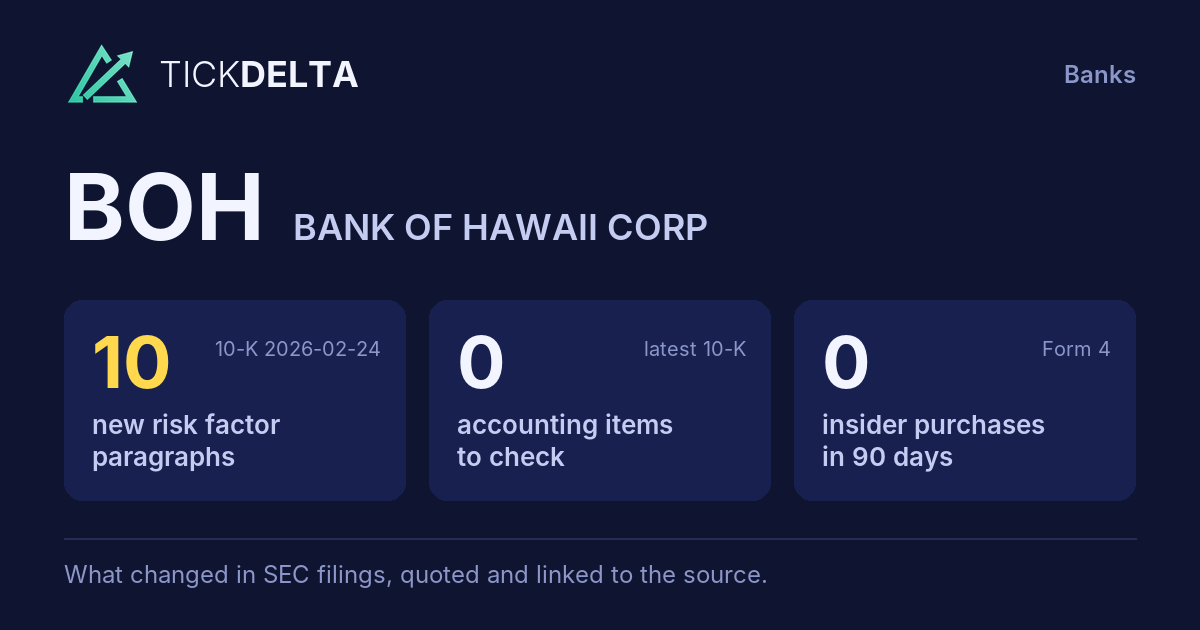
Screener / SEC EDGAR /CIK 0000046195 /10-K filed Feb 24, 2026, compared with Mar 4, 2025 /Numbers from the XBRL of the 10-Ks
NYSE Financials · Banks

Bank Of Hawaii Corp BOH

Compare with peers Embed
The 10-K against last year's

142 changes: 26 added, 13 removed, 102 reworded, 1 quiet changes

10-K Feb 24, 2026 vs Mar 4, 2025

10-K 0000046195-26-000015 (Feb 24, 2026) vs 10-K 0000950170-25-031193 (Mar 4, 2025)

Every paragraph, and how much of it changed

One bar per paragraph, in the order of the 10-K. Height and colour show the share of its words not in the closest paragraph a year earlier; the tallest bars are new paragraphs.

Risk Factors

102 paragraphs · 10 new · 34 reworded · 2 gone · 10-K Feb 24, 2026 against Mar 4, 2025
New paragraph Reworded (5% of its words or more) Same or nearly
Paragraph 53 · 50% changed Every version of it
In addition, there may be increased regulatory scrutiny in the course of routine examinations and otherwise, and new regulations designed to respond to recent negative developments in the banking industry, all of which may increase our costs of doing business and reduce our profitability. Among other things, there may be increased focus by both regulators and investors on deposit composition, the level of uninsured deposits, brokered deposits, unrealized losses in securities portfolios, liquidity, commercial real estate composition and concentration, and capital and general oversight and control of the foregoing. Financial institutions, such as ourselves, could face increased scrutiny or be viewed as higher risk by regulators and/or the investor community, which could negatively affect our results of operations and financial condition or the market for our common stock.
Paragraph 86 · 44% changed Every version of it
Our future depends on our ability to compete effectively. We compete for deposits, loans, leases, and other financial services with a variety of competitors, including banks, thrifts, savings associations, credit unions, mortgage companies, finance companies, mutual funds, brokerage firms, insurance companies, and other non-traditional providers of financial services, including financial technology companies and financial service subsidiaries of commercial and manufacturing companies. Some of our competitors are not subject to the same level of regulation and oversight that is required of banks and BHCs, and may benefit from tax exemptions or lower tax rates. As a result, some of these competitors may have lower cost structures. We expect competitive conditions to intensify as consolidation in the financial services industry continues.
Paragraph 60 · 44% changed Every version of it
Further changes in income tax laws could be enacted, or interpretations of existing income tax laws could change, causing an adverse effect on our financial condition or results of operations. For example, the One Big Beautiful Bill Act (“OBBBA”) was enacted on July 4, 2025, permanently extending several tax provisions originally introduced under the 2017 Tax Cuts and Jobs Act that were set to expire at the end of 2025. The OBBBA also introduced changes to certain U.S. corporate tax rules, most of which take effect in 2026. Although we have evaluated the impact of the OBBBA and do not expect any material changes to our effective tax rate or results of operations, changes in our business and any future regulations or other guidance on the interpretation and application of the new corporate tax rules, may result in additional taxes payable by us, which could materially and adversely affect our financial results and operations. Similarly, our accounting policies and methods are fundamental to how we report our financial condition and results of operations. Some of these policies require use of estimates and assumptions that may affect the value of our assets, liabilities, and financial results. Periodically, new accounting standards are issued or existing standards are revised, changing the methods for preparing our financial statements. These changes are not within our control and may significantly impact our financial condition and results of operations.
Paragraph 34 · 40% changed Every version of it
In determining the level of the reserve for credit losses, we consider numerous factors and our management makes various assumptions and judgments about the loan and lease portfolios, some of which are difficult, subjective, and involve complex judgments. Many of these assumptions are based on current economic conditions, particularly in Hawaiʻi and the West Pacific. If economic conditions stagnate or deteriorate, particularly in Hawaiʻi and the West Pacific, our borrowers may not be able to make timely repayments on their loans or real estate collateral values may decline, resulting in increased delinquencies, foreclosures, and customer bankruptcies, resulting in corresponding increases in credit losses. Our estimates of the risk of loss and amount of loss on any loan are complicated by the significant uncertainties surrounding our borrowers borrowers’ responses to changing business and economic conditions, interest rate environments, inflation and other factors. Because of the degree of uncertainty and susceptibility of these factors to change, our actual losses and estimates of risk of loss inherent in our loan portfolio have varied and are likely to continue to vary from our current estimates. Such variances may materially and adversely affect our financial condition and results of operations.
Paragraph 50 · 38% changed Every version of it
The CFPB has exercised its broad rule-making, supervisory, and examination authority of consumer financial products, as well as expanded data collection and enforcement powers, over depository institutions with more than $10.0 billion in assets. Regulation of overall safety and soundness, the CRA, federal housing and flood insurance, as they pertain to consumer financial products and services, remains with the FRB. As a result In times of greater regulatory scrutiny of consumer financial products as a whole, the Company has become subject to more and expanded regulatory examinations, which also could examinations. Increased regulatory examinations or enforcement actions by regulators may result in increased costs as well as harm to our reputation in the event of a finding that we have not complied with the increased regulatory requirements.
Paragraph 49 · 37% changed Every version of it
The Historically, the CFPB has exercised its broad rule-making, rulemaking, supervisory, and examination authority of consumer financial products, as well as expanded data collection and enforcement powers, over depository institutions with more than $10.0 billion in assets. assets, like the Bank. Regulation of overall safety and soundness, the CRA, federal housing and flood insurance, as they pertain to consumer financial products and services, remains with the FRB. As a result With changes in priority of greater regulatory scrutiny the new administration, the role of the CFPB is changing. Nonetheless, the CFPB’s consumer financial products as a whole, protection laws and rules will continue to govern the Company has become subject to more Bank’s relationship with its customers unless and expanded regulatory examinations, which also could result in increased costs as well as harm to our reputation in the event of a finding that we have not complied with the increased regulatory requirements. until they are changed.
Paragraph 77 · 35% changed Every version of it
In addition to servicing loans in the Company’s portfolio, substantially all of the loans the Company sells to investors are sold with servicing rights retained. The Company also services loans originated by other mortgage loan originators. As servicer, the Company’s primary duties are to: (1) collect payments due from borrowers; (2) advance certain delinquent payments of principal and interest; (3) maintain and administer any hazard, title, or primary mortgage insurance policies relating to the mortgage loans; (4) maintain any required escrow accounts for payment of taxes and insurance and administer escrow payments; and (5) foreclose on defaulted mortgage loans or, to the extent consistent with the documents governing a securitization, consider alternatives to foreclosure, such as loan modifications or short sales. As of December 31, 2024, 2025, we serviced an aggregate unpaid principal balance of approximately $2.5 $2.4 billion.
Paragraph 96 · 31% changed Every version of it
officials. In addition, if one or more financial institutions are found to have violated a law or regulation relating to certain business activities, this could lead to investigations by regulators or other governmental agencies of the same or similar activities by other financial institutions, including the Company, and large fines and remedial measures that may have been imposed in resolving earlier investigations for the same or similar activities at other financial institutions may be used as the basis for future settlements.

MD&A

189 paragraphs · 16 new · 98 reworded · 11 gone · 10-K Feb 24, 2026 against Mar 4, 2025
New paragraph Reworded (5% of its words or more) Same or nearly
Paragraph 83 · 49% changed
Mortgage-backed securities issued by Ginnie Mae, Fannie Mae, and Freddie Mac continue to be the largest concentrations in the portfolio. As of December 31, 2024, 2025, the issuers of these mortgage-backed securities were all AAA-rated, with a low probability of a change in their carry credit ratings in the near future. As of December 31, 2024, our available-for-sale investment securities portfolio was comprised of securities with an average remaining duration of approximately 3.03 years, which does not consider the impact equivalent to those of the interest rate swaps that hedge U.S. Government, reflecting the explicit and/or implicit guarantees provided, and have a portion long history of our available-for-sale portfolio. zero credit loss.
Paragraph 60 · 48% changed
The allocation of the Allowance to our commercial portfolio segment increased Fees, exchange, and other service charges decreased by $9.8 $0.9 million or 13% from 1.6% in 2025 compared to the prior year. This increase was year, primarily due to a $11.1 million the sale of our merchant services portfolio in October 2025 partially offset by an increase in the Allowance allocated to the fees generated from our commercial mortgage portfolio. The increase is primarily due to noninterest income generated from our merchant services portfolio during the impact of an increase in criticized balances years ended December 31, 2025 and qualitative adjustments made to this portfolio. 2024 was $8.7 million and $11.3 million, respectively.
Paragraph 61 · 47% changed
Other noninterest income decreased Investment securities losses increased by $17.4 $15.9 million or 47% 211.6% in 2024 2025 compared to the prior year year, primarily due to a $14.7 $16.8 million gain realized loss on the extinguishments sale of repurchase agreements certain securities in connection with the repositioning of $208.4 million AFS securities during 2023 coupled with a decrease in customer derivative fees earned during 2024 as compared to the prior year. quarter ended December 31, 2025.
Paragraph 59 · 47% changed
decrease was partially offset The average balances of our interest-bearing liabilities increased by $233.7 million or 1% in 2025 compared to the prior year due to an increase in our interest-bearing savings deposits. The As compared to the same period last year, the cost of our interest-bearing liabilities in 2024 increased decreased by 55 33 basis points compared during the year ended December 31, 2025, primarily due to a decrease in the prior year, primarily prevailing interest rate environment, which was driven by customer migration from non-interest bearing and low yield deposit accounts to higher rate deposit products. The cost of our interest-bearing deposits increased by 69 175 basis points in of interest rate cuts by the Federal Open Market Committee from September 2024 compared to the prior year. through December 2025.
Paragraph 158 · 46% changed
Based on our net interest income simulation as of December 31, 2024, 2025, net interest income is expected to increase as interest rates rise. Rising interest rates would drive higher income from floating rate loans, investment securities and interest rate swaps, as well as higher reinvestment yields on cash flows. Conversely, declining interest rates on cause floating rate loans and investment securities, as well as higher reinvestment rates yields to fall, income on loan interest rate swaps to decline and investment securities cashflows. However, cash flows to be reinvested at lower rates. In addition, deposits are assumed to reprice lower than 100% beta, causing interest rates would likely cause an initial decline in net interest income as lower rates would lead expense to lower yields on loans and investment securities, as well as drive higher premium amortization on existing investment securities. Based on our net interest income simulation as of December 31, 2024, NII sensitivity to changes in interest rates for the twelve months subsequent to December 31, 2024, was change less sensitive in comparison to the sensitivity profile for the twelve months subsequent to December 31, 2023. Year-over-year NII sensitivity decreased primarily due to an increase in assumed deposit repricing sensitivity. rapidly than market rate changes.
Paragraph 67 · 44% changed
Total salaries and benefits decreased other expense increased by $1.5 $4.6 million or 1% 8.0% in 2024 2025 compared to the prior year primarily due to a decrease $1.1 million donation to the Bank of Hawaii Foundation, and an increase in separation expense coupled with pension and post-retirement expenses, telephone charges, travel expenses, and broker’s charges, partially offset by a decrease in payroll taxes merchant transactions and share-based compensation, partially offset by an increase in incentive compensation expense and medical, dental, and life insurance expense. card processing fees.
Paragraph 78 · 44% changed
Gross unrealized gains in The carrying value of our investment securities portfolio were $1.3 million was $7.8 billion and $0.7 million $7.3 billion as of December 31, 2024 2025 and 2023, 2024, respectively. Gross unrealized losses The increase was primarily due to the purchase of $1.3 billion in the available-for-sale investment securities portfolio during the year ended December 31, 2025, of which $392.9 million were $1.1 billion and $1.0 billion as floating rate securities. The increase was partially offset by the amortization of existing securities.
Paragraph 57 · 43% changed
The average balances of our earning assets decreased increased by $532.8 $407.2 million or 2% in 2024 2025 compared to the prior year, primarily due to cashflows from increases in the portfolio being used to reduce our interest-bearing liabilities. average balances of available-for-sale (“AFS”) investment securities and commercial mortgage loans. Yields on our investment securities portfolio increased by 4 14 basis points, primarily due to income earned from interest rate swaps that hedge a portion of our AFS securities portfolio partially offset by the impact of a portion of our corporate bonds portfolio converting from fixed-rate securities to lower floating-rate securities in the fourth quarter of 2023. Yields on our loan and lease portfolio increased by 46 basis points due to yield increases on our floating rate loan portfolio, higher rates on loans originated during the period, and income earned from interest rate swaps that hedge a portion of our residential mortgage portfolio.

A paragraph is matched with the one last year that shares the most of its words; under half in common makes it new. The paragraphs shown are the 8 reworded the most in each section.

The paragraph that changed most in each section

The redline

Marked against last year's 10-K: cut words struck through, new words highlighted.

MD&A218 words changed in this paragraph; it is 41% similar to last year's version.
Net income decreased increased by $4.4 $22.7 million or 4% 19% in 2024 2025 compared to the prior year, primarily due to a decrease an increase in net interest income and noninterest income, partially offset by and a decrease in noninterest expense. Net interest income increased by $13.6 million or 6%, primarily due to an increase in loan balances, primarily in commercial mortgages, as well as a net increase in allocated interest income related to increases in balances and spreads on interest-bearing and savings deposits, partially offset by a decline in noninterest-bearing deposit balances and allocated interest income. Noninterest income increased by $18.3 million or 64%, primarily due to a one-time payment on the sale of the Bank’s merchant services portfolio in the fourth quarter, higher customer derivative program revenue, loan and commitment fees, analyzed deposit account fees and a one-time gain on sale of leased assets, partially offset by a reduction in merchant revenues and terminal rentals due to the sale of the portfolio. Noninterest expense decreased by $3.0 $0.6 million or 1% in 2024 compared to the prior year, 1%, primarily due to lower allocated interest income as a result of a decline in the average balance of commercial deposits, including noninterest bearing balances, partially offset by growth in the commercial and industrial and construction loan portfolios. Noninterest income decreased by $4.2 million or 13% in 2024 compared to the prior year, primarily due to a decrease in customer derivative fees, letter of credit fees, and certificate of deposit breakage fees. This decrease was partially offset by increases in account analysis fees, loan fees, and fees earned on money market sweep balances. Noninterest expense decreased by $3.1 million or 4% in 2024 compared to the prior year, primarily due to a decrease in allocated administrative and support unit expenses, salaries and benefits, and broker charges related to the customer derivative program. This decrease was partially offset by an increase in operational losses, merchant processing fees, allocated rent, and software licensing fees. transaction

Source: Item 7, 10-K 0000046195-26-000015 vs Item 7, 10-K 0000950170-25-031193

Risk Factors150 words changed in this paragraph; it is 52% similar to last year's version.
Further changes in income tax laws could be enacted, or interpretations of existing income tax laws could change, causing an adverse effect on our financial condition or results of operations. For example, the One Big Beautiful Bill Act (“OBBBA”) was enacted on July 4, 2025, permanently extending several tax provisions originally introduced under the 2017 Tax Cuts and Jobs Act that were set to expire at the end of 2025. The OBBBA also introduced changes to certain U.S. corporate tax rules, most of which take effect in 2026. Although we have evaluated the impact of the OBBBA and do not expect any material changes to our effective tax rate or results of operations, changes in our business and any future regulations or other guidance on the interpretation and application of the new corporate tax rules, may result in additional taxes payable by us, which could materially and adversely affect our financial results and operations. Similarly, our accounting policies and methods are fundamental to how we report our financial condition and results of operations. Some of these policies require use of estimates and assumptions that may affect the value of our assets, liabilities, and financial results. Periodically, new accounting standards are issued or existing standards are revised, changing the methods for preparing our financial statements. These changes are not within our control and may significantly impact our financial condition and results of operations.

Source: Item 1A, 10-K 0000046195-26-000015 vs Item 1A, 10-K 0000950170-25-031193

Accounting Policies104 words changed in this paragraph; it is 42% similar to last year's version.
The Company is required to own Federal Home Loan Bank (“FHLB”) of Des Moines and Federal Reserve Bank (“FRB”) stock as a condition of membership. These non-marketable equity securities are accounted for at cost which equals par or redemption value. These securities do not have a readily determinable fair value as their ownership is restricted and there is no market for these securities. These securities can only be redeemed or sold at their par value and only to the respective issuing government sponsored institution or to another member institution. The Company records these non-marketable equity securities as a component of other assets, which are periodically evaluated for impairment. Management considers these non-marketable equity securities to be long-term investments. Accordingly, when evaluating these securities for impairment, management considers the ultimate recoverability of the par value rather than by recognizing temporary declines in value.

Source: Item 8, Note 1 – Summary of Significant Accounting Policies, 10-K 0000046195-26-000015 vs Item 8, Note 2 – Summary of Significant Accounting Policies, 10-K 0000950170-25-031193

Legal Proceedings11 words changed in this paragraph; it is 82% similar to last year's version.
(dollars in thousands) December 31, 2025 December 31, 2024 Unfunded Commitments to Extend Credit $ 3,183,221 $ 3,128,272 Standby Letters of Credit 99,692 96,484 Commercial Letters of Credit 7,047 9,339 Total Credit Commitments $ 3,289,960 $ 3,234,095

Source: Item 3, via Note 19 – Commitments and Contingencies, 10-K 0000046195-26-000015 vs Item 3, via Note 20 – Commitments and Contingencies, 10-K 0000950170-25-031193

Sentences and paragraphs added, removed or reworded

Every change, by type

Sentences and paragraphs of BOH's Risk Factors and MD&A, 10-K Feb 24, 2026 against 10-K Mar 4, 2025. Each links to the text at sec.gov.

Quiet changes are sentences kept from last year with one to four words changed, at least one of them a hedge, a modal or a qualifier (may, could, will, not, significant, material…). A year or date rolling forward is not counted.

The full word list

adverse, adversely, all, although, anticipate, anticipates, any, approximately, believe, believes, can, cannot, certain, could, expect, expects, generally, however, if, intend, intends, largely, likely, many, material, materially, may, might, most, must, never, no, not, possible, primarily, probable, should, significant, significantly, some, substantial, substantially, unlikely, will, would

AddedRisk Factors
Significant changes to the size, structure, powers and operations of the federal government, changes to U.S. economic policies, the effects of any prolonged shutdown of the federal government, and uncertainties regarding the potential for these changes may cause economic disruptions that could, in turn, adversely impact our business, results of operations and financial condition.
Read it in 10-K Feb 24, 2026 at sec.gov
AddedRisk Factors
The current U.S. administration has implemented significant changes in federal priorities and has taken steps to change the operations, structure, and policy focus of various federal agencies, as well as regulatory priorities, policy approaches and interpretations of existing laws by those federal agencies. For example, recent executive actions and proposed legislation have changed agency mandates, modified or reduced federal program funding, altered regulatory frameworks, or adjusted the size and composition of the federal workforce. Moreover, leadership transitions at key federal agencies have impacted or may impact rulemaking, supervision, enforcement, and examination priorities across the financial regulatory landscape. These developments in the federal government may have varying effects on the banking and financial services industry that are difficult to predict, which makes it difficult for us to anticipate and mitigate attendant risks. Compliance with changing federal and regulatory priorities could, among other things, increase the costs of operating our business, reduce the demand for our products and services, impact our ability to achieve our business goals, and increase our legal, operational and reputational risks, any or all of which could materially adversely affect our results of operations.
Read it in 10-K Feb 24, 2026 at sec.gov
AddedRisk Factors
The current U.S. administration has also implemented rapid shifts in macroeconomic policies, such as those relating to trade restrictions and tariffs, which have created significant uncertainties regarding U.S. economic growth, the potential for recession, and concerns over an increase in inflation. In particular, these economic policies have created significant instability in the trade relationship between the U.S. and Chinese economies, including tariff escalation, scrutiny of U.S. investment into Chinese companies, and potential limits on Chinese companies’ access to U.S. markets. In order to limit the impact of unpredictable U.S. actions, global companies and governments may reduce the use of the U.S. dollar in world trade and financial transactions, which could result in further volatility in the financial markets and U.S. economy. Slow economic growth, economic contraction or recession, or shifts in broader consumer and business trends in Hawaiʻi and the Pacific Islands would significantly impact our ability to originate loans, the ability of borrowers to repay loans, and the value of the collateral securing loans.
Read it in 10-K Feb 24, 2026 at sec.gov
AddedRisk Factors
Other political and economic events within the United States, including a contentious domestic political environment, changes in or disagreements over U.S. monetary policy and actions of the Federal Reserve, disagreements over long-term federal budget and deficit reduction plans, a U.S. government shutdown, disagreements over, or threats not to increase, the U.S. government’s borrowing limit (or “debt ceiling”), and risk of further downgrade of the ratings of U.S. government debt obligations, also may negatively impact financial markets and the U.S. economy, including the economy of Hawaiʻi and the Pacific Islands. For example, from October 1 to November 12, 2025, the federal government of the United States was shut down as Congress failed to pass appropriations legislation for the 2026 fiscal year and this shutdown added strain to the economic environment in Hawaiʻi. Future disagreements over the U.S. federal budget and appropriations may cause the U.S. federal government to shut down in the future.
Read it in 10-K Feb 24, 2026 at sec.gov
AddedRisk Factors
Further, the perception of the potential for additional, significant changes in federal regulatory or economic policy also has increased uncertainty and may exacerbate declines in investor and consumer confidence, which in turn may adversely
Read it in 10-K Feb 24, 2026 at sec.gov
AddedRisk Factors
Regional business and economic conditions are a major driver of our results of operations. Difficult conditions in the regional business and economic environment, including those caused by the lack of stability and predictability of U.S. policymaking, may materially adversely affect our operating expenses, the quality of our assets, credit losses, and the demand for our products and services.
Read it in 10-K Feb 24, 2026 at sec.gov
AddedRisk Factors
customers do with us. The occurrence of any such failures, disruptions or security breaches could have a negative impact on our results of operations, financial condition, and cash flows as well as damage our brand and reputation.
Read it in 10-K Feb 24, 2026 at sec.gov
Show the other 52
AddedRisk Factors
We and/or our third-party vendors, clients or counterparties have in the past developed or incorporated, and may in the future develop or incorporate AI technology in certain business processes, services or products. The development and use of AI present a number of risks and challenges to our business. The legal and regulatory environment relating to AI is uncertain and rapidly evolving, both in the U.S. and internationally, and includes regulatory schemes targeted specifically at AI as well as provisions in intellectual property, privacy, consumer protection, employment and other laws applicable to the use of AI. These evolving laws, regulations and court decisions could require changes in our implementation of AI technology and increase our compliance costs and the risk of non-compliance. AI models, particularly generative AI models, may produce output or take action that is incorrect or inaccurate, that result in the release of private, confidential or proprietary information, that reflect biases included in the data on which they are trained, infringe on the intellectual property rights of others, or that otherwise exposes the Company to harm. In addition, the complexity of many AI models makes it challenging to understand why they are generating particular outputs. This limited transparency increases the challenges associated with assessing the proper operation of AI models, understanding and monitoring the capabilities of the AI models, reducing erroneous output, eliminating bias and complying with regulations that require documentation or explanation of the basis on which decisions are made. Further, we may rely on AI models developed by third parties, and, to that extent, would be dependent in part on the manner in which those third parties develop and train their models, including risks arising from the inclusion of any unauthorized material in the training data for their models, and the effectiveness of the steps these third parties have taken to limit the risks associated with the output of their models, matters over which we may have limited visibility. Additionally, we are exposed to risks related to the use of AI technologies by third-party vendors, clients, counterparties, clearinghouses and other financial intermediaries. Any of these risks could expose us to liability or adverse legal or regulatory consequences and harm our reputation and the public perception of our business or the effectiveness of our security measures.
Read it in 10-K Feb 24, 2026 at sec.gov
RemovedRisk Factors
In August 2023, wildfires broke out in West Maui destroying the historic town of Lahaina as well as structures and farmland in Upcountry Maui and North Kihei. Roughly 2,200 structures were lost in the fire, 85% of which were homes. Though the economic recovery has been faster than anticipated, Maui's visitor industry remains depressed as the Maui economy continues its gradual post-wildfire recovery. While loans to our customers impacted by the Maui wildfires were not material to our total loan portfolio, real estate property values in the wildfire area were negatively affected and continue to be negatively affected during the wild-fire recovery period.
Read it in 10-K Mar 4, 2025 at sec.gov
RewordedRisk Factors
As a result In times of greater regulatory scrutiny of consumer financial products as a whole, the Company has become subject to more and expanded regulatory examinations, which also could result in increased costs as well as harm to our reputation in the event of a finding that we have not complied with the increased regulatory requirements. examinations.
Read it in 10-K Feb 24, 2026 at sec.gov
RewordedRisk Factors
As a result of greater Increased regulatory scrutiny of consumer financial products as a whole, the Company has become subject to more and expanded regulatory examinations, which also could examinations or enforcement actions by regulators may result in increased costs as well as harm to our reputation in the event of a finding that we have not complied with the increased regulatory requirements.
Read it in 10-K Feb 24, 2026 at sec.gov
RewordedRisk Factors
In light of several recent high-profile data breaches involving other companies’ losses of customer personal and financial information, a material cybersecurity incident could cause customer and/or Bank losses, damage to our brand, and increase our costs through the ongoing cost of technology investments to improve security, as well as the potential financial and reputational impact of a cyber security incident involving the Company.
Read it in 10-K Feb 24, 2026 at sec.gov
RewordedRisk Factors
Events impacting the financial services industry, such as the 2023 failures of Silicon Valley Bank, Signature Bank and First Republic Bank, have resulted industry may result in decreased confidence in banks among uninsured consumer and commercial depositors, other counterparties and investors, as well as significant disruption, volatility and reduced valuations of equity and other securities of banks in the capital markets.
Read it in 10-K Feb 24, 2026 at sec.gov
RewordedRisk Factors
Our estimates of the risk of loss and amount of loss on any loan are complicated by the significant uncertainties surrounding our borrowers responses to changing business and economic conditions, interest rate environments, inflation and other factors.
Read it in 10-K Feb 24, 2026 at sec.gov
RewordedRisk Factors
Economic and inflationary pressure on consumers and uncertainty regarding the economic environment could result in changes in consumer and commercial spending, borrowing and savings habits.
Read it in 10-K Feb 24, 2026 at sec.gov
RewordedRisk Factors
Some of our competitors are not subject to the same level of regulation and oversight that is required of banks and BHCs, and may benefit from tax exemptions or lower tax rates.
Read it in 10-K Feb 24, 2026 at sec.gov
RewordedRisk Factors
These events Disruptions and failures in the banking industry may also result in potentially adverse changes to laws or regulations governing banks and bank holding companies or result in the impositions imposition of restrictions through supervisory or enforcement activities, including higher capital requirements, which could have a material impact on our business.
Read it in 10-K Feb 24, 2026 at sec.gov
RewordedRisk Factors
Our dividend payments and/or stock repurchases may change from time-to-time, time to time, and we cannot provide assurance that we will continue to declare dividends and/or repurchase stock in any particular amounts or at all.
Read it in 10-K Feb 24, 2026 at sec.gov
RewordedRisk Factors
The Historically, the CFPB has exercised its broad rule-making, rulemaking, supervisory, and examination authority of consumer financial products, as well as expanded data collection and enforcement powers, over depository institutions with more than $10.0 billion in assets. assets, like the Bank.
Read it in 10-K Feb 24, 2026 at sec.gov
RewordedRisk Factors
A prolonged period of inflation or other period of high cost of goods such as a result of tariffs given that Hawaiʻi imports certain goods from Mexico, Canada and other countries that may become subject to tariffs, may impact our profitability by negatively impacting our costs and expenses. profitability.
Read it in 10-K Feb 24, 2026 at sec.gov
RewordedRisk Factors
These events occurred during During a period of rapidly rising interest rates which, among other things, resulted may result in unrealized losses in longer duration securities and loans held by banks, and more competition for bank deposits.
Read it in 10-K Feb 24, 2026 at sec.gov
AddedMD&A
As of December 31, 2025, Hawai‘i’s economy faces a challenging environment though conditions have been less severe than earlier anticipated. Tourism continues to soften, with declines in the U.S. mainland market and ongoing weakness in international arrivals, despite modest gains from Japan and Maui’s gradual recovery. Construction remains a key source of stability, supported by major federal contracts and infrastructure projects helping to offset weakness in other sectors. The recent increase in the state minimum wage has boosted incomes for lower-wage workers, however, inflationary pressures continue to build as tariff costs pass through to consumer prices. Federal employment reductions and the 2025 government shutdown have added strain, yet Hawai‘i’s unemployment rate remains low relative to national levels. Hawai‘i’s unemployment rate was 2.2% in December 2025, which was below the U.S. unemployment rate of 4.4%.
Read it in 10-K Feb 24, 2026 at sec.gov
AddedMD&A
•Noninterest income was $179.1 million in 2025, an increase of 3.8% from the prior year, which included an $18.1 million gain related to the sale of our merchant services portfolio partially offset by a $16.8 million loss on the sale of investments in connection with the repositioning of our investment securities portfolio.
Read it in 10-K Feb 24, 2026 at sec.gov
AddedMD&A
In July 2025, the One Big Beautiful Bill Act (“OBBBA”) was enacted, permanently extending several tax provisions originally introduced under the 2017 Tax Cuts and Jobs Act that were set to expire at the end of 2025. The OBBBA also introduced changes to certain U.S. corporate tax rules, most of which take effect in 2026. We have evaluated the impact of the OBBBA and do not expect any material changes to our effective tax rate or results of operations.
Read it in 10-K Feb 24, 2026 at sec.gov
AddedMD&A
processing fees, salaries and benefits, occupancy and equipment expenses, and fewer operational losses in the period, partially offset by increases in data processing, professional services, and allocated administrative, support unit and branch expenses.
Read it in 10-K Feb 24, 2026 at sec.gov
AddedMD&A
The increase in Regular Savings was primarily due to increases in public deposits of $242.5 million, consumer deposits of $200.9 million, and commercial deposits of $5.7 million. The decrease in Money Market was primarily due to decreases in commercial deposits of $57.2 million and consumer deposits of $15.7 million.
Read it in 10-K Feb 24, 2026 at sec.gov
AddedMD&A
Credit risk is the risk that borrowers or counterparties will be unable or unwilling to repay their obligations in accordance with the underlying contractual terms. We manage and control credit risk in the loan and lease portfolio by adhering to
Read it in 10-K Feb 24, 2026 at sec.gov
AddedMD&A
Within our commercial and industrial loan portfolio are loans made to non-depository financial institutions (“NDFIs”). NDFIs encompass a wide range of financial entities that provide services similar to those of traditional banking institutions, but do not accept deposits from the general public and are not regulated by the federal banking agencies. As of December 31, 2025 and 2024, total loans to NDFIs were $80.8 million and $136.0 million, representing less than 1.0% of total loans and leases in both years.
Read it in 10-K Feb 24, 2026 at sec.gov
RemovedMD&A
Global economic conditions remain broadly favorable for the local economy. The Maui economy continues its gradual post-wildfire recovery while the visitor industry for the rest of the Hawaiʻi is expected to operate at a high level. Due to the weak yen, the Japanese visitor market continues to recover slowly. Considering the ongoing recovery efforts on Maui and weaker Japanese yen, visitor arrivals to Hawaiʻi are expected to have moderate growth in 2025.
Read it in 10-K Mar 4, 2025 at sec.gov
RemovedMD&A
The economic environment in Hawaiʻi remained stable with the unemployment rate slightly increasing from 2.9% in December 2023 to 3.0% in December 2024, which was below the U.S. unemployment rate of 4.1%. For the State overall, job growth is expected to expand in 2025 with the main drivers in construction, real estate, and the continued recovery of tourism.
Read it in 10-K Mar 4, 2025 at sec.gov
RemovedMD&A
Investment securities losses, net, decreased by $3.9 million in 2024 compared to the prior year primarily due to $4.6 million net losses on sales of investment securities in 2023, partially offset by higher fees paid to counterparties for Visa Class B share conversion rate expense during 2024.
Read it in 10-K Mar 4, 2025 at sec.gov
RemovedMD&A
Business Segment Net Income Table 6 Year Ended December 31, (dollars in thousands) 2024 2023 1 Consumer Banking $ 129,502 $ 127,433 Commercial Banking 119,423 123,813 Total 248,925 251,246 Treasury and Other (98,931) (80,044) Consolidated Total $ 149,994 $ 171,202
Read it in 10-K Mar 4, 2025 at sec.gov
RemovedMD&A
Commercial Mortgage Breakdown Table 8A As of December 31, 2024 (dollars in thousands) Amount Percent of total % Owner Occupied Multi-family $ 1,025,247 25% 0% Industrial 724,645 18 42 Retail 704,780 18 3 Lodging 676,350 17 0 Office 371,474 9 20 Other1 518,126 13 26 Total Commercial Mortgage $ 4,020,622 100% 13%
Read it in 10-K Mar 4, 2025 at sec.gov
RemovedMD&A
Estimated uninsured deposits are calculated pursuant to regulatory guidance and reported in our Call Report and include deposits collateralized by government-backed securities and intercompany deposits of wholly-owned subsidiaries. The table below presents a reconciliation of our estimated uninsured deposits reported in our Call Report to our adjusted uninsured deposits. We believe the adjusted uninsured deposits reconciliation provides useful information about our deposits at risk.
Read it in 10-K Mar 4, 2025 at sec.gov
RemovedMD&A
Uninsured Deposits Reconciliation Table 13a December 31, (dollars in thousands) 2024 2023 Estimated Uninsured Deposits, as Reported in our Call Report $ 10,744,116 $ 11,012,425 Less: Deposits Collateralized by Government-Backed Securities (1,865,286) (2,038,011) Intercompany Deposits of Wholly-Owned Subsidiaries (123,069) (69,399) Other (108,015) (34,340) Adjusted Uninsured Deposits $ 8,647,746 $ 8,870,675
Read it in 10-K Mar 4, 2025 at sec.gov
RemovedMD&A
Securities Sold Under Agreements to Repurchase Table 14 December 31, (dollars in thousands) 2024 2023 Private Institutions $ 100,000 $ 150,000 Government Entities — 490 Total Securities Sold Under Agreements to Repurchase $ 100,000 $ 150,490
Read it in 10-K Mar 4, 2025 at sec.gov
RemovedMD&A
(dollars in thousands) Table 17 Balance at Beginning of Year $ 11,747 Additions 14,664 Reductions Payments (3,207) Return to Accrual Status (2,192) Charge-offs/Write-downs (1,712) Total Reductions (7,111) Balance at End of Year $ 19,300
Read it in 10-K Mar 4, 2025 at sec.gov
RewordedMD&A
Non-Performing Assets and Accruing Loans and Leases Past Due 90 Days or More Table 16 December 31, (dollars in thousands) 2025 2024 2023 2022 2021 2020 Non-Performing Assets Non-Accrual Loans and Leases Commercial Commercial Mortgage $ 2,085 $ 2,450 $ 2,884 $ 3,309 $ 8,205 Commercial and Industrial $ 1,940 4,627 $ 39 $ 37 $ 243 $ 441 Commercial Mortgage 2,450 2,884 3,309 8,205 8,527 Total Commercial 4,025 7,077 2,923 3,346 8,448 8,968 Consumer Residential Mortgage 5,382 5,052 2,935 4,239 3,305 3,223 Home Equity 4,469 4,514 3,791 4,022 4,881 3,958 Total Consumer 9,851 9,566 6,726 8,261 8,186 7,181 Total Non-Accrual Loans and Leases 13,876 16,643 9,649 11,607 16,634 16,149 Foreclosed Real Estate 295 2,657 2,098 1,040 2,332 2,332 Total Non-Performing Assets $ 14,171 $ 19,300 $ 11,747 $ 12,647 $ 18,966 $ 18,481 Accruing Loans and Leases Past Due 90 Days or More Consumer Residential Mortgage $ 8,834 $ 3,984 $ 3,814 $ 2,429 $ 3,159 5,274 Home Equity 2,152 2,845 1,734 1,673 3,456 3,187 Automobile 520 776 399 589 729 925 Other 753 677 648 683 426 1,160 Total Consumer 12,259 8,282 6,595 5,374 7,770 10,546 Total Accruing Loans and Leases Past Due 90 Days or More $ 12,259 $ 8,282 $ 6,595 $ 5,374 $ 7,770 $ 10,546 Past Due 90 Days or More Restructured Loans on Accrual Status $ 36,568 $ 28,651 $ 43,658 $ 60,519 $ 68,065 and Not Past Due 90 Days or More Total Loans and Leases $ 14,082,050 $ 14,075,980 $ 13,965,026 $ 13,646,420 $ 12,259,076 $ 11,940,020 Ratio of Non-Accrual Loans and Leases to Total Loans and Leases 0.10% 0.12% 0.07% 0.09% 0.14% 0.14% Total Loans and Leases Ratio of Non-Performing Assets to Total Loans and Leases and Foreclosed Real Estate 0.10% 0.14% 0.08% 0.09% 0.15% 0.15% and Foreclosed Real Estate Ratio of Non-Performing Assets to Total Assets 0.06% 0.08% 0.05% 0.05% 0.08% 0.09% Ratio of Commercial Non-Performing Assets to 0.12% 0.05% 0.06% 0.17% 0.18% Total Commercial Loans and Leases and Commercial Foreclosed Real Estate 0.07% 0.12% 0.05% 0.06% 0.17% Ratio of Consumer Non-Performing Assets to 0.15% 0.11% 0.11% 0.14% 0.14% Total Consumer Loans and Leases and Consumer Foreclosed Real Estate 0.13% 0.15% 0.11% 0.11% 0.14% Ratio of Non-Performing Assets and Accruing 0.20% 0.13% 0.13% 0.22% 0.24% Loans and Leases Past Due 90 Days or More to Total Loans and Leases and Foreclosed Real Estate 0.19% 0.20% 0.13% 0.13% 0.22%
Read it in 10-K Feb 24, 2026 at sec.gov
RewordedMD&A
Cash and Cash Equivalents $ 2.6 (2.1) $ (0.3) (5.2) $ 2.3 (7.3) Investment Securities Available-for-Sale Taxable (7.2) 3.1 (4.1) 23.6 (0.1) 23.5 Non-Taxable 0.2 0.2 0.4 1.1 0.0 1.1 Held-to-Maturity Taxable (6.9) (0.4) (7.3) (6.6) (0.5) (7.1) Non-Taxable (0.0) (0.1) — (0.0) (0.1) Total Investment Securities (13.9) 2.9 (11.0) 18.0 (0.6) 17.4 Loans Held for Sale (0.0) (0.0) (0.0) (0.1) 0.0 (0.1) Loans and Leases Commercial Mortgage (0.6) 9.5 8.9 15.1 (5.3) 9.8 Commercial and Industrial 8.9 6.1 15.0 (2.1) (4.6) (6.7) Construction 4.9 4.7 9.6 0.6 (1.6) (1.0) Commercial Lease Financing 0.2 0.7 0.9 1.6 0.4 2.0 Residential Mortgage (2.7) 16.2 13.5 1.4 0.9 2.3 Home Equity (1.8) 11.4 9.6 (3.3) 9.5 6.2 Automobile (2.5) 7.7 5.2 (4.0) 4.9 0.9 Other (1.4) 3.5 2.1 0.6 2.2 2.8 Total Loans and Leases 5.0 59.8 64.8 9.9 6.4 16.3 Other (1.0) 0.1 (0.9) 0.4 (0.1) 0.3 Total Change in Interest Income (7.3) 62.5 55.2 26.1 0.5 26.6 Change in Interest Expense:
Read it in 10-K Feb 24, 2026 at sec.gov
RewordedMD&A
Interest-Bearing Deposits Demand (1.7) 7.9 6.2 (0.1) (3.4) (3.5) Savings 6.2 66.1 72.3 7.6 (27.0) (19.4) Time 24.2 15.3 39.5 (0.5) (21.1) (21.6) Total Interest-Bearing Deposits 28.7 89.3 118.0 Funds Purchased (1.0) 0.1 (0.9) Short-Term Borrowings (6.0) 0.3 (5.7) 7.0 (51.5) (44.5) Securities Sold Under Agreements to Repurchase (15.2) 3.5 (11.7) (2.4) 0.0 (2.4) Other Debt (15.4) (0.5) (15.9) 0.1 (0.1) 0.0 Total Change in Interest Expense (8.9) 92.7 83.8 4.7 (51.6) (46.9) Change in Net Interest Income $ 1.6 21.4 $ (30.2) 52.1 $ (28.6) 73.5
Read it in 10-K Feb 24, 2026 at sec.gov
RewordedMD&A
For 2024, 2025, the increase was attributed to net income of $150.0 million, net preferred stock issuance of $160.6 $205.9 million, other comprehensive income of $53.3 $99.0 million, share-based compensation of $14.4 $16.2 million, and common stock issuances of $5.4 $5.1 million offset by cash dividends of $112.3 $113.0 million paid on common stock shares, cash dividends of $12.6 $21.1 million paid on preferred stock shares, common stock repurchased under share repurchase program of $5.0 million, and common stock repurchases of $5.3 million related to taxes withheld for share based compensation. compensation of $3.8 million.
Read it in 10-K Feb 24, 2026 at sec.gov
RewordedMD&A
The lower effective tax rate in 2024 2025 compared to the prior year was primarily due to return a decrease in nondeductible compensation, and increases in tax benefits related to provision adjustments and low-income housing investments, as well as a change in discrete items partially offset by changes to uncertain tax positions. items.
Read it in 10-K Feb 24, 2026 at sec.gov
RewordedMD&A
At As of December 31, 2024, 2025, we had the intent and ability to hold the investment these securities that were in an unrealized loss position and it is do not more likely than not that we will expect to be required to sell the investment securities them before recovery of recovering their amortized cost basis, which may be occur at maturity.
Read it in 10-K Feb 24, 2026 at sec.gov
RewordedMD&A
The Unfunded Reserve was $1.6 million as of December 31, 2025, and $2.1 million as of December 31, 2024, and $6.0 million as of December 31, 2023, a decrease of $3.9 $0.5 million, which was primarily due to the impact of slightly lower historical loss rates and lower unfunded commitments. commitments in our construction loan portfolio.
Read it in 10-K Feb 24, 2026 at sec.gov
RewordedMD&A
Total other FDIC insurance expense decreased by $0.8 $6.7 million or 1% 37.4% in 2024 2025 compared to the prior year year, primarily due to lower broker's charges as a result partial reduction of fewer customer swaps the FDIC special assessment in 2024 as compared to 2023. 2025.
Read it in 10-K Feb 24, 2026 at sec.gov
RewordedMD&A
This increase decrease was primarily due to a $11.1 reductions in the Allowance of $9.0 million allocated to the commercial and industrial portfolio and $1.4 million allocated to the construction portfolio, partially offset by an increase in the Allowance of $6.5 million allocated to the commercial mortgage portfolio.
Read it in 10-K Feb 24, 2026 at sec.gov
RewordedMD&A
Professional fees Data processing expense increased by $1.9 $2.4 million or 11% 12.5% in 2024 2025 compared to the prior year primarily due to an increase in consulting data services fees and various outsourced support functions related to enhancing our risk management efforts. the additional costs incurred in connection with outsourcing.
Read it in 10-K Feb 24, 2026 at sec.gov
RewordedMD&A
The average balances of our earning assets decreased increased by $532.8 $407.2 million or 2% in 2024 2025 compared to the prior year, primarily due to cashflows from increases in the portfolio being used to reduce our interest-bearing liabilities. average balances of available-for-sale (“AFS”) investment securities and commercial mortgage loans.
Read it in 10-K Feb 24, 2026 at sec.gov
RewordedMD&A
Commercial loans Cash and leases cash equivalents were $6.1 billion $946.5 million as of December 31, 2024, 2025, an increase of $347.9 $182.9 million or 6% 24.0% from the prior year primarily due to increased loan production within our commercial mortgage portfolio. year.
Read it in 10-K Feb 24, 2026 at sec.gov
Quiet changesMD&A
“Management’s Discussion and Analysis of Financial Condition and Results of Operations,” and elsewhere in our most recent this Annual Report on Form 10-K and in subsequent SEC filings.
Read it in 10-K Feb 24, 2026 at sec.gov

Sources

The two latest 10-Ks on EDGAR, section by section. Each change links to the text at sec.gov.

Also

New risk factors: paragraphs with nothing like them last year, quoted in full.

Work with it

Excel workbook · CSV. Google Sheet that stays up to date: paste =IMPORTDATA("https://tickdelta.com/company/BOH/export.csv") into a cell.

Next:Related parties
Esc

Type a ticker such as AAPL, a name, an investor such as Buffett, or a topic such as tariffs. ↑ ↓ to move, Enter to open.