Bank Of Hawaii Corp BOH
New risk paragraphs, branching off last year
Each branch is a paragraph in Risk Factors with nothing like it in the 10-K filed Mar 4, 2025. A box jumps to the paragraph as filed, below.
Paragraphs with nothing like them in last year's 10-K
10 paragraphs in Risk Factors of the 10-K filed Feb 24, 2026 with nothing like them in the 10-K filed Mar 4, 2025. Quoted exactly. Paragraphs that were only edited are under 10-K change.
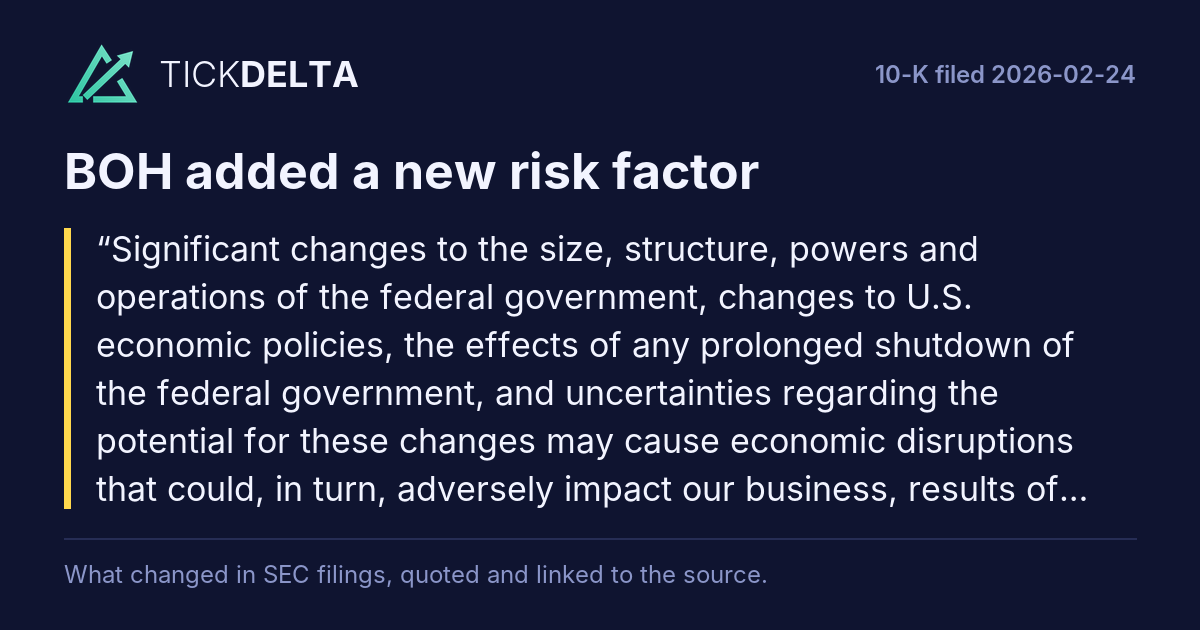
Significant changes to the size, structure, powers and operations of the federal government, changes to U.S. economic policies, the effects of any prolonged shutdown of the federal government, and uncertainties regarding the potential for these changes may cause economic disruptions that could, in turn, adversely impact our business, results of operations and financial condition.
The current U.S. administration has implemented significant changes in federal priorities and has taken steps to change the operations, structure, and policy focus of various federal agencies, as well as regulatory priorities, policy approaches and interpretations of existing laws by those federal agencies. For example, recent executive actions and proposed legislation have changed agency mandates, modified or reduced federal program funding, altered regulatory frameworks, or adjusted the size and composition of the federal workforce. Moreover, leadership transitions at key federal agencies have impacted or may impact rulemaking, supervision, enforcement, and examination priorities across the financial regulatory landscape. These developments in the federal government may have varying effects on the banking and financial services industry that are difficult to predict, which makes it difficult for us to anticipate and mitigate attendant risks. Compliance with changing federal and regulatory priorities could, among other things, increase the costs of operating our business, reduce the demand for our products and services, impact our ability to achieve our business goals, and increase our legal, operational and reputational risks, any or all of which could materially adversely affect our results of operations.
The current U.S. administration has also implemented rapid shifts in macroeconomic policies, such as those relating to trade restrictions and tariffs, which have created significant uncertainties regarding U.S. economic growth, the potential for recession, and concerns over an increase in inflation. In particular, these economic policies have created significant instability in the trade relationship between the U.S. and Chinese economies, including tariff escalation, scrutiny of U.S. investment into Chinese companies, and potential limits on Chinese companies’ access to U.S. markets. In order to limit the impact of unpredictable U.S. actions, global companies and governments may reduce the use of the U.S. dollar in world trade and financial transactions, which could result in further volatility in the financial markets and U.S. economy. Slow economic growth, economic contraction or recession, or shifts in broader consumer and business trends in Hawaiʻi and the Pacific Islands would significantly impact our ability to originate loans, the ability of borrowers to repay loans, and the value of the collateral securing loans.
Other political and economic events within the United States, including a contentious domestic political environment, changes in or disagreements over U.S. monetary policy and actions of the Federal Reserve, disagreements over long-term federal budget and deficit reduction plans, a U.S. government shutdown, disagreements over, or threats not to increase, the U.S. government’s borrowing limit (or “debt ceiling”), and risk of further downgrade of the ratings of U.S. government debt obligations, also may negatively impact financial markets and the U.S. economy, including the economy of Hawaiʻi and the Pacific Islands. For example, from October 1 to November 12, 2025, the federal government of the United States was shut down as Congress failed to pass appropriations legislation for the 2026 fiscal year and this shutdown added strain to the economic environment in Hawaiʻi. Future disagreements over the U.S. federal budget and appropriations may cause the U.S. federal government to shut down in the future.
Further, the perception of the potential for additional, significant changes in federal regulatory or economic policy also has increased uncertainty and may exacerbate declines in investor and consumer confidence, which in turn may adversely
impact financial markets and the broader economy of the U.S. and the economy of Hawaiʻi and the Pacific Islands in particular, perhaps suddenly and to a significant degree.
Regional business and economic conditions are a major driver of our results of operations. Difficult conditions in the regional business and economic environment, including those caused by the lack of stability and predictability of U.S. policymaking, may materially adversely affect our operating expenses, the quality of our assets, credit losses, and the demand for our products and services.
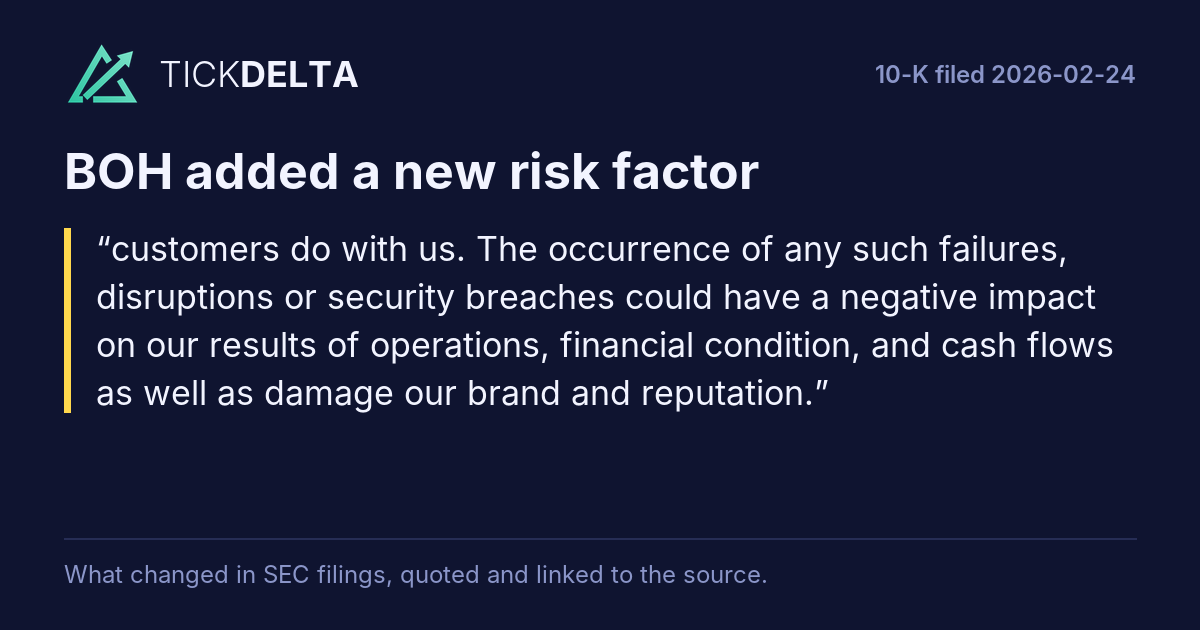
customers do with us. The occurrence of any such failures, disruptions or security breaches could have a negative impact on our results of operations, financial condition, and cash flows as well as damage our brand and reputation.
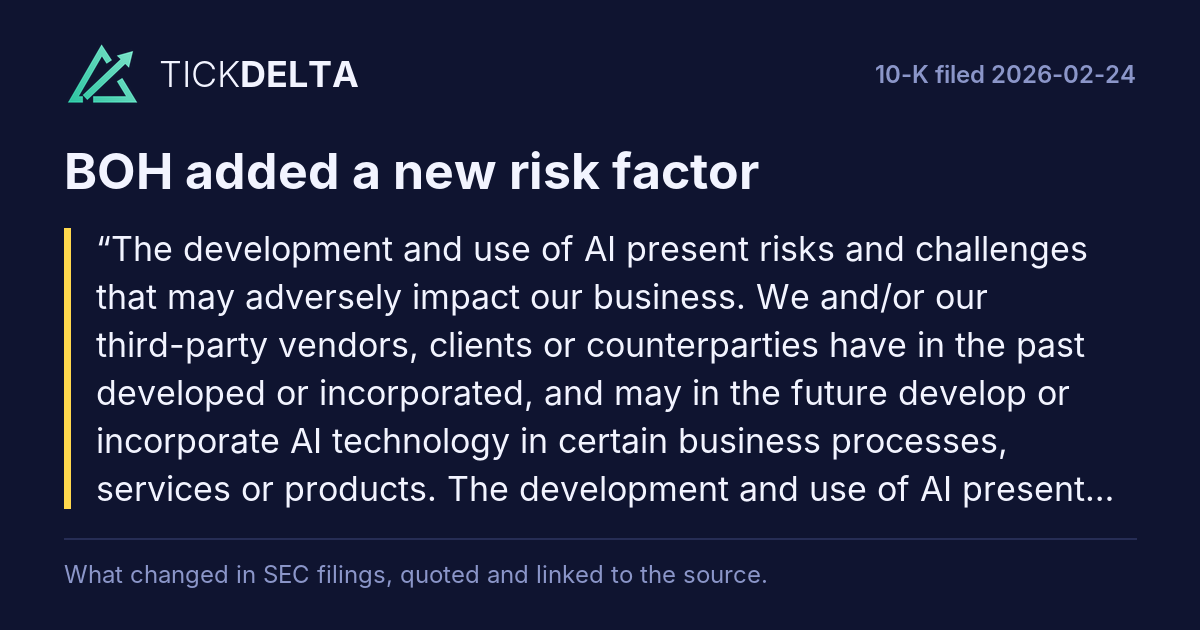
The development and use of AI present risks and challenges that may adversely impact our business.
We and/or our third-party vendors, clients or counterparties have in the past developed or incorporated, and may in the future develop or incorporate AI technology in certain business processes, services or products. The development and use of AI present a number of risks and challenges to our business. The legal and regulatory environment relating to AI is uncertain and rapidly evolving, both in the U.S. and internationally, and includes regulatory schemes targeted specifically at AI as well as provisions in intellectual property, privacy, consumer protection, employment and other laws applicable to the use of AI. These evolving laws, regulations and court decisions could require changes in our implementation of AI technology and increase our compliance costs and the risk of non-compliance. AI models, particularly generative AI models, may produce output or take action that is incorrect or inaccurate, that result in the release of private, confidential or proprietary information, that reflect biases included in the data on which they are trained, infringe on the intellectual property rights of others, or that otherwise exposes the Company to harm. In addition, the complexity of many AI models makes it challenging to understand why they are generating particular outputs. This limited transparency increases the challenges associated with assessing the proper operation of AI models, understanding and monitoring the capabilities of the AI models, reducing erroneous output, eliminating bias and complying with regulations that require documentation or explanation of the basis on which decisions are made. Further, we may rely on AI models developed by third parties, and, to that extent, would be dependent in part on the manner in which those third parties develop and train their models, including risks arising from the inclusion of any unauthorized material in the training data for their models, and the effectiveness of the steps these third parties have taken to limit the risks associated with the output of their models, matters over which we may have limited visibility. Additionally, we are exposed to risks related to the use of AI technologies by third-party vendors, clients, counterparties, clearinghouses and other financial intermediaries. Any of these risks could expose us to liability or adverse legal or regulatory consequences and harm our reputation and the public perception of our business or the effectiveness of our security measures.
Paragraphs in the 10-Q filed Oct 26, 2026 that were not in the one before
New in the latest 10-Q
5 paragraphs in the 10-Q filed Oct 26, 2026 with nothing like them in the 10-Q filed Jul 28, 2026 (at least half the words must differ; new numbers alone do not count). Quoted exactly, grouped by the item heading above them. This is text that changed, not a judgement of how serious it is.
Financial statements and notes
(dollars in thousands) Commercial Consumer Total Three Months Ended September 30, 2026 ─────────────────────────────────────────────────────────────────────────────────────────────────────────────────────────────────────────── Allowance for Credit Losses: Balance at Beginning of Period $ 80,511 $ 66,484 $ 146,995 Loans and Leases Charged-Off (168) (4,545) (4,713) Recoveries on Loans and Leases Previously Charged-Off 41 1,358 1,399 Net Loans and Leases Charged-Off (127) (3,187) (3,314) Provision for Credit Losses (2,386) 4,875 2,489 Balance at End of Period $ 77,998 $ 68,172 $ 146,170 Three Months Ended September 30, 2025 Allowance for Credit Losses: Balance at Beginning of Period $ 78,902 $ 69,641 $ 148,543 Loans and Leases Charged-Off (171) (3,788) (3,959) Recoveries on Loans and Leases Previously Charged-Off 98 1,284 1,382 Net Loans and Leases Charged-Off (73) (2,504) (2,577) Provision for Credit Losses (534) 3,346 2,812 Balance at End of Period $ 78,295 $ 70,483 $ 148,778 Nine Months Ended September 30, 2026 Allowance for Credit Losses: Balance at Beginning of Period $ 79,543 $ 67,223 $ 146,766 Loans and Leases Charged-Off (783) (12,731) (13,514) Recoveries on Loans and Leases Previously Charged-Off 1,783 3,940 5,723 Net Loans and Leases Charged-Off 1,000 (8,791) (7,791) Provision for Credit Losses (2,545) 9,740 7,195 Balance at End of Period $ 77,998 $ 68,172 $ 146,170 Nine Months Ended September 30, 2025 Allowance for Credit Losses: Balance at Beginning of Period $ 83,900 $ 64,628 $ 148,528 Loans and Leases Charged-Off (1,776) (11,903) (13,679) Recoveries on Loans and Leases Previously Charged-Off 253 3,828 4,081 Net Loans and Leases Charged-Off (1,523) (8,075) (9,598) Provision for Credit Losses (4,082) 13,930 9,848 Balance at End of Period $ 78,295 $ 70,483 $ 148,778
Read in the 10-Q
Hawai‘i’s near-term economic outlook has weakened due to the combined effects of storm-related disruptions and geopolitical tensions in the Middle East, which have contributed to higher energy prices, elevated inflation, and increased travel costs. An active storm season, including Hurricane Lowell and earlier Kona Low events, disrupted tourism activity, affected local businesses, damaged residential property, and increased recovery costs across the State. International visitor arrivals have also been pressured by higher travel costs and softer demand from certain markets. Despite these headwinds, visitor activity is expected to improve modestly in 2027 as energy prices moderate and storm-related impacts subside. Statewide payroll employment is expected to decline modestly in 2026, reflecting softer labor demand, while the unemployment rate is projected to remain low by historical standards. Construction activity continues to support economic growth, driven by federal military projects, the Honolulu Skyline rail project, the Kapalama port modernization project, and private-sector development. The residential real estate market remains soft, as elevated mortgage rates continue to constrain housing affordability despite generally stable home prices.
Read in the 10-Q
2 Certain prior period information has been reclassified to conform to the current year presentation.
Read in the 10-Q
Maturity Distribution of Estimated Uninsured Time Deposits Table 12 (dollars in thousands) September 30, 2026 December 31, 2025 Change Remaining maturity: Three months or less $ 754,718 $ 613,444 $ 141,274 After three through six months 264,838 396,599 (131,761) After six through twelve months 355,525 320,938 34,587 After twelve months 19,760 86,151 (66,391) Total $ 1,394,841 $ 1,417,132 $ (22,291)
Read in the 10-Q
Other debt was $853.1 million as of September 30, 2026, an increase of $294.9 million from the prior year. The increase was primarily due to $345.0 million in overnight borrowings from the Federal Home Loan Bank of Des Moines, to provide short-term funding to facilitate loan and deposit activity. This increase was partially offset by the maturity of a $50.0 million FHLB term advance in May 2026. As of September 30, 2026, our available borrowing capacity under our line of credit with the FHLB was $2.1 billion.
Read in the 10-Q
The 10-Q's risk factors against the 10-K
Item 1A of the 10-Q filed Oct 26, 2026 against Item 1A of the 10-K filed Feb 24, 2026.
A 10-Q repeats only the risks that changed, so a 10-K paragraph that is missing from it is not counted as removed.
Added is a paragraph with nothing like it in the 10-K, Reworded a sentence that is in both with several words changed,
Quiet changes a sentence in both where one to four words changed and one is a hedge or a modal
(cut words struck through, new words highlighted).
Text on the page, not a score; each links to the filing at sec.gov.
What the 10-Q itself says about its risk factors:There are no material changes from the risk factors set forth under Part I, Item 1A. “Risk Factors” in the Company’s Annual Report on Form 10-K for the year ended December 31, 2025.
Read in the 10-Q
1 paragraph in the 10-Q's Item 1A, and none of them adds, rewords or quietly edits a paragraph of the 10-K's.
Phrases used for the first time
Two-word phrases in Risk Factors of the 10-K filed Feb 24, 2026 that are in none of the 1 earlier 10-Ks stored, back to Mar 4, 2025
Where each one is used
- third-party vendors: The impacts of climate change, such as extreme weather conditions, natural disasters and rising sea levels, could impact the Bank’s operations as well as those of its customers and third-party vendors upon which it relies. Such events could also result in market volatility or negatively impact our customers’...
- federal agencies: The current U.S. administration has implemented significant changes in federal priorities and has taken steps to change the operations, structure, and policy focus of various federal agencies, as well as regulatory priorities, policy approaches and interpretations of existing laws by those federal agencies. For...
- economic policies: Significant changes to the size, structure, powers and operations of the federal government, changes to U.S. economic policies, the effects of any prolonged shutdown of the federal government, and uncertainties regarding the potential for these changes may cause economic disruptions that could, in turn, adversely...
- uncertainties regarding: Significant changes to the size, structure, powers and operations of the federal government, changes to U.S. economic policies, the effects of any prolonged shutdown of the federal government, and uncertainties regarding the potential for these changes may cause economic disruptions that could, in turn, adversely...
- current administration: The current U.S. administration has implemented significant changes in federal priorities and has taken steps to change the operations, structure, and policy focus of various federal agencies, as well as regulatory priorities, policy approaches and interpretations of existing laws by those federal agencies. For...
- regulatory priorities: The current U.S. administration has implemented significant changes in federal priorities and has taken steps to change the operations, structure, and policy focus of various federal agencies, as well as regulatory priorities, policy approaches and interpretations of existing laws by those federal agencies. For...
- economic growth: The current U.S. administration has also implemented rapid shifts in macroeconomic policies, such as those relating to trade restrictions and tariffs, which have created significant uncertainties regarding U.S. economic growth, the potential for recession, and concerns over an increase in inflation. In particular,...
- federal budget: Other political and economic events within the United States, including a contentious domestic political environment, changes in or disagreements over U.S. monetary policy and actions of the Federal Reserve, disagreements over long-term federal budget and deficit reduction plans, a U.S. government shutdown,...
Used at least twice, small words left out. Counted, not picked: a phrase can be new because the company renamed something.
What was taken out
2 paragraphs of last year's Risk Factors with nothing like them now. The longest are quoted.
Sources
Item 1A of each 10-K and 10-Q on EDGAR, quoted exactly. Each paragraph links to the filing at sec.gov.
Also
10-K change: what was reworded or cut, section by section.
Work with it
Excel workbook · CSV. Google Sheet that stays up to date: paste =IMPORTDATA("https://tickdelta.com/company/BOH/export.csv") into a cell.