Screener / SEC EDGAR /CIK 0000746598 /10-K filed Sep 3, 2026, compared with Sep 4, 2025 /Numbers from the XBRL of the 10-Ks
NYSE Consumer discretionary · Manufacturing

Brady Corp BRC

Compare with peers Embed
The 10-K against last year's

75 changes: 26 added, 3 removed, 46 reworded

10-K Sep 3, 2026 vs Sep 4, 2025

10-K 0000746598-26-000044 (Sep 3, 2026) vs 10-K 0000746598-25-000045 (Sep 4, 2025) Not compared: Legal Proceedings.

Every paragraph, and how much of it changed

One bar per paragraph, in the order of the 10-K. Height and colour show the share of its words not in the closest paragraph a year earlier; the tallest bars are new paragraphs.

Risk Factors

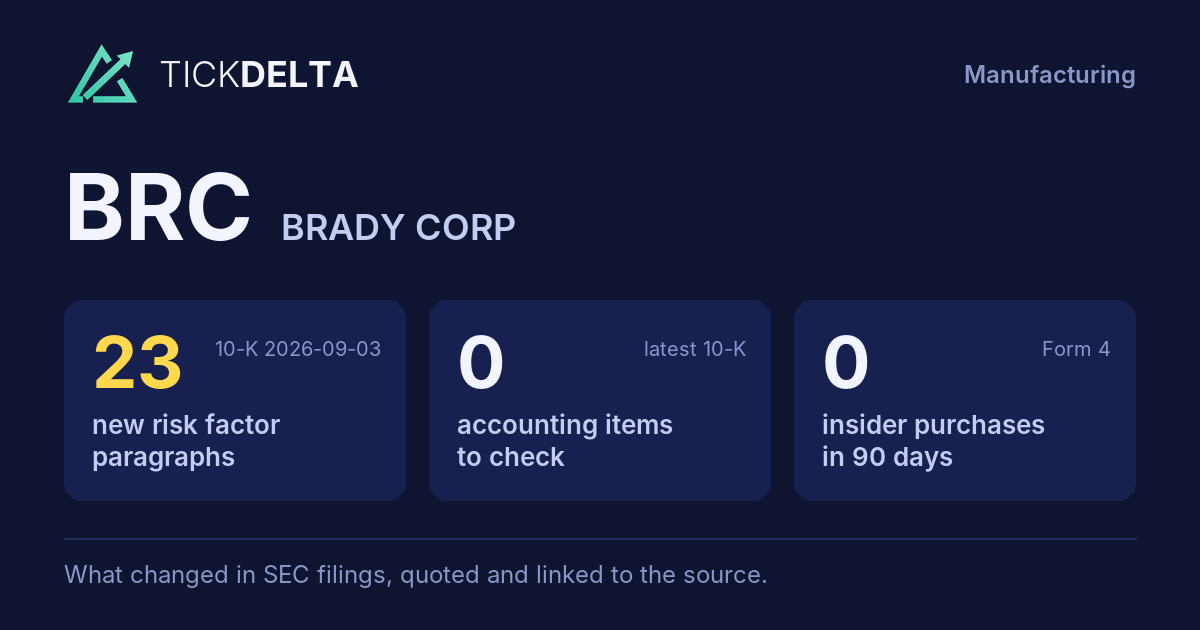
78 paragraphs · 23 new · 17 reworded · 2 gone · 10-K Sep 3, 2026 against Sep 4, 2025
New paragraph Reworded (5% of its words or more) Same or nearly
Paragraph 17 · 48% changed Every version of it
While we have implemented certain cost containment measures and measures, selective price increases, as well as taken increases and other actions intended to offset recent mitigate inflationary pressures in our and supply chain, we chain pressures, these actions may not be able sufficient to offset all of the increases in our operational costs, which costs or the effects of supply shortages and disruptions. If we are unable to obtain necessary materials and components on acceptable terms or recover increased costs through pricing, our business, financial condition and results of operations could be adversely impact our business and financial results. affected.
Paragraph 77 · 47% changed Every version of it
Substantially all of our voting stock is controlled by Elizabeth P. Bruno, one of our directors, and William H. Brady III, both of whom are descendants of the Company's Company’s founder. All of our publicly traded shares are non-voting. Therefore, the voting shareholders have control in most matters requiring approval or acquiescence by shareholders, including the composition of our Board of Directors and many corporate actions, and their interests may not align with those of the non-voting shareholders. Such concentration of ownership may discourage a potential acquirer from making a purchase offer that our public shareholders may find favorable and it may adversely affect the trading price for our non-voting common stock because investors may perceive disadvantages in owning stock in companies whose voting stock is controlled by a limited number of shareholders. Additionally, certain private investors, mutual funds and index sponsors have implemented rules restricting ownership, or excluding from indices, companies with non-voting publicly traded shares. For example, the Company was removed from the Russell 2000 Index in the fourth quarter of fiscal year 2023 for not meeting the minimum voting rights hurdle.
Paragraph 40 · 46% changed Every version of it
The global nature use of AI and the failure to effectively integrate AI and automation into our business exposes us to foreign currency fluctuations that processes could hinder our operational efficiency and adversely affect our business and financial results.
Paragraph 7 · 45% changed Every version of it
Raw material Our increased indebtedness could limit our financial flexibility and other cost inflation as well as product shortages could adversely affect our business and financial results.
Paragraph 73 · 43% changed Every version of it
Globally, many countries have enacted, or plan to enact, legislation and other guidance to align with the Organisation for Economic Co-operation and Development’s (“OECD”) Inclusive Framework on Base Erosion and Profit Shifting Pillar Two (“Pillar Two”) model rules, which aim to establish a global minimum tax rate of 15 percent for large multinational enterprise groups. The In January 2026, the OECD has continued issued additional guidance, including a safe harbor framework for certain U.S. parented groups that is expected to issue new administrative guidance on largely reduce the Pillar Two model rules throughout 2025. Significant uncertainty remains regarding the interpretation and consistent implementation of the Pillar Two model rules across jurisdictions, their interaction with existing national tax laws, and their alignment with current tax treaty obligations. Final adoption and implementation impact of Pillar Two for the Company. Even with this safe harbor, the Company could still be subject to local minimum tax regimes in countries that have adopted these rules. As of July 31, 2026, Pillar Two has not had a material impact on the Company’s income tax liability, provision for income taxes, or effective tax rate, nor does the Company expect a material impact in the jurisdictions where we operate could adversely affect our business and financial results. While it is impossible to predict whether other tax proposals will be enacted, many could have an impact on our business and financial results. future.
Paragraph 37 · 43% changed Every version of it
The failure to properly identify, integrate effectively manage acquisitions, divestitures and grow acquired companies, and to manage contingent liabilities from divested businesses other portfolio management activities could adversely affect our business and financial results.
Paragraph 24 · 40% changed Every version of it
The Our global nature operations are subject to the impact of our business exposes us to foreign currency fluctuations that regional conflict and geopolitical developments, which could adversely affect our business and financial results.
Paragraph 39 · 39% changed Every version of it
We continually assess the strategic fit of our existing businesses and may divest businesses that we determine do not align with our strategic plan, plan or that are not achieving the desired return on investment. Divestitures pose risks and challenges that could negatively impact our business. When we decide to sell a business or specific assets, we We may be unable to do so complete a divestiture on satisfactory terms or within our anticipated timeframe, and even after reaching a definitive agreement to sell a business, the sale is typically transactions may be subject to pre-closing conditions which that may not be satisfied. In addition, Separating a business may also require significant management attention and resources and could result in operational disruptions, including challenges associated with separating systems, processes, personnel and other shared functions, providing or receiving transition services, retaining key employees and maintaining customer and supplier relationships. Divestitures may also result in stranded costs or other expenses that are greater than anticipated, and the impact of the a divestiture on our revenue and net income revenue, earnings or cash flows may be larger than projected, which could distract management, and disputes differ from our expectations. In addition, we may arise with buyers. We have retained also retain responsibility for and have agreed agree to indemnify buyers against certain contingent liabilities related to several businesses that we have sold. The sell and the resolution of these any contingencies has not had could have a material adverse impact on our financial results, but we cannot be certain that this pattern will continue. results.

MD&A

51 paragraphs · 3 new · 35 reworded · 1 gone · 10-K Sep 3, 2026 against Sep 4, 2025
New paragraph Reworded (5% of its words or more) Same or nearly
Paragraph 7 · 49% changed
In recent months, The global trade environment remains complex and continues to evolve, driven by the U.S. government introduced incremental import imposition of tariffs on goods imported into the U.S. from numerous countries, triggering reciprocal tariffs and other actions from many countries on goods exported from the U.S. Trade policies of entering the U.S. and countermeasures from other countries, including China, are complex and rapidly evolving. Our strategy of manufacturing products near the point of sale reduces our overall exposure to tariffs, though certain sourced inputs and manufactured items remain subject to incremental tariffs. nations. Our business has incurred, and expects to we expect will continue to incur, incur additional costs as it relates related to these incremental tariffs and related countermeasures. While we have received some refunds for tariffs previously paid, we continue to incur tariff costs that have remained above historical levels since the foreseeable future. second half of fiscal 2025. Future impacts will depend on changes in trade policy and the timing, availability and amount of these further potential refunds. We also continue to face broader macroeconomic pressures impacting the cost and availability of certain raw materials, components, freight and other inputs. The Company has taken and will continue to take action to mitigate inflationary these pressures caused by the incremental tariffs through a combination of targeted price increases and surcharges, increases, strategic sourcing adjustments, product portfolio optimization, as well as our ongoing efforts to drive sustainable efficiency gains in our operations and administrative structures.
Paragraph 29 · 46% changed
Segment Europe & Australia segment profit decreased 19.4% increased 30.5% to $74.3 million in fiscal 2026 compared to $56.9 million in fiscal 2025 compared to $70.6 million in fiscal 2024. 2025. As a percentage of net sales, segment profit decreased increased to 13.4% in fiscal 2026 compared to 11.0% in fiscal 2025 compared to 15.5% 2025. The increase in fiscal 2024. The decrease in segment profit and segment profit as a percentage of net sales was primarily due to incremental amortization from acquired businesses, driven by a more efficient cost structure following reorganization activities completed in the prior fiscal year, as well as organic sales growth in both regions in the current fiscal year. Additionally, segment profit for the prior fiscal year included reorganization costs and purchase accounting adjustments and reorganization costs in order to streamline our operating structure. adjustments.
Paragraph 27 · 41% changed
Organic sales in the Americas Europe increased in the low-single digits in fiscal 2025. The increase in organic 2026. Organic sales was primarily due to growth in increased across all major product lines with the wire identification, safety and facility identification identification, and product people identification product lines, which was partially offset by a decline in lines driving the people identification and healthcare identification product lines. organic sales growth.
Paragraph 16 · 41% changed
Net sales Operating income increased 12.8% 11.3% to $1,513.6 $263.5 million in fiscal 2025 2026 compared to $1,341.4 $236.6 million in fiscal 2024, which consisted 2025. As a percentage of sales, operating income increased to 15.9% in fiscal 2026 compared to 15.6% in fiscal 2025. The increase in operating income in fiscal 2026 was primarily due to organic sales growth of 2.6% in both reportable segments, gross margin improvements across both reportable segments, and sales growth from acquisitions of 10.5%, which was partially offset by a decrease of 0.3% due to divestitures. Organic sales grew 4.8% in the Americas & Asia segment, while organic sales declined 1.8% SG&A cost efficiencies in the Europe & Australia segment. segment, partially offset by PSS transaction-related costs of $35.7 million.
Paragraph 25 · 41% changed
Gross margin Americas & Asia segment profit increased 10.6% 22.3% to $760.8 $256.6 million in fiscal 2025 compared to $687.9 2026 from $209.8 million in fiscal 2024. 2025. As a percentage percent of net sales, gross margin decreased segment profit increased to 50.3% 23.2% in fiscal 2025 2026 from 51.3% 21.1% in fiscal 2024. 2025. The decrease increase in gross margin segment profit as a percentage of net sales was primarily due to a non-recurring increase in cost of goods sold of $4.1 million related to the fair value adjustment to inventory increased profitability from acquisitions, facility closure and other reorganization costs of $4.9 million, as well as the impact of incremental tariffs, which were partially offset by organic sales growth in higher gross margin product lines. lines, as well as reductions in the cost structure resulting from facility closures and other actions in the prior fiscal year.
Paragraph 19 · 41% changed
Interest expense increased to $9.7 million in fiscal 2026 compared to $4.7 million in fiscal 2025 compared to $3.1 million in fiscal 2024. 2025. The increase in interest expense in fiscal 2025 2026 was primarily due to an increase in outstanding borrowings on increased financing costs related to the Company's Company’s new credit agreement and bridge facilities to fund acquisitions, which was partially offset by a decrease in the weighted average interest rate compared to fiscal 2024. PSS acquisition.
Paragraph 34 · 41% changed
Net cash used in financing provided by operating activities was $83.9 $244.1 million during fiscal 2025 2026 compared to $70.5 $181.2 million in fiscal 2024. 2025. The increase in cash provided by operating activities was primarily due to organic sales growth and improved working capital management in the current year.
Paragraph 18 · 40% changed
Investment and other income was $5.6 million in fiscal 2026 compared to $5.2 million in fiscal 2025 compared to $7.6 million in fiscal 2024. 2025. The decrease increase in investment and other income in fiscal 2025 2026 was primarily due to a decrease an increase in interest income resulting from a reduced cash balance and lower interest rates. the market value of securities held in deferred compensation plans.

A paragraph is matched with the one last year that shares the most of its words; under half in common makes it new. The paragraphs shown are the 8 reworded the most in each section.

The paragraph that changed most in each section

The redline

Marked against last year's 10-K: cut words struck through, new words highlighted.

MD&A183 words changed in this paragraph; it is 42% similar to last year's version.
In recent months, The global trade environment remains complex and continues to evolve, driven by the U.S. government introduced incremental import imposition of tariffs on goods imported into the U.S. from numerous countries, triggering reciprocal tariffs and other actions from many countries on goods exported from the U.S. Trade policies of entering the U.S. and countermeasures from other countries, including China, are complex and rapidly evolving. Our strategy of manufacturing products near the point of sale reduces our overall exposure to tariffs, though certain sourced inputs and manufactured items remain subject to incremental tariffs. nations. Our business has incurred, and expects to we expect will continue to incur, incur additional costs as it relates related to these incremental tariffs and related countermeasures. While we have received some refunds for tariffs previously paid, we continue to incur tariff costs that have remained above historical levels since the foreseeable future. second half of fiscal 2025. Future impacts will depend on changes in trade policy and the timing, availability and amount of these further potential refunds. We also continue to face broader macroeconomic pressures impacting the cost and availability of certain raw materials, components, freight and other inputs. The Company has taken and will continue to take action to mitigate inflationary these pressures caused by the incremental tariffs through a combination of targeted price increases and surcharges, increases, strategic sourcing adjustments, product portfolio optimization, as well as our ongoing efforts to drive sustainable efficiency gains in our operations and administrative structures.

Source: Item 7, 10-K 0000746598-26-000044 vs Item 7, 10-K 0000746598-25-000045

Risk Factors171 words changed in this paragraph; it is 36% similar to last year's version.
We manufacture certain parts and components of our products and therefore require raw materials from suppliers, which could be interrupted for a variety of reasons, including availability and pricing. Our prices and lead times for raw materials and other components necessary for production have continued to fluctuate over the past year, including increased raw production costs, increased wage rates, and extended lead times. Significant increases could adversely affect our profit margins and results of operations. Changes in trade policies; supply chain disruptions; and the imposition of duties and tariffs and potential retaliatory countermeasures could adversely impact the price or availability of raw materials, which could adversely affect our profit margins and results of operations. In addition, labor shortages or an increase increases in the cost of labor could adversely affect our profit margins and results of operations. Due to competitive pressures pressures, contractual arrangements or other factors, we may not be able to pass along increased raw material and component part material, component, labor or other costs to our customers in the form of through price increases increases, or our ability to do so could may be delayed, delayed. Changes in input costs may occur more rapidly than we are able to adjust customer pricing, which could adversely impact our business and financial results. result in periods of reduced profitability.

Source: Item 1A, 10-K 0000746598-26-000044 vs Item 1A, 10-K 0000746598-25-000045

Accounting Policies73 words changed in this paragraph; it is 65% similar to last year's version.
In November December 2023, the Financial Accounting Standards Board (“FASB”) issued Accounting Standards Update (“ASU”) 2023-07, “Segment Reporting 2023-09, “Income Taxes (Topic 280): 740): Improvements to Reportable Segment Income Tax Disclosures.” The guidance requires expanded interim and annual disclosures of segment information including the disclosure standardization and disaggregation of significant segment expenses that are regularly provided to income tax rate reconciliation categories and the chief operating decision maker and included within segment profit and loss. amount of income taxes paid by jurisdiction. The Company adopted ASU 2023-07 2023-09 for the year ended July 31, 2025, 2026, with retrospective application of the expanded segment information for the years ended July 31, 2024 2025 and 2023. 2024. Additional information regarding the Company's reportable segments Company’s income tax rate reconciliations, including the application of the provisions of ASU 2023-09, is included in Note 10 11 to the consolidated financial statements.

Source: Item 8, Note 1 – Summary of Significant Accounting Policies, 10-K 0000746598-26-000044 vs Item 8, Note 1 – Summary of Significant Accounting Policies, 10-K 0000746598-25-000045

Sentences and paragraphs added, removed or reworded

Every change, by type

Sentences and paragraphs of BRC's Risk Factors and MD&A, 10-K Sep 3, 2026 against 10-K Sep 4, 2025. Each links to the text at sec.gov.

Quiet changes are sentences kept from last year with one to four words changed, at least one of them a hedge, a modal or a qualifier (may, could, will, not, significant, material…). A year or date rolling forward is not counted.

The full word list

adverse, adversely, all, although, anticipate, anticipates, any, approximately, believe, believes, can, cannot, certain, could, expect, expects, generally, however, if, intend, intends, largely, likely, many, material, materially, may, might, most, must, never, no, not, possible, primarily, probable, should, significant, significantly, some, substantial, substantially, unlikely, will, would

AddedRisk Factors
On August 3, 2026, we completed the acquisition of PSS. The transaction significantly increases the size and complexity of our current operations and exposes us to operational, financial, and other risks associated with integrating a large global business, and there can be no assurance that the business cultures of the two businesses will prove to be compatible. In addition, in connection with the closing of the transaction, Honeywell completed a global internal reorganization to separate the PSS business from its other operations. Despite completion of this reorganization, we may identify operational, financial, tax, legal or other issues arising from the separation that were not anticipated before closing, which could result in additional costs, liabilities or delays in the integration of the acquired business.
Read it in 10-K Sep 3, 2026 at sec.gov
AddedRisk Factors
The integration of the PSS business requires significant management attention, resources and expenditures. We may experience difficulties in integrating or coordinating systems, processes, internal controls, product portfolios, operations, sales channels and go-to-market activities, as well as retaining employees and maintaining relationships with customers, distributors, other channel partners and suppliers. The ongoing integration process is subject to a number of uncertainties, and it is possible that the ongoing integration process could take longer than anticipated. Our results of operations could also be adversely affected by any issues attributable to the PSS business’s operations that arose or are based on events or actions that occurred prior to the closing of the transaction. These challenges could disrupt our operations, adversely impact customer or channel partner relationships, or prevent us from realizing the anticipated benefits of the acquisition.
Read it in 10-K Sep 3, 2026 at sec.gov
AddedRisk Factors
We may not realize the anticipated benefits of the acquisition, including expected growth opportunities and cost synergies, within the anticipated time periods or at all. These expected benefits and cost synergies are based on estimates and assumptions made by us that are inherently uncertain, and are subject to significant business, economic, and competitive uncertainties and contingencies, all of which are difficult to predict and many of which are beyond our control. We cannot guarantee that we will achieve the full amount of expected benefits and cost synergies on the schedule anticipated, or at all, that the actual expenses required to achieve these benefits and cost synergies will not materially exceed our current estimates, or that these benefits and cost synergies will not have other adverse effects on our business. If we are unable to successfully integrate PSS or realize the expected benefits of the acquisition, our business, financial condition and results of operations could be adversely affected.
Read it in 10-K Sep 3, 2026 at sec.gov
AddedRisk Factors
We have incurred and expect to continue to incur a number of non-recurring costs associated with combining the operations of the two businesses, which cannot be fully estimated accurately at this time. We may also incur additional costs to attract, motivate or retain management personnel and other key employees. We have incurred and will continue to incur acquisition fees and costs related to formulating integration plans for the combined business, and the execution of these plans may lead to additional unanticipated costs.
Read it in 10-K Sep 3, 2026 at sec.gov
AddedRisk Factors
To fund the acquisition of the PSS business, we incurred indebtedness consisting of $800 million aggregate principal amount of borrowings under our new credit agreement and $800 million aggregate principal amount of senior notes issued in a private placement. The use of debt financing to fund the acquisition increases our indebtedness and creates additional financial risks for our business.
Read it in 10-K Sep 3, 2026 at sec.gov
AddedRisk Factors
Our increased leverage could have adverse consequences, including reducing our financial flexibility to respond to changing business and market conditions, limiting our ability to pursue strategic opportunities, and requiring us to dedicate a greater portion of our operating cash flows to principal and interest payments. If our cash flows from operations are insufficient to satisfy our debt service requirements, or we are unable to reduce our indebtedness as anticipated, our ability to fund organic growth initiatives, R&D, capital expenditures, acquisitions and other strategic priorities could be limited.
Read it in 10-K Sep 3, 2026 at sec.gov
AddedRisk Factors
Our ability to make scheduled payments on or to refinance our debt obligations depends on our financial condition and operating performance, which are subject to prevailing economic and competitive conditions and to certain financial, business, legislative, regulatory and other factors beyond our control. We may be unable to maintain a level of cash flows from operating activities sufficient to permit us to fund our day-to-day operations or to pay the principal, premium, if any, and interest on our indebtedness. Rising interest rates may also reduce our ability to access the capital markets and/or increase our cost of capital either of which could adversely affect our business, financial condition and results of operations.
Read it in 10-K Sep 3, 2026 at sec.gov
Show the other 33
AddedRisk Factors
Our debt agreements also contain financial and other covenants that may restrict our ability to take certain actions, and failure to comply with these covenants could result in an event of default and accelerate our repayment obligations. In addition, borrowings under our new credit agreement bear interest at variable rates, which exposes us to increases in interest expense if market interest rates rise. These factors could adversely affect our business, financial condition and results of operations.
Read it in 10-K Sep 3, 2026 at sec.gov
AddedRisk Factors
We manufacture certain parts and components of our products and rely on third-party suppliers for raw materials, components and finished goods. The availability, pricing and lead times of these inputs may be affected by a variety of factors, including supply and demand imbalances, supplier capacity constraints, tariffs and other trade restrictions, geopolitical developments, transportation disruptions and other supply chain constraints. Certain materials and components may be available from a limited number of suppliers, and qualifying alternative suppliers may require significant time and expense.
Read it in 10-K Sep 3, 2026 at sec.gov
AddedRisk Factors
Following the acquisition of PSS, our exposure to the cost and availability of electronic components, including memory and other semiconductor components, has increased. Significant increases in input costs, shortages of key components or extended lead times could increase our costs, disrupt production, limit our ability to meet customer demand and adversely affect our profit margins and results of operations.
Read it in 10-K Sep 3, 2026 at sec.gov
AddedRisk Factors
We may take actions to mitigate supply shortages and disruptions, including increasing inventory levels or purchasing components in advance of anticipated demand. These actions may increase our working capital requirements and expose us to greater risk of excess or obsolete inventory, particularly if customer demand, component pricing or technology trends differ from our expectations.
Read it in 10-K Sep 3, 2026 at sec.gov
RemovedRisk Factors
We manufacture certain parts and components of our products and therefore require raw materials from suppliers, which could be interrupted for a variety of reasons, including availability and pricing. Our prices and lead times for raw materials and other components necessary for production have continued to fluctuate over the past year, including increased raw production costs, increased wage rates, and extended lead times. Significant increases could adversely affect our profit margins and results of operations. Changes in trade policies; supply chain disruptions; and the imposition of duties and tariffs and potential retaliatory countermeasures could adversely impact the price or availability of raw materials, which could adversely affect our profit margins and results of operations. In addition, labor shortages or an increase in the cost of labor could adversely affect our profit margins and results of operations. Due to competitive pressures or other factors, we may not be able to pass along increased raw material and component part costs to our customers in the form of price increases or our ability to do so could be delayed, which could adversely impact our business and financial results.
Read it in 10-K Sep 4, 2025 at sec.gov
RemovedRisk Factors
On July 4, 2025, the U.S. government enacted tax legislation commonly referred to as the One Big Beautiful Bill Act (“OBBBA”). The OBBBA made permanent or extended several provisions from the Tax Cuts and Jobs Act of 2017, including restoration of 100% bonus depreciation, an EBITDA-based limitation on interest expense deductions, and immediate expensing of domestic research and development expenditures. Future changes to these or other tax laws, as well as related regulations and interpretations, could materially affect our financial results.
Read it in 10-K Sep 4, 2025 at sec.gov
RewordedRisk Factors
While we have implemented certain cost containment measures and measures, selective price increases, as well as taken increases and other actions intended to offset recent mitigate inflationary pressures in our and supply chain, we chain pressures, these actions may not be able sufficient to offset all of the increases in our operational costs, which could adversely impact our business costs or the effects of supply shortages and financial results. disruptions.
Read it in 10-K Sep 3, 2026 at sec.gov
RewordedRisk Factors
When we decide to sell a business or specific assets, we We may be unable to do so complete a divestiture on satisfactory terms or within our anticipated timeframe, and even after reaching a definitive agreement to sell a business, the sale is typically transactions may be subject to pre-closing conditions which that may not be satisfied.
Read it in 10-K Sep 3, 2026 at sec.gov
RewordedRisk Factors
We have retained In addition, we may also retain responsibility for and have agreed agree to indemnify buyers against certain contingent liabilities related to several businesses that we sell and the resolution of any contingencies could have sold. a material adverse impact on our financial results.
Read it in 10-K Sep 3, 2026 at sec.gov
RewordedRisk Factors
Recent Acquisitions place significant demands on management, operational, and future acquisitions will financial resources and may require the integration of operations, sales and marketing, finance and administrative functions, and information technology, finance, and administrative operations, which could decrease the time and resources available to focus on our existing businesses and other growth strategies.
Read it in 10-K Sep 3, 2026 at sec.gov
RewordedRisk Factors
Our historical growth has included acquisitions, including, for instance, the acquisition of the PSS business, and acquisitions and may continue to be part of our future growth strategy includes acquisitions. strategy.
Read it in 10-K Sep 3, 2026 at sec.gov
RewordedRisk Factors
The failure to properly identify, integrate effectively manage acquisitions, divestitures and grow acquired companies, and to manage contingent liabilities from divested businesses other portfolio management activities could adversely affect our business and financial results.
Read it in 10-K Sep 3, 2026 at sec.gov
RewordedRisk Factors
Therefore, the voting shareholders have control in most matters requiring approval or acquiescence by shareholders, including the composition of our Board of Directors and many corporate actions, and their interests may not align with those of the non-voting shareholders.
Read it in 10-K Sep 3, 2026 at sec.gov
RewordedRisk Factors
Sales Because a significant portion of our business is conducted outside of the United States, our sales and purchases in currencies other than the U.S. dollar expose us to fluctuations in foreign currencies relative to the U.S. dollar, and which may adversely affect our financial results.
Read it in 10-K Sep 3, 2026 at sec.gov
RewordedRisk Factors
We cannot assure guarantee that we will be able to successfully identify and integrate acquisitions, that these acquisitions acquired businesses will operate profitably, or that we will be able to achieve the desired anticipated sales growth growth, synergies or other benefits from acquisitions.
Read it in 10-K Sep 3, 2026 at sec.gov
RewordedRisk Factors
Raw material material, component and other cost inflation inflation, as well as product shortages supply shortages, could adversely affect our business and financial results.
Read it in 10-K Sep 3, 2026 at sec.gov
RewordedRisk Factors
We have goodwill of $676.9 $686.0 million and other intangible assets of $105.4 $97.8 million as of July 31, 2025, 2026, which represent 45.1% 42.3% of our total assets, and we have recognized impairment charges in the past.
Read it in 10-K Sep 3, 2026 at sec.gov
AddedMD&A
The Company continues to evaluate developments related to tariff policy and related administrative proceedings. While we have received certain refunds for tariffs previously paid, we expect to continue to incur ongoing tariff costs while actively pursuing additional refunds. Any such potential refunds of tariffs previously paid remain subject to ongoing administrative processes and uncertainty regarding their timing, availability, and ultimate amount.
Read it in 10-K Sep 3, 2026 at sec.gov
AddedMD&A
Subsequent to the fiscal year-end, on August 3, 2026, the Company completed the acquisition of Honeywell’s PSS business for a cash purchase price of $1.4 billion, subject to customary post-closing adjustments. The transaction was funded through a combination of cash on hand, immediate borrowings under our new credit agreement, and private placement debt. This funding event included the full drawdown of the $500 million term loan facility alongside initial drawings of approximately $300 million under the revolving credit facility. Concurrently with the closing of the PSS acquisition, the available borrowing capacity under our revolving credit facility automatically expanded from an interim cap of $300 million to the full $500 million facility limit.
Read it in 10-K Sep 3, 2026 at sec.gov
RemovedMD&A
Notwithstanding the uncertain situation relating to tariffs, we believe our financial strength positions us well to continue investing in acquisitions and organic growth opportunities, such as expanded sales channels, marketing programs, and research and development (“R&D”). We remain focused on driving sustainable efficiency gains and automation across our operations and selling, general and administrative (“SG&A”) functions, while also returning capital to our shareholders through dividends and share repurchases. At July 31, 2025, we had cash of $174.3 million, as well as a credit agreement with $198.1 million available for future borrowing, which can be increased up to $1,093.1 million at the Company's option and subject to certain conditions, for total available liquidity of $1,267.4 million.
Read it in 10-K Sep 4, 2025 at sec.gov
RewordedMD&A
The Company believes it is reasonably possible that the amount of gross unrecognized tax benefits could be reduced by up to $3.1 $2.6 million in the next 12 months as a result of the resolution of worldwide tax matters, tax audit settlements, amended tax filings, and/or statute expirations, which would be the maximum amount that would be recognized as an income tax benefit in the consolidated statements of income.
Read it in 10-K Sep 3, 2026 at sec.gov
RewordedMD&A
Americas & Asia net sales increased 12.1% 11.4% to $1,106.6 million in fiscal 2026 compared to $993.7 million in fiscal 2025 compared to $886.5 million in fiscal 2024, 2025, which consisted of organic sales growth of 4.8% and 7.5%, sales growth from acquisitions of 8.3%, which were partially offset by a decrease 3.3%, and an increase from foreign currency translation of 0.6% and a decrease due to a divestiture of 0.4%. 0.6%.
Read it in 10-K Sep 3, 2026 at sec.gov
RewordedMD&A
Net sales increased 12.8% 9.8% to $1,661.6 million in fiscal 2026 compared to $1,513.6 million in fiscal 2025 compared to $1,341.4 million in fiscal 2024, 2025, which consisted of organic sales growth of 2.6% 5.3%, an increase from foreign currency translation of 2.3%, and sales growth from acquisitions of 10.5%, which was partially offset by a decrease of 0.3% due to divestitures. 2.2%.
Read it in 10-K Sep 3, 2026 at sec.gov
RewordedMD&A
GAAP, References in this Annual Report on Form 10-K to “organic sales” refer to sales calculated in accordance with U.S. generally accepted accounting principles (“GAAP”), excluding the impact of foreign currency translation, sales recorded from divested companies up to the first anniversary of their divestiture and sales recorded from acquired companies prior to the first anniversary date of their acquisition.
Read it in 10-K Sep 3, 2026 at sec.gov
RewordedMD&A
Organic sales growth reflected strong execution of our commercial strategies, supported by steady industrial demand in North America, continued expansion in key end markets across Latin America, America and resilient increasing demand in Asia despite mixed economic conditions in certain countries. throughout Asia.
Read it in 10-K Sep 3, 2026 at sec.gov
RewordedMD&A
Our business has incurred, and expects to we expect will continue to incur, incur additional costs as it relates related to these incremental tariffs for the foreseeable future. and related countermeasures.
Read it in 10-K Sep 3, 2026 at sec.gov
RewordedMD&A
The organic sales increase was primarily driven by higher demand realized throughout Asia with continued growth from electronics manufacturing services providers, technology companies, and industrial suppliers across Japan, India, Malaysia and Singapore. the region.
Read it in 10-K Sep 3, 2026 at sec.gov
RewordedMD&A
The increase in R&D spending in fiscal 2025 2026 was primarily due to the acquisition acquisitions of Gravotech, and, to a lesser extent, Microfluidic Solutions and Mecco, and an increase in R&D headcount within the Company's Company’s organic business.
Read it in 10-K Sep 3, 2026 at sec.gov

Sources

The two latest 10-Ks on EDGAR, section by section. Each change links to the text at sec.gov.

Also

New risk factors: paragraphs with nothing like them last year, quoted in full.

Work with it

Excel workbook · CSV. Google Sheet that stays up to date: paste =IMPORTDATA("https://tickdelta.com/company/BRC/export.csv") into a cell.

Next:Related parties
Esc

Type a ticker such as AAPL, a name, an investor such as Buffett, or a topic such as tariffs. ↑ ↓ to move, Enter to open.