Paragraphs with nothing like them in last year's 10-K
Quoted exactly
23 paragraphs in Risk Factors of the 10-K filed Sep 3, 2026
with nothing like them in the 10-K filed Sep 4, 2025. Quoted exactly.
Paragraphs that were only edited are under 10-K change.
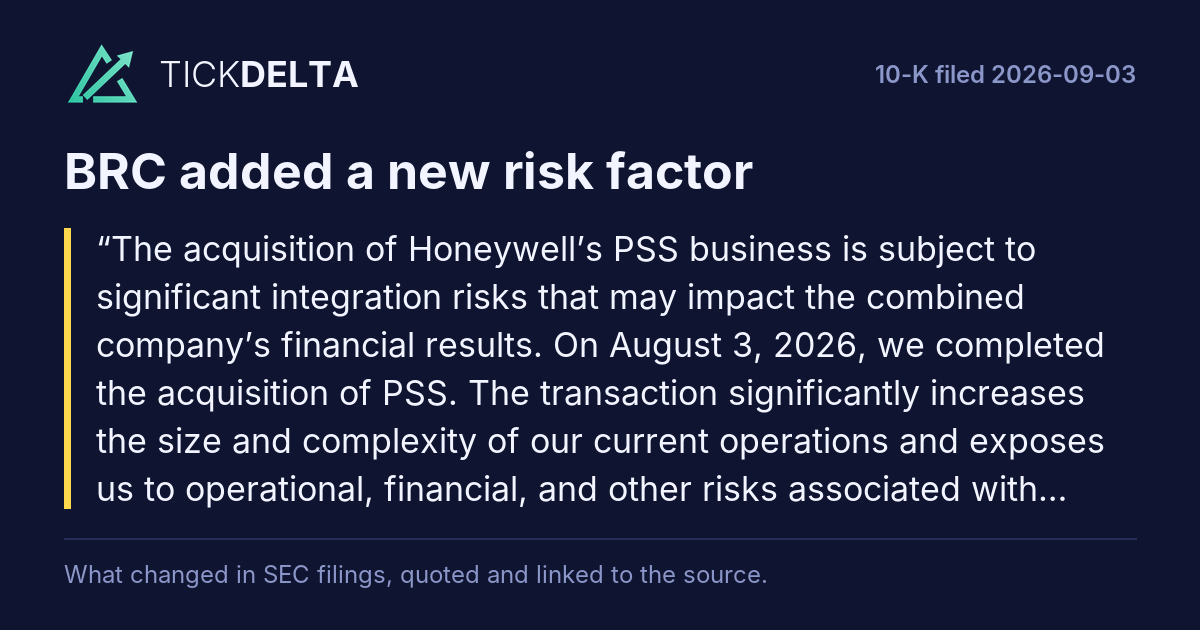
The acquisition of Honeywell’s PSS business is subject to significant integration risks that may impact the combined company’s financial results.
On August 3, 2026, we completed the acquisition of PSS. The transaction significantly increases the size and complexity of our current operations and exposes us to operational, financial, and other risks associated with integrating a large global business, and there can be no assurance that the business cultures of the two businesses will prove to be compatible. In addition, in connection with the closing of the transaction, Honeywell completed a global internal reorganization to separate the PSS business from its other operations. Despite completion of this reorganization, we may identify operational, financial, tax, legal or other issues arising from the separation that were not anticipated before closing, which could result in additional costs, liabilities or delays in the integration of the acquired business.
The integration of the PSS business requires significant management attention, resources and expenditures. We may experience difficulties in integrating or coordinating systems, processes, internal controls, product portfolios, operations, sales channels and go-to-market activities, as well as retaining employees and maintaining relationships with customers, distributors, other channel partners and suppliers. The ongoing integration process is subject to a number of uncertainties, and it is possible that the ongoing integration process could take longer than anticipated. Our results of operations could also be adversely affected by any issues attributable to the PSS business’s operations that arose or are based on events or actions that occurred prior to the closing of the transaction. These challenges could disrupt our operations, adversely impact customer or channel partner relationships, or prevent us from realizing the anticipated benefits of the acquisition.
We may not realize the anticipated benefits of the acquisition, including expected growth opportunities and cost synergies, within the anticipated time periods or at all. These expected benefits and cost synergies are based on estimates and assumptions made by us that are inherently uncertain, and are subject to significant business, economic, and competitive uncertainties and contingencies, all of which are difficult to predict and many of which are beyond our control. We cannot guarantee that we will achieve the full amount of expected benefits and cost synergies on the schedule anticipated, or at all, that the actual expenses required to achieve these benefits and cost synergies will not materially exceed our current estimates, or that these benefits and cost synergies will not have other adverse effects on our business. If we are unable to successfully integrate PSS or realize the expected benefits of the acquisition, our business, financial condition and results of operations could be adversely affected.
We have incurred and expect to continue to incur a number of non-recurring costs associated with combining the operations of the two businesses, which cannot be fully estimated accurately at this time. We may also incur additional costs to attract, motivate or retain management personnel and other key employees. We have incurred and will continue to incur acquisition fees and costs related to formulating integration plans for the combined business, and the execution of these plans may lead to additional unanticipated costs.
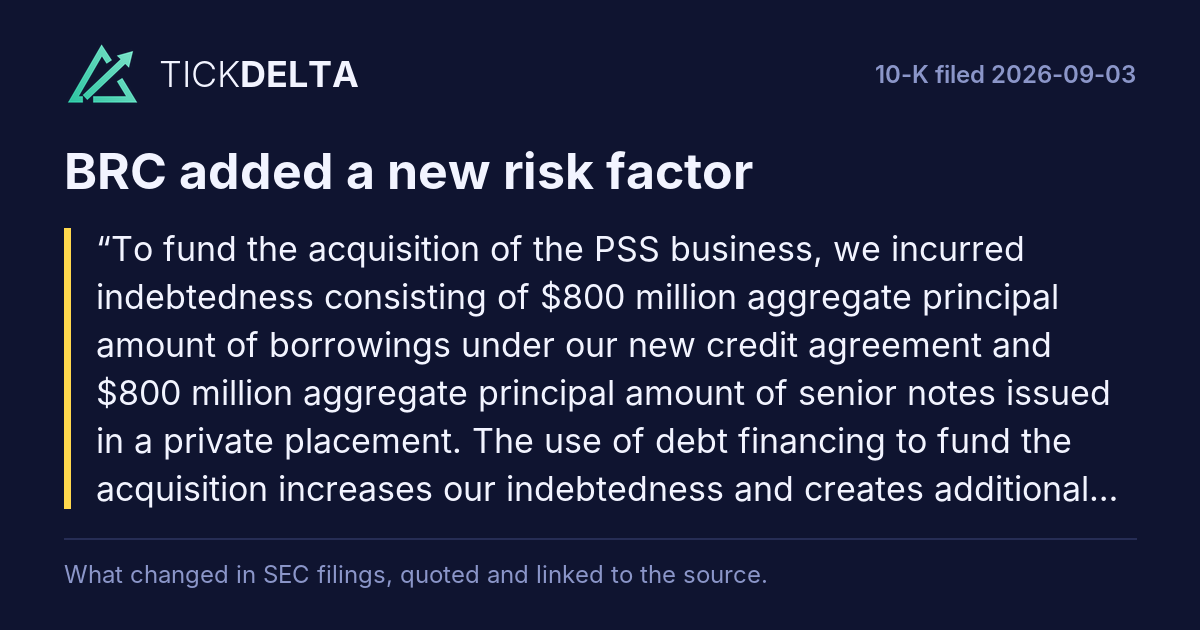
To fund the acquisition of the PSS business, we incurred indebtedness consisting of $800 million aggregate principal amount of borrowings under our new credit agreement and $800 million aggregate principal amount of senior notes issued in a private placement. The use of debt financing to fund the acquisition increases our indebtedness and creates additional financial risks for our business.
Our increased leverage could have adverse consequences, including reducing our financial flexibility to respond to changing business and market conditions, limiting our ability to pursue strategic opportunities, and requiring us to dedicate a greater portion of our operating cash flows to principal and interest payments. If our cash flows from operations are insufficient to satisfy our debt service requirements, or we are unable to reduce our indebtedness as anticipated, our ability to fund organic growth initiatives, R&D, capital expenditures, acquisitions and other strategic priorities could be limited.
Our ability to make scheduled payments on or to refinance our debt obligations depends on our financial condition and operating performance, which are subject to prevailing economic and competitive conditions and to certain financial, business, legislative, regulatory and other factors beyond our control. We may be unable to maintain a level of cash flows from operating activities sufficient to permit us to fund our day-to-day operations or to pay the principal, premium, if any, and interest on our indebtedness. Rising interest rates may also reduce our ability to access the capital markets and/or increase our cost of capital either of which could adversely affect our business, financial condition and results of operations.
Our debt agreements also contain financial and other covenants that may restrict our ability to take certain actions, and failure to comply with these covenants could result in an event of default and accelerate our repayment obligations. In addition, borrowings under our new credit agreement bear interest at variable rates, which exposes us to increases in interest expense if market interest rates rise. These factors could adversely affect our business, financial condition and results of operations.
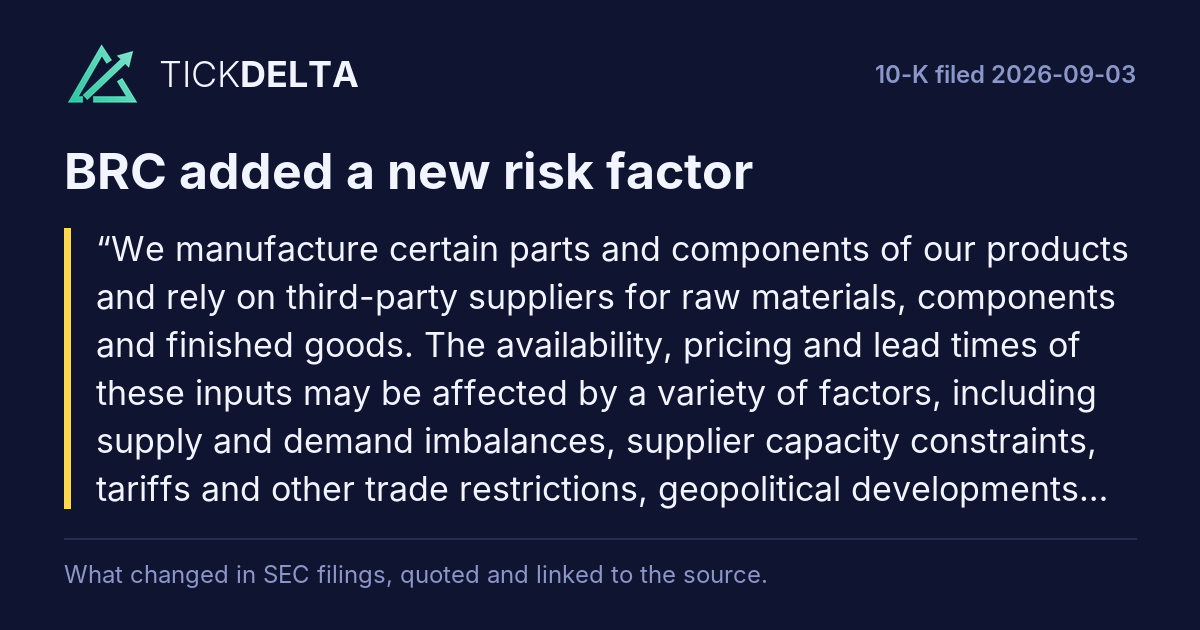
We manufacture certain parts and components of our products and rely on third-party suppliers for raw materials, components and finished goods. The availability, pricing and lead times of these inputs may be affected by a variety of factors, including supply and demand imbalances, supplier capacity constraints, tariffs and other trade restrictions, geopolitical developments, transportation disruptions and other supply chain constraints. Certain materials and components may be available from a limited number of suppliers, and qualifying alternative suppliers may require significant time and expense.
Following the acquisition of PSS, our exposure to the cost and availability of electronic components, including memory and other semiconductor components, has increased. Significant increases in input costs, shortages of key components or extended lead times could increase our costs, disrupt production, limit our ability to meet customer demand and adversely affect our profit margins and results of operations.
We may take actions to mitigate supply shortages and disruptions, including increasing inventory levels or purchasing components in advance of anticipated demand. These actions may increase our working capital requirements and expose us to greater risk of excess or obsolete inventory, particularly if customer demand, component pricing or technology trends differ from our expectations.
In addition, labor shortages or increases in the cost of labor could adversely affect our profit margins and results of operations. Due to competitive pressures, contractual arrangements or other factors, we may not be able to pass increased raw material, component, labor or other costs to our customers through price increases, or our ability to do so may be delayed. Changes in input costs may occur more rapidly than we are able to adjust customer pricing, which could result in periods of reduced profitability.
As a global company with approximately 50% of our sales derived outside of the United States, we are subject to risks associated with political and economic instability, regional conflicts and other geopolitical developments in the markets in which we operate. Such developments may result in disruptions to our commercial operations in affected markets.
Current geopolitical conditions have resulted in disruptions within certain global shipping and distribution channels, including extended lead times and reductions in global freight capacity. These disruptions may increase our transportation costs, extend lead times and adversely affect our operational efficiency.
Geopolitical instability and the resulting economic uncertainty may also adversely impact our customers’ demand for our products, including the interruption of established procurement cycles and the deferral of project timelines across our global customer base. Regional conflicts may result in broader economic downturns or currency devaluations in certain markets, which could diminish the purchasing power of our customers or delay operational investments. These factors could reduce or delay customer demand and result in increased volatility in our sales and results of operations.
Additionally, our business is subject to an increasingly complex global trade environment characterized by shifting trade policies and regulatory requirements. This includes the imposition of new tariffs or changes in existing duties, tariffs, and trade agreements. Our business has incurred, and we expect to continue to occur, additional costs related to the imposition of incremental tariffs and related countermeasures. Since the second half of fiscal 2025, we have incurred tariff costs that have remained above historical levels. We are also subject to evolving governmental policies, import and export controls, trade restrictions and economic sanction laws, which may change rapidly in response to global events. Changes in these requirements, or our inability to comply with them, could increase our costs, restrict our ability to conduct business in certain markets, result in competitive disadvantages or subject us to monetary or non-monetary penalties, which could adversely affect our results of operations.
With the acquisition of PSS, our operational risks are subject to PSS’s global manufacturing operations and footprint. PSS has significant manufacturing operations in China, and a substantial portion of its global inventory is physically located within China and the surrounding regions. As a result, our operations are subject to potential changes in U.S.-China trade relations, shifting regulatory requirements, and local economic or political conditions. Additional tariffs, expanded export controls, trade restrictions, or regulatory shifts by either the U.S. or Chinese governments could increase production and transportation costs, impact output, or restrict our ability to transfer inventory from China to other markets. Additionally, holding a significant level of inventory in the region subjects us to potential customs delays, localized operational disruptions, or logistics constraints, which could disrupt our global shipping and distribution channels. If PSS experiences manufacturing interruptions or delays in distributing inventory internationally, our results of operations could be adversely affected.
Furthermore, our recent acquisition of the PSS business is a central component of our strategy to create a comprehensive technology portfolio, complementing Brady’s leading position in printers and specialty adhesive materials portfolio. The success of this strategy is highly dependent on our ability to effectively integrate PSS. As we dedicate significant management attention and resources to product portfolios and go-to-market activities, there is a risk of operational disruption. Present or future competitors may attempt to capitalize on any such disruptions or delays in our integration process to target our customer and channel partner relationships. If we are unable to seamlessly integrate PSS, or if we fail to realize the expected growth opportunities and cost synergies in a timely manner, our ability to execute our broader strategic goals and compete effectively may be compromised, which could adversely impact our business and financial results.
Show the other 2
We have made investments in developing and implementing AI to streamline internal workflows and enhance operational decision-making. We believe that the effective use of AI within our internal business processes, including supply chain management, administrative functions, and data analysis is critical to our ability to maintain a competitive cost structure and achieve long-term success.
Our R&D into these technologies is ongoing, and we are working to incorporate AI capabilities across our internal infrastructure. However, as with many developing innovations, the integration of AI presents significant risks and challenges. Our efforts integrating AI may not produce meaningful operational efficiency improvements or help maintain a competitive cost structure. If our internal AI initiatives fail to operate as intended, or if we are unable to implement these technologies as effectively or as quickly as our competitors, we may experience higher operating costs than our peers. Furthermore, failure to successfully modernize our internal operations through AI could result in a failure to recoup our investments in these technologies, adversely affecting our business and financial results. In addition, AI technologies may produce inaccurate outputs, cause or contribute to the violation of intellectual property rights, and may be prone to cybersecurity incidents or
service interruptions. Furthermore, the use of AI by us and our employees could increase the risk of exposure of our proprietary, personal and confidential information.
Furthermore, use of AI by our service providers could increase the risk of exposure of our proprietary, personal and confidential information. The use of AI or machine learning technologies by our service providers in their business activities, whether or not known to us, could also expose us to risks, including use of AI tools in violation of agreements with us, use of unauthorized third-party data, inputting our valuable information into AI tools, or deployment of new AI tools without our approval, any of which may give rise to legal or regulatory violations, loss of intellectual property rights, reputational harm, or issues relating to data privacy and data protection.
Paragraphs in the 10-Q filed May 18, 2026 that were not in the one before
New in the latest 10-Q
19 paragraphs in the 10-Q filed May 18, 2026 with nothing like
them in the 10-Q filed Feb 19, 2026 (at least half the words must differ; new numbers alone do not count).
Quoted exactly, grouped by the item heading above them. This is text that changed, not a judgement of how serious it is.
Financial statements and notes
On April 20, 2026, the Company entered into an Equity Purchase Agreement with Honeywell International Inc. (“Honeywell”) to acquire Honeywell’s Productivity Solutions and Services (“PSS”) business, a global manufacturer and provider of mobile computers, barcode scanners, and printing solutions, for a base purchase price of $ 1.4 billion in cash, subject to customary adjustments related to cash, indebtedness, working capital and transaction expenses. The transaction is subject to customary closing conditions, including regulatory approvals, and is expected to close in the second half of calendar year 2026. During the three months ended April 30, 2026, the Company incurred $ 13,506 of acquisition-related costs associated with the pending transaction, which were recorded in selling, general and administrative expenses.
Read in the 10-Qopen_in_new
On April 20, 2026, in connection with the Company’s pending acquisition of the PSS business, the Company entered into a debt commitment letter with BMO Capital Markets that provides for 364-day bridge facilities with aggregate commitments of up to $1.8 billion, subject to customary conditions, including completion of the acquisition. The Company incurred financing costs related to the bridge facilities, which were capitalized in “Other assets” on the condensed consolidated balance sheet. As of April 30, 2026, the acquisition had not been completed, the conditions to availability under the bridge financing had not been satisfied, and no amounts were drawn or outstanding.
Read in the 10-Qopen_in_new
On April 20, 2026, the Company entered into an Equity Purchase Agreement with Honeywell International Inc. (“Honeywell”) to acquire Honeywell’s Productivity Solutions and Services (“PSS”) business, a global manufacturer and provider of mobile computers, barcode scanners and printing solutions, for a base purchase price of $1.4 billion in cash, subject to customary adjustments related to cash, indebtedness, working capital and transaction expenses. We believe the pending
Read in the 10-Qopen_in_new
acquisition of the PSS business, if completed, will provide a complementary product portfolio that will add scale and extend the Company’s reach into adjacent workflows and large enterprise customers.
Read in the 10-Qopen_in_new
We intend to fund the acquisition and related transaction costs through a combination of cash on hand and new debt financing. In connection with the pending acquisition, we entered into a debt commitment letter that provides for 364-day bridge facilities with aggregate commitments of up to $1.8 billion, subject to customary closing conditions. We expect to replace or reduce the commitments under the bridge facilities contemplated by the debt commitment letter with permanent financing prior to closing. The transaction is not subject to a financing condition.
Read in the 10-Qopen_in_new
Show the other 14
The transaction is subject to customary closing conditions, including regulatory approvals, and is expected to close in the second half of calendar year 2026.
Read in the 10-Qopen_in_new
The Company continues to evaluate developments related to tariff policy, including the timing, availability and amount of potential refunds of tariffs previously paid. Any such refunds remain subject to ongoing administrative processes and uncertainty.
Read in the 10-Qopen_in_new
nine-month periods was primarily driven by increased organic sales across Southeast Asia, India and China, as well as Japan in the nine-month period.
Read in the 10-Qopen_in_new
In connection with the pending acquisition of the PSS business, we entered into a debt commitment letter that provides for 364-day bridge facilities with aggregate commitments of up to $1.8 billion, subject to customary conditions, including completion of the acquisition. We expect to fund the acquisition with cash on hand and new debt financing, and we expect to replace or reduce the commitments under the bridge facilities contemplated by the debt commitment letter with permanent financing prior to closing. Following completion of the acquisition, we expect cash flows from operations of the combined company, together with available liquidity, to be sufficient to satisfy our currently anticipated debt service obligations and other cash requirements.
Read in the 10-Qopen_in_new
In connection with the pending acquisition of the PSS business, we entered into a debt commitment letter that provides for 364-day bridge facilities with aggregate commitments of up to $1.8 billion, subject to customary conditions, including completion of the acquisition. As of April 30, 2026, the acquisition had not been completed, the conditions to availability under the bridge facilities had not been satisfied and no amounts were drawn or outstanding. We expect to fund the acquisition with cash on hand and new debt financing, and we expect to replace or reduce the commitments under the bridge facilities contemplated by the debt commitment letter with permanent financing prior to closing. If the acquisition is completed, we expect our outstanding indebtedness, debt service obligations and interest expense to increase.
Read in the 10-Qopen_in_new
• The possibility that events, changes or other circumstances could result in termination of the agreement to acquire the PSS business
Read in the 10-Qopen_in_new
• The Company’s ability to complete the pending acquisition of the PSS business on the anticipated timeline or at all, including risks related to the timing, receipt and terms of required governmental and regulatory approvals and the satisfaction or waiver of other closing conditions
Read in the 10-Qopen_in_new
• The potential effects of the pending acquisition and related integration planning on the Company’s and the PSS business’s relationships with customers, suppliers and other business partners, ability to retain and hire key personnel, operating results and businesses generally
Read in the 10-Qopen_in_new
• The Company’s ability to realize the anticipated strategic and financial benefits of the pending acquisition of the PSS business, including expected synergies, within the anticipated timeframe or at all
Read in the 10-Qopen_in_new
Risk Factors
We may not complete the pending acquisition of Honeywell’s Productivity Solutions and Services business on the anticipated timeline, or at all, and, if completed, the acquisition may not achieve the expected benefits and will increase our leverage.
Read in the 10-Qopen_in_new
We have entered into an agreement to acquire Honeywell International Inc.’s Productivity Solutions and Services (“PSS”) business. Completion of the acquisition is subject to regulatory approvals and other customary closing conditions. While we expect the transaction to close in the second half of calendar year 2026, we cannot provide assurance that all required regulatory approvals will be received, that the other required closing conditions will be satisfied or waived, or that the transaction will be completed on the anticipated timeline or at all.
Read in the 10-Qopen_in_new
If the acquisition is completed, we expect to fund the purchase price with cash on hand and new debt financing. Although we have obtained committed bridge financing to support our ability to fund the acquisition, we expect to replace or reduce the commitments under the bridge facilities contemplated by the debt commitment letter with permanent financing prior to closing. There can be no assurance that permanent financing will be available on terms favorable to us, or at all. If we are unable to obtain permanent financing prior to closing, we may be required to draw on the bridge facilities, which may be on less favorable terms than anticipated permanent financing. In addition, incurring additional debt to finance the acquisition will increase our leverage and debt service obligations, which may reduce our financial flexibility, limit our ability to pursue other strategic opportunities, increase our exposure to interest rate and credit market conditions, and require us to dedicate a greater portion of our cash flows to debt service.
Read in the 10-Qopen_in_new
The acquisition is significant relative to our existing business and involves the separation of the PSS business from Honeywell. As a result, the transaction may involve greater operational complexity than the acquisition of a standalone business, including our reliance on transition services following the completion of the acquisition, the separation and integration of systems, processes and personnel, and the establishment or expansion of certain standalone functions for the PSS business. These activities may take longer, cost more, or be more disruptive to our existing business or to the PSS business than anticipated. We may not realize the anticipated strategic and financial benefits of the acquisition, including expected synergies, within the anticipated timeframe or at all. Delays in completing the acquisition, increased financing or integration costs, operational disruption, or our inability to achieve the expected benefits or synergies could adversely affect our business, financial condition, results of operations and cash flows.
Read in the 10-Qopen_in_new
Item 6
The registrant agrees to furnish a copy of any such schedule or exhibit to the Securities and Exchange Commission upon request.
Read in the 10-Qopen_in_new
The 10-Q's risk factors against the 10-K
Item 1A of the 10-Q filed May 18, 2026 against Item 1A of the 10-K filed Sep 4, 2025.
A 10-Q repeats only the risks that changed, so a 10-K paragraph that is missing from it is not counted as removed.
Added is a paragraph with nothing like it in the 10-K, Reworded a sentence that is in both with several words changed,
Quiet changes a sentence in both where one to four words changed and one is a hedge or a modal
(cut words struck through, new words highlighted).
Text on the page, not a score; each links to the filing at sec.gov.
What the 10-Q itself says about its risk factors:The Company’s business, results of operations, financial condition, and cash flows are subject to various risks and uncertainties, including those described in Part I, Item 1A, “Risk Factors” of Company’s Annual Report on Form 10-K for the year ended July 31, 2025. There have been no material changes from the risk factors set forth in the 2025 Form 10-K, except as discussed below.
Read in the 10-Qopen_in_new
Added10-Q May 18, 2026 vs 10-K Sep 4, 2025
We may not complete the pending acquisition of Honeywell’s Productivity Solutions and Services business on the anticipated timeline, or at all, and, if completed, the acquisition may not achieve the expected benefits and will increase our leverage.
Read it in the 10-Q at sec.govopen_in_new
Added10-Q May 18, 2026 vs 10-K Sep 4, 2025
We have entered into an agreement to acquire Honeywell International Inc.’s Productivity Solutions and Services (“PSS”) business. Completion of the acquisition is subject to regulatory approvals and other customary closing conditions. While we expect the transaction to close in the second half of calendar year 2026, we cannot provide assurance that all required regulatory approvals will be received, that the other required closing conditions will be satisfied or waived, or that the transaction will be completed on the anticipated timeline or at all.
Read it in the 10-Q at sec.govopen_in_new
Added10-Q May 18, 2026 vs 10-K Sep 4, 2025
If the acquisition is completed, we expect to fund the purchase price with cash on hand and new debt financing. Although we have obtained committed bridge financing to support our ability to fund the acquisition, we expect to replace or reduce the commitments under the bridge facilities contemplated by the debt commitment letter with permanent financing prior to closing. There can be no assurance that permanent financing will be available on terms favorable to us, or at all. If we are unable to obtain permanent financing prior to closing, we may be required to draw on the bridge facilities, which may be on less favorable terms than anticipated permanent financing. In addition, incurring additional debt to finance the acquisition will increase our leverage and debt service obligations, which may reduce our financial flexibility, limit our ability to pursue other strategic opportunities, increase our exposure to interest rate and credit market conditions, and require us to dedicate a greater portion of our cash flows to debt service.
Read it in the 10-Q at sec.govopen_in_new
Added10-Q May 18, 2026 vs 10-K Sep 4, 2025
The acquisition is significant relative to our existing business and involves the separation of the PSS business from Honeywell. As a result, the transaction may involve greater operational complexity than the acquisition of a standalone business, including our reliance on transition services following the completion of the acquisition, the separation and integration of systems, processes and personnel, and the establishment or expansion of certain standalone functions for the PSS business. These activities may take longer, cost more, or be more disruptive to our existing business or to the PSS business than anticipated. We may not realize the anticipated strategic and financial benefits of the acquisition, including expected synergies, within the anticipated timeframe or at all. Delays in completing the acquisition, increased financing or integration costs, operational disruption, or our inability to achieve the expected benefits or synergies could adversely affect our business, financial condition, results of operations and cash flows.
Read it in the 10-Q at sec.govopen_in_new
Sources
Item 1A of each 10-K and 10-Q on EDGAR, quoted exactly. Each paragraph links to the filing at sec.gov.
Also
10-K change: what was reworded or cut, section by section.
Work with it
Excel workbook · CSV. Google Sheet that stays up to date: paste =IMPORTDATA("https://tickdelta.com/company/BRC/export.csv") into a cell.