Screener / SEC EDGAR /CIK 0001866581 /10-K filed Feb 13, 2026, compared with Feb 13, 2025 /Numbers from the XBRL of the 10-Ks
NYSE Consumer discretionary · Restaurants

Dutch Bros Inc. BROS

Compare with peers Embed
The 10-K against last year's

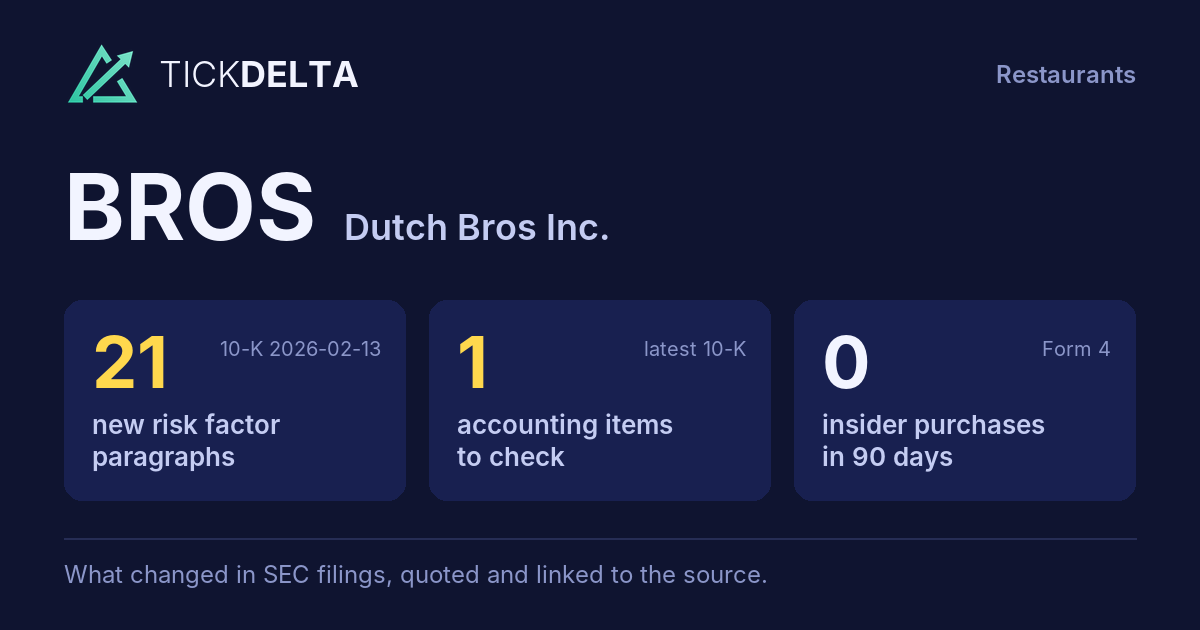
117 changes: 25 added, 13 removed, 76 reworded, 3 quiet changes

10-K Feb 13, 2026 vs Feb 13, 2025

10-K 0001866581-26-000006 (Feb 13, 2026) vs 10-K 0001866581-25-000048 (Feb 13, 2025)

Every paragraph, and how much of it changed

One bar per paragraph, in the order of the 10-K. Height and colour show the share of its words not in the closest paragraph a year earlier; the tallest bars are new paragraphs.

Risk Factors

349 paragraphs · 21 new · 67 reworded · 3 gone · 10-K Feb 13, 2026 against Feb 13, 2025
New paragraph Reworded (5% of its words or more) Same or nearly
Paragraph 220 · 43% changed Every version of it
In each case, these increases in Dutch Bros Inc.’s allocable share of existing tax basis, the tax basis adjustments generated over time, and the application of Section 704(c) of the Code, may increase (for tax purposes) depreciation and amortization deductions allocated to Dutch Bros Inc. Inc.; and, therefore, may reduce the amount of tax that Dutch Bros Inc. would otherwise be required to pay in the future. Actual tax benefits realized by Dutch Bros Inc. may differ from tax benefits calculated under the Tax Receivable Agreements as a result of the use of certain assumptions in the Tax Receivable Agreements, including the use of an assumed weighted-average state and local income tax rate to calculate tax benefits. The payment obligations under the Tax Receivable Agreements are an obligation of Dutch Bros Inc., but not of Dutch Bros OpCo. While the amount of existing tax basis, the anticipated tax basis adjustments, the application of Section 704(c) of the Code, and the actual amount and utilization of tax attributes, as well as the amount and timing of any payments under the Tax Receivable Agreements, will vary depending upon a number of factors, including the timing of redemptions and exchanges, the price of shares of our Class A common stock at the time of redemptions and exchanges, the extent to which such redemptions and exchanges are taxable, and the amount and timing of our income, we expect that as a result of the size of the transfers and increases in the tax basis of the tangible and intangible assets of Dutch Bros OpCo and our possible utilization of tax attributes, including existing tax basis attributable to Dutch Bros OpCo Class A common units acquired in connection with the IPO, the payments that Dutch Bros Inc. may make under the Tax Receivable Agreements may be substantial. The payments under the Tax Receivable Agreements are not conditioned upon continued ownership of Dutch Bros Inc. by the exchanging holders of Dutch Bros OpCo Class A common units or the Pre-IPO Blocker Holders.
Paragraph 232 · 36% changed Every version of it
If we were deemed to be an investment company under the Investment Company Act of 1940, as amended (the 1940 Act), as a result of our ownership of Dutch Bros OpCo, applicable restrictions could make it impractical for us to continue our business as contemplated and could have a material adverse effect on our business.
Paragraph 30 · 32% changed Every version of it
We incur costs and expend resources in our marketing efforts on new menu items, advertising campaigns to raise brand awareness and attract and retain customers, and other initiatives. For example, we began testing hot food offerings in a limited number of shops and implemented mobile order capabilities in over 95% of shops during 2024. These initiatives, and other initiatives we implement, may not be successful in creating new occasions in our shops or improving our financial condition and results of operations, resulting in expenses incurred without the benefit of higher revenue. For example, new menu offerings may not generate enough customer interest and sales to become profitable or cover the costs of their implementation, and may reduce our operating income. Additionally, some Some of our competitors have substantially greater financial resources than we do, which enable them to spend significantly more on marketing, advertising, pricing and other initiatives. Should our competitors increase spending on marketing and advertising and other initiatives or our marketing funds decrease for any reason, or should our advertising, promotions and new menu items fail to reach our customers effectively and efficiently, for example if our marketing efforts do not continue to appeal to our current customers or are perceived negatively, there could be an adverse effect on our revenues and profits could decrease.
Paragraph 56 · 32% changed Every version of it
•increases or continued elevation in prices for commodities, including coffee, milk, and flavored syrups; syrups, including due to announced tariffs whether or not such tariffs are ultimately enacted;
Paragraph 191 · 30% changed Every version of it
Our business is subject to the risk of litigation by employees, customers, competitors, landlords, or neighboring businesses, suppliers, franchise partners, stockholders, or others through private actions, class actions, administrative proceedings, regulatory actions, or other litigation. For example, in March 2023, a putative class action lawsuit was filed alleging that Dutch Bros Inc. and certain of its executive officers made false or misleading statements about the impact of commodity inflation on our financial results, which lawsuit was followed by a number of stockholder derivative lawsuits based on substantially the same underlying factual allegations. While all claims in the above-described putative class action lawsuit were dismissed by the court with prejudice, and all stockholder derivative lawsuits based on substantially the same underlying factual allegations have been dismissed, the outcome of litigation, particularly class action and regulatory actions, is difficult to assess or quantify. In recent years, beverage and restaurant companies have also been subject to lawsuits, including class action lawsuits, alleging violations of federal and state laws regarding workplace and employment matters, discrimination, and similar matters. A number of these lawsuits have resulted in the payment of substantial damages by the defendants. Similar lawsuits have been instituted from time to time alleging violations of various federal and state wage and hour laws regarding, among other things, employee meal deductions, overtime eligibility of assistant managers and failure to pay for all hours worked. Any such lawsuits in which Dutch Bros, Dutch Bros OpCo, or any subsidiary thereof is named as a party may result in substantial expenses and/or damages, even if such lawsuits may ultimately be decided in our favor.
Paragraph 29 · 28% changed Every version of it
We incur costs and expend resources in our marketing efforts on new menu items, advertising campaigns to raise brand awareness and attract and retain customers, and other initiatives. For example, we began testing hot food offerings in a limited number of shops and implemented mobile order ahead capabilities in over 95% of shops during 2024. 2024, and began offering consumer packaged goods in some markets during 2026. These initiatives, and other initiatives we implement, may not be successful in creating new occasions in our shops or improving our financial condition and results of operations, resulting in expenses incurred without the benefit of higher revenue. For example, new menu offerings may not generate enough customer interest and sales to become profitable or cover the costs of their implementation, and may reduce our operating income. Additionally, some the success of a new initiative may negatively impact our competitors have substantially greater financial resources than we do, which enable them to spend significantly more on marketing, advertising, pricing and other initiatives. Should our competitors increase spending on marketing and advertising and other initiatives or our marketing funds decrease existing lines of business, for any reason, or should our advertising, promotions and new menu items fail to reach our customers effectively and efficiently, for example if our marketing efforts do not continue to appeal example, the availability of consumer packaged goods could result in a reduction in traffic to our current customers or are perceived negatively, there shops, and could be an adverse effect on negatively impact our revenues and profits could decrease. overall results of operations.
Paragraph 216 · 27% changed Every version of it
If future cash distributions from Dutch Bros OpCo exceed Dutch Bros Inc.’s liabilities and Dutch Bros Inc. retains such excess cash balance, the shares of Class A common stock may be deemed to increase in value relative to the Dutch Bros OpCo Class A common units. If there is an increase in the relative value of a share of Class A common stock, Continuing Members could be viewed as disproportionately benefiting because the OpCo LLC Agreement and our certificate of incorporation provide that each Dutch Bros OpCo Class A common unit may be redeemed or exchanged for one share Class A common stock. For example, Continuing Members could disproportionately benefit in instances where they have received a tax distribution from Dutch Bros OpCo and subsequently redeem or exchange Dutch Bros OpCo Class A common units for shares of Class A common stock on a one-to-one basis when the value of the Class A common stock is increased relative to the Dutch Bros OpCo Class A common units as a result of Dutch Bros Inc. retaining any cash distribution from Dutch Bros OpCo in excess of Dutch Bros Inc.’s liabilities. If Dutch Bros Inc. retains such excess cash, we may implement measures to mitigate any arguable disproportionate benefits to Continuing Members and to maintain the equal value of Dutch Bros OpCo Class A common units relative to the shares of Class A common stock into which they are exchangeable. Such measures may require consent from Continuing Members, amendment to the OpCo LLC Agreement or our amended and restated certificate of incorporation or approvals required under our governing documents, third-party agreements, including our debt agreements, or applicable law. No assurance can be given that we will be able to obtain the required consents or approvals or that we will be able to maintain the equal value of Dutch Bros OpCo Class A common units and corresponding shares of Class A common stock at all times. To the extent we are unable to fully eliminate any value disparity, our Continuing Members may arguably disproportionately benefit if they acquire shares of Class A common stock in redemption or exchange of their Dutch Bros OpCo Class A common units.
Paragraph 188 · 25% changed Every version of it
Additionally, governmental authorities may adopt broad standards for determining when two or more entities may be deemed joint employers of the same employees. For example, the National Labor Relations Board passed a rule in October 2023, broadening the standards applicable to establishing a joint employer relationship and Congress has a legislation proposal in process that could shift more liability for franchise partner employment practices onto franchisors. The federal PRO Act has been reintroduced and would codify the Browning-Ferris decision that redefined joint employment to include a broader category of conduct by the franchisor. franchisor, while the introduced federal American Franchise Act would amend the National Labor Relations Act by providing definitions as to when a franchisor is considered to exercise substantial direct and immediate control over a franchisee’s employees. If the proposed or similar laws or rules come into effect, it could increase impact the possibility of Dutch Bros being held liable for our franchise partners’ employment practices.

MD&A

77 paragraphs · 4 new · 37 reworded · 10 gone · 10-K Feb 13, 2026 against Feb 13, 2025
New paragraph Reworded (5% of its words or more) Same or nearly
Paragraph 29 · 50% changed
The increase in total other income expense was primarily driven by higher remeasurement gains expenses associated with our credit facility refinance in the current May 2025 (see NOTE 9 — Debt for additional details), and a prior year related to the TRAs liability and the non-recurring gain on sale of the Company airplane, hangar and related equipment to our airplane and hangar. Co-Founder.
Paragraph 27 · 43% changed
The franchising and other gross profit increase of $9.1 $13.4 million was driven by $4.6 million due to newly opened franchised shops not in the comparable shop base, $2.6 million from same shop sales, and a $1.9 million increase from products sold to franchisees, net franchisees (net of costs and adjustments. adjustments), royalties and marketing fees generated from higher franchise partner sales.
Paragraph 23 · 40% changed
As a percentage of company-operated shop shops revenues, occupancy and other costs increased by 20 basis points. These increases were flat. This was primarily due to a 40 basis point increase driven by higher repairs and maintenance, offset by a decrease of 50 basis points from the impact of increased pricing. occupancy rates from new shops as we shift our lease types to a greater proportion of build-to-suit lease agreements, partially offset by leverage.
Paragraph 26 · 39% changed
As a percentage of The company-operated shop revenues, labor costs increased shops gross profit margin decreased by 20 40 basis points. This was primarily due to 180 basis points from driven by increased wages, coffee costs and labor costs partially offset by a decrease of 110 basis points from the impact of increased pricing and a decrease of 50 basis points driven by staffing management. leverage from increased sales in the comparable shop base.
Paragraph 44 · 31% changed
On August 4, 2023, May 29, 2025 (the Effective Date), we amended and restated our existing $650 million senior secured credit facility, dated February 28, 2022 (as previously amended, the 2022 Credit Facility), with JPMorgan Chase Bank, N.A. (as amended, as administrative agent and other financial institutions as the 2022 lenders party thereto (the 2025 Credit Facility) to increase borrowing capacity by $150 million to a total of $650 million. Facility). The 2022 2025 Credit Facility consists of a $350 $500 million revolving credit facility, facility and a term loan facility of up to $100 million, and a delayed draw term loan facility of up to $200 $150 million. The 2022 2025 Credit Facility also includes sublimits for letters of credit and swingline loans of up to $50 $100 million and $15 $20 million, respectively. The 2022 2025 Credit Facility expires on February 28, 2027 May 29, 2030 (the Maturity Date). It also contains an option allowing the Loan Parties to increase the size of the 2025 Credit Facility by up to an additional (i) $230 million or (ii) 80% of EBITDAR, whichever is greater, with the agreement of the Administrative Agent and the applicable lenders party thereto.
Paragraph 68 · 30% changed
Selling, general, and administrative expenses, excluding depreciation and amortization, equity-based compensation expense, expenses associated with equity offerings, COVID-19: prepaid costs not utilized, costs incurred for company-wide milestone events, executive transitions, legal proceedings, transitions costs, and organization realignment and restructuring restructurings costs.
Paragraph 25 · 30% changed
The increase in depreciation and amortization was primarily driven by the opening increase in the number of 128 new company-operated shops during 2024. in the current period compared to the prior period.
Paragraph 34 · 28% changed
The decrease slight increase in investing activities cash outflows was primarily driven by lower higher investment in capital expenditures due to fewer new company-operated shop shops openings in the current period compared to last period, and higher the same period in the prior year, partially offset by lower proceeds from disposal of fixed assets in the current year, driven by the sale of our company plane (a non-recurring event). assets.

A paragraph is matched with the one last year that shares the most of its words; under half in common makes it new. The paragraphs shown are the 8 reworded the most in each section.

The paragraph that changed most in each section

The redline

Marked against last year's 10-K: cut words struck through, new words highlighted.

Risk Factors253 words changed in this paragraph; it is 40% similar to last year's version.
In each case, these increases in Dutch Bros Inc.’s allocable share of existing tax basis, the tax basis adjustments generated over time, and the application of Section 704(c) of the Code, may increase (for tax purposes) depreciation and amortization deductions allocated to Dutch Bros Inc. Inc.; and, therefore, may reduce the amount of tax that Dutch Bros Inc. would otherwise be required to pay in the future. Actual tax benefits realized by Dutch Bros Inc. may differ from tax benefits calculated under the Tax Receivable Agreements as a result of the use of certain assumptions in the Tax Receivable Agreements, including the use of an assumed weighted-average state and local income tax rate to calculate tax benefits. The payment obligations under the Tax Receivable Agreements are an obligation of Dutch Bros Inc., but not of Dutch Bros OpCo. While the amount of existing tax basis, the anticipated tax basis adjustments, the application of Section 704(c) of the Code, and the actual amount and utilization of tax attributes, as well as the amount and timing of any payments under the Tax Receivable Agreements, will vary depending upon a number of factors, including the timing of redemptions and exchanges, the price of shares of our Class A common stock at the time of redemptions and exchanges, the extent to which such redemptions and exchanges are taxable, and the amount and timing of our income, we expect that as a result of the size of the transfers and increases in the tax basis of the tangible and intangible assets of Dutch Bros OpCo and our possible utilization of tax attributes, including existing tax basis attributable to Dutch Bros OpCo Class A common units acquired in connection with the IPO, the payments that Dutch Bros Inc. may make under the Tax Receivable Agreements may be substantial. The payments under the Tax Receivable Agreements are not conditioned upon continued ownership of Dutch Bros Inc. by the exchanging holders of Dutch Bros OpCo Class A common units or the Pre-IPO Blocker Holders.

Source: Item 1A, 10-K 0001866581-26-000006 vs Item 1A, 10-K 0001866581-25-000048

Accounting Policies202 words changed in this paragraph; it is 32% similar to last year's version.
In December 2023, November 2024, the FASB issued ASU No. 2023-09, 2024-03, Income Taxes (Topic 740): Improvements Statement - Reporting Comprehensive Income - Expense Disaggregation Disclosures (Subtopic 220-40). The intent of this ASU is to Income Tax Disclosures. improve public entity financial footnote disclosures around types of expenses in commonly presented expense categories (i.e., cost of sales; selling, general, and administrative expense; and research and development expense). The amendments in this update are intended to enhance ASU do not change or remove current expense disclosure requirements, but rather 1) impact where this information appears in the transparency and decision usefulness of income tax disclosures, primarily through improvements notes to the rate reconciliation consolidated financial statements and income taxes paid information, specifically requiring (1) consistent categories and greater disaggregation 2) add additional disclosure requirements for certain expense line items appearing on the face of information in the rate reconciliation, and (2) income taxes paid disaggregation by jurisdiction. These amendments are our consolidated statements of operations. ASU 2024-03, as amended, is effective for public business entities' annual reporting periods beginning after December 15, 2024 2026 and interim reporting periods within fiscal years beginning after December 15, 2025, and should be applied on a prospective basis. 2027. Early adoption is permitted for annual financial statements that have not yet been issued. The Company is permitted. We are currently assessing the potential impacts of this standard on its income tax disclosures, our business processes and expects to provide additional detail and disclosures under the new guidance. future disclosures.

Source: Item 8, Note 2 – Basis of Presentation and Summary of Significant Accounting Policies, 10-K 0001866581-26-000006 vs Item 8, Note 2 – Basis of Presentation and Summary of Significant Accounting Policies, 10-K 0001866581-25-000048

MD&A106 words changed in this paragraph; it is 60% similar to last year's version.
On August 4, 2023, May 29, 2025 (the Effective Date), we amended and restated our existing $650 million senior secured credit facility, dated February 28, 2022 (as previously amended, the 2022 Credit Facility), with JPMorgan Chase Bank, N.A. (as amended, as administrative agent and other financial institutions as the 2022 lenders party thereto (the 2025 Credit Facility) to increase borrowing capacity by $150 million to a total of $650 million. Facility). The 2022 2025 Credit Facility consists of a $350 $500 million revolving credit facility, facility and a term loan facility of up to $100 million, and a delayed draw term loan facility of up to $200 $150 million. The 2022 2025 Credit Facility also includes sublimits for letters of credit and swingline loans of up to $50 $100 million and $15 $20 million, respectively. The 2022 2025 Credit Facility expires on February 28, 2027 May 29, 2030 (the Maturity Date). It also contains an option allowing the Loan Parties to increase the size of the 2025 Credit Facility by up to an additional (i) $230 million or (ii) 80% of EBITDAR, whichever is greater, with the agreement of the Administrative Agent and the applicable lenders party thereto.

Source: Item 7, 10-K 0001866581-26-000006 vs Item 7, 10-K 0001866581-25-000048

Legal Proceedings14 words changed in this paragraph; it is 89% similar to last year's version.
We periodically provide guarantees to franchise partners for lease payments. Annually, we determine if a liability needs to be recorded related to these guarantees. As of December 31, 2024 2025 and December 31, 2023, 2024, we had guaranteed approximately $8.2 $7.8 million and $1.4 $8.2 million, respectively, in franchise partners’ lease payments and have not established a liability for these guarantees as any liability arising from the guarantees is not material to the consolidated financial statements.

Source: Item 3, via Note 16 – Commitments and Contingencies, 10-K 0001866581-26-000006 vs Item 3, via Note 17 – Commitments and Contingencies, 10-K 0001866581-25-000048

Sentences and paragraphs added, removed or reworded

Every change, by type

Sentences and paragraphs of BROS's Risk Factors and MD&A, 10-K Feb 13, 2026 against 10-K Feb 13, 2025. Each links to the text at sec.gov.

Quiet changes are sentences kept from last year with one to four words changed, at least one of them a hedge, a modal or a qualifier (may, could, will, not, significant, material…). A year or date rolling forward is not counted.

The full word list

adverse, adversely, all, although, anticipate, anticipates, any, approximately, believe, believes, can, cannot, certain, could, expect, expects, generally, however, if, intend, intends, largely, likely, many, material, materially, may, might, most, must, never, no, not, possible, primarily, probable, should, significant, significantly, some, substantial, substantially, unlikely, will, would

AddedRisk Factors
Additionally, we have worked with, and plan to continue to work with, select social media influencers in promoting or marketing our products. Such relationships between Dutch Bros and social media influencers may not be successful or appeal to our customers, and may be perceived negatively. Recently, other brands have faced backlash for partnerships with certain social media influencers due to such influencers’ actions before or after such partnerships. We have limited control over such influencers’ behavior in promoting or marketing our products, and no control over such influencers’ behaviors outside
Read it in 10-K Feb 13, 2026 at sec.gov
AddedRisk Factors
The use of AI technologies within our business processes must be managed effectively and ethically to avoid outputs that are false, biased, or inconsistent with our values and strategies. Failure to properly manage AI technologies within our business processes, could also lead to unauthorized access to sensitive information and could harm our reputation and competitive position. At the same time, if we fail to keep pace with the rapid evolution of AI technologies, our competitive position and business results could suffer. In addition, the evolving regulatory landscape for AI technologies requires continuous monitoring and adaptation to ensure compliance and mitigate potential legal risks.
Read it in 10-K Feb 13, 2026 at sec.gov
AddedRisk Factors
We are subject to evolving state-level Extended Producer Responsibility (EPR) laws and circular economy regulations. These laws, which vary significantly by jurisdiction, require us to take financial or physical responsibility for the end-of-life management of our packaging and single-use products. Compliance with these mandates often requires us to join and fund Producer Responsibility Organizations (PROs), pay significant environmental fees based on material volume, and implement complex tracking and reporting systems for all packaging materials used in our shops. The lack of a uniform federal standard and the rapid adoption of divergent requirements across different states create a fragmented regulatory landscape that is both costly and difficult to navigate. If we are unable to efficiently manage these requirements or if the cost of compliance exceeds our projections, it could materially increase our packaging costs and adversely affect our results of operations.
Read it in 10-K Feb 13, 2026 at sec.gov
AddedRisk Factors
We use machine learning and AI, including generative AI, in our products and services. The development and use of AI technologies presents various privacy and security risks that may impact our business. AI technologies are subject to privacy and data security laws, as well as increasing regulation and scrutiny. Further, countries and states are applying their data and consumer protection laws to AI technologies, and particularly generative AI and interactive chatbots. Several jurisdictions have proposed, enacted, or are considering laws governing the development and use of AI technologies, such as the Colorado Artificial Intelligence Act and California Bot Disclosure Law. Additionally, certain privacy laws extend rights to consumers (such as the right to delete certain personal data) and regulate automated decision making, which may be incompatible with our use of AI technologies. These obligations may make it harder for us to conduct our business using AI technologies, lead to regulatory fines or penalties, require us to change our business practices, retrain our AI technologies, or prevent or limit our use of AI technologies.
Read it in 10-K Feb 13, 2026 at sec.gov
AddedRisk Factors
the availability of this information. The PPACA further permits the Food and Drug Administration to require covered restaurants to make additional nutrient disclosures, such as disclosure of trans-fat content. More recently, U.S. regulatory authorities, including the Food and Drug Administration, have indicated their intent to restrict or prohibit the use of certain food dyes currently permitted for lawful use in the food supply by the end of 2026. The Food and Drug Administration continues to develop a revised post-market food chemical review program. In addition, the Food and Drug Administration is developing a proposed rule to increase oversight of food ingredients deemed Generally Recognized as Safe (GRAS), which, if finalized, would require mandatory submission of GRAS notices for food ingredients. GRAS reform legislation has also been introduced in Congress. Furthermore, an increasing number of states have proposed or enacted laws prohibiting or limiting the use of certain food and color additives and state enforcement actions and investigations into their use are underway. For example, in 2025, the Texas Attorney General’s Office initiated multiple investigations into major food companies regarding the marketing of products containing artificial dyes, resulting in public commitments to remove such additives in the near term and, in one case, a legally binding agreement.by other brands are underway. Should such regulatory change affect the ingredients currently used in our products and we are unable to identify or secure comparable and cost-effective alternative ingredients, such change could have an adverse effect on our results of operations and financial position. An unfavorable report on, or reaction to, our current or future menu ingredients, the size of our portions, or the nutritional content of our menu items could negatively influence the demand for our offerings.
Read it in 10-K Feb 13, 2026 at sec.gov
Show the other 48
AddedRisk Factors
Current or future tariffs or other restrictive trade measures may significantly raise the costs of our imported green coffee beans and other goods, which may adversely impact our product offerings, operational expenses, and construction costs. Such cost increases may reduce our margins and require us to increase prices, which could harm our competitive position, reduce customer demand, and damage customer relationships. Our suppliers and distribution channels are also affected by the current trade environment, and we and they may experience supply chain disruptions as a result of increased costs and uncertainty, as well as risks to the long-term viability of key suppliers, which may impact our ability to
Read it in 10-K Feb 13, 2026 at sec.gov
AddedRisk Factors
meet customer demand or manage inventory efficiently. Tariff and other trade-related cost pressures and supply chain disruptions may lead to reputational harm if we are unable to supply our shops with sufficient products or supply products on expected timelines, or if any price increases are poorly received by customers. In addition, evolving trade policies, including tariffs and trade restrictions, may decrease consumer discretionary spending and result in decreased demand for our products.
Read it in 10-K Feb 13, 2026 at sec.gov
RemovedRisk Factors
Certain of our directors have in the past been, and may in the future be, affiliated with our Sponsor. Such Sponsor-affiliated directors have fiduciary duties to us and, in addition, have duties to our Sponsor. As a result, such a director may face real or apparent conflicts of interest with respect to matters affecting both us and our Sponsor, whose interests may be adverse to ours in some circumstances.
Read it in 10-K Feb 13, 2025 at sec.gov
RemovedRisk Factors
Additionally, our amended and restated certificate of incorporation provides that we renounce any interest or expectancy in, or in being offered an opportunity to participate in, business opportunities that are from time to time available to Sponsor and of its officers, directors, agents, stockholders, members, partners, affiliates and subsidiaries and each such party shall not have any obligation to offer us those opportunities unless presented to one of our directors or officers in his or her capacity as a director or officer.
Read it in 10-K Feb 13, 2025 at sec.gov
RewordedRisk Factors
The For example, the federal PRO Act has been reintroduced and would codify the Browning-Ferris decision that redefined joint employment to include a broader category of conduct by the franchisor. franchisor, while the introduced federal American Franchise Act would amend the National Labor Relations Act by providing definitions as to when a franchisor is considered to exercise substantial direct and immediate control over a franchisee’s employees.
Read it in 10-K Feb 13, 2026 at sec.gov
RewordedRisk Factors
For example, Continuing Members could disproportionately benefit in instances where they have received a tax distribution from Dutch Bros OpCo and subsequently redeem or exchange Dutch Bros OpCo Class A common units for shares of Class A common stock on a one-to-one basis when the value of the Class A common stock is increased relative to the Dutch Bros OpCo Class A common units as a result of Dutch Bros Inc. retaining any cash distribution from Dutch Bros OpCo in excess of Dutch Bros Inc.’s liabilities.
Read it in 10-K Feb 13, 2026 at sec.gov
RewordedRisk Factors
The financial markets and the global economy may also be adversely affected by the current or anticipated impact of tariffs, supply chain disruptions, labor shortages, fluctuations in currency exchange rates, changes in interest rates, military conflict, including the war between Russia and Ukraine and the war between Israel and Hamas, acts of terrorism, or other geopolitical events.
Read it in 10-K Feb 13, 2026 at sec.gov
RewordedRisk Factors
Actual tax benefits realized by Dutch Bros Inc. may differ from tax benefits calculated under the Tax Receivable Agreements as a result of the use of certain assumptions in the Tax Receivable Agreements, including the use of an assumed weighted-average state and local income tax rate to calculate tax benefits.
Read it in 10-K Feb 13, 2026 at sec.gov
RewordedRisk Factors
Moreover, despite our efforts, we may not be successful in achieving compliance if our employees, partners, or other third parties with whom we work do not may fail to comply with applicable data privacy and security obligations. obligations, which could negatively impact our business operations and our ability to achieve and maintain compliance.
Read it in 10-K Feb 13, 2026 at sec.gov
RewordedRisk Factors
Our financial results could be adversely affected by a shift in consumer spending away from outside-the-home beverages, decreases in general discretionary consumer spending (including due to higher gas prices, inflation or lack of consumer confidence), lack of customer acceptance of new products including new drink offerings, hot food, and consumer packaged goods (including due to price increases necessary to cover the costs of new beverages products or higher input costs), brand perception (such as the existence or expansion of our competitors), platforms (such as features of our mobile application app and changes in our loyalty rewards programs and initiatives), a reduction in individual vehicle ownership, which in turn may reduce the usefulness and convenience of our drive-thru shops, or customers reducing their demand for our current offerings as new beverages products, including new drink offerings, hot food, and consumer packaged goods, are introduced.
Read it in 10-K Feb 13, 2026 at sec.gov
RewordedRisk Factors
Further, if we are unable to obtain additional capital when required, or are unable to obtain additional capital on satisfactory terms, our ability to continue to support our business growth or to respond to business opportunities, challenges, or unforeseen circumstances would be adversely affected.
Read it in 10-K Feb 13, 2026 at sec.gov
RewordedRisk Factors
For example, in January during 2025, the US President announced the imposition of tariffs and other sanctions on various countries, including Canada, Mexico, and Colombia, many of which are subject to legal challenges, and it remains uncertain whether they, or similar measures, will ultimately be enacted. enacted or remain in effect.
Read it in 10-K Feb 13, 2026 at sec.gov
RewordedRisk Factors
If we were required to register as an investment company, restrictions imposed by the 1940 Act, including limitations on our capital structure and our ability to transact with affiliates, could make it impractical for us to continue our business as contemplated and could have a material adverse effect on our business.
Read it in 10-K Feb 13, 2026 at sec.gov
RewordedRisk Factors
The global credit and financial markets have experienced extreme volatility and disruptions (including as a result of the COVID-19 pandemic and tariffs, recession concerns, actual or perceived changes in interest rates, and continued economic inflation, and failures of financial institutions), inflation), which has included severely diminished liquidity and credit availability, declines in consumer confidence, prolonged weak consumer demand, a decrease in consumer discretionary spending, declines in slower economic growth, high inflation, uncertainty about economic stability, and increases swings in unemployment rates.
Read it in 10-K Feb 13, 2026 at sec.gov
RewordedRisk Factors
While we are not currently required to implement a FSMA Food Safety Plan or a Hazard Analysis and Critical Points system (HACCP) in our shops, many states have required restaurants to develop and implement HACCP, and the United States government continues to expand the sectors of the food industry that must adopt and implement HACCP.
Read it in 10-K Feb 13, 2026 at sec.gov
RewordedRisk Factors
The price of coffee increased significantly in 2022, has since remained elevated, during 2024 and further increased significantly during the year ended December 31, 2024, 2025, and we expect will it may remain elevated or continue increasing during 2025. 2026.
Read it in 10-K Feb 13, 2026 at sec.gov
Quiet changesRisk Factors
Additionally, some Some of our competitors have substantially greater financial resources than we do, which enable them to spend significantly more on marketing, advertising, pricing and other initiatives.
Read it in 10-K Feb 13, 2026 at sec.gov
Quiet changesRisk Factors
These Certain state laws also impose stricter requirements for processing certain personal information, including sensitive personal data, such as data protection impact assessments.
Read it in 10-K Feb 13, 2026 at sec.gov
Quiet changesRisk Factors
We may be unable to identify all potential allergens present in our products at the time of purchase, whether they may have been were introduced by us or by our third party vendors.
Read it in 10-K Feb 13, 2026 at sec.gov
AddedMD&A
The decrease in the effective tax rate to 13.5% from 21.7% in the same period in 2024 is due to tax deductions related to stock-based compensation, as well as the impact of changes in state rates and apportionment of deferred taxes.
Read it in 10-K Feb 13, 2026 at sec.gov
AddedMD&A
On the Effective Date, we drew the full $150 million in term loan and $50 million in revolving loans under the 2025 Credit Facility, and all outstanding debt under the 2022 Credit Facility was repaid.
Read it in 10-K Feb 13, 2026 at sec.gov
AddedMD&A
Costs incurred as a result of refinancing our credit facility in May 2025, including write-off of unamortized loan costs related to the amendment and restatement of our 2022 Credit Facility, and intermediary fees and other costs related to our 2025 Credit Facility.
Read it in 10-K Feb 13, 2026 at sec.gov
RemovedMD&A
The decrease in interest expense, net was primarily driven by interest income on cash invested in money market funds, partially offset by additional interest on finance leases for new shop builds.
Read it in 10-K Feb 13, 2025 at sec.gov
RemovedMD&A
The increase in tax expense was primarily driven by increased current year pre-tax income and the increase in our ownership interest of Dutch Bros OpCo, changes in state earnings mix, and its impact on deferred taxes.
Read it in 10-K Feb 13, 2025 at sec.gov
RemovedMD&A
Costs related to a catastrophic leave policy that provided paid leave to employees who were required to quarantine due to in-shop exposures and could not work their regular hours. The catastrophic leave program was retired in May 2023.
Read it in 10-K Feb 13, 2025 at sec.gov
RemovedMD&A
Costs related to the write-off of previously prepaid expenses for the development of a virtual corporate engagement platform built in response to the health restrictions of the COVID-19 pandemic. The platform was developed as a substitute for in person engagement practices used pre-pandemic. The platform has been determined ineffective, particularly as we shift back to in-person events with the easing of restrictions related to the COVID-19 pandemic.
Read it in 10-K Feb 13, 2025 at sec.gov
RewordedMD&A
Year Ended December 31, (in thousands, except shop count data; (dollars in thousands; unaudited) 2025 2024 2023 2022 Shop count, beginning of period Company-operated 542 396 271 Franchised 289 275 267 Total shop count 831 671 538 Company-operated new openings 128 146 120 Franchised new openings 23 13 13 Acquisition of franchise shops — — 5 Re-openings 1 — 1 — Shop count, end of period Company-operated 670 542 396 Franchised 312 289 275 Total shop count 982 831 671 Company-operated new openings 141 128 146 Franchised new openings 13 23 13 Re-openings 1 — — 1 Shop count, end of period Company-operated 811 670 542 Franchised 325 312 289 Total shop count 1,136 982 831 Systemwide AUV 2 $ 2,115 $ 2,018 $ 1,973 $ 1,924 Company-operated shops AUV 2 $ 2,061 $ 1,933 $ 1,902 $ 1,895 Systemwide same shop sales 3, 4 5.6 % 5.3 % 2.8 % 1.0 Ticket 2.4 % Ticket 5.4 % 7.3 % 4.8 Transactions 3.2 % Transactions (0.1) % (4.5) % (3.8) % Company-operated same shop sales 3 7.4 % 6.8 % 1.5 % 0.6 Ticket 2.0 % Ticket 5.3 % 7.2 % 4.7 Transactions 5.4 % Transactions 1.5 % (5.7) % (4.1) % Systemwide sales 4 $ 2,223,576 $ 1,819,018 $ 1,444,433 $ 1,163,182 Company-operated shops operating weeks 5 37,667 31,708 24,395 17,489 Franchising shops operating weeks 5 16,527 15,579 14,624 13,828 Dutch Rewards transactions as a percentage of total transactions 6 67.8 72 % 64.5 68 % 62.3 65 %
Read it in 10-K Feb 13, 2026 at sec.gov
RewordedMD&A
The selling, general, and administrative increase of approximately $29.0 $28.7 million was primarily driven by increased expenses of $25.8 $24.7 million primarily consisting of investments in human capital to support our revenue growth and higher performance-based compensation; an increase of $15.7 $9.9 million of organization realignment and restructuring costs (which includes a $1.8 million net expense that resulted from the donation of our former Grants Pass headquarters building for the development of a children’s learning center); $12.6 million of increased related to professional fees and technology services to support our growing business; and $4.0 $5.3 million of increased donations to our Foundation. higher equity-based compensation.
Read it in 10-K Feb 13, 2026 at sec.gov
RewordedMD&A
On a macro level, conditions, including changes in tariffs, tax laws, interest rates, inflation, bank failures and other events affecting financial institutions, commodity costs, geopolitical conflicts (such as the Russia-Ukraine war, the state of war between Israel and Hamas, and the risk of larger regional conflicts), conflicts, and significant weather events (such as the recent wildfires in California), events, have created significant uncertainty in the global economy.
Read it in 10-K Feb 13, 2026 at sec.gov
RewordedMD&A
The franchising and other gross profit increase of $9.1 $13.4 million was driven by $4.6 million due to newly opened franchised shops not in the comparable shop base, $2.6 million from same shop sales, and a $1.9 million increase from products sold to franchisees, net franchisees (net of costs and adjustments. adjustments), royalties and marketing fees generated from higher franchise partner sales.
Read it in 10-K Feb 13, 2026 at sec.gov
RewordedMD&A
The decrease slight increase in investing activities cash outflows was primarily driven by lower higher investment in capital expenditures due to fewer new company-operated shop shops openings in the current period compared to last period, and higher the same period in the prior year, partially offset by lower proceeds from disposal of fixed assets in the current year, driven by the sale of our company plane (a non-recurring event). assets.
Read it in 10-K Feb 13, 2026 at sec.gov
RewordedMD&A
This Our 2024 initiative resulted in realignment activities that occurred in 2023, and restructuring activities to expand our support center operations in Phoenix, Arizona including the build out and move into our new office, that commenced in 2024, and are expected to continue through the first half of were substantially completed in March 2025.
Read it in 10-K Feb 13, 2026 at sec.gov
RewordedMD&A
Defined as EBITDA, excluding equity-based compensation, expenses associated with equity offerings, COVID-19: catastrophic leave expenses, COVID-19: prepaid costs not utilized, costs incurred for company-wide milestone events, expenses associated with credit facility refinancing, executives transitions costs, (gain) loss on the remeasurement of the liability related to the TRAs, estimated expenses related to certain legal disputes, sale of aircraft, Aircraft, and organization realignment and restructuring restructurings costs.
Read it in 10-K Feb 13, 2026 at sec.gov
RewordedMD&A
Section Page Overview and Highlights 73 76 Impact of Global Events 73 76 Results of Operations 74 77 Key Performance Indicators 75 78 Company-operated Shop Shops Results 77 80 Franchising and Other Segment Performance 80 82 Selling, General, and Administrative 80 82 Other Expense 81 83 Income Tax Expense 81 83 Liquidity and Capital Resources 81 83 Non-GAAP Financial Measures 85 88
Read it in 10-K Feb 13, 2026 at sec.gov
RewordedMD&A
The company-operated shop Company-operated shops revenue increase was driven by $262.3 increased $268.8 million from newly opened shops not yet in the comparable shop base and $45.6 $74.6 million from an a 7.4% increase in same shop sales within the comparable shop base. sales.
Read it in 10-K Feb 13, 2026 at sec.gov
RewordedMD&A
The 2022 2025 Credit Facility consists of a $350 $500 million revolving credit facility, facility and a term loan facility of up to $100 million, and a delayed draw term loan facility of up to $200 $150 million.
Read it in 10-K Feb 13, 2026 at sec.gov
RewordedMD&A
Interest on borrowings under the 2022 2025 Credit Facility is based on (a) (i) the Alternate Base Rate plus an applicable margin, or (b) (ii) the Adjusted Term SOFR Rate plus an applicable margin, margin (each as defined in the 2025 Credit Facility), and is payable in accordance with the selected interest rate period (at least quarterly) and upon maturity.
Read it in 10-K Feb 13, 2026 at sec.gov
RewordedMD&A
The increase in depreciation and amortization was primarily driven by the opening increase in the number of 128 new company-operated shops during 2024. in the current period compared to the prior period.
Read it in 10-K Feb 13, 2026 at sec.gov

Sources

The two latest 10-Ks on EDGAR, section by section. Each change links to the text at sec.gov.

Also

New risk factors: paragraphs with nothing like them last year, quoted in full.

Work with it

Excel workbook · CSV. Google Sheet that stays up to date: paste =IMPORTDATA("https://tickdelta.com/company/BROS/export.csv") into a cell.

Next:Related parties
Esc

Type a ticker such as AAPL, a name, an investor such as Buffett, or a topic such as tariffs. ↑ ↓ to move, Enter to open.