Dutch Bros Inc. BROS
New risk paragraphs, branching off last year
Each branch is a paragraph in Risk Factors with nothing like it in the 10-K filed Feb 13, 2025. A box jumps to the paragraph as filed, below.
Paragraphs with nothing like them in last year's 10-K
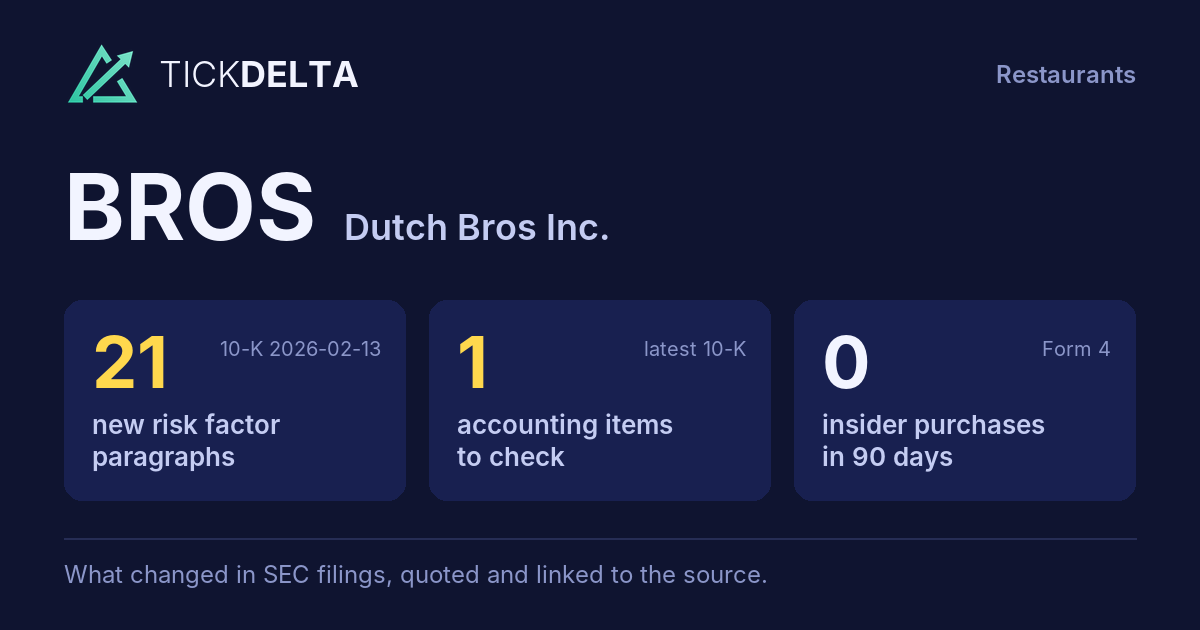
21 paragraphs in Risk Factors of the 10-K filed Feb 13, 2026 with nothing like them in the 10-K filed Feb 13, 2025. Quoted exactly. Paragraphs that were only edited are under 10-K change.
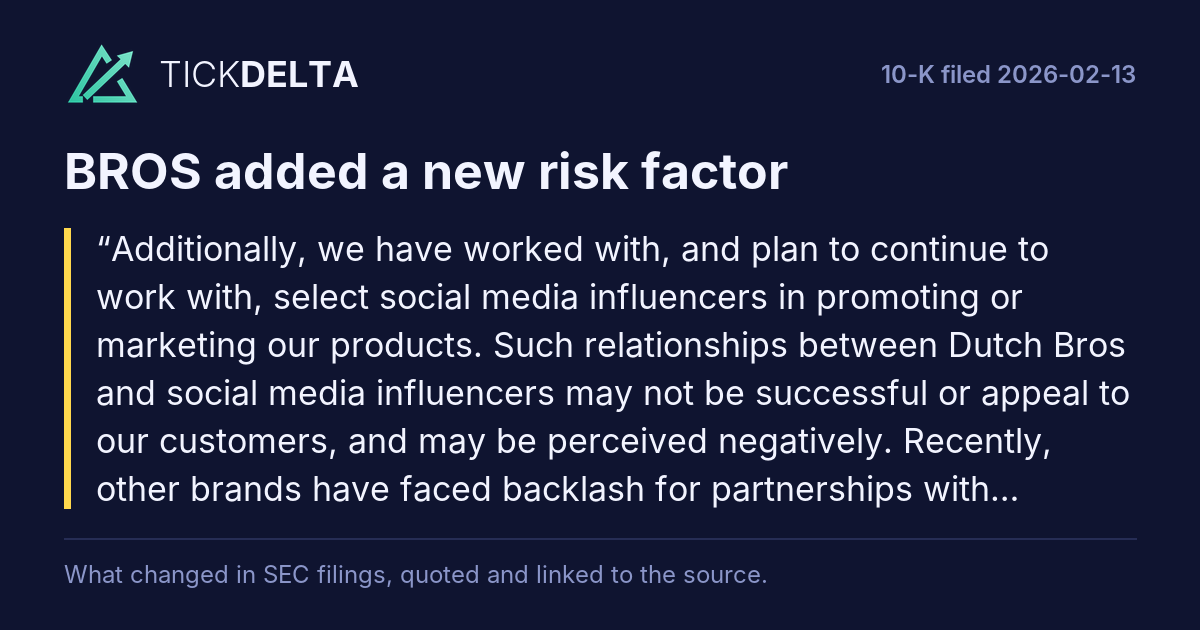
Additionally, we have worked with, and plan to continue to work with, select social media influencers in promoting or marketing our products. Such relationships between Dutch Bros and social media influencers may not be successful or appeal to our customers, and may be perceived negatively. Recently, other brands have faced backlash for partnerships with certain social media influencers due to such influencers’ actions before or after such partnerships. We have limited control over such influencers’ behavior in promoting or marketing our products, and no control over such influencers’ behaviors outside
of any partnership to promote or market our products, and we may face negative public sentiment due to such relationships.
•establish and maintain relationships with necessary third parties, including developers, landlords, and construction companies;
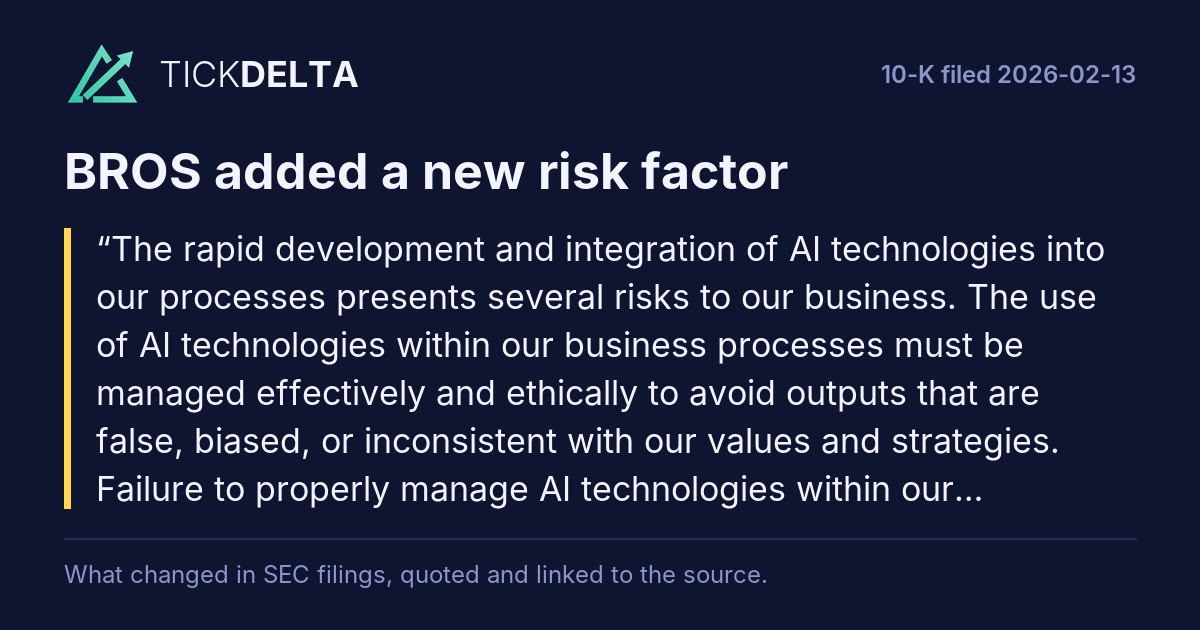
The rapid development and integration of AI technologies into our processes presents several risks to our business.
The use of AI technologies within our business processes must be managed effectively and ethically to avoid outputs that are false, biased, or inconsistent with our values and strategies. Failure to properly manage AI technologies within our business processes, could also lead to unauthorized access to sensitive information and could harm our reputation and competitive position. At the same time, if we fail to keep pace with the rapid evolution of AI technologies, our competitive position and business results could suffer. In addition, the evolving regulatory landscape for AI technologies requires continuous monitoring and adaptation to ensure compliance and mitigate potential legal risks.
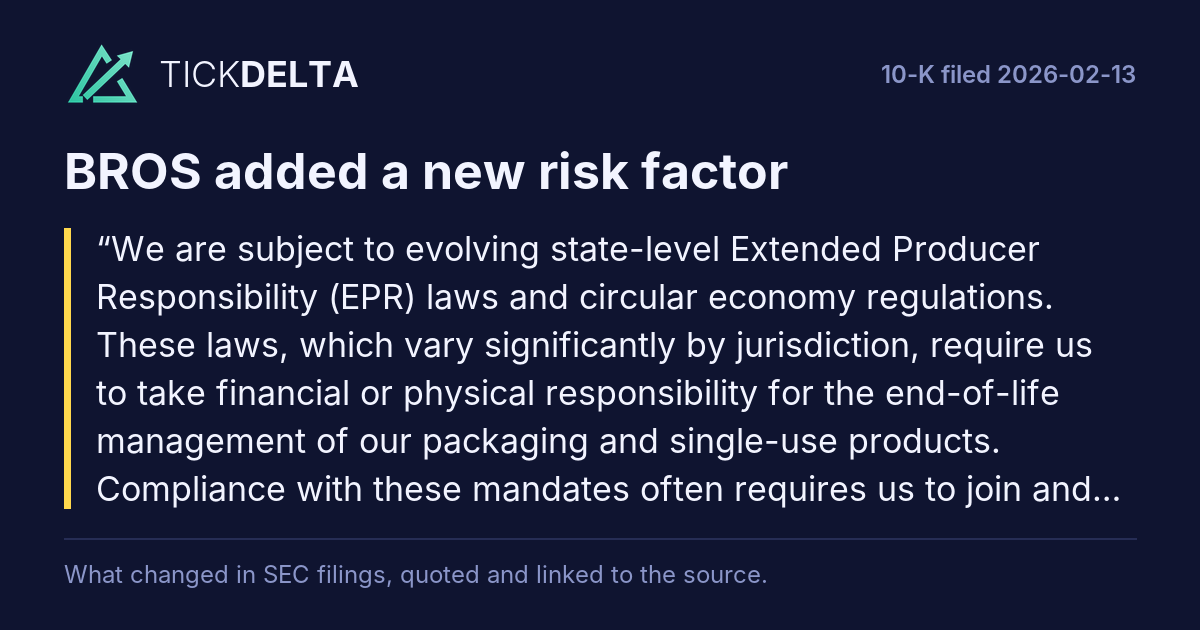
We are subject to evolving state-level Extended Producer Responsibility (EPR) laws and circular economy regulations. These laws, which vary significantly by jurisdiction, require us to take financial or physical responsibility for the end-of-life management of our packaging and single-use products. Compliance with these mandates often requires us to join and fund Producer Responsibility Organizations (PROs), pay significant environmental fees based on material volume, and implement complex tracking and reporting systems for all packaging materials used in our shops. The lack of a uniform federal standard and the rapid adoption of divergent requirements across different states create a fragmented regulatory landscape that is both costly and difficult to navigate. If we are unable to efficiently manage these requirements or if the cost of compliance exceeds our projections, it could materially increase our packaging costs and adversely affect our results of operations.
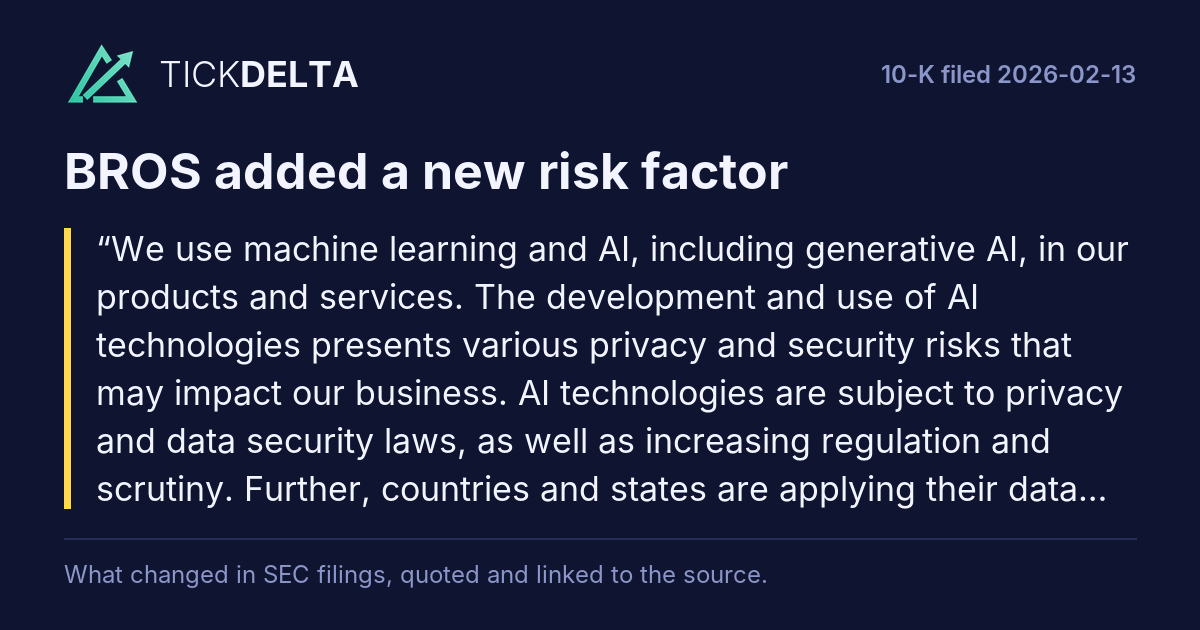
We use machine learning and AI, including generative AI, in our products and services. The development and use of AI technologies presents various privacy and security risks that may impact our business. AI technologies are subject to privacy and data security laws, as well as increasing regulation and scrutiny. Further, countries and states are applying their data and consumer protection laws to AI technologies, and particularly generative AI and interactive chatbots. Several jurisdictions have proposed, enacted, or are considering laws governing the development and use of AI technologies, such as the Colorado Artificial Intelligence Act and California Bot Disclosure Law. Additionally, certain privacy laws extend rights to consumers (such as the right to delete certain personal data) and regulate automated decision making, which may be incompatible with our use of AI technologies. These obligations may make it harder for us to conduct our business using AI technologies, lead to regulatory fines or penalties, require us to change our business practices, retrain our AI technologies, or prevent or limit our use of AI technologies.
Show the other 6
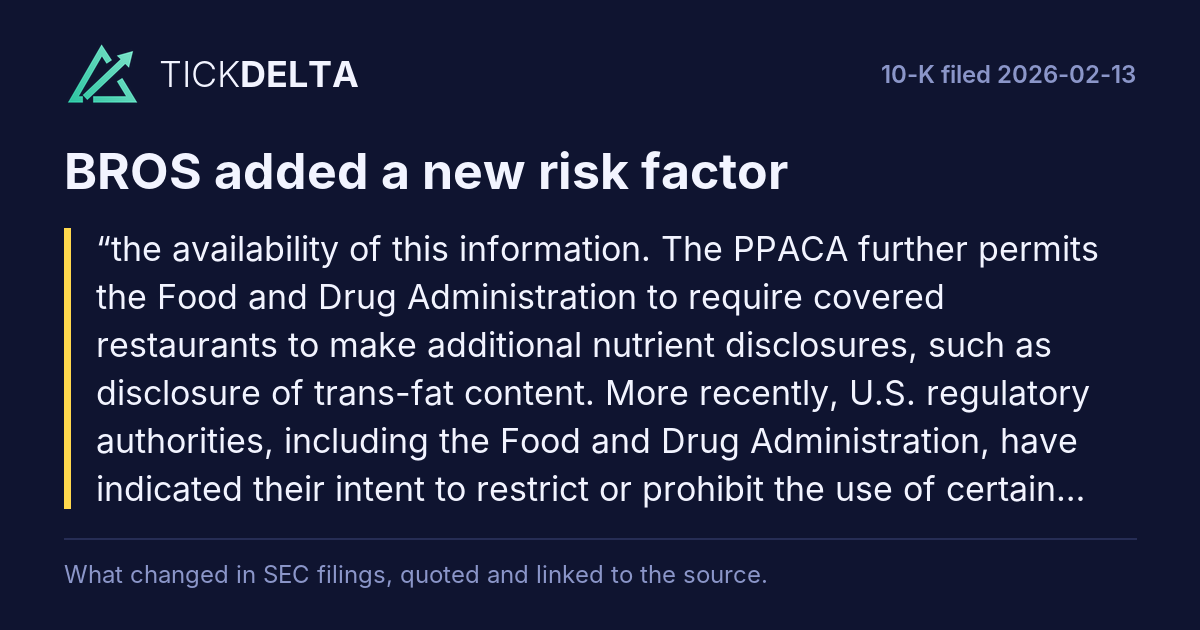
the availability of this information. The PPACA further permits the Food and Drug Administration to require covered restaurants to make additional nutrient disclosures, such as disclosure of trans-fat content. More recently, U.S. regulatory authorities, including the Food and Drug Administration, have indicated their intent to restrict or prohibit the use of certain food dyes currently permitted for lawful use in the food supply by the end of 2026. The Food and Drug Administration continues to develop a revised post-market food chemical review program. In addition, the Food and Drug Administration is developing a proposed rule to increase oversight of food ingredients deemed Generally Recognized as Safe (GRAS), which, if finalized, would require mandatory submission of GRAS notices for food ingredients. GRAS reform legislation has also been introduced in Congress. Furthermore, an increasing number of states have proposed or enacted laws prohibiting or limiting the use of certain food and color additives and state enforcement actions and investigations into their use are underway. For example, in 2025, the Texas Attorney General’s Office initiated multiple investigations into major food companies regarding the marketing of products containing artificial dyes, resulting in public commitments to remove such additives in the near term and, in one case, a legally binding agreement.by other brands are underway. Should such regulatory change affect the ingredients currently used in our products and we are unable to identify or secure comparable and cost-effective alternative ingredients, such change could have an adverse effect on our results of operations and financial position. An unfavorable report on, or reaction to, our current or future menu ingredients, the size of our portions, or the nutritional content of our menu items could negatively influence the demand for our offerings.
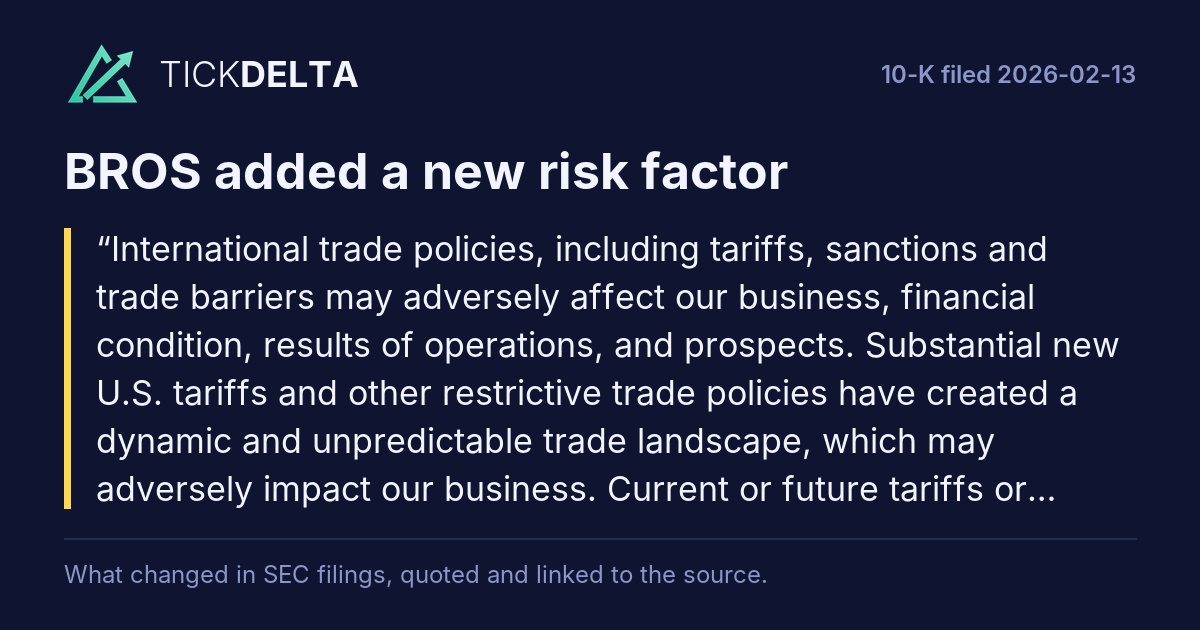
International trade policies, including tariffs, sanctions and trade barriers may adversely affect our business, financial condition, results of operations, and prospects.
Substantial new U.S. tariffs and other restrictive trade policies have created a dynamic and unpredictable trade landscape, which may adversely impact our business.
Current or future tariffs or other restrictive trade measures may significantly raise the costs of our imported green coffee beans and other goods, which may adversely impact our product offerings, operational expenses, and construction costs. Such cost increases may reduce our margins and require us to increase prices, which could harm our competitive position, reduce customer demand, and damage customer relationships. Our suppliers and distribution channels are also affected by the current trade environment, and we and they may experience supply chain disruptions as a result of increased costs and uncertainty, as well as risks to the long-term viability of key suppliers, which may impact our ability to
meet customer demand or manage inventory efficiently. Tariff and other trade-related cost pressures and supply chain disruptions may lead to reputational harm if we are unable to supply our shops with sufficient products or supply products on expected timelines, or if any price increases are poorly received by customers. In addition, evolving trade policies, including tariffs and trade restrictions, may decrease consumer discretionary spending and result in decreased demand for our products.
Trade disputes, trade restrictions, tariffs and other geopolitical tensions between the U.S. and other countries may also exacerbate unfavorable macroeconomic conditions including inflationary pressures, foreign exchange volatility, financial market instability, and economic recessions or downturns, which may also necessitate pricing actions and result in a negative impact on customer demand for our products, limit expansion opportunities, limit our access to capital, or otherwise negatively impact our business and operations. Ongoing tariff, trade restrictions and macroeconomic uncertainty may contribute to volatility in the price of our Class A common stock.
Ongoing uncertainty regarding trade policies may also complicate our short- and long-term strategic planning, and that of our suppliers and distributors, including decisions regarding hiring, product strategy, capital investment, supply chain design, and geographic expansion.
While we continue to monitor trade developments, the ultimate impact of these risks remains uncertain and any prolonged economic downturn, escalation in trade tensions, or deterioration in international perception of U.S.-based companies could materially and adversely affect our business, results of operations, financial condition, and prospects. In addition, tariffs and other trade developments have and may continue to heighten the risks related to the other risk factors described in this Form 10-K.
•dependence on a small number of suppliers, including for co-packing, roasting, and consumer packaged goods;
terms, our ability to continue to support our business growth or to respond to business opportunities, challenges, or unforeseen circumstances would be adversely affected.
This provision would not apply to suits brought to enforce a duty or liability created by the Exchange Act or any other claim for which the U.S. federal courts have exclusive jurisdiction. In addition, our amended
Climate change and volatile adverse weather conditions could adversely affect our shop sales or results of operations.
There is growing concern that climate change and global warming has caused and may continue to cause more severe, volatile weather, which could increase the frequency and duration of weather impacts on our operations. Adverse weather conditions have in the past and may in the future reduce our AUVs and, in more severe cases such as hurricanes, tornadoes, wildfires or other natural disasters, cause temporary restaurant closures, all of which negatively impact our shop sales and AUVs. For example, in 2018 a wildfire partially destroyed a town in northern California, damaged one of our shops and caused poor air quality which reduced customers’ willingness to venture outside their homes and visit our shops. In addition, our supply chain may be subject to increased costs caused by the effects of climate change and diminished energy and water resources. Increasing weather volatility and changes in global weather patterns could reduce coffee bean crop size and crop quality, or destroy crops altogether, which could result in decreased availability or higher pricing for our coffee beans or other commodities. Prolonged weather volatility may force us to source ingredients from new geographic regions, which could impact quality and taste, and increase our costs. These factors are beyond our control and may be
unpredictable. Climate change and government regulation relating to climate change mitigation also could result in construction delays for new shops and interruptions to the availability or increases in the cost of utilities. The ongoing and long-term costs of these impacts related to climate change and other sustainability-related issues could have a material adverse effect on our business and financial condition if we are not able to mitigate them.
Paragraphs in the 10-Q filed Nov 5, 2026 that were not in the one before
New in the latest 10-Q
18 paragraphs in the 10-Q filed Nov 5, 2026 with nothing like them in the 10-Q filed Aug 6, 2026 (at least half the words must differ; new numbers alone do not count). Quoted exactly, grouped by the item heading above them. This is text that changed, not a judgement of how serious it is.
Financial statements and notes
Nine Months Ended September 30, (in thousands; unaudited) 2026 2025 ────────────────────────────────────────────────────────────────────────────────────────────────────────────────────────────────────────────────────────────────── Cash flows from operating activities: Net income $ 112,497 $ 88,120 Adjustments to reconcile net income to net cash provided by operating activities: Depreciation and amortization 113,076 83,389 Non-cash interest expense 370 635 (Gain) loss on disposal of assets (90) 115 Loss on extinguishment of debt — 809 Equity-based compensation 19,112 13,513 Deferred income taxes 22,801 14,649 Non-cash operating lease cost 22,629 14,959 Changes in operating assets and liabilities, net of acquisitions: Accounts receivable, net 2,619 (3,705) Inventories, net 6,916 (8,807) Prepaid expenses and other current assets (598) 2,800 Other long-term assets 954 (9,541) Accounts payable 7,035 1,131 Other current liabilities 16,905 18,603 Deferred revenue (7,391) 1,827 Other long-term liabilities — (8) Operating lease liabilities (19,802) (2,583) Net cash provided by operating activities 297,033 215,906 Cash flows from investing activities: Purchases of property and equipment (214,577) (169,967) Proceeds from disposal of property and equipment 48 31 Escrow deposit for potential acquisition (10,000) — Acquisitions, net of cash acquired (83,330) — Net cash used in investing activities (307,859) (169,936) Cash flows from financing activities: Payments on finance lease liabilities (13,621) (11,266) Proceeds from long-term debt — 250,000 Payments on long-term debt (2,910) (285,716) Payments of debt issuance costs — (1,547) Tax withholding payments upon vesting of equity awards (7,392) (12,035) Distributions to non-controlling interest holders (26,096) (6,867) Payments under tax receivable agreements (13,953) (4,698) Net cash used in financing activities (63,972) (72,129) Net decrease in cash and cash equivalents (74,798) (26,159) Cash and cash equivalents, beginning of period 269,404 293,354 Cash and cash equivalents, end of period $ 194,606 $ 267,195
Read in the 10-Q
We allocate the purchase price paid for acquired assets and liabilities acquired in connection with an acquisition based on the estimated fair value at the time of acquisition. This allocation involves a number of assumptions, estimates, and judgments in determining the fair value. In making these determinations, we may use the assistance of an independent third party valuation specialist.
Read in the 10-Q
Goodwill, if any, is measured as the excess of the purchase price paid over the net of the acquisition date fair values of assets acquired and liabilities assumed. Additional information may become known during the remainder of the measurement period, not to exceed 12 months from the acquisition date, which may result in changes to the amounts and allocations recorded.
Read in the 10-Q
transaction costs allocated to the assets acquired based on their relative fair value as of the acquisition date.
Read in the 10-Q
The following table summarizes the allocations of the purchase price to the estimated fair values of assets acquired and liabilities assumed:
Read in the 10-Q
Show the other 13
(in thousands) September 30, 2026 ───────────────────────────────────────────────────────────────────────────── Acquisition consideration: Purchase price consideration $ 63,525 Cash and cash equivalents 16 Equipment and fixtures 2,991 Building and leasehold improvements 19,566 Lease right-of-use assets 28,784 Reacquired franchise rights 27,000 Other assets 600 Other current liabilities (117) Deferred revenue1 (1,977) Lease obligations (28,434) Net assets acquired 48,429 Goodwill $ 15,096
Read in the 10-Q
Reacquired franchise rights had weighted-average useful lives of 5.4 years at the time of purchase.
Read in the 10-Q
The excess of the purchase price over the aggregate fair value of net assets acquired was allocated to goodwill and is attributable to the benefits expected as a result of the acquisition. This transaction was treated as a taxable asset acquisition for income tax purposes. As such, the amount of goodwill recognized is expected to be fully deductible for tax purposes.
Read in the 10-Q
The purchase price allocation as of the date of the acquisition was based on a preliminary valuation performed by third-party valuation specialists and is subject to revision within the measurement period (up to one year from the acquisition dates) as more detailed analyses are completed and additional information about the fair value of assets acquired and liabilities assumed becomes available. The primary areas that remain preliminary relate to the fair values of building and leasehold improvements purchased and franchise rights reacquired.
Read in the 10-Q
For the reacquired franchise shops, net incremental revenue of approximately $ 13.5 million and net income of approximately $ 1.6 million are included in our consolidated statements of operations for the period from the acquisition date through September 30, 2026.
Read in the 10-Q
The following table reflects our unaudited pro forma results as if the acquisition had taken place as of January 1, 2025:
Read in the 10-Q
The unaudited pro forma information has been prepared for comparative purposes only, in accordance with the acquisition method of accounting, and is not necessarily indicative of the results of operations that would have occurred if the acquisition had been completed on the date indicated, nor is it indicative of future operating results. The pro forma information includes adjustments to eliminate historical franchise-related revenues and expenses associated with the acquired shops.
Read in the 10-Q
During the three months ended September 30, 2026, we entered into an agreement to acquire certain Salad and GoTM sites pursuant to a Chapter 11 bankruptcy proceeding, and funded a $ 10.0 million escrow deposit. The deposit was refunded in full in the fourth quarter of 2026.
Read in the 10-Q
2 Goodwill increased approximately $ 15.1 million as a result of our franchise buyback. Refer to NOTE 4 - Acquisitions for additional information.
Read in the 10-Q
Future annual maturities of long-term debt as of September 30, 2026 are as follows:
Read in the 10-Q
The effective tax rate decreased to 19.1% from 21.9% in the prior-year period, primarily due to benefits of federal tax credits and income attributable to non-controlling interests.
Read in the 10-Q
On October 29, 2026, we amended our 2025 Credit Facility to revise certain negative covenants, allowing us greater flexibility for future capital expenditures. The amendment had no material impact on the facility's borrowing terms.
Read in the 10-Q
Costs incurred as a result of our acquisitions activity, including professional fees and integration costs.
Read in the 10-Q
The 10-Q's risk factors against the 10-K
Item 1A of the 10-Q filed Nov 5, 2026 against Item 1A of the 10-K filed Feb 13, 2026.
A 10-Q repeats only the risks that changed, so a 10-K paragraph that is missing from it is not counted as removed.
Added is a paragraph with nothing like it in the 10-K, Reworded a sentence that is in both with several words changed,
Quiet changes a sentence in both where one to four words changed and one is a hedge or a modal
(cut words struck through, new words highlighted).
Text on the page, not a score; each links to the filing at sec.gov.
Show the other 3
Phrases used for the first time
Two-word phrases in Risk Factors of the 10-K filed Feb 13, 2026 that are in none of the 1 earlier 10-Ks stored, back to Feb 13, 2025
Where each one is used
- consumer packaged: Dutch Bros’ continued success depends on our ability to attract and retain customers. Our financial results could be adversely affected by a shift in consumer spending away from outside-the-home beverages, decreases in general discretionary consumer spending (including due to higher gas prices, inflation or lack of...
- packaged goods: Dutch Bros’ continued success depends on our ability to attract and retain customers. Our financial results could be adversely affected by a shift in consumer spending away from outside-the-home beverages, decreases in general discretionary consumer spending (including due to higher gas prices, inflation or lack of...
- media influencers: Additionally, we have worked with, and plan to continue to work with, select social media influencers in promoting or marketing our products. Such relationships between Dutch Bros and social media influencers may not be successful or appeal to our customers, and may be perceived negatively. Recently, other brands...
- trade policies: International trade policies, including tariffs, sanctions and trade barriers may adversely affect our business, financial condition, results of operations, and prospects.
- shifted majority: We are required to manage multiple relationships with various strategic partners, our franchise partners, customers, and other third parties. In the event of further growth of our operations or in the number of our third-party relationships, our existing management systems, financial and management controls, and...
- chain disruptions: The global credit and financial markets have experienced extreme volatility and disruptions (including as a result of tariffs, recession concerns, actual or perceived changes in interest rates, and continued economic inflation), which has included severely diminished liquidity and credit availability, declines in...
- new drink: Dutch Bros’ continued success depends on our ability to attract and retain customers. Our financial results could be adversely affected by a shift in consumer spending away from outside-the-home beverages, decreases in general discretionary consumer spending (including due to higher gas prices, inflation or lack of...
- drink offerings: Dutch Bros’ continued success depends on our ability to attract and retain customers. Our financial results could be adversely affected by a shift in consumer spending away from outside-the-home beverages, decreases in general discretionary consumer spending (including due to higher gas prices, inflation or lack of...
Used at least twice, small words left out. Counted, not picked: a phrase can be new because the company renamed something.
What was taken out
3 paragraphs of last year's Risk Factors with nothing like them now. The longest are quoted.
Sources
Item 1A of each 10-K and 10-Q on EDGAR, quoted exactly. Each paragraph links to the filing at sec.gov.
Also
10-K change: what was reworded or cut, section by section.
Work with it
Excel workbook · CSV. Google Sheet that stays up to date: paste =IMPORTDATA("https://tickdelta.com/company/BROS/export.csv") into a cell.