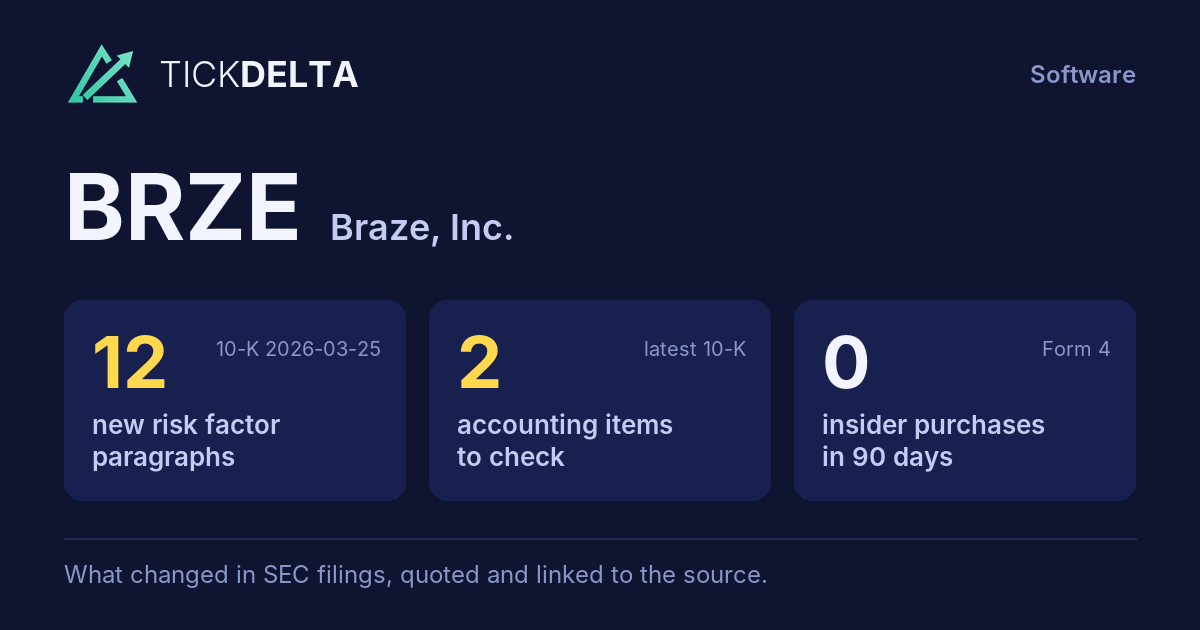
Screener / SEC EDGAR /CIK 0001676238 /10-K filed Mar 25, 2026, compared with Mar 31, 2025 /Numbers from the XBRL of the 10-Ks
Nasdaq Technology · Software

Braze, Inc. BRZE

Compare with peers Embed
The 10-K against last year's

99 changes: 15 added, 19 removed, 61 reworded, 4 quiet changes

10-K Mar 25, 2026 vs Mar 31, 2025

10-K 0001676238-26-000013 (Mar 25, 2026) vs 10-K 0001676238-25-000054 (Mar 31, 2025)

Every paragraph, and how much of it changed

One bar per paragraph, in the order of the 10-K. Height and colour show the share of its words not in the closest paragraph a year earlier; the tallest bars are new paragraphs.

Risk Factors

292 paragraphs · 12 new · 70 reworded · 14 gone · 10-K Mar 25, 2026 against Mar 31, 2025
New paragraph Reworded (5% of its words or more) Same or nearly
Paragraph 267 · 44% changed Every version of it
These provisions may frustrate or prevent any attempts by our stockholders to replace or remove our current management by making it more difficult for stockholders to replace members of our board of directors, which is responsible for appointing the members of our management. In addition, because we are incorporated in Delaware, we are governed by the provisions of Section 203 of the Delaware General Corporation Law, or DGCL, which generally, subject to certain exceptions, prohibits a Delaware corporation from engaging in any of a broad range of business combinations with any “interested” stockholder for a period of three years following the date on which the stockholder became an “interested” stockholder. Any of the foregoing provisions could limit the price that investors might be willing to pay in the future for shares of our Class A common stock, and they could deter potential acquirers of our company, thereby reducing the likelihood that holders of our Class A common stock would receive a premium for their shares of our Class A common stock in an acquisition.
Paragraph 188 · 42% changed Every version of it
We have in the past, and may continue in the future to, become subject to legal proceedings and claims that arise in the ordinary course of business, such as claims brought by our customers in connection with commercial disputes or employment claims made by our current or former employees. Litigation might result in substantial costs and may divert management’s attention and resources, which might seriously harm our business, financial condition and results of operations. Insurance might not cover such claims, provide sufficient payments to cover all the costs to resolve one or more of such claims or continue to be available on terms acceptable to us. A claim brought against us that is uninsured or under-insured could result in unanticipated costs, and our business, financial condition and results of operations may be adversely affected.
Paragraph 123 · 42% changed Every version of it
Our success depends largely upon the continued services of our executive officers, particularly our chief executive officer. We rely heavily on our chief executive officer’s vision, expertise and reputation. We rely on our leadership team for research and development, marketing, sales, services and general and administrative functions, and on mission-critical individual contributors. From time to time, our executive management team may change due to the hiring or departure of executives, which could disrupt our business. We do not have employment agreements with our executive officers or other key personnel that require them to continue to work for us for any specified period; therefore, they could terminate their employment with us at any time. The loss of one or more of our executive officers, particularly our chief executive officer, or key employees (including any limitation on the performance of their duties or short-term or long-term absences as a result of illness or disability) could have a serious adverse effect on our business.
Paragraph 198 · 37% changed Every version of it
Furthermore, our activities are subject to U.S. economic sanctions laws and regulations that prohibit transactions and dealings, including the shipment export or reexport of certain products and services services, to countries, governments and persons targeted by U.S. embargoes or sanctions. Obtaining the necessary export license or other authorization for a particular sale may be time consuming and may result in the delay or loss of sales opportunities even if the export license ultimately may be granted. While we take precautions to prevent our platform from being exported in violation of these laws, including obtaining authorizations for our platform and performing geolocation IP blocking and screenings against United States and other lists of restricted and prohibited persons, we cannot guarantee that the precautions we take will prevent violations of export control and sanctions laws. Additionally, U.S. embargoes and sanctions can change rapidly and unpredictably in response to international events, such as the application of new and broad sanctions against Russia and Belarus in connection with the invasion of Ukraine. Future embargoes or sanctions could have a significant impact on our business or the business of our customers, either of which could have a material adverse effect on our financial results and operations. Violations of U.S. sanctions or export control laws can result in incarceration for responsible employees and managers or the imposition of significant fines or penalties.
Paragraph 199 · 36% changed Every version of it
Furthermore, our activities are subject to U.S. economic sanctions laws and regulations that prohibit the shipment of certain products and services to countries, governments and persons targeted by U.S. embargoes or sanctions. Obtaining the necessary export license or other authorization for a particular sale may be time consuming and may result in the delay or loss of sales opportunities even if the export license ultimately may be granted. While we take precautions to prevent our platform from being exported in violation of these laws, including obtaining authorizations for our platform and performing geolocation IP blocking and screenings against United States and other lists of restricted and prohibited persons, we cannot guarantee that the precautions we take will prevent violations of export control and sanctions laws. Additionally, U.S. embargoes embargoes, trade restrictions and sanctions can change rapidly and unpredictably in response to international events, such as the application of new and broad sanctions and export control restrictions against Russia and Belarus in connection with the invasion of Ukraine. Future embargoes or sanctions on other jurisdictions could have a significant impact on our business or the business of our customers, either of which could have a material adverse effect on our financial results and operations. Violations of U.S. sanctions or export control laws can result in incarceration for responsible employees and managers or the imposition of significant fines or penalties.
Paragraph 244 · 35% changed Every version of it
could affect our ability to conduct normal business operations and adversely affect our results of operations. In addition, many companies that provide cloud-based services have reported a significant increase in cyberattack activity in recent years. Further, events outside of our control, including natural disasters, climate change-related events, pandemics or health crises may arise from time to time and be accompanied by governmental actions. Any such events and responses, including regulatory developments, may cause significant volatility and declines in the global markets, disproportionate impacts to certain industries or sectors, disruptions to commerce (including to economic activity, travel and supply chains), loss of life and property damage, and may materially and adversely affect the global economy or capital markets, as well as our business and results of operations.
Paragraph 175 · 34% changed Every version of it
In addition to EU and U.K. restrictions on cross-border transfers of personal data, other jurisdictions have enacted or are considering similar cross-border personal data transfer laws and data localization laws, any of which could increase the cost and complexity of doing business in those jurisdictions. If we cannot implement a workable, valid compliance mechanism for cross-border transfers of personal data, we may face increased exposure to regulatory actions, substantial fines, and injunctions against processing or transferring personal data from the EEA or elsewhere. The inability to import personal data to the United States could significantly and negatively impact our business operations, including by limiting our ability to offer our full range of services in the EEA and elsewhere, limiting our ability to collaborate with parties that are subject to EU and other privacy, data security and data protection laws or requiring us to increase our personal data processing capabilities in the EEA and elsewhere at significant expense. cross-
Paragraph 202 · 34% changed Every version of it
Various countries regulate the import and export of certain encryption and other technology, including import and export licensing requirements. Some countries have enacted laws that could limit our ability to distribute our platform or could limit our customers’ ability to implement our platform in those countries. Changes in our platform or future changes in export and import regulations may create delays in the introduction of our platform in international markets, prevent our customers with international operations from launching our platform globally or, in some cases, prevent the export or import of our platform to certain countries, governments or persons altogether. Various governmental agencies have proposed additional regulation of encryption technology, including the escrow and government recovery of private encryption keys. Any change in export or import regulations, economic sanctions or related legislation, or change in the countries, governments, persons or technologies targeted by such regulations, could limit our ability to export or sell our platform to existing or potential customers with international operations. operations and impose additional licensing requirements for the sale of our products. Any decreased use of our platform or limitation on our ability to export or sell our platform would adversely affect our business, results of operations and prospects.

MD&A

81 paragraphs · 3 new · 29 reworded · 5 gone · 10-K Mar 25, 2026 against Mar 31, 2025
New paragraph Reworded (5% of its words or more) Same or nearly
Paragraph 12 · 42% changed
We believe we can achieve significant growth by expanding sales within our existing customer base. We expand the use of our platform by existing customers by, among others, adding new channels and increasing the messaging volume we sell to our customers as their businesses and needs continue to grow and as they connect directly with additional consumers, which in turn leads to a need for greater messaging capacity. We intend to continue to invest in developing and enhancing our products and functionality. Our ability to increase sales to existing customers will depend on a number of factors, including our customers’ satisfaction with our solutions, the ability of our customers to attract new end users, competition, pricing and overall changes in our customers’ spending levels.
Paragraph 37 · 41% changed
We expect that general and administrative expenses will increase in absolute dollars and vary from period to period as a percentage of revenue for the foreseeable future but decrease as a percentage of revenue over the long term, as we focus on processes, systems, and controls to enable our internal support functions to scale with the growth of our business. We have incurred, and expect to continue to incur, additional expenses as a result of operating as a public company, including expenses to comply with the rules and regulations applicable to companies listed on The Nasdaq Stock Market LLC, expenses related to compliance and reporting obligations pursuant to the rules and regulations of the SEC, and higher expenses for insurance, investor relations and professional services.
Paragraph 55 · 40% changed
As of January 31, 2025, our principal source of liquidity was cash, cash equivalents, and marketable securities of $514.0 million. Our cash and cash equivalents consist of deposit accounts, interest-bearing money market accounts, U.S. government, and corporate securities that are stated at fair value. Our marketable securities positions consists mostly of highly liquid short-term term investments. The investment income that we generate on these investments is not material to our overall cash balance, but may be adversely affected due to volatility in interest rates.
Paragraph 45 · 36% changed
The increase in other income, net of $5.3 Revenue increased by $144.8 million, or 32.9%, 24.4%, for the fiscal year ended January 31, 2025, 2026 compared to the fiscal year ended January 31, 2024, 2025. Approximately 65.5% of the increase in revenue was attributable to a $5.2 million increase in investment income growth from marketable securities. existing customers, and the remaining 34.5% was attributable to growth from new customers.
Paragraph 52 · 33% changed
The increase in research General and development administrative expense of $14.1 increased by $30.2 million, or 11.8%, 26.0%, for the fiscal year ended January 31, 2025 2026, compared to the fiscal year ended January 31, 2024, 2025. This increase was primarily driven by an increase in personnel and overhead costs of $11.7 million, which included $4.0 million of stock-based compensation costs, due to an increase of $1.6 $17.1 million in software personnel costs and allocated overhead costs, for our general and administrative organization as a result of increased headcount and an increase of $12.6 million in professional services of $0.7 million. These increases were and legal costs primarily due to a period-over-period increase in headcount to support our continued investment in the features and functionality of our platform. associated with acquisition-related expenses.
Paragraph 47 · 32% changed
Our gross profit increased $85.9 $85.4 million, or 26.5%, 20.8%, in the fiscal year ended January 31, 2025 2026, compared to the fiscal year ended January 31, 2024, 2025, and our gross margin increased decreased by 0.4% 2.0% to 67.1% in the fiscal year ended January 31, 2026, from 69.1% in the fiscal year ended January 31, 2025 from 68.7% 2025. The decrease was primarily due to acquisition related operating costs, including personnel costs of acquired workforce and amortization expense of acquired technology, in the fiscal year ended January 31, 2024. These increases were due primarily addition to improved personnel efficiencies, increased costs related to our tech stack.
Paragraph 48 · 31% changed
The increase in sales Sales and marketing expense of $35.2 increased by $44.7 million, or 14.2%, 15.8%, for the fiscal year ended January 31, 2025 2026, compared to the fiscal year ended January 31, 2024, 2025. This increase was primarily driven by an increase in personnel and overhead costs of $22.9 million, which included $7.0 million of stock-based compensation costs. Additionally, the increase was driven in part by due to an increase of $6.4 $34.3 million in promotional personnel costs and product marketing, primarily related to the hosting of regional customer events, allocated overhead costs, for our annual customer conference, sales and other sales related events, an increase of $3.7 million in software costs, and an increase of $2.5 million in deferred contract costs marketing organization as a result of increased headcount and increased variable compensation for our sales growth. personnel. Additionally, advertising, sales, marketing and promotional activities increased by $6.6 million.
Paragraph 50 · 30% changed
The increase in research Research and development expense of $14.1 increased by $33.2 million, or 11.8%, 24.8%, for the fiscal year ended January 31, 2025 2026, compared to the fiscal year ended January 31, 2024, 2025. This increase was primarily driven by an increase in personnel and overhead costs of $11.7 million, which included $4.0 million of stock-based compensation costs, due to an increase of $1.6 $28.2 million in software personnel costs and allocated overhead costs, for our research and an increase in professional services development organization as a result of $0.7 million. These increases were primarily due to a period-over-period increase in headcount to support our continued investment in the features and functionality of our platform. increased headcount.

A paragraph is matched with the one last year that shares the most of its words; under half in common makes it new. The paragraphs shown are the 8 reworded the most in each section.

The paragraph that changed most in each section

The redline

Marked against last year's 10-K: cut words struck through, new words highlighted.

Risk Factors368 words changed in this paragraph; it is 65% similar to last year's version.
The global economy, including credit and financial markets, has experienced extreme volatility and disruptions, including severely diminished liquidity and credit availability, declines in consumer confidence, declines in economic growth, increases in unemployment rates, increases in inflation rates, higher interest rates, tariffs, and uncertainty about economic stability. These unfavorable conditions have been, and may continue to be, exacerbated in the United States and abroad by global and domestic socioeconomic conditions, including the failure of high-profile banking and other financial institutions, the Federal Reserve’s attempts to combat inflation through interest rate increases, unrest in international trade relations (including those related to trade wars, tariffs, taxation, and importation), domestic and foreign political turmoil, natural catastrophes, pandemics related to highly infectious diseases, warfare and terrorist attacks on the United States, Europe, the Asia Pacific region or elsewhere, and international military conflicts and the related political and economic responses. Continued volatility and disruptions may have adverse consequences on us or the third parties on whom we rely. If the financial, equity or credit markets further deteriorate, including as a result of the measures taken to combat inflation, volatility in the banking and financial services sector, political unrest or war, it may make any necessary debt or equity financing more difficult to obtain in a timely manner or on favorable terms, more costly or more dilutive. Increased inflation rates can adversely affect us by increasing our costs, including labor and employee benefits costs. In addition, higher inflation and macroeconomic turmoil and uncertainty could also adversely affect our customers, which could reduce demand for our products and services. For instance, we were founded in 2011, but our business and revenue have grown rapidly over the last several years. As a result of our limited history operating at our current scale, our ability to accurately forecast our future results of operations is limited and subject to a number of uncertainties, including our ability to plan for and model future growth, particularly in a volatile economic environment. Recent increases in inflation, economic volatility and related increases fluctuations in interest rates have affected customer spending behavior. Significant continued increases in inflation, continued economic volatility behavior, and related increases in interest rates if any of factors continue or are exacerbated, could have a material adverse effect on our business, financial condition and results of operations. To the extent there is a sustained general economic downturn and our customer engagement platform is perceived by customers and potential customers as too costly, or too difficult to deploy or migrate to, our revenue may be disproportionately affected by delays or reductions in general customer engagement technology spending. This perception has previously, and may continue to, result in an extension of our sales cycle with potential customers, thus increasing the time and cost associated with our sales process. Further, even if our customers choose to use our platform, they may nonetheless reduce their customer engagement technology spending and elect not to purchase additional products and services in the future due to budget limitations. Additionally, our dollar-based net retention rate is influenced by macroeconomic factors that impact our customers’ purchasing decisions, who may choose to renew their contracts at levels more closely aligned with their current needs, rather than opting for larger commitments based on anticipated future demand. Macroeconomic factors may also impact our collection efforts for customer payments. If we experience collection pressure it may lengthen the time to collect on accounts receivable and increase in our bad debt expense, either of which could negatively impact our free cash flow. Also, competitors may respond to market conditions by lowering prices and attempting to lure away our current and potential customers. In addition, macroeconomic uncertainty may result in an increased pace of consolidation in certain industries in which our customers operate. If this were to occur it may result in reduced overall spending on our services, particularly if our customers are acquired by organizations that do not use our services. We cannot predict the timing, strength or duration of any economic slowdown, instability or recovery, generally or within any particular industry. If the economic conditions of the general economy or the markets in which we operate worsen from present levels, our business, results of operations and financial condition could be materially and adversely affected.

Source: Item 1A, 10-K 0001676238-26-000013 vs Item 1A, 10-K 0001676238-25-000054

Accounting Policies169 words changed in this paragraph; it is 32% similar to last year's version.
In December 2023, the Financial Accounting Standards Board FASB issued Accounting Standards Update ASU No. 2023-09 2023-09, Income Taxes (Topic 740): Improvements to Income Tax Disclosures, (“ASU 2023-09”), which requires public business intends to increase the transparency of income tax disclosures. Under the new guidance, entities on an annual basis to disclose specific categories in a tabular rate reconciliation must categorize and provide additional greater disaggregation of information for reconciling items that meet a five percent quantitative threshold. Additionally, in the ASU requires all entities to disclose the amount of income taxes paid disaggregated by federal, state, and foreign taxes, as well as individual jurisdictions where income taxes paid are equal to or greater than five percent of total rate reconciliation. They must also further disaggregate income taxes paid. ASU 2023-09 For public business entities, it is effective for annual periods beginning after December 15, 2024. Early adoption is permitted and the updated should be applied The Company adopted this standard on a prospective basis, with basis in its consolidated financial statements for the year ended January 31, 2026. The adoption of ASU 2023-07 did not have a retrospective material impact on the Company's consolidated financial statements. Refer to Note 15, Income Taxes, to the consolidated financial statements for further details.

Source: Item 8, Note 2 – Summary of Significant Accounting Policies, 10-K 0001676238-26-000013 vs Item 8, Note 2 – Summary of Significant Accounting Policies, 10-K 0001676238-25-000054

MD&A144 words changed in this paragraph; it is 34% similar to last year's version.
The increase in general General and administrative expenses of $14.1 expense increased by $30.2 million, or 13.8%, 26.0%, for the fiscal year ended January 31, 2025 2026, compared to the fiscal year ended January 31, 2024 2025. This increase was primarily driven by an increase in personnel and overhead costs of $13.2 million, which included $5.6 million of stock-based compensation costs and $2.3 million of depreciation expense, primarily related to the winding down of our old office as we moved to our new headquarters in the fiscal year. The increases were primarily due to investments an increase of $17.1 million in personnel costs and allocated overhead costs, for our finance general and administrative functions to continue to scale our processes, systems, organization as a result of increased headcount and controls, to enable our ongoing compliance with public company legal and regulatory requirements. The increases in expenses were partially offset by a decrease an increase of $12.6 million in professional services and legal costs of $0.5 million related to the acquisition of North Star in the fiscal year ended January 31, 2024. primarily associated with acquisition-related expenses.

Source: Item 7, 10-K 0001676238-26-000013 vs Item 7, 10-K 0001676238-25-000054

Legal Proceedings49 words changed in this paragraph; it is 92% similar to last year's version.
We are subject to indirect taxation in some, but not all, of the various U.S. states and foreign jurisdictions in which we conduct business. Therefore, we have an obligation to charge, collect and remit Value Added Tax (“VAT”) or Goods and Services Tax (“GST”) in connection with certain of our foreign sales transactions and sales and use tax in connection with eligible sales to subscribers in certain U.S. states. On June 21, 2018, the U.S. Supreme Court issued an opinion in South Dakota v. Wayfair. The State of South Dakota alleged that U.S. constitutional law should be revised to permit South Dakota to require remote sellers to collect and remit sales tax in South Dakota in accordance with South Dakota’s sales tax statute. Under the U.S. Supreme Court’s ruling, the longstanding Quill Corp v. North Dakota sales tax case was overruled, and states may now require remote sellers to collect sales tax under certain circumstances. We began collecting sales tax in relevant jurisdictions for the fiscal year ended January 31, 2019. As a result of this ruling and given the scope of our operations, taxing authorities continue to provide regulations that increase the complexity and risks to comply with such laws and could result in substantial liabilities, prospectively as well as retrospectively. Based on the information available, we continue to evaluate and assess the jurisdictions in which indirect tax nexus exists and believe that the indirect tax liabilities are adequate and reasonable. Due to the complexity and uncertainty around the application of these rules by taxing authorities, results may vary materially from expectations, and we have recognized liabilities for contingencies related to state sales and use tax, VAT, and GST deemed probable and estimable totaling $1.4 million and $2.9 million as of January 31, 2026 and 2025, respectively, which is included in accrued expenses and other current liabilities on the consolidated balance sheets.

Source: Item 3, via Note 13 – Commitments and Contingencies, 10-K 0001676238-26-000013 vs Item 3, via Note 13 – Commitments and Contingencies, 10-K 0001676238-25-000054

Sentences and paragraphs added, removed or reworded

Every change, by type

Sentences and paragraphs of BRZE's Risk Factors and MD&A, 10-K Mar 25, 2026 against 10-K Mar 31, 2025. Each links to the text at sec.gov.

Quiet changes are sentences kept from last year with one to four words changed, at least one of them a hedge, a modal or a qualifier (may, could, will, not, significant, material…). A year or date rolling forward is not counted.

The full word list

adverse, adversely, all, although, anticipate, anticipates, any, approximately, believe, believes, can, cannot, certain, could, expect, expects, generally, however, if, intend, intends, largely, likely, many, material, materially, may, might, most, must, never, no, not, possible, primarily, probable, should, significant, significantly, some, substantial, substantially, unlikely, will, would

AddedRisk Factors
The market for customer engagement products is evolving and highly competitive. There are several established and emerging competitors that address specific aspects of customer engagement. We face intense competition from software companies that offer marketing solutions, such as Adobe, Salesforce, Iterable, and Klaviyo. Many of our existing competitors have, and our potential competitors could have, substantial competitive advantages, such as greater name recognition, longer operating histories, larger sales and marketing budgets and resources, greater customer support resources, lower labor and
Read it in 10-K Mar 25, 2026 at sec.gov
AddedRisk Factors
The timing of our sales cycles with our large enterprise customers and related revenue recognition is difficult to predict because of the length and unpredictability of the sales cycle for these customers. Large enterprise customers may have a lengthy sales cycle for the evaluation and procurement of our platform. Additionally, to the extent there is a sustained general economic downturn resulting in delays or reductions in general customer engagement technology spending by large enterprise customers,
Read it in 10-K Mar 25, 2026 at sec.gov
AddedRisk Factors
We believe that maintaining and enhancing our brand is important to support the marketing and sale of our existing and future products to new customers and expand sales of our platform and products to existing customers. We also believe that the
Read it in 10-K Mar 25, 2026 at sec.gov
AddedRisk Factors
international conflicts, domestic unrest or the emergence of new highly infectious diseases, if any, may pose additional challenges for international expansion and may impact our ability to launch new locations and further expand geographically.
Read it in 10-K Mar 25, 2026 at sec.gov
AddedRisk Factors
We may not carry sufficient business interruption insurance or have sufficient contractual remedies to compensate us for losses that may occur as a result of any events that cause interruptions in our service.
Read it in 10-K Mar 25, 2026 at sec.gov
AddedRisk Factors
Further, tax legislation continues to evolve globally with new laws and regulations that create uncertainty in the global economy. The Organization for Economic Cooperation and Development reached agreement among over 140 countries to implement a minimum 15% tax rate on certain multinational enterprises, commonly referred to as the Pillar Two framework. Many countries continue to announce changes in their tax laws and regulations based on the Pillar Two framework. Additionally, the U.S Congress enacted the One Big Beautiful Bill Act which includes significant provisions, including tax cut extensions and modifications to the international tax framework. While we continue to evaluate the impact of these legislative changes as additional guidance becomes available, uncertainty remains regarding the timing and interpretation by tax authorities in affected jurisdictions. These legislative changes could have an adverse impact on our future effective tax rate, tax liabilities, and cash tax.
Read it in 10-K Mar 25, 2026 at sec.gov
Show the other 52
AddedRisk Factors
compete effectively, and adversely affect our results of operations. Any of which may have an adverse impact on our results of operations even as our use and development of AI technologies expands.
Read it in 10-K Mar 25, 2026 at sec.gov
AddedRisk Factors
The automatic conversion of all outstanding shares of our Class B common stock into Class A common stock has eliminated our dual-class structure, which may subject us to increased stockholder activism and potential proxy contests.
Read it in 10-K Mar 25, 2026 at sec.gov
AddedRisk Factors
Upon the retirement and automatic conversion of our Class B common stock into Class A common stock on January 30, 2026, our executive officers and early investors no longer hold super-voting rights. Consequently, our voting power is now more widely distributed among our public stockholders. This transition may make us more susceptible to stockholder activism, proxy contests, and unsolicited takeover proposals. Responding to activist campaigns can be costly and time-consuming, disrupt our operations, and divert the attention of management and our employees. Furthermore, perceived uncertainties as to our future strategic direction resulting from this change in voting control could result in the loss of potential business opportunities and cause volatility in our stock price.
Read it in 10-K Mar 25, 2026 at sec.gov
AddedRisk Factors
and results of operations. If one or more of these analysts cease coverage of our company or fail to regularly publish reports on us, we could lose visibility in the financial markets, which could cause our share price or trading volume to decline.
Read it in 10-K Mar 25, 2026 at sec.gov
RemovedRisk Factors
•The dual class structure of our common stock has the effect of concentrating voting control with our executive officers, directors and significant holders of our capital stock, which limits the ability of holders of our Class A common stock to influence the outcome of important transactions.
Read it in 10-K Mar 31, 2025 at sec.gov
RemovedRisk Factors
To increase our revenue, we must continue to attract new customers and retain, and sell more products to, existing customers. Our success will depend to a substantial extent on the widespread adoption of our platform and products as an alternative to existing products in which many enterprises have invested substantial personnel and financial resources and,
Read it in 10-K Mar 31, 2025 at sec.gov
RemovedRisk Factors
Our brand, reputation and ability to attract new customers depend on the reliable performance of our technology infrastructure and content delivery. Our platform engages with consumers through a number of channels and integrations, and we are dependent on third-party providers for delivery of content in many of these channels and integrations, including, among others, emails, SMS/MMS/RCS, third-party messaging services and audience sync advertising campaigns. We are also dependent on Apple services and Google services for delivery of mobile and web notifications. If any of these third-party
Read it in 10-K Mar 31, 2025 at sec.gov
RemovedRisk Factors
In addition, many jurisdictions have enacted data localization laws and cross-border personal data transfer laws. These laws may make it more difficult for us to transfer personal data across jurisdictions, which could impede our business. For example, legal developments in the EEA have created complexity and uncertainty regarding processing and transfers of personal data from the EEA to the United States and other countries outside the EEA. Similar complexities and uncertainties
Read it in 10-K Mar 31, 2025 at sec.gov
RemovedRisk Factors
Our future revenue and results of operations could be harmed if the increases in demand we have seen from certain industries as a result of the COVID-19 pandemic fail to continue over the long term.
Read it in 10-K Mar 31, 2025 at sec.gov
RemovedRisk Factors
In response to the COVID-19 pandemic, governments previously instituted shelter-in-place orders, social distancing requirements, travel restrictions and similar measures to slow infection rates. These restrictions prompted shifts from physical commerce to e-commerce, from in-room dining to take out and delivery, from gyms to at home health and fitness and from the theaters to in-home media streaming services. Despite our penetration in these industries that benefited from increased demand during the COVID-19 pandemic, this trend may not continue over the long term. Some of our customers have experienced, and may continue to experience, decreases or decreased growth rates in transactions, which would negatively affect our business, financial condition and results of operations. We may also continue to experience decreases or decreased growth rates in sales of new subscriptions to some of our customers, which would adversely affect our business, financial condition and results of operations.
Read it in 10-K Mar 31, 2025 at sec.gov
RemovedRisk Factors
The dual class structure of our common stock has the effect of concentrating voting control with our executive officers, directors and significant holders of our capital stock, which limits the ability of holders of our Class A common stock to influence the outcome of important transactions.
Read it in 10-K Mar 31, 2025 at sec.gov
RemovedRisk Factors
Our Class B common stock has ten votes per share and our Class A common stock, which is the stock listed on the Nasdaq Global Select Market, has one vote per share. As a result, as of January 31, 2025, holders of our Class B common stock collectively beneficially owned, in the aggregate, shares representing approximately 64.6% of the voting power of our outstanding capital stock, and our executive officers, directors and holders of 5% or more of our common stock (by voting power) collectively beneficially owned, in the aggregate, outstanding shares representing approximately 69.2% of the total voting power of our outstanding capital stock. As a result, the holders of our Class B common stock, and in particular our executive officers, directors and holders of 5% or more of our common stock (by voting power), will be able to exercise considerable influence over matters requiring stockholder approval, including the election of directors and approval of significant corporate transactions, such as a merger or other sale of our company or our assets, even if their stock holdings represent less than 50% of the outstanding shares of our capital stock. This concentration of ownership will limit the ability of other stockholders to influence corporate matters and may cause us to make strategic decisions that could involve risks to holders of our Class A common stock or that may not be aligned with the interests of holders of our Class A common stock. This control may adversely affect the market price of our Class A common stock.
Read it in 10-K Mar 31, 2025 at sec.gov
RemovedRisk Factors
Further, future transfers by holders of our Class B common stock will generally result in those shares converting into shares of our Class A common stock, subject to limited exceptions, such as certain transfers effected for tax or estate planning purposes. The conversion of shares of our Class B common stock into shares of our Class A common stock will have the effect, over time, of increasing the relative voting power of those holders of Class B common stock who retain their shares in the long term.
Read it in 10-K Mar 31, 2025 at sec.gov
RewordedRisk Factors
In addition, any future stay-at-home, business closure and other restrictive orders and travel restrictions into and outside the United States as a result of international conflicts, domestic unrest or the emergence of new highly infectious diseases, if any, may pose additional challenges for international expansion and may impact our ability to launch new locations and further expand geographically.
Read it in 10-K Mar 25, 2026 at sec.gov
RewordedRisk Factors
GDPR remain substantially similar for through the time being, the U.K. government has announced that it will seek to chart its own path on data protection Data (Use and Access) Act 2025 and may further reform its relevant laws, including in ways that may differ from the EU GDPR.
Read it in 10-K Mar 25, 2026 at sec.gov
RewordedRisk Factors
Such underlying shares of Class A common stock will become eligible for sale in the public market to the extent such options shares are issued pursuant to the terms of the applicable equity incentive plan or purchase rights are exercised or RSUs are settled, award agreement, subject to compliance with applicable securities laws.
Read it in 10-K Mar 25, 2026 at sec.gov
RewordedRisk Factors
Additionally, while we maintain insurance related to these matters, this insurance might not cover all such claims, provide sufficient payments to cover all the costs to resolve one or more of such claims or continue to be available on terms acceptable to us.
Read it in 10-K Mar 25, 2026 at sec.gov
RewordedRisk Factors
Significant continued Recent increases in inflation, continued economic volatility and related increases fluctuations in interest rates have affected customer spending behavior, and if any of factors continue or are exacerbated, could have a material adverse effect on our business, financial condition and results of operations.
Read it in 10-K Mar 25, 2026 at sec.gov
RewordedRisk Factors
In addition, negative publicity related to our customer relationships, regardless of accuracy, may further damage our business by affecting our ability to compete for new business with actual and prospective customers.
Read it in 10-K Mar 25, 2026 at sec.gov
RewordedRisk Factors
We have registered all of our common stock issuable upon the exercise of outstanding stock options, or settlement of outstanding restricted stock units, or RSUs, or otherwise issuable equity awards, pursuant to the terms of the purchase rights under our employee stock purchase plan or under any other equity incentives we may grant in the future, for public resale under the Securities Act.
Read it in 10-K Mar 25, 2026 at sec.gov
RewordedRisk Factors
Any change Changes in export or import regulations, economic sanctions or related legislation, or change in the countries, governments, persons or technologies targeted by such regulations, could limit our ability to export or sell our platform to existing or potential customers with international operations. operations and impose additional licensing requirements for the sale of our products.
Read it in 10-K Mar 25, 2026 at sec.gov
RewordedRisk Factors
A catastrophic event that results in the destruction or disruption of our data centers, or our network infrastructure, or information technology systems, including any errors, defects, or failures in third-party hardware, could affect our ability to conduct normal business operations and adversely affect our results of operations.
Read it in 10-K Mar 25, 2026 at sec.gov
RewordedRisk Factors
It is possible that, in connection with any applicable action brought against us, a court could find the choice of forum provisions contained in our currently effective amended and restated certificate of incorporation to be inapplicable or unenforceable in such action.
Read it in 10-K Mar 25, 2026 at sec.gov
RewordedRisk Factors
In addition, in recent years, there has been significant merger and acquisition activity among our competitors, including competitors and the acquisition of Leanplum by CleverTap. broader technology industry.
Read it in 10-K Mar 25, 2026 at sec.gov
Quiet changesRisk Factors
Litigation might may result in substantial costs and may divert management’s attention and resources, which might could seriously harm our business, financial condition and results of operations.
Read it in 10-K Mar 25, 2026 at sec.gov
Quiet changesRisk Factors
Insurance might may not cover such claims, provide sufficient payments to cover all the costs to resolve one or more of such claims or continue to be available on terms acceptable to us.
Read it in 10-K Mar 25, 2026 at sec.gov
Quiet changesRisk Factors
Many Some of our existing equity holders may have substantial unrecognized gains on the value of the equity they hold, and therefore they may take steps to sell their shares or otherwise secure the unrecognized gains on those shares.
Read it in 10-K Mar 25, 2026 at sec.gov
AddedMD&A
Tax legislation continues to evolve globally with new laws and regulations that create uncertainty in the global economy. The Organization for Economic Cooperation and Development reached agreement among over 140 countries to implement a minimum 15% tax rate on certain multinational enterprises, commonly referred to as the Pillar Two framework. Many countries continue to announce changes in their tax laws and regulations based on the Pillar Two framework. Additionally, the U.S Congress enacted the One Big Beautiful Bill Act, or the OBBBA, which includes significant provisions, including tax cut extensions and modifications to the international tax framework. While we continue to evaluate the impact of these legislative changes as additional guidance becomes available, uncertainty remains regarding the timing and interpretation by tax authorities in affected jurisdictions. These legislative changes could have an adverse impact on our future effective tax rate, tax liabilities, and cash tax.
Read it in 10-K Mar 25, 2026 at sec.gov
AddedMD&A
Fiscal Year Ended January 31, 2026 2025 2024 (in thousands) Net cash provided by operating activities $ 71,438 $36,680 $6,850 Net cash used in investing activities $ (50,907) $(36,470) $(19,976) Net cash provided by financing activities $ 22,960 $11,695 $13,109
Read it in 10-K Mar 25, 2026 at sec.gov
AddedMD&A
In evaluating our ability to recover our deferred income tax assets, we consider all available positive and negative evidence, including our operating results, ongoing tax planning, and forecasts of future taxable income on a jurisdiction-by-
Read it in 10-K Mar 25, 2026 at sec.gov
RemovedMD&A
compensation, and overhead cost allocations, including rent, utilities, depreciation, information technology costs, amortization of internal use software and certain administrative personnel costs.
Read it in 10-K Mar 31, 2025 at sec.gov
RemovedMD&A
The investment income increase was driven primarily by the graded maturation of the portfolio positions at higher interest rates and the reinvestment of proceeds in a high interest rate environment.
Read it in 10-K Mar 31, 2025 at sec.gov
RemovedMD&A
We capitalize incremental costs of obtaining revenue contracts, which primarily consist of internal sales commissions and agent commissions. We amortize these commissions on a systematic basis, consistent with the pattern of transfer of the expected benefit period or services to which the contract relates, generally up to four years. Four years represents the estimated benefit period of the customer relationship taking into account factors such as peer estimates of technology lives and customer lives as well as our own historical data. Commissions paid for contract renewals are amortized over the renewal period.
Read it in 10-K Mar 31, 2025 at sec.gov
RemovedMD&A
Contract costs are amortized on a straight-line basis over up to four years, which reflects the expected period of benefit of the performance obligation, and may be longer than the initial contract period. We determine the estimated benefit period by considering both qualitative and quantitative factors, including the length of the subscription terms in our customer contracts and the anticipated life of our technology, among other factors.
Read it in 10-K Mar 31, 2025 at sec.gov
RewordedMD&A
While our future capital requirements will depend on many factors, including revenue growth and costs incurred to support customer usage and growth in our customer base, increased research and development expenses to support the growth of our business and related infrastructure, and increased general and administrative expenses to support being a publicly-traded company, we believe our current cash, cash equivalents and marketable securities will be sufficient to meet our working capital and capital expenditure requirements for at least the next 12 months.
Read it in 10-K Mar 25, 2026 at sec.gov
RewordedMD&A
Net cash used in investing activities was $20.0 $50.9 million for the fiscal year ended January 31, 2024, 2026, primarily consisting of purchases of marketable securities of $248.1 million, cash paid for the acquisition of North Star OfferFit, net of $16.3 cash acquired of $181.9 million, purchases of marketable securities of $151.6 million, purchases of property and equipment of $9.8 $9.6 million, and capitalization of internal-use software costs of $3.6 $3.8 million, partially offset by maturities of marketable securities of 257.7 $175.2 million and a return of principal on marketable securities of $120.7 million.
Read it in 10-K Mar 25, 2026 at sec.gov
RewordedMD&A
The increase in sales Sales and marketing expense of $35.2 increased by $44.7 million, or 14.2%, 15.8%, for the fiscal year ended January 31, 2025 2026, compared to the fiscal year ended January 31, 2024, was primarily driven by an increase in personnel and overhead costs of $22.9 million, which included $7.0 million of stock-based compensation costs. 2025.
Read it in 10-K Mar 25, 2026 at sec.gov
RewordedMD&A
Our gross profit increased $85.9 $85.4 million, or 26.5%, 20.8%, in the fiscal year ended January 31, 2025 2026, compared to the fiscal year ended January 31, 2024, 2025, and our gross margin increased decreased by 0.4% 2.0% to 67.1% in the fiscal year ended January 31, 2026, from 69.1% in the fiscal year ended January 31, 2025 from 68.7% in the fiscal year ended January 31, 2024. 2025.
Read it in 10-K Mar 25, 2026 at sec.gov
RewordedMD&A
The increase in other income, net of $5.3 Revenue increased by $144.8 million, or 32.9%, 24.4%, for the fiscal year ended January 31, 2025, 2026 compared to the fiscal year ended January 31, 2024, was attributable to a $5.2 million increase in investment income from marketable securities. 2025.
Read it in 10-K Mar 25, 2026 at sec.gov
RewordedMD&A
These costs primarily include payments to third-party cloud infrastructure providers for hosting software solutions, costs associated with application service providers utilized to deliver the platform, personnel-related costs, including salaries, cash-based performance compensation, benefits and stock-based compensation, and overhead cost allocations, including rent, utilities, information technology costs, depreciation and amortization related to the amortization of acquired intangibles and internal use software and certain administrative personnel costs.
Read it in 10-K Mar 25, 2026 at sec.gov
RewordedMD&A
We expand the use of our platform by existing customers by, among others, adding new channels and increasing the messaging volume we sell to our customers as their businesses and needs continue to grow and as they connect directly with additional consumers, which in turn leads to a need for greater messaging capacity.
Read it in 10-K Mar 25, 2026 at sec.gov
RewordedMD&A
Net cash provided by financing activities was $11.7 $23.0 million for the fiscal year ended January 31, 2025, primarily 2026, consisting of proceeds from the exercise of common stock options of $6.9 $15.9 million and proceeds from stock purchases associated with our employee stock purchase plan of $7.7 million, offset by payments of deferred purchase considerations related to the acquisition of North Star of $2.9 $7.1 million.
Read it in 10-K Mar 25, 2026 at sec.gov
RewordedMD&A
Provision The provision for income taxes consists consist of state income taxes the release of the valuation allowance due to the acquisition of Offerfit and income taxes in certain state and foreign jurisdictions in which we conduct business.
Read it in 10-K Mar 25, 2026 at sec.gov
RewordedMD&A
We generated revenue of $738.2 million, $593.4 million, and $471.8 million, and $355.4 million in the fiscal years ended January 31, 2026, 2025, and 2024, and 2023, respectively, representing year-over-year growth of 25.8% 24.4% from the fiscal years ended January 31, 2024 2025 to January 31, 2025 2026 and 32.7% 25.8% from the fiscal year ended January 31, 2023 2024 to January 31, 2024. 2025.
Read it in 10-K Mar 25, 2026 at sec.gov
RewordedMD&A
The cash inflows were offset by cash outflows primarily from an increase in accounts receivable of $5.4 million and an increase in deferred contract costs of $48.2 $65.2 million as a result of commissions on new bookings and renewals. renewals and an increase in accounts receivable of $22.7 million.
Read it in 10-K Mar 25, 2026 at sec.gov
RewordedMD&A
Sales and marketing 44% 48% 52% 57% Research and development 23% 23% 25% 27% General and administrative 20% 19% 22% 25% Total operating expenses 87% 90% 99% 109% Loss from operations (20)% (21)% (30)% (42)% Other income, net 2% 4% 3% 2% Loss before provision for income taxes (18)% (17)% (27)% (40)% Provision for (benefit from) income taxes —% 1% —% —% Net loss (18)% (18)% (27)% (40)%
Read it in 10-K Mar 25, 2026 at sec.gov
Quiet changesMD&A
Purchase commitments for business operations are predominately primarily related to cloud hosting, infrastructure, and other software-based services and due primarily over the next three years.
Read it in 10-K Mar 25, 2026 at sec.gov

Sources

The two latest 10-Ks on EDGAR, section by section. Each change links to the text at sec.gov.

Also

New risk factors: paragraphs with nothing like them last year, quoted in full.

Work with it

Excel workbook · CSV. Google Sheet that stays up to date: paste =IMPORTDATA("https://tickdelta.com/company/BRZE/export.csv") into a cell.

Next:Related parties
Esc

Type a ticker such as AAPL, a name, an investor such as Buffett, or a topic such as tariffs. ↑ ↓ to move, Enter to open.