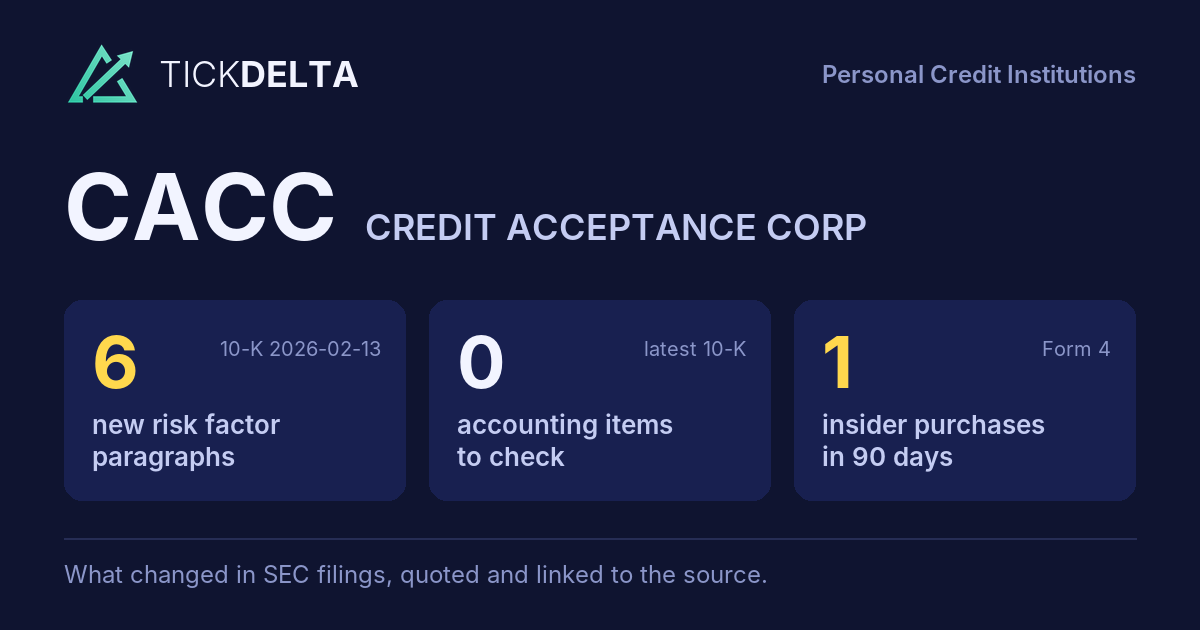
Screener / SEC EDGAR /CIK 0000885550 /10-K filed Feb 13, 2026, compared with Feb 12, 2025 /Numbers from the XBRL of the 10-Ks
Nasdaq Financials · Personal Credit Institutions

Credit Acceptance Corp CACC

Compare with peers Embed
The 10-K against last year's

88 changes: 19 added, 17 removed, 52 reworded

10-K Feb 13, 2026 vs Feb 12, 2025

10-K 0000885550-26-000047 (Feb 13, 2026) vs 10-K 0000885550-25-000012 (Feb 12, 2025)

Every paragraph, and how much of it changed

One bar per paragraph, in the order of the 10-K. Height and colour show the share of its words not in the closest paragraph a year earlier; the tallest bars are new paragraphs.

Risk Factors

85 paragraphs · 6 new · 10 reworded · 0 gone · 10-K Feb 13, 2026 against Feb 12, 2025
New paragraph Reworded (5% of its words or more) Same or nearly
Paragraph 59 · 12% changed Every version of it
All Consumer Loans submitted to us for assignment are processed either through our internet-based CAPS application. or via an integration we have with aggregators used by Dealers to submit credit application information to various finance sources. Our Consumer Loan servicing platform is also technology based. We rely on these systems to record and process significant amounts of data quickly and accurately. Our systems, and those of our third-party service providers, are dependent upon computer and telecommunications equipment, software systems, and internet access. The temporary or permanent loss of any components of these systems through hardware failures, software errors, operating malfunctions, the vulnerability of the internet, or otherwise could interrupt our business operations and harm our business.
Paragraph 6 · 8% changed Every version of it
We are subject to general economic conditions which are beyond our control. During periods of economic slowdown or recession, delinquencies, defaults, repossessions, and losses may increase on our Consumer Loans, and Consumer Loan prepayments prepayments, which historically have been lower in periods with less availability of consumer credit, may decline. These periods are also typically accompanied by decreased consumer demand for automobiles and declining values of automobiles securing outstanding Consumer Loans, which weakens collateral coverage and increases the amount of loss in the event of default. Significant increases in the inventory of used automobiles during periods of economic recession may also depress the prices at which repossessed automobiles may be sold or delay the timing of these sales. Additionally, inflation, higher gasoline prices, the deferral or resumption of student loan payments, increased focus on climate-related initiatives and regulation, declining stock market values, unstable real estate values, resets of adjustable rate mortgages to higher interest rates, increasing unemployment levels, general availability of consumer credit, tariffs, or other factors that impact consumer confidence or disposable income could increase loss frequency and decrease consumer demand for automobiles as well as weaken collateral values of automobiles. Imposition of or increases in tariffs on U.S. imports could result in higher used car prices in the United States, leading to decreased Dealer origination of Consumer Loans and a decline in Consumer Loan assignments to us. Because our business is focused on consumers who do not qualify for conventional automobile financing, the actual rates of delinquencies, defaults, repossessions, and losses on our Consumer Loans could be higher than those experienced in the general automobile finance industry, and could be more dramatically affected by a general economic downturn.

MD&A

145 paragraphs · 13 new · 45 reworded · 17 gone · 10-K Feb 13, 2026 against Feb 12, 2025
New paragraph Reworded (5% of its words or more) Same or nearly
Paragraph 6 · 44% changed
Unit •A 12.6% and 16.5% year-over-year decline in Consumer Loan unit and dollar volumes grew 18.6% and 14.4%, volumes, respectively, as compared to 2022. The average balance of our Loan portfolio increased 5.0% as compared to 2022. 2024.
Paragraph 15 · 44% changed
Unit •A 16.1% and 11.3% year-over-year growth in Consumer Loan unit and dollar volumes grew 18.6% and 14.4%, volumes, respectively, as compared to 2022. The average balance of our Loan portfolio increased 5.0% as compared to 2022. 2023.
Paragraph 28 · 44% changed
(Dollars in millions) Decrease in Forecasted Net Cash Flows For the Years Ended December 31, Total Loans % Change from Forecast at Beginning of Period 2023 $ (206.3) -2.3% 2024 2023 Change Average net Loans receivable balance $ 7,530.7 $ 6,627.8 $ 902.9 Average yield on our Loan portfolio 26.5 % 26.5 % — % (314.0) -3.1% 2025 (169.5) -1.5%
Paragraph 88 · 40% changed
Provision for Income Taxes. For the year ended December 31, 2024, 2025, the effective income tax rate increased to 25.0% from 24.8% from 22.2% for as compared with the year ended December 31, 2023. 2024. The increase was primarily due to: to an increase in state income taxes due to a revision of deferred tax estimates during 2025 and a reduction in excess tax benefits due to an increase in pre-tax income in 2025, partially offset by a decrease in non-deductible executive compensation expense.
Paragraph 27 · 40% changed
The changes in forecasted collection rates impacted forecasted to our forecast of future net cash flows from our Loan portfolio (forecasted collections less forecasted Dealer Holdback payments) as follows: are shown in the following table:
Paragraph 16 · 38% changed
The decline •$314.0 million, of 3.1%, decrease in forecasted collection rates decreased forecasted net cash flows from our Loan portfolio by $206.3 million, or 2.3%, portfolio, which represented a larger decrease compared to a decrease in forecasted collection rates during 2022 that decreased forecasted net cash flows from our Loan portfolio by $59.7 million, or 0.7%. 2023.
Paragraph 121 · 36% changed
On June 17, 2024, 24, 2025, we extended the maturity of our revolving secured line of credit facility from June 22, 2026 2027 to June 22, 2027. The interest rate on borrowings under the facility has changed from the Bloomberg Short-Term Bank Yield Index rate plus 187.5 basis points to the Secured Overnight Financing Rate (“SOFR”) plus 197.5 basis points. 2028.
Paragraph 7 · 33% changed
The decline •$169.5 million, or 1.5%, decrease in forecasted collection rates decreased forecasted net cash flows from our Loan portfolio by $206.3 million, or 2.3%, portfolio, which represented a smaller decrease compared to a decrease in forecasted collection rates during 2022 that decreased forecasted net cash flows from our Loan portfolio by $59.7 million, or 0.7%. 2024.

A paragraph is matched with the one last year that shares the most of its words; under half in common makes it new. The paragraphs shown are the 2 reworded the most in each section.

The paragraph that changed most in each section

The redline

Marked against last year's 10-K: cut words struck through, new words highlighted.

MD&A192 words changed in this paragraph; it is 31% similar to last year's version.
The decline in forecasted collection rates decreased forecasted During the second quarter of 2023, we adjusted our methodology for forecasting the amount and timing of future net cash flows from our Loan portfolio by $314.0 million, or 3.1%, compared to through the utilization of more recent Consumer Loan performance and Consumer Loan prepayment data. We had experienced a decrease in Consumer Loan prepayments to below-average levels and, as a result, slowed our forecasted collection rates during 2023 that decreased net cash flow timing. The below-average levels of Consumer Loan prepayments continued through the fourth quarter of 2023. Changes in the amount and timing of forecasted net cash flows from our Loan portfolio by $206.3 million, or 2.3%. are recognized in the period of change as a provision for credit losses. The $314.0 million decrease in forecasted net cash flows during 2024 was composed implementation of an ordinary decrease in forecasted net cash flows of $166.8 million, or 1.7%, and an the adjustment applied to our forecasting methodology during the second quarter of 2024, which upon implementation, reduced forecasted net cash flows by $147.2 million, or 1.4%. The $206.3 million decrease in forecasted net cash flows during 2023 was composed of an ordinary decrease in forecasted net cash flows of $161.8 million, or 1.8%, and an adjustment to our forecasting methodology, which upon implementation, reduced forecasted net cash flows by $44.5 million, or 0.5%. 0.5%, and increased provision for credit losses by $71.3 million.

Source: Item 7, 10-K 0000885550-26-000047 vs Item 7, 10-K 0000885550-25-000012

Accounting Policies93 words changed in this paragraph; it is 71% similar to last year's version.
Methodology Changes. During the second quarter of 2025, we applied an adjustment to our methodology for forecasting the amount of future net cash flows from our Loan portfolio, which reduced the forecasted collection rates for Consumer Loans assigned in 2024. During the second quarter of 2024, we applied an adjustment to our methodology for forecasting the amount of future net cash flows from our Loan portfolio, which reduced the forecasted collection rates for Consumer Loans assigned in 2022 through 2024. During the second quarter of 2023, we adjusted our methodology for forecasting the amount and timing of future net cash flows from our Loan portfolio through the utilization of more recent Consumer Loan performance and Consumer Loan prepayment data. During the first quarter of 2022, we removed the COVID-19 forecast adjustment (as defined in Note 5) from our estimate of future net cash flows and enhanced our methodology for forecasting the amount and timing of future net cash flows from our Loan portfolio through the utilization of more recent data and new forecast variables. For additional information, see Note 5. For the three year period ended December 31, 2024, 2025, we did not make any other methodology changes for Loans that had a material impact on our financial statements.

Source: Item 8, Note 2 – SUMMARY OF SIGNIFICANT ACCOUNTING POLICIES, 10-K 0000885550-26-000047 vs Item 8, Note 2 – SUMMARY OF SIGNIFICANT ACCOUNTING POLICIES, 10-K 0000885550-25-000012

Risk Factors53 words changed in this paragraph; it is 90% similar to last year's version.
We are subject to general economic conditions which are beyond our control. During periods of economic slowdown or recession, delinquencies, defaults, repossessions, and losses may increase on our Consumer Loans, and Consumer Loan prepayments prepayments, which historically have been lower in periods with less availability of consumer credit, may decline. These periods are also typically accompanied by decreased consumer demand for automobiles and declining values of automobiles securing outstanding Consumer Loans, which weakens collateral coverage and increases the amount of loss in the event of default. Significant increases in the inventory of used automobiles during periods of economic recession may also depress the prices at which repossessed automobiles may be sold or delay the timing of these sales. Additionally, inflation, higher gasoline prices, the deferral or resumption of student loan payments, increased focus on climate-related initiatives and regulation, declining stock market values, unstable real estate values, resets of adjustable rate mortgages to higher interest rates, increasing unemployment levels, general availability of consumer credit, tariffs, or other factors that impact consumer confidence or disposable income could increase loss frequency and decrease consumer demand for automobiles as well as weaken collateral values of automobiles. Imposition of or increases in tariffs on U.S. imports could result in higher used car prices in the United States, leading to decreased Dealer origination of Consumer Loans and a decline in Consumer Loan assignments to us. Because our business is focused on consumers who do not qualify for conventional automobile financing, the actual rates of delinquencies, defaults, repossessions, and losses on our Consumer Loans could be higher than those experienced in the general automobile finance industry, and could be more dramatically affected by a general economic downturn.

Source: Item 1A, 10-K 0000885550-26-000047 vs Item 1A, 10-K 0000885550-25-000012

Legal Proceedings7 words changed in this paragraph; it is 99% similar to last year's version.
In the normal course of business and as a result of the consumer-oriented nature of the industry in which we operate, we and other industry participants are frequently subject to various consumer claims, litigation, and regulatory investigations seeking damages, fines, and statutory penalties. The claims allege, among other theories of liability, violations of state, federal, and foreign truth-in-lending, credit availability, credit reporting, consumer protection, warranty, debt collection, insurance, and other consumer-oriented laws and regulations, including claims seeking damages under the Telephone Consumer Protection Act (“TCPA”), for alleged physical and mental harm relating to the repossession and sale of consumers’ vehicles and other debt collection activities. As the assignee of Consumer Loans originated by Dealers, we may also be named as a co-defendant in lawsuits filed by consumers principally against Dealers. We may also have disputes and litigation with Dealers. The claims may allege, among other theories of liability, that we breached the Dealer servicing agreement. We may also have disputes and litigation with vendors and other third parties. The claims may allege, among other theories of liability, that we breached a license agreement or contract. The damages, fines, and penalties that may be claimed by consumers, regulatory agencies, Dealers, vendors, or other third parties in these types of matters can be substantial. The relief requested by plaintiffs varies but may include requests for compensatory, statutory, and punitive damages and injunctive relief, and plaintiffs may seek treatment as purported class actions or they may file individual arbitration demands for which arbitration providers may request separate filing fees. An adverse ultimate disposition in any action to which we are a party or otherwise subject, or the requirement to pay filing fees for a large number of individual arbitration demands, could have a material adverse impact on our financial position, liquidity, and results of operations.

Source: Item 3, 10-K 0000885550-26-000047 vs Item 3, 10-K 0000885550-25-000012

Sentences and paragraphs added, removed or reworded

Every change, by type

Sentences and paragraphs of CACC's Risk Factors and MD&A, 10-K Feb 13, 2026 against 10-K Feb 12, 2025. Each links to the text at sec.gov.

Quiet changes are sentences kept from last year with one to four words changed, at least one of them a hedge, a modal or a qualifier (may, could, will, not, significant, material…). A year or date rolling forward is not counted.

The full word list

adverse, adversely, all, although, anticipate, anticipates, any, approximately, believe, believes, can, cannot, certain, could, expect, expects, generally, however, if, intend, intends, largely, likely, many, material, materially, may, might, most, must, never, no, not, possible, primarily, probable, should, significant, significantly, some, substantial, substantially, unlikely, will, would

AddedRisk Factors
We, or TPPs, third-party service providers, automobile dealers who participate in our programs, or other third parties with which we transact or have business relationships, may develop or incorporate AI technology in certain business processes, services, or products. The development and use of AI presents several potential risks and challenges to our business. The implementation by us of AI technologies may require significant additional investments in infrastructure, personnel, and training. There can be no assurance that such investments will yield the anticipated benefits or that we will be able to successfully integrate AI into our existing systems and processes without disruption. We may not be able to effectively implement or keep pace with evolutions in AI or other technology-driven products and services as quickly or with the same degree of success as our competitors. Failure to successfully keep pace with technological change affecting the financial services industry could harm our ability to maintain and expand our relationships with Dealers and otherwise adversely affect our business and our ability to compete successfully in the automobile finance market.
Read it in 10-K Feb 13, 2026 at sec.gov
AddedRisk Factors
The legal and regulatory environment relating to AI is complex and rapidly evolving in the United States and includes both regulatory frameworks targeting AI specifically and other laws and regulations related to such matters as intellectual property, privacy, consumer protection, and employment, among others, applicable to the use of AI. These evolving laws and regulations could affect our approach to AI technology and any implementation of AI technology that we may pursue and could result in significant compliance costs and risk of non-compliance.
Read it in 10-K Feb 13, 2026 at sec.gov
AddedRisk Factors
AI models may produce output or take action that is incorrect, that reflects biases included in the data on which they are trained, that results in the release of private, confidential, or proprietary information, that infringes on the intellectual property rights of others, or that is otherwise harmful. The limited transparency of AI models increases the challenges associated with assessing the proper operation of AI models, understanding and monitoring the capabilities of AI models, reducing erroneous output of AI models, eliminating bias in AI models, and complying with relevant regulations. Further, we may rely on AI models developed by third parties, and, to that extent, would be dependent in part on the manner in which those third parties develop and train their models, which could expose us to risks arising from the inclusion of any unauthorized material in the training data for their models and the effectiveness of the steps these third parties have taken to limit the risks associated with the output of their models, matters over which we may have limited visibility.
Read it in 10-K Feb 13, 2026 at sec.gov
AddedRisk Factors
Whether or not we are otherwise able successfully to manage the implementation of AI in our business and address the competitive challenges AI could pose to our business, any failure by TPPs, our third-party service providers, Dealers, or other third parties with which we transact or have business relationships to adhere to our AI policies, or otherwise to use AI in an appropriate manner, could result in legal or regulatory violations, jeopardize our intellectual property rights or those of other parties, or expose us to cybersecurity threats, any of which could adversely affect our business and result in our sustaining reputational, technical, or competitive harm.
Read it in 10-K Feb 13, 2026 at sec.gov
AddedRisk Factors
Any of these risks could expose us to liability or adverse legal or regulatory consequences and harm our reputation and the public perception of our business or the effectiveness of our security measures.
Read it in 10-K Feb 13, 2026 at sec.gov
RewordedRisk Factors
All Consumer Loans submitted to us for assignment are processed either through our internet-based CAPS application. or via an integration we have with aggregators used by Dealers to submit credit application information to various finance sources.
Read it in 10-K Feb 13, 2026 at sec.gov
RewordedRisk Factors
Foss’s death on August 14, 2022, until the final adjournment of the tenth Company’s 2026 annual meeting of shareholders held by the Company after the date of the shareholder agreement, shareholders, the shares in the trust are to be voted in accordance with the recommendation of the Company’s Board of Directors with respect to election and removal of directors, certain routine matters, and any other proposal to be submitted to the Company’s shareholders with respect to any extraordinary transaction providing for the acquisition of all of the Company’s outstanding common stock.
Read it in 10-K Feb 13, 2026 at sec.gov
Show the other 43
RewordedRisk Factors
During periods of economic slowdown or recession, delinquencies, defaults, repossessions, and losses may increase on our Consumer Loans, and Consumer Loan prepayments prepayments, which historically have been lower in periods with less availability of consumer credit, may decline.
Read it in 10-K Feb 13, 2026 at sec.gov
RewordedRisk Factors
In addition, an event of default under our revolving credit facility or warehouse facilities would permit the lenders thereunder to terminate all commitments to extend further credit under our revolving credit facility. such facilities.
Read it in 10-K Feb 13, 2026 at sec.gov
RewordedRisk Factors
Key factors involved in the execution of our business strategy include achieving our desired Consumer Loan assignment volume, continued and successful use of CAPS and other internet-based credit application processing systems and pricing strategy, the use of effective credit risk management techniques and servicing strategies, continued investment in technology to support operating efficiency, and continued access to funding and liquidity sources.
Read it in 10-K Feb 13, 2026 at sec.gov
RewordedRisk Factors
In particular, our revolving credit facility requires, and warehouse facilities require, among other things, that we maintain (i) as of the end of each fiscal quarter, a ratio of consolidated funded debt less unrestricted cash and cash equivalents to consolidated tangible net worth at or below a specified maximum and (ii) as of the end of each fiscal quarter, a ratio of consolidated income available for fixed charges for the period of four consecutive fiscal quarters most recently ended to consolidated fixed charges, as defined in the agreements, for that period of not less than a specified minimum.
Read it in 10-K Feb 13, 2026 at sec.gov
RewordedRisk Factors
Although we have experienced occasional cybersecurity incidents from time to time that have not had a material effect on our business, financial condition, or results of operations, there can be no assurance that a cyber-attack, security breach, or other cybersecurity incident will not have a material adverse effect on us in the future.
Read it in 10-K Feb 13, 2026 at sec.gov
AddedMD&A
•12 workplace awards, including reaching #34 on Great Place to Work® and Fortune magazine's 100 Best Companies to Work For® list and #2 on the 2025 Top Workplaces USA list in the 1,000-2,499 employee company size category.
Read it in 10-K Feb 13, 2026 at sec.gov
AddedMD&A
•13 workplace awards, including reaching #39 on Great Place to Work® and Fortune magazine's 100 Best Companies to Work For® list and #9 on the 2024 Top Workplaces USA list in the 1,000-2,499 employee company size category.
Read it in 10-K Feb 13, 2026 at sec.gov
AddedMD&A
The decreases in forecasted net cash flows for the years ended December 31, 2025, 2024, and 2023, were composed of ordinary decreases in forecasted net cash flows and the following adjustments applied to our forecasting methodology:
Read it in 10-K Feb 13, 2026 at sec.gov
AddedMD&A
•An increase in general and administrative expense of $63.5 million, or 64.9%, primarily due to an increase in legal expenses, which included a $74.2 million contingent loss recognized during 2025, compared to a $8.4 million contingent loss recognized during 2024, both related to previously disclosed legal matters as to which we have recognized cumulative contingent losses of $82.6 million through 2025. The cumulative amount reflects, among other things, preliminary alignment between us and representatives of the agencies involved in the previously disclosed multi-state and New York Attorney General legal matters on certain material terms of a potential settlement of those legal matters, including a potential cash payment by us of $75.5 million.
Read it in 10-K Feb 13, 2026 at sec.gov
AddedMD&A
We endeavor to run our business conservatively, with a large margin of safety in Loan pricing in the aggregate, low leverage on the balance sheet, and significant unused availability on our revolving credit facilities. Our forecasting models have performed best during relatively stable economic periods but have been less accurate during periods of volatility like we have experienced in recent years. Since forecasting collection rates is challenging, our business model is designed to produce acceptable returns in the aggregate even if Loan performance is worse than forecasted. When needed, we have made adjustments to our forecasts on both new and existing Loans, and our recent forecasts incorporate underperformance of post-pandemic vintages. We have also reduced advance rates to the Dealer on more recent vintages, which we believe increases the margin of safety in our business. Based on our estimates as of December 31, 2025 , total forecasted collections for the portfolio were $12.2 billion, which provides $4.5 billion of cushion to our lenders after considering $1.3 billion of estimated interest and operating expenses and $6.4 billion of outstanding debt.
Read it in 10-K Feb 13, 2026 at sec.gov
AddedMD&A
Since 1998, we have completed 60 term securitizations totaling $17.1 billion of debt issued. We believe our securitization trusts contain a significant margin of safety for investors, including structural features such as overcollateralization, subordination, and reserve accounts to protect our investors against credit risk. Our securitization trusts have paid timely interest and principal of all maturing securities in full and have never experienced an early amortization event, event of default, or other adverse event that would cause early or late repayment. Our securitization transactions are generally structured to withstand a 35% decline in the forecasted collection rate before the most junior bond is at risk of taking a principal loss. Accordingly, we believe future net cash flows from collateral securing our outstanding securitization debt are more than sufficient to repay all future obligations of our outstanding securitization trusts.
Read it in 10-K Feb 13, 2026 at sec.gov
RemovedMD&A
Forecasted profitability was lower than our estimates at December 31, 2023, due to both a decline in forecasted collection rates and slower forecasted net cash flow timing since 2023. The slower forecasted net cash flow timing was primarily a result of a decrease in Consumer Loan prepayments, which remain below historical averages.
Read it in 10-K Feb 12, 2025 at sec.gov
RemovedMD&A
Our average cost of debt increased from 5.5% to 7.2%, primarily as a result of higher interest rates on recently completed or extended secured financings and recently issued senior notes and the repayment of older secured financings and senior notes with lower interest rates.
Read it in 10-K Feb 12, 2025 at sec.gov
RemovedMD&A
Forecasted profitability was lower than our estimates at December 31, 2022, due to a decline in forecasted collection rates during 2023 and slower forecasted net cash flow timing during 2023, primarily as a result of a decrease in Consumer Loan prepayments to below-average levels.
Read it in 10-K Feb 12, 2025 at sec.gov
RemovedMD&A
Our average cost of debt increased from 3.6% to 5.5%, primarily as a result of higher interest rates on recently completed or extended secured financings and the repayment of older secured financings with lower interest rates.
Read it in 10-K Feb 12, 2025 at sec.gov
RemovedMD&A
Consumer Loans assigned in 2018 through 2020 have yielded forecasted collection results significantly better than our initial estimates, while Consumer Loans assigned in 2015, 2016, and 2021 through 2023 have yielded forecasted collection results significantly worse than our initial estimates. For all other assignment years presented, actual results have been close to our initial estimates.
Read it in 10-K Feb 12, 2025 at sec.gov
RemovedMD&A
We have experienced increased levels of uncertainty associated with our estimate of the amount and timing of future net cash flows from our Loan portfolio since the beginning of 2020, with realized collections underperforming our expectations during the early stages of the COVID-19 pandemic, outperforming our expectations following the distribution of federal stimulus payments and enhanced unemployment benefits, and underperforming our expectations during the current economic environment. The quarterly changes to our forecast of future net cash flows from our Loan portfolio for the period from January 1, 2020 through December 31, 2024 are shown in the following table:
Read it in 10-K Feb 12, 2025 at sec.gov
RewordedMD&A
Dollar volume increased less declined by more than unit volume in 2023 2025 primarily due to a decrease in the average advance paid, due to decreases size of Consumer Loans assigned, which resulted in a decrease in the average advance rate and the average size of Consumer Loans assigned. paid.
Read it in 10-K Feb 13, 2026 at sec.gov
RewordedMD&A
On September 19, 2024, 2025, we increased the financing amount on Warehouse Facility II from $400.0 million to $500.0 million and extended the date on which the facility our $200.0 million Warehouse Facility VIII will cease to revolve from April 30, September 21, 2026 to September 20, 2027. 19, 2028.
Read it in 10-K Feb 13, 2026 at sec.gov
RewordedMD&A
The higher spread for 2024 2025 Consumer Loans relative to 2023 2024 Consumer Loans as of December 31, 2024 2025 was primarily a result of Consumer Loan performance, as the performance of 2023 2025 Consumer Loans has exceeded our initial estimates while the performance of 2024 Consumer Loans has been lower than our initial estimates by a greater margin than 2024 Consumer Loans. estimates.
Read it in 10-K Feb 13, 2026 at sec.gov
RewordedMD&A
The increase was primarily due to a result of Consumer Loan performance, as the performance of 2023 2025 Dealer Loans has exceeded our initial estimates while the performance of 2024 Dealer Loans has been lower than our initial estimates by a greater margin than 2024 Dealer Loans. estimates.
Read it in 10-K Feb 13, 2026 at sec.gov
RewordedMD&A
The spread as of December 31, 2024 2025 on 2024 Dealer 2025 Purchased Loans was 21.3%, 21.5%, as compared to a spread of 18.3% 21.0% on 2023 Dealer Loans. 2024 Purchased Loans, reflecting the net impact of two offsetting factors.
Read it in 10-K Feb 13, 2026 at sec.gov
RewordedMD&A
The changes in forecasted collection rates impacted forecasted to our forecast of future net cash flows from our Loan portfolio (forecasted collections less forecasted Dealer Holdback payments) as follows: are shown in the following table:
Read it in 10-K Feb 13, 2026 at sec.gov
RewordedMD&A
The increase of $237.3 $149.1 million, or 13.5%, 7.5%, was primarily due to an increase the result of increases in the average net Loans receivable balance, balance and the average yield on our Loan portfolio, as follows:
Read it in 10-K Feb 13, 2026 at sec.gov
RewordedMD&A
The $314.0 $169.5 million decrease in forecasted net cash flows for the year ended December 31, 2024 2025 was composed of an ordinary decrease in forecasted net cash flows of $166.8 $150.9 million, or 1.7%, 1.3%, and an adjustment applied to our forecasting methodology during the second quarter of 2024, methodology, which upon implementation, reduced forecasted net cash flows by $147.2 $18.6 million, or 1.4%, 0.2%, and increased our provision for credit losses by $127.5 $16.5 million.
Read it in 10-K Feb 13, 2026 at sec.gov
RewordedMD&A
Dollar volume increased less than unit volume in 2024 due to a decrease in the average advance paid, due to decreases in the average advance rate and the average size of Consumer Loans assigned. assigned, which resulted in a decrease in the average advance paid.
Read it in 10-K Feb 13, 2026 at sec.gov
RewordedMD&A
The decrease increase in consolidated net income was primarily due to increases a decrease in interest expense and provision for credit losses, losses and an increase in finance charges, partially offset by an increase in finance charges. operating expenses.
Read it in 10-K Feb 13, 2026 at sec.gov
RewordedMD&A
(In millions) For the Years Ended December 31, Provision for Credit Losses 2025 2024 2023 Change Forecast changes $ 493.8 $413.7 $80.1 338.3 $493.8 $ (155.5) New Consumer Loan assignments 277.8 320.9 322.5 (1.6) (43.1) Total $ 814.7 $736.2 $78.5 616.1 $814.7 $ (198.6)
Read it in 10-K Feb 13, 2026 at sec.gov
RewordedMD&A
The increase decrease in provision for credit losses related to forecast changes was primarily due to a greater smaller decline in Consumer Loan performance during 2024 2025 compared to 2023 and slower net cash flow timing during 2024 compared to 2023. 2024.
Read it in 10-K Feb 13, 2026 at sec.gov

Sources

The two latest 10-Ks on EDGAR, section by section. Each change links to the text at sec.gov.

Also

New risk factors: paragraphs with nothing like them last year, quoted in full.

Work with it

Excel workbook · CSV. Google Sheet that stays up to date: paste =IMPORTDATA("https://tickdelta.com/company/CACC/export.csv") into a cell.

Next:Related parties
Esc

Type a ticker such as AAPL, a name, an investor such as Buffett, or a topic such as tariffs. ↑ ↓ to move, Enter to open.