Credit Acceptance Corp CACC
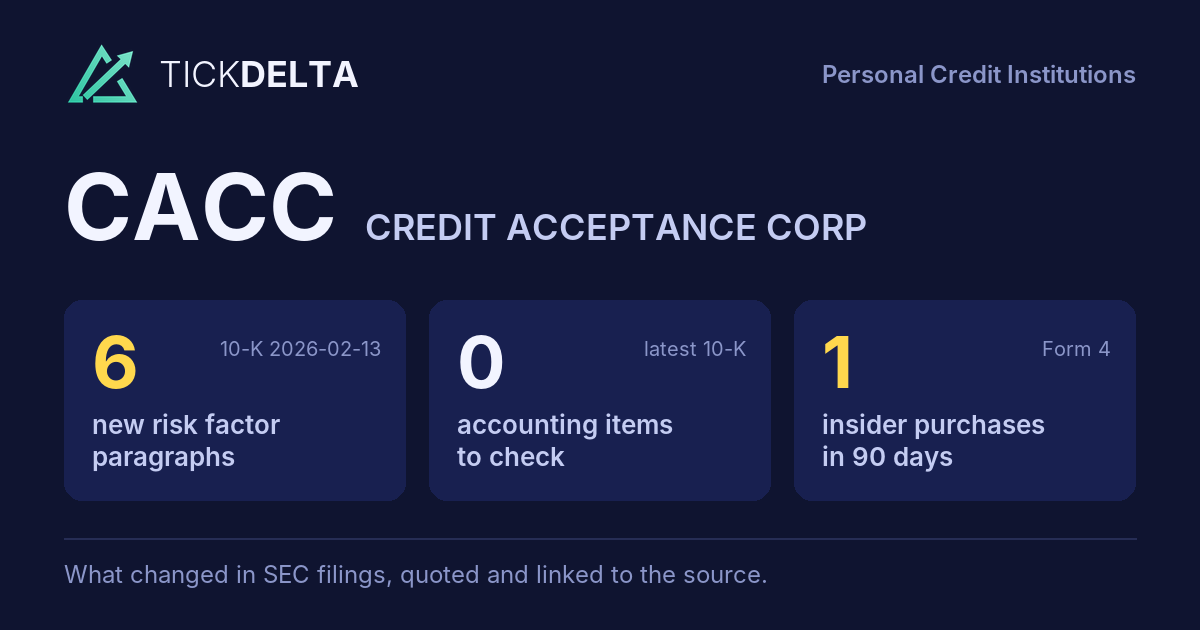
New risk paragraphs, branching off last year
Each branch is a paragraph in Risk Factors with nothing like it in the 10-K filed Feb 12, 2025. A box jumps to the paragraph as filed, below.
Paragraphs with nothing like them in last year's 10-K
6 paragraphs in Risk Factors of the 10-K filed Feb 13, 2026 with nothing like them in the 10-K filed Feb 12, 2025. Quoted exactly. Paragraphs that were only edited are under 10-K change.
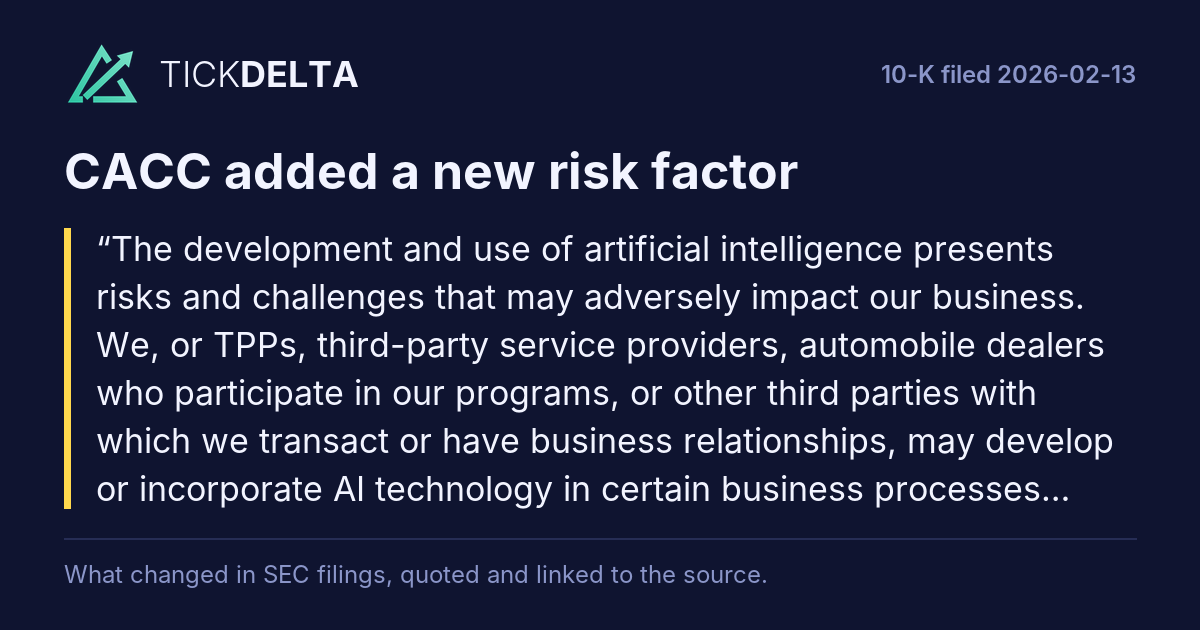
The development and use of artificial intelligence presents risks and challenges that may adversely impact our business.
We, or TPPs, third-party service providers, automobile dealers who participate in our programs, or other third parties with which we transact or have business relationships, may develop or incorporate AI technology in certain business processes, services, or products. The development and use of AI presents several potential risks and challenges to our business. The implementation by us of AI technologies may require significant additional investments in infrastructure, personnel, and training. There can be no assurance that such investments will yield the anticipated benefits or that we will be able to successfully integrate AI into our existing systems and processes without disruption. We may not be able to effectively implement or keep pace with evolutions in AI or other technology-driven products and services as quickly or with the same degree of success as our competitors. Failure to successfully keep pace with technological change affecting the financial services industry could harm our ability to maintain and expand our relationships with Dealers and otherwise adversely affect our business and our ability to compete successfully in the automobile finance market.
The legal and regulatory environment relating to AI is complex and rapidly evolving in the United States and includes both regulatory frameworks targeting AI specifically and other laws and regulations related to such matters as intellectual property, privacy, consumer protection, and employment, among others, applicable to the use of AI. These evolving laws and regulations could affect our approach to AI technology and any implementation of AI technology that we may pursue and could result in significant compliance costs and risk of non-compliance.
AI models may produce output or take action that is incorrect, that reflects biases included in the data on which they are trained, that results in the release of private, confidential, or proprietary information, that infringes on the intellectual property rights of others, or that is otherwise harmful. The limited transparency of AI models increases the challenges associated with assessing the proper operation of AI models, understanding and monitoring the capabilities of AI models, reducing erroneous output of AI models, eliminating bias in AI models, and complying with relevant regulations. Further, we may rely on AI models developed by third parties, and, to that extent, would be dependent in part on the manner in which those third parties develop and train their models, which could expose us to risks arising from the inclusion of any unauthorized material in the training data for their models and the effectiveness of the steps these third parties have taken to limit the risks associated with the output of their models, matters over which we may have limited visibility.
Whether or not we are otherwise able successfully to manage the implementation of AI in our business and address the competitive challenges AI could pose to our business, any failure by TPPs, our third-party service providers, Dealers, or other third parties with which we transact or have business relationships to adhere to our AI policies, or otherwise to use AI in an appropriate manner, could result in legal or regulatory violations, jeopardize our intellectual property rights or those of other parties, or expose us to cybersecurity threats, any of which could adversely affect our business and result in our sustaining reputational, technical, or competitive harm.
Any of these risks could expose us to liability or adverse legal or regulatory consequences and harm our reputation and the public perception of our business or the effectiveness of our security measures.
Paragraphs in the 10-Q filed Oct 29, 2026 that were not in the one before
New in the latest 10-Q
15 paragraphs in the 10-Q filed Oct 29, 2026 with nothing like them in the 10-Q filed Aug 4, 2026 (at least half the words must differ; new numbers alone do not count). Quoted exactly, grouped by the item heading above them. This is text that changed, not a judgement of how serious it is.
Financial statements and notes
Net increase (decrease) in cash and cash equivalents and restricted cash and cash equivalents 17.5 (346.2)
Read in the 10-Q
Cash and cash equivalents and restricted cash and cash equivalents beginning of period 500.7 845.0
Read in the 10-Q
Cash and cash equivalents and restricted cash and cash equivalents end of period $ 518.2 $ 498.8
Read in the 10-Q
Certain amounts for prior periods have been reclassified to conform to the current presentation.
Read in the 10-Q
On September 17, 2026, the Company entered into separate consent judgments (collectively, the “Agreements”) with the office of the attorney general (the “attorney general”) of 40 states (Alabama, Alaska, Arizona, Arkansas, California, Colorado, Connecticut, Delaware, Florida, Georgia, Hawaii, Illinois, Indiana, Kentucky, Louisiana, Maine, Maryland, Michigan, Minnesota, Nebraska, Nevada, New Hampshire, New Jersey, New Mexico, New York, North Carolina, North Dakota, Ohio, Oklahoma, Oregon, Pennsylvania, Rhode Island, South Carolina, South Dakota, Tennessee, Utah, Vermont, Virginia, Washington, and Wisconsin) and the District of Columbia to fully and finally resolve the NY Matter and claims related to the multi-state investigation described above. Each of the 41 Agreements is subject to final court approval in the relevant jurisdiction and is scheduled to become effective on November 2, 2026. As of October 22, 2026, court approval in the relevant jurisdiction had been obtained for 35 of the 41 Agreements. There can be no assurance as to whether the requisite court approval will be obtained for the other Agreements or as to the timing of such approval. Under the terms of the Agreements, the Company paid an aggregate of $ 15.5 million to the attorneys general of the participating states and the District of Columbia (the “Participating Attorneys General”); paid a total amount of $ 60.0 million to a trust account to be used by a settlement administrator selected by a committee of the Participating Attorneys General for the purpose of remediating alleged consumer losses; and will provide debt relief in the form of a waiver of all outstanding balances to certain customers with open accounts as of December 1, 2025, aggregating to an estimated $ 634.0 million. Such payments and debt relief will not require the Company to record charges beyond amounts previously accrued and disclosed in the Company’s financial statements. The Agreements also provide for the release by the attorneys general of specified claims relating to the matters resolved by the Agreements, subject to stated exclusions. In entering into the Agreements, the Company made no admission of wrongdoing or liability. The Agreements require the Company for five years to implement changes to its debt-collection practices for consumer loans originated after December 1, 2025 that meet specified criteria. The Agreements also require, among other things, that, for a seven-year period, the Company issue or require participating dealers to issue additional consumer-facing disclosures regarding vehicle financing, vehicle pricing, and ancillary products and maintain and/or establish policies and practices relating to, among other things, debt relief, affordability‑related protections, dealer oversight and non-use of starter interruption devices. The Company believes these prescriptions and requirements are broadly consistent with regulatory expectations in the automotive finance industry and do not fundamentally alter the Company’s business model or materially affect its business operations. The Agreements require that the Company provide annual reports addressing the Company’s compliance with the Agreements to a monitoring committee for five years and maintain records necessary to demonstrate compliance for at least three years.
Read in the 10-Q
Show the other 10
• Total liquidity stood at $1.2 billion as of September 30, 2026. Additionally, we completed a $600.0 million asset-backed financing, matching the largest Term ABS financing in our history and achieved our lowest credit spreads since late 2021.
Read in the 10-Q
• Scorecard update: Launched a new scorecard that uses refreshed and additional data attributes to enhance our risk-assessment capabilities by credit profile, Dealer, vehicle, and deal structure.
Read in the 10-Q
• Segmentation: Reorganized our sales force to improve alignment by dealer type, origination channel, and geography, with targeted teams for independent dealers, franchise dealers, and national dealer groups.
Read in the 10-Q
• Reduced friction for Dealers: Continued integration improvement with the aggregator platforms and enhanced the deal optimization tool, which reduced friction for Dealers who use Dealertrack, RouteOne, and DealerCenter, and resulted in higher volume with franchise and large independent Dealers.
Read in the 10-Q
• Settled claims related to a longstanding multi-state investigation and the New York state attorney general lawsuit without any admission of fault or wrongdoing by the Company and on terms not requiring the Company to record additional charges beyond amounts previously accrued and disclosed.
Read in the 10-Q
Three Months Ended September 30, 2026 Compared to Three Months Ended September 30, 2025
Read in the 10-Q
Nine Months Ended September 30, 2026 Compared to Nine Months Ended September 30, 2025
Read in the 10-Q
Consumer Loans in lower scorecard bands. Most of the impact of the forecast adjustment we made in the third quarter of 2026 is related to Consumer Loans assigned to us before the scorecard change we introduced in the second quarter of 2026.
Read in the 10-Q
Item 6
10.29 Separation and Advisory Agreement, dated August 19, 2026, between the Company and Ravi Mohan.*
Read in the 10-Q
10.30 Separation and Release Agreement, dated September 3. 2026, between the Company and Jay Martin.*
Read in the 10-Q
The 10-Q's risk factors against the 10-K
Item 1A of the 10-Q filed Oct 29, 2026 against Item 1A of the 10-K filed Feb 13, 2026.
A 10-Q repeats only the risks that changed, so a 10-K paragraph that is missing from it is not counted as removed.
Added is a paragraph with nothing like it in the 10-K, Reworded a sentence that is in both with several words changed,
Quiet changes a sentence in both where one to four words changed and one is a hedge or a modal
(cut words struck through, new words highlighted).
Text on the page, not a score; each links to the filing at sec.gov.
This 10-Q has no Item 1A (Risk Factors) text of its own, so there is nothing to compare. Many companies leave it out when their risks have not changed.
Phrases used for the first time
Two-word phrases in Risk Factors of the 10-K filed Feb 13, 2026 that are in none of the 1 earlier 10-Ks stored, back to Feb 12, 2025
Where each one is used
- credit application: Our financial position, liquidity, and results of operations depend on management’s ability to execute our business strategy. Key factors involved in the execution of our business strategy include achieving our desired Consumer Loan assignment volume, continued and successful use of CAPS and other internet-based...
- keep pace: We, or TPPs, third-party service providers, automobile dealers who participate in our programs, or other third parties with which we transact or have business relationships, may develop or incorporate AI technology in certain business processes, services, or products. The development and use of AI presents several...
Used at least twice, small words left out. Counted, not picked: a phrase can be new because the company renamed something.
Sources
Item 1A of each 10-K and 10-Q on EDGAR, quoted exactly. Each paragraph links to the filing at sec.gov.
Also
10-K change: what was reworded or cut, section by section.
Work with it
Excel workbook · CSV. Google Sheet that stays up to date: paste =IMPORTDATA("https://tickdelta.com/company/CACC/export.csv") into a cell.