Paragraph 44 · 49% changed
Every version of it
Screener
/
SEC EDGAR
/CIK 0000016058
/10-K filed Aug 6, 2026, compared with Aug 7, 2025
/Numbers from the XBRL of the 10-Ks
NYSE
Technology · IT Services
Caci International Inc CACI
The 10-K against last year's
93 changes: 28 added, 16 removed, 49 reworded
10-K Aug 6, 2026 vs Aug 7, 2025
Risk Factors
32.3%
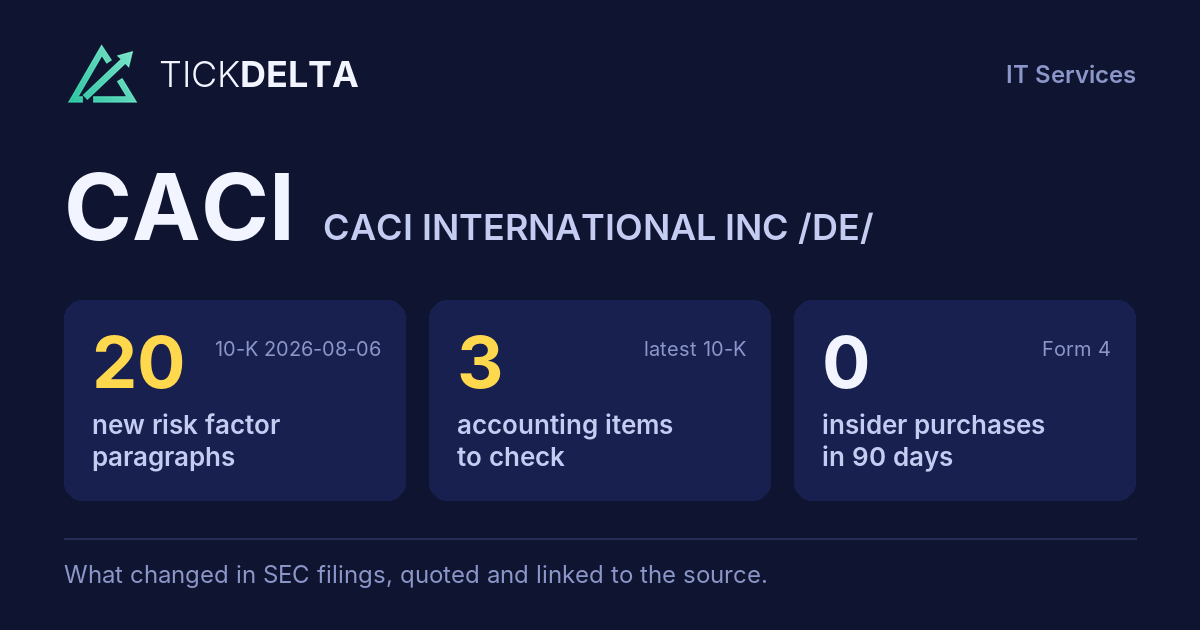
of the text changed · 7,734 words now · 20 new paragraphs, 13 gone
MD&A
21.4%
of the text changed · 4,081 words now · 8 new paragraphs, 3 gone
Legal Proceedings
5.6%
of the text changed · 3,867 words now
Accounting Policies
9.2%
of the text changed · 3,239 words now
10-K 0001628280-26-054195 (Aug 6, 2026) vs 10-K 0001628280-25-038739 (Aug 7, 2025)
Every paragraph, and how much of it changed
One bar per paragraph, in the order of the 10-K. Height and colour show the share of its words not in the closest paragraph a year earlier; the tallest bars are new paragraphs.
Risk Factors
114 paragraphs · 20 new · 35 reworded · 13 gone · 10-K Aug 6, 2026 against Aug 7, 2025
New paragraph
Reworded (5% of its words or more)
Same or nearly
Paragraph 18 · 48% changed
Every version of it
Paragraph 32 · 46% changed
Every version of it
We depend on the timely collection of our receivables to generate cash flow, provide working capital, pay debt, and continue our support ongoing business operations. If the federal government, any of our other customers, or any prime contractor for whom we are a subcontractor fails to pay or delays the payment of their outstanding invoices for any reason, our business and financial condition may and operating results could be materially and adversely affected. The government may fail to pay outstanding invoices for a number of reasons, including lack of appropriated funds or lack of an approved budget. In addition, the Defense Contract Audit Agency (DCAA) may revoke our direct billing privileges, which would adversely affect our ability to collect our receivables in a timely manner. Contracting officers have the authority to impose contractual withholdings, which can also adversely affect our ability to collect timely. The Defense Federal Acquisition Regulations require DoD contracting officers to impose contractual withholdings at no less than certain minimum levels if a contracting officer determines that one or more of a contractor’s business systems have one or more significant deficiencies. Some prime contractors for whom we are a subcontractor have significantly fewer financial resources than we do, which may increase the risk that we may not be paid in full or payment may be delayed. If we experience difficulties collecting receivables, it could cause our actual results to differ materially and adversely from those anticipated.
Paragraph 90 · 45% changed
Every version of it
Paragraph 24 · 45% changed
Every version of it
Paragraph 89 · 44% changed
Every version of it
We must observe laws and regulations relating to the formation, administration and performance of federal government contracts which affect how we do business with our customers and may impose added costs on our business. For example, the Federal Acquisition Regulation operations. These laws and regulations continue to evolve, and the federal government regularly updates or expands compliance obligations in areas such as cybersecurity, supply‑chain integrity, industrial security regulations security, cost accounting, and ethical conduct. Keeping pace with these changes requires ongoing investment in compliance processes, monitoring systems, training, and internal controls, and increases the complexity and cost of the DoD and related laws include provisions that: maintaining compliance across our business.
Paragraph 42 · 40% changed
Every version of it
We may not receive realize the full amounts authorized under value of the contracts included in our backlog, which could reduce cause our future revenues in future periods below the levels and operating results to differ materially from those anticipated.
Paragraph 12 · 34% changed
Every version of it
If the government terminates a contract for convenience, we may recover only our incurred or committed costs, settlement expenses, and profit on work completed prior to the termination. If the government terminates a contract for default, we may be unable to recover even those amounts and instead may be liable for excess costs incurred by the government in procuring undelivered items and services from another source. Depending on the value of a contract, such termination could cause our actual results to differ materially and adversely from those anticipated. Certain contracts also contain organizational conflict of interest (OCI) clauses that limit our ability to compete for or perform certain other contracts. OCIs arise any time we engage in activities that (i) make us unable or potentially unable to render impartial assistance or advice to the government; (ii) impair or might impair our objectivity in performing contract work; or (iii) provide us with an unfair competitive advantage. For example, when we work on the design of a particular system, we may be precluded from competing for the contract to develop and install that system. Depending upon the value of the matters affected, an OCI issue that precludes our participation in or performance of a program or contract could cause our actual results to differ materially and adversely from those anticipated.
Paragraph 44 · 49% changed
Every version of it
10-K Aug 7, 2025The maximum contract value specified under a government contract or task order awarded to us is not necessarily indicative of the revenues that we will realize under that contract. For example, we generate a substantial portion of our revenues from government contracts in which we are not the sole provider, meaning that the government could turn to other companies to fulfill the contract. We also generate revenues from IDIQ contracts, which do not require the government to purchase a pre-determined amount of goods or services under the contract. Action by the government to obtain support from other contractors or failure of the government to order the quantity of work anticipated could cause our actual results to differ materially and adversely from those anticipated.
10-K Aug 6, 2026
There are several reasons why our backlog may not convert into revenue as expected. Many of our federal government contracts include multi‑year performance periods that depend on annual Congressional appropriations, and unfunded work is subject to future funding decisions. A lack of appropriated funds, delays in the federal budget or appropriations process, or efforts to reduce federal spending could delay or preclude the government from funding work included in our backlog. In addition, the maximum contract value specified under a contract or task order is not necessarily indicative of the revenue we will ultimately realize under that contract. For example, we perform significant work under multiple-award and IDIQ contract vehicles that do not require the government to order a minimum amount of goods or services and under which agencies may choose to obtain support from other contractors.
Paragraph 18 · 48% changed
Every version of it
10-K Aug 7, 2025We derive significant revenues from contracts and task orders awarded through a competitive bidding process. If we are unable to consistently win new awards over any extended period, our business and prospects will be adversely affected.
10-K Aug 6, 2026
Our contracts and task orders with the federal government are typically awarded through a competitive bidding process. We expect that much of the business that we will seek in the foreseeable future will continue to be awarded through competitive bidding.
Paragraph 32 · 46% changed
Every version of it
10-K Aug 7, 2025
We depend on the collection of our receivables to generate cash flow, provide working capital, pay debt, and continue our business operations. If the federal government, any of our other customers, or any prime contractor for whom we are a subcontractor fails to pay or delays the payment of their outstanding invoices for any reason, our business and financial condition may be materially and adversely affected. The government may fail to pay outstanding invoices for a number of reasons, including lack of appropriated funds or lack of an approved budget. In addition, the Defense Contract Audit Agency (DCAA) may revoke our direct billing privileges, which would adversely affect our ability to collect our receivables in a timely manner. Contracting officers have the authority to impose contractual withholdings, which can also adversely affect our ability to collect timely. The Defense Federal Acquisition Regulations require DoD contracting officers to impose contractual withholdings at no less than certain minimum levels if a contracting officer determines that one or more of a contractor’s business systems have one or more significant deficiencies. Some prime contractors for whom we are a subcontractor have significantly fewer financial resources than we do, which may increase the risk that we may not be paid in full or payment may be delayed. If we experience difficulties collecting receivables, it could cause our actual results to differ materially and adversely from those anticipated.
10-K Aug 6, 2026
We depend on the timely collection of our receivables to generate cash flow, provide working capital, pay debt, and support ongoing business operations. If the federal government, any of our other customers, or any prime contractor for whom we are a subcontractor fails to pay or delays payment of their outstanding invoices for any reason, our financial condition and operating results could be materially and adversely affected.
Paragraph 90 · 45% changed
Every version of it
10-K Aug 7, 2025We must observe laws and regulations relating to the formation, administration and performance of federal government contracts which affect how we do business with our customers and may impose added costs on our business. For example, the Federal Acquisition Regulation and the industrial security regulations of the DoD and related laws include provisions that:
10-K Aug 6, 2026
For example, the Federal Acquisition Regulation and the industrial security regulations of the DoW and related laws include provisions that:
Paragraph 24 · 45% changed
Every version of it
10-K Aug 7, 2025The number of bid protests of contract awards by unsuccessful bidders is increasing and the U.S. government is taking longer to resolve such protests. Bid protests may result in an increase in expenses related to obtaining contract awards or an unfavorable modification or loss of an award. In the event a bid protest is unsuccessful, the resulting delay in the startup and funding of the work under these contracts may cause our actual results to differ materially and adversely from those anticipated.
10-K Aug 6, 2026
In addition to the challenges of the bidding process, our business could be adversely affected by our competitors protesting major contract awards. Defending against these challenges can result in significant expenses and any such protest or challenge could lead to the resubmission of bids on modified specifications, an unfavorable modification, or the termination, reduction, or complete loss of an awarded contract. Even an unsuccessful bid protest could delay the initiation, startup, and funding of the work under these contracts and may cause our actual results to differ materially and adversely from those anticipated.
Paragraph 89 · 44% changed
Every version of it
10-K Aug 7, 2025
We must observe laws and regulations relating to the formation, administration and performance of federal government contracts which affect how we do business with our customers and may impose added costs on our business. For example, the Federal Acquisition Regulation and the industrial security regulations of the DoD and related laws include provisions that:
10-K Aug 6, 2026
We must observe laws and regulations relating to the formation, administration and performance of federal government contracts which affect how we do business with our customers and may impose added costs on our operations. These laws and regulations continue to evolve, and the federal government regularly updates or expands compliance obligations in areas such as cybersecurity, supply‑chain integrity, industrial security, cost accounting, and ethical conduct. Keeping pace with these changes requires ongoing investment in compliance processes, monitoring systems, training, and internal controls, and increases the complexity and cost of maintaining compliance across our business.
Paragraph 42 · 40% changed
Every version of it
10-K Aug 7, 2025
We may not receive the full amounts authorized under the contracts included in our backlog, which could reduce our revenues in future periods below the levels anticipated.
10-K Aug 6, 2026
We may not realize the full value of the contracts included in our backlog, which could cause our future revenues and operating results to differ materially from those anticipated.
Paragraph 12 · 34% changed
Every version of it
10-K Aug 7, 2025
If the government terminates a contract for convenience, we may recover only our incurred or committed costs, settlement expenses, and profit on work completed prior to the termination. If the government terminates a contract for default, we may be unable to recover even those amounts and instead may be liable for excess costs incurred by the government in procuring undelivered items and services from another source. Depending on the value of a contract, such termination could cause our actual results to differ materially and adversely from those anticipated. Certain contracts also contain organizational conflict of interest (OCI) clauses that limit our ability to compete for or perform certain other contracts. OCIs arise any time we engage in activities that (i) make us unable or potentially unable to render impartial assistance or advice to the government; (ii) impair or might impair our objectivity in performing contract work; or (iii) provide us with an unfair competitive advantage. For example, when we work on the design of a particular system, we may be precluded from competing for the contract to develop and install that system. Depending upon the value of the matters affected, an OCI issue that precludes our participation in or performance of a program or contract could cause our actual results to differ materially and adversely from those anticipated.
10-K Aug 6, 2026
If the government terminates a contract for convenience, we may recover only our incurred or committed costs, settlement expenses, and profit on work completed prior to the termination. If the government terminates a contract for default, we may be unable to recover even those amounts and instead may be liable for excess costs incurred by the government in procuring undelivered items and services from another source. Depending on the value of a contract, such termination could cause our actual results to differ materially and adversely from those anticipated.
MD&A
70 paragraphs · 8 new · 32 reworded · 3 gone · 10-K Aug 6, 2026 against Aug 7, 2025
New paragraph
Reworded (5% of its words or more)
Same or nearly
Paragraph 53 · 48% changed
Net cash provided by (used in) financing activities increased $1,504.8 $756.9 million primarily as a result of a $1,528.3 million of due to an increase in net proceeds borrowings under our debt instruments, including the impact of debt issuance costs for Credit Facility, the Term Loan B Facility B-2, and the 2033 Notes. Notes-2 and a decrease in stock repurchase activity.
Paragraph 27 · 47% changed
Paragraph 15 · 46% changed
See “Note 6 – Sales of Receivables” and “Note 12 – Debt” “Risk Factors” in Part II, I, Item 8 1A of this Annual Report on Form 10-K for additional information. discussion of how changes in the federal budget and appropriations process may affect our operations.
Paragraph 11 · 39% changed
On May 2, 2025, the President Trump submitted the GFY26 Presidential Budget Request (PBR) to Congress, (PBR), which held proposed holding defense spending at the GFY25 enacted (full-year CR) level (a full-year CR) of $893 billion. On July 4, 2025, the President Trump signed the One Big Beautiful Bill Act (OBBBA), which provides a reconciliation bill providing additional mandatory funding above and beyond outside the PBR. regular annual appropriations process. The OBBBA is a reconciliation bill, which is separate from the usual government funding legislation that Congress will still need to pass before October 1, 2025 or pass a CR. The OBBBA provides immediate funding for specified parts of the government, including made immediately available approximately $156 billion in defense funding (including $25 billion for the Golden Dome initiative). When combined with the President’s GFY26 PBR, this represents growth of approximately 13% over GFY25 enacted levels for defense. In addition, the OBBBA provides initiative) and approximately $170 billion for border security and immigration. Since this is direct funding authorized by reconciliation outside the normal budget process, Because these funds will be were authorized through the reconciliation process, they remain available in GFY26 and beyond regardless of whether normal appropriations Congress enacts full-year appropriations, passes a CR, or enters a CR is passed. government shutdown.
Paragraph 51 · 38% changed
Net cash provided by operating activities increased $49.7 $339.7 million primarily due to $162.7 million in higher net income, adjusted for non-cash items, and $48.0 million in lower income taxes payments, partially offset the deduction of domestic R&D costs pursuant to tax provisions enacted by the OBBBA, timing of milestone billings and customer payments of $141.3 million, a decrease of $11.1 million in cash provided by the Company's MARPA, collections, and other net unfavorable favorable changes in other operating assets and liabilities.
Paragraph 21 · 37% changed
•Increased investments in advanced technologies (e.g., AI), technologies, particularly software-based technologies; technologies, including AI;
Paragraph 33 · 33% changed
Depreciation and Amortization. Depreciation The increase in depreciation and amortization for fiscal 2025 increased compared to prior year was due to the amortization of intangible assets obtained through acquisitions made acquired in fiscal 2026 and the timing of intangible assets acquired in fiscal 2025.
Paragraph 46 · 33% changed
Existing cash and cash equivalents and cash generated by operations are our primary sources of liquidity, as well as sales of receivables under our Master Accounts Receivable Purchase Agreement (MARPA) and available borrowings under our Credit Facility. As revolving credit facility (the Revolving Facility), which permits renewable borrowings of June 30, 2025, we had $106.2 up to $2,000.0 million. The Revolving Facility also has sub-facilities of $150.0 million in cash for same-day swing line loan borrowings and cash equivalents. $25.0 million for stand-by letters of credit.
Paragraph 53 · 48% changed
10-K Aug 7, 2025
Net cash provided by (used in) financing activities increased $1,504.8 million primarily as a result of a $1,528.3 million of net proceeds under our debt instruments, including the impact of debt issuance costs for the Term Loan B Facility and 2033 Notes.
10-K Aug 6, 2026
Net cash provided by financing activities increased $756.9 million primarily due to an increase in net borrowings under the Credit Facility, the Term Loan B-2, and the 2033 Notes-2 and a decrease in stock repurchase activity.
Paragraph 27 · 47% changed
10-K Aug 7, 2025•DoD revenues include Expertise and Technology provided to various DoD customers.
10-K Aug 6, 2026
•DoW revenues include Technology and Expertise provided to various DoW customers, excluding those defined as part of the IC.
Paragraph 15 · 46% changed
10-K Aug 7, 2025
See “Note 6 – Sales of Receivables” and “Note 12 – Debt” in Part II, Item 8 of this Annual Report on Form 10-K for additional information.
10-K Aug 6, 2026
See “Risk Factors” in Part I, Item 1A of this Annual Report on Form 10-K for additional discussion of how changes in the federal budget and appropriations process may affect our operations.
Paragraph 11 · 39% changed
10-K Aug 7, 2025
On May 2, 2025, President Trump submitted the GFY26 Presidential Budget Request (PBR) to Congress, which held defense spending at the GFY25 enacted level (a full-year CR) of $893 billion. On July 4, 2025, President Trump signed the One Big Beautiful Bill Act (OBBBA), which provides additional funding above and beyond the PBR. The OBBBA is a reconciliation bill, which is separate from the usual government funding legislation that Congress will still need to pass before October 1, 2025 or pass a CR. The OBBBA provides immediate funding for specified parts of the government, including approximately $156 billion in defense funding (including $25 billion for the Golden Dome initiative). When combined with the President’s GFY26 PBR, this represents growth of approximately 13% over GFY25 enacted levels for defense. In addition, the OBBBA provides approximately $170 billion for border security and immigration. Since this is direct funding authorized by reconciliation outside the normal budget process, these funds will be available in GFY26 and beyond whether normal appropriations or a CR is passed.
10-K Aug 6, 2026
On May 2, 2025, the President submitted the GFY26 Presidential Budget Request (PBR), which proposed holding defense spending at the GFY25 enacted (full-year CR) level of $893 billion. On July 4, 2025, the President signed the One Big Beautiful Bill Act (OBBBA), a reconciliation bill providing additional mandatory funding outside the regular annual appropriations process. The OBBBA made immediately available approximately $156 billion in defense funding (including $25 billion for the Golden Dome initiative) and approximately $170 billion for border security and immigration. Because these funds were authorized through the reconciliation process, they remain available in GFY26 and beyond regardless of whether Congress enacts full-year appropriations, passes a CR, or enters a government shutdown.
Paragraph 51 · 38% changed
10-K Aug 7, 2025
Net cash provided by operating activities increased $49.7 million primarily due to $162.7 million in higher net income, adjusted for non-cash items, and $48.0 million in lower income taxes payments, partially offset by timing of milestone billings and customer payments of $141.3 million, a decrease of $11.1 million in cash provided by the Company's MARPA, and other net unfavorable changes in other operating assets and liabilities.
10-K Aug 6, 2026
Net cash provided by operating activities increased $339.7 million primarily due to higher net income, the deduction of domestic R&D costs pursuant to tax provisions enacted by the OBBBA, timing of customer collections, and other net favorable changes in other operating assets and liabilities.
Paragraph 21 · 37% changed
10-K Aug 7, 2025
•Increased investments in advanced technologies (e.g., AI), particularly software-based technologies;
10-K Aug 6, 2026
•Increased investments in advanced technologies, particularly software-based technologies, including AI;
Paragraph 33 · 33% changed
10-K Aug 7, 2025
Depreciation and Amortization. Depreciation and amortization for fiscal 2025 increased compared to prior year due to the amortization of intangible assets obtained through acquisitions made in fiscal 2025.
10-K Aug 6, 2026
Depreciation and Amortization. The increase in depreciation and amortization was due to the amortization of intangible assets acquired in fiscal 2026 and the timing of intangible assets acquired in fiscal 2025.
Paragraph 46 · 33% changed
10-K Aug 7, 2025
Existing cash and cash equivalents and cash generated by operations are our primary sources of liquidity, as well as sales of receivables under our Master Accounts Receivable Purchase Agreement (MARPA) and available borrowings under our Credit Facility. As of June 30, 2025, we had $106.2 million in cash and cash equivalents.
10-K Aug 6, 2026
Existing cash and cash equivalents and cash generated by operations are our primary sources of liquidity, as well as sales of receivables under our Master Accounts Receivable Purchase Agreement (MARPA) and available borrowings under our revolving credit facility (the Revolving Facility), which permits renewable borrowings of up to $2,000.0 million. The Revolving Facility also has sub-facilities of $150.0 million for same-day swing line loan borrowings and $25.0 million for stand-by letters of credit.
A paragraph is matched with the one last year that shares the most of its words; under half in common makes it new. The paragraphs shown are the 8 reworded the most in each section.
The paragraph that changed most in each section
The redline
Marked against last year's 10-K: cut words struck through, new words highlighted.
Legal Proceedings227 words changed in this paragraph; it is 44% similar to last year's version.
On November 25, 2024, CACI filed a motion for judgment as a matter of law, asserting numerous grounds for setting aside the jury verdict and dismissing the action. On January 10, 2025, the District Court conducted a hearing on that motion and denied the motion. On January 10, 2025, CACI filed a Notice of Appeal to the U.S. Court of Appeals for the Fourth Circuit. The Court of Appeals established a briefing schedule, which concluded on July 25, 2025. The Court of Appeals has scheduled heard oral argument for on September 9, 2025. On March 12, 2026, the Court of Appeals, in a 2-1 decision, affirmed the judgment of the district court against CACI. On April 24, 2026, the Company filed a petition for rehearing or rehearing en banc and asked the Court of Appeals to stay action on that petition pending the Supreme Court’s expected decision in Cisco Systems, Inc. v. Doe, No. 24-856. On June 22, 2026, the Supreme Court issued its decision in the Cisco case. The Supreme Court held that federal courts may not imply any causes of action under the ATS other than perhaps the three law of nations violations recognized at the time of ATS’s enactment—violation of safe conducts, infringements of the rights of ambassadors, and piracy. Both claims of conspiracy on which the judgment against CACI below rests were judicially implied under the ATS. On June 23, 2026, CACI filed a notice with the Court of Appeals apprising the Court of the Cisco decision. In that filing, CACI took the position that Cisco categorically precludes judicially-implied ATS claims beyond the three specific judicially-implied claims that might remain viable under Cisco, a holding that bars the only two claims on which the judgment against CACI rests. Accordingly, CACI requested that the Court reverse the district court’s judgment and remand with instructions to dismiss Plaintiff’s claims for lack of jurisdiction.
Source: Item 3, 10-K 0001628280-26-054195 vs Item 3, 10-K 0001628280-25-038739
Risk Factors212 words changed in this paragraph; it is 32% similar to last year's version.
Because we derive substantially all of our revenues from contracts with the federal government, we believe that the success and development of our business will continue to depend on our successful participation in federal government contract programs. Changes in Actions taken by the federal government budgetary priorities, such as for homeland security or to address global pandemics, or actions taken to address government budget deficits, the national debt, or prevailing economic conditions, including the use of continuing resolutions, delays or reductions in appropriations, or a federal government shutdown, may prevent us from performing on existing contracts, delay our ability to begin work on new awards, or require us to use our own funds to meet our customers’ desired delivery schedules. A lapse in appropriations, delays in the passage of annual budgets, or the use of continuing resolutions can postpone contract awards, slow program execution, interrupt customer decision making, or defer funding availability, even in periods where long-term spending levels remain stable. The duration, frequency, and severity of any such disruptions are unpredictable and could directly affect materially impact our financial performance. A significant decline in government expenditures, a shift of expenditures away from programs that we support or a change in federal government contracting policies could cause federal government agencies to reduce their purchases under contracts, to exercise their right to terminate contracts at any time without penalty or not to exercise options to renew contracts. For further discussion, refer to “Management’s Discussion and Analysis of Financial Condition & Results of Operations” in Part II of this Annual Report on Form 10-K. results.
Source: Item 1A, 10-K 0001628280-26-054195 vs Item 1A, 10-K 0001628280-25-038739
MD&A143 words changed in this paragraph; it is 50% similar to last year's version.
On May 2, 2025, the President Trump submitted the GFY26 Presidential Budget Request (PBR) to Congress, (PBR), which held proposed holding defense spending at the GFY25 enacted (full-year CR) level (a full-year CR) of $893 billion. On July 4, 2025, the President Trump signed the One Big Beautiful Bill Act (OBBBA), which provides a reconciliation bill providing additional mandatory funding above and beyond outside the PBR. regular annual appropriations process. The OBBBA is a reconciliation bill, which is separate from the usual government funding legislation that Congress will still need to pass before October 1, 2025 or pass a CR. The OBBBA provides immediate funding for specified parts of the government, including made immediately available approximately $156 billion in defense funding (including $25 billion for the Golden Dome initiative). When combined with the President’s GFY26 PBR, this represents growth of approximately 13% over GFY25 enacted levels for defense. In addition, the OBBBA provides initiative) and approximately $170 billion for border security and immigration. Since this is direct funding authorized by reconciliation outside the normal budget process, Because these funds will be were authorized through the reconciliation process, they remain available in GFY26 and beyond regardless of whether normal appropriations Congress enacts full-year appropriations, passes a CR, or enters a CR is passed. government shutdown.
Source: Item 7, 10-K 0001628280-26-054195 vs Item 7, 10-K 0001628280-25-038739
Accounting Policies63 words changed in this paragraph; it is 53% similar to last year's version.
Purchases of property, plant, and equipment are capitalized at cost. Depreciation of The Company depreciates or amortizes on a straight-line basis over the useful life: equipment and furniture has been provided over the estimated useful life of the respective assets (ranging from three to eight years) using years; buildings and building improvements up to 40 years; and leasehold improvements over the straight-line method. Leasehold improvements are generally amortized using the straight-line method over shorter of the remaining lease term or the improvements estimated useful life of the improvements, whichever is shorter. life. Repairs and maintenance costs are expensed as incurred.
Source: Item 8, Note 2 – Summary of Significant Accounting Policies, 10-K 0001628280-26-054195 vs Item 8, Note 2 – Summary of Significant Accounting Policies, 10-K 0001628280-25-038739
Sentences and paragraphs added, removed or reworded
Every change, by type
Sentences and paragraphs of CACI's Risk Factors and MD&A, 10-K Aug 6, 2026 against 10-K Aug 7, 2025. Each links to the text at sec.gov.
Quiet changes are sentences kept from last year with one to four words changed, at least one of them a hedge, a modal or a qualifier (may, could, will, not, significant, material…). A year or date rolling forward is not counted.
The full word list
adverse, adversely, all, although, anticipate, anticipates, any, approximately, believe, believes, can, cannot, certain, could, expect, expects, generally, however, if, intend, intends, largely, likely, many, material, materially, may, might, most, must, never, no, not, possible, primarily, probable, should, significant, significantly, some, substantial, substantially, unlikely, will, would
AddedRisk Factors
Because we derive substantially all of our revenues from contracts with the federal government, the success and development of our business will continue to depend on our successful participation in federal government contract programs. Actions taken by the federal government to address government budget deficits, the national debt, or prevailing economic conditions, including the use of continuing resolutions, delays or reductions in appropriations, or a federal government shutdown, may prevent us from performing on existing contracts, delay our ability to begin work on new awards, or require us to use our own funds to meet our customers’ desired delivery schedules. A lapse in appropriations, delays in the passage of annual budgets, or the use of continuing resolutions can postpone contract awards, slow program execution, interrupt customer decision making, or defer funding availability, even in periods where long-term spending levels remain stable. The duration, frequency, and severity of any such disruptions are unpredictable and could materially impact our financial results.
Read it in 10-K Aug 6, 2026 at sec.gov
AddedRisk Factors
Additionally, the federal government may also change its budgeting in response to evolving national security, technology, economic, or policy considerations. A significant decline in expenditures for programs in our addressable markets, or a reallocation of funds toward missions or capabilities we do not directly support, or a change in federal government contracting policies could cause federal agencies to decrease purchases under existing contracts, terminate contracts for convenience, or choose not to exercise options and impact our ability to win new awards.
Read it in 10-K Aug 6, 2026 at sec.gov
AddedRisk Factors
For further discussion, refer to “Management’s Discussion and Analysis of Financial Condition and Results of Operations” in Part II, Item 7 of this Annual Report on Form 10-K.
Read it in 10-K Aug 6, 2026 at sec.gov
AddedRisk Factors
The federal government may delay payment of invoices for several reasons, including lack of appropriated funds, delays in the budget or appropriations process, or other funding constraints. We are also subject to audits or oversight activities by the Defense Contract Audit Agency (DCAA) which has the authority to revoke our direct-billing privileges and contracting officers who may impose contractual withholdings, including those required under the Defense Federal Acquisition Regulations when a contractor’s business systems are found to have a material weakness. Prime contractors for whom we are a subcontractor may also experience cash-flow constraints or have limited financial resources, which increases the risk that payments due to us may be delayed or not paid in full.
Read it in 10-K Aug 6, 2026 at sec.gov
AddedRisk Factors
Difficulties collecting receivables for any reason can impair our ability to meet our financial obligations, increase our cost of capital, reduce our ability to invest in growth or new opportunities, and require us to obtain additional sources of liquidity on less favorable terms. If we are unable to collect receivables in the amounts or within the timeframes we expect, our actual results could differ materially and adversely from those anticipated, and our overall business performance could be negatively affected.
Read it in 10-K Aug 6, 2026 at sec.gov
AddedRisk Factors
Specifically, certain federal agencies are increasingly using alternative or rapid acquisition pathways for emerging technologies, including flexible contracting approaches such as “other transaction authority” agreements. These acquisition methods differ from traditional FAR based processes and may involve requirements, such as participation by non‑traditional contractors or cost‑sharing obligations, that could limit our ability to qualify or compete effectively. If we are unable to adapt to these evolving procurement approaches or meet the associated eligibility, technical, or administrative requirements, we may be unable to pursue certain strategic opportunities in high‑growth areas. As a result, our ability to capture new awards, expand into developing mission areas, or achieve expected levels of performance and growth could be adversely affected.
Read it in 10-K Aug 6, 2026 at sec.gov
AddedRisk Factors
Changes in mission priorities, procurement strategies, or program execution may also result in reductions in scope, fewer task order awards, or lower-than-anticipated ordering levels.
Read it in 10-K Aug 6, 2026 at sec.gov
AddedRisk Factors
Backlog may also not be collected if a customer reduces, delays, or cancels planned work; elects not to exercise contract options; or shifts work to other contractors. Our estimates of unfunded backlog may prove inaccurate, and the timing and amount of revenue ultimately realized may differ materially from our expectations. If we do not receive the anticipated funding, if the government does not order work at expected levels, or if we are unable to perform or retain the work included in our backlog, our future revenues, cash flows, and operating results could be materially and adversely affected.
Read it in 10-K Aug 6, 2026 at sec.gov
Show the other 51
AddedRisk Factors
We use estimates in recognizing revenues, and changes in those estimates may adversely affect our financial results.
Read it in 10-K Aug 6, 2026 at sec.gov
AddedRisk Factors
A significant portion of our revenue is recognized over time using a cost-input measure of progress, which requires us to make accurate estimates of total costs at completion and the fees to be earned on our contracts. Because of the technical complexity of the solutions and services we provide, as well as the extended duration of certain contracts, this estimation process is highly complex and requires significant management judgment. As contract performance progresses, we routinely adjust our initial estimates based on experience gained and newly available information, even when the scope of work under the performance obligation has not changed. If our underlying assumptions or estimates prove to be inaccurate, or if circumstances change, we may be required to make material adjustments to our revenue and profit margins. Such adjustments could have a material adverse effect on our business, financial condition, results of operations, and cash flows.
Read it in 10-K Aug 6, 2026 at sec.gov
AddedRisk Factors
We may incur additional indebtedness, which could impact our ability to service our debts.
Read it in 10-K Aug 6, 2026 at sec.gov
AddedRisk Factors
Disruptions in our supply chain, including shortages of materials, components, or qualified suppliers, could impair our ability to perform on contracts and increase our costs, which could adversely affect our operating results.
Read it in 10-K Aug 6, 2026 at sec.gov
RemovedRisk Factors
RemovedRisk Factors
RemovedRisk Factors
RemovedRisk Factors
RemovedRisk Factors
RemovedRisk Factors
RemovedRisk Factors
RemovedRisk Factors
RemovedRisk Factors
RemovedRisk Factors
RemovedRisk Factors
RemovedRisk Factors
RewordedRisk Factors
RewordedRisk Factors
RewordedRisk Factors
Our senior secured credit facility (the Credit Facility), senior secured term loan (Term Loan B Facility), and senior unsecured notes (2033 Notes) debt instruments impose certain restrictions on our ability to take certain actions which may have an impact on our business, operating results results, and financial condition.
Read it in 10-K Aug 6, 2026 at sec.gov
RewordedRisk Factors
We may not receive realize the full amounts authorized under value of the contracts included in our backlog, which could reduce cause our future revenues in future periods below the levels and operating results to differ materially from those anticipated.
Read it in 10-K Aug 6, 2026 at sec.gov
RewordedRisk Factors
The federal government may change its procurement practices, or adopt new contracting rules and regulations, such as those related to cost accounting standards. a result of an increased focus on affordability, efficiencies, business systems and recovery of costs.
Read it in 10-K Aug 6, 2026 at sec.gov
RewordedRisk Factors
RewordedRisk Factors
RewordedRisk Factors
RewordedRisk Factors
Specifically, we generated 75.4% 53.6% and 74.4% 53.5% of our total revenues in fiscal 2025 2026 and 2024, 2025, respectively, from contracts with agencies of the DoD. Department of War (DoW).
Read it in 10-K Aug 6, 2026 at sec.gov
RewordedRisk Factors
RewordedRisk Factors
RewordedRisk Factors
Depending upon the value of the matters affected, a performance problem that impacts our performance of a program or contract could cause our actual results to differ materially and adversely from those anticipated. anticipated and impair our prospects for future contract awards.
Read it in 10-K Aug 6, 2026 at sec.gov
AddedMD&A
While we view the current budget environment as constructive, the timing and passage of annual appropriations remain uncertain in any given government fiscal year (GFY). During periods when Congress has not enacted full-year appropriations, federal agencies operate under a CR. A CR typically authorizes agencies to continue operating at prior year funding levels and may restrict new program starts or delay contract awards.
Read it in 10-K Aug 6, 2026 at sec.gov
AddedMD&A
The scope and duration of CRs can negatively affect our business by delaying new programs, contract awards, or other customer decisions. If a CR expires without the enactment of full-year appropriations or an extension via a new CR, the federal government must cease non-essential operations (a “government shutdown”), except where continuing activities are authorized by law. We evaluate our portfolio on an ongoing basis to identify areas potentially at risk from CRs or shutdowns and to develop appropriate contingency plans.
Read it in 10-K Aug 6, 2026 at sec.gov
AddedMD&A
On October 1, 2025, the federal government entered a shutdown. On November 12, 2025, the President signed a CR that ended the shutdown and restored government operations, extending funding for most agencies at GFY25 levels through January 30, 2026. Following the expiration of that CR, a partial shutdown occurred. On February 3, 2026, the President signed five of the six remaining GFY26 full-year appropriations bills, alongside a two-week CR for the Department of Homeland Security (DHS). The enacted defense appropriations bill provided full-year funding for the DoW with a topline of $838.7 billion, approximately $8.4 billion above the GFY26 PBR.
Read it in 10-K Aug 6, 2026 at sec.gov
AddedMD&A
On February 14, 2026, the temporary funding for DHS expired, and the department entered a shutdown. Portions of DHS operations continued due to the availability of mandatory OBBBA funding. On April 30, 2026, Congress passed full-year GFY26 funding for DHS, excluding funding for Immigration and Customs Enforcement (ICE) and Customs and Border Protection (CBP), both of which continued to rely on OBBBA funding. On June 9, 2026, Congress passed the Secure America Act (Reconciliation 2.0), providing $70 billion primarily allocated to ICE and CBP. Because this funding was enacted through reconciliation, it remains available through September 30, 2029.
Read it in 10-K Aug 6, 2026 at sec.gov
AddedMD&A
On April 3, 2026, while the GFY26 appropriations process was still being finalized, the President submitted the GFY27 Presidential Budget Request (PBR). The GFY27 PBR proposes $1.15 trillion in discretionary defense spending, $350 billion in mandatory defense spending through a separate reconciliation bill, and $63 billion in discretionary spending for homeland security. Congress is currently evaluating the proposal through the annual congressional appropriations process.
Read it in 10-K Aug 6, 2026 at sec.gov
AddedMD&A
•Increasing focus on application of technologies to defend the homeland, such as counter missile and drone defense;
Read it in 10-K Aug 6, 2026 at sec.gov
AddedMD&A
•IC revenues include Technology and Expertise provided to the 18 intelligence customers defined as the IC by the Office of the Director of National Intelligence.
Read it in 10-K Aug 6, 2026 at sec.gov
AddedMD&A
The following table summarizes cash flow information for the periods presented (in thousands):
Read it in 10-K Aug 6, 2026 at sec.gov
RemovedMD&A
RemovedMD&A
RemovedMD&A
RewordedMD&A
Net cash provided by operating activities increased $49.7 $339.7 million primarily due to $162.7 million in higher net income, adjusted for non-cash items, and $48.0 million in lower income taxes payments, partially offset the deduction of domestic R&D costs pursuant to tax provisions enacted by the OBBBA, timing of milestone billings and customer payments of $141.3 million, a decrease of $11.1 million in cash provided by the Company's MARPA, collections, and other net unfavorable favorable changes in other operating assets and liabilities.
Read it in 10-K Aug 6, 2026 at sec.gov
RewordedMD&A
RewordedMD&A
Over the longer term, our ability to generate sufficient cash flows from operations necessary to fulfill the obligations under the Credit Facility, Term Loan B Facility, 2033 Notes, and any other indebtedness we may incur our long-term cash requirements will depend on our future financial performance which will be affected by many factors outside of our control, including current worldwide economic conditions and financial market conditions. performance.
Read it in 10-K Aug 6, 2026 at sec.gov
RewordedMD&A
We believe that the total addressable market for our offerings is sufficient to support the Company's Company’s plans and is expected to continue to grow over the next several years. 78% of our revenue comes from DoW and IC customers, with additional revenue coming from federal civilian agencies and commercial and other customers.
Read it in 10-K Aug 6, 2026 at sec.gov
RewordedMD&A
As a percentage of revenues, indirect costs and selling expenses decreased to were 21.0% and 21.2% for fiscal 2025 from 22.5% for fiscal 2024, which was primarily attributable to the synergies from the acquisitions. 2026 and 2025, respectively.
Read it in 10-K Aug 6, 2026 at sec.gov
RewordedMD&A
The OBBBA provides immediate funding for specified parts of the government, including made immediately available approximately $156 billion in defense funding (including $25 billion for the Golden Dome initiative). initiative) and approximately $170 billion for border security and immigration.
Read it in 10-K Aug 6, 2026 at sec.gov
RewordedMD&A
We carefully follow closely monitor U.S. federal budget, legislative legislative, and contracting trends developments, and activities and evolve we adjust our business strategies to take account for these into consideration. trends.
Read it in 10-K Aug 6, 2026 at sec.gov
RewordedMD&A
Additional factors that could affect U.S. government spending in our addressable market include changes in set-asides for small businesses and budgetary priorities, including efficiency initiatives like the Department of Government Efficiency, limiting, delaying, or reducing federal government spending in general. priorities.
Read it in 10-K Aug 6, 2026 at sec.gov
RewordedMD&A
The Company has a $3,200.0 $3,250.0 million senior secured credit facility (the Credit Facility, Facility), which consists of a $1,975.0 million the Revolving Facility and a $1,225.0 $1,250.0 million term loan (the Term Loan. Loan).
Read it in 10-K Aug 6, 2026 at sec.gov
RewordedMD&A
Year Ended ended June 30, 2026 2025 2024 Net cash provided by operating activities $ 886,710 $ 547,009 $ 497,331 Net cash used in investing activities (2,734,234) (1,758,943) (151,952) Net cash provided by (used in) financing activities 1,934,807 1,177,881 (326,895) Effect of exchange rate changes on cash and cash equivalents (1,708) 6,273 (299) Net change in cash and cash equivalents $ 85,575 $ (27,780) $ 18,185
Read it in 10-K Aug 6, 2026 at sec.gov
RewordedMD&A
The increase in interest expense and other, net was primarily attributable due to higher outstanding debt balances and costs incurred with debt issuances. in the current year resulting from borrowings used to finance acquisitions.
Read it in 10-K Aug 6, 2026 at sec.gov
RewordedMD&A
As of June 30, 2025, $124.5 2026, the Company had $1,340.0 million was outstanding of undrawn capacity under the Revolving Facility and no borrowings on the swing line. line and stand-by letters of credit.
Read it in 10-K Aug 6, 2026 at sec.gov
Sources
The two latest 10-Ks on EDGAR, section by section. Each change links to the text at sec.gov.
Also
New risk factors: paragraphs with nothing like them last year, quoted in full.
Work with it
Excel workbook · CSV. Google Sheet that stays up to date: paste =IMPORTDATA("https://tickdelta.com/company/CACI/export.csv") into a cell.