Caci International Inc CACI
New risk paragraphs, branching off last year
Each branch is a paragraph in Risk Factors with nothing like it in the 10-K filed Aug 7, 2025. A box jumps to the paragraph as filed, below.
Paragraphs with nothing like them in last year's 10-K
20 paragraphs in Risk Factors of the 10-K filed Aug 6, 2026 with nothing like them in the 10-K filed Aug 7, 2025. Quoted exactly. Paragraphs that were only edited are under 10-K change.
Because we derive substantially all of our revenues from contracts with the federal government, the success and development of our business will continue to depend on our successful participation in federal government contract programs. Actions taken by the federal government to address government budget deficits, the national debt, or prevailing economic conditions, including the use of continuing resolutions, delays or reductions in appropriations, or a federal government shutdown, may prevent us from performing on existing contracts, delay our ability to begin work on new awards, or require us to use our own funds to meet our customers’ desired delivery schedules. A lapse in appropriations, delays in the passage of annual budgets, or the use of continuing resolutions can postpone contract awards, slow program execution, interrupt customer decision making, or defer funding availability, even in periods where long-term spending levels remain stable. The duration, frequency, and severity of any such disruptions are unpredictable and could materially impact our financial results.
Additionally, the federal government may also change its budgeting in response to evolving national security, technology, economic, or policy considerations. A significant decline in expenditures for programs in our addressable markets, or a reallocation of funds toward missions or capabilities we do not directly support, or a change in federal government contracting policies could cause federal agencies to decrease purchases under existing contracts, terminate contracts for convenience, or choose not to exercise options and impact our ability to win new awards.
For further discussion, refer to “Management’s Discussion and Analysis of Financial Condition and Results of Operations” in Part II, Item 7 of this Annual Report on Form 10-K.
The federal government may delay payment of invoices for several reasons, including lack of appropriated funds, delays in the budget or appropriations process, or other funding constraints. We are also subject to audits or oversight activities by the Defense Contract Audit Agency (DCAA) which has the authority to revoke our direct-billing privileges and contracting officers who may impose contractual withholdings, including those required under the Defense Federal Acquisition Regulations when a contractor’s business systems are found to have a material weakness. Prime contractors for whom we are a subcontractor may also experience cash-flow constraints or have limited financial resources, which increases the risk that payments due to us may be delayed or not paid in full.
Difficulties collecting receivables for any reason can impair our ability to meet our financial obligations, increase our cost of capital, reduce our ability to invest in growth or new opportunities, and require us to obtain additional sources of liquidity on less favorable terms. If we are unable to collect receivables in the amounts or within the timeframes we expect, our actual results could differ materially and adversely from those anticipated, and our overall business performance could be negatively affected.
Specifically, certain federal agencies are increasingly using alternative or rapid acquisition pathways for emerging technologies, including flexible contracting approaches such as “other transaction authority” agreements. These acquisition methods differ from traditional FAR based processes and may involve requirements, such as participation by non‑traditional contractors or cost‑sharing obligations, that could limit our ability to qualify or compete effectively. If we are unable to adapt to these evolving procurement approaches or meet the associated eligibility, technical, or administrative requirements, we may be unable to pursue certain strategic opportunities in high‑growth areas. As a result, our ability to capture new awards, expand into developing mission areas, or achieve expected levels of performance and growth could be adversely affected.
Changes in mission priorities, procurement strategies, or program execution may also result in reductions in scope, fewer task order awards, or lower-than-anticipated ordering levels.
Backlog may also not be collected if a customer reduces, delays, or cancels planned work; elects not to exercise contract options; or shifts work to other contractors. Our estimates of unfunded backlog may prove inaccurate, and the timing and amount of revenue ultimately realized may differ materially from our expectations. If we do not receive the anticipated funding, if the government does not order work at expected levels, or if we are unable to perform or retain the work included in our backlog, our future revenues, cash flows, and operating results could be materially and adversely affected.
We use estimates in recognizing revenues, and changes in those estimates may adversely affect our financial results.
A significant portion of our revenue is recognized over time using a cost-input measure of progress, which requires us to make accurate estimates of total costs at completion and the fees to be earned on our contracts. Because of the technical complexity of the solutions and services we provide, as well as the extended duration of certain contracts, this estimation process is highly complex and requires significant management judgment. As contract performance progresses, we routinely adjust our initial estimates based on experience gained and newly available information, even when the scope of work under the performance obligation has not changed. If our underlying assumptions or estimates prove to be inaccurate, or if circumstances change, we may be required to make material adjustments to our revenue and profit margins. Such adjustments could have a material adverse effect on our business, financial condition, results of operations, and cash flows.
Show the other 4
We may incur additional indebtedness, which could impact our ability to service our debts.
Disruptions in our supply chain, including shortages of materials, components, or qualified suppliers, could impair our ability to perform on contracts and increase our costs, which could adversely affect our operating results.
We work with a network of suppliers and subcontractors to provide materials, hardware, software, and other critical components necessary to perform on our contracts, and disruptions, including shortages of specialized parts, supplier capacity constraints, transportation delays, labor shortages, or the financial instability of key vendors, could impair our ability to meet customer requirements. Geopolitical developments, export control restrictions, sanctions, cybersecurity incidents affecting suppliers, changes in trade policy, and evolving federal requirements related to supply chain security may further restrict the availability of qualified suppliers or increase our costs. In addition, certain programs require cleared suppliers or domestically sourced materials, and disruptions affecting these vendors may delay performance or require costly requalification of alternatives. If we are unable to obtain necessary materials or services on a timely and cost effective basis, we may experience performance delays, incur additional costs, or be unable to meet contractual obligations, any of which could materially and adversely affect our revenues, operating results, and customer relationships.
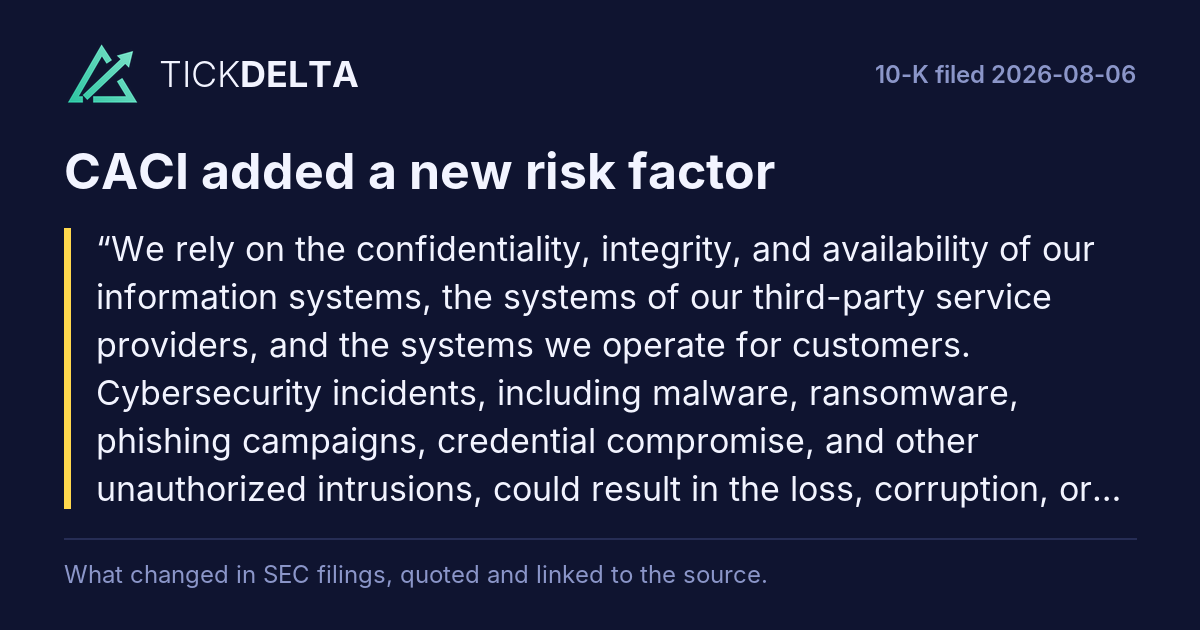
We rely on the confidentiality, integrity, and availability of our information systems, the systems of our third-party service providers, and the systems we operate for customers. Cybersecurity incidents, including malware, ransomware, phishing campaigns, credential compromise, and other unauthorized intrusions, could result in the loss, corruption, or exposure of data or disruptions to our operations or those of our customers. Consistent with industry trends, we continue to experience attempts to gain unauthorized access to our systems and information. Although past incidents have not had a material adverse impact and we actively invest in detection, response, and mitigation capabilities, the nature of these threats continues to evolve, and we cannot predict the impact of any future event. A significant cybersecurity incident could result in operational delays, remediation costs, reputational harm, legal or regulatory exposure, or the loss of current or future business.
Our operations depend on the performance and reliability of our internal networks, data centers, communication systems, critical facilities, and utilities. Systems failures, including software defects, hardware malfunctions, third‑party service outages, natural disasters, power disruptions, or other physical or environmental events, could interrupt our ability to perform on customer contracts or conduct normal business operations. Our property and business interruption insurance may be inadequate to compensate us for all resulting losses. In addition, the systems and networks we maintain for our customers, even when designed with redundancy and resiliency features, may also experience failures or service interruptions. If these systems fail or are disrupted, we could face claims for damages, contract termination, or loss of revenue. Any such event could cause our actual results to differ materially and adversely from those anticipated.
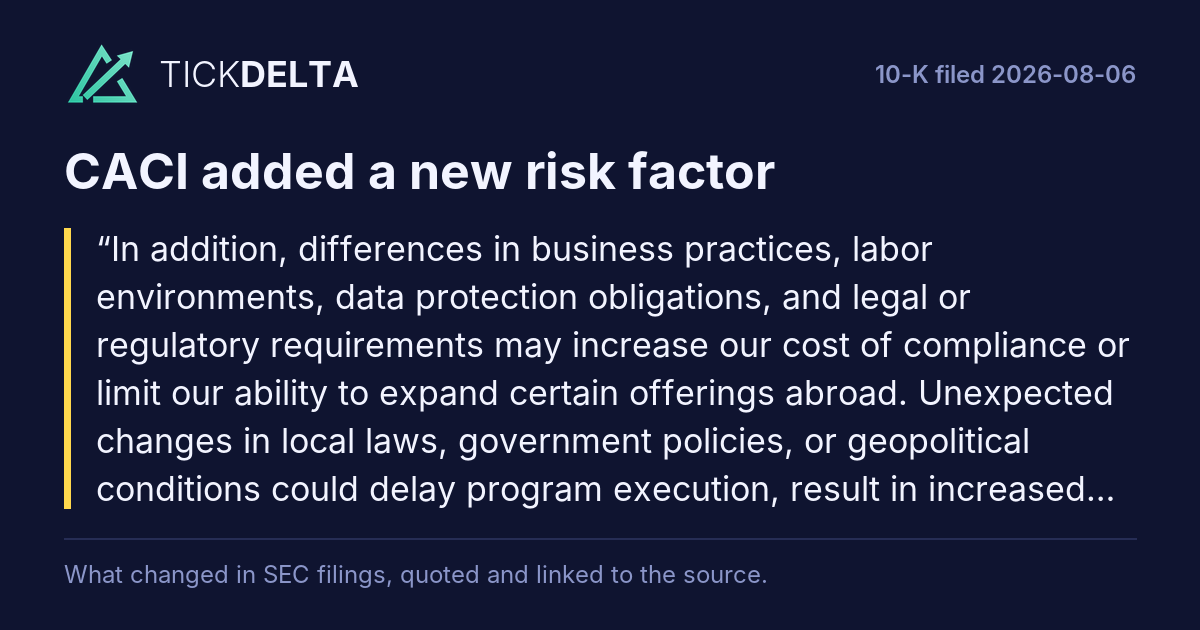
In addition, differences in business practices, labor environments, data protection obligations, and legal or regulatory requirements may increase our cost of compliance or limit our ability to expand certain offerings abroad. Unexpected changes in local laws, government policies, or geopolitical conditions could delay program execution, result in increased operating expenses, or reduce the profitability of our international work. If any of these events occur, our actual results could differ materially and adversely from those anticipated.
Our integration of artificial intelligence and related technologies subjects us to operational and regulatory risks, and our failure to effectively manage these risks could have a material adverse effect on our financial results.
We use AI and machine learning technologies in certain solutions we provide to customers and in aspects of our internal operations, which requires robust governance, secure data environments, and continuous innovation. Due to the technical complexity of these emerging technologies and the highly sensitive nature of our national security and enterprise IT contracts, developing and deploying AI systems is highly complex and involves significant judgment.
Adjustments to our technological approach, security protocols, and compliance frameworks are often required as AI capabilities rapidly evolve, new vulnerabilities or algorithmic biases are discovered, and government regulations, such as executive orders and agency specific directives, are established, even though the core objectives of the performance obligation may not have changed. Flaws in underlying algorithms, vulnerabilities to data poisoning, unpredictable system outputs, or a failure to adapt to evolving federal procurement standards could necessitate costly remediation efforts, result in a loss of competitive advantage, or damage our professional reputation. Such outcomes could have a material adverse effect on our business, financial condition, results of operations, and cash flows.
In addition, competitive dynamics in the AI marketplace are evolving quickly. Rapid advancements by existing competitors, new entrants, or commercial technology firms may outpace our internal development efforts or reduce the value of certain offerings. We may also face challenges recruiting and retaining personnel with specialized skills needed to develop, test, secure, and maintain AI‑enabled systems. If we are unable to adapt to changes in AI technologies, comply with emerging regulatory requirements, or meet customer expectations for responsible and secure AI, our ability to deliver solutions, win new business, or achieve expected financial and operational results could be adversely affected.
Paragraphs in the 10-Q filed Oct 22, 2026 that were not in the one before
New in the latest 10-Q
34 paragraphs in the 10-Q filed Oct 22, 2026 with nothing like them in the 10-Q filed Apr 23, 2026 (at least half the words must differ; new numbers alone do not count). Quoted exactly, grouped by the item heading above them. This is text that changed, not a judgement of how serious it is.
10-Q
(Former name, former address and former fiscal year, if changed since last report)
Read in the 10-Q
Financial statements and notes
The results of operations for the three months ended September 30, 2026 are not necessarily indicative of the results to be expected for any subsequent interim period or for the full fiscal year. All intercompany balances and transactions have been eliminated in consolidation. Certain prior year amounts have been reclassified to conform to the current year presentation.
Read in the 10-Q
There have been no recently adopted or recently issued accounting pronouncements that are material or expected to be material to the Company’s consolidated financial statements.
Read in the 10-Q
Intangible assets, net consists of the following as of the dates presented (in thousands):
Read in the 10-Q
Inventories, net consists of the following as of the dates presented (in thousands):
Read in the 10-Q
Show the other 29
During the three months ended September 30, 2026, the Company made scheduled principal payments of $ 7.8 million on the Term Loan and $ 1.9 million and $ 2.0 million on the Term Loan B and the Term Loan B-2, which are the senior secured term loans, respectively.
Read in the 10-Q
The Company’s interest rate swap cash flow hedges receive variable rate one-month term Secured Overnight Financing Rate (SOFR), and they consist of (dollars in thousands):
Read in the 10-Q
(1) Amounts reclassified from AOCL are included in Interest expense and other, net on the condensed consolidated statements of operations.
Read in the 10-Q
We expect to reclassify net gains of $ 11.0 million from AOCL to earnings during the next twelve months.
Read in the 10-Q
As of September 30, 2026, $ 187.3 million remained available for repurchases of the Company’s common shares under the 2023 Repurchase Program.
Read in the 10-Q
On October 20, 2026, the Board of Directors approved changing the Company’s fiscal year to a calendar year. As a result, the Company will file a transition report covering the six-month transition period ending December 31, 2026.
Read in the 10-Q
While we view the current budget environment as constructive, the timing and passage of annual appropriations remain uncertain in any given government fiscal year (GFY). During periods when Congress has not enacted full-year appropriations, federal agencies operate under a continuing resolution (CR). A CR typically authorizes agencies to continue operating at prior year funding levels and may restrict new program starts or delay contract awards.
Read in the 10-Q
The scope and duration of CRs can negatively affect our business by delaying new programs, contract awards, or other customer decisions. If a CR expires without the enactment of full-year appropriations or an extension via a new CR, the federal government must cease non-essential operations (a “government shutdown”), except where continuing activities are authorized by law. We evaluate our portfolio on an ongoing basis to identify areas potentially at risk from CRs or shutdowns and to develop appropriate contingency plans.
Read in the 10-Q
On February 14, 2026, the temporary funding for DHS expired, and the department entered a shutdown. Portions of DHS operations continued due to the availability of mandatory OBBBA funding. On April 30, 2026, Congress passed full-year GFY26 funding for DHS, excluding funding for Immigration and Customs Enforcement (ICE) and Customs and Border Protection (CBP), both of which continued to rely on OBBBA funding. On June 9, 2026, Congress passed the Secure America Act (Reconciliation 2.0), providing $70 billion primarily allocated to ICE and CBP. Because this funding was enacted through reconciliation, it remains available through September 30, 2029.
Read in the 10-Q
On April 3, 2026, while the GFY26 appropriations process was still being finalized, the President submitted the GFY27 Presidential Budget Request (PBR). The GFY27 PBR proposes $1.15 trillion in discretionary defense spending, $350 billion in mandatory defense spending through a separate reconciliation bill, and $63 billion in discretionary spending for homeland security. On September 2, 2026, the President signed a CR to fund GFY27 through December 11, 2026.
Read in the 10-Q
• Increasing focus on application of technologies to defend the homeland, such as those associated with the Golden Dome program and Counter UxS Defense systems;
Read in the 10-Q
The following table summarizes cash flow information for the periods presented (in thousands):
Read in the 10-Q
Our future financial performance will be affected by many factors outside of our control, including current worldwide economic conditions, financial market conditions, and regulatory factors.
Read in the 10-Q
Legal proceedings
On June 29, 2026, the Court of Appeals directed the parties to file supplemental briefs addressing their views on the effect of the Cisco decision. The parties subsequently filed briefs as directed.
Read in the 10-Q
On August 28, 2026, the Court of Appeals issued its decision granting CACI’s petition for rehearing, vacating the March 12, 2026 decision, reversing the Court of Appeals prior entry of judgment for plaintiffs, and remanding the case to the District Court with directions to dismiss the case. The Court of Appeals will issue the mandate returning the case to the District Court for dismissal unless the Plaintiffs file a petition for rehearing and/or rehearing en banc by October 13, 2026. No petition was filed by the Plaintiffs. On October 20, 2026, the Court of Appeals issued the Mandate, returning the case to the District Court. On October 21, the District Court issued an Order reversing and vacating the Judgment entered on January 10, 2025, entering judgment in favor of CACI, and dismissing the case. The Plaintiffs have indicated that they may seek Supreme Court review of the Court of Appeals decision.
Read in the 10-Q
On July 9, 2026, CACI filed a motion to lift the stay so that CACI could file a motion to dismiss based on the Cisco decision noted above. The District Court denied that motion without prejudice, noting that the Court of Appeals had not yet determined Cisco’s affect on the Al Shimari action.
Read in the 10-Q
On August 31, 2026, CACI filed a notice in the District Court of the Court of Appeals August 28, 2026 decision in the Al Shimari action. That same day the District Court issued a show cause order, directing the Plaintiffs to file a memorandum explaining why the Cisco and Al Shimari decisions did not require dismissal of the Abbass action. Plaintiffs did so, and on September 16, 2026, CACI responded to Plaintiffs’ memo. The Abbass Plaintiffs on September 18, 2026 filed a sur-reply memorandum.
Read in the 10-Q
On October 2, 2026, the District Court orally informed the parties that the Court would wait to see if the plaintiffs in the Al Shimari case file a petition for review with the U.S. Supreme Court. If so, the District Court will await the disposition of Al Shimari by the Supreme Court. If not, the District Court will dismiss the Abbass case.
Read in the 10-Q
Other information
John S. Mengucci, the CEO, adopted a new Rule 10b5-1 trading arrangement on September 14, 2026, that will terminate no later than August 31, 2027. Under the trading arrangement, up to an aggregate of 18,400 shares of common stock are available to be sold by the broker upon reaching pricing targets defined in the trading arrangement. The trading arrangement is intended to satisfy the affirmative defense conditions of Rule 10b5-1(c).
Read in the 10-Q
On October 20, 2026, the Board of Directors (the Board) of the Company changed the Company’s fiscal year end from June 30 to December 31. In connection with the change in fiscal year, and to align the Company’s governance calendar with the new fiscal year, the Board amended the Company’s By-Laws to (i) provide that the date of the annual meeting of shareholders be fixed from time to time by the Board; (ii) provide that the Company’s fiscal year be fixed, and may be changed, from time to time by the Board; and (iii) replace the prior fixed advance notice deadline for shareholder nominations and proposals with a more customary advance notice provision. The foregoing description is qualified in its entirety by reference to the amended By-Laws.
Read in the 10-Q
The Board has set April 15, 2027 as the date of the Company’s 2027 Annual Meeting of Shareholders (the 2027 Annual Meeting), to be held at 9:30 a.m., local time, in a virtual meeting format. The Board has fixed the close of business on February 16, 2027 as the record date for the determination of shareholders entitled to notice of, and to vote at, the 2027 Annual Meeting and any adjournment or postponement thereof. Additional details regarding the virtual meeting will be set forth in the Company’s proxy statement for the 2027 Annual Meeting.
Read in the 10-Q
As the date of the 2027 Annual Meeting has changed by more than 30 calendar days from the first anniversary of the Company’s 2026 annual meeting of shareholders (held on October 15, 2026), the deadlines for the submission of shareholder proposals and director nominations previously disclosed in the Company’s 2026 proxy statement are no longer applicable. In accordance with the Securities Exchange Act of 1934, as amended (the Exchange Act), the Company is providing the following new deadlines:
Read in the 10-Q
• Proposals for inclusion in the Company’s proxy materials under Rule 14a-8. Pursuant to Rule 14a-8 under the Exchange Act, in order for a shareholder proposal to be eligible for inclusion in the Company’s proxy materials for the 2027 Annual Meeting, the proposal must be received by the Secretary of the Company at the Company’s principal executive offices no later than the close of business on December 15, 2026, which the Company has determined to be a reasonable time before it
Read in the 10-Q
expects to begin to print and send its proxy materials. Any such proposal must also satisfy the other requirements of Rule 14a-8.
Read in the 10-Q
• Nominations and other business under the Company’s By-Laws (outside Rule 14a-8). Under the Company’s amended By-Laws, for a shareholder’s notice of a director nomination or other business to be properly brought before the 2027 Annual Meeting (other than a proposal submitted for inclusion in the Company’s proxy statement under Rule 14a-8), the notice must be delivered to, or mailed and received by, the Secretary of the Company no earlier than the close of business on December 16, 2026 and no later than the close of business on the later of (i) January 15, 2027 and (ii) the tenth day following the day on which the Company first publicly announces the date of the 2027 Annual Meeting. Any such notice must comply with the requirements set forth in the By-Laws.
Read in the 10-Q
• Notice under the universal proxy rules (Rule 14a-19). In addition to satisfying the advance notice requirements of the By-Laws, a shareholder who intends to solicit proxies in support of director nominees other than the Company’s nominees must provide notice that sets forth the information required by Rule 14a-19 under the Exchange Act no later than the later of (i) February 14, 2027 and (ii) the tenth calendar day following the day on which the Company first publicly announces the date of the 2027 Annual Meeting.
Read in the 10-Q
All notices, proposals, and nominations described above should be directed to the Secretary of the Company at the Company’s principal executive offices.
Read in the 10-Q
Item 6
101. INS XBRL Instance Document (the instance document does not appear in the Interactive Data File because its XBRL tags are embedded within the Inline XBRL document).
Read in the 10-Q
104 Cover Page Interactive Data File (embedded within the Inline XBRL document and contained in Exhibit 101).
Read in the 10-Q
The 10-Q's risk factors against the 10-K
Item 1A of the 10-Q filed Oct 22, 2026 against Item 1A of the 10-K filed Aug 6, 2026.
A 10-Q repeats only the risks that changed, so a 10-K paragraph that is missing from it is not counted as removed.
Added is a paragraph with nothing like it in the 10-K, Reworded a sentence that is in both with several words changed,
Quiet changes a sentence in both where one to four words changed and one is a hedge or a modal
(cut words struck through, new words highlighted).
Text on the page, not a score; each links to the filing at sec.gov.
What the 10-Q itself says about its risk factors:Reference is made to “Risk Factors” in Part I, Item 1A, in the Registrant’s Annual Report on Form 10-K for the year ended June 30, 2026. There have been no material changes from the risk factors described in that report.
Read in the 10-Q
1 paragraph in the 10-Q's Item 1A, and none of them adds, rewords or quietly edits a paragraph of the 10-K's.
Phrases used for the first time
Two-word phrases in Risk Factors of the 10-K filed Aug 6, 2026 that are in none of the 1 earlier 10-Ks stored, back to Aug 7, 2025
Where each one is used
- program execution: Because we derive substantially all of our revenues from contracts with the federal government, the success and development of our business will continue to depend on our successful participation in federal government contract programs. Actions taken by the federal government to address government budget deficits,...
- intangible assets: We have substantial investments in goodwill and intangible assets as a result of prior acquisitions, and changes in future business conditions could cause these investments to become impaired, requiring substantial write-downs that would reduce our operating income.
- supply chain: We must observe laws and regulations relating to the formation, administration and performance of federal government contracts which affect how we do business with our customers and may impose added costs on our operations. These laws and regulations continue to evolve, and the federal government regularly updates...
- cybersecurity incidents: We work with a network of suppliers and subcontractors to provide materials, hardware, software, and other critical components necessary to perform on our contracts, and disruptions, including shortages of specialized parts, supplier capacity constraints, transportation delays, labor shortages, or the financial...
- continuing resolutions: Because we derive substantially all of our revenues from contracts with the federal government, the success and development of our business will continue to depend on our successful participation in federal government contract programs. Actions taken by the federal government to address government budget deficits,...
- existing contracts: Because we derive substantially all of our revenues from contracts with the federal government, the success and development of our business will continue to depend on our successful participation in federal government contract programs. Actions taken by the federal government to address government budget deficits,...
- several reasons: The federal government may delay payment of invoices for several reasons, including lack of appropriated funds, delays in the budget or appropriations process, or other funding constraints. We are also subject to audits or oversight activities by the Defense Contract Audit Agency (DCAA) which has the authority to...
- funds delays: The federal government may delay payment of invoices for several reasons, including lack of appropriated funds, delays in the budget or appropriations process, or other funding constraints. We are also subject to audits or oversight activities by the Defense Contract Audit Agency (DCAA) which has the authority to...
Used at least twice, small words left out. Counted, not picked: a phrase can be new because the company renamed something.
What was taken out
13 paragraphs of last year's Risk Factors with nothing like them now. The longest are quoted.
Sources
Item 1A of each 10-K and 10-Q on EDGAR, quoted exactly. Each paragraph links to the filing at sec.gov.
Also
10-K change: what was reworded or cut, section by section.
Work with it
Excel workbook · CSV. Google Sheet that stays up to date: paste =IMPORTDATA("https://tickdelta.com/company/CACI/export.csv") into a cell.