Screener / SEC EDGAR /CIK 0000887596 /10-K filed Feb 23, 2026, compared with Feb 24, 2025 /Numbers from the XBRL of the 10-Ks
Nasdaq Consumer discretionary · Restaurants

Cheesecake Factory Inc CAKE

Compare with peers Embed
The 10-K against last year's

102 changes: 6 added, 7 removed, 88 reworded, 1 quiet changes

10-K Feb 23, 2026 vs Feb 24, 2025

10-K 0001104659-26-018643 (Feb 23, 2026) vs 10-K 0001410578-25-000195 (Feb 24, 2025)

Every paragraph, and how much of it changed

One bar per paragraph, in the order of the 10-K. Height and colour show the share of its words not in the closest paragraph a year earlier; the tallest bars are new paragraphs.

Risk Factors

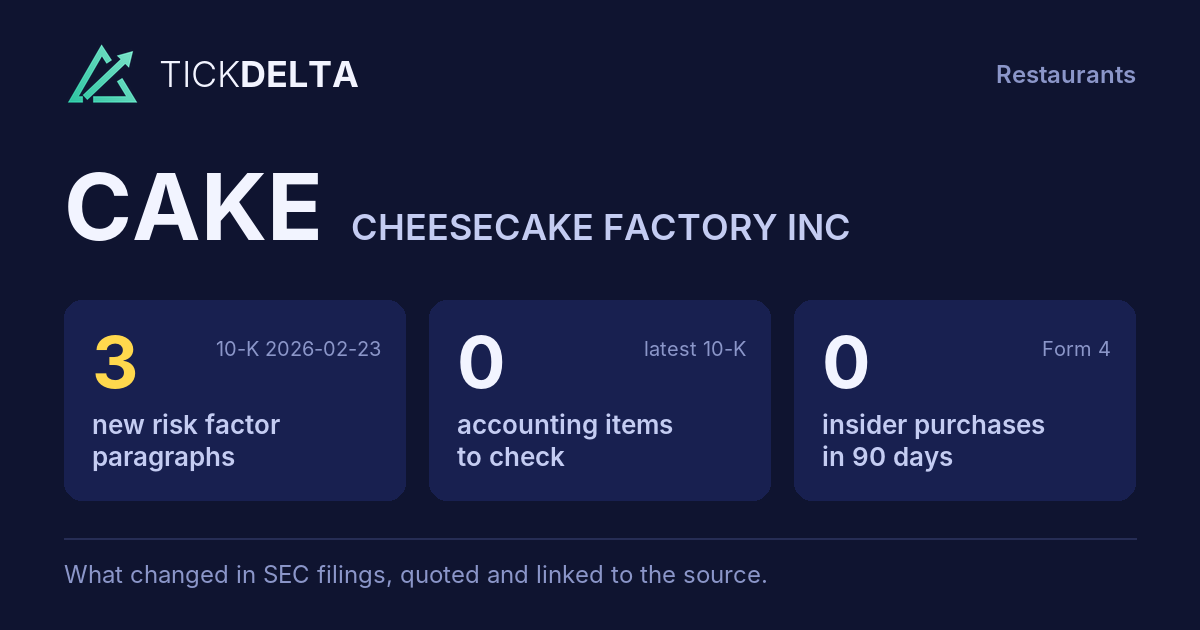
170 paragraphs · 3 new · 49 reworded · 5 gone · 10-K Feb 23, 2026 against Feb 24, 2025
New paragraph Reworded (5% of its words or more) Same or nearly
Paragraph 151 · 48% changed Every version of it
Noteholders of our outstanding Notes may, subject to limited exceptions, require us to repurchase their Notes following a “fundamental change” (which is defined in the indenture governing the Notes) at a cash repurchase price generally equal to the principal amount of the Notes to be repurchased, plus accrued and unpaid interest, if any. In addition, all conversions Additionally, our 2026 Notes mature on June 15, 2026, unless earlier repurchased, redeemed or converted. Beginning on February 17, 2026, the noteholders may convert their 2026 Notes at any time at their election until the close of business on the Notes will be settled partially or entirely in cash. We may not have enough available cash or be able to obtain financing at second scheduled trading day immediately before the time we are required to repurchase the Notes or pay the cash amounts due upon conversion. In addition, applicable law, regulatory authorities and the Loan Agreement or any future indebtedness may restrict our ability to repurchase the Notes or pay the cash amounts due upon conversion. For example, the Loan Agreement restricts us from paying cash upon conversion of the Notes in an amount that exceeds the sum of (i) the principal amount being converted and (ii) any payments received by us or any of our subsidiaries pursuant to the exercise, settlement or termination of any related permitted bond hedge transaction. maturity date.
Paragraph 119 · 43% changed Every version of it
We rely heavily on our in-restaurant and enterprise-wide computer systems and network infrastructure across our operations (“Cyber Environment”), which are vulnerable to various risks. This reliance has grown recently Our dependence on our Cyber Environment continues to grow as we our technology systems have had expanded to rely to a greater extent on systems such as include online ordering, contactless payments, our Cheesecake Rewards® program, systems supporting a remote and hybrid workforce and the like. Remote and hybrid working arrangements at our company (and at many third-party providers) also increase cybersecurity risks due to the challenges associated with managing remote computing assets and security vulnerabilities that are present in many non-corporate and home networks. (See the risk factor titled “If any of our third-party vendors experiences a failure that affects a significant aspect of our business, we may experience data loss, increased costs, operational disruption or other harm, any of which could materially adversely affect our financial performance”). performance.”) Additionally, we may incorporate traditional and generative have, to a limited extent, incorporated artificial intelligence (“AI”) solutions into our business, and may expand our use of traditional and generative AI solutions in the future. In addition to risks generally applicable to the use of any information technology, AI solutions may be susceptible to a variety of additional risks, which may increase our cybersecurity include, without limitation, AI’s use and privacy risk reliance on large datasets that could be the subject of breaches or misuse, potential liability associated with AI decision making and increase expenses. Our Cyber Environment, and the information processed therein, including confidential information and personal information, face numerous and bias in training data, potential liability for failing to comply with rapidly evolving cybersecurity risks that threaten their confidentiality, integrity and availability, including from Cybersecurity Incidents. The efficient management of our operations depends upon our ability to protect our Cyber Environment against damage from theft, casualties such as fire, power loss, telecommunications failure or other catastrophic events, laws regulating AI, as well as from Cybersecurity Incidents. We employ both internal resources ethical concerns relating to AI and external consultants to conduct auditing and testing for weaknesses in our Cyber Environment, intended to help us reduce the likelihood of any Cybersecurity Incident, and have developed a multi-discipline Cybersecurity Incident response plan designed to help ensure that our executives are accurately informed and manage, with the help of content experts, the discovery, investigation and auditing of, and recovery from any Cybersecurity Incidents that we become aware of. Despite these efforts, we can provide no assurance that these measures will successfully prevent all Cybersecurity Incidents or mitigate losses resulting from a Cybersecurity Incident. Cyberattacks are accelerating on a global basis in frequency and magnitude as threat actors are becoming increasingly sophisticated in using techniques and tools—including artificial intelligence— machine learning.
Paragraph 123 · 37% changed Every version of it
Our international licensees have access to certain elements of our intellectual property within their Cyber Environment and may not have developed adequate processes to secure their Cyber Environments against a Cybersecurity Incident and may not maintain robust discovery, investigation, auditing or recovery protocols, or have the ability to promptly and effectively respond to a Cybersecurity Incident.
Paragraph 120 · 31% changed Every version of it
We rely heavily on our in-restaurant and enterprise-wide computer systems and network infrastructure across our operations (“Cyber Environment”), which are vulnerable to various risks. This reliance has grown recently as we have had to rely to a greater extent on systems such as online ordering, contactless payments, our Cheesecake Rewards® program, systems supporting a remote and hybrid workforce and the like. Remote and hybrid working arrangements at our company (and at many third-party providers) also increase cybersecurity risks due to the challenges associated with managing remote computing assets and security vulnerabilities that are present in many non-corporate and home networks. (See the risk factor titled “If any of our third-party vendors experiences a failure that affects a significant aspect of our business, we may experience data loss, increased costs, operational disruption or other harm, any of which could materially adversely affect our financial performance”). Additionally, we may incorporate traditional and generative artificial intelligence solutions into our business, which may increase our cybersecurity and privacy risk and increase expenses. Our Cyber Environment, and the information processed therein, including confidential information and personal information, face numerous and evolving cybersecurity risks that threaten their confidentiality, integrity and availability, including from Cybersecurity Incidents. The efficient management of our operations depends upon our ability to protect our Cyber Environment against damage from theft, casualties such as fire, power loss, telecommunications failure or other catastrophic events, as well as from Cybersecurity Incidents. We employ both internal resources and external consultants to conduct auditing and testing for weaknesses in our Cyber Environment, intended to help us reduce the likelihood of any Cybersecurity Incident, and have developed a multi-discipline Cybersecurity Incident response plan designed to help ensure that our executives are accurately informed and manage, with the help of content experts, the discovery, investigation and auditing of, and recovery from any Cybersecurity Incidents that we become aware of. Despite these efforts, we can provide no assurance that these measures will successfully prevent all Cybersecurity Incidents or mitigate losses resulting from a Cybersecurity Incident. Cyberattacks are accelerating on a global basis in frequency and magnitude as threat actors are becoming increasingly sophisticated in using techniques and tools—including artificial intelligence— tools, including AI, that circumvent security controls, evade detection and remove forensic evidence. As a result, we may be unable to detect, investigate, remediate or recover from future attacks or incidents, or to avoid a material adverse impact to our Cyber Environment, confidential information or business.
Paragraph 107 · 30% changed Every version of it
We are involved in various legal proceedings, including litigation, arbitration and other claims, investigations, inspections, audits, inquiries and similar actions with private litigants and other government governmental authorities. Legal These proceedings, including especially those involving class or collective actions actions, can be expensive expensive, time consuming, and disruptive. Some of these suits disruptive to our operations. Certain cases may purport seek large or may be determined to be class or collective actions and/or involve parties seeking large and/or indeterminate amounts and may remain unresolved for several years. For example, we are currently a defendant in a number of cases containing asserting class or collective-action allegations, or both, in which the plaintiffs have brought collective action claims under federal and state wage and hour laws. Significant legal fees and costs in costs, or adverse judgments and settlements arising from complex class action litigation or an adverse judgment representative litigation, where such amounts are uninsured or settlement that are not insured or are in excess of exceed available insurance coverage coverage, can materially and adversely affect our financial performance.
Paragraph 128 · 28% changed Every version of it
Further, we are subject to laws, regulations and standards covering marketing, advertising and other activities conducted by telephone, email, mobile devices and the Internet, such as the Controlling the Assault of Non-Solicited Pornography and Marketing Act (“the CAN-SPAM Act”), the Telephone Consumer Protection Act (the “TCPA”) and similar state consumer protection and communication privacy laws, such as California’s Invasion of Privacy Act (“CIPA”). Numerous class-action suits under federal and state laws have been filed in recent years against companies who conduct telemarketing and/or SMS texting programs, with many resulting in multi-million-dollar settlements to the plaintiffs. There has also been a noticeable uptick in class actions wherein plaintiffs have utilized a variety of laws, including state wiretapping laws such as CIPA, in relation to companies’ use of tracking technologies, such as cookies and pixels. Actual or perceived failures to comply with requirements relating to marketing, advertising, electronic communications and the Internet, could subject us to legal proceedings, which could expose us to adverse publicity, substantial monetary damages and legal defense costs, injunctive relief and fines or penalties.
Paragraph 50 · 23% changed Every version of it
We continue to evaluate the possibility of entering into similar short-term and long-term arrangements for other commodities and periodically evaluate hedging vehicles, such as direct financial instruments, to assist us in managing risk and variability associated with such commodities. As of the end of fiscal 2024, 2025, we had no hedging contracts in place. Products and services for which we have not entered into contracts can be subject to unforeseen supply and cost fluctuations, which at times may be significant. Additionally, the cost of commodities subject to governmental regulation, such as dairy and corn, can be especially susceptible to price fluctuation. Goods we purchase on the international market may be subject to even greater fluctuations in cost and availability, which could result from a variety of factors, including the value of the U.S. dollar relative to other currencies, international trade disputes, tariffs, geopolitical unrest and varying global demand. New or increased tariffs and other changes in U.S. trade policy could trigger retaliatory actions, including increased tariffs, by affected countries.
Paragraph 56 · 23% changed Every version of it
If we are unable to attract and retain qualified personnel, including due to increasingly competitive labor markets, our restaurants and bakery operations could be short staffed, we may be forced to incur overtime expenses, and our ability to operate and expand our concepts effectively, grow our business and revenues and meet our customers’ demand could be limited, any of which could materially adversely affect our financial performance. These risks may be exacerbated by anticipated changes to and the enforcement of immigration laws and regulations. (See the risk factor titled “Changes in, or any failure to comply with, applicable laws or regulations could materially adversely affect our ability to operate our restaurants and/or increase our cost to do so, which could materially adversely affect our financial performance.”)

MD&A

80 paragraphs · 3 new · 41 reworded · 2 gone · 10-K Feb 23, 2026 against Feb 24, 2025
New paragraph Reworded (5% of its words or more) Same or nearly
Paragraph 17 · 46% changed
Revenues increased 4.1% 4.7% to $3,751.8 million for fiscal 2025 compared to $3,581.7 million for fiscal 2024 compared to $3,439.5 million for fiscal 2023, 2024, primarily due to additional revenue related to new restaurant openings openings. As part of our annual assessment of gift card breakage during fiscal 2025, we had a change in historical redemption pattern related to gift cards and an increase aligned the recognition of gift card breakage to the updated estimated redemption pattern. As a result, in comparable restaurant sales. fiscal 2025, we recognized $17.3 million of additional gift card breakage.
Paragraph 56 · 37% changed
(2) Represents liability for uncertain tax positions. December 30, 2025, we were in compliance with all covenants in effect at that date. (See Note 17 10 of Notes to Consolidated Financial Statements in Part IV, Item 15 of this report for further discussion of income taxes.) our debt.)
Paragraph 7 · 28% changed
Our strategy is driven by our commitment to customer satisfaction deliver exceptional food and hospitality, and is focused centered primarily on menu innovation, service and operational execution to differentiate ourselves from other restaurant concepts, our concepts and drive competitively strong performance that is sustainable. sustainable over the long-term. Financially, we are focused on prudently managing expenses at our restaurants, bakery facilities and corporate support center, and while leveraging our size scale, purchasing power and operational discipline to make the best use of our purchasing power. support financial performance.
Paragraph 60 · 26% changed
On October 26, 2022, Under authorization by our Board increased the authorization to repurchase our common stock by 5.0 million shares up to 61.0 million shares. Under this authorization, shares of our common stock, we have cumulatively repurchased 57.1 59.9 million shares at a total cost of $1,829.7 $1,983.6 million, excluding excise tax through December 31, 2024. 30, 2025. In the first quarter of fiscal 2025, we used approximately $130.0 million of the net proceeds from the 2030 Note issuance to repurchase approximately 2.4 million shares of our common stock. In total, we repurchased 2.9 million shares at a cost of $153.9 million, excluding excise tax, during fiscal 2025. We repurchased 0.5 million shares at a cost of $18.0 million, excluding excise tax, during fiscal 2024 compared to 1.4 million shares at a cost of $46.1 million, excluding excise tax, during fiscal 2023. 2024.
Paragraph 47 · 25% changed
Our corporate financial objectives are to maintain a sufficiently strong and conservative balance sheet to support our operating initiatives and unit growth while maintaining financial flexibility to provide the financial resources necessary to protect and enhance the competitiveness of our restaurant and bakery brands and to provide a prudent level of financial capacity to manage the risks and uncertainties of conducting our business operations under various economic and industry cycles. Typically, cash flows generated from operating activities are our principal source of liquidity, which we use to finance our restaurant expansion plans, ongoing maintenance of our restaurants and bakery facilities and investment in our corporate and information technology infrastructures.
Paragraph 30 · 24% changed
During fiscal 2024, 2025, we recorded impairment $23.0 million of assets and lease terminations expense of $13.6 million primarily related to the impairment of long-lived assets for one The Cheesecake Factory (previously partially impaired) North Italia, one Grand Lux Cafe and six four Other FRC locations (one previously partially impaired), partially offset by impaired) and lease termination income, expense, net for four The Cheesecake Factory restaurants (including related to two relocations), one Grand Lux Cafe location, Cafes (one that closed in fiscal 2023 and one Flower Child location, one Social Monk location that closed in early 2026) and one Other FRC location (that closed in early fiscal 2025). 2026).
Paragraph 10 · 23% changed
For The Cheesecake Factory concept, our strategy is to increase comparable restaurant sales by growing average check while maintaining customer traffic through (1) continuing to offer innovative, high quality menu items that offer customers a wide range of options in terms of flavor, price and value, (2) focusing on service and hospitality with the goal of delivering an exceptional dining experience and (3) continuing to provide our customers with convenient options for off-premise dining. We are continuing our efforts on a number of initiatives, including menu innovation, increasing customer throughput in our restaurants, leveraging our gift card program, partnering with a third party to provide delivery services for our restaurants, increasing customer awareness of our online ordering capabilities and improving the pick-up experience, augmenting our marketing programs, including our Cheesecake Rewards® program, enhancing our training programs and leveraging insights from our customer satisfaction measurement platform.
Paragraph 50 · 20% changed
​ ​ ​ ​ ​ ​ ​ ​ ​ Fiscal Year ​ ​ ​ ​ 2025 ​ ​ ​ 2024 2023 ​ ​ ​ ​ ​ ​ ​ Cash provided by operating activities ​ $ 301.3 ​ $ 268.3 $ 218.4 Additions to property and equipment ​ ​ (146.2) ​ ​ (160.4) ​ (151.6) Acquisition-related deferred consideration and compensation ​ — ​ (24.2) Borrowings on credit facility ​ — ​ 15.0 Repayments on credit facility ​ ​ (110.0) ​ ​ (20.0) Proceeds from long-term convertible debt ​ (15.0) ​ 575.0 ​ ​ — Repayment on long-term convertible debt, including premium on extinguishment ​ ​ (289.8) ​ ​ — Issuance cost associated with long-term debt ​ ​ (16.5) ​ ​ — Proceeds from exercise of stock options ​ ​ 24.6 ​ ​ 12.5 ​ — Common stock dividends paid ​ ​ (52.2) ​ ​ (53.0) ​ (53.2) Treasury stock purchases, inclusive of excise tax ​ ​ (153.9) ​ ​ (18.2) ​ (46.1)

A paragraph is matched with the one last year that shares the most of its words; under half in common makes it new. The paragraphs shown are the 8 reworded the most in each section.

The paragraph that changed most in each section

The redline

Marked against last year's 10-K: cut words struck through, new words highlighted.

Accounting Policies726 words changed in this paragraph; it is 38% similar to last year's version.
Diluted net income per share is computed by dividing net income by the weighted-average number of common stock equivalents outstanding for the period. Common stock equivalents for our convertible senior notes due 2026 (“2026 Notes”) and our convertible senior notes due 2030 (“2030 Notes”) are determined by application of the if-converted method, and common stock equivalents for outstanding stock options, restricted stock and restricted stock units are determined by the application of the treasury stock method. Fiscal Year 2025 2024 2023 (In thousands, except per share data) Net income $ 148,427 $ 156,783 $ 101,351 Basic weighted average shares outstanding 46,786 47,789 48,324 Dilutive effect of equity awards (1) 1,765 1,185 726 Diluted weighted average shares outstanding 48,551 48,974 49,050 Basic net income per share $ 3.17 $ 3.28 $ 2.10 Diluted net income per share $ 3.06 $ 3.20 $ 2.07 (1) Shares of common stock equivalents related to outstanding stock options, restricted stock and restricted stock units of 1.0 million, 2.2 million and 2.9 million for fiscal 2025, 2024 and 2023, respectively, were excluded from the diluted calculation due to their anti-dilutive effect. No shares of common stock equivalents related to the 2026 Notes or 2030 Notes were included in the diluted calculation due to their anti-dilutive effect. Comprehensive Income Comprehensive income includes all changes in equity during a period except those resulting from investment by and distribution to owners. Our comprehensive income consists of net income and translation gains/(losses) related to our Canadian restaurant operations. Foreign Currency The Canadian dollar is the functional currency for our Canadian restaurant operations. Revenue and expense accounts are translated into U.S. dollars using the average exchange rates during the reporting period. Assets and liabilities are translated using the exchange rates in effect at the reporting period end date. Equity accounts are translated at historical rates, except for the change in retained earnings which is the result of the income statement translation process. Translation gains and losses are reported as a separate component in our consolidated statements of comprehensive income and would only be realized upon the sale or upon complete or substantially complete liquidation of the business. Gains and losses from foreign currency transactions are recognized in our consolidated statements of income in other income, net. Recent Accounting Pronouncements Recently Adopted Accounting Standards In November 2023, the FASB issued ASU 2023-07, Segment Reporting (Topic 280): Improvements to Reportable Segment Disclosures, which updates reportable segment disclosure requirements primarily through enhanced disclosures about significant segment expenses. The amendment is effective for fiscal years beginning after December 15, 2023, and for interim periods within fiscal years beginning after December 15, 2024. Early adoption is permitted. The amendment should be applied retrospectively to all prior periods presented in the financial statements. We adopted this standard as of the end of fiscal 2024 and such adoption did not have a significant impact on our disclosures. Recently Issued Accounting Standards Tax Legislation In December 2023, the FASB issued ASU 2023-09, Income Taxes (Topic 740): Improvements to Income Tax Disclosures, which updates income tax disclosures related to the rate reconciliation and requires disclosure of income taxes paid by jurisdiction. The amendment also provides further disclosure comparability. The amendment is effective for fiscal years beginning after December 15, 2024. Early adoption is permitted. The amendment should be applied prospectively. However, retrospective application is permitted. Management is currently evaluating We adopted this ASU to determine its standard as of the end of fiscal 2025 using the prospective transition method and such adoption did not have a significant impact on our disclosures. In November 2024, On July 4, 2025, the FASB issued ASU 2024-03, Income Statement - Reporting Comprehensive Income - Expense Disaggregation Disclosures (Subtopic 220-40), which requires more detailed disclosures U.S. enacted H.R. 1 (a bill “To provide for reconciliation pursuant to Title II of H. Con. Res. 14”). The legislation includes several provisions that may impact the timing and magnitude of certain categories tax deductions and provides for the permanent extension of expenses such as inventory purchases, employee compensation several business tax benefits originally introduced under the 2017 Tax Cuts and depreciation that are components Jobs Act. The enactment of existing expense captions presented H.R. 1 did not have a material impact on the face of the income statement. The amendment is effective for fiscal years beginning after December 15, 2026. Early adoption is permitted. The amendment should be applied prospectively. However, retrospective application is permitted. Management is currently evaluating this ASU to determine its impact on our disclosures. In November 2024, the FASB issued ASU 2024-04, Debt- Debt with Conversion and Other Options (Topic 470): Induced Conversions of Convertible Debt Instruments, which clarifies the requirements for determining whether certain settlements of convertible debt instruments should be accounted for as an induced conversion. The amendments in this update also clarify that the induced conversion guidance applies to a convertible debt instrument that is not currently convertible as long as it had a substantive conversion feature as of both its issuance date and the date the inducement offer is accepted. The amendment is effective for fiscal years beginning after December 15, 2025. Early adoption is permitted. The amendment should be applied prospectively. However, retrospective application is permitted. Management is currently evaluating this ASU to determine its impact on our consolidated financial statements. 2. Fair Value Measurements Fair value measurements are estimated based on valuation techniques and inputs categorized as follows: Level 1: Quoted prices in active markets for identical assets or liabilities Level 2: Observable inputs other than quoted prices in active markets for identical assets and liabilities Level 3: Unobservable inputs in which little or no market activity exists, therefore requiring the Company to develop its own assumptions

Source: 10-K text, Note 1 – Summary of Significant Accounting Policies, 10-K 0001104659-26-018643 vs 10-K text, Note 1 – Summary of Significant Accounting Policies, 10-K 0001410578-25-000195

Risk Factors324 words changed in this paragraph; it is 47% similar to last year's version.
We rely heavily on our in-restaurant and enterprise-wide computer systems and network infrastructure across our operations (“Cyber Environment”), which are vulnerable to various risks. This reliance has grown recently Our dependence on our Cyber Environment continues to grow as we our technology systems have had expanded to rely to a greater extent on systems such as include online ordering, contactless payments, our Cheesecake Rewards® program, systems supporting a remote and hybrid workforce and the like. Remote and hybrid working arrangements at our company (and at many third-party providers) also increase cybersecurity risks due to the challenges associated with managing remote computing assets and security vulnerabilities that are present in many non-corporate and home networks. (See the risk factor titled “If any of our third-party vendors experiences a failure that affects a significant aspect of our business, we may experience data loss, increased costs, operational disruption or other harm, any of which could materially adversely affect our financial performance”). performance.”) Additionally, we may incorporate traditional and generative have, to a limited extent, incorporated artificial intelligence (“AI”) solutions into our business, and may expand our use of traditional and generative AI solutions in the future. In addition to risks generally applicable to the use of any information technology, AI solutions may be susceptible to a variety of additional risks, which may increase our cybersecurity include, without limitation, AI’s use and privacy risk reliance on large datasets that could be the subject of breaches or misuse, potential liability associated with AI decision making and increase expenses. Our Cyber Environment, and the information processed therein, including confidential information and personal information, face numerous and bias in training data, potential liability for failing to comply with rapidly evolving cybersecurity risks that threaten their confidentiality, integrity and availability, including from Cybersecurity Incidents. The efficient management of our operations depends upon our ability to protect our Cyber Environment against damage from theft, casualties such as fire, power loss, telecommunications failure or other catastrophic events, laws regulating AI, as well as from Cybersecurity Incidents. We employ both internal resources ethical concerns relating to AI and external consultants to conduct auditing and testing for weaknesses in our Cyber Environment, intended to help us reduce the likelihood of any Cybersecurity Incident, and have developed a multi-discipline Cybersecurity Incident response plan designed to help ensure that our executives are accurately informed and manage, with the help of content experts, the discovery, investigation and auditing of, and recovery from any Cybersecurity Incidents that we become aware of. Despite these efforts, we can provide no assurance that these measures will successfully prevent all Cybersecurity Incidents or mitigate losses resulting from a Cybersecurity Incident. Cyberattacks are accelerating on a global basis in frequency and magnitude as threat actors are becoming increasingly sophisticated in using techniques and tools—including artificial intelligence— machine learning.

Source: Item 1A, 10-K 0001104659-26-018643 vs Item 1A, 10-K 0001410578-25-000195

MD&A98 words changed in this paragraph; it is 70% similar to last year's version.
​ ​ ​ ​ ​ ​ ​ ​ ​ ​ ​ 2025 ​ ​ ​ 2024 2023 ​ ​ ​ ​ ​ ​ ​ Net income ​ $ 148,427 ​ $ 156,783 $ 101,351 Impairment of assets and lease termination expenses ​ ​ 22,990 ​ ​ 13,647 ​ 29,464 Acquisition-related contingent consideration, compensation and amortization expenses ​ ​ 14,449 ​ ​ 2,429 Gift card adjustment, net (1) ​ 11,686 (9,396) ​ ​ — Loss on extinguishment of debt (2) ​ ​ 15,891 ​ ​ — Uncertain tax positions (3) ​ ​ 2,023 ​ ​ — Tax effect of adjustments (1) (4) ​ ​ (11,423) ​ ​ (4,180) ​ (10,699) Adjusted net income ​ $ 182,961 ​ $ 168,679 $ 131,802 ​ ​ ​ ​ ​ ​ ​ Diluted net income per common share ​ $ 3.06 ​ $ 3.20 $ 2.07 Impairment of assets and lease termination expenses ​ ​ 0.47 ​ ​ 0.28 ​ 0.61 Acquisition-related contingent consideration, compensation and amortization expenses ​ ​ 0.30 ​ ​ 0.05 Gift card adjustment, net (1) ​ 0.24 ​ (0.19) ​ ​ — Loss on extinguishment of debt (2) ​ ​ 0.33 ​ ​ — Uncertain tax positions (3) ​ ​ 0.04 ​ ​ — Tax effect of adjustments (1) (4) ​ (0.24) ​ ​ (0.09) ​ (0.22) Adjusted diluted net income per common share (2) (5) ​ $ 3.77 ​ $ 3.44 $ 2.69

Source: Item 7, 10-K 0001104659-26-018643 vs Item 7, 10-K 0001410578-25-000195

Legal Proceedings21 words changed in this paragraph; it is 89% similar to last year's version.
On June 7, 2024, the Internal Revenue Service (“IRS”) issued its examination report for tax years 2015 through 2020 in which it proposed to disallow a portion of our depreciation deductions and Domestic Production Activity Deductions domestic production activity deductions and to assess penalties. On August 12, 2024, we submitted Protest Memoranda protest memoranda indicating our disagreement with a majority of the findings in the examination report, and our case is now under the jurisdiction of the Appeals Division. We expect to hold an opening conference with Division (“Appeals”). Appeals in the second quarter of conferences were held during fiscal 2025. Based 2025, and based on the current status of this matter, we have reserved an immaterial amount.

Source: Item 3, via Note 13 – Commitments and Contingencies, 10-K 0001104659-26-018643 vs Item 3, via Note 13 – Commitments and Contingencies, 10-K 0001410578-25-000195

Sentences and paragraphs added, removed or reworded

Every change, by type

Sentences and paragraphs of CAKE's Risk Factors and MD&A, 10-K Feb 23, 2026 against 10-K Feb 24, 2025. Each links to the text at sec.gov.

Quiet changes are sentences kept from last year with one to four words changed, at least one of them a hedge, a modal or a qualifier (may, could, will, not, significant, material…). A year or date rolling forward is not counted.

The full word list

adverse, adversely, all, although, anticipate, anticipates, any, approximately, believe, believes, can, cannot, certain, could, expect, expects, generally, however, if, intend, intends, largely, likely, many, material, materially, may, might, most, must, never, no, not, possible, primarily, probable, should, significant, significantly, some, substantial, substantially, unlikely, will, would

AddedRisk Factors
tariffs and other circumstances during fiscal 2025, we, along with the restaurant industry and broader market for beef, experienced high inflation around beef prices compared to historical norms, and we expect this trend to continue into the foreseeable future. Furthermore, a significant portion of our imported items experienced price increases and volatility due to tariffs and regulatory changes in 2025. We expect this trend to continue into 2026.
Read it in 10-K Feb 23, 2026 at sec.gov
RemovedRisk Factors
legal citizenship or residency requirements could result in a disruption in our work force, sanctions against us and adverse publicity, any of which could materially adversely affect our financial performance.
Read it in 10-K Feb 24, 2025 at sec.gov
RemovedRisk Factors
In order to leverage our internal resources and information technology infrastructure, and to support our business continuity and disaster recovery planning efforts, we rely on third-party vendors to provide some of our essential business processes. For example, we rely on a network of third-party distribution warehouses to deliver ingredients and other materials to our restaurants. In some instances, these processes rely on technology and may be outsourced to the vendor in their entirety and in other instances we utilize these vendors’ externally-hosted business applications. Our vendors’ systems are vulnerable to a variety of risks, including,
Read it in 10-K Feb 24, 2025 at sec.gov
RemovedRisk Factors
We are subject to lawsuits, administrative proceedings and claims that arise in the ordinary course of business. These matters typically involve claims by customers, staff members and others regarding issues such as food-borne illness, food safety, premises
Read it in 10-K Feb 24, 2025 at sec.gov
RemovedRisk Factors
and, in turn, may adversely impact our business, operating results, and financial condition. Environmental and social matters have also been the subject of increased scrutiny by regulators in different jurisdictions which may expose us to potential regulatory scrutiny or enforcement actions related to these activities.
Read it in 10-K Feb 24, 2025 at sec.gov
RemovedRisk Factors
that circumvent security controls, evade detection and remove forensic evidence. As a result, we may be unable to detect, investigate, remediate or recover from future attacks or incidents, or to avoid a material adverse impact to our Cyber Environment, confidential information or business.
Read it in 10-K Feb 24, 2025 at sec.gov
Show the other 30
RewordedRisk Factors
We face food safety risk, including the risk of food-borne illness and food contamination (including allergen cross contamination), which are common both in the restaurant industry and the food supply chain. chain, including, those caused by pathogens, such as coronavirus, Ebola, mad cow disease, SARS, swine flu, avian influenza, norovirus or other virus or bacteria, such as hepatitis A, norovirus, listeria, Campylobacter, Clostridium perfringens, salmonella or E.coli, and those that may be caused by parasites, other toxins or food safety issues.
Read it in 10-K Feb 23, 2026 at sec.gov
RewordedRisk Factors
For example, we may be are subject to various disclosure requirements (such as information on greenhouse gas emissions, climate risks, use of offsets, and emissions reduction claims) from the State of California, the International Sustainability Standards Board (ISSB) global sustainability standards, and may be subject to further disclosure requirements to the extent adopted by jurisdictions in which we operate, as well as the SEC’s climate disclosure rules, if they take effect, among other regulations or requirements. operate.
Read it in 10-K Feb 23, 2026 at sec.gov
RewordedRisk Factors
However, our menu price increases may be insufficient to meaningfully offset increased costs and may, if not accepted by customers, result in reduced customer traffic and unfavorable menu mix shifts (i.e., customers reducing their spend by purchasing fewer menu items or lower cost menu items). items) (See the risk factor titled “Our inability to anticipate and react effectively to changes in the costs of key operating resources may increase our cost of doing business, which could materially adversely affect our financial performance.”)
Read it in 10-K Feb 23, 2026 at sec.gov
RewordedRisk Factors
The demand for and availability and price of certain food items may be adversely impacted if a pathogen, such as coronavirus, Ebola, mad cow disease, SARS, swine flu, avian influenza, norovirus any food-borne illness or other virus or bacteria, such as salmonella or E.coli, or if parasites or other toxins infect food contamination infects or are believed to have infected the food supply, including the food supply chain for our restaurants or bakery facilities.
Read it in 10-K Feb 23, 2026 at sec.gov
RewordedRisk Factors
Significant legal fees and costs in costs, or adverse judgments and settlements arising from complex class action litigation or an adverse judgment representative litigation, where such amounts are uninsured or settlement that are not insured or are in excess of exceed available insurance coverage coverage, can materially and adversely affect our financial performance.
Read it in 10-K Feb 23, 2026 at sec.gov
RewordedRisk Factors
For example, in July 2024 October 2025 we experienced limited disruptions to our information technology systems as part of the CrowdStrike software update Amazon Web Services outage that resulted in global information technology outages, including disruptions to our ability to process customer payments at certain impacted thousands of our restaurants. businesses.
Read it in 10-K Feb 23, 2026 at sec.gov
RewordedRisk Factors
(See the risk factor titled “If any of our third-party vendors experiences a failure that affects a significant aspect of our business, we may experience data loss, increased costs, operational disruption or other harm, any of which could materially adversely affect our financial performance”). performance.”) Additionally, we have, to a limited extent, incorporated artificial intelligence (“AI”) solutions into our business, and may expand our use of traditional and generative AI solutions in the future.
Read it in 10-K Feb 23, 2026 at sec.gov
RewordedRisk Factors
This reliance has grown recently Our dependence on our Cyber Environment continues to grow as we our technology systems have had expanded to rely to a greater extent on systems such as include online ordering, contactless payments, our Cheesecake Rewards® program, systems supporting a remote and hybrid workforce and the like.
Read it in 10-K Feb 23, 2026 at sec.gov
RewordedRisk Factors
Changes in applicable U.S. or foreign tax laws and regulations, such as the 2017 enactment of Federal legislation commonly referred to as the Tax Cuts and Jobs Act, The Coronavirus Aid, Relief, and Economic Security Act of 2020 , and 2020, the Inflation Reduction Act of 2022 2022, and H.R. 1, commonly referred to as H.R.1, passed the 119th Congress and was signed into law on July 4, 2025 (collectively, the “Tax Acts”), or their interpretation and application, including the possibility of retroactive effect and changes to state tax laws that may occur in response to the Tax Acts, could affect our tax expense and profitability.
Read it in 10-K Feb 23, 2026 at sec.gov
RewordedRisk Factors
(See the risk factor titled “Failure to appropriately address environmental and social matters could adversely affect our brand, business, results of operations and financial condition.”) We may incur significant additional costs and require operational changes to comply with these laws and regulations and may face fines, penalties or other sanctions, adverse publicity and incur legal liability in the event of our failure to do so.
Read it in 10-K Feb 23, 2026 at sec.gov
RewordedRisk Factors
As of December 31, 2024, 30, 2025, we had approximately $455.0 $644.0 million in principal amount of consolidated indebtedness, including $345.0 $69.0 million aggregate principal amount of convertible senior notes due 2026 (“Notes”). (“2026 Notes”) and $575.0 million aggregate principal amount of convertible senior notes due 2030 (“2030 Notes”).
Read it in 10-K Feb 23, 2026 at sec.gov
RewordedRisk Factors
For example, we transmit confidential credit card information in connection with credit card transactions, we are required to collect and maintain certain personal information in connection with our employment practices, including the administration of our benefit plans, and we collect information for a variety of other reasons, including, in relation to connection with our Cheesecake Rewards® program.
Read it in 10-K Feb 23, 2026 at sec.gov
AddedMD&A
In fiscal 2025, we recorded a $15.9 million loss on early debt extinguishment. On February 28, 2025, we repurchased approximately $276.0 million aggregate principal amount of the 2026 Notes (as defined below) for aggregate consideration of $289.8 million, which included a premium of $13.8 million. The repurchase was accounted for as a debt extinguishment. In addition, we recorded $2.1 million of unamortized issuance costs. (See Note 10 of Notes to Consolidated Financial Statements in Part IV, Item 15 of this report for further discussion on our debt.)
Read it in 10-K Feb 23, 2026 at sec.gov
AddedMD&A
(1) Represents gift card breakage revenue of $17.3 million as a result of a change in historical redemption patterns, partially offset by a non-recurring $7.9 million write-down of gift card inventory.
Read it in 10-K Feb 23, 2026 at sec.gov
AddedMD&A
(3) Represents a reserve for uncertain tax position related to tenant improvement allowances and Section 199 deductions. Uncertain tax positions taken in a tax return are recognized in the financial statements when it is more likely than not that the position will be sustained upon examination by tax authorities based on technical merits, taking into account available administrative remedies and litigation.
Read it in 10-K Feb 23, 2026 at sec.gov
RemovedMD&A
During fiscal 2023, we made payments of $11.3 million for deferred consideration related to the FRC acquisition. During fiscal 2023, we also made payments of $13.0 million for deferred consideration and contingent consideration and compensation related to the FRC acquisition. During fiscal 2024, we made payments of $6.5 million for contingent consideration and compensation related to the FRC acquisition that was included in cash provided by operating activities.
Read it in 10-K Feb 24, 2025 at sec.gov
RemovedMD&A
The FRC acquisition agreement included a contingent consideration provision, a portion of which was considered part of the acquisition consideration and the remainder of which was considered future compensation expense. This contingent consideration and
Read it in 10-K Feb 24, 2025 at sec.gov
RewordedMD&A
During fiscal 2024, 2025, we recorded impairment $23.0 million of assets and lease terminations expense of $13.6 million primarily related to the impairment of long-lived assets for one The Cheesecake Factory (previously partially impaired) North Italia, one Grand Lux Cafe and six four Other FRC locations (one previously partially impaired), partially offset by impaired) and lease termination income, expense, net for four The Cheesecake Factory restaurants (including related to two relocations), one Grand Lux Cafe location, Cafes (one that closed in fiscal 2023 and one Flower Child location, one Social Monk location that closed in early 2026) and one Other FRC location (that closed in early fiscal 2025). 2026).
Read it in 10-K Feb 23, 2026 at sec.gov
RewordedMD&A
Cash flows from operations increased by $49.9 $33.0 million from fiscal 2023 2024 primarily due to higher net income after excluding non-cash activity, timing of operating lease commencements and a decrease in inventory levels, partially offset by lower gift card liabilities, a decrease in prepaid expenses during fiscal 2024 due to a higher balance in fiscal 2023 related to the timing of January rent payments, partially offset by lower impairment of assets payments and lease termination expenses, a payment of deferred consideration and compensation related to the FRC acquisition in excess of acquisition-date fair value and an increase in inventory levels. higher income tax payments.
Read it in 10-K Feb 23, 2026 at sec.gov
RewordedMD&A
We opened 25 restaurants in fiscal 2025 comprised of four The Cheesecake Factory, six North Italia, nine Other FRC, and six Flower Child locations compared to 23 restaurants in fiscal 2024 comprised of three The Cheesecake Factory (including two relocations), six North Italia, eight Other FRC, and six Flower Child locations compared to 16 restaurants in fiscal 2023 comprised of six The Cheesecake Factory, three North Italia, six Other FRC, and one Flower Child location. locations.
Read it in 10-K Feb 23, 2026 at sec.gov
RewordedMD&A
We opened 25 restaurants in fiscal 2025 comprised of four The Cheesecake Factory, six North Italia, nine Other FRC and six Flower Child locations compared to 23 restaurants in fiscal 2024 comprised of three The Cheesecake Factory, six North Italia, eight Other FRC and six Flower Child locations compared to 16 restaurants in fiscal 2023 comprised of six The Cheesecake Factory, three North Italia, six Other FRC and one Flower Child location. locations.
Read it in 10-K Feb 23, 2026 at sec.gov
RewordedMD&A
In fiscal 2024, 2025, we recorded $4.3 a $10.5 million of amortization, partially offset by a $1.9 million decrease increase in the fair value of the contingent consideration and compensation liability primarily stemming from a change in updating the volatility factors, probability of achievement due to passage of time as well as a decrease in fiscal 2025 revenues recent performance and estimated future revenues utilized in the calculation. $3.9 million of amortization.
Read it in 10-K Feb 23, 2026 at sec.gov
RewordedMD&A
In fiscal 2024, 2025, we had an income tax provision of $14.5 million, an effective tax rate of 8.9%, compared to an income tax provision of $14.3 million, an effective tax rate of 8.3%, compared to an income tax benefit of $1.3 million, an effective tax rate of (1.3%) in fiscal 2023. 2024.
Read it in 10-K Feb 23, 2026 at sec.gov
RewordedMD&A
Excluding the impact of the additional gift card breakage recognized in fiscal 2025 (as discussed above), The Cheesecake Factory average sales per restaurant operating week increased 0.7% 0.3% to $238,146 in fiscal 2025 from $237,349 in fiscal 2024 from $235,701 in fiscal 2023. 2024.
Read it in 10-K Feb 23, 2026 at sec.gov
RewordedMD&A
This decrease was primarily due to menu price increases in excess of wage rate inflation (0.6%), and improved staffing levels (0.5%) and the benefit from gift card breakage revenue (0.2%), partially offset by higher management salaries group medical cost due to improved staffing levels (0.2%). larger claim activity (0.3%).
Read it in 10-K Feb 23, 2026 at sec.gov
RewordedMD&A
Revenues increased 4.1% 4.7% to $3,751.8 million for fiscal 2025 compared to $3,581.7 million for fiscal 2024 compared to $3,439.5 million for fiscal 2023, 2024, primarily due to additional revenue related to new restaurant openings and an increase in comparable restaurant sales. openings.
Read it in 10-K Feb 23, 2026 at sec.gov
RewordedMD&A
The increase decrease from fiscal 2023 2024 was primarily driven by decreased customer traffic of 5%, partially offset by an increase in average check of approximately 3% (based on an increase of 6% 4% in menu pricing, partially offset by a 3% 1% negative impact from mix), partially offset by decreased customer traffic of 1%. mix).
Read it in 10-K Feb 23, 2026 at sec.gov
RewordedMD&A
Under this authorization, authorization by our Board to repurchase up to 61.0 million shares of our common stock, we have cumulatively repurchased 57.1 59.9 million shares at a total cost of $1,829.7 $1,983.6 million, excluding excise tax through December 31, 2024. 30, 2025.
Read it in 10-K Feb 23, 2026 at sec.gov
RewordedMD&A
We currently own As of February 23, 2026, we owned and operate 352 operated 368 restaurants throughout the United States and Canada under brands including The Cheesecake Factory® (215 (216 locations), North Italia® (43 (48 locations), Flower Child® (38 (43 locations) and additional brands within our FRC portfolio (49 (55 locations).
Read it in 10-K Feb 23, 2026 at sec.gov

Sources

The two latest 10-Ks on EDGAR, section by section. Each change links to the text at sec.gov.

Also

New risk factors: paragraphs with nothing like them last year, quoted in full.

Work with it

Excel workbook · CSV. Google Sheet that stays up to date: paste =IMPORTDATA("https://tickdelta.com/company/CAKE/export.csv") into a cell.

Next:Related parties
Esc

Type a ticker such as AAPL, a name, an investor such as Buffett, or a topic such as tariffs. ↑ ↓ to move, Enter to open.