Cheesecake Factory Inc CAKE
New risk paragraphs, branching off last year
Each branch is a paragraph in Risk Factors with nothing like it in the 10-K filed Feb 24, 2025. A box jumps to the paragraph as filed, below.
Paragraphs with nothing like them in last year's 10-K
3 paragraphs in Risk Factors of the 10-K filed Feb 23, 2026 with nothing like them in the 10-K filed Feb 24, 2025. Quoted exactly. Paragraphs that were only edited are under 10-K change.
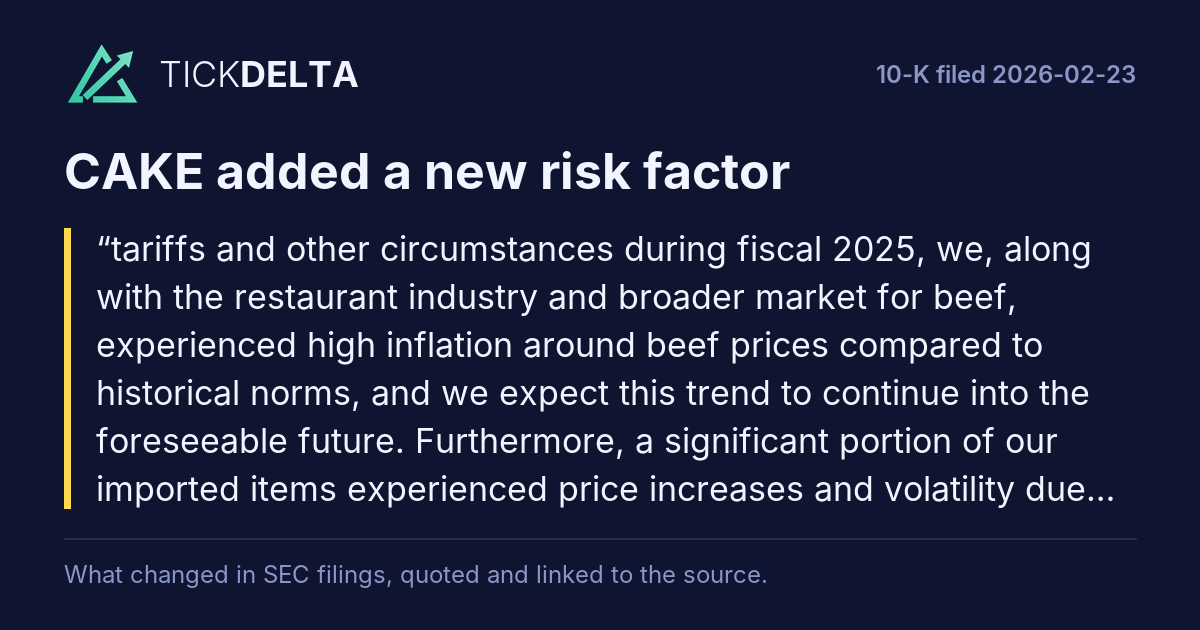
tariffs and other circumstances during fiscal 2025, we, along with the restaurant industry and broader market for beef, experienced high inflation around beef prices compared to historical norms, and we expect this trend to continue into the foreseeable future. Furthermore, a significant portion of our imported items experienced price increases and volatility due to tariffs and regulatory changes in 2025. We expect this trend to continue into 2026.
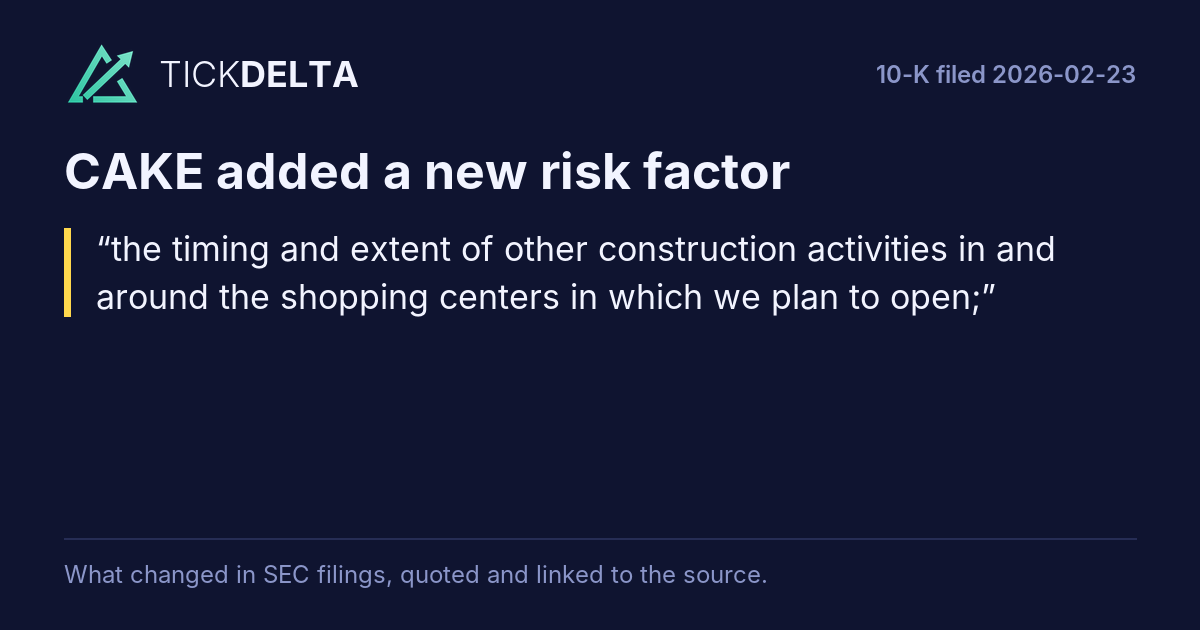
the timing and extent of other construction activities in and around the shopping centers in which we plan to open;
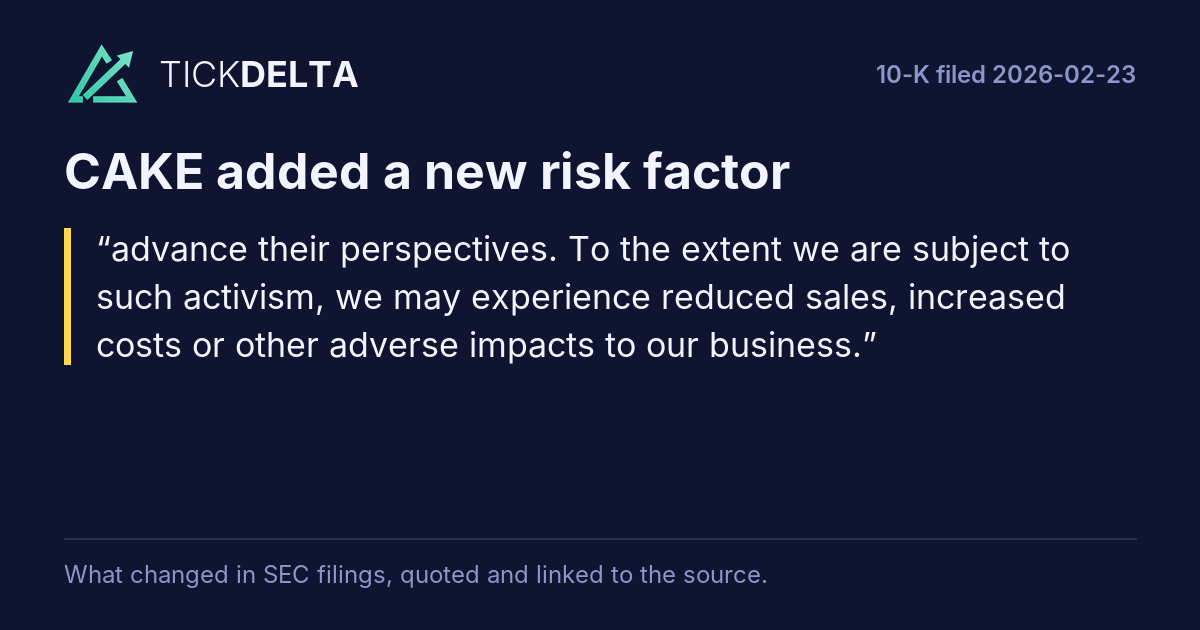
advance their perspectives. To the extent we are subject to such activism, we may experience reduced sales, increased costs or other adverse impacts to our business.
Paragraphs in the 10-Q filed Nov 2, 2026 that were not in the one before
New in the latest 10-Q
16 paragraphs in the 10-Q filed Nov 2, 2026 with nothing like them in the 10-Q filed Aug 3, 2026 (at least half the words must differ; new numbers alone do not count). Quoted exactly, grouped by the item heading above them. This is text that changed, not a judgement of how serious it is.
Financial statements and notes
Payment of deferred consideration and compensation in excess of acquisition-date fair value (13,229) (8,714)
Read in the 10-Q
Repayment on long-term convertible debt, including premium on extinguishment (68,992) (289,800)
Read in the 10-Q
Thirty-Nine Thirty-Nine Weeks Ended Weeks Ended September 29, 2026 September 30, 2025 Beginning balance $ 24,628 $ 20,155 Payment (13,229) (8,714) Change in fair value (11,399) 1,973 Ending balance $ — $ 13,414
Read in the 10-Q
The following table presents information related to stock-based compensation, net of forfeitures (in thousands): Thirteen Thirteen Thirty-Nine Thirty-Nine Weeks Ended Weeks Ended Weeks Ended Weeks Ended September 29, 2026 September 30, 2025 September 29, 2026 September 30, 2025 ────────────────────────────────────────────────────────────────────────────────────────────────────────────────────────────────────────────────────────────────────────────────────────────── Labor expenses $ 1,570 $ 1,975 $ 7,195 $ 6,954 Other operating costs and expenses 47 68 245 268 General and administrative expenses 5,418 3,629 15,370 13,220 Total stock-based compensation 7,035 5,672 22,810 20,442 Income tax benefit 1,735 1,389 5,623 5,018 Total stock-based compensation, net of taxes $ 5,300 $ 4,283 $ 17,187 $ 15,424 Capitalized stock-based compensation (1) $ 54 $ 47 $ 161 $ 160 (1) It is our policy to capitalize the portion of stock-based compensation costs for our internal development department that relates to capitalizable activities such as the design and construction of new restaurants, remodeling existing locations and equipment installation. Capitalized stock-based compensation is included in property and equipment, net on the consolidated balance sheets. Stock Options We did not grant any stock options during the third quarter of fiscal 2026 and fiscal 2025. Stock option activity during the thirty-nine weeks ended September 29, 2026 was as follows: Weighted- Average Weighted- Remaining Average Contractual Aggregate Shares Exercise Price Term Intrinsic Value (1) (In thousands) (Per share) (In years) (In thousands) Outstanding at December 30, 2025 471 $ 41.08 4.1 $4,203.7 Granted - - Exercised (261) 43.14 Forfeited or cancelled - - Outstanding at September 29, 2026 210 $ 38.49 5.3 $14,405.8 Exercisable at September 29, 2026 145 $ 39.49 4.4 $9,806.2 (1) Aggregate intrinsic value is calculated as the difference between our closing stock price at fiscal period end and the exercise price, multiplied by the number of in-the-money options and represents the pre-tax amount that would have been received by the option holders, had they all exercised their options on the fiscal period-end date. The total intrinsic value of options exercised during the thirteen and thirty-nine weeks ended September 29, 2026 was $6.1 million and $8.9 million, respectively. The total intrinsic value of options exercised during the thirteen and thirty-nine weeks ended September 30, 2025 was $0.8 million and $5.0 million, respectively. As of September 29, 2026, total unrecognized stock-based compensation expense related to unvested stock options was $0.7 million, which we expect to recognize over a weighted-average period of approximately 2.1 years. Restricted Shares and Restricted Share Units Restricted share and restricted share unit activity during the thirty-nine weeks ended September 29, 2026 was as follows:
Read in the 10-Q
(2) In the event of the conversion of our 2030 Notes, the principal portion will be settled in cash with any conversion consideration in excess of the principal portion settled in cash and/or shares of our common stock at our option. Therefore, only the amounts expected to be settled in excess of the principal portion are considered dilutive. Accordingly, the 2030 Notes have been included in the diluted calculation because the average market price of our common stock exceeded the conversion p...
Read in the 10-Q
Show the other 11
Acquisition-Related Contingent Consideration, Compensation and Amortization (Income)/Expense
Read in the 10-Q
In the third quarters of fiscal 2026 and 2025, we recorded $12.9 million of income and $0.9 million of expense, respectively, of acquisition-related contingent consideration, compensation and amortization. In the third quarter of fiscal 2026, we recorded a $13.2 million decrease in the fair value of the contingent consideration and compensation liability primarily due to a revised assessment that achievement would not be met based on recent performance, partially offset by $0.3 million of amortization. In the third quarter of fiscal 2025, we recorded $0.9 million of amortization.
Read in the 10-Q
Acquisition-Related Contingent Consideration, Compensation and Amortization Income (Expense)
Read in the 10-Q
In the first nine months of fiscal 2026 and 2025, we recorded $10.5 million of income and $2.9 million of expense, respectively, of acquisition-related contingent consideration, compensation and amortization. In the first nine months of fiscal 2026, we recorded a $13.2 million decrease in the fair value of the contingent consideration and compensation liability primarily due to a revised assessment that achievement would not be met based on recent performance, partially offset by $2.7 million of amortization. In the first nine months of fiscal 2025, we recorded $2.9 million of amortization.
Read in the 10-Q
As of September 29, 2026, the 2030 Notes had a balance of $563.7 million, net of unamortized issuance costs of $11.3 million. As the last reported sale price per share of our common stock exceeded 130% of the conversion price for the 2030 Notes for at least 20 trading days during the 30 consecutive trading days ending on, and including, September 29, 2026, the 2030 Notes are convertible by holders at their option during the fiscal quarter ending December 29, 2026 and are classified as a current liability in the condensed consolidated balance sheets as of September 29, 2026.
Read in the 10-Q
Risk Factors
The risk factor set forth below updates, and should be read together with, the risk factors disclosed in our Annual Report. Except as set forth below, there have been no material changes to the risk factors disclosed in our Annual Report.
Read in the 10-Q
We may be unable to raise the funds necessary to repurchase the Notes for cash following a fundamental change, or to pay the cash amounts due upon conversion, and our other indebtedness limits our ability to repurchase the Notes or pay cash upon their conversion.
Read in the 10-Q
Noteholders of our outstanding 2030 Notes may, subject to limited exceptions, require us to repurchase their 2030 Notes following a “fundamental change” (which is defined in the indenture governing the 2030 Notes) at a cash repurchase price generally equal to the principal amount of the 2030 Notes to be repurchased, plus accrued and unpaid interest, if any. Upon maturity of the 2030 Notes, we must pay their principal amount and accrued and unpaid interest in cash, unless they have been previously repurchased, redeemed or converted. In addition, because the last reported sale price per share of our common stock exceeded 130% of the conversion price for the 2030 Notes for at least 20 trading days during the 30 consecutive trading days ending on, and including, September 29, 2026, the 2030 Notes are convertible by holders at their option during the fiscal quarter ending December 29, 2026.
Read in the 10-Q
All conversions of the 2030 Notes will be settled partially or entirely in cash. We may not have enough available cash or be able to obtain financing at the time we are required to repurchase the 2030 Notes or pay the cash amounts due upon conversion. In addition, applicable law, regulatory authorities and the Loan Agreement or any future indebtedness may restrict our ability to repurchase the 2030 Notes or pay the cash amounts due upon conversion. For example, the Loan Agreement restricts us from paying cash upon conversion of the 2030 Notes in an amount that exceeds the sum of (i) the principal amount being converted and (ii) any payments received by us or any of our subsidiaries pursuant to the exercise, settlement or termination of any related permitted bond hedge transaction.
Read in the 10-Q
Furthermore, the Loan Agreement places several restrictions on our ability to repurchase the 2030 Notes upon a fundamental change. Under the Loan Agreement, we are permitted to repurchase 2030 Notes upon a fundamental change only if (i) no default or event of default exists and (ii) our pro forma net adjusted leverage ratio (as measured in accordance with the Loan Agreement) does not exceed 4.25 to 1.00 and our EBITDAR to interest and rental expense ratio (as measured in accordance with the Loan Agreement) is at least 1.90 to 1.00.
Read in the 10-Q
Our failure to repurchase the 2030 Notes or pay the cash amounts due upon conversion when required will constitute a default under the indenture governing the 2030 Notes. A default under the indenture governing the 2030 Notes or the fundamental change itself could also lead to a default under the Loan Agreement and agreements governing our other or future indebtedness, which may result in that other indebtedness becoming immediately payable in full. We may not have sufficient funds to satisfy all amounts due under such indebtedness and the 2030 Notes.
Read in the 10-Q
The 10-Q's risk factors against the 10-K
Item 1A of the 10-Q filed Nov 2, 2026 against Item 1A of the 10-K filed Feb 23, 2026.
A 10-Q repeats only the risks that changed, so a 10-K paragraph that is missing from it is not counted as removed.
Added is a paragraph with nothing like it in the 10-K, Reworded a sentence that is in both with several words changed,
Quiet changes a sentence in both where one to four words changed and one is a hedge or a modal
(cut words struck through, new words highlighted).
Text on the page, not a score; each links to the filing at sec.gov.
What the 10-Q itself says about its risk factors:The risk factor set forth below updates, and should be read together with, the risk factors disclosed in our Annual Report. Except as set forth below, there have been no material changes to the risk factors disclosed in our Annual Report.
Read in the 10-Q
Phrases used for the first time
Two-word phrases in Risk Factors of the 10-K filed Feb 23, 2026 that are in none of the 1 earlier 10-Ks stored, back to Feb 24, 2025
Where each one is used
- trade agreements: Dining out is a discretionary expenditure that is influenced by domestic and global economic conditions, including, but not limited to: geopolitical instability, including armed conflicts, supply shortages, interest rates, changes to the terms of international trade agreements, unemployment, significant cost...
Used at least twice, small words left out. Counted, not picked: a phrase can be new because the company renamed something.
What was taken out
5 paragraphs of last year's Risk Factors with nothing like them now. The longest are quoted.
Sources
Item 1A of each 10-K and 10-Q on EDGAR, quoted exactly. Each paragraph links to the filing at sec.gov.
Also
10-K change: what was reworded or cut, section by section.
Work with it
Excel workbook · CSV. Google Sheet that stays up to date: paste =IMPORTDATA("https://tickdelta.com/company/CAKE/export.csv") into a cell.