Paragraph 75 · 47% changed
Every version of it
Screener
/
SEC EDGAR
/CIK 0001406666
/10-K filed Feb 20, 2026, compared with Feb 21, 2025
/Numbers from the XBRL of the 10-Ks
NYSE
Communication · Communications Services
Calix, Inc CALX
The 10-K against last year's
99 changes: 26 added, 10 removed, 62 reworded, 1 quiet changes
10-K Feb 20, 2026 vs Feb 21, 2025
Risk Factors
21.4%
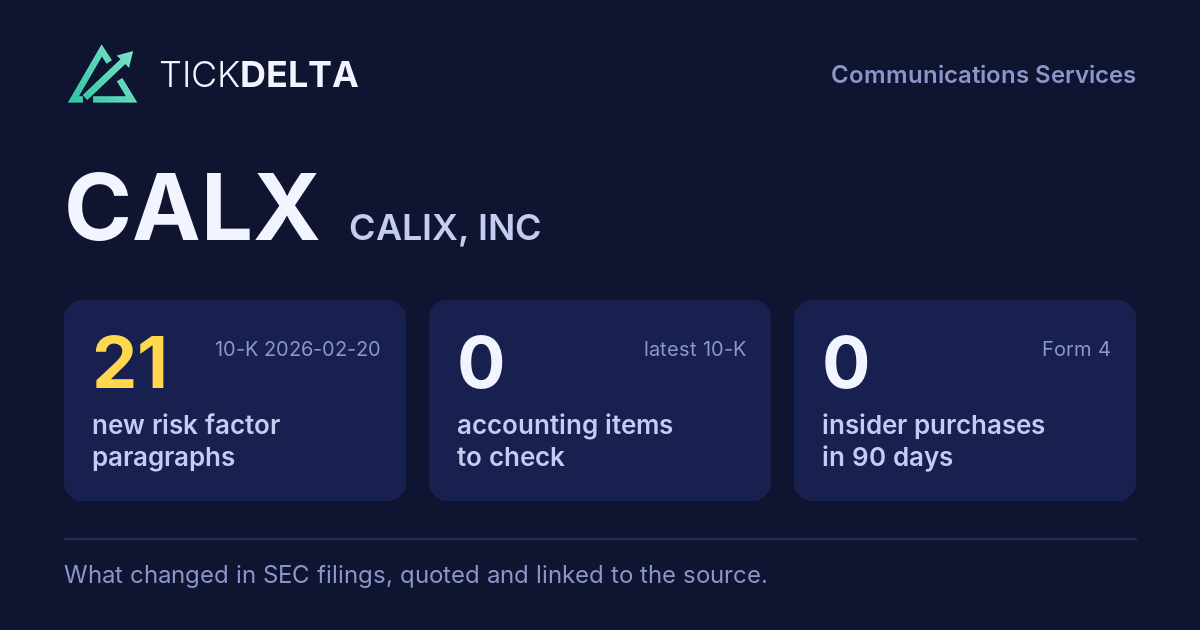
of the text changed · 16,385 words now · 21 new paragraphs, 4 gone
MD&A
21.1%
of the text changed · 4,338 words now · 5 new paragraphs, 6 gone
Legal Proceedings
48.5%
of the text changed · 669 words now
Accounting Policies
19.9%
of the text changed · 3,397 words now
10-K 0001406666-26-000005 (Feb 20, 2026) vs 10-K 0001406666-25-000008 (Feb 21, 2025)
Every paragraph, and how much of it changed
One bar per paragraph, in the order of the 10-K. Height and colour show the share of its words not in the closest paragraph a year earlier; the tallest bars are new paragraphs.
Risk Factors
168 paragraphs · 21 new · 86 reworded · 4 gone · 10-K Feb 20, 2026 against Feb 21, 2025
New paragraph
Reworded (5% of its words or more)
Same or nearly
Paragraph 124 · 43% changed
Every version of it
Paragraph 91 · 39% changed
Every version of it
We operate our Oracle enterprise resource planning, or ERP, planning (“ERP”) system on Oracle’s cloud platform and our software billing application on Salesforce.com. With these implementations, we are highly dependent upon Oracle and Saleforce.com to host, manage and maintain our ERP system and supporting applications. Any disruptions to their business or processes, or delays in their ability to provide services to us, may in turn disrupt our business operations or increase costs. Furthermore, we receive quarterly system updates and enhancements on the cloud platform according to Oracle’s release timeline and change management processes, which if not managed properly may disrupt our business operations and delay our ability to process transactions and produce reports necessary to conduct our business. We are highly dependent upon our ERP system for critical business functions, including order processing and management, supply chain and procurement operations, financial planning, accounting and reporting; accordingly, protracted disruption in functionality or processing capabilities of the ERP system could materially impair our ability to process transactions timely or produce accurate financial statements on a timely basis. If our systems suffer prolonged interruption, our results of operations and cash flows would be adversely affected.
Paragraph 139 · 38% changed
Every version of it
Paragraph 136 · 38% changed
Every version of it
The EU GDPR and UK GDPR regulate cross-border transfers of personal data out of the European Economic Area, or the EEA, Area (the “EEA”) and the UK. There is currently legal complexity and uncertainty regarding international personal data transfers, and we expect this to continue. In particular, we expect For example, there are number of decisions and proceedings in the European Commission approval EU where the legality of the current EU-US Data Privacy Framework for data transfers to certified entities in the U.S. to be challenged and international transfers to the U.S. and to other jurisdictions more generally to continue to be subject to enhanced scrutiny by regulators. China is being challenged. As the regulatory guidance and enforcement landscape in relation to data transfers further develops, our business, operations and financial condition could be adversely affected and we could suffer additional costs, complaints and/or regulatory investigations or fines. We may also have to stop using certain tools and vendors and make other operational changes. Further, our customers may not use our services in a manner that is compliant with applicable data privacy laws and regulations and our services may not be competitive in certain markets. We may also become subject to new laws that regulate both personal and non-personal data. For example, the Data Act came into effect on September 12, 2025, establishing new requirements for providers of data processing services (including cloud, SaaS) into the EU. The Data Act requires providers to facilitate customers switching to other providers/ on-premise solutions and porting their data within certain timeframes; remove technical, contractual, and commercial obstacles to service switching (including switching charges); and include certain mandatory terms in customer contracts. Failure to comply with the Data Act can result in regulatory enforcement and fines, civil claims, and reputational damage. The Data Act, together with developing guidance in this area, may require changes to our customer contracts, products, operations and business practices, increase our compliance costs, require adjustments to our revenue recognition practices and adversely affect our financial condition, business and operations.
Paragraph 167 · 36% changed
Every version of it
Our management is responsible for establishing and maintaining adequate internal control over financial reporting to provide reasonable assurance regarding the reliability of our financial reporting and the preparation of financial statements in accordance with U.S. generally accepted accounting principles. Our management does not expect that our internal control over financial reporting will prevent or detect all error and all fraud. A control system, no matter how well designed and operated, can provide only reasonable, not absolute, assurance that the control system’s objectives will be met. Because of the inherent limitations in all control systems, no evaluation of controls can provide absolute assurance that misstatements due to error or fraud will not occur or that all control issues and instances of fraud, if any, within our company will have been detected. If we are unable to produce accurate financial statements on a timely basis, investors could lose confidence in the reliability of our financial statements, which could cause the market price of our common stock to decline and make it more difficult for us to finance our operations and growth.
Paragraph 157 · 30% changed
Every version of it
Paragraph 138 · 28% changed
Every version of it
In light of the complex and evolving nature of EU, EU Member State and UK privacy data and security laws, there can be no assurances that we will be successful in our efforts to comply with such laws; violations of such laws could result in regulatory investigations, fines, orders to cease/change our use of technologies and/or our processing activities, enforcement notices and assessment notices (for a compulsory audit), as well as lead to civil claims including class actions, and reputational damage.
Paragraph 75 · 47% changed
Every version of it
10-K Feb 21, 2025Our failure to adequately address and resolve risks and uncertainties associated with acquisitions could have a material adverse impact on our financial condition and results of operations.
10-K Feb 20, 2026
accrue additional liabilities for component inventory held by our suppliers, both of which could have a material adverse effect on our financial condition and results of operations.
Paragraph 124 · 43% changed
Every version of it
10-K Feb 21, 2025Our industry is characterized by rapid technological change, changing needs of BEPs, evolving industry standards and frequent introductions of new products and platform offerings. We invest significant amounts to pursue innovative technologies that we believe will be adopted by BEPs. For example, we have invested and plan to continue to invest resources in our platform offerings. In addition, on an ongoing basis, we expect to reposition our product and service offerings and introduce new offerings as we encounter rapidly changing BEP requirements and increasing competitive pressures. If we cannot increase sales of our new platform and services, keep pace with rapid technological developments to meet customer needs and compete with evolving standards or if the technologies we choose to invest in fail to meet customer needs or are not adopted by customers in the timeframes that we expect, our financial condition and results of operations would be adversely affected.
10-K Feb 20, 2026
needs and compete with evolving standards or if the technologies we choose to invest in fail to meet customer needs or are not adopted by customers in the timeframes that we expect, our financial condition and results of operations would be adversely affected.
Paragraph 91 · 39% changed
Every version of it
10-K Feb 21, 2025
We operate our Oracle enterprise resource planning, or ERP, system on Oracle’s cloud platform and our software billing application on Salesforce.com. With these implementations, we are highly dependent upon Oracle and Saleforce.com to host, manage and maintain our ERP system and supporting applications. Any disruptions to their business or processes, or delays in their ability to provide services to us, may in turn disrupt our business operations or increase costs. Furthermore, we receive quarterly system updates and enhancements on the cloud platform according to Oracle’s release timeline and change management processes, which if not managed properly may disrupt our business operations and delay our ability to process transactions and produce reports necessary to conduct our business. We are highly dependent upon our ERP system for critical business functions, including order processing and management, supply chain and procurement operations, financial planning, accounting and reporting; accordingly, protracted disruption in functionality or processing capabilities of the ERP system could materially impair our ability to process transactions timely or produce accurate financial statements on a timely basis. If our systems suffer prolonged interruption, our results of operations and cash flows would be adversely affected.
10-K Feb 20, 2026
We operate our Oracle enterprise resource planning (“ERP”) system on Oracle’s cloud platform and our software billing application on Salesforce.com. With these implementations, we are highly dependent upon Oracle and Saleforce.com to host, manage and maintain our ERP system and supporting applications. Any disruptions to their business or processes, or delays in their ability to provide services to us, may in turn disrupt our business operations or increase costs. Furthermore, we receive
Paragraph 139 · 38% changed
Every version of it
10-K Feb 21, 2025In light of the complex and evolving nature of EU, EU Member State and UK privacy and security laws, there can be no assurances that we will be successful in our efforts to comply with such laws; violations of such laws could result in regulatory investigations, fines, orders to cease/change our use of technologies and/or our processing activities, enforcement notices and assessment notices (for a compulsory audit), as well as lead to civil claims including class actions, and reputational damage.
10-K Feb 20, 2026
investigations, fines, orders to cease/change our use of technologies and/or our processing activities, enforcement notices and assessment notices (for a compulsory audit), as well as lead to civil claims including class actions and reputational damage.
Paragraph 136 · 38% changed
Every version of it
10-K Feb 21, 2025
The EU GDPR and UK GDPR regulate cross-border transfers of personal data out of the European Economic Area, or the EEA, and the UK. There is currently legal complexity and uncertainty regarding international personal data transfers, and we expect this to continue. In particular, we expect the European Commission approval of the current EU-US Data Privacy Framework for data transfers to certified entities in the U.S. to be challenged and international transfers to the U.S. and to other jurisdictions more generally to continue to be subject to enhanced scrutiny by regulators. As the regulatory guidance and enforcement landscape in relation to data transfers further develops, our business, operations and financial condition could be adversely affected and we could suffer additional costs, complaints and/or regulatory investigations or fines. We may also have to stop using certain tools and vendors and make other operational changes. Further, our customers may not use our services in a manner that is compliant with applicable data privacy laws and regulations and our services may not be competitive in certain markets.
10-K Feb 20, 2026
The GDPR regulate cross-border transfers of personal data out of the European Economic Area (the “EEA”) and the UK. There is currently legal complexity and uncertainty regarding international personal data transfers, and we expect this to continue. For example, there are number of decisions and proceedings in the EU where the legality of data transfers to China is being challenged. As the regulatory guidance and enforcement landscape in relation to data transfers further develops, our business, operations and financial condition could be adversely affected and we could suffer additional costs, complaints and/or regulatory investigations or fines. We may also have to stop using certain tools and vendors and make other operational changes. Further, our customers may not use our services in a manner that is compliant with applicable data privacy laws and regulations and our services may not be competitive in certain markets. We may also become subject to new laws that regulate both personal and non-personal data. For example, the Data Act came into effect on September 12, 2025, establishing new requirements for providers of data processing services (including cloud, SaaS) into the EU. The Data Act requires providers to facilitate customers switching to other providers/ on-premise solutions and porting their data within certain timeframes; remove technical, contractual, and commercial obstacles to service switching (including switching charges); and include certain mandatory terms in customer contracts. Failure to comply with the Data Act can result in regulatory enforcement and fines, civil claims, and reputational damage. The Data Act, together with developing guidance in this area, may require changes to our customer contracts, products, operations and business practices, increase our compliance costs, require adjustments to our revenue recognition practices and adversely affect our financial condition, business and operations.
Paragraph 167 · 36% changed
Every version of it
10-K Feb 21, 2025
Our management is responsible for establishing and maintaining adequate internal control over financial reporting to provide reasonable assurance regarding the reliability of our financial reporting and the preparation of financial statements in accordance with U.S. generally accepted accounting principles. Our management does not expect that our internal control over financial reporting will prevent or detect all error and all fraud. A control system, no matter how well designed and operated, can provide only reasonable, not absolute, assurance that the control system’s objectives will be met. Because of the inherent limitations in all control systems, no evaluation of controls can provide absolute assurance that misstatements due to error or fraud will not occur or that all control issues and instances of fraud, if any, within our company will have been detected. If we are unable to produce accurate financial statements on a timely basis, investors could lose confidence in the reliability of our financial statements, which could cause the market price of our common stock to decline and make it more difficult for us to finance our operations and growth.
10-K Feb 20, 2026
Our management is responsible for establishing and maintaining adequate internal control over financial reporting to provide reasonable assurance regarding the reliability of our financial reporting and the preparation of financial statements in accordance with U.S. generally accepted accounting principles. Our management does not expect that our internal control over financial reporting will prevent or detect all error and all fraud. A control system, no matter how well designed and operated,
Paragraph 157 · 30% changed
Every version of it
10-K Feb 21, 2025While our working capital needs to support our business operations and growth have been funded from operating cash flows and through issuance of our common stock under our equity incentive plans, we may need additional capital if our current plans and assumptions change. If our financial position deteriorates, we may not be able to secure a source of financing to support our working capital needs on acceptable terms or at all. If future financings involve the issuance of equity securities, our then-existing stockholders will suffer dilution. If we raise debt financing, we may be subject to restrictive covenants that limit our ability to conduct our business. If we are unable to obtain and sustain operating income and positive cash flows from operations, our liquidity, results of operations and financial condition may be adversely affected. Furthermore, if we are unable to generate sufficient cash flows to support our operational needs, we may need to cease our common stock repurchase program or seek additional sources of liquidity, including borrowings, to support our working capital needs, even if we believe we have generated sufficient cash flows to support our operational needs. There is no assurance that any other sources of liquidity may be available to us on acceptable terms or at all. If we are unable to generate sufficient cash flows or obtain other sources of liquidity, we will be forced to limit our development activities, reduce our investment in growth initiatives and institute cost-cutting measures, all of which would adversely impact our business and growth.
10-K Feb 20, 2026
or seek additional sources of liquidity, including borrowings, to support our working capital needs, even if we believe we have generated sufficient cash flows to support our operational needs. There is no assurance that any other sources of liquidity may be available to us on acceptable terms or at all. If we are unable to generate sufficient cash flows or obtain other sources of liquidity, we will be forced to limit our development activities, reduce our investment in growth initiatives and institute cost-cutting measures, all of which would adversely impact our business and growth.
Paragraph 138 · 28% changed
Every version of it
10-K Feb 21, 2025
In light of the complex and evolving nature of EU, EU Member State and UK privacy and security laws, there can be no assurances that we will be successful in our efforts to comply with such laws; violations of such laws could result in regulatory investigations, fines, orders to cease/change our use of technologies and/or our processing activities, enforcement notices and assessment notices (for a compulsory audit), as well as lead to civil claims including class actions, and reputational damage.
10-K Feb 20, 2026
In light of the complex and evolving nature of EU, EU Member State and UK data and security laws, there can be no assurances that we will be successful in our efforts to comply with such laws; violations of such laws could result in regulatory
MD&A
56 paragraphs · 5 new · 28 reworded · 6 gone · 10-K Feb 20, 2026 against Feb 21, 2025
New paragraph
Reworded (5% of its words or more)
Same or nearly
Paragraph 20 · 40% changed
In November 2024, September 2025, the FASB issued ASU No. 2024-03, Income Statement—Reporting Comprehensive Income—Expense Disaggregation Disclosures, which requires additional disclosure of certain costs 2025-06, Intangibles—Goodwill and expenses within the notes Other—Internal-Use Software (Subtopic 350-40): Targeted Improvements to the financial statements. The updated standard Accounting for Internal-Use Software, which clarifies and modernizes the accounting for internal-use software. ASU No. 2025-06 is effective for our annual periods beginning in 2027 and interim periods beginning us in the first quarter of 2028. Early 2028, with early adoption is permitted. The standard permits application of the guidance using a prospective, retrospective, or modified transition approach. We are currently evaluating the impact that the updated standard will have on our financial statement disclosures.
Paragraph 30 · 35% changed
During 2024, 2025, sales and marketing expenses as a percentage of revenue increased decreased to 25% from 26% from 21% due to lower higher revenue compared to 2023. 2024. We expect our investments in sales and marketing will be relatively flat increase in absolute dollars in the near term. on a year-over-year basis, but decline as a percentage of revenue, as we continue to land new customers and expand our platform, cloud and managed services.
Paragraph 38 · 32% changed
Interest income and other expense, net increased by $2.2 $1.8 million in 2024 2025 compared with 2023 2024 mainly due to a higher rate of larger average cash balance offset partially by a decrease in interest earned on our cash, cash equivalents and marketable securities as well as a larger cash and marketable securities balance. rates.
Paragraph 48 · 29% changed
In 2024, 2025, cash inflows from changes in operating assets and liabilities primarily consisted of decreases an increase in accounts receivable payable of $46.7 $21.5 million and inventory of $30.3 million, both due to lower revenue, and increased inventory purchases, a decrease in prepaid expenses and other assets of $11.2 $17.3 million due to a reduction in our inventory deposits, an increase in accrued liabilities of $11.8 million mainly due to incentive compensation related accruals and an increase in deferred revenue of $2.6 million. These changes were partially offset by a decrease increases in accrued liabilities inventory of $36.0 million, a decrease in $31.0 million and accounts payable receivable of $15.1 $20.0 million due to the lower inventory purchases and a decrease in deferred revenue of $13.9 million due to a change in billing practices towards monthly versus annual. support increased revenue.
Paragraph 35 · 27% changed
The decrease increase in general and administrative expenses of $1.5 $9.5 million in 2024 2025 compared to 2023 2024 was mainly due to a decrease increases in legal costs due to a settlement in 2023 personnel expenses of $3.3 $6.1 million and lower outside services expenses stock-based compensation of $2.9 million. These decreases were partially offset by increases in stock-based compensation of $2.0 million and personnel expenses of $1.6 million.
Paragraph 36 · 26% changed
During 2024, 2025, general and administrative expenses as a percentage of revenue increased decreased to 11% from 12% from 10% due to lower higher revenue compared to 2023. 2024. We expect our general and administrative investments to be fairly constant increase in absolute dollars in the near term and potentially but decline as a percentage of revenue over time in relation to anticipated longer-term increased revenue.
Paragraph 24 · 24% changed
Our revenue is principally derived in the U.S. Revenue generated in the U.S. U.S., which represented 92% 93% of revenue in 2024 2025 and 91% 92% in 2023. 2024. Our primary focus has been, and in the near term will continue to be, the U.S. and Canada given our large, direct sales and marketing presence and the amount of government stimulus being invested into underserved and not-served areas of these countries. The decrease in With the introduction of our third-generation platform, we will increase our attention on international revenue for 2024, as compared to 2023, was mainly due to lower shipments to Europe and to a lesser extent the Americas outside the U.S. markets.
Paragraph 7 · 22% changed
Cost of revenue is strongly correlated to revenue and tends to fluctuate due to all of the above factors that may cause revenue fluctuations. Factors that have impacted our cost of revenue, or that we expect may impact cost of revenue in future periods, also include: changes in the mix of products delivered, customer location and regional mix, changes in the cost of our inventory, investments to support expansion of cloud and customer support offerings as well as our customer success organization, changes in product warranty, incurrence of retrofit costs, amortization of intangibles, support fees for silicon-related development work for our products, changes in trade policies, allowances for obligations to our suppliers and inventory write-downs. In addition, Factors that we periodically ship by air versus by ocean in order to meet delivery commitments to our customers, which is more costly. Cost of revenue also includes fixed expenses related to our internal operations, which could increase expect may impact our cost of revenue as a percentage of revenue if our revenue declines. in future periods include the
Paragraph 20 · 40% changed
10-K Feb 21, 2025
In November 2024, the FASB issued ASU No. 2024-03, Income Statement—Reporting Comprehensive Income—Expense Disaggregation Disclosures, which requires additional disclosure of certain costs and expenses within the notes to the financial statements. The updated standard is effective for our annual periods beginning in 2027 and interim periods beginning in the first quarter of 2028. Early adoption is permitted. We are currently evaluating the impact that the updated standard will have on our financial statement disclosures.
10-K Feb 20, 2026
In September 2025, the FASB issued ASU No. 2025-06, Intangibles—Goodwill and Other—Internal-Use Software (Subtopic 350-40): Targeted Improvements to the Accounting for Internal-Use Software, which clarifies and modernizes the accounting for internal-use software. ASU No. 2025-06 is effective for us in the first quarter of 2028, with early adoption permitted. The standard permits application of the guidance using a prospective, retrospective, or modified transition approach. We are currently evaluating the impact that the updated standard will have on our financial statement disclosures.
Paragraph 30 · 35% changed
10-K Feb 21, 2025
During 2024, sales and marketing expenses as a percentage of revenue increased to 26% from 21% due to lower revenue compared to 2023. We expect our investments in sales and marketing will be relatively flat in absolute dollars in the near term.
10-K Feb 20, 2026
During 2025, sales and marketing expenses as a percentage of revenue decreased to 25% from 26% due to higher revenue compared to 2024. We expect our investments in sales and marketing will increase in absolute dollars on a year-over-year basis, but decline as a percentage of revenue, as we continue to land new customers and expand our platform, cloud and managed services.
Paragraph 38 · 32% changed
10-K Feb 21, 2025
Interest income and other expense, net increased by $2.2 million in 2024 compared with 2023 mainly due to a higher rate of interest earned on our cash, cash equivalents and marketable securities as well as a larger cash and marketable securities balance.
10-K Feb 20, 2026
Interest income and other expense, net increased by $1.8 million in 2025 compared with 2024 mainly due to a larger average cash balance offset partially by a decrease in interest rates.
Paragraph 48 · 29% changed
10-K Feb 21, 2025
In 2024, cash inflows from changes in operating assets and liabilities primarily consisted of decreases in accounts receivable of $46.7 million and inventory of $30.3 million, both due to lower revenue, and a decrease in prepaid expenses and other assets of $11.2 million. These changes were partially offset by a decrease in accrued liabilities of $36.0 million, a decrease in accounts payable of $15.1 million due to the lower inventory purchases and a decrease in deferred revenue of $13.9 million due to a change in billing practices towards monthly versus annual.
10-K Feb 20, 2026
In 2025, cash inflows from changes in operating assets and liabilities primarily consisted of an increase in accounts payable of $21.5 million due to increased inventory purchases, a decrease in prepaid expenses and other assets of $17.3 million due to a reduction in our inventory deposits, an increase in accrued liabilities of $11.8 million mainly due to incentive compensation related accruals and an increase in deferred revenue of $2.6 million. These changes were partially offset by increases in inventory of $31.0 million and accounts receivable of $20.0 million to support increased revenue.
Paragraph 35 · 27% changed
10-K Feb 21, 2025
The decrease in general and administrative expenses of $1.5 million in 2024 compared to 2023 was mainly due to a decrease in legal costs due to a settlement in 2023 of $3.3 million and lower outside services expenses of $2.9 million. These decreases were partially offset by increases in stock-based compensation of $2.0 million and personnel expenses of $1.6 million.
10-K Feb 20, 2026
The increase in general and administrative expenses of $9.5 million in 2025 compared to 2024 was mainly due to increases in personnel expenses of $6.1 million and stock-based compensation of $2.9 million.
Paragraph 36 · 26% changed
10-K Feb 21, 2025
During 2024, general and administrative expenses as a percentage of revenue increased to 12% from 10% due to lower revenue compared to 2023. We expect our general and administrative investments to be fairly constant in absolute dollars in the near term and potentially decline as a percentage of revenue over time in relation to anticipated longer-term increased revenue.
10-K Feb 20, 2026
During 2025, general and administrative expenses as a percentage of revenue decreased to 11% from 12% due to higher revenue compared to 2024. We expect our general and administrative investments to increase in absolute dollars but decline as a percentage of revenue.
Paragraph 24 · 24% changed
10-K Feb 21, 2025
Our revenue is principally derived in the U.S. Revenue generated in the U.S. represented 92% of revenue in 2024 and 91% in 2023. Our primary focus has been, and in the near term will continue to be, the U.S. and Canada given our large, direct sales and marketing presence and the amount of government stimulus being invested into underserved and not-served areas of these countries. The decrease in international revenue for 2024, as compared to 2023, was mainly due to lower shipments to Europe and to a lesser extent the Americas outside the U.S.
10-K Feb 20, 2026
Our revenue is principally derived in the U.S., which represented 93% of revenue in 2025 and 92% in 2024. Our primary focus has been, and in the near term will continue to be, the U.S. and Canada given our large, direct sales and marketing presence and the amount of government stimulus being invested into underserved and not-served areas of these countries. With the introduction of our third-generation platform, we will increase our attention on international markets.
Paragraph 7 · 22% changed
10-K Feb 21, 2025
Cost of revenue is strongly correlated to revenue and tends to fluctuate due to all of the above factors that may cause revenue fluctuations. Factors that have impacted our cost of revenue, or that we expect may impact cost of revenue in future periods, also include: changes in the mix of products delivered, customer location and regional mix, changes in the cost of our inventory, investments to support expansion of cloud and customer support offerings as well as our customer success organization, changes in product warranty, incurrence of retrofit costs, amortization of intangibles, support fees for silicon-related development work for our products, changes in trade policies, allowances for obligations to our suppliers and inventory write-downs. In addition, we periodically ship by air versus by ocean in order to meet delivery commitments to our customers, which is more costly. Cost of revenue also includes fixed expenses related to our internal operations, which could increase our cost of revenue as a percentage of revenue if our revenue declines.
10-K Feb 20, 2026
Cost of revenue is strongly correlated to revenue and tends to fluctuate due to all of the above factors that may cause revenue fluctuations. Factors that have impacted our cost of revenue, or that we expect may impact cost of revenue in future periods, also include: changes in the mix of products delivered, customer location and regional mix, changes in the cost of our inventory, investments to support expansion of cloud and customer support offerings as well as our customer success organization, changes in product warranty, incurrence of retrofit costs, amortization of intangibles, allowances for obligations to our suppliers and inventory write-downs. Factors that we expect may impact our cost of revenue in future periods include the
A paragraph is matched with the one last year that shares the most of its words; under half in common makes it new. The paragraphs shown are the 8 reworded the most in each section.
The paragraph that changed most in each section
The redline
Marked against last year's 10-K: cut words struck through, new words highlighted.
Risk Factors329 words changed in this paragraph; it is 35% similar to last year's version.
Geopolitical issues, issues such as the Russian invasion of Ukraine, armed conflict in the Middle East, conflicts, relations between the U.S. and China, tariff and trade policy changes, changes and increasing potential of conflict involving countries in Asia that are critical to our supply-chain operations, such as Taiwan and China, have resulted in increasing global tensions and create uncertainty for global commerce. New or increased tariffs and other changes in U.S. trade policy, including new sanctions, could have triggered and may continue to trigger retaliatory actions by affected countries. In addition, inflation countries or changes in the demand from customers displeased with U.S. has affected businesses across many industries, tariff and trade policy changes. U.S. executive orders have resulted in tariffs on imports from numerous countries, including ours, by increasing the costs of labor, employee healthcare, components China and freight and shipping, which may further constrain other Asian countries where our customers’ sole-source or prospective customers’ budgets. To the extent there is a sustained general economic downturn, and our platform and services limited-source suppliers are perceived by customers or potential customers as costly, or too difficult to deploy or migrate to, our revenue may be disproportionately affected by delays or reductions in spending. Sustained or worsening of global economic conditions and geopolitical issues may located. Consequently, absent policy changes, these actions will increase our cost of doing business, materially disrupt our supply chain operations, cause our customers to reduce or delay spending and intensify pricing pressures. We cannot predict revenue. To the timing, strength or duration of any economic slowdown, instability or recovery, generally or within any particular industry. If the economic conditions of the general economy or markets extent dissatisfaction with U.S. government policy results in which we operate worsen from present levels, U.S.-based suppliers being disfavored over foreign-based alternatives, it may diminish demand for our products, products with such customers and cause them to find alternative sourcing or otherwise make it more difficult for us to sell more products to these customers. The imposition of additional tariffs or other trade barriers by countries other than the U.S., including China and other Asian countries, will increase our business, financial condition costs in these markets, and results to the extent these increased costs result in increased prices for our customers, we expect the demand for products in these markets to decrease as some of operations, could be adversely affected. our customers seek alternative sources, making it more difficult for us to sell our products in these markets.
Source: Item 1A, 10-K 0001406666-26-000005 vs Item 1A, 10-K 0001406666-25-000008
Legal Proceedings124 words changed in this paragraph; it is 37% similar to last year's version.
Source: Item 3, via Note 5 – Commitments and Contingencies, 10-K 0001406666-26-000005 vs Item 3, via Note 5 – Commitments and Contingencies, 10-K 0001406666-25-000008
MD&A117 words changed in this paragraph; it is 51% similar to last year's version.
Gross profit decreased increased by $64.7 $114.7 million to $568.3 million during 2025 from $453.6 million during 2024 from $518.3 million during 2023. 2024. This decrease increase was mainly due to the corresponding decrease increase in revenue. Gross margin increased to 56.8% during 2025 from 54.6% during 2024 from 49.9% during 2023. 2024. The increase in gross margin of 470 220 basis points, compared to the corresponding period in 2023, 2024, was primarily related to a charge the continued adoption of $28.7 million that we recorded in the fourth quarter of 2023 as we wrote down obsolete inventory and accrued a liability for components at suppliers primarily associated with our legacy product family that existed before our shift to an all-platform model. Furthermore, there was a mix shift of hardware sales towards small customers, which generally have higher gross margins, from large- and medium-sized customers. Additionally, we continued to experience growth in our licenses, platform, cloud and managed services, which became a greater percentage of services by new broadband service providers and our total revenue since the overall decline in revenue was related to our appliance revenue. CXP customers winning new subscribers.
Source: Item 7, 10-K 0001406666-26-000005 vs Item 7, 10-K 0001406666-25-000008
Accounting Policies79 words changed in this paragraph; it is 65% similar to last year's version.
Source: Item 8, Note 1 – Description of Business and Significant Accounting Policies, 10-K 0001406666-26-000005 vs Item 8, Note 1 – Description of Business and Significant Accounting Policies, 10-K 0001406666-25-000008
Sentences and paragraphs added, removed or reworded
Every change, by type
Sentences and paragraphs of CALX's Risk Factors and MD&A, 10-K Feb 20, 2026 against 10-K Feb 21, 2025. Each links to the text at sec.gov.
Quiet changes are sentences kept from last year with one to four words changed, at least one of them a hedge, a modal or a qualifier (may, could, will, not, significant, material…). A year or date rolling forward is not counted.
The full word list
adverse, adversely, all, although, anticipate, anticipates, any, approximately, believe, believes, can, cannot, certain, could, expect, expects, generally, however, if, intend, intends, largely, likely, many, material, materially, may, might, most, must, never, no, not, possible, primarily, probable, should, significant, significantly, some, substantial, substantially, unlikely, will, would
AddedRisk Factors
The principal risks and uncertainties affecting our business include the following:
Read it in 10-K Feb 20, 2026 at sec.gov
AddedRisk Factors
•If we fail to properly develop, invest in, and manage AI Technologies used in our products and services, our business, financial condition, and results of operations could be materially adversely affected.
Read it in 10-K Feb 20, 2026 at sec.gov
AddedRisk Factors
•The imposition of new duties, tariffs, trade barriers and retaliatory countermeasures implemented by the U.S. and other governments and resulting impact on customer demand may have a material adverse effect on our business, financial condition and results of operations.
Read it in 10-K Feb 20, 2026 at sec.gov
AddedRisk Factors
•Limitations on ability to manage third-party risks. Our business with certain third-party manufacturers may represent a relatively small percentage of their revenue. Consequently, our orders may not be given adequate priority if such manufacturers have to allocate limited capacity among competing customers. This could delay supplies of product to
Read it in 10-K Feb 20, 2026 at sec.gov
AddedRisk Factors
If we fail to properly develop, invest in, and manage AI Technologies used in our products and services, our business, financial condition, and results of operations could be materially adversely affected.
Read it in 10-K Feb 20, 2026 at sec.gov
AddedRisk Factors
We use AI, machine learning, and automated decision-making technologies, including proprietary AI and machine learning algorithms and models (collectively, “AI Technologies”) throughout our business, and are making significant investments in this area. For example, with the implementation of our agentic workflows within our platform, we will aim to provide both our customer success team and CXP customers with advanced automated tools to augment their operations, accelerate transformation initiatives and expand their impact independent of traditional resource constraints.
Read it in 10-K Feb 20, 2026 at sec.gov
AddedRisk Factors
We expect that increased investment will be required in the future to continuously improve our use of AI Technologies. As with many technological innovations, there are significant risks involved in developing, maintaining and deploying these technologies, and there can be no assurance that the usage of, or our investments in, such technologies will always enhance our products or services or be beneficial to our business, including our efficiency or profitability.
Read it in 10-K Feb 20, 2026 at sec.gov
AddedRisk Factors
In particular, if the models underlying our AI Technologies are: incorrectly designed or implemented; trained or reliant on incomplete, inadequate, inaccurate, biased or otherwise poor quality data, or on data to which we do not have sufficient rights or in relation to which we and/or the providers of such data have not implemented sufficient legal compliance measures; used without sufficient oversight and governance to ensure their responsible use; and/or adversely impacted by unforeseen defects, technical challenges, cybersecurity threats or material performance issues, the performance of our products, services and business, as well as our reputation and the reputations of our customers, could suffer or we could incur liability resulting from the violation of laws or contracts to which we are a party or civil claims.
Read it in 10-K Feb 20, 2026 at sec.gov
Show the other 44
AddedRisk Factors
With respect to our products or services that incorporate AI Technologies, including agentic AI, the market for such products and services is rapidly evolving and unproven in many industries, including our own, and important assumptions about the characteristics of targeted markets, pricing, sales cycles, cost, performance, and perceived value associated with our services or products may be inaccurate. We cannot be sure that the market will continue to grow or that it will grow in ways we anticipate. In addition, market acceptance and consumer perceptions of products and services that incorporate AI Technologies is uncertain.
Read it in 10-K Feb 20, 2026 at sec.gov
AddedRisk Factors
Additionally, the regulatory framework for AI Technologies is rapidly evolving. Existing laws and regulations may be interpreted in ways that could affect the operation of our AI Technologies, and federal, state and foreign government bodies and agencies have introduced or are currently considering additional laws and regulations applicable to AI Technologies. For example, in the U.S., legislation related to AI Technologies has been introduced at the federal level and enacted or proposed by various states, including California, Colorado, Connecticut and Texas. Some enacted or proposed frameworks include requirements focused on transparency, risk-management and accountability for AI Technologies, while others focus on high-risk uses of AI or the use of automated decision-making. Collectively, these developments signal an emerging trend towards a patchwork of state-level governance of AI in the U.S. Furthermore, the Trump administration’s approach to investment in and regulation of AI technologies has and is expected to continue to deviate from that of the previous administration, and we will need to adapt to any changes that may result from such approach, including as the result of new or changing executive orders. For instance, the U.S. federal government may seek to pre-empt state laws when they seek to govern certain topics as evidenced by the Trump administration’s “Ensuring a National Policy Framework for Artificial Intelligence” Executive Order signed on December 11, 2025. This order calls for federal standards and legislation that would preempt conflicting state AI regulations and create a federal litigation task force focused on challenging state AI laws in court. In Europe, the EU Artificial Intelligence Act (“EU AI Act”) establishes a comprehensive, risk-based governance framework for AI in the European Union (“EU”) market. The majority of the substantive requirements will apply from August 2, 2026. The EU AI Act applies to companies that develop, use and/or provide AI in the EU, with specific requirements based on the relevant AI use cases. For example, in relation to our use of generative AI, we may be subject to certain disclosure and transparency obligations, with fines up to the greater of €15 million or 3% of global revenue.
Read it in 10-K Feb 20, 2026 at sec.gov
AddedRisk Factors
In addition, the revised EU Product Liability Directive, to be implemented into EU member state national law by December 2026, extends the EU’s existing strict product liability regime to AI and facilitates civil claims in respect of harm caused by AI. Once fully applicable, the EU AI Act and the EU Product Liability Directive, together with developing guidance and/or decisions in this area, will have a material impact on the way AI is regulated in the EU. The cost to comply with such laws, regulations, decisions and/or guidance interpreting existing laws, or to adjust our business plans based on changes to how such laws are enforced, could be significant and would increase our operating expenses (such as by imposing additional reporting obligations regarding our use of AI Technologies) or impact our ability to use, procure or commercialize AI Technologies. Such an increase in operating expenses, as well as any actual or perceived failure to comply with such laws and regulations, could adversely affect our business, financial condition and results of operations.
Read it in 10-K Feb 20, 2026 at sec.gov
AddedRisk Factors
The imposition of new duties, tariffs, trade barriers and retaliatory countermeasures implemented by the U.S. and other governments and resulting impact on customer demand may have a material adverse effect on our business, financial condition and results of operations.
Read it in 10-K Feb 20, 2026 at sec.gov
RemovedRisk Factors
RemovedRisk Factors
RemovedRisk Factors
RemovedRisk Factors
RewordedRisk Factors
In light of the complex and evolving nature of EU, EU Member State and UK privacy data and security laws, there can be no assurances that we will be successful in our efforts to comply with such laws; violations of such laws could result in regulatory investigations, fines, orders to cease/change our use of technologies and/or our processing activities, enforcement notices and assessment notices (for a compulsory audit), as well as lead to civil claims including class actions, and reputational damage.
Read it in 10-K Feb 20, 2026 at sec.gov
RewordedRisk Factors
We are also subject to certain anti-takeover provisions under Delaware law, which prohibits a corporation, in general, from engaging in a business combination with any holder of 15% or more of its capital stock unless the holder has held the stock for three years or, among other things, the Board of Directors has approved the transaction.
Read it in 10-K Feb 20, 2026 at sec.gov
RewordedRisk Factors
Further, security incidents could subject us to obligations under privacy and data security laws and regulations around the world (including to notify governmental authorities, regulatory bodies and/or affected individuals), lead to liability given the increasing development of such strict laws and regulations, increase the risk of litigation and governmental or regulatory investigation, require us to notify our customers or other counterparties in relation to such incidents, damage our reputation and adversely affect our business, financial condition, operating results and cash flows.
Read it in 10-K Feb 20, 2026 at sec.gov
RewordedRisk Factors
Furthermore, if we are unable to generate sufficient cash flows to support our operational needs, we may need to cease our common stock repurchase program or seek additional sources of liquidity, including borrowings, to support our working capital needs, even if we believe we have generated sufficient cash flows to support our operational needs.
Read it in 10-K Feb 20, 2026 at sec.gov
RewordedRisk Factors
If we fail to accurately plan our inventory levels, which becomes more challenging as component lead times increase, we may have to increase write offs for excess or obsolete inventory, or accrue additional liabilities for component inventory held by our suppliers, both of which could have a material adverse effect on our financial condition and results of operations.
Read it in 10-K Feb 20, 2026 at sec.gov
RewordedRisk Factors
The General Data Protection Regulation, or EU GDPR, Regulation (“EU GDPR”) adopted by the European Union, or EU, and the UK General Data Protection Regulation, or UK GDPR, Regulation (“UK GDPR”) adopted by the United Kingdom, or UK, Kingdom (“UK”) (the EU GDPR and UK GDPR hereinafter referred to as the GDPR) “GDPR”) and national data protection supplementing laws in these jurisdictions impose specific duties and requirements upon companies that are subject to their provisions and collect, process or control personal data of individuals.
Read it in 10-K Feb 20, 2026 at sec.gov
RewordedRisk Factors
Department of Commerce Agriculture’s Rural Utility Service or National Telecommunications and Information Administration’s, or NTIA’s, Administration’s (“NTIA”) Broadband Equity, Access and Deployment, or BEAD, Program Deployment (“BEAD”) program loans and grants, to finance capital spending.
Read it in 10-K Feb 20, 2026 at sec.gov
RewordedRisk Factors
Factors that impact variability of our operating results include our ability to predict our revenue and reduce and control our costs, our ability to predict product functions and features desired by our customers, the impact of global economic and geopolitical events and conditions, including tariffs, trade controls, inflation, government shutdowns, market instability and economic downturns, our ability to effectively manage our global supply chain operations, our ability to effectively manage third parties upon whom we depend to conduct our business, our customers’ spending patterns and purchasing decisions, the impact of competition, customer adoption of our products, our ability to manage our legal, contractual and regulatory obligations and liabilities and other risk factors identified in “Management’s Discussion and Analysis of Financial Condition and Results of Operations” and in this “Risk Factors” section.
Read it in 10-K Feb 20, 2026 at sec.gov
RewordedRisk Factors
We are subject to significant accounting, legal and regulatory requirements, including requirements and rules under the Sarbanes-Oxley Act, or SOX, Act and the Dodd-Frank Wall Street Reform and Consumer Protection Act, or Dodd-Frank, Act among other rules and regulations implemented by the SEC, SEC as well as listing requirements of the New York Stock Exchange, or NYSE. Exchange (“NYSE”).
Read it in 10-K Feb 20, 2026 at sec.gov
RewordedRisk Factors
We have in the past discovered, and may in the future discover, areas of our internal financial and accounting controls and procedures that need improvement, particularly as we enhance, automate and improve functionality of our processes and internal applications.
Read it in 10-K Feb 20, 2026 at sec.gov
RewordedRisk Factors
A control system, no matter how well designed and operated, can provide only reasonable, not absolute, assurance that the control system’s objectives will be met.
Read it in 10-K Feb 20, 2026 at sec.gov
RewordedRisk Factors
For example, the U.S. government passed The Infrastructure Investment Jobs Act, which charged the NTIA with establishing the BEAD Program program and ensuring that BEAD-funded infrastructure projects comply with the Buy America Domestic Content Procurement Preference, or Buy Preference (“Buy America Preference, Preference”) of the Build America, Buy America Act, or BABA. Act (“BABA”).
Read it in 10-K Feb 20, 2026 at sec.gov
Quiet changesRisk Factors
Third parties may also choose not to not renew licenses with us, demand unreasonable license fees or cease to offer technologies that we require.
Read it in 10-K Feb 20, 2026 at sec.gov
AddedMD&A
We develop, market and sell platform, cloud and managed services, which are powered by agentic AI, that enable CSPs providers of all types and sizes to innovate and transform their businesses to focus on delivering outstanding subscriber experiences and become CXPs. The platform combines the Calix Agent Workforce™ with intelligent appliances, software, cloud and fully integrated SmartLife™ managed services to enable simplified business models that acquire, retain and grow subscribers and revenue. Calix Customer Success guides service providers through every stage of their transformation journey with expertise across technology, business and market insights. Our partner community extends innovation so customers can grow their businesses across markets at scale. With deep broadband expertise and an end-to-end approach from the datacenters’ access edge to every residential, business and municipal subscriber location, Calix enables any service provider to simplify operations, engagement, and service; innovate for their subscribers; and grow value for members, investors, and the communities they serve. This focus on subscriber experience allows CXPs to expand their brand through increased subscriber acquisition, loyalty and revenue while reducing their operating costs.
Read it in 10-K Feb 20, 2026 at sec.gov
AddedMD&A
same factors in the prior quarter, changes in trade policies and the transition from DDR4 to DDR5 memory. Regarding trade policies, in April 2025, the U.S. President signed an executive order increasing tariffs on imports from numerous countries, including China and other Asian countries where our sole-source or limited-source suppliers are located. Currently, the majority of our finished goods are exempt from tariffs. For imported components for domestic manufacturing and certain finished goods, these actions increased our cost of revenue. We continue to evaluate the actions we may be able to take to mitigate such costs as we monitor and navigate this challenging and dynamic operating environment. Regarding the DDR4 to DDR5 transition, the reduction in manufacturing capacity of DDR4 memory has resulted in increased DDR4 memory prices and will increase the cost of our products. In addition, we periodically ship by air versus by ocean in order to meet delivery commitments to our customers, which is more costly. Cost of revenue also includes fixed expenses related to our internal operations, which could increase our cost of revenue as a percentage of revenue if our revenue declines.
Read it in 10-K Feb 20, 2026 at sec.gov
AddedMD&A
Our revenue increased by $168.5 million, or 20%, during 2025 compared with 2024. The increase in appliance revenue was due to the adoption of our platform, cloud and managed services by new customers as we continue to take footprint from legacy box vendors and the continued robust expansion of our appliances within our existing customer base. The increase in software and service revenue is due to our CXP customers adding new subscribers. Our software is sold on a per-subscriber basis. CXPs use
Read it in 10-K Feb 20, 2026 at sec.gov
AddedMD&A
our platform, cloud and managed services to deliver better subscriber experiences as evidenced by best-in-class Net Promoter ScoresSM, thereby allowing them to take market share.
Read it in 10-K Feb 20, 2026 at sec.gov
AddedMD&A
Gross profit increased by $114.7 million to $568.3 million during 2025 from $453.6 million during 2024. This increase was mainly due to the corresponding increase in revenue. Gross margin increased to 56.8% during 2025 from 54.6% during 2024. The increase in gross margin of 220 basis points, compared to the corresponding period in 2024, was primarily related to the continued adoption of our platform, cloud and managed services by new broadband service providers and our CXP customers winning new subscribers.
Read it in 10-K Feb 20, 2026 at sec.gov
RemovedMD&A
RemovedMD&A
RemovedMD&A
RemovedMD&A
RemovedMD&A
RemovedMD&A
RewordedMD&A
In 2024, 2025, cash inflows from changes in operating assets and liabilities primarily consisted of decreases an increase in accounts receivable payable of $46.7 $21.5 million and inventory of $30.3 million, both due to lower revenue, and increased inventory purchases, a decrease in prepaid expenses and other assets of $11.2 $17.3 million due to a reduction in our inventory deposits, an increase in accrued liabilities of $11.8 million mainly due to incentive compensation related accruals and an increase in deferred revenue of $2.6 million.
Read it in 10-K Feb 20, 2026 at sec.gov
RewordedMD&A
The increase in net cash provided by operating activities during 2024 2025 as compared to 2023 2024 was due primarily to an increase in our net operating results after adjustment of non-cash charges of $87.4 million partially offset by a decrease in our net cash inflow resulting from changes in operating assets and liabilities of $70.7 million partially offset by a decrease in our net operating results after adjustment of non-cash charges of $58.6 $20.9 million.
Read it in 10-K Feb 20, 2026 at sec.gov
RewordedMD&A
Our revenue and potential revenue growth will depend on on, among other things, our ability to develop, market and sell our platform and managed services to strategically aligned customers of all types such as MSPs, local and competitive exchange carriers, cable MSOs, WISPs, fiber overbuilders, cable MSOs, municipalities overbuilders such as municipalities, electric cooperatives, tribal communities, multiple dwelling units (“MDU”) and electric cooperatives hospitality providers in the U.S. and internationally.
Read it in 10-K Feb 20, 2026 at sec.gov
RewordedMD&A
The increase in research and development expenses of $2.1 $10.5 million during 2024 2025 compared with 2023 2024 was mainly due to increases in stock-based compensation of $4.3 million, outside services of $3.7 million, depreciation and amortization of $3.0 million, stock-based compensation of $2.1 million, software subscriptions of $1.9 million and personnel prototypes and test equipment expenses of $1.2 $1.7 million.
Read it in 10-K Feb 20, 2026 at sec.gov
RewordedMD&A
As of December 31, 2024, 2025, our liability for taxes that would be payable because of repatriation of undistributed earnings of our foreign subsidiaries was limited to foreign withholding taxes as the future distribution is not expected to be taxable in the U.S. was not significant and limited to withholding taxes considering our existing net operating loss carryovers.
Read it in 10-K Feb 20, 2026 at sec.gov
RewordedMD&A
In 2024, 2025, net cash provided by used in financing activities of $20.9 $28.4 million consisted of purchases of our common stock of $93.6 million partially offset by the issuance of common stock related to our equity plans of $31.6 million partially offset by purchases of our common stock of $10.7 $65.2 million.
Read it in 10-K Feb 20, 2026 at sec.gov
RewordedMD&A
In 2024, 2025, net cash used in investing activities of $109.5 $6.4 million consisted of net purchases of marketable securities of $91.4 million and capital expenditures of $18.1 $19.4 million, primarily consisting of purchases of test and computer equipment. equipment, partially offset by net maturities and sales of marketable securities of $13.0 million.
Read it in 10-K Feb 20, 2026 at sec.gov
RewordedMD&A
The decrease increase in general and administrative expenses of $1.5 $9.5 million in 2024 2025 compared to 2023 2024 was mainly due to a decrease increases in legal costs due to a settlement in 2023 personnel expenses of $3.3 $6.1 million and lower outside services expenses stock-based compensation of $2.9 million.
Read it in 10-K Feb 20, 2026 at sec.gov
RewordedMD&A
Our effective tax rate was lower higher than the federal statutory rate of 21% primarily due to research and development tax credits and provision to return adjustments, partially the impact of non-deductible stock-based compensation offset by the favorable impact of stock-based compensation and uncertain U.S. federal research tax positions. credits.
Read it in 10-K Feb 20, 2026 at sec.gov
RewordedMD&A
Sales and marketing expenses increased by $3.3 $30.8 million during 2024 2025 compared to 2023 2024 primarily due to increases in personnel expenses of $20.6 million, mostly related to incentive compensation and increased headcount, stock-based compensation of $3.9 million, marketing expenses of $0.8 $9.9 million and travel expenses of $0.6 $2.3 million.
Read it in 10-K Feb 20, 2026 at sec.gov
RewordedMD&A
Non-cash charges consisted of stock-based compensation of $70.8 million and $87.9 million, depreciation and amortization of $19.6 $17.7 million and deferred income taxes of $12.9 million partially offset by deferred income taxes of $10.0 million and net accretion of available-for-sale securities of $5.3 $3.7 million.
Read it in 10-K Feb 20, 2026 at sec.gov
RewordedMD&A
In addition, from time to time, we procure component inventory primarily as a result of manufacturing due to the discontinuation of critical components by suppliers or suppliers, a change in suppliers. suppliers or in connection with our supply assurance plans.
Read it in 10-K Feb 20, 2026 at sec.gov
Sources
The two latest 10-Ks on EDGAR, section by section. Each change links to the text at sec.gov.
Also
New risk factors: paragraphs with nothing like them last year, quoted in full.
Work with it
Excel workbook · CSV. Google Sheet that stays up to date: paste =IMPORTDATA("https://tickdelta.com/company/CALX/export.csv") into a cell.