Screener / SEC EDGAR /CIK 0001406666 /10-K filed Feb 20, 2026, compared with Feb 21, 2025 /Numbers from the XBRL of the 10-Ks
NYSE Communication · Communications Services

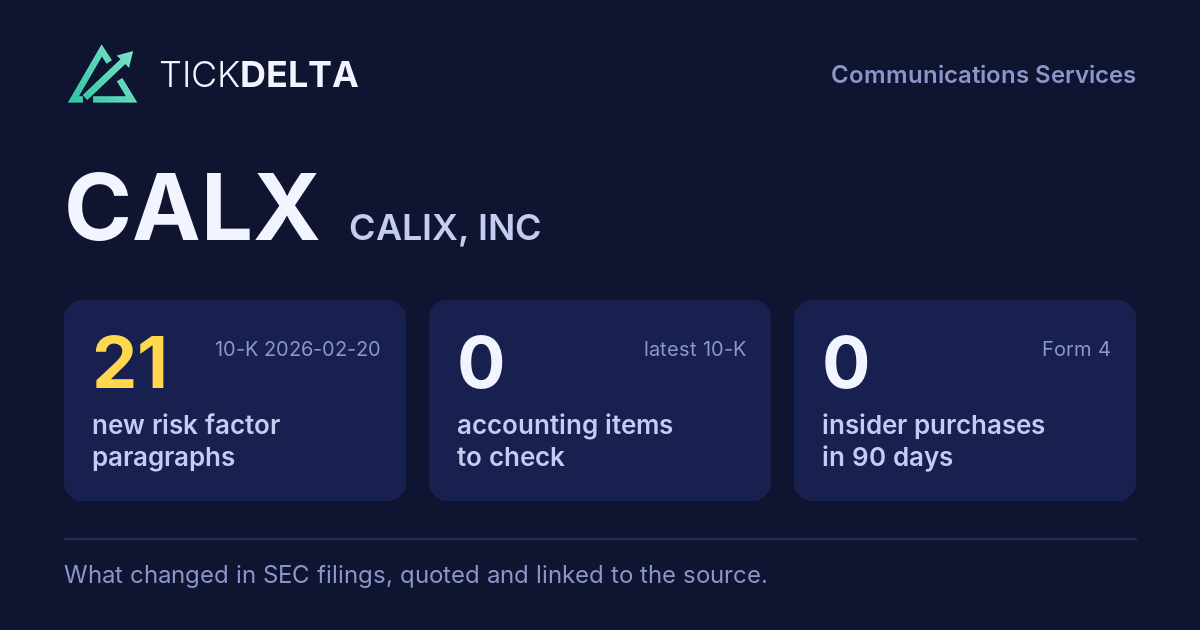
Calix, Inc CALX

Compare with peers Embed
New in the 10-K 21 paragraphs with nothing like them in the 10-K filed Feb 21, 2025 New in the 10-Q 20 paragraphs not in the 10-Q filed Jul 21, 2026 10-Q against the 10-K 67 risk factor paragraphs and sentences added or reworded

New risk paragraphs, branching off last year

Each branch is a paragraph in Risk Factors with nothing like it in the 10-K filed Feb 21, 2025. A box jumps to the paragraph as filed, below.

21 new

Paragraphs with nothing like them in last year's 10-K

Quoted exactly

21 paragraphs in Risk Factors of the 10-K filed Feb 20, 2026 with nothing like them in the 10-K filed Feb 21, 2025. Quoted exactly. Paragraphs that were only edited are under 10-K change.

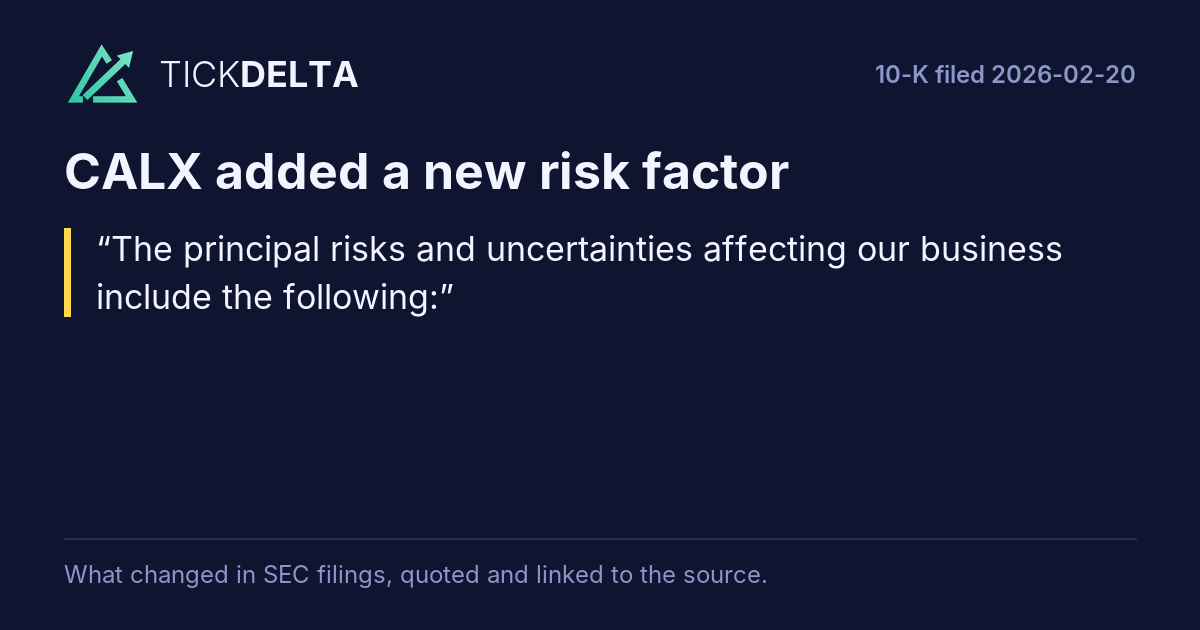
The principal risks and uncertainties affecting our business include the following:

Read in the 10-K

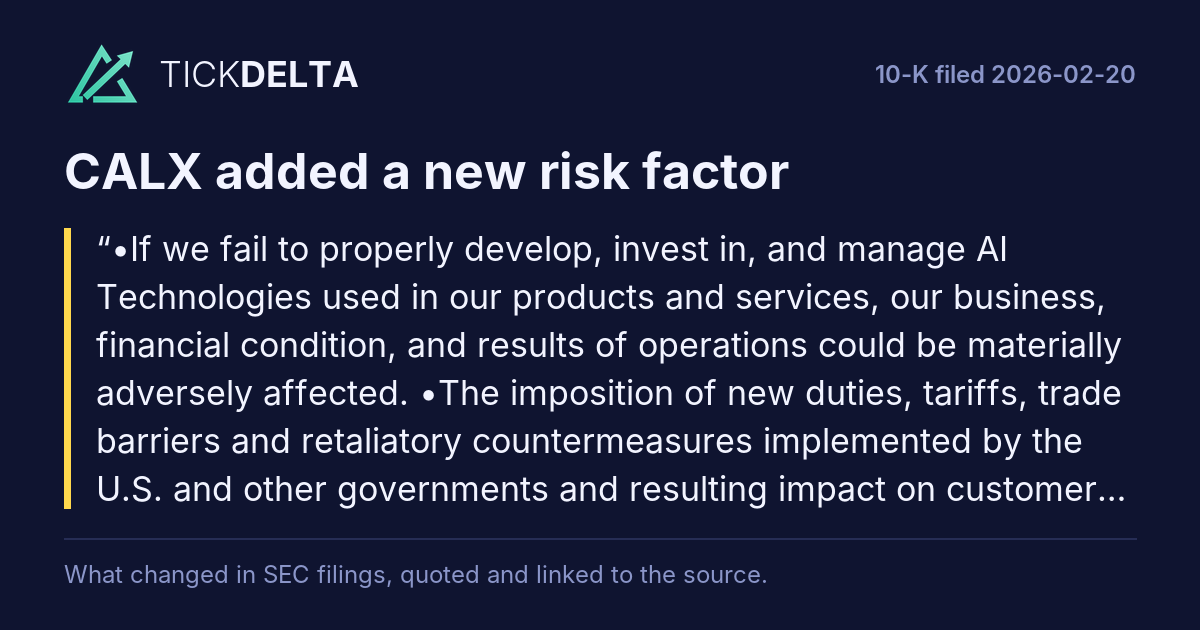
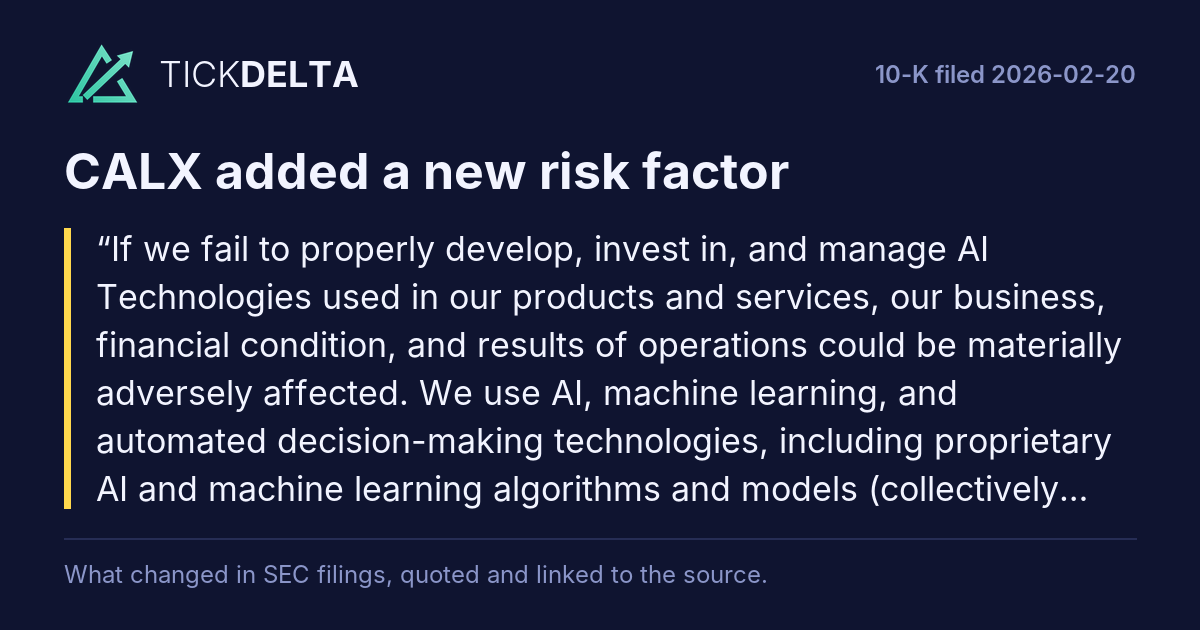
•If we fail to properly develop, invest in, and manage AI Technologies used in our products and services, our business, financial condition, and results of operations could be materially adversely affected.

•The imposition of new duties, tariffs, trade barriers and retaliatory countermeasures implemented by the U.S. and other governments and resulting impact on customer demand may have a material adverse effect on our business, financial condition and results of operations.

Read in the 10-K

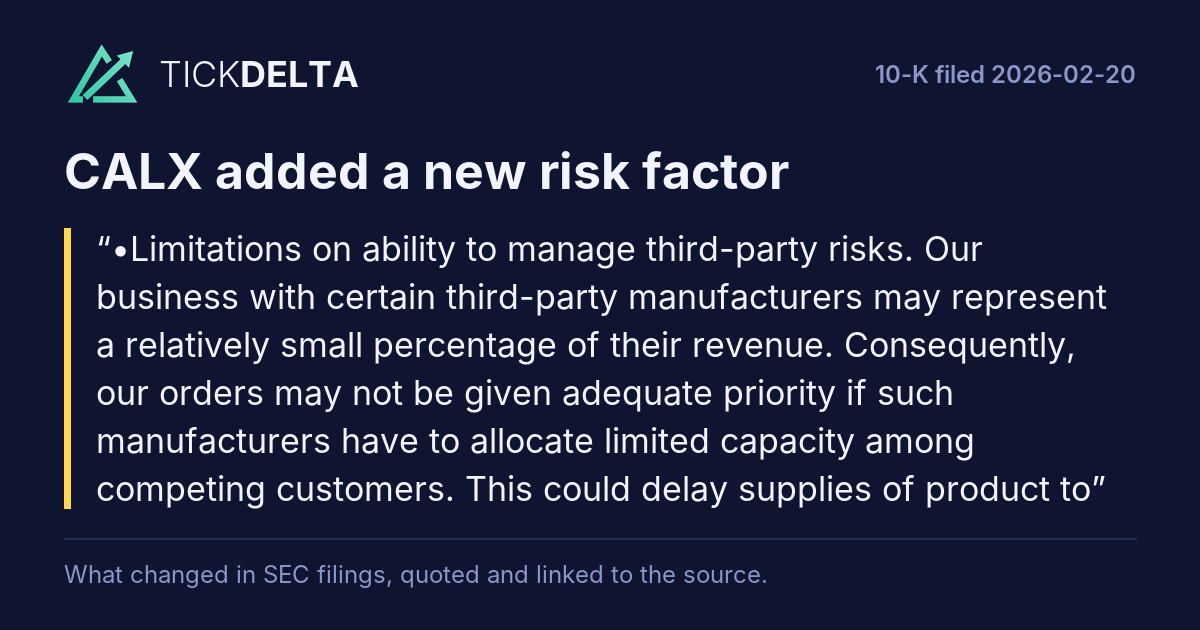
•Limitations on ability to manage third-party risks. Our business with certain third-party manufacturers may represent a relatively small percentage of their revenue. Consequently, our orders may not be given adequate priority if such manufacturers have to allocate limited capacity among competing customers. This could delay supplies of product to

Read in the 10-K

If we fail to properly develop, invest in, and manage AI Technologies used in our products and services, our business, financial condition, and results of operations could be materially adversely affected.

We use AI, machine learning, and automated decision-making technologies, including proprietary AI and machine learning algorithms and models (collectively, “AI Technologies”) throughout our business, and are making significant investments in this area. For example, with the implementation of our agentic workflows within our platform, we will aim to provide both our customer success team and CXP customers with advanced automated tools to augment their operations, accelerate transformation initiatives and expand their impact independent of traditional resource constraints.

We expect that increased investment will be required in the future to continuously improve our use of AI Technologies. As with many technological innovations, there are significant risks involved in developing, maintaining and deploying these technologies, and there can be no assurance that the usage of, or our investments in, such technologies will always enhance our products or services or be beneficial to our business, including our efficiency or profitability.

In particular, if the models underlying our AI Technologies are: incorrectly designed or implemented; trained or reliant on incomplete, inadequate, inaccurate, biased or otherwise poor quality data, or on data to which we do not have sufficient rights or in relation to which we and/or the providers of such data have not implemented sufficient legal compliance measures; used without sufficient oversight and governance to ensure their responsible use; and/or adversely impacted by unforeseen defects, technical challenges, cybersecurity threats or material performance issues, the performance of our products, services and business, as well as our reputation and the reputations of our customers, could suffer or we could incur liability resulting from the violation of laws or contracts to which we are a party or civil claims.

With respect to our products or services that incorporate AI Technologies, including agentic AI, the market for such products and services is rapidly evolving and unproven in many industries, including our own, and important assumptions about the characteristics of targeted markets, pricing, sales cycles, cost, performance, and perceived value associated with our services or products may be inaccurate. We cannot be sure that the market will continue to grow or that it will grow in ways we anticipate. In addition, market acceptance and consumer perceptions of products and services that incorporate AI Technologies is uncertain.

Additionally, the regulatory framework for AI Technologies is rapidly evolving. Existing laws and regulations may be interpreted in ways that could affect the operation of our AI Technologies, and federal, state and foreign government bodies and agencies have introduced or are currently considering additional laws and regulations applicable to AI Technologies. For example, in the U.S., legislation related to AI Technologies has been introduced at the federal level and enacted or proposed by various states, including California, Colorado, Connecticut and Texas. Some enacted or proposed frameworks include requirements focused on transparency, risk-management and accountability for AI Technologies, while others focus on high-risk uses of AI or the use of automated decision-making. Collectively, these developments signal an emerging trend towards a patchwork of state-level governance of AI in the U.S. Furthermore, the Trump administration’s approach to investment in and regulation of AI technologies has and is expected to continue to deviate from that of the previous administration, and we will need to adapt to any changes that may result from such approach, including as the result of new or changing executive orders. For instance, the U.S. federal government may seek to pre-empt state laws when they seek to govern certain topics as evidenced by the Trump administration’s “Ensuring a National Policy Framework for Artificial Intelligence” Executive Order signed on December 11, 2025. This order calls for federal standards and legislation that would preempt conflicting state AI regulations and create a federal litigation task force focused on challenging state AI laws in court. In Europe, the EU Artificial Intelligence Act (“EU AI Act”) establishes a comprehensive, risk-based governance framework for AI in the European Union (“EU”) market. The majority of the substantive requirements will apply from August 2, 2026. The EU AI Act applies to companies that develop, use and/or provide AI in the EU, with specific requirements based on the relevant AI use cases. For example, in relation to our use of generative AI, we may be subject to certain disclosure and transparency obligations, with fines up to the greater of €15 million or 3% of global revenue.

In addition, the revised EU Product Liability Directive, to be implemented into EU member state national law by December 2026, extends the EU’s existing strict product liability regime to AI and facilitates civil claims in respect of harm caused by AI. Once fully applicable, the EU AI Act and the EU Product Liability Directive, together with developing guidance and/or decisions in this area, will have a material impact on the way AI is regulated in the EU. The cost to comply with such laws, regulations, decisions and/or guidance interpreting existing laws, or to adjust our business plans based on changes to how such laws are enforced, could be significant and would increase our operating expenses (such as by imposing additional reporting obligations regarding our use of AI Technologies) or impact our ability to use, procure or commercialize AI Technologies. Such an increase in operating expenses, as well as any actual or perceived failure to comply with such laws and regulations, could adversely affect our business, financial condition and results of operations.

The imposition of new duties, tariffs, trade barriers and retaliatory countermeasures implemented by the U.S. and other governments and resulting impact on customer demand may have a material adverse effect on our business, financial condition and results of operations.

The implementation of significant changes to U.S. trade policies, sanctions, legislation, treaties and tariffs, including, but not limited to, significant new tariffs on goods imported into the U.S., have introduced uncertainty to our business and will increase the cost of our U.S. manufactured products and components sourced outside of the U.S., which will result in an increase to our cost of revenue and may cause a reduction in our gross margin. In response, China announced additional tariffs on U.S. goods and new export control restrictions. The imposition of additional tariffs or other trade barriers by countries outside of the U.S may increase our costs in these markets, and to the extent these increased costs result in increased prices for our customers, the demand for our products may decrease as our customers seek alternative sourcing, making it more difficult for us to sell our products in some markets.

The extent and duration of increased tariffs and the resulting impact on general economic conditions and on our business are uncertain and depend on various factors, such as negotiations between the U.S. and affected countries, the responses of other countries or regions, exemptions or exclusions that may be granted, availability and cost of alternative sources of supply, and demand for our products in affected markets. Other countries where we operate or sell our products may themselves change their own policies on trade as well, which may affect future business and foreign investment in their respective countries. U.S. and foreign policy changes and uncertainty about such changes has resulted in increased market volatility and currency exchange rate fluctuations. To the extent dissatisfaction with U.S. government policy results in U.S.-based suppliers being disfavored over foreign-based alternatives, it may diminish demand for our products with such customers and cause them to find alternative sourcing or otherwise make it more difficult for us to sell more products to these customers.

As a result of these dynamics, we may find it difficult to predict the impact to our business of these and future changes to the trading relationships between the U.S. or other countries or the impact on our business of new laws or regulations adopted by the U.S. or other countries.

Read in the 10-K

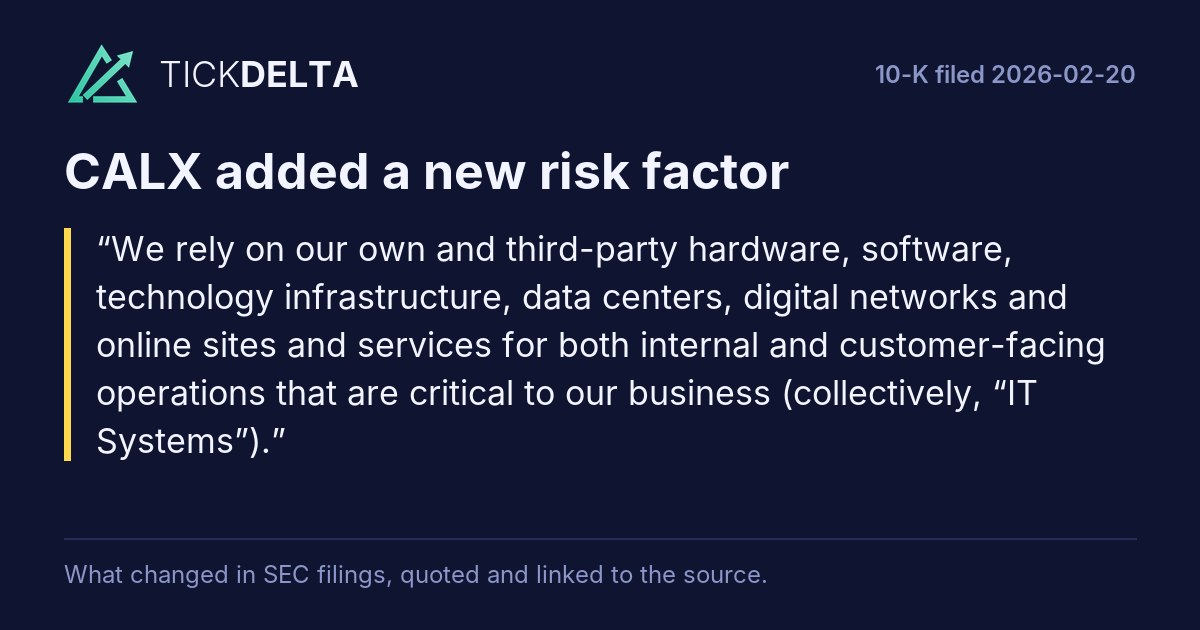
We rely on our own and third-party hardware, software, technology infrastructure, data centers, digital networks and online sites and services for both internal and customer-facing operations that are critical to our business (collectively, “IT Systems”).

Read in the 10-K
Show the other 4

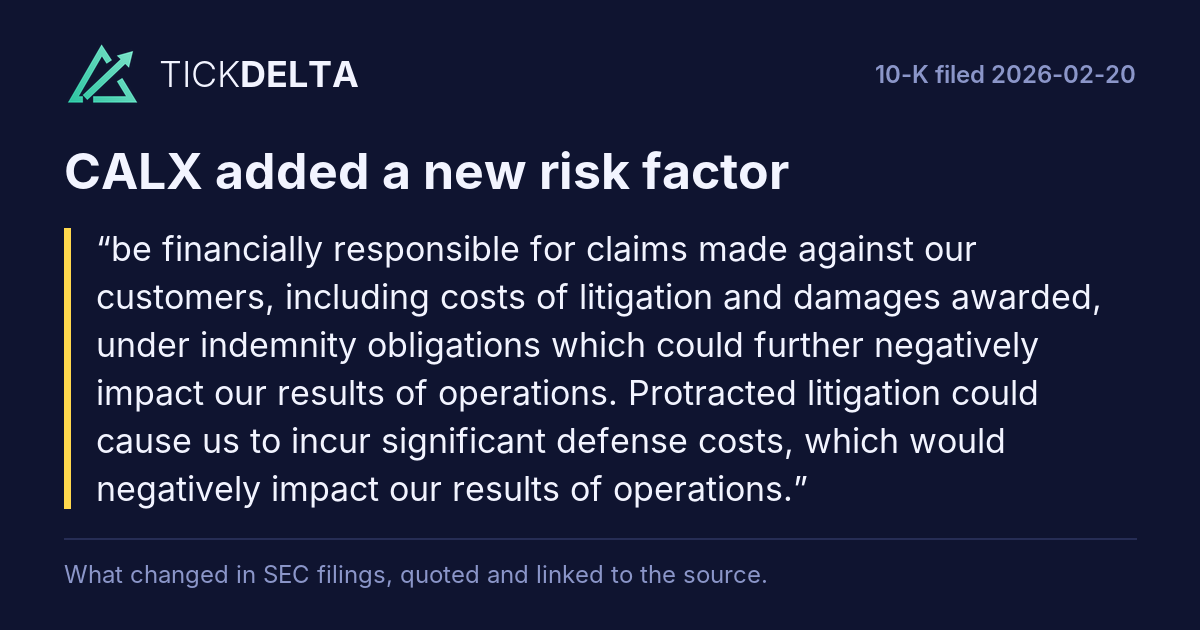
be financially responsible for claims made against our customers, including costs of litigation and damages awarded, under indemnity obligations which could further negatively impact our results of operations. Protracted litigation could cause us to incur significant defense costs, which would negatively impact our results of operations.

Read in the 10-K

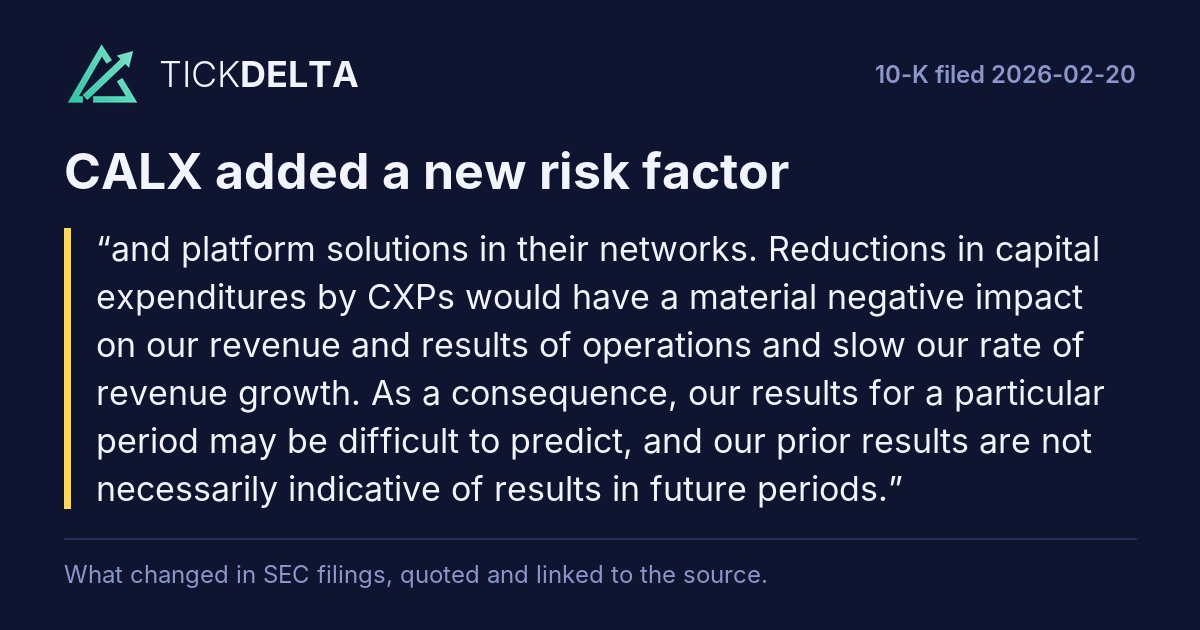
and platform solutions in their networks. Reductions in capital expenditures by CXPs would have a material negative impact on our revenue and results of operations and slow our rate of revenue growth. As a consequence, our results for a particular period may be difficult to predict, and our prior results are not necessarily indicative of results in future periods.

Read in the 10-K

Geopolitical issues such as armed conflicts, relations between the U.S. and China, tariff and trade policy changes and increasing potential of conflict involving countries in Asia that are critical to our supply-chain operations, such as Taiwan and China, have resulted in increasing global tensions and create uncertainty for global commerce. New or increased tariffs and other changes in U.S. trade policy, including new sanctions, have triggered and may continue to trigger retaliatory actions by affected countries or changes in demand from customers displeased with U.S. tariff and trade policy changes. U.S. executive orders have resulted in tariffs on imports from numerous countries, including China and other Asian countries where our sole-source or limited-source suppliers are located. Consequently, absent policy changes, these actions will increase our cost of revenue. To the extent dissatisfaction with U.S. government policy results in U.S.-based suppliers being disfavored over foreign-based alternatives, it may diminish demand for our products with such customers and cause them to find alternative sourcing or otherwise make it more difficult for us to sell more products to these customers. The imposition of additional tariffs or other trade barriers by countries other than the U.S., including China and other Asian countries, will increase our costs in these markets, and to the extent these increased costs result in increased prices for our customers, we expect the demand for products in these markets to decrease as some of our customers seek alternative sources, making it more difficult for us to sell our products in these markets.

Read in the 10-K

In 2024, the National Security Division of the U.S. Department of Justice (“DOJ”) issued a new rule—referred to as the “Data Security Program” (“DSP”) aimed at preventing access to “bulk U.S. sensitive personal data” and “government-related data” by “countries of concern” (including China, Russia, Iran, North Korea, Cuba, and Venezuela) and “covered persons” (as all such terms are defined in the DSP). Effective as of April 8, 2025, and fully enforceable as of July 9, 2025, the DSP imposes stringent obligations on companies within its scope and prohibits or restricts “covered data transactions” that grant countries of concern or covered persons access to bulk U.S. sensitive personal data or any amount of government-related data. The DSP is new, complex and has yet to be enforced, and as such, there is a risk that our interpretation of its applicability, scope and requirements is incorrect, incomplete or misapplied.

Compliance with the DSP may require us to invest heavily in data security and compliance measures such as implementing and complying with the Cybersecurity and Infrastructure Security Agency’s guidelines and other burdensome recordkeeping, reporting and auditing requirements. It may also require us to implement new processes, stop or restrict certain data transfers, alter the geographic scope of our operations, cease doing business with certain third parties or using certain tools or vendors, or change how data flows throughout our business, any of which could materially impact our business operations or hinder our ability to grow our business. Finally, non-compliance with the DSP could result in significant civil or criminal penalties, which could materially adversely affect our business, results of operations and financial condition.

Read in the 10-K

Paragraphs in the 10-Q filed Nov 3, 2026 that were not in the one before

New in the latest 10-Q

20 paragraphs in the 10-Q filed Nov 3, 2026 with nothing like them in the 10-Q filed Jul 21, 2026 (at least half the words must differ; new numbers alone do not count). Quoted exactly, grouped by the item heading above them. This is text that changed, not a judgement of how serious it is.

Financial statements and notes

Three Months Ended Nine Months Ended September 26, September 27, September 26, September 27,

Read in the 10-Q

Three Months Ended Nine Months Ended September 26, September 27, September 26, September 27,

Read in the 10-Q

Three Months Ended Nine Months Ended September 26, September 27, September 26, September 27,

Read in the 10-Q

Three Months Ended Nine Months Ended September 26, September 27, September 26, September 27,

Read in the 10-Q

Three Months Ended Nine Months Ended September 26, September 27, September 26, September 27,

Read in the 10-Q
Show the other 15

Three Months Ended Nine Months Ended September 26, September 27, September 26, September 27,

Read in the 10-Q

Comparison of the Three and Nine Months Ended September 26, 2026 and September 27, 2025

Read in the 10-Q

platform where we operated in a dual cloud environment to successfully support customer migrations during a portion of the respective periods.

Read in the 10-Q

recognition of tax benefits related to uncertain tax positions and changes in or the interpretation of tax laws in jurisdictions where we conduct business.

Read in the 10-Q

Market risk

currencies are Chinese Renminbi, or RMB, Indian Rupee, or INR, Canadian Dollar, or CAD, British Pounds Sterling, or GBP, and Euro, or EUR.

Read in the 10-Q

Risk Factors

• We are currently a defendant in a putative securities class action alleging that we made materially false or misleading statements regarding our memory component supply and its impact on our non-GAAP gross margins.

Read in the 10-Q

In Europe, the EU Artificial Intelligence Act (“EU AI Act”) establishes a comprehensive, risk-based governance framework for AI systems used or placed on the market in the European Union (“EU”). We have assessed the applicability of the EU AI Act to our current products, services, and internal uses of AI, including certain cases of generative AI, and we do not presently believe that our current AI-related activities are subject to the EU AI Act’s most burdensome requirements applicable to high-risk AI systems. However, certain provisions of the EU AI Act may apply to our use and offering of AI-enabled functionality, including transparency, documentation, governance, and other compliance obligations. We are continuing to review our products, services, and AI use cases, monitor regulatory guidance and implementing measures, and enhance our internal AI governance, policies, controls, and compliance processes. As the EU Act continues to be interpreted and implemented, changes in our products, services, AI use cases, regulatory compliance, or enforcement priorities could result in additional compliance obligations, increased costs, operational changes, or potential exposure to fines and other penalties. For example, certain violations of the EU AI Act may be subject to fines of up to the greater of €15 million or 3% of global revenue.

Read in the 10-Q

We are currently a defendant in a putative securities class action alleging that we made materially false or misleading statements regarding our memory component supply and its impact on our non-GAAP gross margins.

Read in the 10-Q

generally alleges that we and the named individual defendants made material misrepresentations and/or omissions relating to our memory component supply and its impact on non-GAAP gross margins, in violation of Sections 10(b) and 20(a) of the Exchange Act and Rule 10b-5 promulgated thereunder. Among other things, the complaint alleges we failed to disclose that our first-quarter margins had significantly benefited from advance purchasing of memory components, that our advance-purchased supply was dwindling, and that we were therefore experiencing negative margin pressure from rising market prices for memory components.

Read in the 10-Q

We intend to vigorously defend this action; however, litigation of this nature is inherently uncertain, and we cannot predict its outcome or reasonably estimate a range of possible loss. Regardless of outcome, this litigation could result in substantial legal fees and defense costs, divert management's attention and internal resources from our business, and harm our reputation, results of operations, or the market price of our common stock. We may not succeed in obtaining dismissal or resolving the litigation within the limits of available insurance coverage. Additional lawsuits, including derivative claims, or regulatory inquiries premised on the same underlying allegations may also be filed or initiated against us.

Read in the 10-Q

present levels, demand for our products, and our business, financial condition and results of operations, could be adversely affected.

Read in the 10-Q

On March 23, 2026, the FCC updated its “Covered List” under Section 2 of the Secure and Trusted Communications Networks Act of 2019 to include certain foreign-produced “consumer-grade routers.” Models previously authorized by the FCC generally may continue to be imported, marketed and sold in the U.S. New covered models, however, generally cannot obtain the required FCC equipment authorization without first securing conditional approval from the Department of War (“DoW”) or the Department of Homeland Security (“DHS”), or an applicable waiver.

Read in the 10-Q

Although we primarily market systems to CSPs, regulators could interpret “consumer-grade routers” broadly enough to include certain Calix hardware deployed in residential environments. Such an interpretation could restrict our ability to obtain FCC equipment authorization for new models or, after January 1, 2029, to provide security patches, firmware updates or functionality enhancements for affected products.

Read in the 10-Q

We have obtained conditional approvals and FCC equipment authorizations permitting the continued importation, sale, deployment, support and maintenance in the U.S. of our GigaSpire® and GigaPro® gateway appliance families. Depending on the applicable model or class, these approvals extend through late 2027 and are subject to conditions, limitations, renewal requirements, modification and additional regulatory scrutiny. The FCC has also granted a waiver permitting basic software and firmware updates through January 1, 2029.

Read in the 10-Q

These approvals and waivers could be modified, revoked, not renewed or interpreted more narrowly than we expect. We may need additional approvals or waivers, be required to make notifications or disclose supply-chain information, or become subject to additional conditions in connection with future products, product enhancements, manufacturing changes or supply-chain arrangements. Regulatory uncertainty, including uncertainty regarding our ability to support affected products over their expected useful lives, could cause customers to delay purchases or select competitors perceived as presenting less regulatory risk. Compliance could also require us to modify products or supply chains or implement U.S. manufacturing or “onshoring” plans, which could require significant capital expenditures, delay product introductions and increase unit costs that we may be unable to pass on to customers. If we fail to obtain, maintain or renew necessary approvals or waivers, or otherwise comply with applicable regulatory requirements, our ability to offer and maintain affected products could be significantly restricted, which could have a material adverse effect on our business, financial condition and results of operations.

Read in the 10-Q

The 10-Q's risk factors against the 10-K

Item 1A of the 10-Q filed Nov 3, 2026 against Item 1A of the 10-K filed Feb 20, 2026. A 10-Q repeats only the risks that changed, so a 10-K paragraph that is missing from it is not counted as removed. Added is a paragraph with nothing like it in the 10-K, Reworded a sentence that is in both with several words changed, Quiet changes a sentence in both where one to four words changed and one is a hedge or a modal (cut words struck through, new words highlighted). Text on the page, not a score; each links to the filing at sec.gov.

Added10-Q Nov 3, 2026 vs 10-K Feb 20, 2026
• We face risks associated with dependence on third-party vendors; component prices volatility and shortages have in the past, currently are, and may in the future adversely affect our gross margin and results of operations; and our mitigation strategies may be of limited or temporary value.

Read it in the 10-Q at sec.gov

Added10-Q Nov 3, 2026 vs 10-K Feb 20, 2026
• We are currently a defendant in a putative securities class action alleging that we made materially false or misleading statements regarding our memory component supply and its impact on our non-GAAP gross margins.

Read it in the 10-Q at sec.gov

Added10-Q Nov 3, 2026 vs 10-K Feb 20, 2026
• Failure to obtain or maintain necessary regulatory approvals from the FCC or other governmental agencies, or limitations put on on-going support of certain foreign-produced products, could significantly restrict our ability to offer and maintain certain products in the U.S. market.

Read it in the 10-Q at sec.gov

Added10-Q Nov 3, 2026 vs 10-K Feb 20, 2026
We face risks associated with dependence on third-party vendors; component prices volatility and shortages have in the past, currently are, and may in the future adversely affect our gross margin and results of operations; and our mitigation strategies may be of limited or temporary value.

Read it in the 10-Q at sec.gov

Added10-Q Nov 3, 2026 vs 10-K Feb 20, 2026
A significant portion of our cost of revenue is driven by memory component pricing, which is subject to significant volatility and has significantly increased recently. Although we have in the past, are currently, and may in the future use advance purchasing and pricing actions, including memory surcharges, to mitigate these impacts, such measures may be only partially effective. As component prices stay at their current level or increase, our gross margin and operating results have in the past, currently are, and may in the future be adversely affected.

Read it in the 10-Q at sec.gov

Show the other 22
Added10-Q Nov 3, 2026 vs 10-K Feb 20, 2026
Any interruption in the development, supply or distribution of our products, any continued increase in memory or other component costs or any inability to recover increased component costs through surcharges or other pricing actions, have adversely affected and may in the future adversely affect our ability to meet scheduled product deliveries to our customers and could result in lost revenue or higher costs, which have adversely impacted, and may in the future adversely impact, our gross margin and operating results and harm our business.

Read it in the 10-Q at sec.gov

Added10-Q Nov 3, 2026 vs 10-K Feb 20, 2026
Additionally, the regulatory framework for AI Technologies is rapidly evolving. Already, certain existing legal regimes (e.g., relating to data privacy) regulate certain aspects of AI Technologies, and existing laws and regulations may be enjoined in judicial proceedings, interpreted or enforced in ways that would affect the operation of our AI Technologies, or could be rescinded or amended as new administrations take differing approaches to evolving AI Technologies. Additionally, many federal, state and foreign government bodies and agencies have enacted or are currently considering additional laws and regulations governing AI. As a result, implementation standards and enforcement practices are likely to remain uncertain for the foreseeable future, and we cannot predict the impact future laws, regulations, or standards, or the market perception of their requirements, may have on our business or how we will respond to these laws or regulations.

Read it in the 10-Q at sec.gov

Added10-Q Nov 3, 2026 vs 10-K Feb 20, 2026
For example, in the U.S., the regulatory framework for AI Technologies faces significant uncertainty. At the federal level, Congress has yet to enact meaningful AI legislation. Instead, federal policy on AI has been shaped by a series of executive orders that have shifted priorities and requirements substantially depending on the administration in power. In the absence of AI legislation, states have filled the void by enacting laws regulating different aspects of AI Technologies. For example, California has enacted laws and regulations related to AI safety protocols, reporting and transparency, among other AI-related topics. Numerous other states have enacted, passed or are considering AI-focused legislation, creating a patchwork of state-level governance of AI in the U.S. and a complex compliance challenge. However, the durability of these laws and the potential of additional state-level legislative activity faces uncertainty following President Trump’s December 2025 Executive Order “Ensuring a National Policy Framework for Artificial Intelligence”, which establishes a federal policy favoring a uniform national AI regulatory framework designed to promote innovation and U.S. global competitiveness, and directs federal agencies to identify, challenge, and potentially pre-empt state and local AI laws that are viewed as inconsistent with or burdensome to this national approach. It remains to be seen how agencies will effectuate this directive, and how states will approach AI legislation moving forward.

Read it in the 10-Q at sec.gov

Added10-Q Nov 3, 2026 vs 10-K Feb 20, 2026
In Europe, the EU Artificial Intelligence Act (“EU AI Act”) establishes a comprehensive, risk-based governance framework for AI systems used or placed on the market in the European Union (“EU”). We have assessed the applicability of the EU AI Act to our current products, services, and internal uses of AI, including certain cases of generative AI, and we do not presently believe that our current AI-related activities are subject to the EU AI Act’s most burdensome requirements applicable to high-risk AI systems. However, certain provisions of the EU AI Act may apply to our use and offering of AI-enabled functionality, including transparency, documentation, governance, and other compliance obligations. We are continuing to review our products, services, and AI use cases, monitor regulatory guidance and implementing measures, and enhance our internal AI governance, policies, controls, and compliance processes. As the EU Act continues to be interpreted and implemented, changes in our products, services, AI use cases, regulatory compliance, or enforcement priorities could result in additional compliance obligations, increased costs, operational changes, or potential exposure to fines and other penalties. For example, certain violations of the EU AI Act may be subject to fines of up to the greater of €15 million or 3% of global revenue.

Read it in the 10-Q at sec.gov

Added10-Q Nov 3, 2026 vs 10-K Feb 20, 2026
We are currently a defendant in a putative securities class action alleging that we made materially false or misleading statements regarding our memory component supply and its impact on our non-GAAP gross margins.

Read it in the 10-Q at sec.gov

Added10-Q Nov 3, 2026 vs 10-K Feb 20, 2026
On May 27, 2026, a putative shareholder class action captioned Noor v. Calix, Inc., et al., Case No. 5:26-cv-04993-PCP, was filed in the U.S. District Court for the Northern District of California against us and certain of our current officers, on behalf of persons who purchased or otherwise acquired our securities between January 28, 2026 and April 21, 2026. The complaint

Read it in the 10-Q at sec.gov

Added10-Q Nov 3, 2026 vs 10-K Feb 20, 2026
generally alleges that we and the named individual defendants made material misrepresentations and/or omissions relating to our memory component supply and its impact on non-GAAP gross margins, in violation of Sections 10(b) and 20(a) of the Exchange Act and Rule 10b-5 promulgated thereunder. Among other things, the complaint alleges we failed to disclose that our first-quarter margins had significantly benefited from advance purchasing of memory components, that our advance-purchased supply was dwindling, and that we were therefore experiencing negative margin pressure from rising market prices for memory components.

Read it in the 10-Q at sec.gov

Reworded10-Q Nov 3, 2026 vs 10-K Feb 20, 2026
Factors that impact variability of our operating results include our ability to predict our revenue and reduce and control our costs, costs; the level, timing, and effectiveness of advance purchasing of memory and other components; the rate at which advance-purchased inventory is depleted; the level and trajectory of memory and other component market prices, including DDR memory prices; the timing, scope, and effectiveness of memory surcharges and other pricing actions, which have in the past, currently do, and may in the future recover only a portion of increased costs and have not in the past, currently do not and may not in the future generate incremental gross profit; our ability to predict product functions and features desired by our customers, the impact of global economic and geopolitical events and conditions, including tariffs, trade controls, inflation, government shutdowns, market instability and economic downturns, our ability to effectively manage our global supply chain operations, our ability to effectively manage third parties upon whom we depend to conduct our business, our customers’ spending patterns and purchasing decisions, the impact of competition, customer adoption of our products, our ability to manage our legal, contractual and regulatory obligations and liabilities and other risk factors identified in “Management’s Discussion and Analysis of Financial Condition and Results of Operations” and in this “Risk Factors” section.

Read it in the 10-Q at sec.govThe 10-K sentence

Reworded10-Q Nov 3, 2026 vs 10-K Feb 20, 2026
The implementation of significant changes to U.S. trade policies, sanctions, legislation, treaties and tariffs, including, but not limited to, significant new tariffs on goods imported into the U.S., have introduced uncertainty to our business and will increase the cost of our U.S. manufactured products and components sourced outside of the U.S., which will result in an increase to our cost of revenue and may cause a reduction in our gross margin.

Read it in the 10-Q at sec.govThe 10-K sentence

Reworded10-Q Nov 3, 2026 vs 10-K Feb 20, 2026
The interpretation interpretation, application and application amendment of these data protection laws laws, regulations and regulations other requirements are often uncertain and constantly changing, and it is possible that they may be interpreted and applied in a manner that is inconsistent with our data practices. practices or that new laws, regulations and other requirements require us to incur significant costs, implement new processes, or change our processing of information and business operations.

Read it in the 10-Q at sec.govThe 10-K sentence

Reworded10-Q Nov 3, 2026 vs 10-K Feb 20, 2026
The implementation of significant changes (and uncertainty related to U.S. trade policies, sanctions, legislation, treaties and tariffs, including, but not limited to, significant new tariffs on goods imported into the U.S., enforceability thereof), have introduced uncertainty to our business and will may increase the cost of our U.S. manufactured products and components sourced outside of the U.S., which will may result in an increase to our cost of revenue and may cause a reduction in our gross margin.

Read it in the 10-Q at sec.govThe 10-K sentence

Reworded10-Q Nov 3, 2026 vs 10-K Feb 20, 2026
In light of the complex and evolving nature of EU, EU Member State and UK data and security laws, there can be no assurances that we will be successful in our efforts to comply with such laws; violations of such laws could result in regulatory investigations, fines, orders to cease/change our use of technologies and/or our processing activities, enforcement notices and assessment notices (for a compulsory audit), as well as lead to civil claims including class actions and reputational damage.

Read it in the 10-Q at sec.govThe 10-K sentence

Reworded10-Q Nov 3, 2026 vs 10-K Feb 20, 2026
Furthermore, if we are unable to generate sufficient cash flows to support our operational needs, we may need to cease our common stock repurchase program or seek additional sources of liquidity, including borrowings, to support our working capital needs, even if we believe we have generated sufficient cash flows to support our operational needs.

Read it in the 10-Q at sec.govThe 10-K sentence

Reworded10-Q Nov 3, 2026 vs 10-K Feb 20, 2026
This may adversely affect our ability to obtain components and materials needed to manufacture our products at acceptable prices in a timely fashion, or at all. all, which would adversely affect our ability to meet scheduled product deliveries to our customers, increase costs and in turn harm our business and results of operations.

Read it in the 10-Q at sec.govThe 10-K sentence

Reworded10-Q Nov 3, 2026 vs 10-K Feb 20, 2026
If we are subject to or affected by the CCPA, or other domestic privacy and data protection laws, any Any liability from failure to comply with the requirements of these applicable privacy and data protection laws could adversely affect our financial condition.

Read it in the 10-Q at sec.govThe 10-K sentence

Reworded10-Q Nov 3, 2026 vs 10-K Feb 20, 2026
If we fail to accurately plan our inventory levels, which becomes more challenging as component lead times increase, we may have to increase write offs for excess or obsolete inventory, or accrue additional liabilities for component inventory held by our suppliers, both of which could have a material adverse effect on our financial condition and results of operations.

Read it in the 10-Q at sec.govThe 10-K sentence

Reworded10-Q Nov 3, 2026 vs 10-K Feb 20, 2026
If we do not effectively assist our customers in deploying our products, succeed in helping them quickly resolve post-deployment issues, effectively utilize features or enhancements or provide effective support, it could adversely affect our ability to sell our products to existing customers and harm our reputation with potential new customers.

Read it in the 10-Q at sec.govThe 10-K sentence

Reworded10-Q Nov 3, 2026 vs 10-K Feb 20, 2026
Government authorities in the U.S. and around the world have implemented and are continuing to implement broader and more stringent laws laws, rules, regulations, industry standards and regulations other requirements concerning data protection. protection, privacy, security and the processing of personal information, many of which we are subject to.

Read it in the 10-Q at sec.govThe 10-K sentence

Reworded10-Q Nov 3, 2026 vs 10-K Feb 20, 2026
We face numerous and evolving cybersecurity risks that threaten the confidentiality, integrity and availability of our IT Systems and Confidential Information, including from diverse threat actors such as state-sponsored organizations, opportunistic hackers and hacktivists, as well as through diverse attack vectors such as social engineering/phishing, malware (including ransomware), malfeasance by insiders, human or technological error and, as a result of malicious code embedded in open-source software, bugs, misconfigurations or exploited vulnerabilities in software or hardware that is integrated into our (or our suppliers’ or service providers’) IT Systems, products or services.

Read it in the 10-Q at sec.govThe 10-K sentence

Quiet changes10-Q Nov 3, 2026 vs 10-K Feb 20, 2026
The imposition of additional tariffs or other trade barriers by countries other than the U.S., including China and other Asian countries, will may increase our costs in these markets, and to the extent these increased costs result in increased prices for our customers, we expect the demand for products in these markets to decrease as some of our customers seek alternative sources, making it more difficult for us to sell our products in these markets.

Read it in the 10-Q at sec.govThe 10-K sentence

Quiet changes10-Q Nov 3, 2026 vs 10-K Feb 20, 2026
Such laws and regulations will be are subject to interpretation by various courts and other governmental authorities, thus creating potentially complex compliance issues for us and our future customers and strategic partners.

Read it in the 10-Q at sec.govThe 10-K sentence

The first 27 of 67 are shown (at most 12 of each type).

Phrases used for the first time

Two-word phrases in Risk Factors of the 10-K filed Feb 20, 2026 that are in none of the 1 earlier 10-Ks stored, back to Feb 21, 2025

trade barriers ×4data act ×4existing cxps ×3tariffs trade ×3changing cxp ×3cxp requirements ×3additional tariffs ×3alternative sourcing ×3properly develop ×2develop invest ×2new duties ×2duties tariffs ×2retaliatory countermeasures ×2countermeasures implemented ×2cxps due ×2privacy security ×2
Where each one is used
  • trade barriers: •The imposition of new duties, tariffs, trade barriers and retaliatory countermeasures implemented by the U.S. and other governments and resulting impact on customer demand may have a material adverse effect on our business, financial condition and results of operations.
  • data act: The GDPR regulate cross-border transfers of personal data out of the European Economic Area (the “EEA”) and the UK. There is currently legal complexity and uncertainty regarding international personal data transfers, and we expect this to continue. For example, there are number of decisions and proceedings in the...
  • existing cxps: •If we do not successfully execute our business strategy to increase our sales to new and existing CXPs, our operating results, financial condition, cash flows and long-term growth may be negatively impacted.
  • tariffs trade: •The imposition of new duties, tariffs, trade barriers and retaliatory countermeasures implemented by the U.S. and other governments and resulting impact on customer demand may have a material adverse effect on our business, financial condition and results of operations.
  • changing cxp: •Our industry is characterized by rapid technological advancements, and if we fail to develop new products or enhancements that meet changing CXP requirements, we could experience lower sales.
  • cxp requirements: •Our industry is characterized by rapid technological advancements, and if we fail to develop new products or enhancements that meet changing CXP requirements, we could experience lower sales.
  • additional tariffs: The implementation of significant changes to U.S. trade policies, sanctions, legislation, treaties and tariffs, including, but not limited to, significant new tariffs on goods imported into the U.S., have introduced uncertainty to our business and will increase the cost of our U.S. manufactured products and...
  • alternative sourcing: The implementation of significant changes to U.S. trade policies, sanctions, legislation, treaties and tariffs, including, but not limited to, significant new tariffs on goods imported into the U.S., have introduced uncertainty to our business and will increase the cost of our U.S. manufactured products and...

The 10-K at sec.gov

Used at least twice, small words left out. Counted, not picked: a phrase can be new because the company renamed something.

What was taken out

4 paragraphs of last year's Risk Factors with nothing like them now. The longest are quoted.

Across all companies
We and/or our customers are also subject to evolving EU and UK privacy laws on cookies, tracking technologies, e-marketing and electronic communications. Recent European court and regulator decisions are driving increased attention to cookies and tracking technologies. If the trend of increasing enforcement by regulators of the strict approach to opt-in consent for all but essential use cases, as seen in recent guidance and decisions continues, this could lead to substantial costs, require significant systems changes, limit the effectiveness of marketing activities conducted on behalf of...
In the 10-K filed Feb 21, 2025
•Manufacturing constraints, shortages and other disruptions. We do not have internal manufacturing capabilities and rely solely on a small number of CMs and ODMs to manufacture and supply our products. Our business operations and ability to supply our products are highly dependent upon our ability to secure adequate third-party manufacturing capabilities and capacity and to effectively manage those third parties to meet our business needs. Our dependence solely on third-party manufacturers makes us vulnerable to possible supply and capacity constraints and reduces our
In the 10-K filed Feb 21, 2025
investigation, require us to notify our customers or other counterparties in relation to such incidents, damage our reputation and adversely affect our business, financial condition, operating results and cash flows. Although we maintain insurance that may apply to cybersecurity risks and liabilities, there can be no guarantee that any or all costs or losses incurred will be partially or fully insured or that we will be able to procure applicable insurance in the future on reasonable terms or at all.
In the 10-K filed Feb 21, 2025
holder of 15% or more of its capital stock unless the holder has held the stock for three years or, among other things, the Board of Directors has approved the transaction.
In the 10-K filed Feb 21, 2025

Sources

Item 1A of each 10-K and 10-Q on EDGAR, quoted exactly. Each paragraph links to the filing at sec.gov.

Also

10-K change: what was reworded or cut, section by section.

Work with it

Excel workbook · CSV. Google Sheet that stays up to date: paste =IMPORTDATA("https://tickdelta.com/company/CALX/export.csv") into a cell.

Next:10-K change
Esc

Type a ticker such as AAPL, a name, an investor such as Buffett, or a topic such as tariffs. ↑ ↓ to move, Enter to open.