tickdelta
Sign in

Tickdelta is free for now. Sign up and get Pro free

← Screener

CATCaterpillar Inc.

Industrials · Construction Machinery · NYSE

Originally organized as Caterpillar Tractor Co. in 1925 in the State of California, our company was reorganized as Caterpillar Inc. in 1986 in the State of Delaware. 10-K, Item 1

Headquarters
Irving, TX
CEO
Joseph E. Creed
Next results
around Jan 28, 2027
Compare with peers → Embed

When the SEC's staff reviews a filing, it writes to the company with numbered questions, and the company answers each one in a letter. SEC publishes the exchange once the review is over, at least 20 business days later. Below: what the staff asked CAT, and the company's answer to each question, quoted from the letters. A question is not an accusation; most reviews end with the company adding detail to its next filing.

Form 10-K for the fiscal year ended December 31, 2023

2024-03-11 to 2024-04-01 · 4 questions · 1 letter from the SEC, 1 from the company
Review closed 2024-04-01
Non-GAAP measuresDebtIncome taxesSegmentsResults discussion (MD&A)Liquidity and cash
2023 Compared with 2022 · Other Profit/Loss and Tax Items, page 33
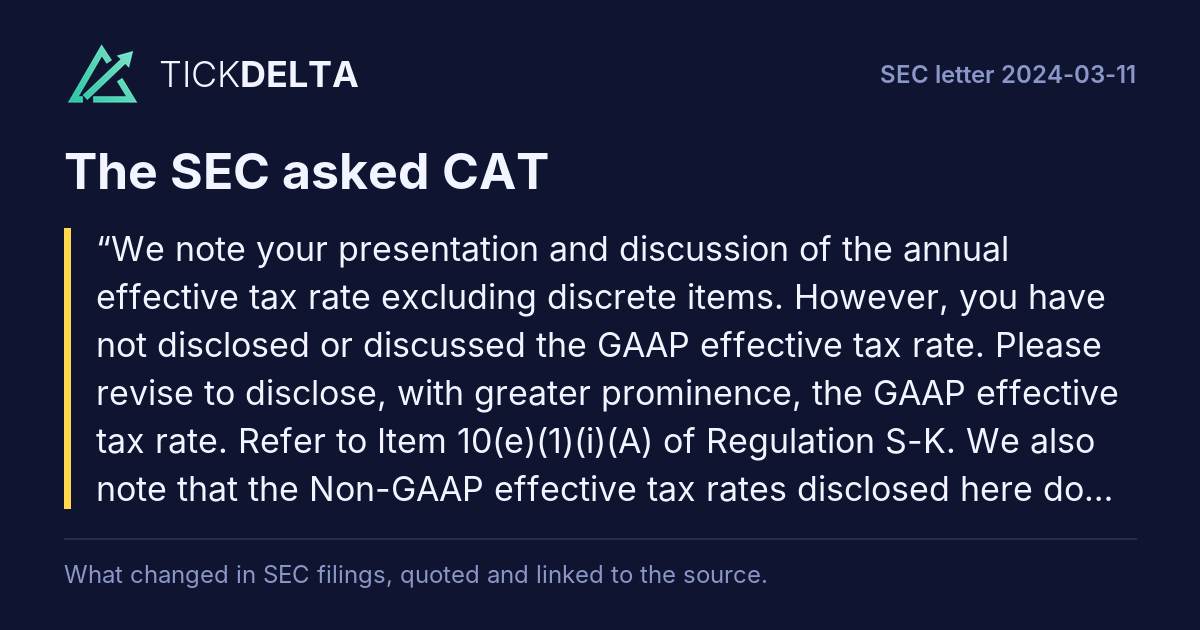
SEC asked (1)
We note your presentation and discussion of the annual effective tax rate excluding discrete items. However, you have not disclosed or discussed the GAAP effective tax rate. Please revise to disclose, with greater prominence, the GAAP effective tax rate. Refer to Item 10(e)(1)(i)(A) of Regulation S-K.
Rest of the question

We also note that the Non-GAAP effective tax rates disclosed here do not agree to the Non-GAAP effective tax rates disclosed in the reconciliation on page 47. Please advise.

CAT answered
We respectfully acknowledge the Staff’s comment regarding the GAAP effective tax rate. Beginning with the Management’s Discussion and Analysis included in our Form 10-Q for the quarter ending March 31, 2024, the Company will disclose the GAAP effective tax rate in an introductory sentence to the discussion of our provision for income taxes in accordance with Item 10(e)(1)(i)(A) of Regulation S-K.

Further, we will provide a reconciliation of our GAAP effective tax rate to our annual effective tax rate, excluding discrete items, in accordance with Item 10(e)(1)(i)(B) of Regulation S-K, along
Rest of the answer

with the other disclosures required by Item 10(e) of Regulation

S-K.

In addition, we acknowledge the Staff’s comments regarding the disagreement between the effective tax rate measures disclosed in the discussion on page 33 of the 2023 Form 10-K (i.e., the annual effective tax rate, excluding discrete items) and the reconciliation table on page 47 of the 2023 Form 10-K (i.e., our adjusted effective tax rate). We respectfully advise the Staff that the discrete items disclosed on page 33 were determined based on the guidance in ASC 740-270-25, while the adjustments in the reconciliation table on page 47 were determined by management in compliance with the framework prescribed in Item 10(e)(1)(i) of Regulation S-K.

The adjustments reflected in the non-GAAP reconciliation table may differ from the discrete items that are excluded from our annual effective tax rate and accordingly, the calculated tax rate in the last row of the reconciliation table (i.e., our adjusted effective tax rate) often has not equaled the annual effective tax rate, excluding discrete items. As the Company does not use the adjusted effective tax rate disclosed on page 47 for any analysis or discussion purposes and in response to the Staff’s comment, in future filings, we will update the reconciliation table to omit the column presenting the adjusted effective tax rate, such that the only adjusted tax rate measure we present will be our annual effective tax rate, excluding discrete items, as discussed above.

Read in the reply ↗
In its next report

First report after the company's reply of 2024-03-22: 10-Q filed 2024-05-01 ↗, against the 10-Q filed 2023-11-01 ↗.

Tickdelta does not hold the text of both reports, so they are not compared here.
Construction Industries, page 33
SEC asked (2)
Your discussion of segment profit for each of your segments beginning on page 33 refers to various factors that impacted segment operations; however, you do not quantify the impact of these factors. For example, you state that the increase in Resource Industries operating profit was due to favorable price realization, partially offset by lower sales volume.
Rest of the question

You also disclose that the increase in Energy & Transportation’s profit was mainly due to favorable price realization and higher sales volume, partially offset by unfavorable manufacturing costs and higher SG&A/R&D expenses. Where a material change is due to two or more factors, please revise to provide a quantified discussion of the various factors impacting such change. Refer to Item 303(b) of Regulation S-K.

CAT answered
We respectfully acknowledge the Staff’s comment. Beginning with our Form 10-Q for the quarter ending March 31, 2024, we will revise our disclosure to expand our discussion and analysis to include both qualitative and quantitative factors that result in material changes to the Company’s segment profit to the extent such information is appropriate to enhance readers’ understanding of the magnitude and relative impact of each factor. Read in the reply ↗
In its next report

First report after the company's reply of 2024-03-22: 10-Q filed 2024-05-01 ↗, against the 10-Q filed 2023-11-01 ↗.

Tickdelta does not hold the text of both reports, so they are not compared here.

Liquidity and Capital Resources, page 37
SEC asked (3)
We note your disclosure of consolidated net worth, covenant interest coverage ratio, and covenant leverage ratio which are non-GAAP measures. Please revise to provide the disclosures required by Item 10(e)(1)(i) of Regulation S-K.
CAT answered
The Company has historically presented its consolidated net worth, covenant interest coverage ratio and covenant leverage ratio (collectively, the “Covenants”) in the “Liquidity and Capital

Resources” section of its Management’s Discussion and Analysis disclosures. The Company provides this information not to demonstrate the Company’s performance, but rather to comply with Item 303(b)(1) of Regulation S-K, which requires registrants to “identify any known trends or any known demands, commitments, events or uncertainties that will result in or that are reasonably likely to result in the
Rest of the answer

registrant’s liquidity increasing or decreasing in any material way.”

We further respectfully direct the Staff’s attention to Question

102.09 of the Staff’s Compliance & Disclosure Interpretations regarding Non-GAAP Financial Measures (“Question 102.09”), in which the Staff makes clear that, notwithstanding the prohibitions set forth in Item 10(e) of Regulation S-K, if a registrant believes that (a) a credit agreement is a material agreement, (b) a covenant thereunder is a material term of the credit agreement and (c) information about such covenant is material to an investor’s understanding of the registrant’s financial condition and/or liquidity, then the registrant may in fact “be required to disclose the measure as calculated by the debt covenant as part of its MD&A.” (emphasis added) As demonstrated by the disclosures on pages 37-38 of the Company’s 2023

Form 10-K, each of the foregoing conditions has been met, which compels disclosure of the Covenants.

Importantly, both Regulation G and Item 10(e) of Regulation S-K specifically exclude from the definition of “non-GAAP financial measure” any measure that is “required to be disclosed by … Commission rules.” In light of the guidance reflected in Question 102.09 and the disclosure framework set forth in Item 303(b)(1) of Regulation S-K, we respectfully submit that disclosure of the Covenants is a required element of the Company’s periodic reports. Accordingly, the Covenants are not, by definition, “non-GAAP financial measures”, and disclosure of such Covenants in the “Liquidity and Capital Resources” section of the Company’s Management’s Discussion and Analysis should not be subject to the general prohibitions and requirements related to non-GAAP financial measures set forth in Regulation G and

Item 10(e) of Regulation S-K.

Notwithstanding the foregoing, we will enhance our disclosures in future filings, starting with our Form 10-Q for the quarter ending March 31, 2024, to make clear that the Covenants are being reported as calculated under the Credit Facility (as defined in the 2023 Form 10-K) and not pursuant to GAAP and to refer to the agreements governing the Credit Facility attached as exhibits to our periodic reports for further information related to the calculations thereof.

Read in the reply ↗
In its next report

First report after the company's reply of 2024-03-22: 10-Q filed 2024-05-01 ↗, against the 10-Q filed 2023-11-01 ↗.

Tickdelta does not hold the text of both reports, so they are not compared here.

Consolidated Financial Statements · Note 15. Credit committments, page 100
SEC asked (4)
Please revise to remove consolidated net worth, covenant interest coverage ratio, and covenant leverage ratio from the footnotes as the disclosure of non-GAAP measures in the financial statements or footnotes is prohibited. Refer to Item 10(e)(1)(ii)(C) of Regulation S-K.
CAT answered
The Company respectfully acknowledges the Staff’s comment and will update future annual reports, beginning with the Form 10-K for the fiscal year ended December 31, 2024, to exclude consolidated net worth, covenant interest coverage ratio, and covenant leverage ratio from the notes to the consolidated financial statements.

* * * * *

If you need any further information, please contact William E.
Rest of the answer

Schaupp,

Vice President and Chief Accounting Officer by phone at (303) 675-1000 or by email at Bill.Schaupp@cat.com or Nicole Puza, Corporate Securities

Counsel and Corporate Secretary by phone at (224) 551-4291 or by email at Puza_Nikki@cat.com.

Read in the reply ↗
In its next report

First report after the company's reply of 2024-03-22: 10-Q filed 2024-05-01 ↗, against the 10-Q filed 2023-11-01 ↗.

Tickdelta does not hold the text of both reports, so they are not compared here.

Also in this review: closing letter, 2024-04-01
Form 10-K

2022-09-23 to 2023-01-12 · 5 questions · 1 letter from the SEC, 1 from the company
Review closed 2023-01-12
Results discussion (MD&A)Risk factorsLiquidity and cashGoodwill and impairmentIncome taxesInventory
Item 1A. Risk Factors · The COVID-19 pandemic could materially adversely affect our business..., page 10
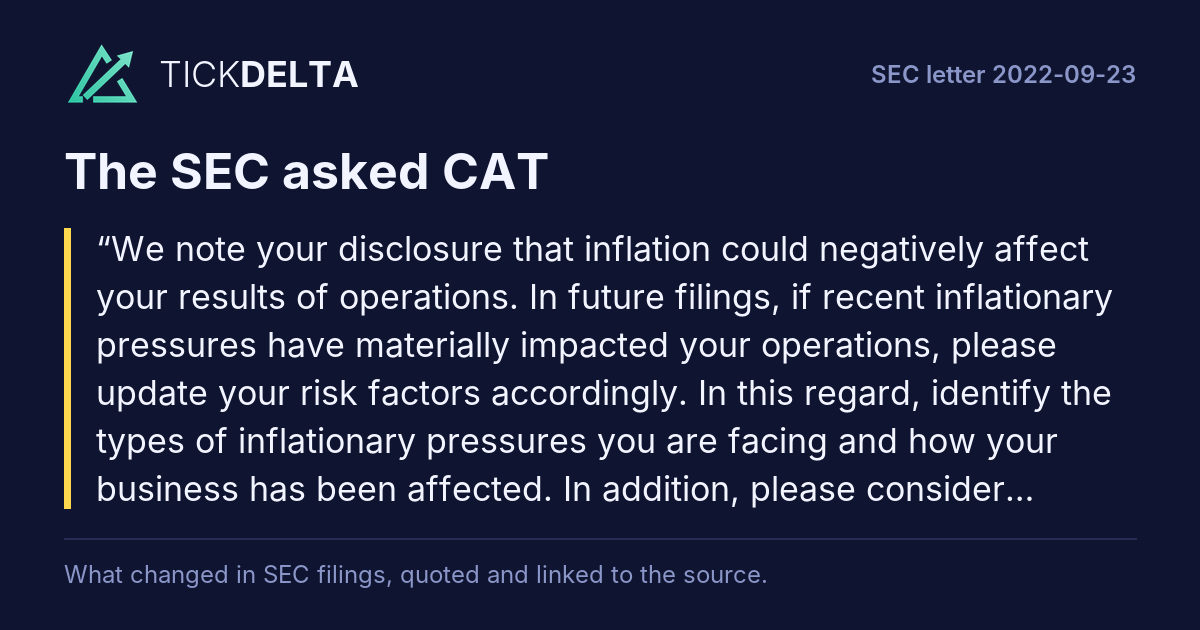
SEC asked (1)
We note your disclosure that inflation could negatively affect your results of operations. In future filings, if recent inflationary pressures have materially impacted your operations, please update your risk factors accordingly. In this regard, identify the types of inflationary pressures you are facing and how your business has been affected.
Rest of the question

In addition, please consider whether your disclosure about known trends and uncertainties in your MD&A should be also updated to account for inflationary trends.

CAT answered
We respectfully note the Staff’s comment.

We have experienced and disclosed inflationary pressures related to (1) higher manufacturing costs as a result of shortages of material and components that have led to higher costs along with (2) supply chain disruptions leading to higher freight expenses. Please see our responses 2 and 5 for examples of additional disclosures relating to the impacts of these inflationary pressures.

In response to the Staff’s comment, we will enhance our risk factors and MD&A disclosure in future filings to include a discussion of specific types of inflationary
Rest of the answer

pressures if we believe any individual type could materially impact our results of operations.

Read in the reply ↗
In its next report

First report after the company's reply of 2022-10-07: 10-Q filed 2022-11-02 ↗, against the 10-Q filed 2022-08-03 ↗.

Tickdelta does not hold the text of both reports, so they are not compared here.

Item 7. Management’s Discussion and Analysis of Financial Condition..., page 27
SEC asked (2)
We note your risk factors in the subsection entitled “Macroeconomic Risks” on page 11. While these disclosures appear to describe certain challenges presented by your current operating environment, we are unable to locate a comprehensive discussion of how material trends are expected to affect your cash flows, liquidity, capital resources, cash requirements, financial position, or results of operations.
Rest of the question

With a view towards future disclosure, please tell us about your material trends and uncertainties as well as any relevant upstream and downstream drivers. Note that trends or uncertainties may include impairments of financial assets or long-lived assets; declines in the value of inventory, investments, or recoverability of deferred tax assets; the collectability of consideration related to contracts with customers; and modification of contracts with customers. Refer to Item 303 of Regulation S-K.

CAT answered
At present, the most material trends impacting our business are continuing supply chain disruptions and increasing costs of materials, and we expect these trends to continue in the near-term through the end of 2022. Transportation shortages, for example, have impacted our suppliers, which leads to production delays in our facilities and impacts our ability to meet increasing customer demand. To help mitigate these challenges, we have proactively redirected components, altered our assembly processes and increased production inventory levels across the enterprise.
Rest of the answer

Notwithstanding these efforts, we have been unable to completely satisfy strong customer demand for our machines and engines, and we anticipate that continued transportation shortages will impact our results of operations in the near-term. Furthermore, supply chain disruptions have led to increased costs due to factory inefficiencies and higher freight expenses. We have and will continue to take appropriate price actions to more than offset these manufacturing cost increases. To date, these price actions have minimized the impact of the incremental manufacturing costs on our cash flows, liquidity and results of operations.

In response to the Staff’s comment, future filings will include a discussion in the MD&A of how material trends are expected to affect our cash flows, liquidity, capital resources, cash requirements, financial position or results of operations, including any additional material trend information that we discuss in our earnings calls.

COMMEnt:

Read in the reply ↗
In its next report

First report after the company's reply of 2022-10-07: 10-Q filed 2022-11-02 ↗, against the 10-Q filed 2022-08-03 ↗.

Tickdelta does not hold the text of both reports, so they are not compared here.

Item 7. Management’s Discussion and Analysis of Financial Condition..., page 27
SEC asked (3)
We note that during your earnings calls on April 28, 2022 and August 2, 2022, your management discussed the ongoing effects on your business of persistent supply chain disruptions and backlogs, which have required alternative solutions including engineering redesigns and increased dual sourcing.
Rest of the question

Your management also discussed its views on margin pressures and the anticipated effect of the Bipartisan Infrastructure Law. In future filings, your MD&A disclosure should address all material relevant trends and uncertainties, including those identified in your earnings calls. Please also explain when you anticipate that any temporary trends and uncertainties will normalize. If there are specific risks that will be amplified by the trends discussed, revise your risk factors to more fully describe the potential risks and how you intend to mitigate.

CAT answered
As referenced above, we will enhance our MD&A disclosure in future filings to provide more detail regarding all material relevant trends and uncertainties. Furthermore, we will provide additional disclosure that explains when we anticipate that any temporary trends and uncertainties will normalize. In addition, to the extent that any specific risks are amplified by the trends we identify, we will revise our risk factor disclosure accordingly and describe our mitigation efforts. Read in the reply ↗
In its next report

First report after the company's reply of 2022-10-07: 10-Q filed 2022-11-02 ↗, against the 10-Q filed 2022-08-03 ↗.

Tickdelta does not hold the text of both reports, so they are not compared here.

Item 7. Management’s Discussion and Analysis of Financial Condition..., page 27
SEC asked (4)
We note your reference to digital investments on page 40. With a view towards future disclosure, please tell us about your digital initiatives and their significance to your business. To the extent there are material trends that are reasonably likely to affect your digital initiatives, please explain how these trends may affect your liquidity and capital resources or results of operations.
Rest of the question

Response to COVID-19 and Global Business Conditions, page 27

CAT answered
We are executing upon a number of digital initiatives.

These initiatives are strategic enablers for our three primary segments; including individual digital products and solutions for use with many of our machines and engines, as well as broader digital platforms that allow for enhanced communication between Caterpillar and our dealers and end-users. We are constantly investing in and upgrading our digital products and platforms.
Rest of the answer

Although we believe that collectively our digital products and platforms continue to improve the overall customer experience, enhance brand loyalty and support our strategy of profitable growth, to date, we do not believe the cost to implement any individual product or platform has had a material impact on our liquidity or capital resources or results of operations. In future filings, we will include a more detailed discussion of our digital initiatives if the cost and/or benefits of any individual initiative is material to our results of operations or liquidity and capital resources.

Response to COVID-19 and Global Business Conditions,

Read in the reply ↗
In its next report

First report after the company's reply of 2022-10-07: 10-Q filed 2022-11-02 ↗, against the 10-Q filed 2022-08-03 ↗.

Tickdelta does not hold the text of both reports, so they are not compared here.

Item 7. Management’s Discussion and Analysis of Financial Condition..., page 27
SEC asked (5)
You state that you have experienced transportation shortages which have resulted in delays and increased costs, and that your suppliers have had availability issues and freight delays, which has led to delays of production in your facilities. During your earnings calls on April 28, 2022 and August 2, 2022, your management stated that you continue to face supply chain challenges which have not significantly improved.
Rest of the question

With a view to future disclosure, please tell us specifically how supply chain issues have affected your cash flows, liquidity, capital resources, cash requirements, financial position, or results of operation and how you expect such issues to affect your business in the future. Please also elaborate on your mitigation efforts.

CAT answered
We continue to be impacted by supply chain disruptions and associated cost and labor pressures. Our manufacturing costs have risen primarily due to costs of material and freight. We have also started to see some inefficiencies in our factories, although to a lesser extent. In addition, in recent months, supply chain constraints have impacted sales of equipment across our segments. We are focused on developing and modifying contingency plans to minimize these challenges that have affected, and will likely continue to impact, our ability to meet customer demand.
Rest of the answer

For example, we have continued to increase production inventory levels, which negatively impacts operating cash flow, but do not anticipate the same level of increases moving forward in 2022. Moreover, we have taken and will continue to take appropriate price actions to more than offset the manufacturing cost increases we are experiencing due to supply chain disruptions and general inflationary cost pressures. To date, as discussed above, these price actions have minimized the impact that higher manufacturing costs have had on our cash flows, liquidity and results of operations.

In response to the Staff’s comment, consistent with the foregoing, we will enhance our MD&A disclosure in future filings to provide additional detail on the specific impact of supply chain issues, any related trends and our expected mitigation efforts.

* * * * *

If you need any further information, please contact

William E. Schaupp, Vice President and Chief Accounting Officer by phone at (309) 675-1000 or by email at Bill.Schaupp@cat.com or Nicole

Puza, Corporate Securities Counsel and Corporate Secretary by phone at (224) 551-4291 or by email at Puza_Nikki@cat.com.

Read in the reply ↗
In its next report

First report after the company's reply of 2022-10-07: 10-Q filed 2022-11-02 ↗, against the 10-Q filed 2022-08-03 ↗.

Tickdelta does not hold the text of both reports, so they are not compared here.

Also in this review: closing letter, 2023-01-12

From the SEC's correspondence on EDGAR: staff letters (form UPLOAD) and company letters (form CORRESP), 6 letters filed since 2022-09-23. Questions and answers are matched by their numbers; topics come from words in each question. The reports are compared word for word (same form, before the first SEC letter against the first report after the company's reply). No AI.

Work on CAT in a spreadsheet: Excel workbook (a sheet per section, ten years by column, charts, links to the filings) · CSV. For a Google Sheet that stays up to date, paste =IMPORTDATA("https://tickdelta.com/company/CAT/export.csv") into a cell.