Paragraph 4 · 42% changed
Every version of it
Screener
/
SEC EDGAR
/CIK 0000944148
/10-K filed Feb 26, 2026, compared with Feb 28, 2025
/Numbers from the XBRL of the 10-Ks
NYSE
Industrials · Business Services
CBIZ, Inc. CBZ
The 10-K against last year's
117 changes: 20 added, 17 removed, 80 reworded
10-K Feb 26, 2026 vs Feb 28, 2025
Risk Factors
26.1%
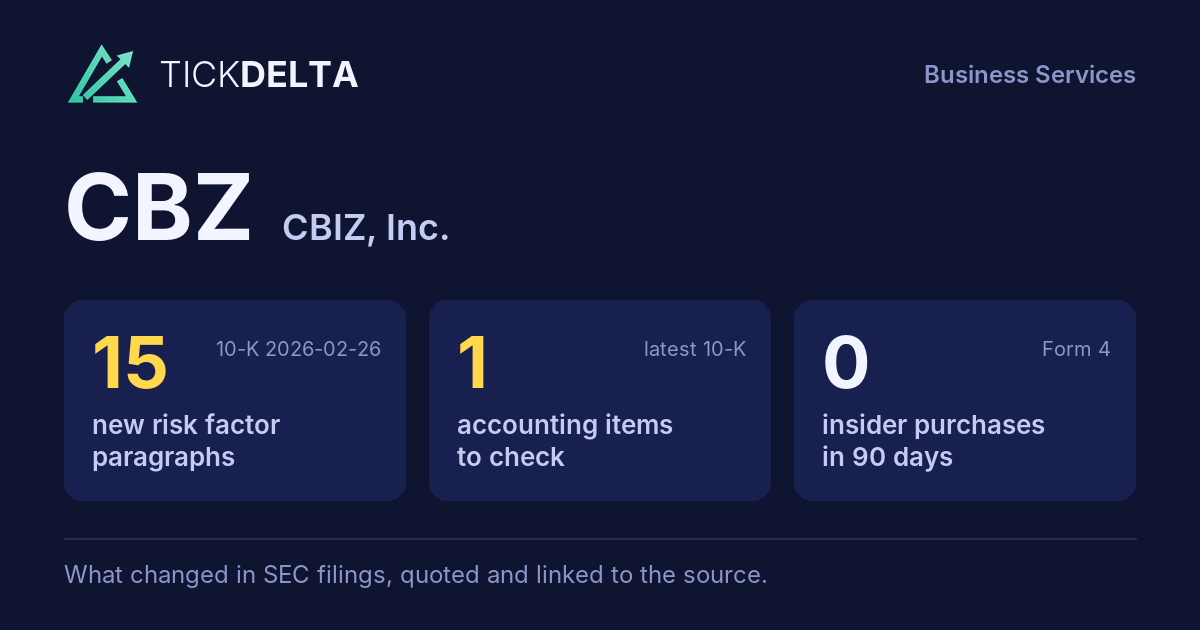
of the text changed · 9,014 words now · 15 new paragraphs, 7 gone
MD&A
25.9%
of the text changed · 6,740 words now · 5 new paragraphs, 10 gone
Legal Proceedings
26.8%
of the text changed · 970 words now
Accounting Policies
31.0%
of the text changed · 4,304 words now
10-K 0000944148-26-000038 (Feb 26, 2026) vs 10-K 0001628280-25-008893 (Feb 28, 2025)
Every paragraph, and how much of it changed
One bar per paragraph, in the order of the 10-K. Height and colour show the share of its words not in the closest paragraph a year earlier; the tallest bars are new paragraphs.
Risk Factors
58 paragraphs · 15 new · 25 reworded · 7 gone · 10-K Feb 26, 2026 against Feb 28, 2025
New paragraph
Reworded (5% of its words or more)
Same or nearly
Paragraph 11 · 30% changed
Every version of it
Under the ASA with CBIZ CPAs and our other ASAs, we provide a range of services to the CPA firms, including: functions such as professional staff, office management, bookkeeping, and accounting; preparing marketing and promotion materials; and providing office space, computer equipment, systems support and administrative support. Services are performed in exchange for a fee. Fees earned by us under the ASAs are recorded as revenue in our Consolidated Statements of Comprehensive Income. In the event that accounts receivable and unbilled work in process become uncollectible by the CPA firms, the service fee due to us is typically reduced on a proportional basis.
Paragraph 2 · 27% changed
Every version of it
Payments on accounts receivable may be slower than expected, or amounts due on receivables or notes may not be fully collectible. Professional services firms often experience higher average accounts receivable days outstanding compared to many other industries, which may be magnified if the general economy worsens. If our collections become slower, our liquidity may be adversely impacted. We monitor the aging of receivables regularly and make assessments of the ability of customers to pay amounts due. We provide for potential bad debts and recognize additional reserves against bad debts as we deem appropriate. Notwithstanding these measures, our customers may face unexpected circumstances that adversely impact their ability to pay their trade receivables or note obligations to us, and we may face unexpected losses as a result.
Paragraph 12 · 25% changed
Every version of it
Paragraph 48 · 22% changed
Every version of it
We require a significant amount of cash for interest payments on our debt and to expand our business as planned. As of December 31, 2024, 2025, our debt consisted primarily of $1.4 billion $1,472.4 million in principal amount outstanding under our Amended and Restated Credit Agreement, by and among CBIZ Operations, Inc., as the Borrower, the Company, the several banks, financial institutions, institutional lenders and other investors from time to time party thereto as the Lenders, and Bank of America, N.A., as Agent, as Issuing Bank and as Swing Line Bank (as amended by that certain First Amendment, dated as of March 7, 2025 and restated credit agreement (the as further amended by that certain Second Amendment, dated as of April 29, 2025, the "2024 Credit Facilities") providing for $2.0 billion $2,000.0 million in senior secured credit facilities, consisting of a $1.4 billion $1,400.0 million term loan (the "Term Loan") and $600.0 million revolving credit facility (the "Revolving Credit Facility"). Our debt requires us to dedicate a portion of our cash flow from operations to pay interest on our indebtedness, thereby reducing the funds available to use for acquisitions, capital expenditures and general corporate purposes. Our ability to make interest payments on our debt, and to fund acquisitions, will depend upon our ability to generate cash in the future. Insufficient cash flow could place us at risk of default under our debt agreements or could prevent us from expanding our business as planned. Our ability to generate cash is subject to general economic, financial, competitive, legislative, regulatory and other factors that are beyond our control. Our business may not generate sufficient cash flow from operations and future borrowings may not be available to us under the 2024 Credit Facilities in an amount sufficient to enable us to fund our other liquidity needs. Volatility in interest rates from monetary policy or economic conditions could increase interest expense, cause uncertainty and impact our ability to pay interest on our indebtedness. Refer to Item 7A, Quantitative and Qualitative Disclosures about Market Risk, for further information regarding interest rate risk.
Paragraph 54 · 19% changed
Every version of it
The future issuance of additional shares could adversely affect the price of our common stock. Future sales or issuances of common stock, including those related to the uses Transaction described below, or the perception that sales could occur, could adversely affect the market price of our common stock and dilute the percentage ownership held by our stockholders. We have authorized 250.0 million shares of common stock, and have approximately 53.3 54.7 million shares of common stock outstanding at January 31, 2025. 2026. A substantial number of these shares have been issued in connection with acquisitions, including the Transaction. As part of many acquisitions, shares are contractually restricted from sale for a one-year period, and as of January 31, 2026, approximately 63 thousand shares of our common stock were under lock-up contractual restrictions that expire by December 31, 2026. We cannot be sure when sales by holders of our stock will occur, how many shares will be sold or the effect that sales may have on the market price of our common stock.
Paragraph 53 · 17% changed
Every version of it
The significant number of shares issuable as the stock consideration in the Transaction may adversely impact our stock price.There price. There can be no assurance the Transaction will be accretive to earnings per share, at all or in expected timeframes. If we do not perform as expected following the Transaction or costs or assumed liabilities are greater than anticipated, our earnings per share could be adversely impacted by the significant increase in outstanding shares. In addition, although restrictions on resale under applicable securities laws prevent sales in at least the six months following closing, after that time, Marcum partners are not no longer subject to contractual limitations on their ability to resell shares once they receive them. received upon the closing of the Transaction. Additionally, pursuant to the terms of the Transaction, CBIZ is obligated to deliver shares to the Marcum partners each month for 36 months following January 2, 2025. While the delivery of the stock consideration in installments over approximately four years may mitigate the potential for sales of a large volume at any particular time, persistent selling, or the perception of persistent selling, could adversely impact the market price of our common stock.
Paragraph 3 · 17% changed
Every version of it
Our business could be adversely affected if the non-attest business assets we acquired, or the attest assets CBIZ CPAs acquired, from Marcum does do not perform to our expectations or we underestimate the liabilities we are assuming. Even if we successfully integrate the non-attest business assets we acquired from Marcum and CBIZ CPAs successfully integrates the attest business assets it acquired from Marcum, there can be no assurance we will realize the anticipated benefits of the Transaction. While our management and advisors have spent significant time and resources evaluating Marcum’s business, it is difficult to predict future performance and the benefits from a transaction involving large and complex organizations. In addition, we assumed Marcum’s liabilities other than specified excluded liabilities that were not contributed by Marcum to MAG Marcum Advisory Group ("MAG") prior to closing of the Transaction. It is possible that we may have underestimated the liabilities that we assumed, or we may have assumed liabilities that are unknown or that we did not foresee and were not excluded from Marcum’s contribution to Marcum Advisory Group ("MAG"). MAG. If the liabilities that we assumed are more than we anticipate, or insurance coverage is not available to us in sufficient amounts to cover the liabilities that we assumed, it could increase the effective cost of the Transaction and adversely impact our financial condition and results of operations. The performance and benefits that we ultimately achieve may be influenced by a variety of factors, many of which are outside of our control. If we do not achieve the anticipated benefits of the Transaction, at all or in the expected timeframe, or become responsible for costs or liabilities that we did not foresee, our business could be adversely affected.
Paragraph 4 · 42% changed
Every version of it
10-K Feb 28, 2025Our business could be adversely affected if Marcum does not perform to our expectations or we underestimate the liabilities we are assuming. Even if we successfully integrate Marcum, there can be no assurance we will realize the anticipated benefits of the Transaction. While our management and advisors have spent significant time and resources evaluating Marcum’s business, it is difficult to predict future performance and the benefits from a transaction involving large and complex organizations. In addition, we assumed Marcum’s liabilities other than specified excluded liabilities that were not contributed by Marcum to MAG prior to closing of the Transaction. It is possible that we may have underestimated the liabilities that we assumed, or we may have assumed liabilities that are unknown or that we did not foresee and were not excluded from Marcum’s contribution to Marcum Advisory Group ("MAG"). If the liabilities that we assumed are more than we anticipate, or insurance coverage is not available to us in sufficient amounts to cover the liabilities that we assumed, it could increase the effective cost of the Transaction and adversely impact our financial condition and results of operations. The performance and benefits that we ultimately achieve may be influenced by a variety of factors, many of which are outside of our control. If we do not achieve the anticipated benefits of the Transaction, at all or in the expected timeframe, or become responsible for costs or liabilities that we did not foresee, our business could be adversely affected.
10-K Feb 26, 2026
the Transaction and adversely impact our financial condition and results of operations. The performance and benefits that we ultimately achieve may be influenced by a variety of factors, many of which are outside of our control. If we do not achieve the anticipated benefits of the Transaction, at all or in the expected timeframe, or become responsible for costs or liabilities that we did not foresee, our business could be adversely affected.
Paragraph 11 · 30% changed
Every version of it
10-K Feb 28, 2025
Under the ASA with CBIZ CPAs and our other ASAs, we provide a range of services to the CPA firms, including: functions such as professional staff, office management, bookkeeping, and accounting; preparing marketing and promotion materials; and providing office space, computer equipment, systems support and administrative support. Services are performed in exchange for a fee. Fees earned by us under the ASAs are recorded as revenue in our Consolidated Statements of Comprehensive Income. In the event that accounts receivable and unbilled work in process become uncollectible by the CPA firms, the service fee due to us is typically reduced on a proportional basis.
10-K Feb 26, 2026
Under the ASA with CBIZ CPAs and our other ASAs, we provide a range of services to the CPA firms, including: functions such as professional staff, office management, bookkeeping, and accounting; preparing marketing and promotion materials; and providing office space, computer equipment, systems support and administrative support.
Paragraph 2 · 27% changed
Every version of it
10-K Feb 28, 2025
Payments on accounts receivable may be slower than expected, or amounts due on receivables or notes may not be fully collectible. Professional services firms often experience higher average accounts receivable days outstanding compared to many other industries, which may be magnified if the general economy worsens. If our collections become slower, our liquidity may be adversely impacted. We monitor the aging of receivables
10-K Feb 26, 2026
Payments on accounts receivable may be slower than expected, or amounts due on receivables or notes may not be fully collectible. Professional services firms often experience higher average accounts receivable days outstanding compared to many other industries, which may be magnified if the general economy worsens. If our collections become slower, our liquidity may be adversely impacted. We monitor the aging of receivables regularly and make assessments of the ability of customers to pay amounts due. We provide for potential bad debts and recognize additional reserves against bad debts as we deem appropriate. Notwithstanding these measures, our customers may face unexpected circumstances that adversely impact their ability to pay their trade receivables or note obligations to us, and we may face unexpected losses as a result.
Paragraph 12 · 25% changed
Every version of it
10-K Feb 28, 2025Under the ASA with CBIZ CPAs and our other ASAs, we provide a range of services to the CPA firms, including: functions such as professional staff, office management, bookkeeping, and accounting; preparing marketing and promotion materials; and providing office space, computer equipment, systems support and administrative support. Services are performed in exchange for a fee. Fees earned by us under the ASAs are recorded as revenue in our Consolidated Statements of Comprehensive Income. In the event that accounts receivable and unbilled work in process become uncollectible by the CPA firms, the service fee due to us is typically reduced on a proportional basis.
10-K Feb 26, 2026
Services are performed in exchange for a fee. Fees earned by us under the ASAs are recorded as revenue in our Consolidated Statements of Comprehensive Income. In the event that accounts receivable and unbilled work in process become uncollectible by the CPA firms, the service fee due to us is typically reduced on a proportional basis.
Paragraph 48 · 22% changed
Every version of it
10-K Feb 28, 2025
We require a significant amount of cash for interest payments on our debt and to expand our business as planned. As of December 31, 2024, our debt consisted primarily of $1.4 billion in principal amount outstanding under our amended and restated credit agreement (the "2024 Credit Facilities") providing for $2.0 billion in senior secured credit facilities, consisting of a $1.4 billion term loan (the "Term Loan") and $600.0 million revolving credit facility (the "Revolving Credit Facility"). Our debt requires us to dedicate a portion of our cash flow from operations to pay interest on our indebtedness, thereby reducing the funds available to use for acquisitions, capital expenditures and general corporate purposes. Our ability to make interest payments on our debt, and to fund acquisitions, will depend upon our ability to generate cash in the future. Insufficient cash flow could place us at risk of default under our debt agreements or could prevent us from expanding our business as planned. Our ability to generate cash is subject to general economic, financial, competitive, legislative, regulatory and other factors that are beyond our control. Our business may not generate sufficient cash flow from operations and future borrowings may not be available to us under the 2024 Credit Facilities in an amount sufficient to enable us to fund our other liquidity
10-K Feb 26, 2026
We require a significant amount of cash for interest payments on our debt and to expand our business as planned. As of December 31, 2025, our debt consisted primarily of $1,472.4 million in principal amount outstanding under our Amended and Restated Credit Agreement, by and among CBIZ Operations, Inc., as the Borrower, the Company, the several banks, financial institutions, institutional lenders and other investors from time to time party thereto as the Lenders, and Bank of America, N.A., as Agent, as Issuing Bank and as Swing Line Bank (as amended by that certain First Amendment, dated as of March 7, 2025 and as further amended by that certain Second Amendment, dated as of April 29, 2025, the "2024 Credit Facilities") providing for $2,000.0 million in senior secured credit facilities, consisting of a $1,400.0 million term loan (the "Term Loan") and $600.0 million revolving credit facility (the "Revolving Credit Facility"). Our debt requires us to dedicate a portion of our cash flow from operations to pay interest on our indebtedness, thereby reducing the funds available to use for acquisitions, capital expenditures and general corporate purposes. Our ability to make interest payments on our debt, and to fund acquisitions, will depend upon our ability to generate cash in the future. Insufficient cash flow could place us at risk of default under our debt agreements or could prevent us from expanding our business as planned. Our ability to generate cash is subject to general economic, financial, competitive, legislative, regulatory and other factors that are beyond our control. Our business may not generate sufficient cash flow from operations and future borrowings may not be available to us under the 2024 Credit Facilities in an amount sufficient to enable us to fund our other liquidity needs. Volatility in interest rates from monetary policy or economic conditions could increase interest expense, cause uncertainty and impact our ability to pay interest on our indebtedness. Refer to Item 7A, Quantitative and Qualitative Disclosures about Market Risk, for further information regarding interest rate risk.
Paragraph 54 · 19% changed
Every version of it
10-K Feb 28, 2025
The future issuance of additional shares could adversely affect the price of our common stock. Future sales or issuances of common stock, including those related to the uses described below, or the perception that sales could occur, could adversely affect the market price of our common stock and dilute the percentage ownership held by our stockholders. We have authorized 250.0 million shares of common stock, and have approximately 53.3 million shares of common stock outstanding at January 31, 2025. A substantial number of these shares have been issued in connection with acquisitions, including the Transaction. As part of many acquisitions, shares are
10-K Feb 26, 2026
The future issuance of additional shares could adversely affect the price of our common stock. Future sales or issuances of common stock, including those related to the Transaction described below, or the perception that sales could occur, could adversely affect the market price of our common stock and dilute the percentage ownership held by our stockholders. We have authorized 250.0 million shares of common stock, and have approximately 54.7 million shares of common stock outstanding at January 31, 2026. A substantial number of these shares have been issued in connection with acquisitions, including the Transaction. As part of many acquisitions, shares are contractually restricted from sale for a one-year period, and as of January 31, 2026, approximately 63 thousand shares of our common stock were under lock-up contractual restrictions that expire by December 31, 2026. We cannot be sure when sales by holders of our stock will occur, how many shares will be sold or the effect that sales may have on the market price of our common stock.
Paragraph 53 · 17% changed
Every version of it
10-K Feb 28, 2025
The significant number of shares issuable as the stock consideration in the Transaction may adversely impact our stock price.There can be no assurance the Transaction will be accretive to earnings per share, at all or in expected timeframes. If we do not perform as expected following the Transaction or costs or assumed liabilities are greater than anticipated, our earnings per share could be adversely impacted by the significant increase in outstanding shares. In addition, although restrictions on resale under applicable securities laws prevent sales in at least the six months following closing, after that time, Marcum partners are not subject to contractual limitations on their ability to resell shares once they receive them. While the delivery of the stock consideration in installments over approximately four years may mitigate the potential for sales of a large volume at any particular time, persistent selling, or the perception of persistent selling, could adversely impact the market price of our common stock.
10-K Feb 26, 2026
The significant number of shares issuable as the stock consideration in the Transaction may adversely impact our stock price. There can be no assurance the Transaction will be accretive to earnings per share, at all or in expected timeframes. If we do not perform as expected following the Transaction or costs or assumed liabilities are greater than anticipated, our earnings per share could be adversely impacted by the significant increase in outstanding shares. In addition, Marcum partners are no longer subject to contractual limitations on their ability to resell shares they received upon the closing of the Transaction. Additionally, pursuant to the terms of the Transaction, CBIZ is obligated to deliver shares to the Marcum partners each month for 36 months following January 2, 2025. While the delivery of the stock consideration in installments over approximately four years may mitigate the potential for sales of a large volume at any particular time, persistent selling, or the perception of persistent selling, could adversely impact the market price of our common stock.
Paragraph 3 · 17% changed
Every version of it
10-K Feb 28, 2025
Our business could be adversely affected if Marcum does not perform to our expectations or we underestimate the liabilities we are assuming. Even if we successfully integrate Marcum, there can be no assurance we will realize the anticipated benefits of the Transaction. While our management and advisors have spent significant time and resources evaluating Marcum’s business, it is difficult to predict future performance and the benefits from a transaction involving large and complex organizations. In addition, we assumed Marcum’s liabilities other than specified excluded liabilities that were not contributed by Marcum to MAG prior to closing of the Transaction. It is possible that we may have underestimated the liabilities that we assumed, or we may have assumed liabilities that are unknown or that we did not foresee and were not excluded from Marcum’s contribution to Marcum Advisory Group ("MAG"). If the liabilities that we assumed are more than we anticipate, or insurance coverage is not available to us in sufficient amounts to cover the liabilities that we assumed, it could increase the effective cost of the Transaction and adversely impact our financial condition and results of operations. The performance and benefits that we ultimately achieve may be influenced by a variety of factors, many of which are outside of our control. If we do not achieve the anticipated benefits of the Transaction, at all or in the expected timeframe, or become responsible for costs or liabilities that we did not foresee, our business could be adversely affected.
10-K Feb 26, 2026
Our business could be adversely affected if the non-attest business assets we acquired, or the attest assets CBIZ CPAs acquired, from Marcum do not perform to our expectations or we underestimate the liabilities we are assuming. Even if we successfully integrate the non-attest business assets we acquired from Marcum and CBIZ CPAs successfully integrates the attest business assets it acquired from Marcum, there can be no assurance we will realize the anticipated benefits of the Transaction. While our management and advisors have spent significant time and resources evaluating Marcum’s business, it is difficult to predict future performance and the benefits from a transaction involving large and complex organizations. In addition, we assumed Marcum’s liabilities other than specified excluded liabilities that were not contributed by Marcum to Marcum Advisory Group ("MAG") prior to closing of the Transaction. It is possible that we may have underestimated the liabilities that we assumed, or we may have assumed liabilities that are unknown or that we did not foresee and were not excluded from Marcum’s contribution to MAG. If the liabilities that we assumed are more than we anticipate, or insurance coverage is not available to us in sufficient amounts to cover the liabilities that we assumed, it could increase the effective cost of
MD&A
81 paragraphs · 5 new · 41 reworded · 10 gone · 10-K Feb 26, 2026 against Feb 28, 2025
New paragraph
Reworded (5% of its words or more)
Same or nearly
Paragraph 78 · 50% changed
Paragraph 31 · 48% changed
The Benefits and Insurance Financial Services practice group revenue in 2024 grew increased by 4.8% 68.9% to $401.0 million from $382.6 $2,301.5 million in 2023. Same-unit revenue increased by $15.3 million, or 4.0%, 2025 from $1,362.5 million in 2024 when 2024. This increase of $938.9 million was primarily the result of the Transaction and was across all service lines. When compared to the same period in 2023. The increase primarily driven 2024, revenue from traditional accounting and tax-related services increased by a $16.3 million increase in employee benefit $796.9 million, revenue from advisory services increased by $94.0 million, revenue from national technology services increased by $46.1 million, and retirement benefit revenue from government healthcare consulting services lines, as well as a $0.7 million increase in other project-based services, partially offset by a decrease of $1.8 million in property and casualty services. increased $1.9 million.
Paragraph 36 · 40% changed
Paragraph 32 · 38% changed
Paragraph 45 · 35% changed
Our working capital management primarily relates to trade accounts receivable, accounts payable, incentive-based compensation and other assets, which consists consist of other receivables and prepaid assets typically related to activities in the normal course of our business operations. At any specific point in time, working capital is subject to many variables, including seasonality and the timing of cash receipts and payments, most notably in the timing of insurance premiums to the carriers within our Benefits and Insurance Services practice group. We have restricted cash on deposit from clients in connection with the pass-through of insurance premiums to the carrier with the related liability for these funds recorded in “Accounts payable” in the accompanying Consolidated Balance Sheets.
Paragraph 35 · 34% changed
Operating expenses increased by $238.5 $6.4 million in 2024 2025 as compared to 2023, primarily as a result of $178.9 million, or 22.5%, in higher personnel costs, of which acquisitions contributed approximately $141.4 million to the 2024. This increase was primarily driven by the Transaction in 2024. Compared direct costs and personnel costs which increased by $5.6 million and $1.7 million, respectively, when compared to the same period in 2023, direct costs, 2024. This increase was partially offset by a decrease of $1.3 million of depreciation and amortization expense, facility costs, technology costs, travel expenses and entertainment costs, professional service costs, and allocations increased by $15.8 million, $11.6 million, $10.7 million, $7.9 million, $7.1 million, $5.9 million, and $1.6 million, respectively, as well as $1.0 a decrease of $0.4 million lower in other miscellaneous discretionary costs to support business growth. costs. Operating expense as a percentage of revenue increased remained relatively unchanged at 81.7% in 2025, as compared to 89.1% 81.9% in 2024 from 84.0% in 2023. 2024.
Paragraph 41 · 33% changed
Total other expense, net increased by $18.4 $51.8 million to $73.5 million from $21.6 million from $3.2 million in 2023. 2024. Total other expense, net includes a net gain gains of $21.1 $23.3 million and a net gain of $19.5 $21.1 million associated with the non-qualified deferred compensation plan in 2024 2025 and 2023, 2024, respectively. Excluding the impact of the non-qualified deferred compensation plan, total other expense, net would have been $96.8 million in 2025 and $42.8 million in 2024 and $22.7 million in 2023, 2024, a net increase in expense of approximately $20.1 $54.0 million. The increase was driven by $14.2 primarily due to $72.8 million higher interest expense due expense, partially offset by a gain from a legal settlement of $12.5 million recorded to the borrowing under the 2024 Credit Facilities to finance the Transaction, as well as higher blended weighted average effective interest rate experienced in 2024 as compared to 2023, $4.4 other income (expense), net, $4.6 million higher contingent earnout expense associated with prior acquisitions, fair value adjustments, an increase of $1.7 million of interest income, and $2.5 $0.1 million higher other miscellaneous expenses. adjustments.
Paragraph 61 · 32% changed
Paragraph 78 · 50% changed
10-K Feb 28, 2025Refer to Note 2, Business Combinations, to the accompanying consolidated financial statements for further discussion on acquisitions.
10-K Feb 26, 2026
For further information regarding our goodwill balances and the quantitative assessment performed, refer to Note 6, Goodwill and Other Intangible Assets, net, to the accompanying consolidated financial statements.
Paragraph 31 · 48% changed
10-K Feb 28, 2025
The Benefits and Insurance Services practice group revenue in 2024 grew by 4.8% to $401.0 million from $382.6 million in 2023. Same-unit revenue increased by $15.3 million, or 4.0%, in 2024 when compared to the same period in 2023. The increase primarily driven by a $16.3 million increase in employee benefit and retirement benefit services lines, as well as a $0.7 million increase in other project-based services, partially offset by a decrease of $1.8 million in property and casualty services.
10-K Feb 26, 2026
The Financial Services practice group revenue increased by 68.9% to $2,301.5 million in 2025 from $1,362.5 million in 2024. This increase of $938.9 million was primarily the result of the Transaction and was across all service lines. When compared to the same period in 2024, revenue from traditional accounting and tax-related services increased by $796.9 million, revenue from advisory services increased by $94.0 million, revenue from national technology services increased by $46.1 million, and revenue from government healthcare consulting services increased $1.9 million.
Paragraph 36 · 40% changed
10-K Feb 28, 2025Revenue growth in this practice group was primarily driven by our cost-plus contract with a single client, which has existed since 1999. The cost-plus contract is a five-year contract with the most recent renewal through
10-K Feb 26, 2026
During the year ended December 31, 2024, we completed the sale of CBIZ KA Consulting Services, LLC ("KA Consulting"), which was a component of the National Practices group. For the year ended December 31, 2024, KA Consulting contributed approximately $8.4 million of revenue. The remaining National Practice Group is primarily driven by our cost-plus contract with a single client, which has existed since 1999. The cost-plus contract is a five-year contract with the most recent renewal through December 31, 2028. The decrease in revenue and in operating expense was attributed to the result of the sale of KA Consulting.
Paragraph 32 · 38% changed
10-K Feb 28, 2025The Financial Services practice group revenue in 2024 grew by 17.4% to $1,362.5 million from $1,160.7 million in 2023. Same-unit revenue grew by $55.7 million, or 4.8%, across all service lines, primarily driven by a $24.5 million increase from those units that provide traditional accounting and tax-related services, a $19.2 million increase in government healthcare compliance business, and a $11.9 million increase from those units that provide project-oriented advisory services. The impact of the acquired businesses, net of divestitures, contributed $146.2 million, or 10.7%, of 2024 revenue. We provide a range of services to affiliated CPA firms under ASAs. Fees earned under the ASAs are recorded as revenue in the accompanying Consolidated Statements of Comprehensive Income and were $306.5 million and $259.6 million in 2024 and 2023, respectively.
10-K Feb 26, 2026
We provide a range of services to affiliated CPA firms under ASAs. Fees earned under the ASAs are recorded as revenue in the accompanying Consolidated Statements of Comprehensive Income and were $651.2 million and $306.5 million in 2025 and 2024, respectively.
Paragraph 45 · 35% changed
10-K Feb 28, 2025
Our working capital management primarily relates to trade accounts receivable, accounts payable, incentive-based compensation and other assets, which consists of other receivables and prepaid assets typically related to activities in the normal course of our business operations. At any specific point in time, working capital is subject to many variables, including seasonality and the timing of cash receipts and payments, most notably in the timing of insurance premiums to the carriers within our Benefits and Insurance Services practice group. We have restricted cash on deposit from clients in connection with the pass-through of insurance premiums to the carrier with the related liability for these funds recorded in “Accounts payable” in the accompanying Consolidated Balance Sheets.
10-K Feb 26, 2026
Our working capital management primarily relates to trade accounts receivable, accounts payable, incentive-based compensation and other assets, which consist of other receivables and prepaid assets typically related to activities in the normal course of our business operations. At any specific point in time, working capital is subject to many
Paragraph 35 · 34% changed
10-K Feb 28, 2025
Operating expenses increased by $238.5 million in 2024 as compared to 2023, primarily as a result of $178.9 million, or 22.5%, in higher personnel costs, of which acquisitions contributed approximately $141.4 million to the increase primarily driven by the Transaction in 2024. Compared to the same period in 2023, direct costs, depreciation and amortization expense, facility costs, technology costs, travel and entertainment costs, professional service costs, and allocations increased by $15.8 million, $11.6 million, $10.7 million, $7.9 million, $7.1 million, $5.9 million, and $1.6 million, respectively, as well as $1.0 million lower other discretionary costs to support business growth. Operating expense as a percentage of revenue increased to 89.1% in 2024 from 84.0% in 2023.
10-K Feb 26, 2026
Operating expenses increased by $6.4 million in 2025 as compared to 2024. This increase was primarily driven by direct costs and personnel costs which increased by $5.6 million and $1.7 million, respectively, when compared to the same period in 2024. This increase was partially offset by a decrease of $1.3 million of depreciation and amortization expenses and a decrease of $0.4 million in other miscellaneous discretionary costs. Operating expense as a percentage of revenue remained relatively unchanged at 81.7% in 2025, as compared to 81.9% in 2024.
Paragraph 41 · 33% changed
10-K Feb 28, 2025
Total other expense, net increased by $18.4 million to $21.6 million from $3.2 million in 2023. Total other expense, net includes a net gain of $21.1 million and a net gain of $19.5 million associated with the non-qualified deferred compensation plan in 2024 and 2023, respectively. Excluding the impact of the non-qualified deferred compensation plan, total other expense, net would have been $42.8 million in 2024 and $22.7 million in 2023, a net increase in expense of approximately $20.1 million. The increase was driven by $14.2 million higher interest expense due to the borrowing under the 2024 Credit Facilities to finance the Transaction, as well as higher blended weighted average effective interest rate experienced in 2024 as compared to 2023, $4.4 million higher contingent earnout expense associated with prior acquisitions, and $2.5 million higher other miscellaneous expenses.
10-K Feb 26, 2026
Total other expense, net increased by $51.8 million to $73.5 million from $21.6 million in 2024. Total other expense, net includes net gains of $23.3 million and $21.1 million associated with the non-qualified deferred compensation plan in 2025 and 2024, respectively. Excluding the impact of the non-qualified deferred compensation plan, total other expense, net would have been $96.8 million in 2025 and $42.8 million in 2024, a net increase in expense of approximately $54.0 million. The increase was primarily due to $72.8 million higher interest expense, partially offset by a gain from a legal settlement of $12.5 million recorded to other income (expense), net, $4.6 million higher fair value adjustments, an increase of $1.7 million of interest income, and $0.1 million higher other adjustments.
Paragraph 61 · 32% changed
10-K Feb 28, 2025Credit Facilities will be sufficient to meet cash requirements for 2025 and beyond. We believe that cash provided by operations, as well as available funds under the 2024 Credit Facilities will be sufficient to meet cash requirements for the next 12 months and beyond. Refer to Note 10, Debt and Financing Arrangements, to the accompanying consolidated financial statements for further discussion of the 2024 Credit Facilities.
10-K Feb 26, 2026
cash provided by operations, as well as available funds under our 2024 Credit Facilities will be sufficient to meet cash requirements for 2026 and beyond.
A paragraph is matched with the one last year that shares the most of its words; under half in common makes it new. The paragraphs shown are the 8 reworded the most in each section.
The paragraph that changed most in each section
The redline
Marked against last year's 10-K: cut words struck through, new words highlighted.
MD&A251 words changed in this paragraph; it is 31% similar to last year's version.
The goodwill impairment test is performed at a reporting unit level. A reporting unit is an operating segment of a business or one level below an operating segment. At December 31, 2024, During the fourth quarter of 2025, we had six completed certain organizational reporting units, changes which resulted in a realignment and re-aggregation of reporting units in both the Financial Services and Benefits and Insurance Services practice groups, which one is a resulted in new reporting unit resulting from the Transaction. The new reporting unit was added to units that align the internal reporting structure with the services provided by the three these practice groups. The organizational changes did not result in a change in the reportable segments, nor did they result in a change of the total number of reporting units for goodwill impairment test purposes. As of December October 31, 2024, 2025, immediately after the amount organizational changes, there are a total of goodwill assigned to this six reporting unit units, of which three are within the Financial Services practice group, two are within the Benefits and Insurances practice group, and one is subject to change upon within the finalization of National Practice group. While the purchase price allocation. Refer to Note. 2, Business Combination for detailed discussion of the Transaction. We may use either a qualitative or quantitative approach when testing a reporting unit’s goodwill for impairment. Under the qualitative assessment, we are not required to calculate the fair value of a reporting unit unless we determine that it is more likely than not that its fair value is less than its carrying amount. If under the quantitative assessment the fair value of a reporting unit is less than its carrying amount, then the amount of the impairment loss, if any, must be measured. Any such impairment charge would reduce earnings and could be material.
Source: Item 7, 10-K 0000944148-26-000038 vs Item 7, 10-K 0001628280-25-008893
Accounting Policies164 words changed in this paragraph; it is 40% similar to last year's version.
The goodwill impairment test is performed at a reporting unit level. A reporting unit is an operating segment of a business or one level below an operating segment. At December 31, 2024, During the fourth quarter of 2025, we had six completed certain organizational reporting changes which resulted in a realignment and re-aggregation of reporting units carrying goodwill balances, of which one is a in both the Financial Services and Benefits and Insurance Services practice groups. These organizational reporting changes resulted in new reporting unit resulting from the Transaction. The new reporting unit was added to units that align the internal reporting structure with the services provided by the three these practice groups. The organizational changes did not result in a change in the reportable segments, nor did they result in a change of the total number of reporting units for goodwill impairment test purposes. As of December October 31, 2024, 2025, immediately after the amount organizational changes, there are a total of goodwill assigned to this six reporting unit units, of which three are within the Financial Services practice group, two are within the Benefits and Insurances practice group, and one is subject to change upon within the finalization of the purchase price allocation. Refer to Note. 2 Business Combinations for detailed discussion of the Transaction. National Practice group.
Source: 10-K text, Note 1 – BASIS OF PRESENTATION AND SIGNIFICANT ACCOUNTING POLICIES, 10-K 0000944148-26-000038 vs 10-K text, Note 1 – BASIS OF PRESENTATION AND SIGNIFICANT ACCOUNTING POLICIES, 10-K 0001628280-25-008893
Risk Factors138 words changed in this paragraph; it is 84% similar to last year's version.
With respect to CPA firm clients that are required to file audited financial statements with the SEC, the SEC staff has informed us that, under Regulation S-X, it considers CBIZ to be an "associated entity" of the CPA firms with which CBIZ has contractual relationships. Accordingly, we do not hold any financial interest in, nor do we enter into any business relationship with, an SEC-reporting attest client that the CPA firm performing an audit could not maintain. Further, we do not provide any non-audit services to an SEC-reporting attest client that the CPA firm performing an audit could not provide under the auditor independence restrictions set out in the Sarbanes-Oxley Act of 2002 ("Sarbanes-Oxley"), Act, and other rules and requirements of the SEC and the Public Company Accounting Oversight Board (“PCAOB”). As a result, the acquisition and integration of Marcum's attest business assets into CBIZ CPAs and Marcum's non-attest business assets into CBIZ will result resulted in conflicts and independence impairments that will likely require required certain services to be terminated and result resulted in a loss of revenue. Although we conducted due diligence on conflicts revenue, and independence issues in connection with the Transaction, it is possible that the conflicts and independence issues, and resulting potential loss of revenue, future acquisitions could be more significant than anticipated. have a similar effect. Applicable professional standards generally permit us to provide additional services to privately-held companies, in addition to those services that may be provided to SEC-reporting attest clients of a CPA firm. We and the CPA firms have implemented policies and procedures designed to enable us to maintain independence and freedom from conflicts of interest in accordance with applicable standards. In the past, given the pre-existing limits set by us CBIZ CPAs on our its relationships with SEC-reporting attest clients of the CPA firms, and the limited number and size of such clients, the imposition of independence restrictions under Sarbanes-Oxley, the Sarbanes-Oxley Act, SEC rules and interpretation, and PCAOB standards did not materially affect our revenues. Following the Attest Purchase, there There has been a significant increase in the number of SEC-reporting attest clients of CBIZ CPAs (from very few or none in recent periods CPAs. CBIZ CPAs’ is now subject to well over 100 annual inspection by the PCAOB. In addition, its system of quality control could be subject to additional regulatory scrutiny following the Attest Purchase). As Transaction as a result, it result of the previously settled PCAOB and SEC sanctions against Marcum related to quality control failures and violations of audit standards in connection with its prior audit work. It may be more challenging to manage conflicts of interest and independence restrictions and these challenges could adversely impact our revenues and results of operations. The SEC staff has further informed us that independence rules that apply to clients that receive attest services under SEC and PCAOB standards from such CPA firms would prohibit such clients from holding any shares of our common stock.
Source: Item 1A, 10-K 0000944148-26-000038 vs Item 1A, 10-K 0001628280-25-008893
Legal Proceedings132 words changed in this paragraph; it is 60% similar to last year's version.
On December 8, 2023, CBIZ was named as a defendant in a second putative class action lawsuit in the United States District Court for the District of Massachusetts by an individual making similar claims and seeking similar remedies as in the first lawsuit regarding the cyberattack CBIZ experienced on or about May 31, 2023. Both cases were transferred into a multidistrict litigation, styled as In Re: MOVEit Customer Data Security Breach Litigation, pending in the United States District Court for the District of Massachusetts (the “MDL”). To date, the MDL has over 180 300 cases against over 100 different defendants, all with claims arising out of the cyberbreach by hackers of Progress Software Corporation’s MOVEit Transfer software. The MDL has a bellwether structure, under which defendants in the MDL cases have been divided into bellwether and non-bellwether defendants. CBIZ is a non-bellwether defendant. The cases against the bellwether defendants are moving forward while the cases against the non-bellwether defendants, including CBIZ, are not. The bellwether cases are in early stages of discovery, which will be followed by class certification and dispositive-motion practice. Due to the early stage of litigation, litigation against the bellwether defendants and CBIZ’s status as a non-bellwether defendant, the Company is not able to determine or predict the ultimate outcome of these lawsuits nor reasonably provide an estimate or range of the possible outcome or losses, if any.
Source: Item 3, via Note 12 – COMMITMENTS AND CONTINGENCIES, 10-K 0000944148-26-000038 vs Item 3, via Note 12 – COMMITMENTS AND CONTINGENCIES, 10-K 0001628280-25-008893
Sentences and paragraphs added, removed or reworded
Every change, by type
Sentences and paragraphs of CBZ's Risk Factors and MD&A, 10-K Feb 26, 2026 against 10-K Feb 28, 2025. Each links to the text at sec.gov.
Quiet changes are sentences kept from last year with one to four words changed, at least one of them a hedge, a modal or a qualifier (may, could, will, not, significant, material…). A year or date rolling forward is not counted.
The full word list
adverse, adversely, all, although, anticipate, anticipates, any, approximately, believe, believes, can, cannot, certain, could, expect, expects, generally, however, if, intend, intends, largely, likely, many, material, materially, may, might, most, must, never, no, not, possible, primarily, probable, should, significant, significantly, some, substantial, substantially, unlikely, will, would
AddedRisk Factors
Our profitability could suffer if we are not able to effectively utilize our employees, maintain operational efficiencies or manage our cost structure. Our failure to manage the utilization of our professionals who generally bill on an hourly basis or to maintain or increase the hourly rates we charge our clients for our services, could result in adverse consequences, such as non- or lower-revenue-generating professionals, increased employee turnover, fixed compensation expenses in periods of declining revenue or the inability to appropriately staff engagements.
Read it in 10-K Feb 26, 2026 at sec.gov
AddedRisk Factors
A number of factors affect the utilization of our professionals, some of which are outside our control, including general economic and financial market conditions; the complexity, number, type, size and timing of client engagements; the level of demand for our services; appropriate staffing levels in light of changing client demands, expectations or market conditions; our ability to transition our employees efficiently from completed engagements to new engagements; the transition period for new hires that results in a temporary drop in utilization; unanticipated changes in the scope of client engagements; our ability to forecast demand for our services; conditions affecting our clients’ businesses and industries; competition; and acquisitions. In addition, our expansion into or within lines of business or geographic locations where our brand is not well-known or where demand for our services is not well-developed could also contribute to low or lower utilization rates in certain service offerings or locations.
Read it in 10-K Feb 26, 2026 at sec.gov
AddedRisk Factors
Our primary asset is our people, and our people account for the majority of our expenses. If we are unable to manage staffing levels on a timely basis in light of changing opportunities or conditions, our ability to accept or service client engagements, take advantage of positive market and industry developments, expand into new service offerings, realize future growth or manage our cost structure could be negatively affected, which could negatively impact our client relationships, competitiveness, revenue and profitability.
Read it in 10-K Feb 26, 2026 at sec.gov
AddedRisk Factors
on our results of operations and financial condition. Given the significant increase in goodwill and intangible assets following the Transaction, the potential magnitude of any such impairment could be significant.
Read it in 10-K Feb 26, 2026 at sec.gov
AddedRisk Factors
Claims or adverse publicity could harm our brand, reputation and ability to compete and attract and retain clients, talent and future acquisition targets. Our reputation is susceptible to damage by actions or statements made by current or former clients, employees, competitors, vendors, adversaries in legal proceedings, government regulators, professional licensing organizations, members of the investment community and the media. Our engagements may involve matters that may result in a severe impact on a client’s business, cause the client a substantial monetary loss or prevent the client from pursuing business opportunities. Additionally, some of our engagements may involve matters or clients that may be socially or politically unpopular, which could result in adverse publicity and harm our reputation. Our ability to retain existing clients and generate repeat engagements depends upon our ability to maintain a high degree of client satisfaction. Our ability to attract new clients and future acquisition targets, and to hire and retain highly skilled professionals, depends upon our reputation in the professional services industry. As a result, any claims or adverse publicity involving the quality of our services or the reputation of our professionals, matters or clients may be more damaging than similar claims or publicity relating to businesses in other industries. There is a risk that negative information about us, even if untrue, could adversely affect our business, could cause damage to our reputation and be challenging to repair.
Read it in 10-K Feb 26, 2026 at sec.gov
AddedRisk Factors
Damage to our reputation could also reduce the value and effectiveness of our brand name and could reduce investor confidence in us. Any such claims, adverse publicity or negative connotations may adversely affect our reputation or the reputations of our professionals, or may otherwise harm our ability to attract or retain clients, employees and acquisition targets, any of which could have a material adverse effect on our business, financial condition and results of operations.
Read it in 10-K Feb 26, 2026 at sec.gov
AddedRisk Factors
Uncertainty in the current economic and geopolitical environment could lead to declines in demand for certain of our services. Demand for our services is affected by global economic conditions, including recessions, inflation, interest rates, tax rates, geopolitical conflicts, tariffs, trade wars, government debt ceiling negotiations and economic uncertainty, and the general level of economic activity in the geographic regions and industries in which we operate. When conditions in the global economy, including the credit markets, deteriorate, or economic activity slows, many companies [outsource less of their nonrecurring projects to service providers and some companies, as a cost-saving measure, choose to rely on their own in-house resources to conduct such nonrecurring projects internally, and under these conditions, companies have cut back on demand for the services we offer, all of which negatively affects our financial condition and results of operations.] We also experience more competitive pricing pressure during periods of economic decline. If the geopolitical uncertainties result in a reduction in business confidence, when the national or global economy or credit market conditions in general deteriorate, the unemployment rate increases or any changes occur in U.S. trade policy (including any increases in tariffs that result in a trade war), such uncertainty or changes put negative pressure on demand for our services and our pricing, resulting in lower cash flows and a negative effect on our business, financial condition and results of operations. In addition, some of our clients experience reduced access to credit and lower revenues, resulting in their inability to meet their payment obligations to us.
Read it in 10-K Feb 26, 2026 at sec.gov
AddedRisk Factors
Failure to maintain our reputation and brand could impact our ability to attract and retain clients, employees and future acquisition targets, and may have a material adverse effect on our business, financial condition and results of operations. As a professional services advisor, our ability to secure new engagements depends heavily upon maintaining our reputation and brand and the individual reputations of our professionals. Any factor that diminishes our brand or reputation or that of our professionals, including not meeting client expectations or illegal practices or misconduct by our professionals, could make it substantially more difficult for us to attract new clients, employees and acquisition targets, or to retain existing clients and employees. Similarly, because we obtain many of our new engagements from former or current clients, or from referrals by those clients, any client that is unsatisfied with the quality of our work could impair our ability to secure new engagements and clients, and could impair our ability to hire new employees or attract acquisition targets.
Read it in 10-K Feb 26, 2026 at sec.gov
Show the other 50
AddedRisk Factors
Further, we provide our services primarily in connection with significant or complex matters that often involve confidential and sensitive information, and our work is the product of the judgments of our professionals and other staff operating under significant time and other pressures. As a result, we may not always perform to our client’s standards or expectations. In addition, we may face reputational damage from, among other things, litigation against us, SEC or other domestic or foreign governmental investigations or sanctions, professional licensing organization disciplinary investigations or actions or our failure to protect confidential information. For example, in 2023, the SEC and PCAOB implemented sanctions against Marcum related to quality control failures and violations of audit standards in connection with its audit work for a large number of special purpose acquisition company clients as
Read it in 10-K Feb 26, 2026 at sec.gov
AddedRisk Factors
well as other clients. Likewise, in the past, employee negligence or misconduct has adversely affected our business, and we cannot assure that this will not occur in the future. If our employees engage in actual or perceived misconduct or negligence in the provision of client services, we could be subject to regulatory sanctions and legal liability and could suffer serious harm to our reputation, financial position, current client relationships and ability to attract future clients, and our insurance coverage may not be sufficient to fully compensate us for any losses we may incur. It is not always possible to deter or prevent employee misconduct or negligence, and the precautions we take may not be effective in all cases. In addition, our professionals and other employees are responsible for the security of the information in our systems or under our control and for ensuring that non-public information is kept confidential. Should any employee not follow appropriate security measures, this could result in the improper release or use of confidential information. If our employees engage in misconduct or fail to follow appropriate security measures, we could be subject to legal liability and reputational harm, which could impair our ability to attract and retain clients and in turn materially adversely affect our business, financial condition and results of operations.
Read it in 10-K Feb 26, 2026 at sec.gov
AddedRisk Factors
We are dependent on our existing client base and our ability to retain and expand our relationships with those clients. Our clients may terminate our engagements with little or no notice and without penalty, which may result in unexpected declines in our revenue or unexpected costs. Our ability to maintain continuing relationships with our clients and successfully obtain payment for our services is essential to the growth and profitability of our business. However, the volume of work performed for any specific client varies from year to year, and we generally do not have long-term commitments from clients to use our services. A client in one year may not provide the same level of revenue for us in any subsequent year. Further, one or more of our clients could be acquired, and there can be no assurance that the acquirer would choose to continue to use our services. In addition, the services we provide to our clients, and the revenue and income from those services, may decline or vary as the type and quantity of services we provide changes over time. Our business model also depends on relationships our teams develop with our clients so that we can understand our clients’ needs and deliver services that are tailored to those needs. If a client is not satisfied with the quality of work performed by us, or with the services delivered, we could incur additional costs to address the situation, the profitability of that work might be impaired, and the client’s dissatisfaction with our services could damage our ability to obtain additional work from that client or new clients in the future. In particular, clients that are not satisfied might seek to terminate existing contracts, which could cause us to incur costs for the services performed prior to termination with no associated revenue. This could also direct future business to our competitors.
Read it in 10-K Feb 26, 2026 at sec.gov
AddedRisk Factors
Our clients’ ability to terminate engagements with little or no notice, and our clients’ inability or unwillingness to pay for services we performed, can make our future revenue and profitability difficult to predict. Although a substantial majority of our revenue is generated from clients who contributed to our revenue in past years, our engagements with our clients are typically singular in nature. Therefore, we must seek to obtain new engagements when our current engagements end.
Read it in 10-K Feb 26, 2026 at sec.gov
RemovedRisk Factors
RemovedRisk Factors
RemovedRisk Factors
RemovedRisk Factors
RemovedRisk Factors
RemovedRisk Factors
RemovedRisk Factors
RewordedRisk Factors
As of December 31, 2024, 2025, our debt consisted primarily of $1.4 billion $1,472.4 million in principal amount outstanding under our Amended and Restated Credit Agreement, by and among CBIZ Operations, Inc., as the Borrower, the Company, the several banks, financial institutions, institutional lenders and other investors from time to time party thereto as the Lenders, and Bank of America, N.A., as Agent, as Issuing Bank and as Swing Line Bank (as amended by that certain First Amendment, dated as of March 7, 2025 and restated credit agreement (the as further amended by that certain Second Amendment, dated as of April 29, 2025, the "2024 Credit Facilities") providing for $2.0 billion $2,000.0 million in senior secured credit facilities, consisting of a $1.4 billion $1,400.0 million term loan (the "Term Loan") and $600.0 million revolving credit facility (the "Revolving Credit Facility").
Read it in 10-K Feb 26, 2026 at sec.gov
RewordedRisk Factors
RewordedRisk Factors
The price of our common stock could be adversely impacted if we do not perform to expectations following the Transaction.The market price of our common stock could be adversely affected if we do not perform to our own and investor expectations. Transaction.
Read it in 10-K Feb 26, 2026 at sec.gov
RewordedRisk Factors
As a result, the acquisition and integration of Marcum's attest business assets into CBIZ CPAs and Marcum's non-attest business assets into CBIZ will result resulted in conflicts and independence impairments that will likely require required certain services to be terminated and result resulted in a loss of revenue. revenue, and future acquisitions could have a similar effect.
Read it in 10-K Feb 26, 2026 at sec.gov
RewordedRisk Factors
The significant number of shares issuable as the stock consideration in the Transaction may adversely impact our stock price.There can be no assurance the Transaction will be accretive to earnings per share, at all or in expected timeframes. price.
Read it in 10-K Feb 26, 2026 at sec.gov
RewordedRisk Factors
Even if we successfully integrate the non-attest business assets we acquired from Marcum and CBIZ CPAs successfully integrates the attest business assets it acquired from Marcum, there can be no assurance we will realize the anticipated benefits of the Transaction.
Read it in 10-K Feb 26, 2026 at sec.gov
RewordedRisk Factors
RewordedRisk Factors
The price of our common stock could be adversely impacted if we do not perform to expectations following the Transaction.The market price of our common stock could be adversely affected if we do not perform to our own and investor expectations.
Read it in 10-K Feb 26, 2026 at sec.gov
RewordedRisk Factors
Our business could be adversely affected if the non-attest business assets we acquired, or the attest assets CBIZ CPAs acquired, from Marcum does do not perform to our expectations or we underestimate the liabilities we are assuming.
Read it in 10-K Feb 26, 2026 at sec.gov
RewordedRisk Factors
The success of our acquisitions, including the success of our recent acquisition of Marcum pursuant to the Transaction, acquisitions will depend, in part, on our ability to successfully integrate acquired businesses with current operations.
Read it in 10-K Feb 26, 2026 at sec.gov
RewordedRisk Factors
As a condition to close the Transaction, CBIZ CPAs, a CPA firm with which we maintain an ASA, completed the Attest Purchase, which consisted of purchasing purchased from Marcum substantially all of Marcum's attest business assets, subject to certain exclusions. exclusions (the "Attest Purchase").
Read it in 10-K Feb 26, 2026 at sec.gov
RewordedRisk Factors
AddedMD&A
The goodwill impairment test is performed at a reporting unit level. A reporting unit is an operating segment of a business or one level below an operating segment. During the fourth quarter of 2025, we completed certain organizational reporting changes which resulted in a realignment and re-aggregation of reporting units in both the Financial Services and Benefits and Insurance Services practice groups, which resulted in new reporting units that align the internal reporting structure with the services provided by these practice groups. The organizational changes did not result in a change in the reportable segments, nor did they result in a change of the total number of reporting units for goodwill impairment test purposes. As of October 31, 2025, immediately after the organizational changes, there are a total of six reporting units, of which three are within the Financial Services practice group, two are within the Benefits and Insurances practice group, and one is within the National Practice group. While the
Read it in 10-K Feb 26, 2026 at sec.gov
AddedMD&A
overall number of reporting units did not change, the components within the reporting units were impacted by the organizational reporting changes.
Read it in 10-K Feb 26, 2026 at sec.gov
AddedMD&A
As a result of the aforementioned changes in reporting units, we performed a qualitative assessment immediately before the change in reporting units. We concluded that it was more likely than not that the fair values of each of our reporting units immediately before the change exceeded their respective carrying values and, therefore, goodwill related to those reporting units was determined to not be impaired.
Read it in 10-K Feb 26, 2026 at sec.gov
AddedMD&A
The change in reporting units resulted in a triggering event. Accordingly, we performed a quantitative assessment and comparison of the fair value of our reporting units to their respective carrying value on the annual testing date. Based on the results of the quantitative assessment, the estimated fair values of the reporting units are in excess of their respective carrying values, therefore, there was no impairment to goodwill.
Read it in 10-K Feb 26, 2026 at sec.gov
AddedMD&A
It is possible, depending upon a number of factors that are not determinable at this time or within our control, that the fair values of one or more of our reporting units could decrease in the future and result in an impairment to goodwill. Specifically, further declines in our market capitalization may trigger the need for future impairment tests where the conclusions may differ and could result in the recognition of an impairment charge. Additionally, any significant adverse change in our near or long-term projections or macroeconomic conditions could result in future impairment charges, which could be material.
Read it in 10-K Feb 26, 2026 at sec.gov
RemovedMD&A
RemovedMD&A
RemovedMD&A
RemovedMD&A
RemovedMD&A
RemovedMD&A
RemovedMD&A
RemovedMD&A
RemovedMD&A
RemovedMD&A
RewordedMD&A
Credit Facility - Our primary financing arrangement is the $2.0 billion unsecured $2,000.0 million secured credit facility, which is that certain Amended and Restated Credit Agreement, by and among CBIZ Operations, Inc., CBIZ, Inc. as the Borrower, the Company, the several banks, financial institutions, institutional lenders and other investors from time to time party thereto as the Lenders, and Bank of America, N.A., as administrative agent Agent, as Issuing Bank and bank, as Swing Line Bank (as amended by that certain First Amendment, dated as of March 7, 2025 and other participating banks, as further amended by that certain Second Amendment, dated as of April 29, 2025), which provides us with the capital necessary to meet our working capital needs as well as the flexibility to continue with our strategic initiatives, including business acquisitions and share repurchases, and matures in 2029.
Read it in 10-K Feb 26, 2026 at sec.gov
RewordedMD&A
The increase in operating costs expenses was driven by $194.5 $581.3 million higher personnel cost (of which the Transaction contributed approximately $128.6 million), $14.1 million higher direct costs, $11.3 cost, $50.4 million higher depreciation and amortization costs, $10.9 $46.9 million higher facility costs, $10.7 $35.8 million higher direct costs, $20.3 million higher technology costs, $10.2 $16.4 million higher professional fees, $9.6 million higher travel and entertainment costs, $7.6 $5.1 million higher professional fees, and $2.2 marketing costs, $3.5 million higher bad debt expense.The increases were offset by a $0.1 expense, and $0.8 million decrease increase in other discretionary spending.
Read it in 10-K Feb 26, 2026 at sec.gov
RewordedMD&A
Excluding the non-qualified deferred compensation expenses, operating expense increased by approximately $3.6 $15.0 million, primarily driven by $5.6 $5.9 million higher professional service fees, $5.3 million higher facility costs, $2.6 million higher personnel costs, offset by $1.1 and $1.2 million lower marketing expenses and $0.9 million lower higher other miscellaneous discretionary costs. spending to support business growth.
Read it in 10-K Feb 26, 2026 at sec.gov
RewordedMD&A
Excluding the impact of the deferred compensation plan, which was recorded in "Corporate and Other" for segment reporting purposes, G&A expenses would have been $118.4 million, or 4.3% of revenue, in 2025, as compared to $106.4 million, or 5.9% of revenue, in 2024 as compared to $55.7 million, or 3.5% of revenue, in 2023, 2024, an increase of $50.7 $12.0 million in 2024 2025 as compared to prior year.
Read it in 10-K Feb 26, 2026 at sec.gov
RewordedMD&A
Excluding the impact of the deferred compensation plan the Other Income (Expense), net balance for the year ended December 31, 2024 2025, would be an expense income of $7.6 million primarily related to the $7.0 million expense increase to the fair value of the contingent purchase price liability. $10.0 million.
Read it in 10-K Feb 26, 2026 at sec.gov
RewordedMD&A
Operating expenses increased by $238.5 $751.2 million in 2024 2025, as compared to 2023, 2024, primarily as a result of $178.9 million, or 22.5%, in $578.3 million higher personnel costs, of which acquisitions contributed approximately $141.4 million to the increase costs primarily driven by the Transaction in 2024. 2025.
Read it in 10-K Feb 26, 2026 at sec.gov
RewordedMD&A
Earnings per diluted share was $1.83 in 2025, compared to $0.78 in 2024, compared to $2.39 in 2023, with a fully diluted weighted average share count of 63.2 million shares in 2025, compared to 52.7 million shares in 2024, compared to 50.6 million shares in 2023. 2024.
Read it in 10-K Feb 26, 2026 at sec.gov
RewordedMD&A
We review these assets for impairment whenever events or changes in circumstances (including declines in the price of our common stock and market capitalization, deterioration in macroeconomic conditions, and declining financial performance in comparison to projected results) indicate an asset’s carrying value may not be recoverable.
Read it in 10-K Feb 26, 2026 at sec.gov
RewordedMD&A
Excluding the impact of the non-qualified deferred compensation plan, which was recorded in "Corporate and Other" for segment reporting purposes, operating expenses would have been $2,382.3 million, or 86.4% of revenue, in 2025 as compared to $1,612.2 million, or 88.9% of revenue, in 2024 as compared to $1,350.8 million, or 84.9% of revenue, in 2023. 2024.
Read it in 10-K Feb 26, 2026 at sec.gov
RewordedMD&A
Excluding the impact of the deferred compensation plan plan, the Other Income (Expense), net balance for the year ended December 31, 2024 2024, would be an expense of $7.6 million primarily related to the $7.0 million expense increase to the fair value of the contingent purchase price liability. million.
Read it in 10-K Feb 26, 2026 at sec.gov
RewordedMD&A
Our blended average debt balance and blended weighted average interest rate was $1,517.9 million and 6.56%, respectively, in 2025, as compared to $538.6 million and 6.00%, respectively, in 2024, as compared to $364.1 million and 5.23%, respectively, in 2023. 2024.
Read it in 10-K Feb 26, 2026 at sec.gov
RewordedMD&A
Sources
The two latest 10-Ks on EDGAR, section by section. Each change links to the text at sec.gov.
Also
New risk factors: paragraphs with nothing like them last year, quoted in full.
Work with it
Excel workbook · CSV. Google Sheet that stays up to date: paste =IMPORTDATA("https://tickdelta.com/company/CBZ/export.csv") into a cell.