Added10-Q Oct 30, 2026 vs 10-K Feb 26, 2026
The Proposed Merger may not be completed on the anticipated terms or timeline, or at all.
Each branch is a paragraph in Risk Factors with nothing like it in the 10-K filed Feb 28, 2025. A box jumps to the paragraph as filed, below.
15 paragraphs in Risk Factors of the 10-K filed Feb 26, 2026 with nothing like them in the 10-K filed Feb 28, 2025. Quoted exactly. Paragraphs that were only edited are under 10-K change.
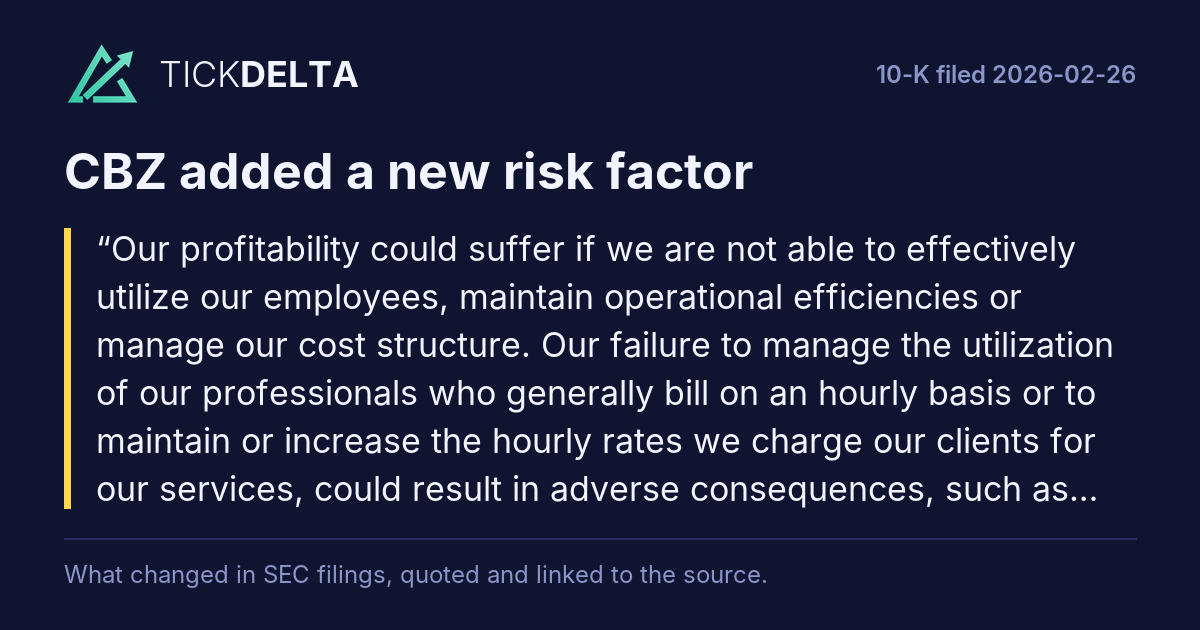
Our profitability could suffer if we are not able to effectively utilize our employees, maintain operational efficiencies or manage our cost structure. Our failure to manage the utilization of our professionals who generally bill on an hourly basis or to maintain or increase the hourly rates we charge our clients for our services, could result in adverse consequences, such as non- or lower-revenue-generating professionals, increased employee turnover, fixed compensation expenses in periods of declining revenue or the inability to appropriately staff engagements.
A number of factors affect the utilization of our professionals, some of which are outside our control, including general economic and financial market conditions; the complexity, number, type, size and timing of client engagements; the level of demand for our services; appropriate staffing levels in light of changing client demands, expectations or market conditions; our ability to transition our employees efficiently from completed engagements to new engagements; the transition period for new hires that results in a temporary drop in utilization; unanticipated changes in the scope of client engagements; our ability to forecast demand for our services; conditions affecting our clients’ businesses and industries; competition; and acquisitions. In addition, our expansion into or within lines of business or geographic locations where our brand is not well-known or where demand for our services is not well-developed could also contribute to low or lower utilization rates in certain service offerings or locations.
Our primary asset is our people, and our people account for the majority of our expenses. If we are unable to manage staffing levels on a timely basis in light of changing opportunities or conditions, our ability to accept or service client engagements, take advantage of positive market and industry developments, expand into new service offerings, realize future growth or manage our cost structure could be negatively affected, which could negatively impact our client relationships, competitiveness, revenue and profitability.
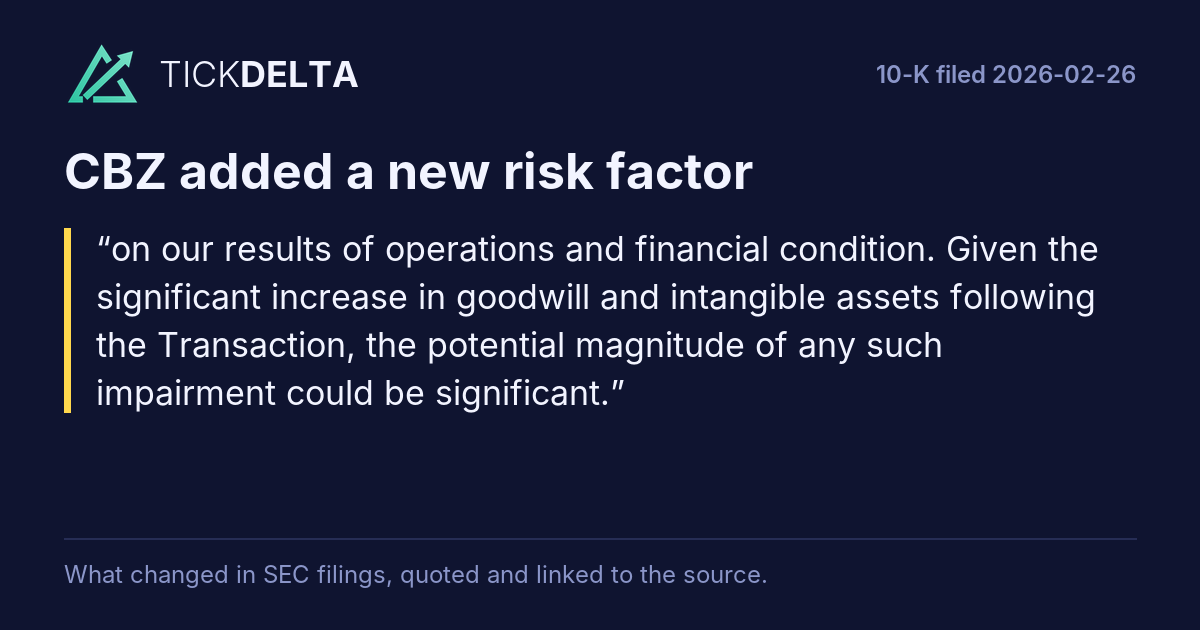
on our results of operations and financial condition. Given the significant increase in goodwill and intangible assets following the Transaction, the potential magnitude of any such impairment could be significant.
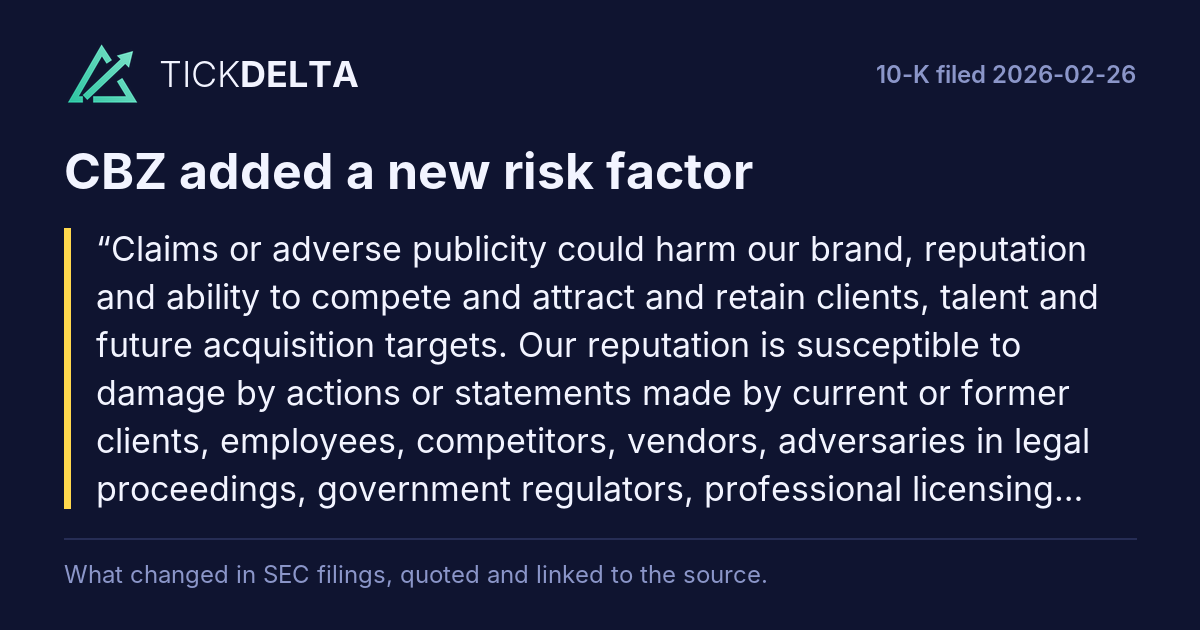
Claims or adverse publicity could harm our brand, reputation and ability to compete and attract and retain clients, talent and future acquisition targets. Our reputation is susceptible to damage by actions or statements made by current or former clients, employees, competitors, vendors, adversaries in legal proceedings, government regulators, professional licensing organizations, members of the investment community and the media. Our engagements may involve matters that may result in a severe impact on a client’s business, cause the client a substantial monetary loss or prevent the client from pursuing business opportunities. Additionally, some of our engagements may involve matters or clients that may be socially or politically unpopular, which could result in adverse publicity and harm our reputation. Our ability to retain existing clients and generate repeat engagements depends upon our ability to maintain a high degree of client satisfaction. Our ability to attract new clients and future acquisition targets, and to hire and retain highly skilled professionals, depends upon our reputation in the professional services industry. As a result, any claims or adverse publicity involving the quality of our services or the reputation of our professionals, matters or clients may be more damaging than similar claims or publicity relating to businesses in other industries. There is a risk that negative information about us, even if untrue, could adversely affect our business, could cause damage to our reputation and be challenging to repair.
Damage to our reputation could also reduce the value and effectiveness of our brand name and could reduce investor confidence in us. Any such claims, adverse publicity or negative connotations may adversely affect our reputation or the reputations of our professionals, or may otherwise harm our ability to attract or retain clients, employees and acquisition targets, any of which could have a material adverse effect on our business, financial condition and results of operations.
Uncertainty in the current economic and geopolitical environment could lead to declines in demand for certain of our services. Demand for our services is affected by global economic conditions, including recessions, inflation, interest rates, tax rates, geopolitical conflicts, tariffs, trade wars, government debt ceiling negotiations and economic uncertainty, and the general level of economic activity in the geographic regions and industries in which we operate. When conditions in the global economy, including the credit markets, deteriorate, or economic activity slows, many companies [outsource less of their nonrecurring projects to service providers and some companies, as a cost-saving measure, choose to rely on their own in-house resources to conduct such nonrecurring projects internally, and under these conditions, companies have cut back on demand for the services we offer, all of which negatively affects our financial condition and results of operations.] We also experience more competitive pricing pressure during periods of economic decline. If the geopolitical uncertainties result in a reduction in business confidence, when the national or global economy or credit market conditions in general deteriorate, the unemployment rate increases or any changes occur in U.S. trade policy (including any increases in tariffs that result in a trade war), such uncertainty or changes put negative pressure on demand for our services and our pricing, resulting in lower cash flows and a negative effect on our business, financial condition and results of operations. In addition, some of our clients experience reduced access to credit and lower revenues, resulting in their inability to meet their payment obligations to us.
Failure to maintain our reputation and brand could impact our ability to attract and retain clients, employees and future acquisition targets, and may have a material adverse effect on our business, financial condition and results of operations. As a professional services advisor, our ability to secure new engagements depends heavily upon maintaining our reputation and brand and the individual reputations of our professionals. Any factor that diminishes our brand or reputation or that of our professionals, including not meeting client expectations or illegal practices or misconduct by our professionals, could make it substantially more difficult for us to attract new clients, employees and acquisition targets, or to retain existing clients and employees. Similarly, because we obtain many of our new engagements from former or current clients, or from referrals by those clients, any client that is unsatisfied with the quality of our work could impair our ability to secure new engagements and clients, and could impair our ability to hire new employees or attract acquisition targets.
Further, we provide our services primarily in connection with significant or complex matters that often involve confidential and sensitive information, and our work is the product of the judgments of our professionals and other staff operating under significant time and other pressures. As a result, we may not always perform to our client’s standards or expectations. In addition, we may face reputational damage from, among other things, litigation against us, SEC or other domestic or foreign governmental investigations or sanctions, professional licensing organization disciplinary investigations or actions or our failure to protect confidential information. For example, in 2023, the SEC and PCAOB implemented sanctions against Marcum related to quality control failures and violations of audit standards in connection with its audit work for a large number of special purpose acquisition company clients as
well as other clients. Likewise, in the past, employee negligence or misconduct has adversely affected our business, and we cannot assure that this will not occur in the future. If our employees engage in actual or perceived misconduct or negligence in the provision of client services, we could be subject to regulatory sanctions and legal liability and could suffer serious harm to our reputation, financial position, current client relationships and ability to attract future clients, and our insurance coverage may not be sufficient to fully compensate us for any losses we may incur. It is not always possible to deter or prevent employee misconduct or negligence, and the precautions we take may not be effective in all cases. In addition, our professionals and other employees are responsible for the security of the information in our systems or under our control and for ensuring that non-public information is kept confidential. Should any employee not follow appropriate security measures, this could result in the improper release or use of confidential information. If our employees engage in misconduct or fail to follow appropriate security measures, we could be subject to legal liability and reputational harm, which could impair our ability to attract and retain clients and in turn materially adversely affect our business, financial condition and results of operations.
We are dependent on our existing client base and our ability to retain and expand our relationships with those clients. Our clients may terminate our engagements with little or no notice and without penalty, which may result in unexpected declines in our revenue or unexpected costs. Our ability to maintain continuing relationships with our clients and successfully obtain payment for our services is essential to the growth and profitability of our business. However, the volume of work performed for any specific client varies from year to year, and we generally do not have long-term commitments from clients to use our services. A client in one year may not provide the same level of revenue for us in any subsequent year. Further, one or more of our clients could be acquired, and there can be no assurance that the acquirer would choose to continue to use our services. In addition, the services we provide to our clients, and the revenue and income from those services, may decline or vary as the type and quantity of services we provide changes over time. Our business model also depends on relationships our teams develop with our clients so that we can understand our clients’ needs and deliver services that are tailored to those needs. If a client is not satisfied with the quality of work performed by us, or with the services delivered, we could incur additional costs to address the situation, the profitability of that work might be impaired, and the client’s dissatisfaction with our services could damage our ability to obtain additional work from that client or new clients in the future. In particular, clients that are not satisfied might seek to terminate existing contracts, which could cause us to incur costs for the services performed prior to termination with no associated revenue. This could also direct future business to our competitors.
Our clients’ ability to terminate engagements with little or no notice, and our clients’ inability or unwillingness to pay for services we performed, can make our future revenue and profitability difficult to predict. Although a substantial majority of our revenue is generated from clients who contributed to our revenue in past years, our engagements with our clients are typically singular in nature. Therefore, we must seek to obtain new engagements when our current engagements end.
The engagement letters that we typically enter into with clients do not obligate them to continue to use our services. Termination, non-renewal, delay or renegotiation of an engagement could cause us to have a higher-than-expected number of unassigned employees and thus compress our margins until we are able to reallocate our headcount. Clients that delay payment, request modifications to their payment arrangements, or fail to meet their payment obligations to us could increase our cash collection time, cause us to incur bad debt expense, or cause us to incur expenses in collections actions. We may also fail to assess the creditworthiness of our clients adequately or accurately. If we are unable to replace clients or revenue as engagements end, or if clients unexpectedly cancel engagements with us or curtail the scope of our engagements and we are unable to replace the revenue from those engagements, eliminate the costs associated with those engagements or find other engagements to utilize our professionals, our business, financial condition and results of operations could be materially adversely affected.
We may be subject to the actions of activist stockholders. Our Board of Directors and management team are committed to acting in the best interest of all of our stockholders. We value constructive input from investors and regularly engage in dialogue with our stockholders regarding strategy and performance. Activist stockholders who disagree with the composition of the Board of Directors, our strategy or management approach may seek to effect change through various strategies and channels. Responding to stockholder activism can be costly and time-consuming, disrupt our operations, and divert the attention of management and our employees from our strategic initiatives. Activist campaigns can create perceived uncertainties as to our future direction, strategy, or leadership and may result in the loss of potential business opportunities, harm our ability to attract new employees, investors, and customers, and cause our stock price to experience periods of volatility or stagnation.
Furthermore, once fully issued, the future stock consideration issuable from the Transaction is expected to constitute approximately 12%, as of December 31, 2025, of our outstanding shares of common stock, without giving
New in the latest 10-Q
18 paragraphs in the 10-Q filed Oct 30, 2026 with nothing like them in the 10-Q filed Aug 4, 2026 (at least half the words must differ; new numbers alone do not count). Quoted exactly, grouped by the item heading above them. This is text that changed, not a judgement of how serious it is.
Delaware 22-2769024 (State or other jurisdiction of incorporation (I.R.S. Employer or organization) Identification No.) 5959 Rockside Woods, N. Suite 600 44131 Independence, Ohio (Zip Code) (Address of principal executive offices)
Read in the 10-Q
t have a balance outstanding at September 30, 2026 or December 31, 2025. The line of credit was renewed in July 2026 and will terminate on July 30, 2027.
Read in the 10-Q
Net unrealized (loss) gain on available-for-sale securities, net of taxes(1) $ (419) $ 35 $ (764) $ 158
Read in the 10-Q
Net unrealized gain (loss) on interest rate swaps, net of taxes(2) 4,838 (1,271) 9,171 (4,736)
Read in the 10-Q
The change in reporting units is considered a triggering event. We performed a quantitative assessme
Read in the 10-Q
On October 27, 2026, the Company held a virtual special meeting of stockholders (the “Special Meeting”). At the Special Meeting, among other matters, the proposal to adopt the Merger Agreement was approved, having received “for” votes from holders of a majority of the outstanding shares entitled to vote on the Merger Agreement proposal.
Read in the 10-Q
The Company expects to close the proposed Merger on or about November 2, 2026, in accordance with, and subject to the terms of, the Merger Agreement.
Read in the 10-Q
On October 27, 2026, the Company held a virtual special meeting of stockholders (the “Special Meeting”). At the Special Meeting, among other matters, the proposal to adopt the Merger Agreement was approved, having received “for” votes from holders of a majority of the outstanding shares entitled to vote on the Merger Agreement proposal.
Read in the 10-Q
The Company expects to close the proposed Merger on or about November 2, 2026, in accordance with, and subject to the terms of, the Merger Agreement.
Read in the 10-Q
Three Months Ended September 30, 2026 2025 (Amounts in thousands, except percentages) As Deferred Adjusted % of As Deferred Adjusted % of
Read in the 10-Q
Nine Months Ended September 30, 2026 2025 (Amounts in thousands, except percentages) As Deferred Adjusted % of As Deferred Adjusted % of
Read in the 10-Q
Three and nine months ended September 30, 2026 compared with September 30, 2025.
Read in the 10-Q
Subsequent to the filing of the Company’s Annual Report on Form 10-K for the year ended December 31, 2025 (as amended), the Company determined that the total number of shares of common stock purchased and delivered pursuant to the ESPP to plan participants exceeded the amount authorized under the ESPP and previously registered on Form S-8 registration statements and resulted in an obligation to remediate this matter. In connection with evaluating the impact of the purchase and delivery of the Eligible Shares and the voluntary rescission offer, management identified a material weakness in the Company’s internal control over financial reporting relating to the administration of the ESPP (the “ESPP Material Weakness”). In the evaluation, the Company determined that it did not effectively design and implement controls to ensure share purchases and deliveries associated with the ESPP did not exceed the amount authorized under the ESPP and registered with the SEC.
Read in the 10-Q
As management continues to evaluate and enhance the Company’s internal control over financial reporting, it may take additional measures to address control deficiencies or modify certain remediation activities described above. The identified Material Weaknesses will not be considered remediated until the applicable remediated controls have operated for a sufficient period of time and management has concluded, through testing, that such controls are
Read in the 10-Q
The Proposed Merger may not be completed on the anticipated terms or timeline, or at all.
Read in the 10-Q
The pendency of the proposed Merger could adversely affect our business and operations.
Read in the 10-Q
Issuer Purchases of Equity Securities Third Quarter Purchases Total Average Total Number of Maximum Number of Price Paid Shares Number of Shares Per Purchased as Shares That Purchased Share Part of Publicly May Yet Be Announced Plan Purchased Under the Plan July 1 – July 31, 2026 4 $33.94 4 2,557 August 1 – August 31, 2026 1 $54.74 1 2,556 September 1 - September 30, 2026 140 $54.65 140 2,416 Third Quarter Purchases 145 145
Read in the 10-Q
During the quarter ended September 30, 2026, no director or officer of the Company
Read in the 10-Q
Item 1A of the 10-Q filed Oct 30, 2026 against Item 1A of the 10-K filed Feb 26, 2026.
A 10-Q repeats only the risks that changed, so a 10-K paragraph that is missing from it is not counted as removed.
Added is a paragraph with nothing like it in the 10-K, Reworded a sentence that is in both with several words changed,
Quiet changes a sentence in both where one to four words changed and one is a hedge or a modal
(cut words struck through, new words highlighted).
Text on the page, not a score; each links to the filing at sec.gov.
Two-word phrases in Risk Factors of the 10-K filed Feb 26, 2026 that are in none of the 1 earlier 10-Ks stored, back to Feb 28, 2025
Used at least twice, small words left out. Counted, not picked: a phrase can be new because the company renamed something.
7 paragraphs of last year's Risk Factors with nothing like them now. The longest are quoted.
Item 1A of each 10-K and 10-Q on EDGAR, quoted exactly. Each paragraph links to the filing at sec.gov.
10-K change: what was reworded or cut, section by section.
Excel workbook · CSV. Google Sheet that stays up to date: paste =IMPORTDATA("https://tickdelta.com/company/CBZ/export.csv") into a cell.