Paragraph 63 · 46% changed
Every version of it
Screener
/
SEC EDGAR
/CIK 0001627223
/10-K filed Feb 24, 2026, compared with Feb 18, 2025
/Numbers from the XBRL of the 10-Ks
NYSE
Materials · Chemicals & Allied Products
Chemours Co CC
The 10-K against last year's
175 changes: 34 added, 25 removed, 114 reworded, 2 quiet changes
10-K Feb 24, 2026 vs Feb 18, 2025
Risk Factors
16.6%
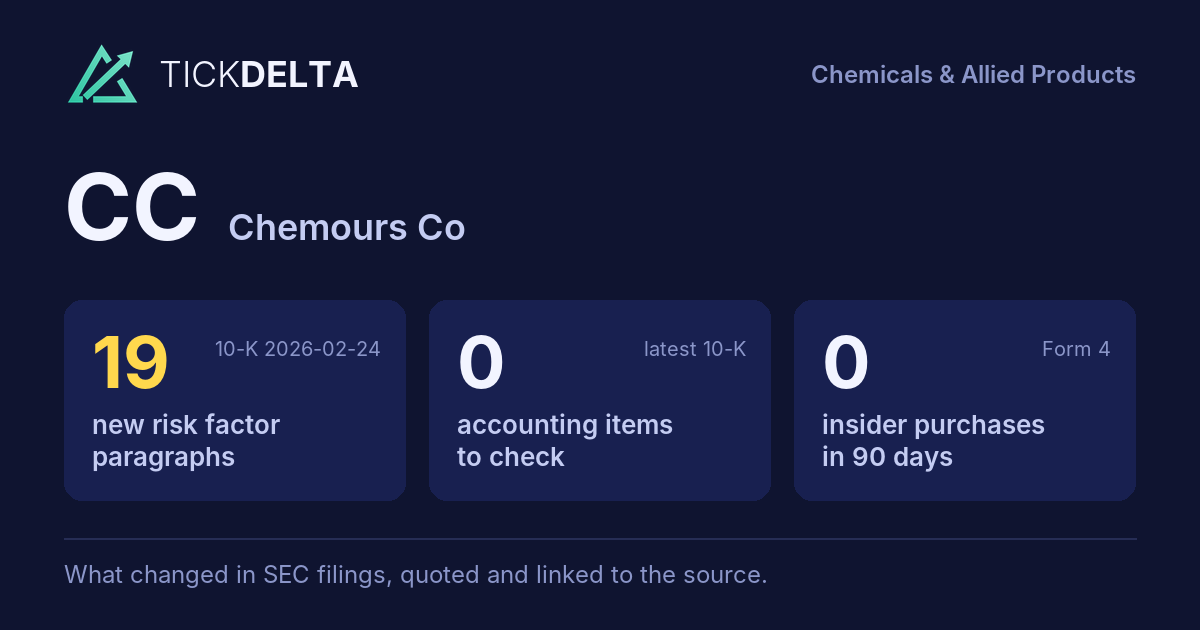
of the text changed · 17,319 words now · 19 new paragraphs, 12 gone
MD&A
21.1%
of the text changed · 19,806 words now · 15 new paragraphs, 13 gone
Legal Proceedings
27.7%
of the text changed · 27,624 words now
Accounting Policies
5.2%
of the text changed · 5,724 words now
10-K 0001193125-26-065201 (Feb 24, 2026) vs 10-K 0000950170-25-021787 (Feb 18, 2025)
Every paragraph, and how much of it changed
One bar per paragraph, in the order of the 10-K. Height and colour show the share of its words not in the closest paragraph a year earlier; the tallest bars are new paragraphs.
Risk Factors
203 paragraphs · 19 new · 56 reworded · 12 gone · 10-K Feb 24, 2026 against Feb 18, 2025
New paragraph
Reworded (5% of its words or more)
Same or nearly
Paragraph 67 · 38% changed
Every version of it
Generally, taxes resulting from the failure of the Separation and distribution or certain related transactions to qualify for non-recognition treatment under U.S. federal, state, and/or local tax law, and/or foreign tax law, would be imposed on EID or EID’s stockholders and, under the tax matters agreement that we entered into with EID prior to the Separation, EID is generally obligated to indemnify us against such taxes to the extent that we may be jointly, severally, or secondarily liable for such taxes. However, under the terms of the tax matters agreement, we are also generally responsible for any taxes imposed on EID that arise from the failure of the distribution to qualify as tax-free for U.S. federal income tax purposes within the meaning of Section 355 of the Internal Revenue Code (“IRC”) or the failure of such related transactions to qualify for tax-free treatment, to the extent such failure to qualify is attributable to actions, events, or transactions relating to our or our affiliates’ stock, assets, or business, or any breach of our or our affiliates’ representations, covenants, or obligations under the tax matters agreement (or any other agreement we enter into in connection with the Separation and distribution), the materials submitted to the U.S. Internal Revenue Service (“IRS”) or other governmental authorities in connection with the request for the IRS Ruling or other tax rulings or the representation letter provided to counsel in connection with the tax opinion. Events triggering an indemnification obligation under the agreement include events occurring after the distribution that cause EID to recognize a gain under Section 355(e) of the IRC. Such tax amounts could be significant. To the extent we are responsible for any liability under the tax matters agreement, there could be a material adverse impact on our financial condition, results of operations, and cash flows in future reporting periods.
Paragraph 45 · 37% changed
Every version of it
Our operations operations, products and production facilities are dependent upon attainment and renewal of requisite operating permits and are subject to extensive environmental and health and safety laws, regulations, and enforcements, proceedings or other actions at national, international, and local levels in numerous jurisdictions, relating to pollution, protection of the environment, climate change, transporting and storing raw materials and finished products, storing and disposing of hazardous wastes, and product content and other safety or human rights concerns. Such laws include, but are not limited to:
Paragraph 116 · 35% changed
Every version of it
Paragraph 84 · 34% changed
Every version of it
If significant tariffs or other restrictions continue to be placed on foreign imports and related countermeasures are taken by impacted foreign countries, our results of operations, financial condition condition, and cash flows may be negatively affected. For example, on February 1, 2025, the United States continues to maintain historically elevated global reciprocal tariffs, including duties applied to imports from India. Tariffs affecting imports from China remain relatively stable through the first half of the year following the U.S. imposed a 25% decision in late 2025 to extend the suspension of certain heightened duties until late 2026. Some U.S. trading partners, including the European Union, have indicated that they could implement significant retaliatory tariff on imports from Canada and Mexico, which were subsequently suspended for a period of one month, and a 10% additional tariff on imports from China. Historically, tariffs have led other measures in response to increased trade and political tensions. In response geopolitical tensions with the United States. The U.S. Supreme Court is reviewing the legality of certain heightened tariffs imposed by the Trump administration, but even if the Court constrains the President’s use of the authorities underlying these tariffs, Trump administration officials have stated that the United States would utilize other authorities to tariffs, foreign countries have implemented retaliatory sustain heightened tariffs on U.S. goods. in some form. Political tensions as a result of these and other trade policies measures could reduce trade volume, investment, technological exchange and other economic activities between major international economies, resulting in a material an adverse effect on global economic conditions and the stability of global financial markets. If While we actively monitor changes and adjust our operations accordingly, if further tariffs are imposed on a broader range of imports, or if further retaliatory trade measures are taken by impacted foreign countries in response to additional tariffs, we may be required to raise our prices or incur additional expenses, which may result in the loss of customers and our results of operations could be negatively affected.
Paragraph 71 · 33% changed
Every version of it
We have devoted substantial internal and external resources towards the Audit Committee Internal Review incurred and expect to continue to devote substantial resources towards the implementation of enhanced procedures and controls over deficiencies and the remediation of material weaknesses in our internal control over financial reporting. Because of these efforts, we have incurred and expect that we will continue to incur incurring significant fees and expenses for legal, accounting, financial financial, and other consulting professional services arising from the audit committee internal review, related regulatory inquiries and professional services, as well as litigation, and the ongoing implementation and maintenance of systems enhanced internal controls and processes that will need to be updated, supplemented or replaced. remediation measures. Additionally, we have indemnification and expense advancement obligations pursuant to our bylaws and indemnification agreements with respect to certain current and former members of senior management and our directors. In connection with the Audit Committee Internal Review, audit committee internal review, we have received requests from former members of senior management under such indemnification agreements and our bylaws to provide advances of funds for legal fees and other expenses, and we expect additional requests in connection with the Audit Committee Internal Review audit committee internal review and any future related litigation, which could be significant. We have taken several remediation efforts These matters could result in response to the Audit Committee Internal Review. However, there can be no assurance that these steps us incurring additional costs and future steps will be successful. To the extent these steps are unsuccessful or incomplete, or we identify additional matters requiring remediation, we liabilities, which may be required material to devote significant additional time and expense to additional remediation efforts. The incurrence of significant additional expenses or the requirement that management devote substantial time to these efforts could reduce the time otherwise available to execute on our business strategies and could have a material adverse effect on our results of operations, financial condition, and cash flows.
Paragraph 57 · 32% changed
Every version of it
In January of 2024, the European Council adopted a regulation supporting the phase down of hydrofluorocarbons (“HFC”) by 2050 and multiple bans on HFCs and hydrofluoroolefin (“HFO”) in select applications. The new regulation entered into force on March 11, 2024, and includes both reviews and exemptions. No later than January 1, 2030, the European Commission will publish a report on the effects of the regulation and whether the bans are upheld based on technical feasibility and socioeconomic impact of alternatives. Also in 2024, Regulation (EU) 2024/573 was published and became effective, with a later implementing regulation ((EU) 2024/2473), that changed rules governing F-Gas reporting and quota consumption. In preparing its 2024 F-Gas reporting submissions, we encountered uncertainty on how to report due to impacts from the implementation of the new regulation in the reporting portal as well as technical challenges associated therewith. We raised these reporting concerns with the competent authorities and resources and are continuing to evaluate the potential impact of these new F-Gas reporting and quota consumption regulations on us.
Paragraph 115 · 30% changed
Every version of it
Our operational and financial condition may be negatively impacted by the widespread outbreak of any illnesses or communicable diseases, as well as any associated public health crises that may ensue, such as the COVID-19 pandemic. ensue. To minimize transmission, social and economic restrictions have been or may be imposed in the U.S. and abroad, including travel bans, quarantines, restrictions on public gatherings, shelter-in-place orders, and/or safer-at-home orders. These restrictions, while necessary and important for public health, can have negative implications for our business and the U.S. and global economies.
Paragraph 63 · 46% changed
Every version of it
10-K Feb 18, 2025In March 2023, EPA proposed a NPDWR to establish Maximum Contaminant Levels (MCL’s) for six PFAS, with PFOA and PFOS having MCLs as individual compounds (each proposed as 4 parts per trillion – (“ppt”)) and four other PFAS compounds, including HFPO Dimer Acid, having a hazard index approach limit on any mixture containing one or more of the compounds. The proposed PFAS NPDWR was subject to public comment through May 30, 2023, and on April 10, 2024 EPA issued its final rule, which included promulgating individual MCLs for PFOA and PFOS at 4ppt and individual MCLs for PFHxS, PFNA and HFPO-DA at 10ppt. In addition, EPA finalized a hazard index of 1 (unitless) as the MCL for any mixture of PFHxS, PFNA, HFPO-DA and PFBS. The final rule became effective 60 days from publication in the Federal Register and the compliance date for public water systems in the U.S. to meet the MCLs is five years from the publication date. In June 2024, Chemours, as well as other organizations including the American Water Works Association and the American Chemistry Council, filed petitions for review of the final rule in the U.S. Court of Appeals for the D.C. Circuit. This appeal is now being held in abeyance until April 2025 to allow EPA to review the underlying rule. Also in April 2024, EPA issued a final rule designating PFOA and PFOS as hazardous substances under CERCLA, which has also been challenged in the same appeals court. EPA has moved to hold this appeal also in abeyance to allow review of the underlying rule. Depending on the ultimate outcome of EPA’s actions, our estimated environmental remediation liabilities and accrued litigation could increase to meet any new drinking water standards, which could have a material adverse effect on our results of operations, financial condition, and cash flows.
10-K Feb 24, 2026
Also in April 2024, EPA issued a final rule designating PFOA and PFOS as hazardous substances under CERCLA, which has also been challenged in the same appeals court. This matter is under consideration by the court, and oral argument was held in January 2026. Depending on the ultimate outcome of EPA’s actions, our estimated environmental remediation liabilities and accrued litigation could increase to meet any new drinking water standards, which could have a material adverse effect on our results of operations, financial condition, and cash flows.
Paragraph 67 · 38% changed
Every version of it
10-K Feb 18, 2025
Generally, taxes resulting from the failure of the Separation and distribution or certain related transactions to qualify for non-recognition treatment under U.S. federal, state, and/or local tax law, and/or foreign tax law, would be imposed on EID or EID’s stockholders and, under the tax matters agreement that we entered into with EID prior to the Separation, EID is generally obligated to indemnify us against such taxes to the extent that we may be jointly, severally, or secondarily liable for such taxes. However, under the terms of the tax matters agreement, we are also generally responsible for any taxes imposed on EID that arise from the failure of the distribution to qualify as tax-free for U.S. federal income tax purposes within the meaning of Section 355 of the Internal Revenue Code (“IRC”) or the failure of such related transactions to qualify for tax-free treatment, to the extent such failure to qualify is attributable to actions, events, or transactions relating to our or our affiliates’ stock, assets, or business, or any breach of our or our affiliates’ representations, covenants, or obligations under the tax matters agreement (or any other agreement we enter into in connection with the Separation and distribution), the materials submitted to the U.S. Internal Revenue Service (“IRS”) or other governmental authorities in connection with the request for the IRS Ruling or other tax rulings or the representation letter provided to counsel in connection with the tax opinion. Events triggering an indemnification obligation under the agreement include events occurring after the distribution that cause EID to recognize a gain under Section 355(e) of the IRC. Such tax amounts could be significant. To the extent we are responsible for any liability under the tax matters agreement, there could be a material adverse impact on our financial condition, results of operations, and cash flows in future reporting periods.
10-K Feb 24, 2026
Generally, taxes resulting from the failure of the Separation and distribution or certain related transactions to qualify for non-recognition treatment under U.S. federal, state, and/or local tax law, and/or foreign tax law, would be imposed on EID or EID’s stockholders and, under the tax matters agreement that we entered into with EID prior to the Separation, EID is generally obligated to indemnify us against such taxes to the extent that we may be jointly, severally, or secondarily liable for such taxes. However, under the terms of the tax matters agreement, we are also generally responsible
Paragraph 45 · 37% changed
Every version of it
10-K Feb 18, 2025
Our operations and production facilities are dependent upon attainment and renewal of requisite operating permits and are subject to extensive environmental and health and safety laws, regulations, and enforcements, proceedings or other actions at national, international, and local levels in numerous jurisdictions, relating to pollution, protection of the environment, climate change, transporting and storing raw materials and finished products, storing and disposing of hazardous wastes, and product content and other safety or human rights concerns. Such laws include, but are not limited to:
10-K Feb 24, 2026
Our operations, products and production facilities are dependent upon attainment and renewal of requisite operating permits and are subject to extensive environmental and health and safety laws, regulations, and enforcements, proceedings or other actions at national, international, and local
Paragraph 116 · 35% changed
Every version of it
10-K Feb 18, 2025Our operational and financial condition may be negatively impacted by the widespread outbreak of any illnesses or communicable diseases, as well as any associated public health crises that may ensue, such as the COVID-19 pandemic. To minimize transmission, social and economic restrictions have been or may be imposed in the U.S. and abroad, including travel bans, quarantines, restrictions on public gatherings, shelter-in-place orders, and/or safer-at-home orders. These restrictions, while necessary and important for public health, can have negative implications for our business and the U.S. and global economies.
10-K Feb 24, 2026
the U.S. and abroad, including travel bans, quarantines, restrictions on public gatherings, shelter-in-place orders, and/or safer-at-home orders. These restrictions, while necessary and important for public health, can have negative implications for our business and the U.S. and global economies.
Paragraph 84 · 34% changed
Every version of it
10-K Feb 18, 2025
If significant tariffs or other restrictions continue to be placed on foreign imports and related countermeasures are taken by impacted foreign countries, our results of operations, financial condition and cash flows may be negatively affected. For example, on February 1, 2025, the U.S. imposed a 25% tariff on imports from Canada and Mexico, which were subsequently suspended for a period of one month, and a 10% additional tariff on imports from China. Historically, tariffs have led to increased trade and political tensions. In response to tariffs, foreign countries have implemented retaliatory tariffs on U.S. goods. Political tensions as a result of trade policies could reduce trade volume, investment, technological exchange and other economic activities between major international economies, resulting in a material adverse effect on global economic conditions and the stability of global financial markets. If further tariffs are imposed on a broader range of imports, or if further retaliatory trade measures are taken by impacted foreign countries in response to additional tariffs, we may be required to raise our prices or incur additional expenses, which may result in the loss of customers and our results of operations could be negatively affected.
10-K Feb 24, 2026
If significant tariffs or other restrictions continue to be placed on foreign imports and related countermeasures are taken by impacted foreign countries, our results of operations, financial condition, and cash flows may be negatively affected. For example, the United States continues to maintain historically elevated global reciprocal tariffs, including duties applied to imports from India. Tariffs affecting imports from China remain relatively stable through the first half of the year following the U.S. decision in late 2025 to extend the suspension of certain heightened duties until late 2026. Some U.S. trading partners, including the European Union, have indicated that they could implement significant retaliatory tariff and other measures in response to trade and geopolitical tensions with the United States. The U.S. Supreme Court is reviewing the legality of certain heightened tariffs imposed by the Trump administration, but even if the Court constrains the President’s use of the authorities underlying these tariffs, Trump administration officials have stated that the United States would utilize other authorities to sustain heightened tariffs in some form. Political tensions as a result of these and other trade measures could reduce trade volume, investment, technological exchange and other economic activities between major international economies, resulting in an adverse effect on global economic conditions and the stability of global financial markets. While we actively monitor changes and adjust our operations accordingly, if further tariffs are imposed on a broader range of imports, or if further retaliatory trade measures are taken by impacted foreign countries in response to additional tariffs, we may be required to raise our prices or incur additional expenses, which may result in the loss of customers and our results of operations could be negatively affected.
Paragraph 71 · 33% changed
Every version of it
10-K Feb 18, 2025
We have devoted substantial internal and external resources towards the Audit Committee Internal Review and expect to continue to devote substantial resources towards the implementation of enhanced procedures and controls over deficiencies and the remediation of material weaknesses in our internal control over financial reporting. Because of these efforts, we have incurred and expect that we will continue to incur significant fees and expenses for legal, accounting, financial and other consulting and professional services, as well as the implementation and maintenance of systems and processes that will need to be updated, supplemented or replaced. Additionally, we have indemnification and expense advancement obligations pursuant to our bylaws and indemnification agreements with respect to certain current and former members of senior management and our directors. In connection with the Audit Committee Internal Review, we have received requests from former members of senior management under such indemnification agreements and our bylaws to provide advances of funds for legal fees and other expenses, and we expect additional requests in connection with the Audit Committee Internal Review and any future related litigation, which could be significant. We have taken several remediation efforts in response to the Audit Committee Internal Review. However, there can be no assurance that these steps and future steps will be successful. To the extent these steps are unsuccessful or incomplete, or we identify additional matters requiring remediation, we may be required to devote significant additional time and expense to additional remediation efforts. The incurrence of significant additional expenses or the requirement that management devote substantial time to these efforts could reduce the time otherwise available to execute on our business strategies and could have a material adverse effect on our results of operations, financial condition, and cash flows.
10-K Feb 24, 2026
We have incurred and expect to continue incurring significant expenses for legal, accounting, financial, and other professional services arising from the audit committee internal review, related regulatory inquiries and litigation, and the ongoing implementation and maintenance of enhanced internal controls and remediation measures. Additionally, we have indemnification and expense advancement obligations pursuant to our bylaws and indemnification agreements with respect to certain current and former members of senior management and our directors. In connection with the audit committee internal review, we have received requests from former members of senior management under such indemnification agreements and our bylaws to provide advances of funds for legal fees and other expenses, and we expect additional requests in connection with the audit committee internal review and any future related litigation, which could be significant. These matters could result in us incurring additional costs and liabilities, which may be material to our results of operations, financial condition, and cash flows.
Paragraph 57 · 32% changed
Every version of it
10-K Feb 18, 2025
In January of 2024, the European Council adopted a regulation supporting the phase down of hydrofluorocarbons (“HFC”) by 2050 and multiple bans on HFCs and hydrofluoroolefin (“HFO”) in select applications. The new regulation entered into force on March 11, 2024, and includes both reviews and exemptions. No later than January 1, 2030, the European Commission will publish a report on the effects of the regulation and whether the bans are upheld based on technical feasibility and socioeconomic impact of alternatives.
10-K Feb 24, 2026
In January 2024, the European Council adopted a regulation supporting the phase down of hydrofluorocarbons (“HFC”) by 2050 and multiple bans on HFCs and hydrofluoroolefin (“HFO”) in select applications. The new regulation entered into force on March 11, 2024, and includes both reviews and exemptions. No later than January 1, 2030, the European Commission will publish a report on the effects of the regulation and whether the bans are upheld based on technical feasibility and socioeconomic impact of alternatives. Also in 2024, Regulation (EU) 2024/573 was published and became effective, with a later implementing regulation ((EU) 2024/2473), that changed rules governing F-Gas reporting and quota consumption. In preparing its 2024 F-Gas reporting submissions, we encountered uncertainty on how to report due to impacts from the implementation of the new regulation in the reporting portal as well as technical challenges associated therewith. We raised these reporting concerns with the competent authorities and resources and are continuing to evaluate the potential impact of these new F-Gas reporting and quota consumption regulations on us.
Paragraph 115 · 30% changed
Every version of it
10-K Feb 18, 2025
Our operational and financial condition may be negatively impacted by the widespread outbreak of any illnesses or communicable diseases, as well as any associated public health crises that may ensue, such as the COVID-19 pandemic. To minimize transmission, social and economic restrictions have been or may be imposed in the U.S. and abroad, including travel bans, quarantines, restrictions on public gatherings, shelter-in-place orders, and/or safer-at-home orders. These restrictions, while necessary and important for public health, can have negative implications for our business and the U.S. and global economies.
10-K Feb 24, 2026
Our operational and financial condition may be negatively impacted by the widespread outbreak of any illnesses or communicable diseases, as well as any associated public health crises that may ensue. To minimize transmission, social and economic restrictions have been or may be imposed in
MD&A
208 paragraphs · 15 new · 73 reworded · 13 gone · 10-K Feb 24, 2026 against Feb 18, 2025
New paragraph
Reworded (5% of its words or more)
Same or nearly
Paragraph 27 · 50% changed
Our cost of goods sold (“COGS”) decreased other income, net increased by $141 $18 million (or 3%) over 100%) to $4.6 billion $26 million for the year ended December 31, 2024, 2025, compared with COGS other income, net of $4.8 billion $8 million for the same period in 2023. 2024. The decrease increase in COGS our other income, net for the year ended December 31, 2024 2025 was primarily attributable to lower sales volume. For the year ended December 31, 2023, COGS included gain on sale of $7 million related to certain parcels of land at our manufacturing site in Kuan Yin, Taiwan (as further described in "Note 13 – Property, Plant and Equipment, Net"), proceeds from a $40 million charge settlement of a patent infringement matter relating to certain raw materials copolymer patents associated with our Advanced Performance Materials segment, royalty income from technology licensing and stores inventories written off related to the Kuan Yin, Taiwan plant shutdown. non-operating pension and other post-retirement employee benefit income.
Paragraph 49 · 49% changed
Segment Adjusted EBITDA increased decreased by $22 $156 million (or 8%) 52%) to $312 $145 million and Segment Adjusted EBITDA margin increased decreased by approximately 100 600 basis points to 12% 6% for the year ended December 31, 2024, 2025, compared with Segment Adjusted EBITDA of $290 $301 million and Segment Adjusted EBITDA margin of 11% 12% for the same period in 2023. 2024. The increases decreases in Segment Adjusted EBITDA and Segment Adjusted EBITDA margin for the year ended December 31, 2025 was primarily attributable to the aforementioned decrease in price, lower cost absorption related to decisions to reduce production level, along with operational disruption costs of approximately $41 million, including the previously disclosed impacts from cold weather downtime and rail line service interruption. As previously disclosed, these disruptions were primarily driven caused by a rail line service interruption impacting feedstock mix and other limited operational issues. In order to fulfill customer orders, due to this rail line interruption, we elected to consume higher-cost ore feedstock, which resulted in incremental costs of $15 million in the second quarter. The net costs associated with other operational disruptions were $26 million for the previous quarters. These operational headwinds were partially offset by continued cost savings realized from under the Titanium Technologies Transformation Plan, partially offset by the aforementioned decrease in price and the unplanned weather-related downtime at our Altamira, Mexico manufacturing site as mentioned above. The downtime resulted in a negative cost impact of $26 million across the second and third quarters of 2024, after which there were no further cost impacts. Plan.
Paragraph 142 · 48% changed
Paragraph 112 · 46% changed
Paragraph 55 · 44% changed
Segment Adjusted EBITDA decreased by $109 $52 million (or 16%) 33%) to $576 $108 million and Segment Adjusted EBITDA margin decreased by approximately 600 300 basis points to 31% 9% for the year ended December 31, 2024, 2025, compared with Segment Adjusted EBITDA of $685 $160 million and Segment Adjusted EBITDA margin of 37% 12% for the same period in 2023. year ended December 31, 2024. The decreases in Segment Adjusted EBITDA and Segment Adjusted EBITDA margin for the year ended December 31, 2024 2025 were primarily attributable to the aforementioned decrease in price operational impacts related to the FreonTM Refrigerants portfolio, increased costs outage at the Washington Works site. These disruptions were related to near-term quota allowances, identified damages to critical pieces of equipment that led to an unscheduled full shutdown at our site, which resulted in an approximately $20 million impact to the third quarter. Additionally, as a result of the lower volumes described in previous paragraphs above, the second half of 2025 was impacted by higher costs as a result of lower fixed cost absorption, higher input costs associated with purchasing non-Corpus based low GWP refrigerant, and decreases in volumes within the FreonTM Refrigerants portfolio, partially offset by higher demand within the OpteonTM Refrigerants portfolio as a result of continued stationary and automotive end-market adoption. an increase in price.
Paragraph 54 · 42% changed
Our Advanced Performance Materials segment’s net sales decreased by $136 $63 million (or 9%) 5%) to $1.3 billion for the year ended December 31, 2024, 2025, compared with segment net sales of $1.5 $1.3 billion for the same period in 2023. 2024. The decrease in segment net sales for the year ended December 31, 2024 2025 was primarily attributable to a decrease in price of 5%, a decrease in volumes of 3% and unfavorable currency movements which added a 1% headwind 8%, partially offset by an increase in price of 3%. The decrease in volume was primarily driven by operational impacts related to the segment's net sales. Volumes decreased primarily due to weaker demand outage at the Washington Works site, the exit of the SPS CapstoneTM product line as well as weakness in the cyclical end markets impacting Advanced Materials and products serving hydrogen market and lower volumes in more economically sensitive end markets. markets under Performance Solutions. The decrease increase in price was primarily due to softer market dynamics and driven by stronger pricing in high-value applications as well as pricing opportunities associated with the exit of the SPS Capstone™ product mix. line.
Paragraph 85 · 40% changed
Paragraph 109 · 39% changed
Our prepaid expenses short-term and other assets increased current maturities of long-term debt decreased by $5 $12 million (or 8%) 22%) to $71 $42 million at December 31, 2024, 2025 compared with prepaid expenses short-term and other assets current maturities of $66 long-term debt of $54 million at December 31, 2023. 2024. The increase decrease in our prepaid expenses short-term and other current assets at December 31, 2024 maturities of long-term debt was primarily attributable to higher prepaid income taxes. a decrease in supplier financing net payments, a decrease in insurance amortization and a capital lease liability reclassification.
Paragraph 27 · 50% changed
10-K Feb 18, 2025
Our cost of goods sold (“COGS”) decreased by $141 million (or 3%) to $4.6 billion for the year ended December 31, 2024, compared with COGS of $4.8 billion for the same period in 2023. The decrease in COGS for the year ended December 31, 2024 was primarily attributable to lower sales volume. For the year ended December 31, 2023, COGS included a $40 million charge relating to certain raw materials and stores inventories written off related to the Kuan Yin, Taiwan plant shutdown.
10-K Feb 24, 2026
Our other income, net increased by $18 million (or over 100%) to $26 million for the year ended December 31, 2025, compared with other income, net of $8 million for the same period in 2024. The increase in our other income, net for the year ended December 31, 2025 was primarily attributable to the gain on sale of $7 million related to certain parcels of land at our manufacturing site in Kuan Yin, Taiwan (as further described in "Note 13 – Property, Plant and Equipment, Net"), proceeds from a settlement of a patent infringement matter relating to certain copolymer patents associated with our Advanced Performance Materials segment, royalty income from technology licensing and non-operating pension and other post-retirement employee benefit income.
Paragraph 49 · 49% changed
10-K Feb 18, 2025
Segment Adjusted EBITDA increased by $22 million (or 8%) to $312 million and Segment Adjusted EBITDA margin increased by approximately 100 basis points to 12% for the year ended December 31, 2024, compared with Segment Adjusted EBITDA of $290 million and Segment Adjusted EBITDA margin of 11% for the same period in 2023. The increases in Adjusted EBITDA and Segment Adjusted EBITDA margin were primarily driven by cost savings realized from the Titanium Technologies Transformation Plan, partially offset by the aforementioned decrease in price and the unplanned weather-related downtime at our Altamira, Mexico manufacturing site as mentioned above. The downtime resulted in a negative cost impact of $26 million across the second and third quarters of 2024, after which there were no further cost impacts.
10-K Feb 24, 2026
Segment Adjusted EBITDA decreased by $156 million (or 52%) to $145 million and Segment Adjusted EBITDA margin decreased by approximately 600 basis points to 6% for the year ended December 31, 2025, compared with Segment Adjusted EBITDA of $301 million and Segment Adjusted EBITDA margin of 12% for the same period in 2024. The decreases in Segment Adjusted EBITDA and Adjusted EBITDA margin for the year ended December 31, 2025 was primarily attributable to the aforementioned decrease in price, lower cost absorption related to decisions to reduce production level, along with operational disruption costs of approximately $41 million, including the previously disclosed impacts from cold weather downtime and rail line service interruption. As previously disclosed, these disruptions were primarily caused by a rail line service interruption impacting feedstock mix and other limited operational issues. In order to fulfill customer orders, due to this rail line interruption, we elected to consume higher-cost ore feedstock, which resulted in incremental costs of $15 million in the second quarter. The net costs associated with other operational disruptions were $26 million for the previous quarters. These operational headwinds were partially offset by continued cost savings under the Titanium Technologies Transformation Plan.
Paragraph 142 · 48% changed
10-K Feb 18, 2025Notwithstanding the results of our trigger-based interim impairment assessment during the third quarter of 2024, further negative market developments, notably as it relates to the hydrogen market or future strategic decisions involving a particular group of assets, may trigger an assessment of the recoverability of the related assets and such an assessment could result in future impairment losses.
10-K Feb 24, 2026
Further, the Company continually monitors macroeconomic and industry-specific conditions for indicators of potential impairment of goodwill and long-lived assets. During 2025, the Company evaluated the sustained weakness in the global TiO₂ market, including lower selling prices and utilization levels, as well as delays in the development of hydrogen-related infrastructure affecting certain end markets. Based on this evaluation, the Company concluded that no triggering events were identified and, accordingly, no interim impairment tests were required. However, further negative market developments, notably in the markets previously mentioned or future strategic decisions involving a particular group of assets, may trigger an assessment of the recoverability of the related assets and such an assessment could result in future impairment losses.
Paragraph 112 · 46% changed
10-K Feb 18, 2025Our other accrued liabilities decreased by $665 million (or 63%) to $393 million at December 31, 2024, compared with other accrued liabilities of $1.1 billion at December 31, 2023. The decrease in our other accrued liabilities at December 31, 2024 was primarily attributable to the derecognition of the accrued liabilities related to the U.S. public water system settlement agreement following Final Judgment, as defined in the U.S. public water system settlement agreement. This matter is further discussed in "Note 22 – Commitments and Contingent Liabilities" to the Consolidated Financial Statements in this Annual Report on Form 10-K.
10-K Feb 24, 2026
litigation following the settlement agreement with the State of New Jersey and the Hoosick Falls settlement. These matters are further discussed in "Note 22 – Commitments and Contingent Liabilities" to the Consolidated Financial Statements in this Annual Report on Form 10-K. Additionally, the increase in our other accrued liabilities was due to a change in the fair value of our cross-currency swap and an increase in our interest accrued as driven by the timing of payments under our senior unsecured notes, partially offset by a decrease in income taxes payable and accrued severance. These matters are further discussed in "Note 19 – Other Accrued Liabilities" to the Consolidated Financial Statements in this Annual Report on Form 10-K.
Paragraph 55 · 44% changed
10-K Feb 18, 2025
Segment Adjusted EBITDA decreased by $109 million (or 16%) to $576 million and Segment Adjusted EBITDA margin decreased by approximately 600 basis points to 31% for the year ended December 31, 2024, compared with Segment Adjusted EBITDA of $685 million and Segment Adjusted EBITDA margin of 37% for the same period in 2023. The decreases in Segment Adjusted EBITDA and Adjusted EBITDA margin for the year ended December 31, 2024 were primarily attributable to the aforementioned decrease in price related to the FreonTM Refrigerants portfolio, increased costs related to near-term quota allowances, lower fixed cost absorption, higher input costs associated with purchasing non-Corpus based low GWP refrigerant, and decreases in volumes within the FreonTM Refrigerants portfolio, partially offset by higher demand within the OpteonTM Refrigerants portfolio as a result of continued stationary and automotive end-market adoption.
10-K Feb 24, 2026
Segment Adjusted EBITDA decreased by $52 million (or 33%) to $108 million and Segment Adjusted EBITDA margin decreased by approximately 300 basis points to 9% for the year ended December 31, 2025, compared with Segment Adjusted EBITDA of $160 million and Segment Adjusted EBITDA margin of 12% for the year ended December 31, 2024. The decreases in Segment Adjusted EBITDA and Segment Adjusted EBITDA margin for the year ended December 31, 2025 were primarily attributable to the operational impacts related to the outage at the Washington Works site. These disruptions were related to identified damages to critical pieces of equipment that led to an unscheduled full shutdown at our site, which resulted in an approximately $20 million impact to the third quarter. Additionally, as a result of the lower volumes described in previous paragraphs above, the second half of 2025 was impacted by higher costs as a result of lower fixed cost absorption, partially offset by an increase in price.
Paragraph 54 · 42% changed
10-K Feb 18, 2025
Our Advanced Performance Materials segment’s net sales decreased by $136 million (or 9%) to $1.3 billion for the year ended December 31, 2024, compared with segment net sales of $1.5 billion for the same period in 2023. The decrease in segment net sales for the year ended December 31, 2024 was primarily attributable to a decrease in price of 5%, a decrease in volumes of 3% and unfavorable currency movements which added a 1% headwind to the segment's net sales. Volumes decreased primarily due to weaker demand in the hydrogen market and lower volumes in more economically sensitive end markets. The decrease in price was primarily due to softer market dynamics and product mix.
10-K Feb 24, 2026
Our Advanced Performance Materials segment’s net sales decreased by $63 million (or 5%) to $1.3 billion for the year ended December 31, 2025, compared with segment net sales of $1.3 billion for the same period in 2024. The decrease in segment net sales for the year ended December 31, 2025 was primarily attributable a decrease in volumes of 8%, partially offset by an increase in price of 3%. The decrease in volume was primarily driven by operational impacts related to the outage at the Washington Works site, the exit of the SPS CapstoneTM product line as well as weakness in cyclical end markets impacting Advanced Materials and products serving hydrogen markets under Performance Solutions. The increase in price was primarily driven by stronger pricing in high-value applications as well as pricing opportunities associated with the exit of the SPS Capstone™ product line.
Paragraph 85 · 40% changed
10-K Feb 18, 2025Refer to “Note 20 – Debt” to the Consolidated Financial Statements for a discussion of our credit facilities and notes.
10-K Feb 24, 2026
December 31, 2026, 2027, 2028, 2029 and 2030, respectively. For a schedule of our lease payments for the next five years and thereafter, refer to “Note 14 – Leases” to the Consolidated Financial Statements.
Paragraph 109 · 39% changed
10-K Feb 18, 2025
Our prepaid expenses and other assets increased by $5 million (or 8%) to $71 million at December 31, 2024, compared with prepaid expenses and other assets of $66 million at December 31, 2023. The increase in our prepaid expenses and other current assets at December 31, 2024 was primarily attributable to higher prepaid income taxes.
10-K Feb 24, 2026
Our short-term and current maturities of long-term debt decreased by $12 million (or 22%) to $42 million at December 31, 2025 compared with short-term and current maturities of long-term debt of $54 million at December 31, 2024. The decrease in our short-term and current maturities of long-term debt was primarily attributable to a decrease in supplier financing net payments, a decrease in insurance amortization and a capital lease liability reclassification.
A paragraph is matched with the one last year that shares the most of its words; under half in common makes it new. The paragraphs shown are the 8 reworded the most in each section.
The paragraph that changed most in each section
The redline
Marked against last year's 10-K: cut words struck through, new words highlighted.
Legal Proceedings713 words changed in this paragraph; it is 43% similar to last year's version.
Source: Item 3, via Note 22 – Commitments and Contingent Liabilities, 10-K 0001193125-26-065201 vs Item 3, via Note 22 – Commitments and Contingent Liabilities, 10-K 0000950170-25-021787
Accounting Policies546 words changed in this paragraph; it is 57% similar to last year's version.
Assets and Liabilities Held for Sale The Company classifies long-lived assets or disposal groups as held for sale in the period when the following held for sale criteria are met: (i) the Company commits to a plan to sell; (ii) the long-lived asset or disposal group is available for immediate sale in its present condition subject only to terms that are usual and customary for sales of such long-lived assets or disposal groups; (iii) an active program to locate a buyer and other actions required to complete the plan to sell have been initiated; (iv) the sale is probable within one year; (v) the asset or disposal group is being actively marketed for sale at a price that is reasonable in relation to its current fair value; and (vi) it is unlikely that significant changes to the plan will be made or that the plan will be withdrawn. Long-lived assets and disposal groups classified as held for sale are measured at the lower of their carrying amount or fair value less costs to sell. The Company ceases depreciation and amortization for a disposal group upon it being classified as held for sale. Recent Accounting Pronouncements Accounting Guidance Issued and Not Yet Adopted Joint Venture Formations In August 2023, the Financial Accounting Standards Board ("FASB") issued ASU 2023-05, Business Combinations - Joint Venture Formations, which requires joint ventures to initially measure its assets and liabilities at fair value on the formation date. The guidance will be effective prospectively to all joint ventures formed on or after January 1, 2025, with early adoption permitted. The Company will adopt the guidance and apply the provisions of ASU 2023-05 to joint ventures formed on or after January 1, 2025. Improvements to Income Tax Disclosures In December 2023, the FASB issued ASU 2023-09, Income Taxes (Topic 740): Improvements to Income Tax Disclosures, which requires enhanced disclosure around the effective tax rate reconciliation, along with incremental disclosure around income taxes paid and certain income statement-related disclosures. The guidance will be effective prospectively for fiscal years beginning after December 15, 2024, with early adoption permitted. The Company plans to adopt the guidance and include required enhanced disclosures in its consolidated financial statements beginning in the year ending December 31, 2025. Disaggregation of Income Statement Expenses In November 2024, the FASB issued ASU 2024-03, Income Statement - Reporting Comprehensive Income - Expense Disaggregation Disclosures, which requires more detailed disclosures of certain categories of expenses such as inventory purchases, employee compensation and depreciation that are components of existing expense captions presented on the face of the income statement. The guidance will be effective for fiscal years beginning after December 15, 2026, and interim periods within fiscal years beginning after December 15, 2027. Companies have the option to apply the guidance either on a retrospective or prospective basis, and early adoption is permitted. The Company is currently evaluating the impacts the adoption of this standard will have on its consolidated financial statements. Intangibles - Internal-Use Software In September 2025, the FASB issued ASU 2025-06, Intangibles - Goodwill and Other - Internal-Use Software, which amends certain aspects of the accounting for and disclosure of software costs under ASC 350-40. ASU 2025-06 clarifies and modernizes the accounting for costs related to internal-use software. The amendments in ASU 2025-06 remove all references to project stages throughout Subtopic 350-40 and clarify the threshold entities apply to begin capitalizing costs. The guidance will be effective for fiscal years beginning after December 15, 2027, and interim periods within those fiscal periods. Companies have the option to apply the guidance on a retrospective or prospective basis, and early adoption is permitted. The Company is currently evaluating the impact the adoption of this standard will have on its consolidated financial statements. Recently Adopted Accounting Guidance Joint Venture Formations In August 2023, the Financial Accounting Standards Board ("FASB") issued ASU 2023-05, Business Combinations - Joint Venture Formations, which requires joint ventures to initially measure its assets and liabilities at fair value on the formation date. The guidance will be effective prospectively to all joint ventures formed on or after January 1, 2025, with early adoption permitted. The Company has adopted the guidance and applied the provisions of ASU 2023-05 to joint ventures formed on or after January 1, 2025. Improvements to Reportable Segment Income Tax Disclosures In November December 2023, the FASB issued ASU 2023-07, 2023-09, Income Taxes (Topic 740): Improvements to Reportable Segment Income Tax Disclosures, which requires enhanced disclosure around the effective tax rate reconciliation, along with incremental disclosures related to a public entity's reportable segments, including the disclosure of significant segment expense categories around income taxes paid and amounts certain income statement-related disclosures. The guidance will be effective prospectively for each reportable segment. This guidance is effective for the Company for the year fiscal years beginning January 1, after December 15, 2024, with early adoption permitted. The amendments should be applied retrospectively to all prior periods presented Company has prospectively adopted the guidance and includes the required enhanced disclosures in its consolidated financial statements beginning in the financial statements. The Company adopted ASU 2023-07 on year ending December 31, 2024 2025. Refer to "Note 9 - Income Taxes" for this reconciliation and included enhanced disclosure of significant segment expense categories and amounts within "Note 29 - Geographic and Segment Information", the effect of which did not have an impact on its financial position, results of operations, or cash flows. further details.
Source: 10-K text, Note 3 – Summary of Significant Accounting Policies, 10-K 0001193125-26-065201 vs 10-K text, Note 3 – Summary of Significant Accounting Policies, 10-K 0000950170-25-021787
MD&A303 words changed in this paragraph; it is 57% similar to last year's version.
In addition, in March 2022, the public prosecutor in The Netherlands has raised a matter related to an alleged infraction of Regulation (EU) 517/2014. Due to a reporting error, our Dordrecht Works facility exceeded its allocated or transferred quota of hydrofluorocarbons within the European market over several years. We implemented improvements to our reporting procedures and operated within the allocated quota. We paid a fine in the fourth quarter of 2022. On October 31, 2024, we received a request from the Dutch ILT agency to amend our F-gas reporting for certain years to reflect HFCs produced and consumed or destroyed at the Dordrecht Works facility. The agency asserts that under Regulation (EU) 2024/573, which repealed and replaced Regulation 517/2014 in February 2024, such compounds are subject to the F-gas quota system. In November 2024, we made minor amendments to its F-gas reporting for the above years and consulted with the Dutch ILT agency and EU Commission on to address the above. Dutch ILT's assertion that certain compounds are subject to the F-gas quota system. In February 2025, the Company we received an intention for the ILT to collect a penalty of €1 million based on the consideration that HFC-23 imported or acquired on the market and added to the production process rather than directly sent for destruction is quota consuming. The Company is We are reviewing the ILT intention. intention and met with the agency in April 2025 to review the matter and Dordrecht Works’ HFC-23 related operations. In May 2025, ILT noticed the collection of the penalty of €1 million (Euro), which was paid by us in June 2025. We have submitted an objection to the collection of the penalty. In June 2025, the European Commission sent a compliance letter related to the Dordrecht Works operations alleging infringement of Article 16(1) of the F-gas regulation by exceeding its annual quota between 2016 to 2019 and 2021 to 2024, asserting a total reduction of 1,114,016 tons of carbon dioxide equivalent. In June 2025 the European Commission also sent a compliance letter asserting that, based upon its 2024 reporting year submission, a quota exceedance occurred making it subject to a reduced quota allocation in the future and penalties. We responded to the compliance letter and on August 1, 2025 the European Commission sent a letter-decision imposing a 200% quota reduction penalty applicable in 2026. On October 9, 2025, we filed an application for annulment of such decision in the General Court of the European Union based upon the decision violating EU law and its principle of proportionality. We also filed for an interim action to suspend the August 1, 2025 decision and the court issued an order granting temporary relief whereby the quota reduction decision was suspended during the interim proceedings. In January 2026, the court issued an order dismissing the interim action and temporary suspension. The annulment matter is proceeding. Based on available information, we do not believe the above matter will have a material impact on our financial position, results of operation or cash flows.
Source: Item 7, 10-K 0001193125-26-065201 vs Item 7, 10-K 0000950170-25-021787
Risk Factors238 words changed in this paragraph; it is 33% similar to last year's version.
In March 2024, ECHA published a registration update for trifluoroacetic acid (“TFA”). This update includes a self-classification, by TFA registrants, of a Category 2 Reprotoxin. Reproductive toxicant. BAuA, the German competent authority responsible for REACH and the CLP regulation in Germany, submitted a dossier to ECHA proposing to harmonize the hazard classification of TFA. In parallel, Germany has announced its intention to submit a proposal to revise the existing harmonized (legally binding) classification to include reprotoxicity. The proposal will go through May 2025, ECHA launched a 60-day public consultation period on the CLH proposal for TFA which included updates to collect its hazard classification for reproductive toxicity, newly proposed as a category 1B, and introduced a PMT/vPvM (Persistent, Mobile and Toxic/very Persistent and very Mobile) classification. The public consultation period concluded and now ECHA’s Risk Assessment Committee ("RAC") is reviewing the dossier submitted by the German authority and the public comments from interested parties. Next, ECHA’s received. RAC will review the submission and all comments and adopt develop an opinion, which could take up should be submitted to 18 months. Based on this opinion, the European Commission will prepare a legislative proposal in conjunction with Member State experts. If Member States and through the European Parliament do not object, the final harmonized classification course of 2026. The EU Commission will then review RAC’s opinion and determine whether to proceed with the decision to amend the CLP regulation. If the Commission adopts the decision and amends Annex VI of the CLP Regulation, the changes become legally binding across the EU after a transition period. There It should also be noted that there are many variables in this process, other regulatory assessments underway from the European Food and Drug Agency ("EFSA") reviewing TFA which could take years to complete. impact timing of the CLH.
Source: Item 1A, 10-K 0001193125-26-065201 vs Item 1A, 10-K 0000950170-25-021787
Sentences and paragraphs added, removed or reworded
Every change, by type
Sentences and paragraphs of CC's Risk Factors and MD&A, 10-K Feb 24, 2026 against 10-K Feb 18, 2025. Each links to the text at sec.gov.
Quiet changes are sentences kept from last year with one to four words changed, at least one of them a hedge, a modal or a qualifier (may, could, will, not, significant, material…). A year or date rolling forward is not counted.
The full word list
adverse, adversely, all, although, anticipate, anticipates, any, approximately, believe, believes, can, cannot, certain, could, expect, expects, generally, however, if, intend, intends, largely, likely, many, material, materially, may, might, most, must, never, no, not, possible, primarily, probable, should, significant, significantly, some, substantial, substantially, unlikely, will, would
AddedRisk Factors
•The current geopolitical environment has led to rapidly changing economic sanctions issued by the United States against individuals, entities and countries and resulted in countermeasures imposed by other jurisdictions. Failure to detect and abide by these changes could impact our reputation and results of operations, financial condition, and cash flows.
Read it in 10-K Feb 24, 2026 at sec.gov
AddedRisk Factors
•The emergence, renegotiation, or expiration of free trade agreements (“FTAs”) and other international trade frameworks could adversely affect our competitiveness, supply chain, and financial results;
Read it in 10-K Feb 24, 2026 at sec.gov
AddedRisk Factors
•Our use of new and evolving technologies, including artificial intelligence (“AI”), may present risks and challenges that could adversely impact our business, competitive position, and financial condition.
Read it in 10-K Feb 24, 2026 at sec.gov
AddedRisk Factors
In March 2024, ECHA published a registration update for trifluoroacetic acid (“TFA”). This update includes a self-classification, by TFA registrants, of a Category 2 Reproductive toxicant. BAuA, the German competent authority responsible for REACH and the CLP regulation in Germany, submitted a dossier to ECHA proposing to harmonize the hazard classification of TFA. In May 2025, ECHA launched a 60-day public consultation period on the CLH proposal for TFA which included updates to its hazard classification for reproductive toxicity, newly proposed as a category 1B, and introduced a PMT/vPvM (Persistent, Mobile and Toxic/very Persistent and very Mobile) classification. The public consultation period concluded and now ECHA’s Risk Assessment Committee ("RAC") is reviewing the dossier submitted by the German authority and the public comments received. RAC will develop an opinion, which should be submitted to the European Commission through the course of 2026. The EU Commission will then review RAC’s opinion and determine whether to proceed with the decision to amend the CLP regulation. If the Commission adopts the decision and amends Annex VI of the CLP Regulation, the changes become legally binding across the EU after a transition period. It should also be noted that there are other regulatory assessments underway from the European Food and Drug Agency ("EFSA") reviewing TFA which could impact timing of the CLH.
Read it in 10-K Feb 24, 2026 at sec.gov
AddedRisk Factors
In connection with the matters evaluated during the audit committee internal review in 2024, we have received inquiries and information requests from regulatory authorities and may be subject to additional investigations, enforcement actions, or other proceedings. Additionally, private plaintiffs have also initiated litigation, and additional stockholder demands or lawsuits may be filed. In addition, we are aware of additional efforts by private law firms to solicit clients in regard to potential securities class action or derivative litigation. Refer to "Note 22 – Commitments and Contingent Liabilities" to the Consolidated Financial Statements a discussion of these matters.
Read it in 10-K Feb 24, 2026 at sec.gov
AddedRisk Factors
The current geopolitical environment has led to rapidly changing economic sanctions issued by the United States against individuals, entities and countries and resulted in countermeasures imposed by other jurisdictions. Failure to detect and abide by these changes could impact our reputation and results of operations, financial condition, and cash flows.
Read it in 10-K Feb 24, 2026 at sec.gov
AddedRisk Factors
The global geopolitical environment remains highly volatile, and economic sanctions imposed by the United States and other jurisdictions continue to evolve with little warning. Sanctions may be expanded, withdrawn, or restructured in response to rapidly shifting diplomatic, security, or economic conditions. Countermeasures taken by foreign governments can further complicate the landscape, creating an unpredictable and fast‑moving set of requirements governing who we may transact with, where we may operate, and how we manage cross‑border financial and commercial activities. This unpredictability increases the risk of inadvertent non‑compliance, which could subject us to regulatory scrutiny, legal penalties, business disruptions, and reputational harm, any of which could adversely affect our results of operations, financial condition, and cash flows.
Read it in 10-K Feb 24, 2026 at sec.gov
AddedRisk Factors
We actively monitor sanctions developments and have implemented a range of compliance measures designed to reduce the risk associated with these rapidly changing regimes. While these efforts are intended to help us detect and respond to new or amended requirements, no compliance program can fully eliminate the risk of violations given the speed and complexity with which sanctions can be imposed or interpreted. As geopolitical tensions continue to influence global trade and regulatory environments, remaining compliant will require ongoing vigilance and may result in increased operational and administrative costs. Despite our mitigation efforts, failure to keep pace with evolving sanctions could still materially impact our business, reputation, and financial performance.
Read it in 10-K Feb 24, 2026 at sec.gov
Show the other 66
AddedRisk Factors
The emergence, renegotiation, or expiration of FTAs and other international trade frameworks could adversely affect our competitiveness, supply chain, and financial results.
Read it in 10-K Feb 24, 2026 at sec.gov
AddedRisk Factors
The emergence of new FTAs, the renegotiation of existing FTAs, or the expiration or withdrawal of countries from such frameworks could adversely affect our global competitiveness, supply chain efficiency, and financial performance. Changes in trade terms—such as modified rules of origin, shifts in tariff schedules, new compliance requirements, or uneven enforcement—may alter sourcing economics, disrupt established trade flows, or constrain our ability to optimize production and distribution across regions. These developments could also increase raw‑material or logistics costs, limit market access, or require operational adjustments that may not be fully offset by pricing or mitigation actions. Because these outcomes often arise quickly and vary by jurisdiction, the impact of evolving trade regimes may be difficult to predict and could materially affect our business, results of operations, and cash flows.
Read it in 10-K Feb 24, 2026 at sec.gov
AddedRisk Factors
On July 4, 2025, the U.S. government enacted the One Big Beautiful Bill Act (the “Tax Act”), which includes significant changes to various tax provisions previously enacted by the Tax Cuts and Jobs Act of 2017 (“TCJA”). Among other things, the Tax Act makes permanent extension of certain expiring provisions of TCJA, modifies certain aspects of the international tax framework, and restores favorable tax treatment for certain business provisions. While we have incorporated the impacts of provisions with 2025 effective dates into our provision for income taxes for the quarter, we continue to
Read it in 10-K Feb 24, 2026 at sec.gov
AddedRisk Factors
evaluate the impact of the Tax Act for future tax years, notably with respect to interest expense deductibility and U.S. taxation of earnings by our non-US subsidiaries.
Read it in 10-K Feb 24, 2026 at sec.gov
RemovedRisk Factors
RemovedRisk Factors
RemovedRisk Factors
RemovedRisk Factors
RemovedRisk Factors
RemovedRisk Factors
RemovedRisk Factors
RemovedRisk Factors
RemovedRisk Factors
RemovedRisk Factors
RemovedRisk Factors
RemovedRisk Factors
RewordedRisk Factors
In August 2025, we, EID and the DuPont Indemnitees entered into a PFAS Insurance Proceeds Memorandum of Understanding (“PFAS Insurance MOU”) related to the New Jersey settlement providing for our assignment of certain PFAS-related insurance rights in exchange for funding toward our obligations, Disputes with or among the DuPont Indemnitees and others which may arise with respect to the MOU, PFAS Insurance MOU and PFAS matters, including disputes based on matters of law or contract interpretation, could materially adversely affect our results of operations, financial condition, and cash flows.
Read it in 10-K Feb 24, 2026 at sec.gov
RewordedRisk Factors
Our operations operations, products and production facilities are dependent upon attainment and renewal of requisite operating permits and are subject to extensive environmental and health and safety laws, regulations, and enforcements, proceedings or other actions at national, international, and local levels in numerous jurisdictions, relating to pollution, protection of the environment, climate change, transporting and storing raw materials and finished products, storing and disposing of hazardous wastes, and product content and other safety or human rights concerns.
Read it in 10-K Feb 24, 2026 at sec.gov
RewordedRisk Factors
RewordedRisk Factors
Our success depends on the performance of our ability to attract, retain, and develop our key employees, including our senior management team, which is currently led by a new our Chief Executive Officer. Officer, and to identify and prepare successors for critical roles.
Read it in 10-K Feb 24, 2026 at sec.gov
RewordedRisk Factors
See also “As a result of the Audit Committee Internal Review, audit committee internal review in 2024, we may be exposed to civil and criminal litigation from investors and/or regulatory entities, entities and significant financial and operational costs, which may adversely affect our reputation, results of operations, financial condition, and cash flows” flows" for a discussion of recent requests for information and potential private litigation.
Read it in 10-K Feb 24, 2026 at sec.gov
RewordedRisk Factors
We are also subject to requests for information, including those described below under “As a result of the Audit Committee Internal Review, audit committee internal review in 2024, we may be exposed to civil and criminal litigation from investors and/or regulatory entities, entities and significant financial and operational costs, which may adversely affect our reputation, results of operations, financial condition, and cash flows.
Read it in 10-K Feb 24, 2026 at sec.gov
RewordedRisk Factors
As a result of the Audit Committee Internal Review that commenced audit committee internal review in 2024, we may be exposed to civil and criminal litigation from investors and/or regulatory entities, entities and significant financial and operational costs, which may adversely affect our reputation, results of operations, financial condition, and cash flows.
Read it in 10-K Feb 24, 2026 at sec.gov
RewordedRisk Factors
To minimize transmission, social and economic restrictions have been or may be imposed in the U.S. and abroad, including travel bans, quarantines, restrictions on public gatherings, shelter-in-place orders, and/or safer-at-home orders.
Read it in 10-K Feb 24, 2026 at sec.gov
RewordedRisk Factors
We and certain of our customers third parties (e.g., vendors, suppliers and suppliers other service providers) whom we rely on have experienced business and/or supply chain disruptions, plant downtime, power outages, and/or information technology system and network disruptions.
Read it in 10-K Feb 24, 2026 at sec.gov
RewordedRisk Factors
Our ability to make scheduled payments on our indebtedness, including on our outstanding notes, to comply with covenants in our debt instruments and to refinance our indebtedness, including on our outstanding notes, depends on and is subject to our financial condition and operating performance, which in turn is affected by general and regional economic, financial, competitive, business, and other factors (many of which are beyond our control), including the availability of financing in the international banking and capital markets.
Read it in 10-K Feb 24, 2026 at sec.gov
RewordedRisk Factors
We must continue to develop lower-emission manufacturing technologies and identify, develop, and market innovative products or enhance existing products in a disciplined manner and focused on high-return, low-risk initiatives on a timely basis to help us maintain or improve our profit margins and our competitive position.
Read it in 10-K Feb 24, 2026 at sec.gov
RewordedRisk Factors
Quiet changesRisk Factors
Comments were submitted from individuals and organizations during the consultation period in 2023 and the restriction dossier will be is being reviewed by the ECHA Risk Assessment Committee ("RAC") and Socio-economic Analysis Committees (“SEAC”).
Read it in 10-K Feb 24, 2026 at sec.gov
AddedMD&A
In January 2026, we, through our subsidiary, The Chemours (Taiwan) Company Limited, entered into the Purchase Agreements with four entities affiliated with each other: Century Wind Power Co., Ltd., Century Iron and Steel Industrial Co., Ltd., Century Huaxin Wind Energy Co., Ltd. and Mr. Lai Wen-Hsiang, to sell ten parcels of land in Kuan Yin, Taiwan, for a total purchase price of approximately $360 million. We anticipate that the sale of the Property will be completed through one or more closings, which are expected to occur by mid-year 2026, subject to the satisfaction of certain closing conditions set forth in the Purchase Agreements and local regulatory approval, inclusive of environmental conditions. We intend to use the cash proceeds from the sale of the Property to reduce the Company’s debt obligations.
Read it in 10-K Feb 24, 2026 at sec.gov
AddedMD&A
In January 2026, our Washington Works site experienced a disruption that necessitated a temporary shutdown, limiting our capacity at this key manufacturing facility in our Advanced Performance Materials business. This event was traced to equipment affected by a local utility service outage in August of 2025, which is integral to our fluoropolymer supply chain and involves complex chemical processing technology. Although operations have resumed, the unplanned outage coincided with challenging winter weather, resulting in delays to the restart. This unplanned outage is expected to have a negative earnings impact of $20 million to $25 million for APM in the first quarter of 2026.
Read it in 10-K Feb 24, 2026 at sec.gov
AddedMD&A
As part of our Portfolio Management pillar of our Pathway to Thrive Strategy, in January 2026, we made the strategic decision to temporarily idle one of our mines located in northern Florida and transition to a third-party earth-moving contractor. This revised approach is expected to support our overall cost efforts and promote improved cash generation. Also in our Titanium Technologies business, in February 2026, we welcomed Michael Foley as the new business president.
Read it in 10-K Feb 24, 2026 at sec.gov
AddedMD&A
On October 15, 2025, we entered into Amendment No. 4 (the “Fourth Amendment”) among the Company, certain subsidiaries of the Company, the lenders from time to time party thereto and JPMorgan Chase Bank, N.A., as administrative agent, which amends the Credit Agreement. The Fourth Amendment extended the maturity date of our $1,050 million senior secured U.S. Dollar Term Loan from August 18, 2028 to October 15, 2032. The Fourth Amendment also changed the applicable margin in respect of the Dollar Term Loan to, at our election, adjusted Term Secured Overnight Financing Rate ("SOFR") + 3.50% or adjusted base rate plus 2.50%.
Read it in 10-K Feb 24, 2026 at sec.gov
AddedMD&A
On October 13, 2025, we entered into a Receivables Purchase Agreement (the "Purchase Agreement") with BNP Paribas Factor GmbH (“BNP”). Pursuant to the Purchase Agreement, and subject to the terms and conditions set forth therein, certain subsidiaries of the Company agreed to offer for sale and to sell, and BNP agreed to purchase, certain eligible receivables and related rights in an amount of up to an aggregate outstanding balance of €180 million. The initial term of the Purchase Agreement extends through October 31, 2026 and will be automatically extended for one-year period, unless earlier terminated in accordance with the terms of the Purchase Agreement.
Read it in 10-K Feb 24, 2026 at sec.gov
AddedMD&A
The chemicals sector has been and continues to be impacted by changes in U.S. and foreign trade policies, particularly the introduction and adjustment of tariffs by the United States as well as foreign retaliatory tariffs. We actively monitor changes and adjust our operations accordingly to enhance supply chain flexibility, including taking certain pricing actions and evaluating opportunities to source products not directly impacted by existing or potential tariffs. The long-term impact of tariffs, including potential changes to existing tariffs or the imposition of further retaliatory trade measures, on our business, financial condition and results of operations remains uncertain.
Read it in 10-K Feb 24, 2026 at sec.gov
AddedMD&A
On July 4, 2025, the U.S. government enacted the Tax Act, which includes significant changes to various tax provisions previously enacted by the TCJA. The Tax Act makes permanent extension of certain expiring provisions of TCJA, modifications to the international tax framework, and the restoration of favorable tax treatment for certain business provisions. While we have incorporated the impacts of provisions with 2025 effective dates into our provision for income taxes for the year-ended December 31, 2025, we continue to evaluate the impact of the Tax Act for future tax years, notably with respect to interest expense deductibility and U.S. taxation of earnings by our non-US subsidiaries.
Read it in 10-K Feb 24, 2026 at sec.gov
AddedMD&A
Valuation allowance require an assessment of both positive and negative evidence when determining whether it is more likely than not that deferred tax assets are recoverable. Such assessment is required on a jurisdiction-by-jurisdiction basis. The ultimate realization of deferred tax assessment is dependent upon the generation of future taxable income during the periods in which those temporary difference become deductible. Our US federal, state, and foreign valuation allowances are based on projections of taxable income, which may be subject to change in the future, and may be impacted by the Tax Act provisions going into effect in 2026 regarding interest deductibility limitations, and events subsequent to our Balance Sheet date including the previously disclosed sale of land in Kuan Yin, Taiwan and any future costs incurred in connection with Note 22, Commitments and Contingent Liabilities.
Read it in 10-K Feb 24, 2026 at sec.gov
AddedMD&A
(1)As part of our decision to exit our SPS CapstoneTM business, we incurred accelerated depreciation charges of $23 million during the year ended December 31, 2025, which are included within the "Depreciation and amortization" caption above, and therefore are not included as separate adjustment within this caption.
Read it in 10-K Feb 24, 2026 at sec.gov
AddedMD&A
In March 2025, the Company entered into Amendment No. 4 to its Amended and Restated Purchase Agreement in respect of its securitization facility to extend the maturity date from March 31, 2025 to March 31, 2028 and decrease the facility limit from $175 million to $165 million.
Read it in 10-K Feb 24, 2026 at sec.gov
AddedMD&A
In May 2025, the Company entered into the Amendment No. 3 (the "Third Amendment") among the Company, certain subsidiaries of the Company, the lenders from time to time party thereto and JPMorgan Chase Bank, N.A., as administrative agent, which amends the Credit Agreement. The Third Amendment increased the total net leverage ratio thresholds governing the applicable rate for the Company’s revolving commitments existing immediately prior to the consummation of the transaction contemplated by the Amendment to May 2, 2030, increased the maximum senior secured net leverage ratio quarterly maintenance test through the fiscal quarter ended September 30, 2026, extended the termination date of certain revolving commitments and increased the aggregate revolving commitments available to $1,000 million, comprised of $780 million in revolving commitments that mature on May 2, 2030 and $220 million in revolving commitments that mature on October 7, 2026; in each case, subject to springing maturity provisions.
Read it in 10-K Feb 24, 2026 at sec.gov
AddedMD&A
In October 2025, the Company entered into Amendment No. 4 (the “Fourth Amendment”) among the Company, certain subsidiaries of the Company, the lenders from time to time party thereto and JPMorgan Chase Bank, N.A., as administrative agent, which amends the Credit Agreement. The Fourth Amendment extended the maturity date of the Company’s $1,050 million senior secured U.S. Dollar Term Loan from August 18, 2028 to October 15, 2032. The Fourth Amendment also changed the applicable margin in respect of the Dollar Term Loan to, at the election of the Company, adjusted Term SOFR + 3.50% or adjusted base rate plus 2.50%.
Read it in 10-K Feb 24, 2026 at sec.gov
RemovedMD&A
RemovedMD&A
RemovedMD&A
RemovedMD&A
RemovedMD&A
RemovedMD&A
RemovedMD&A
RemovedMD&A
RemovedMD&A
RemovedMD&A
RemovedMD&A
RemovedMD&A
RewordedMD&A
Year Ended December 31, (Dollars in millions, except per share amounts) 2025 2024 2023 Net sales $ 5,808 $ 5,782 $ 6,078 Cost of goods sold 4,631 4,772 4,906 4,640 Gross profit 1,151 1,306 902 1,142 Selling, general, and administrative expense 585 1,290 799 598 Research and development expense 108 109 108 Restructuring, asset-related, and other charges 59 60 153 Goodwill impairment charge — 56 — Total other operating expenses 810 1,551 966 823 Equity in earnings of affiliates 35 43 45 Interest expense, net (264) (208) (269) (263) Loss on extinguishment of debt (1) (5) (1) Other income, net 26 8 91 Income (loss) (Loss) income before income taxes 127 (318) (277) 106 Provision for (benefit from) income taxes 41 (81) 109 37 Net (loss) income (loss) 86 (237) (386) 69 Less:
Read it in 10-K Feb 24, 2026 at sec.gov
RewordedMD&A
The increase in our inventories at December 31, 2024 2025 was primarily attributable to an increase in the value of our raw materialinventories due to higher inventories raw materials costs within our Titanium Technologies business business, as well as an increase in line with seasonal demand patterns and higher inventories within our Thermal & Specialized Solutions business business, partially offset by a decrease in advance of plant maintenance activity in the fourth quarter of 2024. inventories within our Advanced Performance Materials business.
Read it in 10-K Feb 24, 2026 at sec.gov
RewordedMD&A
The decrease in our capital expenditures for the year ended December 31, 2024 2025 was primarily attributable to a decrease in capital expenditures in Advanced Performance Materials following completion of capital investments related to PFA capacity expansion, partially offset by an increase in maintenance capital expenditures in Thermal & Specialized Solutions related due to OpteonTM capacity expansion. timing of planned major maintenance and the conclusion of the Corpus expansion project.
Read it in 10-K Feb 24, 2026 at sec.gov
RewordedMD&A
For the year ended December 31, 2024, 2025, our restructuring, asset-related, and other charges were primarily attributable to $27 million of non-cash asset-related charges, $20 million charges of $24 million, employee separation charges of $13 million and $3 million of decommissioning and other charges of $15 million related to the 2024 Restructuring Program initialed in the third quarter of 2024. SPS CapstoneTM Exit.
Read it in 10-K Feb 24, 2026 at sec.gov
RewordedMD&A
RewordedMD&A
The decrease in segment net sales for the year ended December 31, 2024 2025 was primarily attributable to a decrease in price of 5%, a decrease in volumes of 3% and unfavorable currency movements which added a 1% headwind to the segment's net sales. 8%, partially offset by an increase in price of 3%.
Read it in 10-K Feb 24, 2026 at sec.gov
RewordedMD&A
Pursuant to the binding MOU that we entered into with DuPont, Corteva, and EID in January 2021, costs related to potential future legacy PFAS liabilities arising out of pre-July 1, 2015 conduct will subject to the cost-sharing arrangement, where we bear half of the cost of such future potential legacy PFAS liabilities and DuPont and Corteva will collectively bear the other half of the cost of such future potential legacy PFAS liabilities up to an aggregate $4 billion, of which approximately $2.0 $1.3 billion is available after consideration of the funding of the payment to the State of Ohio Ohio, and supplemental payment to the State of Delaware (discussed below). Delaware, and the net present value of the scheduled settlement payments per the terms of the settlement agreement with the State of New Jersey, described further below.
Read it in 10-K Feb 24, 2026 at sec.gov
RewordedMD&A
RewordedMD&A
Our cost of goods sold (“COGS”) decreased other income, net increased by $141 $18 million (or 3%) over 100%) to $4.6 billion $26 million for the year ended December 31, 2024, 2025, compared with COGS other income, net of $4.8 billion $8 million for the same period in 2023. 2024.
Read it in 10-K Feb 24, 2026 at sec.gov
RewordedMD&A
December 31, (Dollars in millions) 2025 2024 2023 Chambers Works, Deepwater, New Jersey $ 73 $ 31 $ 30 Dordrecht Works, Netherlands (1) 30 28 4 Fayetteville Works, Fayetteville, North Carolina 320 351 383 Pompton Lakes, New Jersey 53 41 41 USS Lead, East Chicago, Indiana (2) — 12 Washington Works, West Virginia 24 25 22 All other sites 118 95 98 Total environmental remediation $ 618 $ 571 $ 590
Read it in 10-K Feb 24, 2026 at sec.gov
RewordedMD&A
The decrease in segment net sales for the year ended December 31, 2024 2025 was primarily attributable to a 5% 6% price decrease, partially offset by as well as a 1% volume increase despite unplanned downtime at our Altamira, Mexico manufacturing site due to extreme drought in the region. decrease.
Read it in 10-K Feb 24, 2026 at sec.gov
RewordedMD&A
Our capital expenditures decreased net sales increased by $10 $26 million (or 3%) 0%) to $360 million $5.8 billion for the year ended December 31, 2024, 2025, compared with capital expenditures net sales of $370 million $5.8 billion for the same period in 2023. 2024.
Read it in 10-K Feb 24, 2026 at sec.gov
Quiet changesMD&A
Sources
The two latest 10-Ks on EDGAR, section by section. Each change links to the text at sec.gov.
Also
New risk factors: paragraphs with nothing like them last year, quoted in full.
Work with it
Excel workbook · CSV. Google Sheet that stays up to date: paste =IMPORTDATA("https://tickdelta.com/company/CC/export.csv") into a cell.