Added10-Q Nov 5, 2026 vs 10-K Feb 24, 2026
There were no share repurchases during the three months ended September 30, 2026.
Each branch is a paragraph in Risk Factors with nothing like it in the 10-K filed Feb 18, 2025. A box jumps to the paragraph as filed, below.
19 paragraphs in Risk Factors of the 10-K filed Feb 24, 2026 with nothing like them in the 10-K filed Feb 18, 2025. Quoted exactly. Paragraphs that were only edited are under 10-K change.
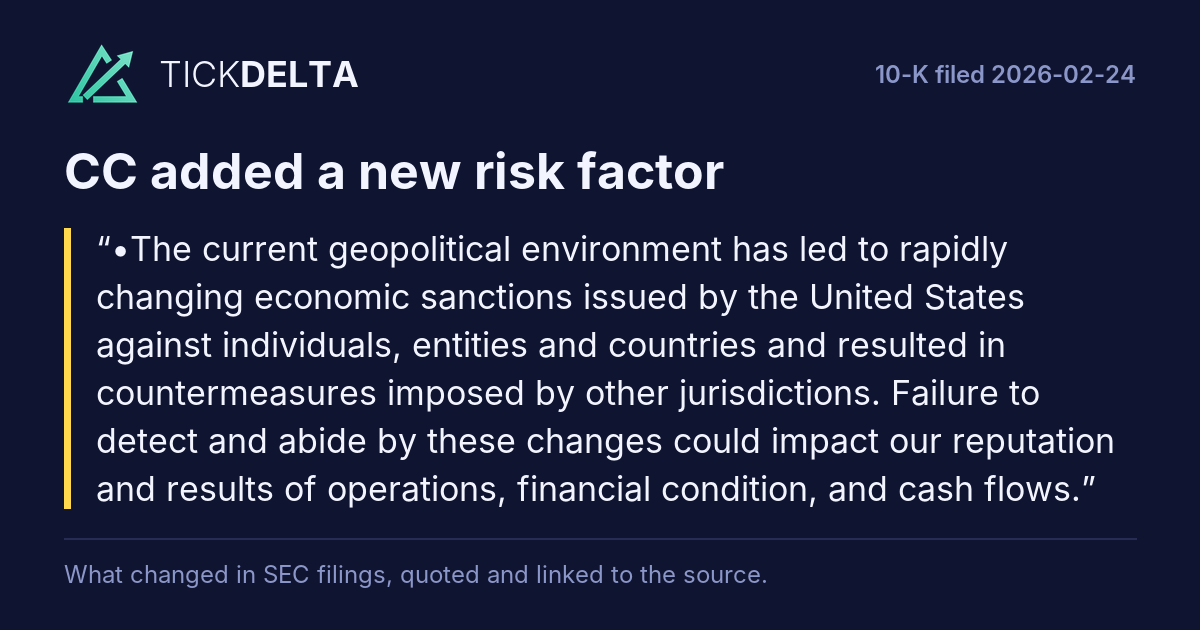
•The current geopolitical environment has led to rapidly changing economic sanctions issued by the United States against individuals, entities and countries and resulted in countermeasures imposed by other jurisdictions. Failure to detect and abide by these changes could impact our reputation and results of operations, financial condition, and cash flows.
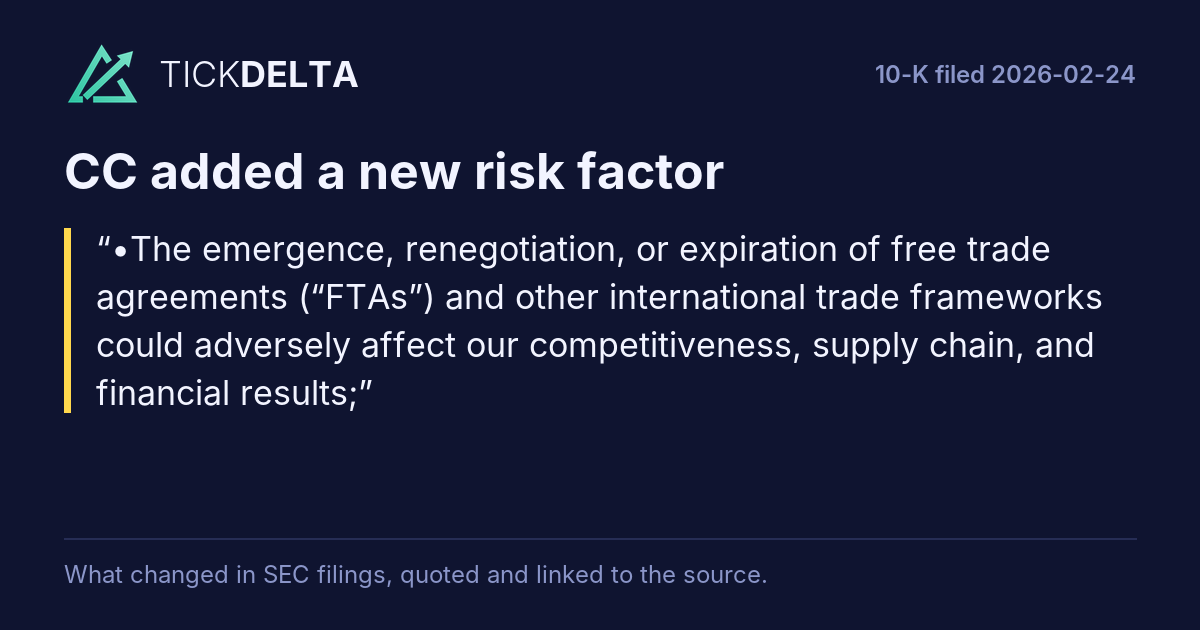
•The emergence, renegotiation, or expiration of free trade agreements (“FTAs”) and other international trade frameworks could adversely affect our competitiveness, supply chain, and financial results;
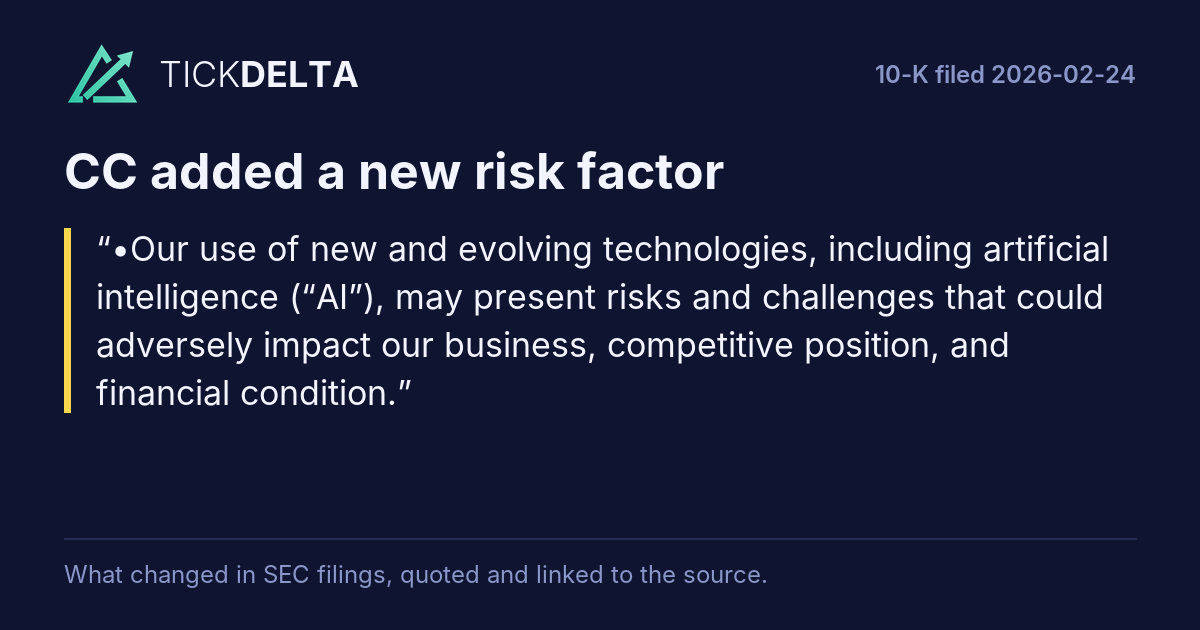
•Our use of new and evolving technologies, including artificial intelligence (“AI”), may present risks and challenges that could adversely impact our business, competitive position, and financial condition.
In March 2024, ECHA published a registration update for trifluoroacetic acid (“TFA”). This update includes a self-classification, by TFA registrants, of a Category 2 Reproductive toxicant. BAuA, the German competent authority responsible for REACH and the CLP regulation in Germany, submitted a dossier to ECHA proposing to harmonize the hazard classification of TFA. In May 2025, ECHA launched a 60-day public consultation period on the CLH proposal for TFA which included updates to its hazard classification for reproductive toxicity, newly proposed as a category 1B, and introduced a PMT/vPvM (Persistent, Mobile and Toxic/very Persistent and very Mobile) classification. The public consultation period concluded and now ECHA’s Risk Assessment Committee ("RAC") is reviewing the dossier submitted by the German authority and the public comments received. RAC will develop an opinion, which should be submitted to the European Commission through the course of 2026. The EU Commission will then review RAC’s opinion and determine whether to proceed with the decision to amend the CLP regulation. If the Commission adopts the decision and amends Annex VI of the CLP Regulation, the changes become legally binding across the EU after a transition period. It should also be noted that there are other regulatory assessments underway from the European Food and Drug Agency ("EFSA") reviewing TFA which could impact timing of the CLH.
In connection with the matters evaluated during the audit committee internal review in 2024, we have received inquiries and information requests from regulatory authorities and may be subject to additional investigations, enforcement actions, or other proceedings. Additionally, private plaintiffs have also initiated litigation, and additional stockholder demands or lawsuits may be filed. In addition, we are aware of additional efforts by private law firms to solicit clients in regard to potential securities class action or derivative litigation. Refer to "Note 22 – Commitments and Contingent Liabilities" to the Consolidated Financial Statements a discussion of these matters.
The current geopolitical environment has led to rapidly changing economic sanctions issued by the United States against individuals, entities and countries and resulted in countermeasures imposed by other jurisdictions. Failure to detect and abide by these changes could impact our reputation and results of operations, financial condition, and cash flows.
The global geopolitical environment remains highly volatile, and economic sanctions imposed by the United States and other jurisdictions continue to evolve with little warning. Sanctions may be expanded, withdrawn, or restructured in response to rapidly shifting diplomatic, security, or economic conditions. Countermeasures taken by foreign governments can further complicate the landscape, creating an unpredictable and fast‑moving set of requirements governing who we may transact with, where we may operate, and how we manage cross‑border financial and commercial activities. This unpredictability increases the risk of inadvertent non‑compliance, which could subject us to regulatory scrutiny, legal penalties, business disruptions, and reputational harm, any of which could adversely affect our results of operations, financial condition, and cash flows.
We actively monitor sanctions developments and have implemented a range of compliance measures designed to reduce the risk associated with these rapidly changing regimes. While these efforts are intended to help us detect and respond to new or amended requirements, no compliance program can fully eliminate the risk of violations given the speed and complexity with which sanctions can be imposed or interpreted. As geopolitical tensions continue to influence global trade and regulatory environments, remaining compliant will require ongoing vigilance and may result in increased operational and administrative costs. Despite our mitigation efforts, failure to keep pace with evolving sanctions could still materially impact our business, reputation, and financial performance.
The emergence, renegotiation, or expiration of FTAs and other international trade frameworks could adversely affect our competitiveness, supply chain, and financial results.
The emergence of new FTAs, the renegotiation of existing FTAs, or the expiration or withdrawal of countries from such frameworks could adversely affect our global competitiveness, supply chain efficiency, and financial performance. Changes in trade terms—such as modified rules of origin, shifts in tariff schedules, new compliance requirements, or uneven enforcement—may alter sourcing economics, disrupt established trade flows, or constrain our ability to optimize production and distribution across regions. These developments could also increase raw‑material or logistics costs, limit market access, or require operational adjustments that may not be fully offset by pricing or mitigation actions. Because these outcomes often arise quickly and vary by jurisdiction, the impact of evolving trade regimes may be difficult to predict and could materially affect our business, results of operations, and cash flows.
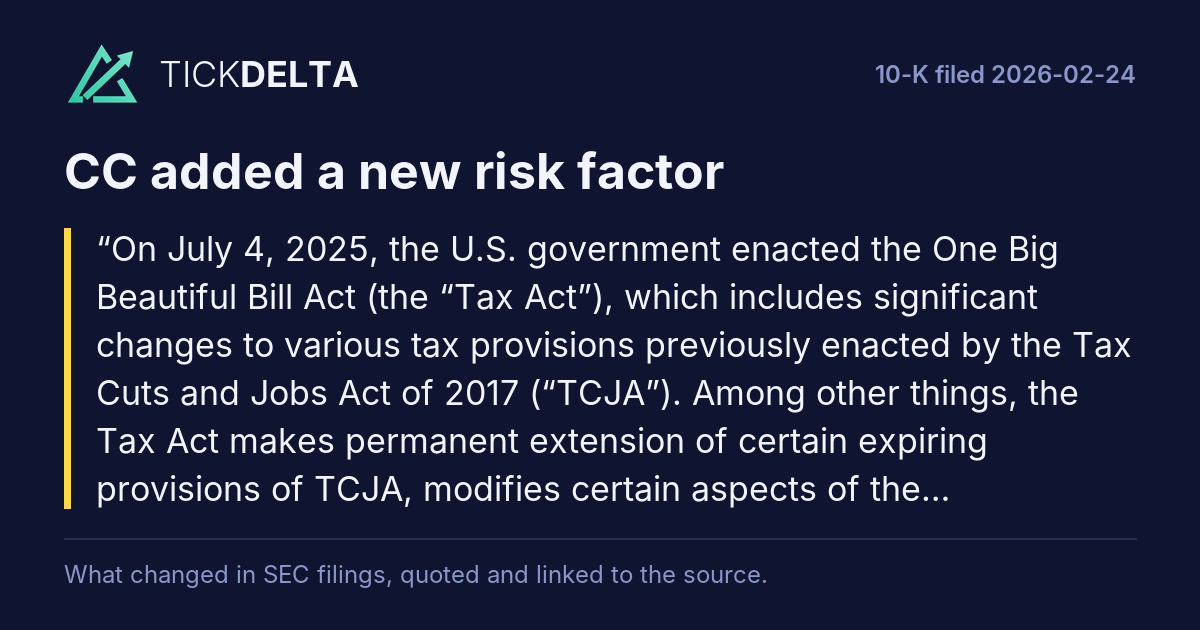
On July 4, 2025, the U.S. government enacted the One Big Beautiful Bill Act (the “Tax Act”), which includes significant changes to various tax provisions previously enacted by the Tax Cuts and Jobs Act of 2017 (“TCJA”). Among other things, the Tax Act makes permanent extension of certain expiring provisions of TCJA, modifies certain aspects of the international tax framework, and restores favorable tax treatment for certain business provisions. While we have incorporated the impacts of provisions with 2025 effective dates into our provision for income taxes for the quarter, we continue to
evaluate the impact of the Tax Act for future tax years, notably with respect to interest expense deductibility and U.S. taxation of earnings by our non-US subsidiaries.
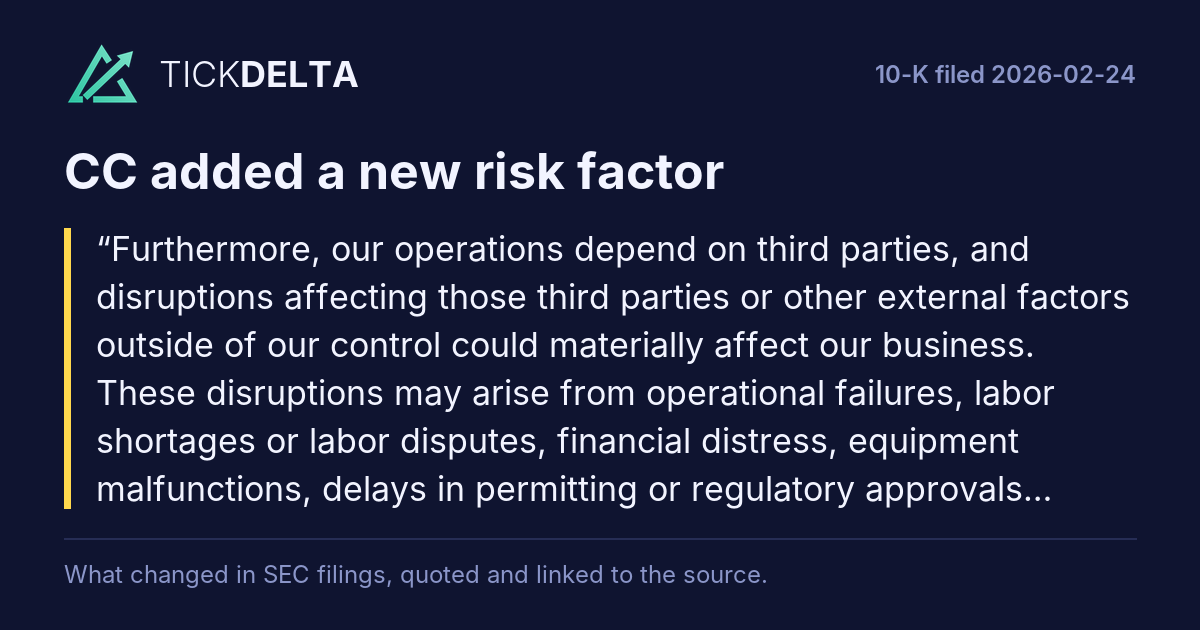
Furthermore, our operations depend on third parties, and disruptions affecting those third parties or other external factors outside of our control could materially affect our business. These disruptions may arise from operational failures, labor shortages or labor disputes, financial distress, equipment malfunctions, delays in permitting or regulatory approvals, constraints in the availability of raw materials or critical inputs, or other events outside of our control. For example, in July 2025, we began experiencing production constraints following a local power outage at our Washington Works, West Virginia site, we identified damage to a critical piece of equipment that resulted in unscheduled downtime into August. Any such third-party failure or delay could interrupt production, delay deliveries of raw materials, increase costs, limit product availability or impair our ability to meet customer demand.
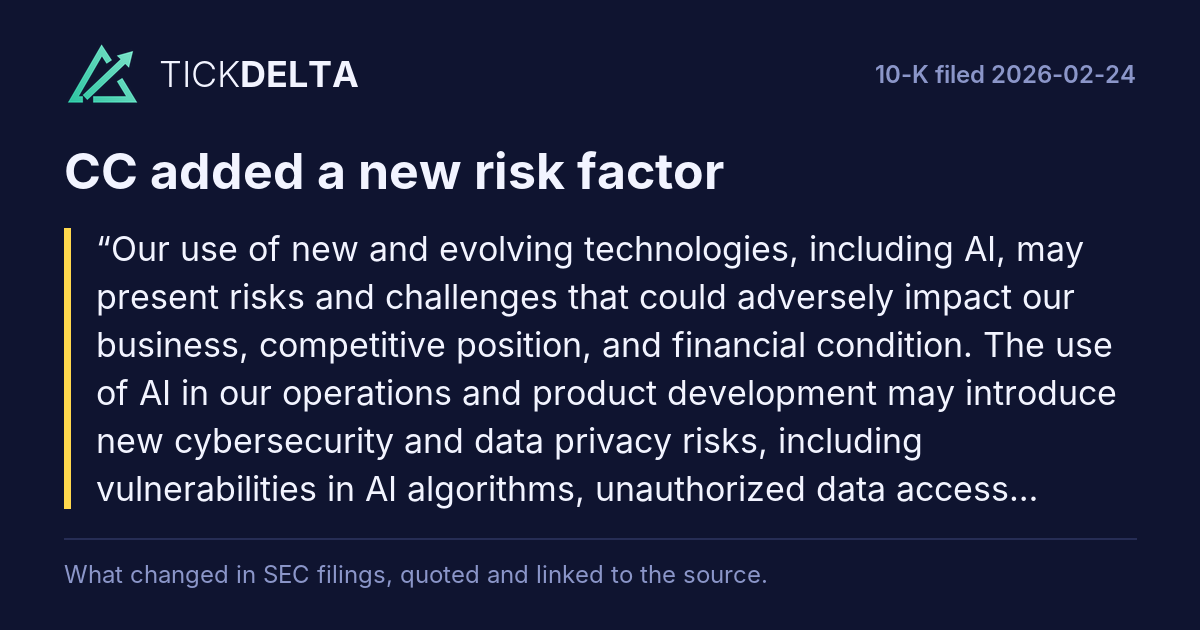
Our use of new and evolving technologies, including AI, may present risks and challenges that could adversely impact our business, competitive position, and financial condition.
The use of AI in our operations and product development may introduce new cybersecurity and data privacy risks, including vulnerabilities in AI algorithms, unauthorized data access, unintended bias in automated decision-making, potential for AI systems to process or generate personal data in ways that violate data privacy regulations, inadvertent exposure of confidential business information or trade secrets, and potential liability for discriminatory outcomes from AI systems. These AI-related risks may be difficult to detect, prevent, or remediate, and could result in regulatory investigations, fines, litigation, reputational damage, and increased compliance costs as well as impact our financial condition and results of operations. In addition, malicious actors may leverage increasingly sophisticated AI-driven techniques to attempt to gain unauthorized access to our networks, compromise personal or confidential information, or misappropriate intellectual property. Any successful attack, misuse, or system failure could result in business disruptions, reputational harm, regulatory scrutiny, litigation, financial losses, or penalties.
The use of AI technologies can give rise to intellectual property risks, including by disclosing or otherwise compromising our confidential or proprietary intellectual property, or by undermining our ability to assert or defend ownership rights in intellectual property created with the assistance of AI tools. Our vendors may also incorporate AI tools into their offerings, and the providers of these AI tools may not meet existing or rapidly evolving regulatory or industry standards, including with respect to privacy and data security.
In addition, the competitive impact of AI remains uncertain and may evolve rapidly. Our competitors may deploy AI technologies more effectively, use AI to improve their operations or products more rapidly, or develop new offerings enabled by AI that could reduce demand for our products or otherwise place us at a competitive disadvantage. There can be no assurance that our use of AI will enhance our business operations, improve efficiency, or otherwise result in anticipated benefits. These risks associated with AI could materially and adversely affect our reputation, business operations, financial condition, and results of operations.
• limiting our flexibility in refinancing and increasing our financing costs in connection with any refinancing of existing indebtedness;
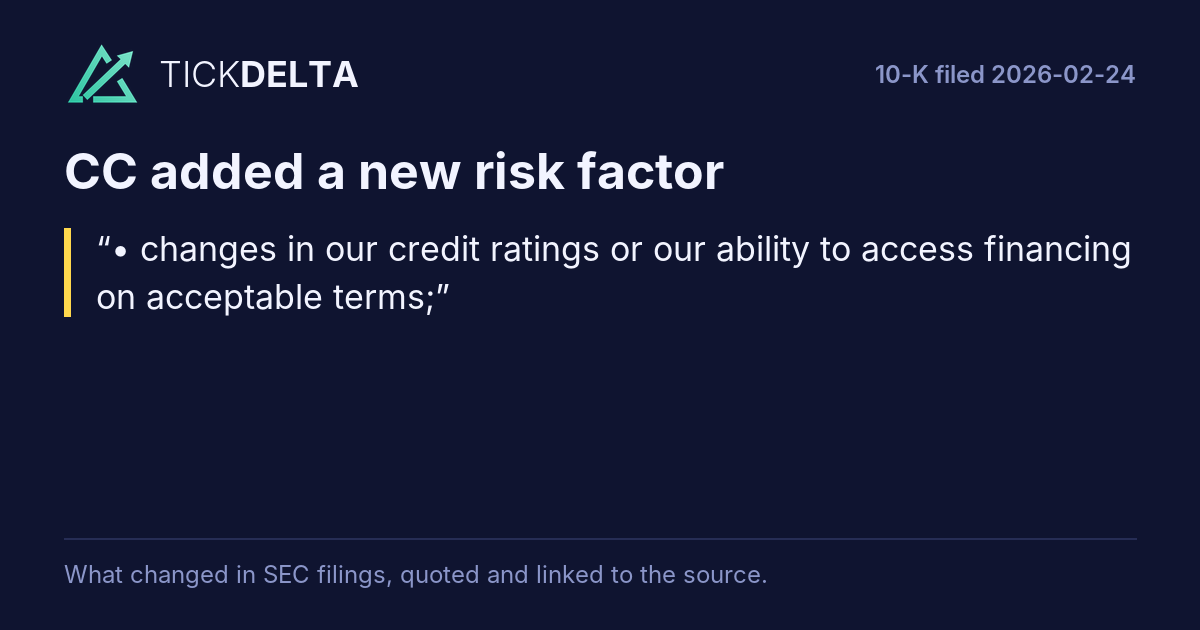
• changes in our credit ratings or our ability to access financing on acceptable terms;
New in the latest 10-Q
20 paragraphs in the 10-Q filed Nov 5, 2026 with nothing like them in the 10-Q filed Aug 5, 2026 (at least half the words must differ; new numbers alone do not count). Quoted exactly, grouped by the item heading above them. This is text that changed, not a judgement of how serious it is.
Three Months Ended September 30, 2026 2025 Pre-tax Tax After-tax Pre-tax Tax After-tax ──────────────────────────────────────────────────────────────────────────────────────────────────────────────────────────────────────────────────────────────────────────────────────────────────────────────────────────────── Net income $ 196 $ 46 Other comprehensive income (loss): Hedging activities: Unrealized gain on net investment hedge $ 12 $ — 12 $ 5 $ (1) 4 Unrealized gain on cash flow hedge 1 — 1 2 — 2 Reclassifications to net income - cash flow hedge — — — 2 — 2 Hedging activities, net 13 — 13 9 (1) 8 Cumulative translation adjustment — — — (1) — (1) Defined benefit plans: Additions to accumulated other comprehensive income (loss): Net gain (loss) 6 (1) 5 2 — 2 Effect of foreign exchange rates — — — — — — Reclassifications to net income: Amortization of actuarial loss — — — 1 — 1 Amortization of prior service gain — — — — — — Settlement (loss) — — — (2) — (2) Defined benefit plans, net $ 6 $ (1) 5 $ 1 $ — 1 Other comprehensive income 18 8 Comprehensive (loss) income 214 54 Less: Comprehensive income attributable to non-controlling interests — — Comprehensive (loss) income attributable to Chemours $ 214 $ 54
Read in the 10-Q
Paid-in Other Comprehensive Shares Amount Shares Amount Capital Earnings (Loss) Income Interests Total Equity Common stock issued - 162,698 — — — — — — — —
Read in the 10-Q
outstanding - basic Dilutive effect of the Company’s employee 578,749 461,349 - -
Read in the 10-Q
Debt Fair Value The following table sets forth the estimated fair values of the Company’s senior debt issues, which are based on quotes received from third-party brokers, and are classified as Level 2 financial instruments in the fair value hierarchy. September 30, 2026 December 31, 2025 Carrying Fair Value Carrying Fair Value
Read in the 10-Q
In September 2026, in connection with agreeing to the North Carolina Settlement as described below, the parties reached certain further understandings concerning the MOU. Pursuant to this, the valuation of the North Carolina Settlement amount and potential future multi-year settlements will be done on a net present value basis for purposes of calculating Qualified Spend, whereby the settlement amount will be applied against the MOU Qualified Spend cap reflecting the net present value spread equally over a twenty-five-year period from the date a settlement becomes final (rather than the actual timing of the payments) and using an 8% discount rate. In addition, all future contributions to the MOU escrow account will be considered satisfied by the companies’ New Jersey and North Carolina settlement payments, including Chemours’ $50 escrow contribution that would have been due in September 2026.
Read in the 10-Q
In October 2026, a personal injury lawsuit was filed in the United States District Court for the Southern District of West Virginia against EIDP, DuPont, Corteva, and the Company. Plaintiff alleges that she is a Leach Class Member as a result of residing in Wood County and working in close proximity to the Washington Works Plant, and ingested drinking water contaminated with PFOA. Plaintiff seeks damages including compensatory damages, past and future medical expenses and punitive damages.
Read in the 10-Q
The agreement was entered into solely by way of compromise and settlement and is not in any way an admission of liability or fault by Chemours or the other parties.
Read in the 10-Q
Also, in Alabama, a purported class action was filed in July 2022 in Alabama federal court by the Utilities Board of Tuskegee on behalf of certain drinking water utilities against 3M, EID, Corteva and the Company alleging contamination of drinking water. The complaints allege negligence, public nuisance, private nuisance and trespass. The plaintiffs seek injunctive relief as well as compensatory and punitive damages.
Read in the 10-Q
In May and August 2026, thirteen of these Alabama Water Authority matters were transferred to the AFFF MDL. In August 2026, one of the state court cases was dismissed (“Frisco City”). One matter is proceeding in federal court (“Loachapoka”) and another matter (“Saraland”) in Alabama state court.
Read in the 10-Q
In August 2026, the JPML created an MDL for cases alleging injury due to PFAS contained in firefighter turnout gear that do not contain allegations related to AFFF. The Non-AFFF Firefighter turnout gear MDL is proceeding in the District of Minnesota. As of October 2026, there are 16 cases in the MDL, including the following:
Read in the 10-Q
In November 2026, Chemours Netherlands B.V. and other entities were served with a writ of summons issued by the PFAS-Free Green Claim Foundation purporting to represent in the proceedings the interests of persons residing in South Holland and certain other municipalities. The Foundation seeks, inter alia, declarations of unlawful conduct and liability in connection with PFAS emission; a phase-out of PFAS emissions or discharges, with associated penalties; and other damages and costs related to personal injury and property claims. The Company is reviewing the summons and no procedural order has been entered in the matter. As this matter is in its early stages and there are significant factual issues still to be reviewed, the Company believes a loss with respect to this matter is only reasonably possible and the Company is unable to develop a reasonable estimate of a possible loss or range of losses, if any, at this time.
Read in the 10-Q
The Company has received letters from two water utilities near the Dordrecht Works site asserting that they have or may suffer damages from PFAS contamination and are seeking to hold the Company liable. The Company has reserved its rights with respect to such claims and is engaging with the utilities to review the basis of such assertions.
Read in the 10-Q
In September 2026, a putative class action was filed in West Virginia federal court against the Company, related to alleged releases of PFAS compounds including PFOA from the Washington Works Local Landfill (“Goff” matter). Plaintiffs are residents and property owners in the nearby Lake Washington subdivision, and allege their respective properties, groundwater, and surface water have been exposed to, affected by, or damaged by the releases from the Local Landfill. Plaintiffs brought counts for negligence, private nuisance, trespass, negligence per se, failure to warn, medical monitoring, strict liability, as well as injunctive relief and punitive damages.
Read in the 10-Q
In September 2026, a proposed class action lawsuit was filed in Vermont federal court on behalf of Shaftsburg and Bennington residents who claim their wells are contaminated with PFOA. The complaint names Saint-Gobain, 3M, EIDP, Chemours, Corteva, Inc. and E.I. DuPont de Nemours as defendants. The complaint asserts 4 classes of Plaintiffs: (1) Property Devaluation and Groundwater Protection Act Class for Drinking Water Contamination; (2) Property Devaluation Class for Soil Contamination; (3) Nuisance; and (4) Medical Monitoring. Plaintiffs assert causes of action for negligence, private nuisance, failure to warn, violation of the Vermont Groundwater Protection Act, and Medical Monitoring.
Read in the 10-Q
In October 2026, a class action was filed in Delaware federal court against the Company and current officers of the Company alleging violations of Sections 10(b) and 20(a) of the Securities Exchange Act of 1934 and SEC Rule 10b-5. The complaint alleges claims on behalf of a proposed class of purchasers of Chemours stock beginning February 20, 2026 and ending August 4, 2026 related to certain statements made during the class period regarding demand for the Company’s Opteon™ products and financial guidance. The complaint seeks compensatory damages and fees. The Company is reviewing the complaint and intends to vigorously defend against the claims.
Read in the 10-Q
In September 2026, the Company, along with EID, Corteva and DuPont entered into a settlement to resolve certain litigations and claims, including the North Carolina NRD matter and 11 local entities relating to PFAS and other historical discharges from Fayetteville Works, as well as the State’s claims of PFAS contamination unrelated to that site, including from the use of AFFF (the “North Carolina Settlement”). This settlement includes resolution of three of the four lawsuits referenced above that were filed by public water suppliers, as well as resolving the Cumberland County matter. Overall settlement payments total $455 over 15 years. In addition, the North Carolina Settlement acknowledges that certain obligations under the 2019 Consent Order have been completed and establishes procedures to resolve certain remaining obligations relating to off-site areas, including implementation of drinking water programs. As of September 30, 2026, the Company has legal reserves recorded of $205, which reflects both the net present value of the Company's North Carolina Settlement obligation, as well as the settlement in principle to resolve the actions encompassing approximately 2,900 private well owners described above. $113 is recorded as current accrued litigation and $92 as long-term accrued litigation as of September 30, 2026. The Company made its first annual North Carolina Settlement payment in October 2026 for $51.
Read in the 10-Q
In June 2026, the Company received an inquiry from the ILT concerning the methodology and data used in its 2022 HFC‑23 F‑Gas reporting. A subsequent internal review identified discrepancies in certain reported data. The Company is preparing a voluntary corrective submission to the regulator and, in parallel, ILT has notified the Company that it intends to conduct an inspection relating to the matter. Furthermore, ILT has requested information about reported purchases from 2021, 2022 and 2023. In October 2026, the European Commission also sent a compliance letter to the Company asserting that, based on its 2021 and 2022 reporting year corrections sent to the Dutch competent authorities, a quota exceedance occurred in those years making it subject to a reduced quota allocation in 2028 onwards and penalties. The eventual impact is not known yet and the matter remains under regulatory review. Based on the status of this inquiry and ongoing review, the Company does not consider any possible loss estimable as of September 30, 2026.
Read in the 10-Q
On September 1, 2026, the Company designated all foreign currency borrowings as a net investment hedge of the Company's foreign currency exchange rate exposure of the net investments of certain of its euro-denominated subsidiaries.
Read in the 10-Q
On September 1, 2026, the Company designated all foreign currency borrowings as a net investment hedge of the Company's foreign currency exchange rate exposure of the net investments of certain of its euro-denominated subsidiaries.
Read in the 10-Q
There were no share repurchases during the three months ended September 30, 2026.
Read in the 10-Q
Item 1A of the 10-Q filed Nov 5, 2026 against Item 1A of the 10-K filed Feb 24, 2026.
A 10-Q repeats only the risks that changed, so a 10-K paragraph that is missing from it is not counted as removed.
Added is a paragraph with nothing like it in the 10-K, Reworded a sentence that is in both with several words changed,
Quiet changes a sentence in both where one to four words changed and one is a hedge or a modal
(cut words struck through, new words highlighted).
Text on the page, not a score; each links to the filing at sec.gov.
What the 10-Q itself says about its risk factors:Except for the updated risk factor set forth below, there have been no material changes to the risk factors disclosed in our Annual Report on Form 10-K for the year ended December 31, 2025.
Read in the 10-Q
Two-word phrases in Risk Factors of the 10-K filed Feb 24, 2026 that are in none of the 1 earlier 10-Ks stored, back to Feb 18, 2025
Used at least twice, small words left out. Counted, not picked: a phrase can be new because the company renamed something.
12 paragraphs of last year's Risk Factors with nothing like them now. The longest are quoted.
Item 1A of each 10-K and 10-Q on EDGAR, quoted exactly. Each paragraph links to the filing at sec.gov.
10-K change: what was reworded or cut, section by section.
Excel workbook · CSV. Google Sheet that stays up to date: paste =IMPORTDATA("https://tickdelta.com/company/CC/export.csv") into a cell.