Screener / SEC EDGAR /CIK 0001341766 /10-K filed Mar 2, 2026, compared with Mar 3, 2025 /Numbers from the XBRL of the 10-Ks
Nasdaq Consumer staples · Soft Drinks

Celsius Holdings, Inc. CELH

Compare with peers Embed
SEC comment letters, last 20 years

5 reviews of CELH's filings by SEC staff

UPLOAD and CORRESP
Reviews 5 latest letter Jun 17, 2024
Questions asked 64 each answered in the company's own letter
No closing letter 0 reviews without a letter saying the staff completed it

When the SEC's staff reviews a filing, it writes to the company with numbered questions, and the company answers each one in a letter. SEC publishes the exchange once the review is over, at least 20 business days later. A question is not an accusation; most reviews end with the company adding detail to its next filing.

How the reviews went

Every review on EDGAR, from the first staff letter to the letter that closes it

  1. 1. Staff letters 13 UPLOAD
  2. 2. Questions in them 64 numbered comments
  3. 3. Company replies 12 CORRESP
  4. 4. Reviews closed 5 of 5 closing letter

Half the closed reviews took 55 days or less from the first letter to the closing letter.

Form 10-K for the Year Ended December 31, 2023

2024-06-17 to 2024-08-21 · 2 questions · 2 letters from the SEC, 2 from the company
Review closed 2024-08-21
Liquidity and cashRevenueNon-GAAP measures
Consolidated Financial Statements
SEC asked
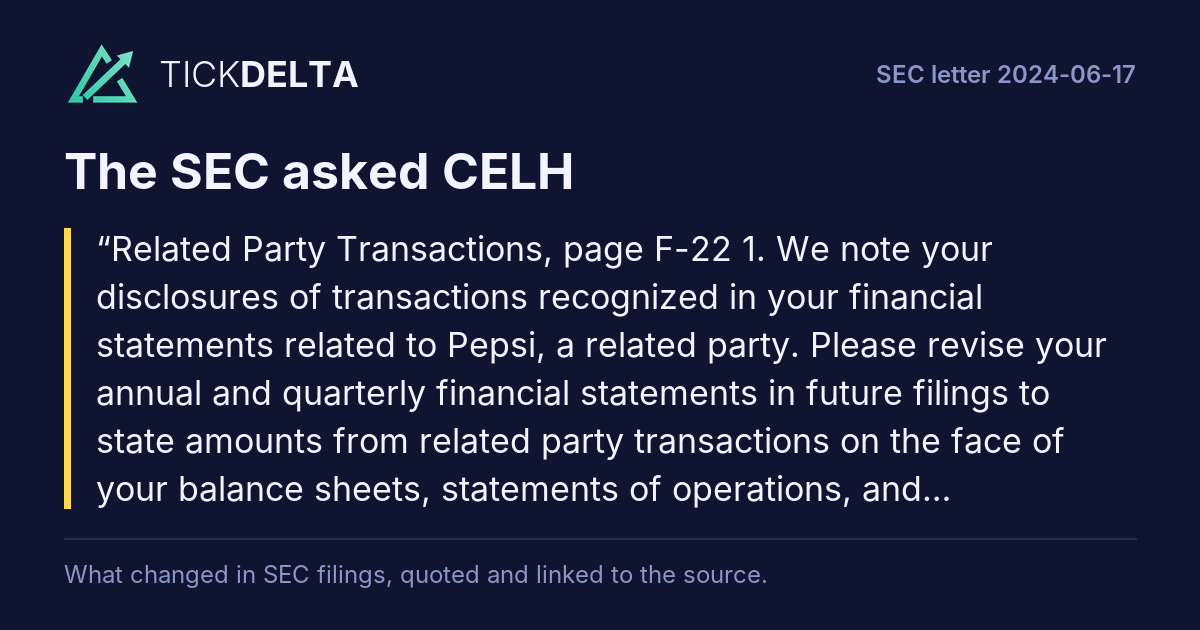
Related Party Transactions, page F-22 1. We note your disclosures of transactions recognized in your financial statements related to Pepsi, a related party. Please revise your annual and quarterly financial statements in future filings to state amounts from related party transactions on the face of your balance sheets, statements of operations, and statements of cash flows as required by Rule 4-08(k) of Regulation
Rest of the question

S-X. 2. We note your disclosures regarding the agreements you entered into with Pepsi during 2022. Please more fully explain the terms of the agreements and the basis for your accounting for the agreements. Please specifically address the following: • Tell us the contractual terms of the agreements, including the existence and nature of potential renewal options. • Explain any facts and circumstances under which the agreements can be terminated by either party, including the potential consequences in the event the agreements are terminated. • Explain how product pricing and other material terms under the agreements are determined, including when and how often pricing terms are negotiated. • Tell us the terms and conditions related to the amounts you received from Pepsi to reimburse you for the termination of former distribution agreements, including any provision that would require you to repay the amount in the event the agreements with Pepsi were terminated. • Tell us how you determined the estimated fair value of the series A preferred stock you issued to Pepsi in 2022. • Explain how you determined the appropriate accounting for the series A preferred stock you issued, including why you issued the series A preferred stock at less than estimated fair value, what the asset you recorded for the excess fair value over the issuance proceeds actually represents, and why the series A preferred stock is recorded at an amount in excess of its redemption value. Exhibit 99.1 Reconciliation of Non-GAAP Financial Measures 3. We note your calculation of Adjusted EBITDA excludes contract termination costs associated with certain former distributors to facilitate your migration to Pepsi’s system. We also note you received funds from Pepsi to reimburse you for these costs that you recorded as deferred revenue. Please explain to us why you believe it is appropriate to include a non-GAAP adjustment to exclude contract termination costs from Adjusted EBITDA but not exclude the impact of the related reimbursement from Pepsi. In your response, discuss your consideration of the guidance in Question 100.02 of the Division of Corporation Finance’s Compliance & Disclosure Interpretations on Non-GAAP Financial Measures.

CELH answered
We acknowledge the importance of transparent disclosure of related party matters and respectfully advise the Staff that when preparing our financial statements, we reviewed and considered the applicability of Rule 4-08(k) of Regulation S-X, which provides that certain financial information with respect to related party transactions should be set forth on the face of the appropriate financial statements.
Rest of the answer

Within the notes to our consolidated financial statements in the Form 10-K, we included related party information in note 13 to the consolidated financial statements, captioned “Related Party Transactions”. Therein, we identified transactions entered into with related parties and their respective impacts on our consolidated balance sheets, consolidated statements of operations and comprehensive income and consolidated statements of cash flows. In addition, we have included specific disclosures associated with Pepsi in other sections, as applicable, such as in note 2 to the consolidated financial statements, captioned “Concentrations of Risk”. Consequently, we believe that we have provided transparent and clear disclosure of our related party transactions and their impact upon our consolidated financial position, results of operations and cash flows.

We believe that including more specific disclosure of our transactions with Pepsi (particularly specific dollar amounts) on the face of our financial statements would provide our competitors with critical, competitively sensitive information regarding our margins and the profitability of our relationship with Pepsi, which would result in competitive harm to the Company. We are concerned that our other customers and potential customers will use this information to our detriment in their negotiations with us, which would similarly result in competitive harm. Due to the commercially and competitively sensitive nature of information pertaining to our distributor relationship with Pepsi, we respectfully submit to the Staff that we believe that our current approach to related party disclosure is consistent with Rule 4-08(k), as well as with Section 552(b)(4) of the Freedom of Information Act, 5 U.S.C.A. § 552(b)(4) (1976) and the parallel Commission regulation, 17 C.F.R. § 200.80(b)(4) (1976), which exempt from public disclosure “trade secrets and commercial or financial information obtained from a person [that is] privileged or confidential.”

In addition to the competitive harm that would result from such additional disclosures, the transactions with Pepsi disclosed in note 13 to the consolidated financial statements impact several financial statement line items. We believe that including additional lines items within the face of our financial statements regarding the impact of all related party transactions would not provide useful information to investors but would instead add undue complexity to our financial statements that may result in potential confusion to readers of our financial statements. Additionally, we believe that the need to then also revise prior period financial statements for comparability would be unduly burdensome in comparison to the benefits derived by the readers of our financial statements.

Also, while we acknowledge that the practices of other public companies in applying the U.S. Securities and Exchange Commission’s rules and regulations do not control the Staff’s position in any particular issue of interpretation, we believe that the practices of other public companies may be instructive and perhaps persuasive in our circumstances. As we determined the appropriate presentation of related party transactions in our financial statements, we reviewed recent public filings of other entities with similar business operations and revenues from related parties, noting that these reporting companies did not include related party information on the face of their respective financial statements but rather within the notes to the financial statements as we did in the Form 10-K. Monster Beverage Corporation (“Monster”) is one such example given the ownership interest in Monster by The Coca-Cola Company and given that many investors consider that relationship similar to our relationship with Pepsi. We strongly believe that the commercially sensitive nature of such information and harm to be caused by the disclosure thereof, as well as the potential for confusion by more complex financial statements and the burden imposed thereby are likely the reasons other public companies utilize a method of related party disclosures similar to ours.

2. We note your disclosures regarding the agreements you entered into with Pepsi during 2022. Please more fully explain the terms of the agreements and the basis for your accounting for the agreements. Please specifically address the following:

•Tell us the contractual terms of the agreements, including the existence and nature of potential renewal options.

Response:

We respectfully direct the Staff’s attention to note 4 to the consolidated financial statements “Revenue”, which details the Distribution Agreement with Pepsi, effective from August 1, 2022. As disclosed in such note, the Distribution Agreement provides the terms and conditions for us to sell our products to Pepsi and authorizes Pepsi to sell and distribute our existing and future beverage products in the defined territories within the United States. Additionally, the Distribution Agreement has provisions for termination without cause and without penalty by either party in the nineteenth year (2041), in the twenty-ninth year (2051), and at the end of every subsequent ten-year period thereafter by providing 12 months’ notice. While the Distribution Agreement does not explicitly outline traditional renewal terms, it is structured to allow for ongoing engagement without fixed end dates, subject to its termination provisions.

As further discussed in notes 4 and 13 to the consolidated financial statements, in conjunction with the Distribution Agreement, the Transition Agreement with Pepsi addressed the termination of previous distributor contracts, which contracts included standard industry termination penalties. Pepsi agreed to reimburse the Company up to $250 million for these termination expenses. Amounts received from Pepsi as reimbursement for termination expenses were measured at the amount of consideration received by the distributor and accounted for as a liability and classified as deferred revenue, which are recognized ratably over the twenty-year term of the Distribution Agreement as credits to revenue. The total termination costs for which Pepsi reimbursed us (net of unused proceeds returned to Pepsi) was approximately $193 million.

The Securities Purchase Agreement, which we entered into with Pepsi concurrently with the Distribution Agreement and the Transition Agreement, provided for Pepsi's acquisition of approximately 1.5 million shares of the Company’s Series A Convertible Preferred Stock (“Series A Shares”), convertible into common stock on specified terms. This agreement includes specific rights and restrictions, such as non-transferability clauses, the right for Pepsi to nominate a board member, and provisions detailing conditions under which the preferred stock could be redeemed or converted. These terms align the long-term interests of both parties and provide a framework for Pepsi's active participation in our corporate governance. As further discussed below, the Series A Shares are classified outside of permanent equity and presented in the mezzanine section of our balance sheet. The excess of the fair value over the issuance proceeds of the Series A Shares was recorded as a debit to Deferred Other Costs (which is an asset on the Company’s consolidated balance sheets). These Deferred Other Costs are being amortized ratably over the twenty-year term of the Distribution Agreement as a reduction (debit) to revenue.

•Explain any facts and circumstances under which the agreements can be terminated by either party, including the potential consequences in the event the agreements are terminated.

Response:

As outlined in note 4 to the consolidated financial statements and Part I, Item 1 “Business” of the Form 10-K, the Distribution Agreement with Pepsi allows for termination by either party without cause at the end of the nineteenth year (2041), the twenty-ninth year (2051), and at the end of every subsequent ten-year interval thereafter, by providing 12 months’ notice. Additionally, either party to the Distribution Agreement may terminate the agreement with “cause” (including by Pepsi if the Company undergoes a change of control involving a competitor). “Cause” includes customary terms, such as insolvency of the other party, cessation of material parts of the other party’s beverage business, and material breach of the Distribution Agreement. Also, the Company and Pepsi may terminate the Distribution Agreement in connection with the execution by the Company of a binding written agreement to consummate a change of control. Except for a termination by the Company with cause or a termination by Pepsi without cause, the Company is required to pay Pepsi certain compensation upon a termination as specified in the Distribution Agreement. The effect of these termination fees would likely be material to our financial statements and would be recorded as a selling, general and administrative expense upon termination of the Distribution Agreement.

As disclosed in note 2 to the consolidated financial statements “Concentrations of Credit Risk”, Pepsi accounted for 59.4% of our revenue for the year ended December 31, 2023 and 69.0% of our accounts receivable at December 31, 2023, illustrating the substantial dependence we have on this relationship for our sales and cash flow. The loss of this primary distributor would necessitate seeking new distribution channels or partnerships to replace the extensive network provided by Pepsi, which could disrupt our operations and potentially lead to a significant short-term decline in sales and operational efficiencies. As disclosed in Part I, Item 1A “Risk Factors” of the 10-K, we caution investors that “[w]e have extensive commercial arrangements with Pepsi and, as a result, significant disagreements with Pepsi or a termination of these arrangements could materially adversely impact our financial position and results of operations.” In addition, we discuss such risks in Part II, Item 7 “Management’s Discussion and Analysis of Financial Condition and Results of Operations” to the Form 10-K, including, among other things, the fact that “[a]ny disruption in Pepsi’s operations, shifts in their strategic focus, reduction in service levels or support for our products, or changes in the terms of our partnership could directly impact our sales performance and revenue streams. This dependency also extends to accounts receivable, where a significant portion of our receivables is tied to Pepsi. Delays or defaults in these receivables could adversely affect our cash flow and financial planning.”

•Explain how product pricing and other material terms under the agreements are determined, including when and how often pricing terms are negotiated.

Response:

The Distribution Agreement with Pepsi provides specific guidelines and parameters around terms of the sales of our goods to Pepsi, as well as for sales to third parties. These terms include the prices Pepsi must pay Celsius for products that Pepsi resells to Pepsi’s customers (i.e., a distributor wholesale price) and the pricing principles for product sales to end customers. In addition, the agreement incorporates quarterly and annual reviews, as well as evaluation procedures associated with pricing parameters on a go-forward basis. The agreement is structured to ensure that we meet our strategic objectives of achieving efficient distribution of Celsius products and support Pepsi’s ability to execute its customer sales effectively at the retail level.

We and Pepsi review our relationship, including terms of the Distribution Agreement, periodically but at least quarterly. We develop an annual joint business plan projecting results that we hope to achieve in the coming year and engage in annual and quarterly business reviews to determine the performance of the relationship. Mechanisms exist for both the Company and Pepsi to evaluate adjusting pricing during the year, but at least once annually. In addition, our teams perform quarterly updates, and we work together as a part of the joint business planning process to formalize alignment on promotional calendars, incentive programs, promotional strategies and other activities to drive growth of our business.

The specific pricing models and information with respect to our agreement with Pepsi constitute commercially sensitive information that we customarily and actually treat as confidential. We further believe that this information is exempt from public disclosure under Section 552(b)(4) of the Freedom of Information Act, 5 U.S.C.A. § 552(b)(4) (1976), and the parallel Commission regulation, 17 C.F.R. § 200.80(b)(4) (1976), as “trade secrets and commercial or financial information obtained from a person [that is] privileged or confidential.”

•Tell us the terms and conditions related to the amounts you received from Pepsi to reimburse you for the termination of former distribution agreements, including any provision that would require you to repay the amount in the event the agreements with Pepsi were terminated.

Response:

As disclosed in note 4 to the consolidated financial statements, under the Transition Agreement, Pepsi agreed to pay us up to $250 million to facilitate the transition of distribution rights to Pepsi from prior distributors, which the Distribution Agreement required that we terminate. Amounts received from Pepsi were contractually restricted to only be used to pay termination fees due to former distributors; any excess cash received over amounts due to other distributors was required to be refunded back to Pepsi. We refunded any excess amounts to Pepsi as of December 31, 2023. If the Distribution Agreement had been terminated prior to us terminating agreements with prior distributors, any unutilized portion of these funds would have been required to be refunded to Pepsi. Although there were specific provisions that would have required repayment of the termination costs, as of December 31, 2023, we no longer had, and do not currently have, any exposure to Pepsi with respect to any of these amounts, including in the event either party had terminated as of such date, or does terminate, any of our current agreements with Pepsi. Total net payments received from Pepsi for distributor termination costs amounted to $193 million, have been recorded as deferred revenue, and are being amortized ratably as a credit to revenue over the twenty-year term of the Distribution Agreement.

•Tell us how you determined the estimated fair value of the series A preferred stock you issued to Pepsi in 2022.

Response:

The Series A Shares are classified in mezzanine equity, see note 14 to the consolidated financial statements, “Mezzanine Equity”, and the valuation of the Series A Shares represents a non-recurring fair value measurement. We determined the fair value of the 1,466,666 Series A Shares issued to Pepsi on August 1, 2022 using a valuation model developed with the assistance of a third-party consultant engaged for this purpose. As disclosed in note 16 to the consolidated financial statements, “Fair Value Measurements”, we used a Monte Carlo simulation model to determine the fair value of the Series A Shares as of August 1, 2022. The Monte Carlo simulation utilized multiple input variables to determine the value of the Series A Shares, including:

◦A volatility rate of 45%, which was based on the trading performances of the Company’s and a certain peer group’s common stock;

◦A risk free interest rate of 2.69%, which was based on the US STRIPS Rate with a corresponding term as of the issuance date;

◦A dividend rate of 5.0%, which is consistent with the provisions of the Series A Shares and with the Company’s past payments made in cash;

◦The closing price of the Company’s common stock on the issuance date of $98.87 per share;

◦A debt discount rate of 12.5%, which was based on estimated credit analysis and corresponding market yields as of the issuance date; and

◦A discount for lack of marketability attributed to the unregistered nature of the underlying stock and the time required to register such stock. The Company applied a nominal discount for lack of marketability with respect to the unregistered nature of the underlying shares.

The model was specifically chosen for its ability to integrate critical assumptions that reflected both the Company’s strategic positioning and the broader market dynamics that would be in place following the effectiveness of our agreements with Pepsi.

•Explain how you determined the appropriate accounting for the series A preferred stock you issued, including why you issued the series A preferred stock at less than estimated fair value, what the asset you recorded for the excess fair value over the issuance proceeds actually represents, and why the series A preferred stock is recorded at an amount in excess of its redemption value.

Response:

The accounting for the Series A Shares was guided by FASB ASC Topic 505 Equity, FASB ASC Topic 815 Derivatives and Hedging, ASC Topic 480 Distinguishing Liabilities from Equity, and ASC 480-10-S99-3A, SEC Staff Announcement: Classification and Measurement of Redeemable Securities, among other applicable accounting standards to determine their appropriate classification and measurement. The Series A Shares are redeemable only upon the exercise of a holder or issuer redemption right (or a change in control). Accordingly, the redemption of Series A Preferred Stock is not unconditional and not considered to be mandatorily redeemable under ASC 480. Additionally, the Series A Shares settle on a fixed number of common shares (similar to equity), instead of on a fixed or determinable dollar amount (similar to debt). As a result, the Series A Shares were classified as temporary equity. Management also evaluated the economic characteristics of the terms and features (e.g., conversion and redemption rights, dividends, etc.) of the contract for debt-like attributes and concluded that the host is more akin to equity. Therefore, it was determined that embedded features, like those discussed in note 14 to the consolidated financial statements captioned “Mezzanine Equity”, are clearly and closely related and not required to be bifurcated, under ASC 815-15-25.

The excess of the Series A Shares’ fair value over the proceeds received by the Company ($282.5 million) was recorded as a deferred other cost, and is being amortized over the twenty-year term of the Distribution Agreement, which reflects our strategy to align the costs associated with the issuance directly with the benefits expected from the Distribution Agreement over its term. Since we expect the excess amount to be recovered through anticipated purchase orders issued by Pepsi, we concluded that the excess amount meets the definition of an asset under FASB Concepts Statement 6, defined as “probable future economic benefits obtained or controlled by a particular entity as a result of past transactions or events”.

The Series A Shares are redeemable in the event of a change in control as defined in the Certificate of Designation for the Series A Shares. ASC 480-10-S99-3A requires preferred securities that are redeemable for cash or other assets to be classified outside of permanent equity if they are redeemable (i) at a fixed or determinable price on a fixed or determinable date, (ii) at the option of the holder, or (iii) upon the occurrence of an event that is not solely within the control of the issuer. Preferred securities that are mandatorily redeemable are required to be classified by the issuer as liabilities whereas under ASC 480-10-S99-3A, an issuer should classify a preferred security whose redemption is contingent on an event not entirely in control of the issuer as mezzanine (or temporary) equity. The Series A Shares are not “mandatorily redeemable,” and because a change in control is an event that is “not solely within the control of” the Company, we concluded that the Series A Shares should be classified as mezzanine equity in our consolidated balance sheets and statement of changes in stockholders’ equity and mezzanine equity, as of and for the years ended December 31, 2022 and 2023.

Upon initial recognition, the Series A Shares were measured at their fair value at issuance, net of issuance costs (the “initial carrying value”), without subsequent accretion. The Series A Shares are neither currently redeemable nor is it probable they will become redeemable in the future. Therefore, the Series A Shares were not required to be remeasured and have continued to be carried at the initial carrying value subsequent to the issuance of such shares. We continue to monitor the Series A Shares closely for any changes in conditions that might affect their accounting treatment and carrying value.

The Company evaluated the Security Purchase Agreement, Transition Agreement, Distribution Agreement, and other agreements executed with Pepsi on August 1, 2022, as one combined contract because the agreements were executed on the same day, with the same counterparty, and in contemplation of one another, and the contractual terms are defined and referenced across all of the agreements. These agreements are collectively referred to as the “Pepsi Arrangement” herein. Management concluded the Pepsi Arrangement was partially within the scope of each of ASC 606 Revenue from Contracts with Customers ("ASC 606”), ASC 505, Equity ("ASC 505”), and ASC 480, Distinguishing liabilities from equity ("ASC 480”). The Company first applied the measurement and classification criteria in ASC 505 and ASC 480 with respect to the Company’s issuance of the Series A Shares, as the substance of the issuance of the Series A Shares was determined to be a financing transaction.

After application of the measurement and classification principles in ASC 505 and ASC 480 to the Pepsi Arrangement, the Company accounted for the residual revenue elements of the Pepsi Arrangement under ASC 606. The revenue elements of the Pepsi Arrangement consisted of (i) $227.8 million in payments initially received from Pepsi under the Transition Agreement (or net payments of approximately $193 million after reimbursing Pepsi for unused proceeds) and (ii) a $282.5 million implicit payment made to Pepsi by Celsius, representing the excess fair value over issuance proceeds received for the Series A Shares.

The $282.5 million excess fair value over issuance proceeds of the Series A Shares represents an implicit upfront payment made to a customer. The Company concluded that this payment meets the definition of an asset and has been recorded as a current and non-current Deferred Other Cost in the Company’s consolidated balance sheet. The Company is amortizing this asset balance as a debit to revenue (contra-revenue) ratably over a twenty-year period consistent with the terms of the Distribution Agreement.

The issuance of the Series A Shares at a discount, and the related recording of an asset for the excess fair value over the issuance proceeds, represented our strategic decision to solidify and enhance our partnership with Pepsi. By aligning Pepsi’s interests with those of the Company through equity participation, we believe that we strengthened Pepsi’s commitment to our mutual goals, including distribution success and market penetration, and the issuance of the shares at a discount incentivized Pepsi for sustained collaboration. Additionally, the discount reflected a strategic exchange for access to Pepsi’s extensive resources, including its vast distribution network and established customer relationships, which represent substantial economic benefits that justified the discount. This was further designed to foster long-term value creation for our stockholders by positioning the Company for sustained growth and success in a competitive marketplace. We believe that the strategic benefits derived from the Pepsi Arrangement - enhanced partnership alignment, incentivized collaboration, and access to critical resources - outweigh the impact of the discount on the Series A Shares, supporting our objectives of long-term value creation.

Form 8-K filed February 29, 2024

Exhibit 99.1

Reconciliation of Non-GAAP Financial Measures

3. We note your calculation of Adjusted EBITDA excludes contract termination costs associated with certain former distributors to facilitate your migration to Pepsi’s system. We also note you received funds from Pepsi to reimburse you for these costs that you recorded as deferred revenue. Please explain to us why you believe it is appropriate to include a non-GAAP adjustment to exclude contract termination costs from Adjusted EBITDA but not exclude the impact of the related reimbursement from Pepsi. In your response, discuss your consideration of the guidance in Question 100.02 of the Division of Corporation Finance’s Compliance & Disclosure Interpretations on Non-GAAP Financial Measures.

Response:

We respectfully acknowledge the Staff’s comment and confirm that we have considered the guidance contained in the Staff’s Non-GAAP Financial Measures Compliance and Disclosure Interpretations. The Non-GAAP Adjusted EBITDA amount adjusts for identified distributor termination fees within the reconciliations presented for the years ended December 2023 and 2022, as well as for the three months ended December 2023 and 2022. These specific termination fees were associated with several agreements that we entered into with Pepsi (i.e., the Pepsi Arrangement described in response to comment 2 above) that transformed our business and allowed us to enter into an arrangement with one of the preeminent supply and distribution businesses in the world. This transformation required that we terminate a majority of our then existing distribution system and, as a result, we deemed the Transition Agreement with Pepsi as well as the ensuing costs associated with this transformative event to be non-recurring and infrequent. As the termination fees associated with the Pepsi Arrangement represented material, short-term, non-recurring costs that we necessarily and immediately expensed in accordance with GAAP, we believe that it was appropriate to itemize and exclude these costs from Adjusted EBITDA and we believe this enhances investors’ understanding of our core operating performance.

With respect to the two items that we capitalized to the balance sheet (the deferred revenue recorded as both a short term and long term liability in the aggregate amount of $193.0 million, as well as deferred other costs recorded as both a short term and long term asset in the aggregate amount of $282.5 million), these items, when viewed on a quarterly or annual basis, represent small recurring amounts being amortized to revenue each quarter over the twenty-year term of the Distribution Agreement. The quarterly and annual amortization amounts of $1.1 million and $4.4 million, respectively, in the aggregate are immaterial and we therefore believe that reflecting adjustments for them in Adjusted EBITDA on a quarterly basis for twenty years would not be helpful to the readers of our financial statements. As required by GAAP, the deferred revenue is amortized as a credit to revenue while the deferred other costs are amortized as an offset (debit) to revenue, in each case over the twenty-year life of the Distribution Agreement. On a net basis, these entries result in a GAAP entry that reduces revenue by approximately $1.1 million per quarter or approximately $4.4 million per year. If we included the net amortization of each of these on a quarterly basis, then we would have a $1.1 million dollar add-back (increase to Non-GAAP Adjusted EBITDA) for twenty years to include in the schedule each quarter. As these items are immaterial in nature, and recur on a quarterly basis for twenty years, we believe that including these amortized amounts in our Adjusted EBITDA, while favorably impacting the result, would not be helpful to an investor’s understanding of our operating performance.

Read in the reply
In its next report

First report after the company's reply of Jul 5, 2024: 10-Q filed Aug 6, 2024 ↗, against the 10-Q filed May 7, 2024 ↗.

Tickdelta does not hold the text of both reports, so they are not compared here.
Consolidated Financial Statements
SEC asked
Related Party Transactions, page F-22 1. We have considered your response to prior comment 1; however, Rule 4-08(k)(1), Rule 502 and Rule 5-03 of Regulation S-X require related party transactions to be stated on the face of balance sheets, statements of operations, and statements of cash flows, in addition to related party and concentration of risk disclosures required to be provided in the notes to the financial
Rest of the question

statements under GAAP. It is not clear to us that stating amounts from related party transactions on the face of your financial statements would cause competitive harm and we do not believe the potential of competitive harm is sufficient to allow non-compliance with disclosure requirements in Regulation S-X. Please revise your financial statements in future annual and quarterly filings to comply with the above referenced disclosure requirements.

CELH answered
We respectfully acknowledge the Staff’s comment and the provisions of Rule 4-08(k)(1), Rule 5-02 and Rule 5-03 of Regulation S-X to present related party transactions on the face of the balance sheets, statements of operations and comprehensive income, and statements of cash flows. Accordingly, beginning with our Quarterly Report on Form 10-Q for the quarter ended September 30, 2024, we will prepare our financial statements in future annual and quarterly filings to provide this information on the face of our financial statements.

Set forth below for the Staff’s consideration is a draft of
Rest of the answer

the Company’s proposed presentation of related party transactions on the face of our consolidated balance sheets, consolidated statements of operations and comprehensive income, and consolidated statements of cash flows:

Celsius Holdings, Inc.

Consolidated Balance Sheets

(In thousands, except share and per share amounts) (Unaudited)

March 31, 2024 December 31, 2023

ASSETS

Current assets:

Cash and cash equivalents $ 879,498 $ 755,981

Accounts receivable-net[1]

200,117 183,703

Note receivable-current-net 2,259 2,318

Inventories-net 197,504 229,275

Prepaid expenses and other current assets 21,523 19,503

Deferred other costs-current[2]

14,124 14,124

Total current assets 1,315,025 1,204,904

Property and equipment-net 28,350 24,868

Deferred tax assets 22,437 29,518

Right of use assets-operating leases 1,688 1,957

Right of use assets-finance leases 263 208

Other long-term assets 7,963 291

Deferred other costs-non-current[2]

244,807 248,338

Intangibles-net 11,741 12,139

Goodwill 13,866 14,173

Total Assets $ 1,646,140 $ 1,536,396

LIABILITIES, MEZZANINE EQUITY AND STOCKHOLDERS’ EQUITY

Current liabilities:

Accounts payable 40,196 $ 42,840

Accrued expenses 63,871 62,120

Income taxes payable 58,619 50,424

Accrued promotional allowance[3]

129,201 99,787

Lease liability obligation-operating leases 821 980

Lease liability obligation-finance leases 61 59

Deferred revenue-current[2]

9,513 9,513

Other current liabilities 12,987 10,890

Total current liabilities 315,269 276,613

Lease liability obligation-operating leases 850 955

Lease liability obligation-finance leases 245 193

Deferred tax liability 2,248 2,880

Deferred revenue-non-current[2]

164,849 167,227

Total Liabilities 483,461 447,868

Commitments and contingencies (Note 15)

Mezzanine Equity[2]:

Series A convertible preferred stock, $0.001 par value, 5% cumulative dividends; 1,466,666 shares issued and outstanding at each of March 31, 2024 and December 31, 2023, aggregate liquidation preference of $550,000 as of March 31, 2024 and December 31, 2023 824,488 824,488

Stockholders’ Equity:

Common stock, $0.001 par value; 300,000,000 shares authorized, 233,070,146 and 231,787,482 shares issued and outstanding at March 31, 2024 and December 31, 2023, respectively 78 77

Additional paid-in capital 281,247 276,717

Accumulated other comprehensive loss (2,055) (701)

Retained earnings (accumulated deficit) 58,921 (12,053)

Total Stockholders’ Equity 338,191 264,040

Total Liabilities, Mezzanine Equity and Stockholders’ Equity $ 1,646,140 $ 1,536,396

The accompanying notes are an integral part of these unaudited consolidated financial statements

[1] Includes $xxx and $xxx from a related party as of March 31, 2024 and December 31, 2023, respectively.

[2] Amounts in this line item are associated with a related party for all periods presented.

[3] Includes $xxx and $xxx from a related party as of March 31, 2024 and December 31, 2023, respectively.

Consolidated Statements of Operations and Comprehensive Income

(In thousands, except per share amounts)

(Unaudited)

For The Three Months Ended March 31,

2024 2023

Revenue[1]

$ 355,708 $ 259,939

Cost of revenue 173,501 146,121

Gross profit 182,207 113,818

Selling, general and administrative expenses 99,017 68,905

Income from operations 83,190 44,913

Other income (expense):

Interest income on note receivable 28 45

Interest income, net 9,612 4,924

Foreign exchange loss (369) (118)

Total other income 9,271 4,851

Net income before income taxes 92,461 49,764

Income tax expense (14,650) (8,537)

Net income $ 77,811 $ 41,227

Dividends on Series A preferred shares[2]

(6,837) (6,781)

Income allocated to participating preferred shares[2]

(6,128) (2,934)

Net income attributable to common stockholders $ 64,846 $ 31,512

Other comprehensive (loss) income:

Foreign currency translation (loss) gain, net of income tax (1,354) 594

Comprehensive income $ 63,492 $ 32,106

Earnings per share:[3]

Basic $ 0.28 $ 0.14

Diluted $ 0.27 $ 0.13

Weighted average shares outstanding[3]:

Basic 232,780 230,019

Diluted 237,523 236,277

[1] Includes $xxx and $xxx from a related party for the three months ended March 31, 2024 and 2023, respectively.

[3] Forward Stock Split - The accompanying consolidated financial statements and notes thereto have been retrospectively adjusted to reflect the three-forone stock split that became effective on November 13, 2023. See Note 2. Basis of Presentation and Summary of Significant Accounting Policies for more information.

Consolidated Statements of Cash Flows

(In thousands) (Unaudited)

Cash flows from operating activities:

Adjustments to reconcile net income to net cash provided by operating activities:

Depreciation and amortization 1,229 549

Allowance for expected credit losses[1]

2,250 837

Amortization of deferred other costs[2]

3,531 3,531

Inventory excess and obsolescence 2,386 1,672

Gain on disposal of property and equipment (8) —

Stock-based compensation expense 3,563 5,507

Deferred income taxes-net 6,450 2,873

Foreign exchange loss 369 69

Changes in operating assets and liabilities:

Accounts receivable-net[3]

(18,664) (109,639)

Inventories-net 29,386 17,338

Prepaid expenses and other current assets (2,076) (4,166)

Accounts payable (3,013) (19,712)

Accrued expenses 1,998 12,643

Income taxes payable 8,250 7,251

Accrued promotional allowance[4]

29,414 32,248

Accrued distributor termination fees (248) (2,923)

Other current liabilities 2,094 1,508

Change in right of use and lease obligation-net (23) (15)

Deferred revenue[2]

(2,378) (4,625)

Other assets (7,672) (4)

Net cash provided by (used in) operating activities 134,649 (13,831)

Cash flows from investing activities:

Collections from note receivable — 3,233

Purchase of property and equipment[5]

(4,525) (2,253)

Net cash (used in) provided by investing activities (4,525) 980

Cash flows from financing activities:

Principal payments on finance lease obligations (15) (11)

Proceeds from exercise of stock options 967 478

Net cash used in financing activities (5,885) (6,314)

Effect of exchange rate changes on cash and cash equivalents (722) (181)

Net increase (decrease) in cash and cash equivalents 123,517 (19,346)

Cash and cash equivalents at beginning of the period 755,981 652,927

Cash and cash equivalents at end of the period $ 879,498 $ 633,581

Supplemental disclosures:

Cash paid for:

Taxes $ 320 $ 408

[1] Includes $xxx and $xxx associated with a related party for the three months ended March 31, 2024 and 2023, respectively.

[3] Includes $xxx and $xxx associated with a related party for the three months ended March 31, 2024 and 2023, respectively.

[4] Includes $xxx and $xxx associated with a related party for the three months ended March 31, 2024 and 2023, respectively.

[5] Includes $xxx and $xxx associated with a related party for the three months ended March 31, 2024 and 2023, respectively.

Read in the reply
In its next report

First report after the company's reply of Aug 9, 2024: 10-Q filed Nov 6, 2024 ↗, against the 10-Q filed May 7, 2024 ↗.

Tickdelta does not hold the text of both reports, so they are not compared here.

Also in this review: request for more time, Jun 25, 2024, request for more time, Jul 29, 2024, closing letter, 2024-08-21
Form 10-K for the Fiscal Year Ended December 31, 2022

2023-08-24 to 2023-10-18 · 9 questions · 3 letters from the SEC, 3 from the company
Review closed 2023-10-18
Results discussion (MD&A)Climate
After reviewing your response to these comments, we may have additional comments. General
SEC asked (1)
We note that you provided more expansive disclosure in your August 2021 Environmental, Social, and Governance ("ESG") Report than you provided in your SEC filings. Please advise us what consideration you gave to providing the same type of climate-related disclosure in your SEC filings as you provided in your ESG Report.
CELH answered
We respectfully advise the Staff that when considering whether to include climate-related information and trends in our SEC filings, we evaluate the requirements of the applicable form, our other obligations under applicable law, including the Securities Exchange Act of 1934, as amended, and the applicable rules and regulations of the Commission. We also consider the Commission’s Guidance Regarding Disclosure Related to Climate Change, Interpretive Release No. 33-9106 (February 8, 2010) (the “2010 Guidance”) and assess the materiality of the information under consideration.
Rest of the answer

In accordance with these rules and guidance, we include climate-related disclosures and risk factors in our Form 10-K filings as required, including in Item 1 and Item 1A.

The Company published its inaugural ESG Report in August 2021 to inform all stakeholders (including consumers, suppliers, communities, customers, and employees) of the Company’s sustainability, social and governance practices and priorities. In contrast to the prescribed disclosure requirements under the securities laws that are designed for investors, the ESG Report is voluntary, intended to communicate an array of ESG issues and aimed at a broad group of stakeholders interested in many varying ESG issues. Accordingly, our ESG Report, provides information beyond that considered material for investors in the context of disclosures required in an annual report on Form 10-K.

The Company respectfully advises the Staff that it will, in response to the Staff’s comment, and historical practice, continue to evaluate its climate-related disclosure in its SEC filings in the future in light of applicable Commission rules, regulations and guidance and applicable standards of materiality.

Read in the reply
In its next report

First report after the company's reply of Sep 6, 2023: 10-Q filed Nov 7, 2023 ↗, against the 10-Q filed Aug 8, 2023 ↗.

Tickdelta does not hold the text of both reports, so they are not compared here.

Management's Discussion and Analysis of Financial Condition and Results of Operations, page
SEC asked (2)
To the extent material, discuss the indirect consequences of climate-related regulation or business trends, such as the following: • decreased demand for goods or services that produce significant greenhouse gas emissions or are related to carbon-based energy sources; • increased demand for goods that result in lower emissions than competing products; • increased competition to develop or utilize innovative new
Rest of the question

products that result in lower emissions; • increased demand for generation and transmission of energy from alternative energy sources; and • any anticipated reputational risks resulting from operations or products that produce material greenhouse gas emissions.

CELH answered
The Company evaluates the impact of indirect climate-related risks and opportunities by tracking applicable regulations, shifting customer preferences and expectations, and technological advances in manufacturing and distribution. It collaborates with certain suppliers, co-packers and distributors with knowledge of emerging trends and that are committed to sustainability and fuel-efficiency.
Rest of the answer

Further, our 2022 Form 10-K includes disclosure on the types of impacts that climate-related regulation and business trends could potentially have on the Company’s business, financial condition, and results of operations. See Part I. Item 1. Business – Compliance with Environmental Laws on page 7 and Part I. Item 1A. Risk Factors – “Global or regional catastrophic events could impact our operations and affect our ability to grow our business” as well as “Climate change and natural disasters may affect our business” on pages 11-12, and “Product safety and quality concerns, or other negative publicity (whether or not warranted) could damage our brand image and corporate reputation and may cause our business to suffer” on pages 15-16.

During the periods covered by the 2022 Form 10-K, the Company utilized third party data from sources such as Numerator, IRI, Nielsen and SPINS to understand the latest market data and consumer insights across the beverage category. The Company respectfully advises the Staff that, while the collective interaction of a broad array of macroeconomic, competitive, and consumer behavioral factors make sales trend and consumer demand analysis difficult, the Company has not identified any correlating trends that indicate that sustainability is the primary driver for purchase conversion for its customer base. That said, we recognize consumer priorities may change in the future and we will continue to monitor as we analyze customer shopping behaviors and preferences.

We recognize that our reputation and brand image could be significantly damaged if we are perceived to not live up to our commitment to sustainability. The significance of this risk is seen throughout our 2022 Form 10-K disclosures. For example, we highlight our brand image and corporate reputation as one of the key factors on which we compete (See “We compete in an industry that is brand-conscious, so brand name recognition and acceptance of our products are critical to our success and significant marketing and advertising could be needed to achieve and sustain brand recognition,” page 15) and note the potential reputation risk for noncompliance with laws, including environmental laws (See “Our business is subject to many regulations and noncompliance is costly,” page 15). We specifically discuss the potential reputational harm and impact on consumer preferences associated with our environmental impact and the sustainability of our operations in the risk factor on pages 15-16 (See “Product safety and quality concerns, or other negative publicity (whether or not warranted) could damage our brand image and corporate reputation and may cause our business to suffer”).

We will continue to assess climate change impacts on our business and monitor the material indirect consequences of climate-related regulation or business trends, and if they are considered reasonably likely to have a material effect on our business, financial condition or results of operations, we will disclose such consequences in future filings with the Commission as appropriate.

Read in the reply
In its next report

First report after the company's reply of Sep 6, 2023: 10-Q filed Nov 7, 2023 ↗, against the 10-Q filed Aug 8, 2023 ↗.

Tickdelta does not hold the text of both reports, so they are not compared here.

Management's Discussion and Analysis of Financial Condition and Results of Operations, page
SEC asked (3)
We note your disclosures on pages 15 and 16 of your Form 10-K regarding the impact of the physical effects of climate change. Discuss in greater detail the physical effects of climate change on your operations and results.
Rest of the question

This disclosure may include the following: • severity of weather, including water availability and quality; • quantification of material weather-related damages to your property or operations; and • any weather-related impacts on the cost or availability of insurance. Your response should include quantitative information for each of the periods for which financial statements are presented in your Form 10-K and explain whether changes are expected in future periods.

CELH answered
should include quantitative information for each of the periods for which financial statements are presented in your Form 10-K and explain whether changes are expected in future periods.

Response:

During the periods covered by the 2022 Form 10-K, the Company has not experienced any material physical or operational disruptions related to the physical effects of climate change.
Rest of the answer

While in the ordinary course of business, individual properties may experience severe weather conditions, such as heavy snow, drought or rainfall, and natural disasters, such as hurricanes and tornados, which may interrupt or disrupt operations, no such conditions have led to material physical damages resulting in material loss of business or operational disruption, either individually or in the aggregate for the periods covered by the 2022 Form 10-K. The Company respectfully advises the Staff that during the periods covered by the 2022 Form 10-K, the Company did not own any real property and maintained minimal physical assets on its leased properties. Our products are produced and assembled by third party beverage co-packer manufacturing plants. In the event that any of our co-packers are affected by a severe weather-related event, we believe that we have sufficient redundancies such that we would be able to obtain the services of alternative co-packers. During the periods covered by the 2022 Form 10-K, we did not experience any material disruptions to our business or material impacts on our operations in connection with any weather-related events that affected our co-packers. We believe the disclosures in our 2022 Form 10-K – including the risk factors titled “Global or regional catastrophic events could impact our operations and affect our ability to grow our business” and “Climate change and natural disasters may affect our business” on pages 11-12 and “We rely on third party co-packers to manufacture our products. If we are unable to maintain good relationships with our co-packers and/or their ability to manufacture our products becomes constrained or unavailable to us, our business could suffer.” on page 9– provide investors with sufficient information to evaluate potential areas of severe weather-related risk on our operations.

As further disclosed in our 2022 Form 10-K, our sales are seasonal, with our highest sales volumes generally occurring in the second and third quarters of the year, which correspond to the warmer months of the year in our major markets. Consumer demand for our products is also affected by weather conditions. Cool, wet spring or summer weather could result in decreased sales of our products and could have an adverse effect on our results of operations. We respectfully advise the Staff that we believe the disclosures in our 2022 Form 10-K – including in Part I. Item 1. Business - Seasonality and in the risk factor titled “Our sales are affected by seasonality” on page 15 – provide investors with sufficient information regarding the seasonality of our products.

We have not experienced material changes to the amount or availability of overall insurance coverage, or coverage specific to weather-related events during the periods covered by the 2022 Form 10-K. Pricing for the Company’s insurance program has generally increased at the rate of the broader insurance market. While the Company’s insurers currently do not break out pricing specific to weather-related risks, they have communicated that when losses are experienced, the insurance industry raises premiums and limits coverage. As noted above, the Company did not own any real property and maintains minimal physical assets. The Company’s leased properties are predominately insured by the owners, with a portion of the cost passed through to the Company. Accordingly, the Company does not currently anticipate any difficulty in obtaining property insurance in the future and at this time continues to expect that the cost of insurance will not be material to the Company's results of operations.

The Company will continue to monitor these events for future filings with the Commission, as appropriate, and update the risk factors or provide additional disclosure to the extent that the physical effects of climate change become material to us or are expected to become material to us.

Read in the reply
In its next report

First report after the company's reply of Sep 6, 2023: 10-Q filed Nov 7, 2023 ↗, against the 10-Q filed Aug 8, 2023 ↗.

Tickdelta does not hold the text of both reports, so they are not compared here.

Management's Discussion and Analysis of Financial Condition and Results of Operations, page
SEC asked (4)
If material, provide disclosure about your purchase or sale of carbon credits or offsets and any material effects on your business, financial condition, and results of operations. To the extent applicable, ensure you provide quantitative information with your response for each of the periods for which financial statements are presented in your Form 10-K and for any future periods.
CELH answered
In response to the Staff’s comment, the Company respectfully advises the Staff that the Company has not purchased or sold any carbon credits or offsets during the periods covered by the 2022 Form 10-K and through the date of this letter. The Company acknowledges the Staff’s comment and in future filings, will disclose the purchase and sale of carbon credits or offsets to the extent material to the financial statements and any material effects on the Company’s business, financial condition and results of operations.
Read in the reply
In its next report

First report after the company's reply of Sep 6, 2023: 10-Q filed Nov 7, 2023 ↗, against the 10-Q filed Aug 8, 2023 ↗.

Tickdelta does not hold the text of both reports, so they are not compared here.

Form 10-K · Management's Discussion and Analysis of Financial Condition and Results of Operations, page
SEC asked (1)
We note your response to prior comment 2 reflects that you track shifting customer preferences and expectations, as well as technological advances in manufacturing and distribution, and utilize third party data to understand the latest market data and consumer insights, and that you have not identified any correlating trends that indicate that sustainability was not the primary driver for purchase conversion for
Rest of the question

your customer base. Please clarify the meaning of purchase conversion and its relationship to climate change regulation. Please also explain how you evaluated the information you considered for each of the following and provide support for your determination of materiality: • decreased demand for goods or services that produce significant greenhouse gas emissions or are related to carbon-based energy sources; • increased demand for goods that result in lower emissions than competing products; • increased competition to develop or utilize innovative new products that result in lower emissions; and • increased demand for generation and transmission of energy from alternative energy sources.

CELH answered
We respectfully advise the Staff that purchase conversion refers to the potential that or rate at which consumers transition from prospective buyers to actual paying customers, which is one of several of the metrics used in assessing the impact of consumer preferences on product sales and is an indicator of demand. The Company has not identified any material direct or indirect consequences stemming from climate-related regulation or business trends. Our focus has been on trends popular within the consumer goods and beverage categories.
Rest of the answer

These trends include factors like functionality, great tasting, refreshing, low/no sugar, energy (Source: Glanbia Nutritionals, Healthy Snacking U&A Study, 2022), as well as demographics considerations such as age and gender, fitness, various health needs, among others (Source: Mintel Energy US).

The disclosures in the Company’s SEC reports are made in accordance with the disclosure requirements of the U.S. securities laws and regulations, including with respect to materiality pursuant to Rule 12b-20 of the Securities Exchange Act of 1934. We considered this standard in evaluating the materiality of the indirect consequences of climate-related factors on demand and competition as set forth in the bullets above.

As requested by the Staff, below we further address each of the bullet points set forth in the comment.

•Decreased demand for goods or services that produce significant greenhouse gas emissions (“GHG”) or are related to carbon-based energy sources;

During the three-year period covered by the Form 10-K, to our knowledge, we did not experience any decreased demand for our goods or services because those goods or services produce significant GHG emissions or because they are related to carbon-based energy sources. Rather, we believe our significant growth and the increase in demand for our products during the periods covered by our 2022 Form 10-K can be attributed to our marketing and sales efforts that target a number of consumer trends and lifestyles as described below. We are also unaware of any increased demand during those periods for goods in our market that resulted in lower emissions than competing products. We are not aware of specific data indicating that a company’s GHG emissions are a component of consumer demand in our industry; and such climate change factors have not been highlighted in the third-party research that we have evaluated as a key trend of consumer preference or a driver of growth within our beverage segment. We evaluate consumer preferences as part of our business strategy to differentiate our product, focusing on trends in beverages and consumer goods like healthy lifestyles, 'better-for-you' products, and sustained energy, among others. As disclosed in our risk factor “We are subject to significant competition in the functional energy drink and supplement industries” on p. 14 of our 2022 Form 10-K, we have concluded that our principal areas of competition are taste, pricing, packaging, distribution channel penetration, development of new products and flavors and marketing campaigns. These conclusions are based on an evaluation of our product growth rates and observed sales trends, as well as certain third-party reports published on consumer preferences in the energy beverage industry and related purchase conversion rates for new consumers. In this evaluation, we have not identified any material decrease or increase in demand for our products related to GHG emissions. Should we detect a potential material business trend from this factor, we will reevaluate with a view towards disclosure in the future.

•increased competition to develop or utilize innovative new products that result in lower emissions;

We are not aware of any increased competition based on the development of innovative new products designed to produce lower GHG emissions. Our business strategy includes product development to meet competition. As disclosed above and in our risk factor “Our inability to innovate successfully and to provide new cutting-edge products could adversely affect our business and financial results” on p. 14 of our 2022 Form 10-K, we believe that our ability to compete effectively is based, in part, by our ability to develop new flavors, products and packaging and to continue to identify and predict consumer trends and preferences. In executing our strategy, we monitor our competitors’ products and have not identified to date any increased competition from products resulting in lower emissions. We are aware of certain new entrants to the market that use alternative product packaging; however, we have not realized an impact on the demand for our products or our sales growth. To the extent that any such new product innovations materially impact our business, financial condition, or results of operations in the future, we will provide additional disclosure as appropriate.

During the three-year period covered by the Form 10-K, we have not identified any increased demand for the generation and transmission of energy from alternative energy sources. The Company is not directly engaged in the generation or transmission of energy from alternative energy sources or otherwise. As disclosed in our risk factor “We are subject to significant competition in the functional energy drink and supplement industries” on p. 14 of our 2022 Form 10-K, sales of our products in gas station chains may be affected by improvements in fuel efficiency and increased consumer preferences for electric or alternative fuel-powered vehicles, which may result in fewer trips by consumers to gas stations and a corresponding reduction in purchases of our products by consumers in convenience gas retailers. However, to date, we have not experienced any material impact on our financial condition or results of operations related to an increased demand for the generation and transmission of energy from alternative energy sources.

Our competitors use similar co-packers and distributors in their operations and as a result, we all benefit from improvements made by the co-packers and distributors, thus reducing our risk within this area of our operations.

We acknowledge the importance of assessing potential impacts related to climate change and sustainability and will continue to evaluate the indirect consequences of climate-related regulation or business trends to our business in light of applicable SEC rules, regulations and guidance, and applicable standards of materiality, as defined above.

1.We note your response to prior comment 3 states that you did not experience any material physical or operational disruptions related to the physical effects of climate change. As previously requested, please provide quantitative information for the periods covered by your Form 10-K regarding weather-related damages to your leased property and operations, including with respect to the impact to your operations of any weather-related events that affected your co-packers. Please also discuss whether your co-packers have been impacted by water availability and quality, and any correlating impact on your operations and results.

Response

We are not aware of weather-related damages of any significance to our leased properties throughout the periods covered in our 2022 Form 10-K. As a lessee, no weather-related damages of any significance were brought to our attention by the lessor. Additionally, to our knowledge, our operations were unaffected by any weather-related incidents, including water availability and quality issues, that may have impacted our co-packers during the reporting periods covered in our 2022 Form 10-K. As the customer, no weather-related events of any significance were brought to our attention by our co-packers. In the event that any weather-related events were to impact our co-packers in the future, the Company has implemented comprehensive contingency plans to mitigate any potential significant disruptions, by leveraging our extensive network of co-packers and distributors across the US. This national presence enables us to shift production and distribution seamlessly to alternative co-packers, ensuring the uninterrupted continuity of our operations and preventing any material impact on the Company's sales.

Our contingency plans are thoroughly documented and regularly reviewed and updated to remain adaptable to evolving threats. Furthermore, we continuously monitor weather conditions and related risks to proactively address any potential disruptions that may arise.

1.Your response to prior comment 3 states that a portion of the insurance costs of your leased properties are passed through to you. Please quantify such pass through costs to you for each of the periods presented in your Form 10-K and explain whether changes are expected in future periods.

Response

In response to the Staff’s comment, please note that our lease agreements do not itemize insurance and other costs. Instead, such costs are embedded within the overall variable pass-through common area maintenance or CAM costs. For the periods covered by our 2022 Form 10-K, our CAM costs for our leased properties in the United States were approximately $107,000 for 2020, $108,000 for 2021 and $144,000 for 2022. The CAM costs for all of our leased properties globally were less than $300,000 in the aggregate for each of the fiscal years presented in our 2022 Form 10-K. Regarding changes in future periods, we anticipate that insurance costs associated with our leased properties may continue to fluctuate, as has been consistent with historical trends. We respectfully advise the Staff, that as previously mentioned, these fluctuations are influenced by various factors, including changes in insurance premiums and market dynamics as well as the need for increased space associated with our growth. We continue to expect these pass-through costs to be insignificant to our business in future periods, assuming that we continue to utilize the same properties.

1.We note your response to prior comment 4 and reissue in part. Please tell us whether you expect to purchase carbon credits or offsets in future periods.

Response

We respectfully advise the Staff, that as of the date hereof, the Company has not purchased, nor do we currently expect to purchase carbon credits or offsets in future periods.

Read in the reply
In its next report

First report after the company's reply of Sep 29, 2023: 10-Q filed Nov 7, 2023 ↗, against the 10-Q filed Aug 8, 2023 ↗.

Tickdelta does not hold the text of both reports, so they are not compared here.

Form 10-K · Management's Discussion and Analysis of Financial Condition and Results of Operations, page
SEC asked (2)
We note your response to prior comment 3 states that you did not experience any material physical or operational disruptions related to the physical effects of climate change. As previously requested, please provide quantitative information for the periods covered by your Form 10-K regarding weather-related damages to your leased property and operations, including with respect to the impact to your operations of any
Rest of the question

weather-related events that affected your co-packers. Please also discuss whether your co-packers have been impacted by water availability and quality, and any correlating impact on your operations and results.

CELH answered

No numbered answer found in the reply. Read the reply ↗

In its next report

First report after the company's reply of Sep 29, 2023: 10-Q filed Nov 7, 2023 ↗, against the 10-Q filed Aug 8, 2023 ↗.

Tickdelta does not hold the text of both reports, so they are not compared here.

Form 10-K · Management's Discussion and Analysis of Financial Condition and Results of Operations, page
SEC asked (3)
Your response to prior comment 3 states that a portion of the insurance costs of your leased properties are passed through to you. Please quantify such pass through costs to you for each of the periods presented in your Form 10-K and explain whether changes are expected in future periods.
CELH answered

No numbered answer found in the reply. Read the reply ↗

In its next report

First report after the company's reply of Sep 29, 2023: 10-Q filed Nov 7, 2023 ↗, against the 10-Q filed Aug 8, 2023 ↗.

Tickdelta does not hold the text of both reports, so they are not compared here.

Form 10-K · Management's Discussion and Analysis of Financial Condition and Results of Operations, page
SEC asked (4)
We note your response to prior comment 4 and reissue in part. Please tell us whether you expect to purchase carbon credits or offsets in future periods.
CELH answered

No numbered answer found in the reply. Read the reply ↗

In its next report

First report after the company's reply of Sep 29, 2023: 10-Q filed Nov 7, 2023 ↗, against the 10-Q filed Aug 8, 2023 ↗.

Tickdelta does not hold the text of both reports, so they are not compared here.

Form 10-K · Management's Discussion and Analysis of Financial Condition and Results of Operations, page
SEC asked
We note your response to prior comment 2 states that you are not aware of weather-related damages of any significance to your leased properties throughout the periods covered in your 10-K, and no weather weather-related damages of any significance were brought to your attention by the lessor. Please revise your disclosure to clarify whether you experienced any weather-related damages to your leased properties.
Rest of the question

If so, please explain how you concluded on its significance, and provide quantitative information to support your determination.

CELH answered
In reply to your request, we have revisited our response regarding weather-related damages to our leased properties. We can confirm that during the periods covered in our 2022 Form 10-K, we did not experience any direct expenditures in connection with weather-related damages to our leased properties during the periods covered by our 2022 Form 10-K, other than as part of our routine property maintenance.

We respectfully advise the Staff that the landlords of our leased properties are responsible for maintaining and repairing the common and external areas of the building that may be impacted
Rest of the answer

by weather-related damages. Our portion of these costs are passed through to us in the common area maintenance or CAM costs. For the periods covered by our 2022 Form 10-K, our CAM costs for our leased properties in the United States were approximately $107,000 for 2020, $108,000 for 2021 and $144,000 for 2022, and less than $300,000 in the aggregate per year for our leased properties globally.

We will continue to assess the impacts of climate change, including weather-related damages, on our business and if they are considered reasonably likely to have a material effect on our business, financial condition or results of operations, we will disclose such consequences in future filings with the Commission as appropriate.

We hope that the foregoing has been responsive to the Staff’s comment. If you have any further questions or require additional details, please do not hesitate to reach out to contact Jarrod Langhans at [email protected] at your convenience.

Read in the reply
In its next report

First report after the company's reply of Oct 16, 2023: 10-Q filed Nov 7, 2023 ↗, against the 10-Q filed Aug 8, 2023 ↗.

Tickdelta does not hold the text of both reports, so they are not compared here.

Also in this review: closing letter, 2023-10-18

Form 10-K for the Year Ended December 31, 2019

2020-12-22 to 2021-05-20 · 17 questions · 3 letters from the SEC, 4 from the company
Review closed 2021-05-20
SegmentsAcquisitionsRevenueControlsResults discussion (MD&A)Risk factorsLiquidity and cashGoodwill and impairmentChina
Consolidated Statements of Operations and Comprehensive Income, page 2
SEC asked (1)
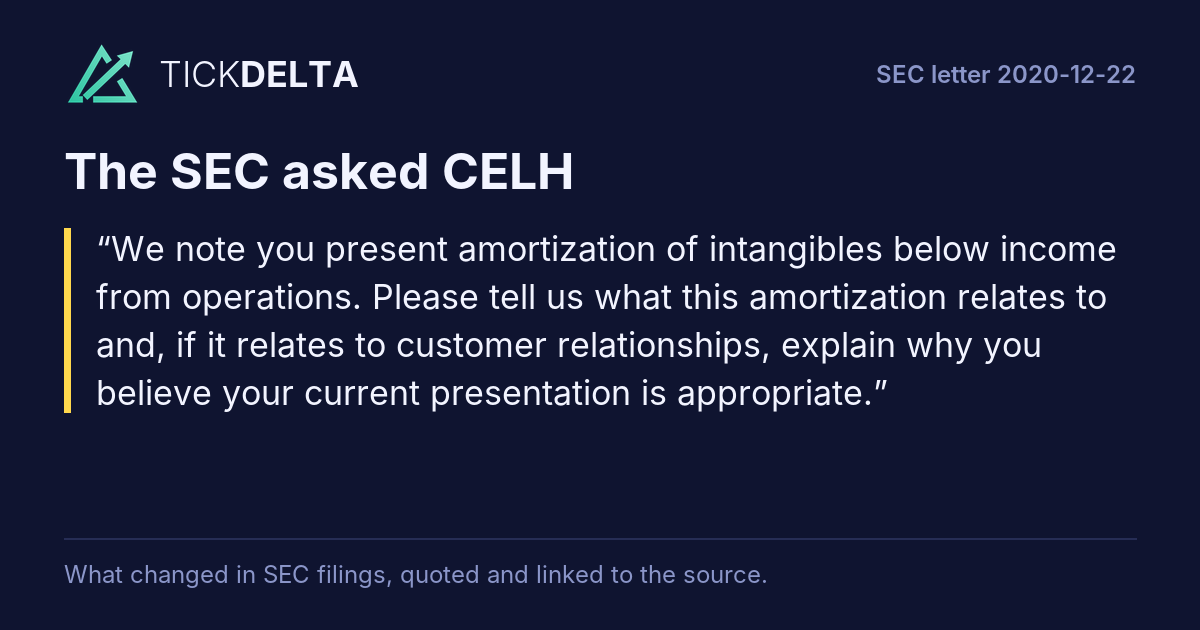
We note you present amortization of intangibles below income from operations. Please tell us what this amortization relates to and, if it relates to customer relationships, explain why you believe your current presentation is appropriate.
CELH answered
Amortization of intangibles relates to customer relationships. We believe the current presentation is appropriate because we view amortization of customer relationships as being non-operational in nature. It does not represent a direct operational expense that the Company incurs as a part of its core, ongoing business activities, which include procuring, marketing, and distributing its products, and/or administrative activities directly related to operating the business.
Rest of the answer

Further, the underlying intangible asset that gives rise to amortization is non-operational in nature, having resulted from the application of business combination accounting. This is in contrast to assets like property, plant and equipment, for example, which are acquired for direct use in the Company’s operations. In light of the non-operational nature of amortization of intangibles, we believe that the current presentation provides the clearest and most faithful view of the Company’s operating performance and its underlying economics.

Securities and Exchange Commission

January 21, 2021

We also note that many financial statement users disregard amortization of intangibles when analyzing the Company’s performance relative to its competitors, due to its non-operational and non-cash nature. Because of this, if we were to aggregate amortization of intangibles as part of other direct operational expenses, we believe it could potentially reduce the transparency and usefulness of the Company’s financial statements for financial statement users.

Under our current presentation, amortization of intangibles is a separately labeled line item, allowing financial statement users to clearly understand its nature and evaluate it accordingly. We note that this is consistent with the guidance of Rule 5-03(b)(9) of Regulation S-X, Non-operating expenses, which states that “…miscellaneous income deductions shall be separately stated in the statement of comprehensive income or in a note thereto, indicating clearly the nature of the transactions out of which the items arose.” We also note that our current presentation does not contradict the guidance of SAB Topic 11.B, which addresses the exclusion of “depreciation, depletion and amortization of property, plant and equipment [emphasis added]” from cost of sales or operating expenses, because amortization of intangibles does not relate to property, plant and equipment.

Lastly, we believe that the guidance of ASC 350-30-45-2 allows for judgment in its application when it states that “amortization expense and impairment losses for intangible assets shall be presented in income statement line items within continuing operations as deemed appropriate for each entity [emphasis added].” We interpret this to mean that the presentation of amortization of intangibles is not prescriptive but, rather, based on the specific factors underlying the nature of the expense and other similar intricacies, such as those described in the preceding paragraphs. We believe the current presentation in the Company’s financial statements appropriately reflects the underlying nature of amortization of intangibles and enables financial statement users to determine the true operational results of the business.

10-K for the Year Ended December 31, 2019

Item

1. Business, page 1

Read in the reply
In its next report

First report after the company's reply of Jan 21, 2021: 10-K filed Mar 11, 2021 ↗, against the 10-K filed Mar 12, 2020 ↗.

Tickdelta does not hold the text of both reports, so they are not compared here.

Item 1. Business, page 1
SEC asked (2)
Your disclosure on page F-9 indicates that you have significant customers who account for more than 10% of revenue. Please revise your Business section to disclose and discuss your dependence on these significant customers and identify them. Refer to Item 101(h) of Regulation S-K.
Rest of the question

Additionally, please tell us what consideration you have given to including a risk factor related to your dependence on significant customers.

CELH answered
As our business continues to grow and evolve significantly, we continue to monitor the adequacy of our disclosures and have been considering enhancing them prospectively in-line with the observations provided. As such, we will implement complementing our disclosure in this area when we file our next 10-K in March 2021, reflecting our 2020 financial results.

While one customer, Amazon, accounted for more than 10% of our revenues during the year ended December 31, 2019 (and is expected to do so during the year ended December 31, 2020), we do not believe that we are dependent on such customer.
Rest of the answer

Nonetheless, in response to the Staff’s comment, we propose to add the following disclosure in “Item 1. Business” in our in our Annual

Report on Form 10-K for the year ended December 31, 2020 (the “2020 Form 10-K”):

“As a result of the growth of our business and the increase in online sales in 2020 related in part to the COVID-19 pandemic, one customer, Amazon, accounted for approximately 25% and 12.0% of our revenues during the years ended December 31, 2020 and December

31, 2019, respectively. Notwithstanding the foregoing, we do not believe that we are dependent on our sales to Amazon for our continued growth and profitability.”

Regarding the risk factor consideration related to dependence on significant customers, please consider the following:

-It’s our understanding that there is no specific requirement to include/exclude such a discussion about customer concentration risk.

Reg S-K Item 105 speaks broadly about what to include in risk factors. It emphasizes disclosing ‘material’ factors, where ‘material’ is defined as: “…matters as to which an average prudent investor ought reasonably to be informed before buying or selling any security of the particular company.” However, we are always striving to provide better visibility and understanding of our business to the users of our financial statements and therefore propose to add explanatory details on future filings regarding the potential risk factor pertaining to concentration of sales.

7. Management's Discussion and Analysis of Financial Condition and Results of Operations

Read in the reply
In its next report

First report after the company's reply of Jan 21, 2021: 10-K filed Mar 11, 2021 ↗, against the 10-K filed Mar 12, 2020 ↗.

Tickdelta does not hold the text of both reports, so they are not compared here.

Results of Operations · Results of Operations, page 18
SEC asked (3)
Please revise your discussion of results of operations to provide greater insight into the causes of material changes in the components of net income. For example, you disclose that an increase in sales volume is the key driver for the 43% increase in revenue in 2019 without providing underlying reasons for the change in volume. Refer to Item 303(a)(3) of Regulation S-K and SEC Release No. 33-8350.
CELH answered
our business continues to grow and evolve significantly, we continue to monitor the adequacy of our disclosures and have been considering enhancing them prospectively in-line with the observations provided. As such, we will implement complementing our

Specifically, we have been very objective and factual with the comments in this area. Specifically, we will be including additional details providing underlying rationale for material changes in key operational metrics to provide better understanding to users of the results of material changes in the components of net income.

7.
Rest of the answer

Management's Discussion and Analysis of Financial Condition and Results of Operations

Read in the reply
In its next report

First report after the company's reply of Jan 21, 2021: 10-K filed Mar 11, 2021 ↗, against the 10-K filed Mar 12, 2020 ↗.

Tickdelta does not hold the text of both reports, so they are not compared here.

Liquidity and Capital Resources, page 20
SEC asked (4)
Please provide a more robust analysis of the changes in net cash provided by (used in) operating activities. Your analysis should quantify all factors cited and address the material drivers underlying those factors.
Rest of the question

Please note that merely citing changes in working capital items and other items identified in the statement of cash flows may not provide a sufficient basis to understand how operating cash between comparative periods changed. In addition, please also discuss the underlying drivers responsible for material changes in your cash flows from investing and financing activities for all periods presented. Refer to Section IV.B of SEC Release 33-8350.

CELH answered
our business continues to grow and evolve significantly, we continue to monitor the adequacy of our disclosures and have been considering enhancing them prospectively in-line with the Staff’s comments. As such, we propose to provide expanded disclosure in our 2020 Form 10-K additional details and supporting analyses to allow readers to better understand changes in operating, investing and financing activities, between comparable periods and their impacts on cash flows.
Read in the reply
In its next report

First report after the company's reply of Jan 21, 2021: 10-K filed Mar 11, 2021 ↗, against the 10-K filed Mar 12, 2020 ↗.

Tickdelta does not hold the text of both reports, so they are not compared here.

Item 9A. Controls and Procedures, page 21
SEC asked (5)
You disclose on page 22 that management has excluded the acquired business from management’s report on internal control over financial reporting. Please revise your disclosure to identify the acquired business and indicate the significance of the acquired business to your consolidated financial statements.
Rest of the question

Notwithstanding management’s exclusion of the acquired business’ internal controls from your annual assessment, you must disclose any material change to your internal control over financial reporting due to the acquisition pursuant to Exchange Act Rule 13a-15(d) or 15(d)-15(d), whichever applies. Refer to Question 3 of SEC’s Frequently Asked Questions on Management’s Report on Internal Control over Financial Reporting and Certification of Disclosure in Exchange Act Periodic Reports. In addition, it appears to us that your auditors' report, which includes their assessment of internal control over financial reporting, should also include an explanatory paragraph excluding the acquired business or you should explain to us how and why their assessment differed from your assessment. Consolidated Financial Statements 2. Basis of Presentation and Summary of Significant Accounting Policies

CELH answered
“The

SEC’s general guidance permits the exclusion of an assessment of the effectiveness of a registrant’s controls and procedures as they relate to its internal control over financial reporting for an acquired business during the first year following such acquisition if, among other circumstances and factors, there is not an adequate amount of time between the acquisition date and the date of assessment. On October 25, 2019, we completed the acquisition of Func Food Group, Oyj (“Func Food”) and did not have time to perform an adequate assessment of their internal control environment.
Rest of the answer

In accordance with the SEC guidance, the scope of our evaluation of internal controls over financial reporting as of December 31, 2019, did not include an assessment of the internal controls over financial reporting of these acquired operations. Net Revenue generated from the acquired operations only represented 8.8% as of December 31, 2019. Although we were not able to execute a thorough assessment, we began to perform evaluations of internal controls, on an on-going basis, over financial reporting for these acquired operations as well as their processes and systems. As such, it was deemed that the acquired operations and financial reporting processes did not have a material impact to our internal controls over financial reporting. Additionally, we conducted multiple training sessions with their finance and administrative personnel including their managing director, as it relates to our internal control environment and policies which were implemented as part of the integration process. Moreover, from a financial reporting perspective we review their figures and conduct thorough analytical reviews of their results and also validate the consolidation of their figures at the European level.

the Auditor’s report we have been advised that they took the above aspects into consideration, particularly as to the materiality impact of the acquisition and deemed not necessary to provide additional explanations in this area. As part of their review of our purchase accounting procedures, we also provided them with documentation which reflected our prompt attention to having Func

Food incorporate our policies and procedures to ensure that their internal control environment was aligned with ours as part of our integration process. Additionally, we have been performing our assessment of their internal control environment during 2020, despite the COVID limitations and even obtained the services of Grant Thornton in the Nordics to assist with this assessment and the related testing to ensure that their internal controls are in-fact aligned, are in-place and working effectively. This provides comfort that there is no adverse impact to our financial reporting regarding the acquisition. Furthermore, we were informed that

Assurance Dimensions were subject to a review by the PCAOB office which included a thorough examination of our audit and therefore all their workpapers, audit and risk planning, compliance & substantive testing, conclusions of their work and therefore the validity or content of their audit report. The PCAOB had noted that the audit opinion should have referenced an exclusion of Func

Foods controls but Assurance Dimensions, our independent registered public accounting firm, noted to the PCAOB that their audit opinion cross-referenced to management’s assessment of internal controls which properly excluded the testing of controls for Func Food. The PCAOB did not indicate that any further action was necessary in this aspect.

Financial Statements

2. Basis of Presentation and Summary of Significant Accounting Policies

Read in the reply
In its next report

First report after the company's reply of Jan 21, 2021: 10-K filed Mar 11, 2021 ↗, against the 10-K filed Mar 12, 2020 ↗.

Tickdelta does not hold the text of both reports, so they are not compared here.

Segment Reporting, page F-8
SEC asked (6)
We note your disclosures that you have a number of operating divisions and that separate segment data has not been presented as they meet the criteria for aggregation. Please identify and explain to us how you determined your operating segments as defined in ASC 280-10-50-1.
Rest of the question

Please also demonstrate to us how you determined that your operating segments can be aggregated and how your aggregation complies with the requirements of ASC 280-10-50-11, including similar economic characteristics. In addition, please address the apparent inconsistency in your disclosures related to segments in your Form 10-Q for the period ended September 30, 2020 which appear to indicate you aggregate operating segments but also indicate you have a single operating segment.

CELH answered
determining our operating segments, we considered the definition in ASC 280-10-50-1, which defines an operating segment as a component of a reporting entity with three characteristics:

● 50-1(a)

It engages in business activities from which it may recognize revenues and incur expenses

(including revenues and expenses relating to transactions with other components of the same public entity).

● 50-1(b)

Its operating results are regularly reviewed by the public entity's chief operating decision maker (CODM) to make decisions about resources to be allocated to the segment and assess its
Rest of the answer

performance.

● 50-1(c)

Its discrete financial information is available.

Even though we have operations in several geographies that satisfy criteria (a) and (c) above, we operate as a single enterprise. Our operations and strategies are centrally designed and executed given that our geographical components are very similar. Our CODM, the CEO, reviews operating results primarily from a consolidated perspective, and makes decisions and allocates resources based on that review.

The reason our CODM focuses on consolidated results in making decisions and allocating resources is because of the significant economic interdependencies between our geographical operations and the Company’s U.S. entity. Because of these intertwined operations, it is not useful or meaningful to look at a given geographical area in isolation. For example, our European operations (Func Food) rely on Celsius Holdings in the following ways:

● Similar products and similar types of customers—Both Func Food and Celsius primarily focus on selling Celsius-branded beverages and Func Food’s customers are similar to those of Celsius Holdings, including large retailers, sporting goods stores, and specialty stores.

● Interdependent operations and sharing of resources—Func Food purchases all of its Celsius inventory from Celsius Holdings via transfer-pricing arrangements. As of September 30,

2020, the majority of Func Food’s inventories consisted of intercompany purchases from Celsius Holdings (approximately EUR 4.2M of total inventory of EUR 5.6M, or 75%).

Thus, the cash flows and economics of Func Food are dependent on Celsius Holdings. Due to this extensive economic relationship, it is important to view both Func Food and Celsius

Holdings together, as a whole, in order to capture the true profitability, operating performance, cashflows and recovery of goodwill.

● Benefiting from common research and development—Func Food is dependent on new product development performed by Celsius Holdings. The beverage industry is highly competitive, with one area of competition being development of new products. In order for Func Food to remain competitive, it must rely on Celsius Holdings to develop new products and flavors.

● Other operational interdependencies and overlap—Func Food is also dependent on Celsius

Holdings with respect to these other areas:

o Marketing

– Celsius Holdings assists Func Food with various marketing activities, including social media, launching of new products, budgeting, standardizing and harmonizing the brand as it relates to packaging/labeling and ingredient contents (i.e., Caffeine levels), to the extent possible, taking into consideration regulatory aspects and customer preferences.

Providing brand continuity and standardization, as much possible, regarding Social Media aspects.

o Business development – Celsius Holdings helps Func Food determine the best ways to structure its business model for specific markets. Determine the best approach in entering markets and compliance with all regulatory and corporate governance requirements (e.g., UK, Germany, others), proper capitalization and capital structure, determining required investments, etc. Additionally, we provide guidance to establish the most appropriate corporate structure regarding legal entities taking into consideration import and tax matters.

o General operations – Celsius Holdings provides assistance related to determining production, raw material procurement, proper inventory levels (i.e., all supply chain aspects), logistics, meeting importing requirements, warehousing aspects, as well as distribution to clients and merchandising.

o Finance-

Financial Reporting, Budgeting, Forecasting, Capital Budgeting, Consolidation, Implementation of internal controls (e.g., SOX Compliance), Taxes – Celsius Holdings provides assistance in all these aspects pertaining to the Finance area and to ensure proper financial reporting and compliance with US-GAAP.

o Treasury

– Celsius Holdings provides assistance as to cash management, coordination of currency transactions and transfer of funds among countries.

o IT

- Evaluation of systems, applications, standardizing email protocols, data management, evaluation and utilization of CRM areas, resource planning, use and training of desktop applications (e.g., Microsoft Office=>e.g., Macros, Links, etc.).

o HR-

Compliance with local labor requirements, company policies & procedures, coordinating staffing requirements based on budget, coordinating company benefits (e.g., stock options,

RSAs).

have always viewed, and continue to view, the company as a single operating segment, both preand post- European acquisition.

While there are discrete operational intricacies in the different geographical regions, the CEO makes strategic decisions for allocating resources and evaluates company performance at the consolidated level. As such, the CEO reviews consolidated data in order to make orchestrated decisions for the enterprise as whole particularly as it relates to Operational (procurement/Supply-Chain) decisions, Research and Development (e.g., New Products), Marketing initiatives and Brand consistency/uniformity as well as Selling and Distribution strategies.

Our past disclosures about aggregating multiple segments were simply an inadvertent misnomer which does not have a material impact to the use of the financials. This will certainly not be the case prospectively. As a growing company, we will continue to monitor these aspects and certainly make any modifications that may be necessary in our 2020 Form 10-K and subsequent reports under the

Securities Exchange Act of 1934, as amended, to provide better visibility to users of the financial statements but in a well thought out matter. In that manner, ensure that the additional information provided is actually beneficial and does not cause confusion or makes our financial statement too complex and “bureaucratic” for our shareholders.

On a final note, Celsius Holdings much like Monster (a major competitor) basically only sells Celsius brand beverages (revenues of other products are immaterial). As such, our reporting mirrors Monster’s, as they only provide details by product lines and not by location even though they sell across the world.

Read in the reply
In its next report

First report after the company's reply of Jan 21, 2021: 10-K filed Mar 11, 2021 ↗, against the 10-K filed Mar 12, 2020 ↗.

Tickdelta does not hold the text of both reports, so they are not compared here.

Segment Reporting, page F-8
SEC asked (7)
It appears that you have significant revenue from operations within and outside of the United States. Please provide the revenue and long-lived asset by country disclosures required by ASC 280-10-50-41 or explain to us why you do not believe they are required. 6. Note Receivable, page F-16
CELH answered
do not believe that country specific information is required due to materiality aspects and therefore will not add much value to the users of the financial statements. The majority or more material amounts of revenue in each region disclosed in footnote

3 come from single countries in each region that we already discuss/disclose throughout our 2019 Form 10-K. (e.g., substantially all of ‘Asian’ revenue comes from China-royalties, substantially all of Europe revenue comes from the Nordics and basically mainly Sweden (94%).
Rest of the answer

As such, each individual Nordic country revenue is immaterial for disclosure. Additionally, all of North American revenue comes from U.S. Following are all the details to provide more visibility regarding our comments:

Europe=>Nordics:

-Sweden=>~$13,590k

-Finland=>~$632k

-Norway=>~$234k

-Total

Europe=>~$14,456k

Asia:

-China=>~$350k

(Royalties)

-Malaysia=>~$435k

-All others-Misc.=>~$56k

Asia=>~$841k

All

Others

-Bermuda~=>~$160k

-Others-Misc.=>~$31k

Total

Others=>~$191k long-lived assets as of 12/31/2019 are immaterial in nature at ~$943k or ~1% of total assets. If we then view this on a more granular level, it becomes more evident that the economic aspects are inconsequential:

Property,

Plant and Equipment ~$133k basically all in the US

Right

Of Use=>~$810k or ~.9%:

-US=>~$120k

-Europe=>~$690k

For intangible assets, it is disclosed in the related footnote that they all relate to the European acquisition, which as noted above relates to specific countries that are discussed throughout the 10-K. As such, our financial statement users are aware of the specific countries in the European region.

6. Note Receivable, page F-16

Read in the reply
In its next report

First report after the company's reply of Jan 21, 2021: 10-K filed Mar 11, 2021 ↗, against the 10-K filed Mar 12, 2020 ↗.

Tickdelta does not hold the text of both reports, so they are not compared here.

Segment Reporting, page F-8
SEC asked (8)
We note your disclosures related to a license and repayment of investment agreement with Qifeng, including the fact that you recorded a note receivable and other income during the year ended December 31, 2019. Please provide us additional information related to the material terms of this agreement and more fully explain to us how you determined your accounting is appropriate, specifically address why you believe
Rest of the question

recording other income is appropriate and how you determined the receivable is not related to the license agreement. 10. Acquisition European Operations, page F-20

CELH answered
agreement is divided into the two sections, containing the following material terms:

● License agreement: The license agreement grants Qifeng a 50-year exclusive license to procure, market, sell, and distribute Celsius brand products in China. The licensing fee is fixed for the first five years, amounting to a total of approximately $6.6 million, and is variable thereafter based on annual revenue. The future applicable royalty rates will be mutually agreed to each year but the amounts cannot be less than the preceding year’s value.
Rest of the answer

Minimum starting rates are specified in the agreement.

● Repayment of investment agreement (note receivable): The repayment of investment agreement acknowledges the fact that the Company had made significant investments in years prior to entering into the agreement in order to expand its global brand into the China market. In light of this past investment, Qifeng agrees to repay the Company in the form of the note receivable. The note receivable has a five-year term with scheduled principal payments and a weighted-average interest rate, which subsequently was amended to a fixed rate of 3.21% per annum. This past investment pertained to marketing initiatives and activities to develop the Celsius brand.

● The license agreement may be terminated by mutual consent or upon the occurrence of certain events, such as material breach. However, upon termination of the license agreement for any reason, the repayment of the investment agreement would continue to remain in effect and the note would remain fully collectible.

determined that recording the note receivable as other income was appropriate because it is a separate component of the contract that falls outside the scope of the revenue standard, ASC 606. This is consistent with the guidance of ASC 606-10-15-4, which says that if a contract with a customer is partially within the scope of ASC 606 and partially within the scope of other guidance, then a reporting entity should first apply the separation or measurement guidance in other applicable standards (if any) and then apply the guidance in the revenue standard.

determined that the note receivable is not related to the license agreement because none of the terms or underlying economics of the two agreements are interdependent. For example, the amount of consideration to be paid in the license agreement does not depend on any of the terms of the note receivable agreement. The minimum starting royalty rates specified in the license agreement are consistent with industry market rates, showing that the pricing in the license agreement was not determined in contemplation of the note receivable. Similarly, the interest rate on the note receivable is reflective of credit risk and market rates and to account for time value of money. Furthermore, Qifeng is contractually obligated to repay the note receivable regardless of whether or not the Company satisfies its performance obligation under the license agreement. We believe these considerations demonstrate that the note receivable is separate from the license agreement by analogizing to the guidance of ASC 606-10-25-9, which outlines the factors an entity should consider when deciding whether or not to combine two or more contracts entered into at the same time.

To further eliminate the possibility that the note receivable might relate to some other revenue activity, we considered the definition of revenue under ASC 606-10-20:

Revenue:

Inflows or other enhancements of assets of an entity or settlements of its liabilities (or a combination of both) from delivering or producing goods, rendering services, or other activities that constitute the entity’s ongoing major or central operations.

gain related to the note receivable does not meet the definition of revenue because it was not “an inflow that resulted from the Company delivering or producing goods, rendering service, or any other activities that constitute the Company’s ongoing major or central operations” and does not fit the description of “ordinary business activities” as defined in ASC 606-10. The note receivable represents reimbursement of past investment that the Company made in the China market in previous years to develop the brand.

Company’s primary revenue-generating activity is selling, distributing, and licensing its beverages, not selling or providing marketing services to customers or third parties. While the Company does perform marketing activities as part of its own daily operations to build the Celsius brand, it has never done so as an “ongoing major or central” service in exchange for consideration from its customers. Marketing activities or initiatives have never been a revenue stream for the company. Further, there was no prior mutual agreement, explicit or implicit, that these amounts would eventually be reimbursed (i.e., there was no contract, which is the first step that must be met to recognize revenue under ASC 606). Lastly, we re-emphasize that the collection of the note receivable is not contingent upon the Company providing any future goods or services to Qifeng, which demonstrates that it does not relate to any performance obligations that might indicate the presence of a revenue contract.

Given that no other revenue or income recognition guidance applies to the note receivable, we concluded that recording it to other income was appropriate based on ASC 610-10-05-1, Other Income—Overall, which includes “income recognized that is not…within the scope of Topic 606 [or other revenue or income recognition guidance].” Absent specific separation and measurement guidance, and because the pricing and terms of both the license agreement and note agreement were at market (i.e., already on a standalone basis), the amount allocated to the note receivable was the stated amount, which in turn was based on the cost of the marketing initiatives that were incurred or invested in the China market to develop the Celsius brand.

believe recording the gain pertaining to the note receivable in other income properly reflects the nature of the transaction.

To have otherwise recorded it in revenue would have caused the financial statements to be misleading (e.g., would distort profitability, including gross margin), due to the non-recurring nature of the transaction and the fact that it was not related to any of the

Company’s ongoing major or central revenue-generating activities.

10. Acquisition European Operations, page F-20

Read in the reply
In its next report

First report after the company's reply of Jan 21, 2021: 10-K filed Mar 11, 2021 ↗, against the 10-K filed Mar 12, 2020 ↗.

Tickdelta does not hold the text of both reports, so they are not compared here.

Segment Reporting, page F-8
SEC asked (9)
We note you acquired Func Food on October 25, 2019 and provided historical financial statements related to the acquisition in a Form 8-K/A. Please explain to us how you determined the historical financial statements you provided fully comply with Rule 305/8-04 of Regulation S-X.
Rest of the question

Please specifically address the following potential deficiencies: • the historical financial statements for the year ended December 31, 2018 appear to be unaudited since they include an "except for" auditors' report; • the historical financial statements for the year ended December 31, 2017 appear to be unaudited; and • interim financial statements are not provided. Please also address if and how these potential deficiencies impact your assessment of disclosure controls and procedures.

CELH answered
determine the appropriate historical financial statements required by Rule 3-05 for the Func Food acquisition, we performed the three tests described in Rule 1-02(w) (referenced by Rule 3-05) to determine the level of significance of the business acquisition.

The result of the tests was a significance level exceeding the 50-percent threshold, requiring that we provide the following financial statements pursuant to Rule 3-05(b)(2)(iv):

● Audited balance sheets as of the end of the two most recent fiscal years, statements of operations, comprehensive income, cash flows, and changes in
Rest of the answer

stockholders’ equity for the three most recent fiscal years, and

● Unaudited financial statements as of and for the appropriate interim period preceding the acquisition and the corresponding interim period in the prior year.

However, an accommodation provided by Rule 3-05(b)(2)(iv) allows registrants to omit the earliest year if the revenues of the acquired business are less than $100 million in the most recent fiscal year. Because this was applicable to Func Food, we provided audited financial statements covering the two most recent fiscal years, 2018 and 2017, rather than three fiscal years.

auditor’s report for the historical financial statements covers both fiscal years 2018 and 2017, which are presented comparatively within the same set of financial statements. While the report only specifically mentions 2018, the scope of the audit also includes

2017. We have copies of financial statements both, in English and Finnish pertaining to the 2017 audit. The Finnish version is signed by the partner in-charge of the audit. We will be pleased to provide the 2017 audited financial statements upon request.

Additionally, Func Food was required to publish or make their audited financial statements available to the public as they had financed their business via publicly traded bonds. We also noted no disclaimers such as “unaudited” or other qualifying language related to the 2017 financial statements. Further, we note that the auditors’ report says that that the auditor has been appointed to Func Food for “a total period of uninterrupted engagement of two years.” we understand that “except for” audit opinions usually do not meet the requirements of Regulation S-X Article 2, in this specific instance we believe that the audited financial statements still satisfy the requirements due to the fact that the sole basis for the qualified opinion related to the predecessor entity’s goodwill, intangible assets, and intercompany balances

(in relation to the predecessor parent company’s standalone audit)—none of which has an impact on how the business combination is accounted for, or on the ongoing future performance of the entity following acquisition. Predecessor goodwill and intangible assets do not carry over to the successor entity as part a business combination. Rather, new balances of goodwill and intangible assets are independently measured and established as part of applying the acquisition method of accounting. Additionally, any remaining intercompany balances within the predecessor entity were not part of the assets acquired and liabilities assumed in the business combination, having become fully eliminated upon acquisition and consolidation with the Company. Because none of these items are relevant to the accounting for the acquisition or to the ongoing future operations of the acquired business, we do not believe that the “except for” audit opinion impacts the reliability or relevance of the financial statements for the Company’s financial statement users, as it relates to satisfying Rule 3-05 of Regulation S-X.

the interim period financial information required by Rule 3-05 of Regulation S-X, the most recent interim period preceding the date of the acquisition was the nine months ended September 30, 2019, for which we provided an unaudited balance sheet and income statement within the pro forma financial statements filed with the Form 8-K/A as Exhibit 99.3. However, because Func Food stopped preparing interim financial statements after its Q1 2019 period end (which is when the predecessor entity began seeking relief by restructuring of its debt) and because of limited accounting personnel available at the time of the acquisition, it was impractical to obtain statements of comprehensive income, cash flows, and changes in stockholders’ equity for the required interim period, nine months ended September 30, 2019.

recognize that the financial statements covering the corresponding prior year interim period, the nine months ended September

30, 2018, were omitted inadvertently from the Form 8-K/A exhibits. We note they are/were publicly available on Func Food’s website on its investor relations page. If required, we can provide them in an amended filing.

do not believe this affects our assessment of disclosure controls and procedures given the unique, non-recurring nature of the situation (i.e., business acquisition) and the transaction itself. We also believe there is minimal to no impact on the ability of our investors and stakeholders to understand the nature of the acquisition, as the more relevant information pertains to what impact the acquisition will have on the Company going forward under new management and the results of prospective operations.

Given that this is an isolated incident with minor impact and relates to a non-recurring transaction, we do not believe that it is indicative of any pervasive issues concerning the effectiveness of the Company’s disclosure controls and procedures.

Read in the reply
In its next report

First report after the company's reply of Jan 21, 2021: 10-K filed Mar 11, 2021 ↗, against the 10-K filed Mar 12, 2020 ↗.

Tickdelta does not hold the text of both reports, so they are not compared here.

Form 10-Q for the Quarter Ended September 30, 2020 · Consolidated Statements of Operations and Comprehensive Income, page 2
SEC asked (1)
We note your response to prior comment 1, including your view that the amortization of intangibles that relates to acquired customer relationships is non-operational in nature. Please address the following: • Explain the specific nature of the customer relationships you acquired in the Func Food acquisition and tell us if they are used in your current business; • Explain the specific factors you considered in
Rest of the question

estimating the 25 year useful life for the customer relationships you acquired. Refer to ASC 350-30-35-3; • To the extent the customer relationship intangibles are used in your current business, we believe presenting the related amortization below income from operations is not appropriate given that customer relationships are related to your business and are integral to your revenue generating activities; and • To the extent the customer relationship intangibles are not used in your current business, tell us how you have assessed them for impairment.

CELH answered
The customer relationships acquired in the

Func Food acquisition consisted of Func Food’s Swedish and Finnish customer bases, which include relationships with retailers, wholesalers, and health stores. These relationships are used in our current business.

The estimated 25-year useful life for the customer relationships was based on a historical attrition analysis and discussions with local management and represents the total number of years before a cut-off point at which the cash flows contributing to the value of the asset become negligible.
Rest of the answer

External valuation experts were engaged to perform a thorough analysis to confirm and provide proper valuation guidance, which included considerations around a reasonable useful life regarding the realization of these assets. Attached please find the full report from these experts which contains all the specific and detailed calculations, assumptions and estimates (Exhibit A).

FOIA CONFIDENTIAL TREATMENT REQUESTED PURSUANT TO 17 C.F.R. § 200.83

BY CELSIUS HOLDINGS, INC.: CELH-001

Securities and Exchange Commission

In considering the illustrative factors of

ASC 350-30-35-3 and additional guidance given in past SEC letters, in which “churn” rate of customers is mentioned as a possible factor to consider in estimating the useful life, we believed the attrition-based approach was the most direct and relevant factor in estimating the useful life of the customer relationships. We also considered the composition of the types of customers, both with respect to Func Food and Celsius’ own historical experience with similar customer relationships, noting that such relationships are long-standing, with low attrition and a very high concentration in a limited number of major retailers.

As such, the relationships that have been developed carry a significant intangible value and it is reasonable to estimate that this benefit will be derived over many years. These relationships are vital in the placing of product at these key retailers and in gaining additional market share (e.g. “shelf space”, preferred locations including coolers and having POP material and displays).

We acknowledge your position that amortization related to customer relationship intangibles should be presented within income from operations and, while we still believe our original position holds merit, we will reclassify the presentation of amortization related to customer relationship intangibles to general and administrative expenses beginning with our Form 10-K for the year ended December 31, 2020. We believe presenting amortization in general and administrative expenses, as opposed to cost of revenue, is appropriate as it is most consistent with the nature of the asset, which is not directly linked to or used in the sourcing and distribution of products to our customers.

Form 10-K for the Year Ended December 31,

Read in the reply
In its next report

First report after the company's reply of Mar 4, 2021: 10-K filed Mar 11, 2021 ↗, against the 10-K filed Mar 12, 2020 ↗.

Tickdelta does not hold the text of both reports, so they are not compared here.

Item 9A. Controls and Procedures, page 21
SEC asked (2)
We note your response to prior comment 5. Please amend your Form 10-K for the year ended December 31, 2019 to include a revised report from your auditor regarding their assessment of your internal control over financial reporting that appropriately references the scope of the assessment regarding the acquired business that was excluded from management’s assessment of internal control over financial reporting.
Rest of the question

In the amended filing, please also include a revised report from management regarding your assessment of internal control over financial reporting that identifies the acquired business and indicates the significance of the acquired business to your consolidated financial statements. Refer to Question 3 of the Frequently Asked Question on Management’s Report on Internal Control over Financial Reporting and Certification of Disclosure Controls in Exchange Act Periodic Reports available on our website at: https://www.sec.gov/info/accountants/controlfaq.htm.

CELH answered
We have been informed that our auditors will be issuing two opinions as it relates to our 2020 comparative financial statements. As such, they will be complementing their 2019 opinion regarding the internal control environment to reflect that it did not cover an assessment of the internal controls of the acquired entity which is in-line with management’s disclosure.

BY CELSIUS HOLDINGS, INC.: CELH-002

We do not believe that amending our Form 10-K for the year ended December 31, 2019 would provide any benefit or any additional value to our investors, given the amount of time that has elapsed
Rest of the answer

since its filing. We also note that as part of our post-acquisition assessment of the acquired business' internal controls over financial reporting, we have concluded that they are effective, which provides further comfort that there are or were not any underlying issues that would have been material for disclosure in the Form 10-K for the year ended December 31, 2019. This post-acquisition assessment has involved significant time and resources, both internal and external, including the assistance of Grant Thornton in the Nordics, in evaluating the acquired business' internal controls over financial reporting and integrating them with our own.

Lastly, adequate disclosure was provided in our Form 10-K for the year ended December 31, 2019 to allow our investors to understand the scope of management’s assessment of internal control over financial reporting and that any impact of the acquired business on the Company’s internal control over financial reporting from the date of the acquisition, October 25, 2019, through December 31, 2019 was immaterial.

We noted the limited period of time during which the acquired business was part of our consolidated results (a little over only two months), the fact that post-acquisition activity of the acquired business was immaterial for the year ended December 31, 2019, and the non-complex nature and composition of the acquired business’ transactions and assets and liabilities. Further, while not a primary factor in this consideration, we also note that the significance of the acquired business is readily apparent from the footnote disclosure related to the acquisition.

Read in the reply
In its next report

First report after the company's reply of Mar 4, 2021: 10-K filed Mar 11, 2021 ↗, against the 10-K filed Mar 12, 2020 ↗.

Tickdelta does not hold the text of both reports, so they are not compared here.

Item 9A. Controls and Procedures, page 21
SEC asked (3)
We note your response to prior comment 9. In light of the deficiencies related to management’s report on internal control over financial reporting, your auditor’s report regarding their assessment of your internal control over financial reporting, along with your omission of the required interim financial statements for 2019 and required annual audited financial statements for 2018 covered by an unqualified
Rest of the question

auditors’ report for your significant acquisition of Func Food, we believe there is a strong indication that your disclosure control and procedures were not effective as of December 31, 2019. In light of these facts, please amend your Form 10-K for the year ended December 31, 2019 to disclose that your disclosure control and procedures were not effective and explain the reasons why. Consolidated Financial Statements 2. Basis of Presentation and Summary of Significant Accounting Policies

CELH answered
While we acknowledge that some nominal required information was omitted from Form 10-K, we strongly believe that this is an area in which there needs to be consideration regarding materiality and professional judgement within our filings and disclosures. Therefore, we respectfully disagree that there is a strong indication that our disclosure control and procedures were not effective as of December 31, 2019.
Rest of the answer

We believe we have provided valid explanations for why the information was omitted and the omissions were intentional and well thought out, with the exception of the inadvertent omission of the comparative interim period for the nine months ended September 30, 2018, which is clearly immaterial for disclosure purposes.

We understand the SEC has allowed companies to omit certain information required by Rule 3-13 when it is deemed to be burdensome to comply with the requirement. The SEC has encouraged registrants to seek modifications to their financial reporting requirements under Regulation S-X, Rule 3-13, particularly when the requirements are burdensome but may not be material to the total mix of information available to investors. Rule 3-13 has historically given the Staff the authority to permit the omission or substitution of certain financial statements otherwise required under Regulation S-X where consistent with the protection of investors. Examples of waiver requests under Rule 3-13 include the omission of one or more years of historical financial statements for a recently acquired business that is subject to Regulation

S-X, Rule 3-05.5. In May 2020, the SEC issued a final rule that amended the financial statement requirements for acquisitions of businesses. One of the key amendments included was to “permit the use of abbreviated financial statements for an acquiree in certain circumstances without a request for SEC staff permission.” Although this amendment came out subsequent to the period in question, it further represents the exceptions that have historically been granted to other filers and supports our position.

Although we acknowledge that we did not seek out waivers from the SEC in advance of our filing, this does not change the nature of our conclusion that investors received an adequate amount of information about the acquired business to make informed investment decisions which have now been validated by the results of operations during the past approximately 14 months.

BY CELSIUS HOLDINGS, INC.: CELH-003

Consolidated Financial Statements

2. Basis of Presentation and Summary of

Read in the reply
In its next report

First report after the company's reply of Mar 4, 2021: 10-K filed Mar 11, 2021 ↗, against the 10-K filed Mar 12, 2020 ↗.

Tickdelta does not hold the text of both reports, so they are not compared here.

Segment Reporting, page F-8
SEC asked (4)
We note your response to prior comment 7. Please revise future filings to disclose revenue and long-lived assets attributed to the U.S., your country of domicile, and to any other individual countries that are material (over 10%) as provided in your response letter. 6. Note Receivable, page F-16
CELH answered
We will revise future filings to disclose revenue and long-lived assets attributed to the U.S., our country of domicile, and to any other individual countries that are material (over 10%) beginning with our Form 10-K for the year ended December 31, 2020.

The following illustrates our expected disclosures:

2.
Rest of the answer

BASIS OF PRESENTATION AND SUMMARY OF SIGNIFICANT ACCOUNTING

POLICIES

[…]

Long-lived Asset Geographic Data

The following table sets forth long-lived asset information, excluding goodwill and intangibles, where individual countries represent a material portion of the total:

December 31,

2020

United States

$

[*]

Sweden

Finland

Long-lived assets related to foreign operations

Total long-lived assets

3. REVENUE

All of the Company’s North

America revenue is derived from the United States, which is the Company’s country of domicile. Of the Company’s total foreign revenues of $[*] million and $[*] million for the years ended December 31, 2020 and 2019, respectively, the only individual country that represents a material portion of total consolidated revenue was Sweden, which had total revenues of approximately

$[*] million and $[*] million for the years ended December 31, 2020 and 2019, respectively. Revenue is attributed to countries based on the location of the customer.

BY CELSIUS HOLDINGS, INC.: CELH-004

6. Note Receivable, page F-16

Read in the reply
In its next report

First report after the company's reply of Mar 4, 2021: 10-K filed Mar 11, 2021 ↗, against the 10-K filed Mar 12, 2020 ↗.

Tickdelta does not hold the text of both reports, so they are not compared here.

Segment Reporting, page F-8
SEC asked (5)
We note your response to prior comment 8 in which you indicate you determined the note receivable from Qifeng is not related to the license agreement because none of the terms or underlying economics are interdependent; however, we note the note receivable and license agreement were entered into at the same time, with the same party, and require fixed cash payments over a five year time period.
Rest of the question

In addition, it is not clear to us why Qifeng would reimburse you for past investments you made in the China market in previous years to develop your brand without the license agreement. Please more fully address the following: • Explain the reasons for the change in your distribution strategy in the Asian region relative to your relationship with Qifeng; • Explain what each party obtained and/or transferred as a result of the agreement; and • Explain the reasons why Qifeng would agree to reimburse you for past investments you made in the China market in previous years to develop your brand without the license agreement. Also, explain if any amounts being paid by Qifeng will be used to continue to develop your brand in the Asian region.

CELH answered
[CONFIDENTIAL]

BY CELSIUS HOLDINGS, INC.: CELH-005

Please advise as to your concurrence with the above. If you have any further questions or comments, kindly contact the undersigned at

(561) 276-2239.
Read in the reply
In its next report

First report after the company's reply of Mar 4, 2021: 10-K filed Mar 11, 2021 ↗, against the 10-K filed Mar 12, 2020 ↗.

Tickdelta does not hold the text of both reports, so they are not compared here.

Item 9A. Controls and Procedures, page 21
SEC asked (1)
We have considered your responses to prior comments 2 and 3. Please be advised that the definition of disclosure controls and procedures provided in Rule 13a-15(e) indicates that effective controls and procedures would ensure that information required to be disclosed by the issuer is recorded, processed, summarized and reported within the time periods specified in the Commission’s rules and forms.
Rest of the question

We believe your failure to provide a management report and auditors’ report on internal control over financial reporting in your 2019 Form 10-K that meet the requirements of Item 308 of Regulation S-K and your failure to provide audited annual and unaudited interim financial statements for a significant acquisition that meet the requirements of Rule 8-04 of Regulation S-X resulted in your filings being materially deficient and also resulted in you not being a timely filer under your reporting obligations for both the Exchange Act and the Securities Act. Although we acknowledge companies may seek relief under Rule 3-13 of Regulation S-X and may request waivers for certain required disclosures, we note you did not submit any such requests. We also acknowledge that the rules regarding required financial statements for significant acquisitions have changed, however, we note the financial statements you filed did not comply with the old rules or the new rules. In light of these facts, please amend your 2019 Form10-K to include a revised management report and a revised auditors’ report on internal control over financial reporting that comply with prior comment 2 and revise your conclusion related to disclosure controls and procedures to indicate that they were not effective and to explain the reasons why to comply with prior comment 3.

CELH answered
While we respectfully disagree with the Staff’s position, as we have extensively set forth in our prior correspondence and telephone conference with the Staff, we have agreed to amend the 2019 Form 10-K (a) to provide a revised management report and a revised auditor’s report on internal control over internal controls and procedures, as requested by the Staff; and (b) to revise our conclusion related to disclosure controls and procedures in the manner requested by the Staff.

1 | P a g e

Attached hereto as Exhibit A is the proposed revised disclosure.
Rest of the answer

If the Staff concurs that the attached language fully addresses the Staff’s comments, we will proceed to promptly file an amendment to the 2019 Form 10-K.

Read in the reply
In its next report

First report after the company's reply of Apr 14, 2021: 10-Q filed May 13, 2021 ↗, against the 10-Q filed Nov 12, 2020 ↗.

Tickdelta does not hold the text of both reports, so they are not compared here.

Consolidated Financial Statements
SEC asked (2)
Basis of Presentation and Summary of Significant Accounting Policies Segment Reporting, page F-10 2. We note your disclosure states that even though you have operations in several geographies, you operate as a single enterprise. We also note you have previously indicated to us that you have one operating segment and one reportable segment.
Rest of the question

Given that you have one operating segment and one reportable, please revise future filing to correct your reference to net sales by "reporting segment" on page F-17 since it implies you have multiple segments. 6. Note Receivable, page F-18

CELH answered
We will revise our future fillings regarding net sales to state “reporting by geography” rather than reference “segment reporting” as requested by the Staff.

6. Note Receivable, page F-18
Read in the reply
In its next report

First report after the company's reply of Apr 14, 2021: 10-Q filed May 13, 2021 ↗, against the 10-Q filed Nov 12, 2020 ↗.

Tickdelta does not hold the text of both reports, so they are not compared here.

Consolidated Financial Statements
SEC asked (3)
We note your disclosures that: "As collateral, we have maintained a stock certificate in Celsius Holdings, Inc., which amounted to 337,079 shares"; "In order to obtain payment pertaining to amounts that are due on March 31, 2021, we will release 62,000 shares which will provide sufficient funds to pay in full the amount that is due regarding the Note, interest and royalties"; and "We will maintain the remaining
Rest of the question

275,079 shares as collateral or guarantee of payment on the remaining amounts that will become due over the next three-years". Please tell us, and revise future filings to disclose, when and how Qifeng obtained your shares. Please also tell us, and revise future filings to disclose, who currently possesses the shares such that you have the ability to release them. To the extent Qifeng has essentially returned shares you issued to them, please more fully explain to us how you determined your accounting and presentation is appropriate.

CELH answered
advise the Staff that the shares of Celsius common stock referred to in the 2020 Form 10-K were acquired and are held by Risejoy Services

Limited which (as disclosed to the footnotes to the Item 12 beneficial ownership table in the 2020 Form 10-K), is under common control with Qifeng, our Chinese licensee.
Rest of the answer

The 337,079 shares were issued in a private transaction on April 20, 2015 pursuant to the exemptions from registration under the Securities Act of 1933, as amended (the “Securities Act”) afforded by Section 4(a)(2) thereof and Regulation D thereunder, as subsequently reported in our filings under the Securities Exchange Act of 1934, as amended. We have recently filed a Registration Statement on Form S-3 covering the resale of certain shares, including those held by Risejoy. Effectiveness of such Registration Statement is pending resolution of the Staff’s accounting comments on our Securities Exchange Act filings.

These shares have been held by Issuer Direct, our transfer agent. At the date of the filing of the 2020 Form 10-K, we had agreed to only release 62,000 shares so that the owner of Qifeng (and Risejoy) could publicly sell them pursuant to Rule 144 under the Securities Act and use the proceeds therefrom to pay the Note Receivable which was due on March 31, 2021. Given that our stock price declined subsequent to our March filing, we were subsequently requested to transfer the entire 337,079 shares to the owner’s stock brokerage account in order to be able to serve as collateral to obtain the necessary funding to pay the amount due on the Note Receivable and related interest.

Payment in-full was received timely pertaining to the amounts due on March 31, 2021 and a letter of guarantee was executed with several restrictions regarding these shares. In particular, it was agreed that the stock would not be sold or transferred without the prior written consent from Celsius Holdings, Inc. There are several other restrictions and agreements, which include that a Statement of Account will be provided to Celsius on a Quarterly basis to confirm and validate the existence of the shares. These shares serve only as collateral and provide comfort as to the “ability to pay” and mitigate any impairment or collectability concerns regarding the

Note Receivable. No shares have been returned to us. Hence, there is no impact or effect the accounting and/or the presentation of the

Note Receivable or any other aspect thereof.

2 | P a g e respectfully advise the Staff that we will expand disclosure in our future filings to provide the additional information and details requested by the Staff, as applicable.

Please advise as to your concurrence with the above. If you have any further questions or comments, kindly contact the undersigned at (561)

276-2239.

Read in the reply
In its next report

First report after the company's reply of Apr 14, 2021: 10-Q filed May 13, 2021 ↗, against the 10-Q filed Nov 12, 2020 ↗.

Tickdelta does not hold the text of both reports, so they are not compared here.

Also in this review: company letter, Apr 26, 2021, closing letter, 2021-05-20

Form 10-K for the year ended December 31, 2017

2018-08-16 to 2018-09-19 · 2 questions · 2 letters from the SEC, 2 from the company
Review closed 2018-09-19
Controls
Item 9.A. Controls and Procedures · Management's report on internal control over financial reporting, page 22
SEC asked
Please revise to include a statement identifying the framework used by management to evaluate the effectiveness of the Company's internal control over financial reporting. Refer to Item 308 of Regulation S-K for guidance.
Rest of the question

Also, your current disclosures on page 23 indicate that your Interim President and Chief Executive Officer and your Chief Financial Officer conducted an evaluation of the effectiveness of the design and operation of your disclosure controls and procedures and determined they were effective. Please revise to provide management's assessment and conclusion with respect to the effectiveness of your internal control over financial reporting as of the end of the Company's most recent fiscal year as required by Item 308 of Regulation S-K. In closing, we remind you that the company and its management are responsible for the accuracy and adequacy of their disclosures, notwithstanding any review, comments, action or absence of action by the staff.

CELH answered
In response to the comment set forth in the Staff’s letter dated August 16, 2018, we attach hereto as Exhibit A, a revised version of “Item 9A.

Controls and Procedures” of the Company’s 2017 Form 10-K, giving effect to the revisions requested by the Staff.

The Company hereby advises the Staff that it will include the revised language in all future periodic filings where it is applicable.

If you have any further comments or questions with respect to this letter and Exhibit A attached hereto, please contact the undersigned at 561.276.2239.
Read in the reply
In its next report

First report after the company's reply of Aug 21, 2018: 10-Q filed Nov 8, 2018 ↗, against the 10-Q filed Aug 9, 2018 ↗.

Tickdelta does not hold the text of both reports, so they are not compared here.

Item 9A. Controls and Procedures · Management's Report on Internal Control Over Financial Reporting, page 22
SEC asked
We note your proposed disclosures to be made in response to our comment. Management's report on internal control over financial reporting still does not identify the relevant framework that was used to evaluate your internal controls over financial reporting. Please revise to indicate the relevant framework that was used to evaluate your internal controls over financial reporting.
Rest of the question

Also, the proposed disclosures continue to indicate that management evaluated the effectiveness of disclosure controls and procedures as of December 31, 2017 rather than internal controls over financial reporting. Please revise to indicate that management evaluated the effectiveness of your internal controls over financial reporting and provide management's conclusions with respect to the effectiveness of these controls. Refer to the guidance outlined in Item 308 of Regulation S-K.

CELH answered
In response to the further comment set forth in the Staff’s letter dated September 11, 2018, we attach hereto as Exhibit A, a further revised version of “Item 9A. Controls and Procedures” of the Company’s

2017 Form 10-K, giving effect to the additional revisions requested by the Staff. The Company hereby advises the Staff that it will include the revised language in all future periodic filings where it is applicable.

If you have any further comments or questions with respect to this letter and Exhibit A attached hereto, please contact the undersigned at 561.276.2239.
Read in the reply
In its next report

First report after the company's reply of Sep 13, 2018: 10-Q filed Nov 8, 2018 ↗, against the 10-Q filed Aug 9, 2018 ↗.

Tickdelta does not hold the text of both reports, so they are not compared here.

Also in this review: closing letter, 2018-09-19

Form 10

2016-08-12 to 2016-10-04 · 34 questions · 3 letters from the SEC, 1 from the company
Review closed 2016-10-04
Results discussion (MD&A)RevenueLiquidity and cashInventoryRisk factorsExecutive paySegments
SEC letter of Aug 12, 2016 ↗ no reply letter on EDGAR
Business, page 3
SEC asked (1)
According to your disclosures under Note 2 to your financial statements, 57.4% of your revenues for the year ended December 31, 2015, were generated from two customers and 61.8% of your accounts receivable balance as of December 31, 2015, was comprised of amounts due from two customers.
Rest of the question

Please provide additional disclosure pursuant to Item 101(h)(4)(vi) of Regulation S-K regarding your dependence on one or a few major customers.

CELH answered

No reply letter found.

Risk Factors, page 8
SEC asked (2)
We note you indicate that you qualify as an “emerging growth company” as defined in the Jumpstart Our Business Startups Act and disclose the implications of being an emerging growth company on page 12. Please also disclose your election under Section 107(b) of the Jobs Act.
Rest of the question

If you elect to opt-out of the extended transition period for complying with new or revised accounting standards pursuant to Section 107(b) of the Jobs Act, include a statement that the election is irrevocable. Management’s Discussion and Analysis of Financial Condition and Results of Operations,

CELH answered

No reply letter found.

Risk Factors, page 8
SEC asked (3)
Please describe any known trends and uncertainties that will have, or are reasonably likely to have, a material impact on your revenues or income or result in your liquidity decreasing or increasing in any material way.
Rest of the question

For example, you state that your revenue decrease of 21% for the quarter ended March 31, 2016, from the same period in the prior year was mainly associated with a 68% decrease in international revenue from your Swedish distribution partner, who was adversely affected by a rebalancing of inventory. You further state that this decrease was offset by a 79% growth in domestic revenues associated from blended growth rates of 103% in retail accounts mainly from convenience store expansion initiatives, 16% in health and fitness accounts and 43% in internet retailer accounts from the same period in 2015. If any of these factors that impacted your revenues are known trends, please describe. Please also provide analysis concerning the quality and variability of your earnings and cash flows so that investors can ascertain the likelihood or the extent past performance is indicative of future performance. For guidance, see Item 303(a) of Regulation S-K; Securities Act Release No. 33-8350, Section I.B (December 29, 2003); and Securities Act Release No. 33-6835, Section III.B (May 18, 1989).

CELH answered

No reply letter found.

Results of Operations, page 15
SEC asked (4)
We note you discuss changes in revenue by sales categories on page 15 and 16. For each period presented, please quantify and disclose the amount of revenue by sales categories. Please also expand your discussion to address changes in volume, price and underlying discounts and promotions.
CELH answered

No reply letter found.

Results of Operations, page 15
SEC asked (5)
We also note that for the period ended December 31, 2015, revenue increased by 18% while cost of sales increased by 13%; however, there does not appear to be a robust analysis of the reasons behind this increase in gross profit.
Rest of the question

Please expand your disclosures to discuss the main cost drivers affecting cost of sales and how those costs impacted your gross profit during each period presented, as well as discussion of expected trends and known effects on future operations. Please refer to Item 303(a)(3) of Regulation S-K for guidance.

CELH answered

No reply letter found.

Liquidity and Capital Resources, page 17
SEC asked (6)
Please describe your material sources of liquidity, including the material terms of the Loan and Security Agreement with CD Financial. See Item 303(a)(1) of Regulation S-K. For additional guidance, see Securities Act Release No. 33-8350, Section IV (December 29, 2003).
CELH answered

No reply letter found.

Security Ownership of Certain Beneficial Owners and Management, page 18
SEC asked (7)
Please disclose the addresses of your greater than 5% beneficial owners. See Item 403 of Regulation S-K.
CELH answered

No reply letter found.

Executive Compensation, page 23
SEC asked (8)
We note your disclosure on page 23 that the employment agreements for your CEO and CFO provide for certain severance payments in the event of termination other than for “cause” and for “golden parachute” payments in the event of termination following a “change in control.” Please disclose the material terms of these agreements pursuant to Item 402(q)(2) of Regulation S-K.
CELH answered

No reply letter found.

Certain Relationships and Related Transactions, page 25
SEC asked (9)
Please also disclose the approximate dollar value of the amount involved in the transaction with All Def Digital since the beginning of your last fiscal year. See Item 404(a) of Regulation S-K.
CELH answered

No reply letter found.

Certain Relationships and Related Transactions, page 25
SEC asked (10)
We note your cross-reference to the disclosure under Item 10. Recent Sales of Unregistered Securities. For each of these transactions, please identify the related person and, if applicable, the approximate dollar value of the amount involved for each related person in the transaction. See Item 404(a) of Regulation S-K.
CELH answered

No reply letter found.

Certain Relationships and Related Transactions, page 25
SEC asked (11)
Please describe the Loan and Security Agreement with CD Financial. See Item 404(a)(5) and Instruction 1 to Item 404 of Regulation S-K.
CELH answered

No reply letter found.

Certain Relationships and Related Transactions, page 25
SEC asked (12)
Please describe the material terms of the Investors’ Rights Agreement, such as the matters requiring investor director approval.
CELH answered

No reply letter found.

Description of Registrant’s Securities to be Registered, page 28
SEC asked (13)
We note your disclosure that on December 31, 2018, your Preferred C Shares will automatically convert into the number of shares of your common stock “determined by dividing the liquidation preference of $0.52 per Preferred C Share by the conversion price then in effect.” However, Section 4(a) and Section 8(a) of the Certificate of Designation of Series C Convertible Preferred Stock do not reflect this liquidation
Rest of the question

preference. Please clarify.

CELH answered

No reply letter found.

Exhibits, page 30
SEC asked (14)
Please file the 2015 Purchase Agreement as an exhibit. See Item 601(b)(10) of
CELH answered

No reply letter found.

Financial Statements · Statements of Cash Flows, page F-6
SEC asked (15)
We note you use the indirect method to determine the net cash flow from operating activities by adjusting “net loss available to common stockholders” rather than the “net loss” of the entity. Please tell us how your methodology is consistent with ASC 230-1045-28.
CELH answered

No reply letter found.

Basis of Presentation and Summary of Significant Accounting Policies, page F-7
SEC asked (16)
We note you have not reported information about your operating segment. Please explain why you believe that you are not subject to the reporting requirements under ASC 280 or provide draft disclosure in the response letter.
CELH answered

No reply letter found.

Business, page 3
SEC asked (1)
We note your response to comment 1. However, the percentages you have disclosed under Item 1 as the proportions of sales attributable to your two largest customers for the year ended December 31, 2015, and the six months ended June 20 [sic], 2016, correspond to the proportions of the accounts receivable balance, rather than sales, as of December 31, 2015, and June 30, 2016, per Note 2 to the financial statements.
Rest of the question

Please revise accordingly.

CELH answered
In response to the

Staff’s comment, we corrected the disclosure previously provided on the subsection of “Item 1. Business” entitled “Distribution” to reflect disclosure based on revenues.

Management’s Discussion and Analysis of Financial Condition and Results of Operations.
Read in the reply
Management’s Discussion and Analysis of Financial Condition and Results of Operations · Results of Operations, page 15
SEC asked (2)
You state that your Swedish distribution partner was adversely affected by a rebalancing of inventory. Please tell us what the rebalancing of inventory represents and describe the facts and circumstances surrounding it.
CELH answered
In response to the

Staff’s comment, the disclosure regarding the rebalancing of inventory by our Swedish distributor has been expanded in the

“Revenue” subsections relating to the six months ended June 30, 2016 and 2015 and the years ending December

31, 2015 and 2016.
Read in the reply
Management’s Discussion and Analysis of Financial Condition and Results of Operations · Results of Operations, page 15
SEC asked (3)
We note your response to comment 4. Please provide a narrative discussion of the extent to which the changes in revenue were attributable to increases in prices or to increases in volume for all periods presented. Refer to Item 303(a)(3)(iii) of Regulation S-K for guidance.
CELH answered
As requested by the Staff, the Company has added disclosure to disclosure in the “Revenue” subsections relating to the six months ended June 30, 2016 and 2015, and the years ending December 31, 2015 and 2016, to clarify that the increases in revenues discussed therein were attributable in large part to increases in sales volume as opposed to price increases.
Read in the reply
Management’s Discussion and Analysis of Financial Condition and Results of Operations · Results of Operations, page 15
SEC asked (4)
We note your response to comment 5. It is unclear how the improvement in gross profit margins was primarily attributable to the increases in revenue. Please revise your disclosure to discuss the underlying drivers which caused the increases in gross profit margins including changes in cost of revenues for all periods provided.
CELH answered
The disclosure explaining the reasons for improvement in gross profit margins has been revised and expanded in response to the Staff’s comment.
Read in the reply
Liquidity and Capital Resources, page 17
SEC asked (5)
Please revise your disclosure to address the material changes in the underlying drivers of your cashflows for all periods presented. Refer to Securities Act Release No. 33-8350, Section IV.B.
CELH answered
The revised disclosure has been provided as requested by the

Staff.

Security Ownership of Certain Beneficial Owners and Management,
Read in the reply
Security Ownership of Certain Beneficial Owners and Management, page 18
SEC asked (6)
We note your response to comment 7. However, it is unclear why you refer to the company’s address for beneficial owners who are not officers or directors of the company. Please disclose the addresses of your greater than 5% beneficial owners. See Item 403(a) of Regulation S-K.
CELH answered
Separate addresses for the Company’s 5% or greater beneficial owners have been provided in the principal shareholders table as requested by the Staff.
Read in the reply
Security Ownership of Certain Beneficial Owners and Management, page 18
SEC asked (7)
If applicable, please disclose whether any of the greater than 5% beneficial owners are acting as a group. For example, it appears that some of the investors in the Investors’ Rights Agreement are affiliated with Li Ka Shing and Solina Chau Hoi Shuen. Refer to Item 403(a) of Regulation S-K and Section 13(d)(3) of the Securities Exchange Act.
CELH answered
The footnote disclosure to the principal shareholders table has been revised to reflect that Ms. Chau is deemed to have beneficial ownership of shares of common stock owned by Oscar Time Limited, as well as Grieg International Limited. Other than with respect to relationships disclosed in the footnotes to the principal shareholders table, to the Company’s knowledge after inquiry, none of the Company’s

5% or greater beneficial owners are acting as a group.
Read in the reply
Certain Relationships and Related Transactions, page 25
SEC asked (8)
We note your response to comment 10. However, for the April 20, 2015 common stock purchase transaction, please identify the related persons and the approximate dollar value of the amount involved for each such related person. Also identify the related persons party to the Investors’ Rights Agreement.
CELH answered
The requested disclosure has been provided in response to the Staff’s comment.
Read in the reply
Certain Relationships and Related Transactions, page 25
SEC asked (9)
We note your response to comment 11. We also note that you were required to repay $300,000 to CD Financial and to convert $4,000,000 of the outstanding principal balance into Series D Convertible Preferred Stock pursuant to the terms of the Amendment to Loan and Security Agreement dated April 16, 2015. Please disclose the terms of the amendment and explain how the interest rate of 5% per annum is determined.
Rest of the question

Please also disclose any payments made to CD Financial under the Loan and Security Agreement in 2013 and 2014. See Item 404(a)(5) and Instruction 1 to Item 404 of Regulation S-K.

CELH answered
The disclosure regarding the CD Financial credit facility has been revised and expanded in response to the Staff’s comment.
Read in the reply
Certain Relationships and Related Transactions, page 25
SEC asked (10)
We note your response to comment 12. However, as previously requested, please describe the matters requiring Investor Director approval under the terms of the Investors’ Rights Agreement.
CELH answered
The additional disclosure regarding matters requiring Investor Director approval under the terms of the Investors’ Rights Agreement has been provided as requested by the Staff.
Read in the reply
Exhibits, page 30
SEC asked (11)
We note your response to comment 14. Please file the schedules and exhibits to the Common Stock Purchase Agreement dated April 20, 2015.
CELH answered
The referenced Common

Stock Purchase Agreement including the schedules and exhibits thereto has been refiled in its entirety as an exhibit to Amendment

No. 2 to the Form 10 Registration Statement.
Read in the reply
Exhibits, page 30
SEC asked (12)
We note your disclosure in Note 2 to the financial statements for the periods ending December 31, 2015 and June 30, 2016 relating to the concentration of your revenues with a distributor located in Sweden. Please advise us whether your contract with that distributor is a material contract that is required to be filed pursuant to Item 601(b)(10)(ii)(B) of Regulation S-K.
CELH answered
Following review of the Staff’s comment, the Company has filed the distribution agreement with People’s Choice AB as an exhibit to Amendment
Read in the reply
Financial Statements · Statements of Cash Flows, page F-22
SEC asked (13)
We note that you report $273,935 of net loss for the six month ended June 30, 2015 in the Statements of Operations. However, you report net income rather than net loss for the same period in the statement of cash flows. Please resolve this inconsistency. 10. Preferred Stock – Related Party, page F-16
CELH answered
The inconsistency noted by the Staff, which was an inadvertent error has been corrected.
Read in the reply
Financial Statements · Statements of Cash Flows, page F-22
SEC asked (14)
Please disclose any rights and privileges, including the liquidation preferences, of your preferred stock in accordance with ASC 505-10-50-3 and 4.
CELH answered
requested by the Staff has been added to the “Related Party” footnote in response to the Staff’s comment.

If you have any further questions or comments, kindly contact the undersigned at (561) 276-2239 or our counsel, Dale S. Bergman, Esq. of Gutierrez
Read in the reply
SEC letter of Sep 26, 2016 ↗ no reply letter on EDGAR
Management’s Discussion and Analysis of Financial Condition and Results of Operations · Results of Operations, page 15
SEC asked (1)
We note your response to comment 2. The determination of your Swedish Distribution to reduce the number of weeks of inventory on hand appears to be a known trend. Please revise your disclosure to explain the underlying reasons for the reduction of inventory on hand and describe the ongoing implications of the change to your operating results.
CELH answered

No reply letter found.

Liquidity and Capital Resources, page 17
SEC asked (2)
We note your response to comment 5. Please address material changes in the underlying drivers of your operating cash flows for the periods ended December 31, 2015 and 2014.
CELH answered

No reply letter found.

Certain Relationships and Related Transactions, page 25
SEC asked (3)
We note your response to comment 9; however, it is still unclear how the interest rate of 5% per annum is determined. Please file as an exhibit the outstanding promissory note and other exhibits referred to in the Loan and Security Agreement with CD Financial, LLC, as amended. Financial Statements 9. Preferred Stock– Related Party, page F-34
CELH answered

No reply letter found.

Certain Relationships and Related Transactions, page 25
SEC asked (4)
We note your response to comment 14. Please provide similar disclosures related to your preferred stock for the interim period.
CELH answered

No reply letter found.

Also in this review: closing letter, 2016-10-04

SEC enforcement releases naming CELH

Litigation releases and accounting and auditing enforcement releases (AAER) · sec.gov

1

A release is listed only when SEC's list names Celsius Holdings, Inc. (or a name it had before) among those the action is against. The page does not say what the release found: open it on sec.gov. A release against a person at the company, or one that names the company under another spelling, is not matched, so this list can be shorter than SEC's.

Letters without questions

Other letters

UPLOAD and CORRESP
5 other letters: notices that a filing will not be reviewed, requests to declare a registration effective, and the like
  • Sep 21, 2020 · SEC: will not review the filing · Celsius Holdings, Inc. · Registration Statement on Form S-3 · Filed September 17, 2020...
  • Sep 21, 2020 · CELH: letter to the SEC · Celsius Holdings, Inc. (the “Company”) · Registration Statement on Form S-3 · File No....
  • Jan 31, 2019 · CELH: letter to the SEC · Celsius Holdings, Inc. (the “Company”) · Registration Statement on Form S-3, as...
  • Dec 27, 2018 · CELH: letter to the SEC · Celsius Holdings, Inc. (the “Company”) · Registration Statement on Form S-3, as...
  • Dec 20, 2018 · SEC: will not review the filing · Celsius Holdings, Inc. · Registration Statement on Form S-3 · Filed December 19, 2018...

From the SEC's correspondence on EDGAR: staff letters (form UPLOAD) and company letters (form CORRESP), 37 letters filed since 2016-08-12. Questions and answers are matched by their numbers; topics come from words in each question. The reports are compared word for word (same form, before the first SEC letter against the first report after the company's reply). No AI.

Sources

The SEC's correspondence on EDGAR: staff letters (form UPLOAD) and company letters (form CORRESP), matched question by question. No AI.

Also

Filings: the letters in the filing list.

Work with it

Excel workbook · CSV. Google Sheet that stays up to date: paste =IMPORTDATA("https://tickdelta.com/company/CELH/export.csv") into a cell.

Next in Owners and insiders:Insider trades
Esc

Type a ticker such as AAPL, a name, an investor such as Buffett, or a topic such as tariffs. ↑ ↓ to move, Enter to open.