Paragraph 68 · 49% changed
Every version of it
Screener
/
SEC EDGAR
/CIK 0000039263
/10-K filed Feb 5, 2026, compared with Feb 6, 2025
/Numbers from the XBRL of the 10-Ks
NYSE
Financials · Banks
Cullen/Frost Bankers, Inc. CFR
The 10-K against last year's
200 changes: 18 added, 6 removed, 176 reworded
10-K Feb 5, 2026 vs Feb 6, 2025
Risk Factors
8.9%
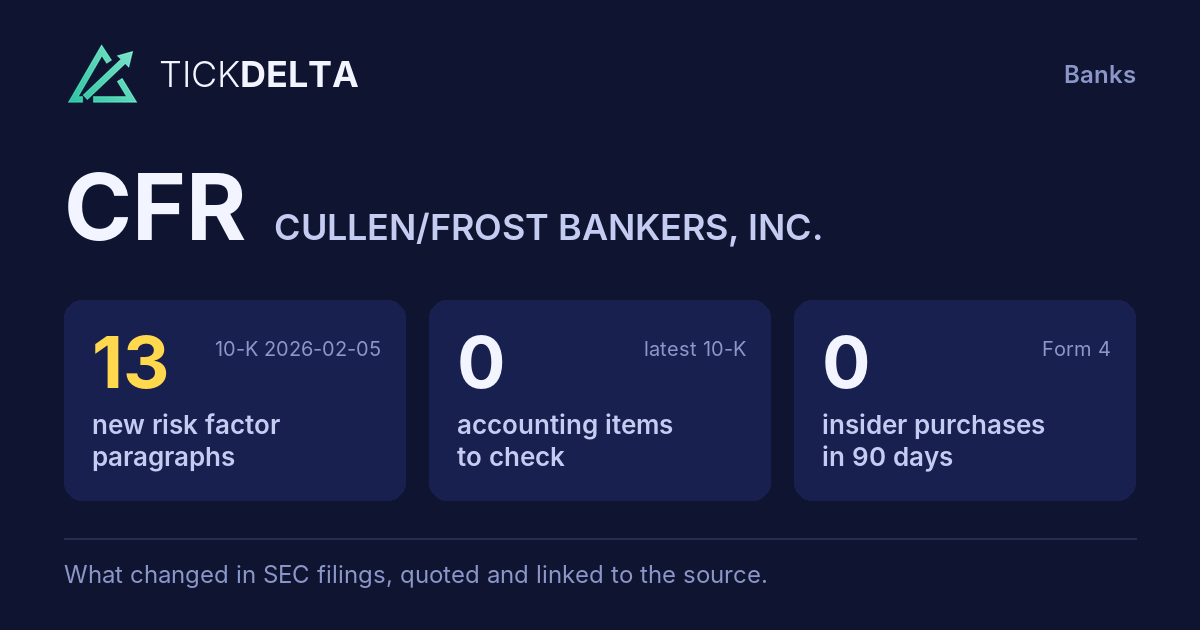
of the text changed · 10,908 words now · 13 new paragraphs, 2 gone
MD&A
18.4%
of the text changed · 17,195 words now · 5 new paragraphs, 4 gone
Legal Proceedings
13.4%
of the text changed · 952 words now
Accounting Policies
1.9%
of the text changed · 4,303 words now
10-K 0000039263-26-000011 (Feb 5, 2026) vs 10-K 0000039263-25-000017 (Feb 6, 2025)
Every paragraph, and how much of it changed
One bar per paragraph, in the order of the 10-K. Height and colour show the share of its words not in the closest paragraph a year earlier; the tallest bars are new paragraphs.
Risk Factors
99 paragraphs · 13 new · 29 reworded · 2 gone · 10-K Feb 5, 2026 against Feb 6, 2025
New paragraph
Reworded (5% of its words or more)
Same or nearly
Paragraph 58 · 42% changed
Every version of it
Paragraph 69 · 40% changed
Every version of it
We generally seek merger or acquisition partners that are culturally similar and have experienced management and possess either significant market presence or have potential for improved profitability through financial management, economies of scale or expanded services. Acquiring other banks, businesses, or branches involves various risks commonly associated with acquisitions, including, among other things, (i) potential exposure to unknown or contingent liabilities of the target company; (ii) exposure to potential asset quality issues of the target company; (iii) potential disruption to our business; (iv) potential diversion of our management’s time and attention; (v) the possible loss of key employees and customers of the target company; (vi) difficulty in estimating the value of the target company; and (vii) potential changes in banking or tax laws or regulations that may affect the target company.
Paragraph 70 · 22% changed
Every version of it
Paragraph 81 · 18% changed
Every version of it
Our success depends, to a certain extent, upon local, national and global economic and political conditions, as well as governmental monetary policies. Our financial performance generally, and in particular the ability of borrowers to pay interest on and repay principal of outstanding loans and the value of collateral securing those loans, as well as demand for loans and other products and services we offer, is highly dependent upon the business environment in the markets where we operate, in the State of Texas and in the United States as a whole. A favorable business environment is generally characterized by, among other factors, economic growth, efficient capital markets, low inflation, low unemployment, high business and investor confidence, and strong business earnings. Unfavorable or uncertain economic and market conditions can be caused by a decline in economic growth both in the U.S. and internationally; declines in business activity or investor or business confidence; limitations on the availability of or increases in the cost of credit and capital; increases in inflation or interest rates; high unemployment; oil price volatility; natural disasters; trade policies and tariffs; or a combination of these or other factors. In addition, financial markets and global supply chains may be adversely affected by the current or anticipated impact of global wars/military conflicts, terrorism or other geopolitical events. Current economic conditions are being heavily impacted by recent inflationary conditions and higher interest rates, the effects of which may impact our profitability by negatively impacting our fixed costs and expenses. Economic and inflationary pressure on consumers and uncertainty regarding economic improvement could result in changes in consumer and business spending, borrowing and savings habits. Such conditions could have a material adverse effect on the credit quality of our loans and our business, financial condition and results of operations.
Paragraph 23 · 17% changed
Every version of it
Paragraph 22 · 15% changed
Every version of it
Paragraph 57 · 15% changed
Every version of it
In addition, we face significant regulatory scrutiny, in the course of routine examinations and otherwise, and new regulations in response to negative developments in the banking industry, which may increase our cost of doing business and reduce our profitability. Among other things, there may be increased focus by both regulators and investors on deposit composition, the level of uninsured deposits, brokered deposits, unrealized losses in securities portfolios, liquidity, commercial real estate loan composition and concentrations, and capital as well as general oversight and control of the foregoing. We could face increased scrutiny or be viewed as higher risk by regulators and/or the investor community, which could have a material adverse effect on our business, financial condition and results of operations.
Paragraph 68 · 49% changed
Every version of it
10-K Feb 6, 2025Furthermore, any new line of business, new product or service and/or new technology could have a significant impact on the effectiveness of our system of internal controls. Failure to successfully manage these risks in the development and implementation of new lines of business, new products or services and/or new technologies could have a material adverse effect on our business, financial condition and results of operations.
10-K Feb 5, 2026
The duration and economic impact of any government shutdown are inherently uncertain, and any such event could, individually or in the aggregate, have a material adverse effect on our business, financial condition and results of operations.
Paragraph 58 · 42% changed
Every version of it
10-K Feb 6, 2025In addition, we face significant regulatory scrutiny, in the course of routine examinations and otherwise, and new regulations in response to negative developments in the banking industry, which may increase our cost of doing business and reduce our profitability. Among other things, there may be increased focus by both regulators and investors on deposit composition, the level of uninsured deposits, brokered deposits, unrealized losses in securities portfolios, liquidity, commercial real estate loan composition and concentrations, and capital as well as general oversight and control of the foregoing. We could face increased scrutiny or be viewed as higher risk by regulators and/or the investor community, which could have a material adverse effect on our business, financial condition and results of operations.
10-K Feb 5, 2026
oversight and control of the foregoing. We could face increased scrutiny or be viewed as higher risk by regulators and/or the investor community, which could have a material adverse effect on our business, financial condition and results of operations.
Paragraph 69 · 40% changed
Every version of it
10-K Feb 6, 2025
We generally seek merger or acquisition partners that are culturally similar and have experienced management and possess either significant market presence or have potential for improved profitability through financial management, economies of scale or expanded services. Acquiring other banks, businesses, or branches involves various risks commonly associated with acquisitions, including, among other things, (i) potential exposure to unknown or contingent liabilities of the target company; (ii) exposure to potential asset quality issues of the target company; (iii) potential disruption to our business; (iv) potential diversion of our management’s time and attention; (v) the possible loss of key employees and customers of the target company; (vi) difficulty in estimating the value of the target company; and (vii) potential changes in banking or tax laws or regulations that may affect the target company.
10-K Feb 5, 2026
We generally seek merger or acquisition partners that are culturally similar and have experienced management and possess either significant market presence or have potential for improved profitability through financial management, economies of scale or expanded services. Acquiring other banks, businesses, or branches involves
Paragraph 70 · 22% changed
Every version of it
10-K Feb 6, 2025We generally seek merger or acquisition partners that are culturally similar and have experienced management and possess either significant market presence or have potential for improved profitability through financial management, economies of scale or expanded services. Acquiring other banks, businesses, or branches involves various risks commonly associated with acquisitions, including, among other things, (i) potential exposure to unknown or contingent liabilities of the target company; (ii) exposure to potential asset quality issues of the target company; (iii) potential disruption to our business; (iv) potential diversion of our management’s time and attention; (v) the possible loss of key employees and customers of the target company; (vi) difficulty in estimating the value of the target company; and (vii) potential changes in banking or tax laws or regulations that may affect the target company.
10-K Feb 5, 2026
various risks commonly associated with acquisitions, including, among other things, (i) potential exposure to unknown or contingent liabilities of the target company; (ii) exposure to potential asset quality issues of the target company; (iii) potential disruption to our business; (iv) potential diversion of our management’s time and attention; (v) the possible loss of key employees and customers of the target company; (vi) difficulty in estimating the value of the target company; and (vii) potential changes in banking or tax laws or regulations that may affect the target company.
Paragraph 81 · 18% changed
Every version of it
10-K Feb 6, 2025
Our success depends, to a certain extent, upon local, national and global economic and political conditions, as well as governmental monetary policies. Our financial performance generally, and in particular the ability of borrowers to pay interest on and repay principal of outstanding loans and the value of collateral securing those loans, as well as demand for loans and other products and services we offer, is highly dependent upon the business environment in the markets where we operate, in the State of Texas and in the United States as a whole. A favorable business environment is generally characterized by, among other factors, economic growth, efficient capital markets, low inflation, low unemployment, high business and investor confidence, and strong business earnings. Unfavorable or uncertain economic and market conditions can be caused by a decline in economic growth both in the U.S. and internationally; declines in business activity or investor or business confidence; limitations on the availability of or increases in the cost of credit and capital; increases in inflation or interest rates; high unemployment; oil price volatility; natural disasters; trade policies and tariffs; or a combination of these or other factors. In addition, financial
10-K Feb 5, 2026
Our success depends, to a certain extent, upon local, national and global economic and political conditions, as well as governmental monetary policies. Our financial performance generally, and in particular the ability of borrowers to pay interest on and repay principal of outstanding loans and the value of collateral securing those loans, as well as demand for loans and other products and services we offer, is highly dependent upon the business environment in the markets where we operate, in the State of Texas and in the United States as a whole. A favorable business environment is generally characterized by, among other factors, economic growth, efficient capital markets, low inflation, low unemployment, high business and investor confidence, and strong business earnings. Unfavorable or uncertain economic and market conditions can be caused by a decline in economic growth both in the U.S. and internationally; declines in business activity or investor or business confidence; limitations on the availability of or increases in the cost of credit and capital; increases in inflation or interest rates; high unemployment; oil price volatility; natural disasters; trade policies and tariffs; or a combination of these or other factors. In addition, financial markets and global supply chains may be adversely affected by the current or anticipated impact of global wars/military conflicts, terrorism or other geopolitical events. Current economic conditions are being heavily impacted by recent inflationary conditions and higher interest rates, the effects of which may impact our profitability by negatively impacting our fixed costs and expenses. Economic and inflationary pressure on consumers and uncertainty regarding economic improvement could result in changes in consumer and business spending, borrowing and savings habits. Such conditions could have a material adverse effect on the credit quality of our loans and our business, financial condition and results of operations.
Paragraph 23 · 17% changed
Every version of it
10-K Feb 6, 2025views on these matters, we are at increased risk that any action, or lack thereof, concerning these matters will be perceived negatively by some stakeholders, which could negatively affect our business and reputation. Negative public opinion could also result from adverse news or publicity that impairs the reputation of the financial services industry generally or from the actions of our employees, customers, affiliates or third parties with whom we do business.
10-K Feb 5, 2026
negatively by some stakeholders, which could negatively affect our business and reputation. Negative public opinion could also result from adverse news or publicity that impairs the reputation of the financial services industry generally or from the actions of our employees, customers, affiliates or third parties with whom we do business.
Paragraph 22 · 15% changed
Every version of it
10-K Feb 6, 2025Reputation risk, or the risk to our earnings, liquidity, and capital from negative public opinion, is inherent in our business. Negative public opinion could adversely affect our ability to keep and attract customers and expose us to adverse legal and regulatory consequences. Negative public opinion could result from our actual or alleged conduct in any number of activities, including (i) lending practices, (ii) branching strategy, (iii) product and service offerings, (iv) corporate governance, (v) regulatory compliance, (vi) mergers and acquisitions, (vii) disclosure, (viii) sharing or inadequate protection of customer information, (ix) successful or attempted cyber-attacks against us, our customers or our third-party partners or vendors and (x) failure to discharge any publicly announced commitments to employees or ESG initiatives or to respond adequately to social and sustainability concerns from the viewpoint of our stakeholders from actions taken by government regulators and community organizations in response to our conduct. There has been an increased focus by investors and other stakeholders on topics related to corporate policies and approaches regarding ESG and diversity, equity and inclusion matters. Due to divergent stakeholder
10-K Feb 5, 2026
Risk to our earnings, liquidity, and capital from negative public opinion, is inherent in our business. Negative public opinion could adversely affect our ability to keep and attract customers and expose us to adverse legal and regulatory consequences. Negative public opinion could result from our actual or alleged conduct in any number of activities, including (i) lending practices, (ii) branching strategy, (iii) product and service offerings, (iv) corporate governance, (v) regulatory compliance, (vi) mergers and acquisitions, (vii) disclosure, (viii) sharing or inadequate protection of customer information, (ix) successful or attempted cyber-attacks against us, our customers or our third-party partners or vendors and (x) failure to achieve any publicly announced commitments to employees or other initiatives or to respond adequately to stakeholders’ concerns or actions taken by government regulators and community organizations. There is focus by some investors and other stakeholders on topics related to corporate policies and approaches related to environmental and social matters. Due to divergent stakeholder views on these matters, we are at increased risk that any action, or lack thereof, concerning these matters will be perceived
Paragraph 57 · 15% changed
Every version of it
10-K Feb 6, 2025
In addition, we face significant regulatory scrutiny, in the course of routine examinations and otherwise, and new regulations in response to negative developments in the banking industry, which may increase our cost of doing business and reduce our profitability. Among other things, there may be increased focus by both regulators and investors on deposit composition, the level of uninsured deposits, brokered deposits, unrealized losses in securities portfolios, liquidity, commercial real estate loan composition and concentrations, and capital as well as general oversight and control of the foregoing. We could face increased scrutiny or be viewed as higher risk by regulators and/or the investor community, which could have a material adverse effect on our business, financial condition and results of operations.
10-K Feb 5, 2026
In addition, we face significant regulatory scrutiny, in the course of routine examinations and otherwise, and new regulations in response to negative developments in the banking industry, which may increase our cost of doing business and reduce our profitability. Among other things, there may be increased focus by both regulators and investors on deposit composition, the level of uninsured deposits, brokered deposits, unrealized losses in securities portfolios, liquidity, commercial real estate loan composition and concentrations, and capital as well as general
MD&A
181 paragraphs · 5 new · 78 reworded · 4 gone · 10-K Feb 5, 2026 against Feb 6, 2025
New paragraph
Reworded (5% of its words or more)
Same or nearly
Paragraph 74 · 50% changed
In November 2023, December 2025, based upon the first six quarterly collections of the special assessment and anticipated collections for the seventh quarterly special assessment, the FDIC issued a an interim final rule to implement a amend the collection of the special assessment to recover losses reduce the eighth quarterly assessment rate from 3.36 basis points to 2.97 basis points. Because the DIF incurred as a result of bank failures earlier that year and cumulative amount collected through the FDIC's use of the systemic risk exception to cover certain deposits that were otherwise uninsured. The initial eight quarter special assessment period is projected to equal the FDIC’s loss estimate, the additional two quarter extended assessment period was based on estimated uninsured deposits as of December 31, 2022 (excluding the first $5.0 billion) and was assessed at a quarterly rate of 3.36 basis points, over eight quarterly assessment periods, beginning in the first quarter of 2024. As a result of removed. In light this interim final rule, we accrued $51.5 reversed a total of $9.7 million ($40.7 ($7.7 million after tax) of our special deposit insurance assessment accrual based upon a decrease in expected future payments related to this the special deposit insurance assessment. The interim final rule also requires the FDIC to provide an offset to regular quarterly deposit insurance assessments for institutions subject to the special assessment if the aggregate amount collected exceeds estimated losses following the resolution of pending litigation, and again following the termination of the receiverships. As provided for in the fourth quarter special assessment rule, if losses at the termination of 2023. This the receiverships exceed the amount was based on our estimate of collected, the FDIC will implement a one-time final shortfall special assessment to ensure the full amount of the assessment at that time. In February 2024, the FDIC notified insured depository institutions that their loss estimate related to the aforementioned bank failures had increased. As a result, we accrued an additional $7.7 million ($6.1 million after tax), related to an expected update of the special assessment during the first quarter of 2024. Upon receipt of the update during the second quarter of 2024, we accrued an additional $1.2 million ($984 thousand after tax) related to the special assessment. In June 2024, due to the increased estimate of losses, the FDIC announced that it projects that the special assessment will be collected for an additional two quarters beyond the initial eight-quarter collection period, at a lower rate. This updated assessment was made under the FDIC's final rule whereby the estimated loss pursuant to the systemic risk determination can be periodically adjusted. The FDIC has also retained the ability to cease collection early, extend the special assessment collection period and impose a final shortfall special assessment. actual losses is recovered as required by law. The extent to which any such additional future assessments offsets or a future one-time shortfall special assessment will impact our future deposit insurance expense is currently uncertain.
Paragraph 121 · 46% changed
Paragraph 72 · 42% changed
Deposit Insurance. Deposit insurance expense totaled $18.8 million in 2025 compared to $37.3 million in 2024 compared to $76.6 million in 2023. 2024. Deposit insurance expense include during 2024 included accruals totaling $9.0 million ($7.1 million after tax) in 2024 and $51.5 million ($40.7 million after tax) in 2023 related to a special deposit insurance assessment discussed below. Excluding these amounts During 2025, we reversed a total of $9.7 million ($7.7 million after tax) of our special deposit insurance assessment accrual based upon a decrease in expected future payments related to the special assessment, deposit insurance assessment. Excluding the special assessments from 2024 and reversals in 2025, deposit insurance expense would have increased $3.2 million in 2024 compared to 2023 primarily due to an increase in did not significantly fluctuate during the assessment rate. comparable periods.
Paragraph 84 · 42% changed
Paragraph 55 · 39% changed
Paragraph 83 · 36% changed
Paragraph 65 · 36% changed
Other Non-Interest Income. Other non-interest income for 2024 decreased $2.9 2025 increased $3.3 million, or 5.2%, 6.4%, compared to 2023. 2024. The decrease increase was primarily related to decreases increases in sundry gains on the sale of foreclosed and other miscellaneous income (down $6.9 assets (up $3.0 million) and income from customer derivative securities trading and foreign exchange transactions (down $2.0 million), among other things, derivatives trading activities (up $1.8 million and $791 thousand, respectively), partly offset by increases a decrease in public finance underwriting fees (up $4.9 (down $1.7 million), income from customer securities trading activities (up $957 thousand), and earnings on the cash surrender value of life insurance (up $802 thousand), among other things. Sundry and other miscellaneous income during 2024 included $4.6 million in card related incentives and $1.9 million related to the recovery of prior write-offs, among other things, while sundry and other miscellaneous income during 2023 included $5.6 million related to the recovery of prior write-offs, $4.4 million in card related incentives, and $1.5 million related to distributions received from a Small Business Investment Company (“SBIC”) fund investment, among other things. The fluctuations in public finance underwriting fees and income from customer derivative, foreign exchange derivative and securities trading transactions activities were primarily related to variations in transaction volumes. The increase in earnings Gains on the cash surrender value sale of life insurance was foreclosed and other assets during 2025 included a $2.5 million gain related to an increase the sale of a foreclosed real estate property during the first quarter and $768 thousand in market interest rates. gains related to sales of certain lots of land during the fourth quarter.
Paragraph 81 · 33% changed
The increase in service charges on deposit accounts was primarily related to increases in commercial service charges and overdraft charges on consumer and commercial accounts The increase in commercial service charges during 2024 was partly related to an increase in billable services partly offset by the effect of a higher average earnings credit rate applied to deposits maintained by treasury management customers. The increase in commercial service charges was also partly related, and, to a lesser extent, to an increase in commercial accounts, and commercial service fees on non-analyzed accounts. charges. The increase in overdraft charges was impacted by an increase in the volume of fee assessed overdrafts in part due to growth in the number of accounts. The increases in insurance commissions and fees were primarily related to increases in commercial lines benefit plan commissions, property and casualty commissions and contingent commissions life insurance commissions. The increase in other non-interest income was primarily related to increases in gains on the sale of foreclosed and other assets and income from customer securities trading and derivatives trading activities, partly offset by decreases a decrease in life insurance commissions. public finance underwriting fees, among other things. The increase in interchange and card transaction fees was primarily due to an increase in transaction volumes income from card transactions partly offset by an increase in network costs. The decrease increase in other non-interest income charges, commissions and fees was primarily related due to decreases increases in sundry commitment fees on unused lines of credit, merchant services rebates, funds transfer service charges, and other miscellaneous income and income from customer derivative and foreign exchange transactions, letter of credit fees, among other things, partly offset by increases a decrease in public finance underwriting fees and earnings on the cash surrender value of life insurance, subscription fee income, among other things. See the analysis of these categories of non-interest income included in the section captioned “Non-Interest Income” included elsewhere in this discussion.
Paragraph 74 · 50% changed
10-K Feb 6, 2025
In November 2023, the FDIC issued a final rule to implement a special assessment to recover losses to the DIF incurred as a result of bank failures earlier that year and the FDIC's use of the systemic risk exception to cover certain deposits that were otherwise uninsured. The special assessment was based on estimated uninsured deposits as of December 31, 2022 (excluding the first $5.0 billion) and was assessed at a quarterly rate of 3.36 basis points, over eight quarterly assessment periods, beginning in the first quarter of 2024. As a result of this final rule, we accrued $51.5 million ($40.7 million after tax) related to this assessment in the fourth quarter of 2023. This amount was based on our estimate of the full amount of the assessment at that time. In February 2024, the FDIC notified insured depository institutions that their loss estimate related to the aforementioned bank failures had increased. As a result, we accrued an additional $7.7 million ($6.1 million after tax), related to an expected update of the special assessment during the first quarter of 2024. Upon receipt of the update during the second quarter of 2024, we accrued an additional $1.2 million ($984 thousand after tax) related to the special assessment. In June 2024, due to the increased estimate of losses, the FDIC announced that it projects that the special assessment will be collected for an additional two quarters beyond the initial eight-quarter collection period, at a lower rate. This updated assessment was made under the FDIC's final rule whereby the estimated loss pursuant to the systemic risk determination can be periodically adjusted. The FDIC has also retained the ability to cease collection early, extend the special assessment collection period and impose a final shortfall special assessment. The extent to which any such additional future assessments will impact our future deposit insurance expense is currently uncertain.
10-K Feb 5, 2026
In December 2025, based upon the first six quarterly collections of the special assessment and anticipated collections for the seventh quarterly special assessment, the FDIC issued an interim final rule to amend the collection of the special assessment to reduce the eighth quarterly assessment rate from 3.36 basis points to 2.97 basis points. Because the cumulative amount collected through the initial eight quarter special assessment period is projected to equal the FDIC’s loss estimate, the additional two quarter extended assessment period was removed. In light this interim final rule, we reversed a total of $9.7 million ($7.7 million after tax) of our special deposit insurance assessment accrual based upon a decrease in expected future payments related to the special deposit insurance assessment. The interim final rule also requires the FDIC to provide an offset to regular quarterly deposit insurance assessments for institutions subject to the special assessment if the aggregate amount collected exceeds estimated losses following the resolution of pending litigation, and again following the termination of the receiverships. As provided for in the special assessment rule, if losses at the termination of the receiverships exceed the amount collected, the FDIC will implement a one-time final shortfall special assessment to ensure the full amount of actual losses is recovered as required by law. The extent to which any such future offsets or a future one-time shortfall special assessment will impact our future deposit insurance expense is currently uncertain.
Paragraph 121 · 46% changed
10-K Feb 6, 2025As of December 31, 2023, we provided qualitative adjustments, as detailed in the table below. Further information regarding these qualitative adjustments is provided in our 2023 Form 10-K.
10-K Feb 5, 2026
Further information regarding the geographic distribution of commercial real estate loans, by class, as of December 31, 2025 and 2024, is presented in the table below.
Paragraph 72 · 42% changed
10-K Feb 6, 2025
Deposit Insurance. Deposit insurance expense totaled $37.3 million in 2024 compared to $76.6 million in 2023. Deposit insurance expense include accruals totaling $9.0 million ($7.1 million after tax) in 2024 and $51.5 million ($40.7 million after tax) in 2023 related to a special deposit insurance assessment discussed below. Excluding these amounts related to the special assessment, deposit insurance expense would have increased $3.2 million in 2024 compared to 2023 primarily due to an increase in the assessment rate.
10-K Feb 5, 2026
Deposit Insurance. Deposit insurance expense totaled $18.8 million in 2025 compared to $37.3 million in 2024. Deposit insurance expense during 2024 included accruals totaling $9.0 million ($7.1 million after tax) related to a special deposit insurance assessment discussed below. During 2025, we reversed a total of $9.7 million ($7.7 million after tax) of our special deposit insurance assessment accrual based upon a decrease in expected future payments related to the special deposit insurance assessment. Excluding the special assessments from 2024 and reversals in 2025, deposit insurance expense did not significantly fluctuate during the comparable periods.
Paragraph 84 · 42% changed
10-K Feb 6, 2025which was primarily related to information technology services; travel, meals and entertainment; stationery/printing expense; postage expense; and business development expense, among other things. The increase from these items was partly offset by a decrease in donations expense and a decrease in sundry and other miscellaneous expense, in part due to certain operational losses and write-offs recognized in 2023, among other things. The increase in employee benefits expense was primarily related to increases in medical/dental benefits expense and payroll taxes, among other things, partly offset by a decrease in 401(k)/profit sharing plan expense and an increase in the net periodic benefit related to our defined benefit retirement plan, among other things. Deposit insurance expense include accruals totaling $9.0 million ($7.1 million after tax) in 2024 and $51.5 million ($40.7 million after tax) in 2023 related to a special deposit insurance assessment. Excluding these amounts related to the special assessment, deposit insurance expense would have increased $3.2 million in 2024 compared to 2023 primarily due to an increase in the assessment rate. See the analysis of these categories of non-interest expense included in the section captioned “Non-Interest Expense” included elsewhere in this discussion.
10-K Feb 5, 2026
partly offset by a decrease in check card expenses, among other things. The increase in employee benefits expense was primarily related to increases in medical/dental benefits expense, 401(k) plan expense, and payroll taxes. The increase in technology, furniture, and equipment expense was primarily related to increases in cloud services expense, software maintenance expense, depreciation on furniture and equipment, and service contracts expense, among other things. The increase in net occupancy expense was primarily related to increases in depreciation on buildings and leasehold improvements; lease expense; and property taxes, among other things. Deposit insurance expense during 2024 included accruals totaling $9.0 million ($7.1 million after tax) related to a special deposit insurance assessment. During 2025, we reversed a total of $9.7 million ($7.7 million after tax) of our special deposit insurance assessment accrual based upon a decrease in expected future payments related to the special deposit insurance assessment. Excluding the special assessments from 2024 and reversals in 2025, deposit insurance expense did not significantly fluctuate during the comparable periods. See the analysis of these categories of non-interest expense included in the section captioned “Non-Interest Expense” included elsewhere in this discussion.
Paragraph 55 · 39% changed
10-K Feb 6, 2025Non-interest income for 2024 increased $13.5 million, or 5.4%, compared to 2023. The increase was primarily related to increases in service charges on deposit accounts; insurance commissions and fees; and interchange and card transaction fees partly offset by a decrease in other non-interest income.
10-K Feb 5, 2026
Service Charges on Deposit Accounts. Service charges on deposit accounts for 2025 increased $15.3 million, or 14.4%, compared to 2024. The increase was primarily related to increases in overdraft charges on consumer and, to a lesser extent, commercial accounts (up $7.6 million and $1.1 million, respectively), and commercial service charges (up $7.2 million).
Paragraph 83 · 36% changed
10-K Feb 6, 2025Non-interest expense for 2024 increased $61.0 million, or 5.7%, compared to 2023. The increase was primarily related to increases in salaries and wages; technology, furniture, and equipment expense; other non-interest expense; employee benefit expense; and net occupancy expense, partly offset by a decrease in deposit insurance expense. The increase in salaries and wages was primarily related to an increase in salaries due to annual merit and market increases and an increase in the number of employees. Salaries and wages were also impacted, to a lesser extent, by increases in incentive compensation and commissions and a decrease in stock-based compensation. The increase in technology, furniture, and equipment expense was primarily related to increases in cloud services expense, service contracts expense, software amortization, and software maintenance expense, among other things. The increase in other non-interest expense included increases in advertising/promotions expense; professional services expense,
10-K Feb 5, 2026
The increase in salaries and wages was primarily related to increases in salaries due to annual merit and market increases and an increase in the number of employees. Salaries and wages were also impacted, to a lesser extent, by increases in incentive compensation and stock-based compensation. The increase in other non-interest expense included increases in fraud losses; sundry and other miscellaneous expense; advertising/promotions expense; donations expense, primarily related to donations to the Frost Charitable Foundation; professional services expense; business development expense; travel, meals and entertainment; and communications expense; among other things,
Paragraph 65 · 36% changed
10-K Feb 6, 2025
Other Non-Interest Income. Other non-interest income for 2024 decreased $2.9 million, or 5.2%, compared to 2023. The decrease was primarily related to decreases in sundry and other miscellaneous income (down $6.9 million) and income from customer derivative and foreign exchange transactions (down $2.0 million), among other things, partly offset by increases in public finance underwriting fees (up $4.9 million), income from customer securities trading activities (up $957 thousand), and earnings on the cash surrender value of life insurance (up $802 thousand), among other things. Sundry and other miscellaneous income during 2024 included $4.6 million in card related incentives and $1.9 million related to the recovery of prior write-offs, among other things, while sundry and other miscellaneous income during 2023 included $5.6 million related to the recovery of prior write-offs, $4.4 million in card related incentives, and $1.5 million related to distributions received from a Small Business Investment Company (“SBIC”) fund investment, among other things. The fluctuations in public finance underwriting fees and income from customer derivative, foreign exchange and securities trading transactions were primarily related to variations in transaction volumes. The increase in earnings on the cash surrender value of life insurance was related to an increase in market interest rates.
10-K Feb 5, 2026
Other Non-Interest Income. Other non-interest income for 2025 increased $3.3 million, or 6.4%, compared to 2024. The increase was primarily related to increases in gains on the sale of foreclosed and other assets (up $3.0 million) and income from customer securities trading and derivatives trading activities (up $1.8 million and $791 thousand, respectively), partly offset by a decrease in public finance underwriting fees (down $1.7 million), among other things. The fluctuations in public finance underwriting fees and income from customer derivative and securities trading activities were primarily related to variations in transaction volumes. Gains on the sale of foreclosed and other assets during 2025 included a $2.5 million gain related to the sale of a foreclosed real estate property during the first quarter and $768 thousand in gains related to sales of certain lots of land during the fourth quarter.
Paragraph 81 · 33% changed
10-K Feb 6, 2025
The increase in service charges on deposit accounts was primarily related to increases in commercial service charges and overdraft charges on consumer and commercial accounts The increase in commercial service charges during 2024 was partly related to an increase in billable services partly offset by the effect of a higher average earnings credit rate applied to deposits maintained by treasury management customers. The increase in commercial service charges was also partly related, to a lesser extent, to an increase in service fees on non-analyzed accounts. The increase in overdraft charges was impacted by an increase in the volume of fee assessed overdrafts in part due to growth in the number of accounts. The increases in insurance commissions and fees were primarily related to increases in commercial lines property and casualty commissions and contingent commissions partly offset by decreases in life insurance commissions. The increase in interchange and card transaction fees was primarily due to an increase in transaction volumes partly offset by an increase in network costs. The decrease in other non-interest income was primarily related to decreases in sundry and other miscellaneous income and income from customer derivative and foreign exchange transactions, among other things, partly offset by increases in public finance underwriting fees and earnings on the cash surrender value of life insurance, among other things. See the analysis of these categories of non-interest income included in the section captioned “Non-Interest Income” included elsewhere in this discussion.
10-K Feb 5, 2026
The increase in service charges on deposit accounts was primarily related to increases in overdraft charges on consumer and, to a lesser extent, commercial accounts, and commercial service charges. The increase in insurance commissions and fees were primarily related to increases in benefit plan commissions, property and casualty commissions and life insurance commissions. The increase in other non-interest income was primarily related to increases in gains on the sale of foreclosed and other assets and income from customer securities trading and derivatives trading activities, partly offset by a decrease in public finance underwriting fees, among other things. The increase in interchange and card transaction fees was primarily due to an increase in income from card transactions partly offset by an increase in network costs. The increase in other charges, commissions and fees was primarily due to increases in commitment fees on unused lines of credit, merchant services rebates, funds transfer service charges, and letter of credit fees, among other things, partly offset by a decrease in subscription fee income, among other things. See the analysis of these categories of non-interest income included in the section captioned “Non-Interest Income” included elsewhere in this discussion.
A paragraph is matched with the one last year that shares the most of its words; under half in common makes it new. The paragraphs shown are the 8 reworded the most in each section.
The paragraph that changed most in each section
The redline
Marked against last year's 10-K: cut words struck through, new words highlighted.
MD&A220 words changed in this paragraph; it is 35% similar to last year's version.
Source: Item 7, 10-K 0000039263-26-000011 vs Item 7, 10-K 0000039263-25-000017
Risk Factors103 words changed in this paragraph; it is 79% similar to last year's version.
Our success depends, to a certain extent, upon local, national and global economic and political conditions, as well as governmental monetary policies. Our financial performance generally, and in particular the ability of borrowers to pay interest on and repay principal of outstanding loans and the value of collateral securing those loans, as well as demand for loans and other products and services we offer, is highly dependent upon the business environment in the markets where we operate, in the State of Texas and in the United States as a whole. A favorable business environment is generally characterized by, among other factors, economic growth, efficient capital markets, low inflation, low unemployment, high business and investor confidence, and strong business earnings. Unfavorable or uncertain economic and market conditions can be caused by a decline in economic growth both in the U.S. and internationally; declines in business activity or investor or business confidence; limitations on the availability of or increases in the cost of credit and capital; increases in inflation or interest rates; high unemployment; oil price volatility; natural disasters; trade policies and tariffs; or a combination of these or other factors. In addition, financial markets and global supply chains may be adversely affected by the current or anticipated impact of global wars/military conflicts, terrorism or other geopolitical events. Current economic conditions are being heavily impacted by recent inflationary conditions and higher interest rates, the effects of which may impact our profitability by negatively impacting our fixed costs and expenses. Economic and inflationary pressure on consumers and uncertainty regarding economic improvement could result in changes in consumer and business spending, borrowing and savings habits. Such conditions could have a material adverse effect on the credit quality of our loans and our business, financial condition and results of operations.
Source: Item 1A, 10-K 0000039263-26-000011 vs Item 1A, 10-K 0000039263-25-000017
Legal Proceedings90 words changed in this paragraph; it is 78% similar to last year's version.
Allowance For Credit Losses - Off-Balance-Sheet Credit Exposures. The allowance for credit losses on off-balance-sheet credit exposures is a liability account, calculated in accordance with ASC 326, representing expected credit losses over the contractual period for which we are exposed to credit risk resulting from a contractual obligation to extend credit. No allowance is recognized if we have the unconditional right to cancel the obligation. Off-balance-sheet credit exposures primarily consist of amounts available under outstanding lines of credit and letters of credit detailed in the table above. For the period of exposure, the estimate of expected credit losses considers both the likelihood that funding will occur and the amount expected to be funded over the estimated remaining life of the commitment or other off-balance-sheet exposure. The likelihood and expected amount of funding are based on historical utilization rates. The amount of the allowance represents management's best estimate of expected credit losses on commitments expected to be funded over the contractual life of the commitment. Estimating credit losses on amounts expected to be funded uses the same methodology as described for loans in Note 3 - Loans as if such commitments were funded. This methodology was also impacted by the model updates during 2024, as described in Note 3 - Loans. For 2024, the overall approximate impact of the model updates was a $1.8 million increase in modeled expected credit losses for off-balance-sheet credit exposures ($1.6 million related to consumer and other loan commitments and $211 thousand related to non-owner-occupied commercial real estate loan commitments).
Source: Item 3, via Note 7 – Off-Balance-Sheet Arrangements, Commitments, Guarantees and Contingencies, 10-K 0000039263-26-000011 vs Item 3, via Note 7 – Off-Balance-Sheet Arrangements, Commitments, Guarantees and Contingencies, 10-K 0000039263-25-000017
Accounting Policies33 words changed in this paragraph; it is 84% similar to last year's version.
Allowance For Credit Losses - Held-to-Maturity Securities. The allowance for credit losses on held-to-maturity securities is a contra-asset valuation account, calculated in accordance with Accounting Standards Codification (“ASC”) Topic 326 (“ASC 326”), that is deducted from the amortized cost basis of held-to-maturity securities to present management's best estimate of the net amount expected to be collected. Held-to-maturity securities are charged-off against the allowance when deemed uncollectible by management. Adjustments to the allowance are reported in our income statement as a component of credit loss expense. Management measures expected credit losses on held-to-maturity securities on a collective basis by major security type with each type sharing similar risk characteristics and considers historical credit loss information that is adjusted for current conditions and reasonable
Source: Item 8, Note 1 – Summary of Significant Accounting Policies, 10-K 0000039263-26-000011 vs Item 8, Note 1 – Summary of Significant Accounting Policies, 10-K 0000039263-25-000017
Sentences and paragraphs added, removed or reworded
Every change, by type
Sentences and paragraphs of CFR's Risk Factors and MD&A, 10-K Feb 5, 2026 against 10-K Feb 6, 2025. Each links to the text at sec.gov.
Quiet changes are sentences kept from last year with one to four words changed, at least one of them a hedge, a modal or a qualifier (may, could, will, not, significant, material…). A year or date rolling forward is not counted.
The full word list
adverse, adversely, all, although, anticipate, anticipates, any, approximately, believe, believes, can, cannot, certain, could, expect, expects, generally, however, if, intend, intends, largely, likely, many, material, materially, may, might, most, must, never, no, not, possible, primarily, probable, should, significant, significantly, some, substantial, substantially, unlikely, will, would
AddedRisk Factors
Furthermore, the rapid development of quantum computing poses a material risk to the encryption standards currently securing our financial systems, as future quantum capabilities could enable unauthorized decryption of sensitive data, disruption of transaction integrity and invalidation of digital identities, potentially leading to financial losses and reputational damage.
Read it in 10-K Feb 5, 2026 at sec.gov
AddedRisk Factors
Increasing Fraud Risk Could Adversely Affect Our Business, Financial Condition, and Reputation
Read it in 10-K Feb 5, 2026 at sec.gov
AddedRisk Factors
We are exposed to an increasing risk of fraud, including cyber fraud, identity theft, account takeover, and other fraudulent activities targeting financial institutions and their customers. The sophistication and frequency of these schemes continue to grow, driven by advances in technology and the proliferation of digital banking channels. Fraudulent activity can result in financial losses for us or our customers, increased operational costs, and potential legal exposure.
Read it in 10-K Feb 5, 2026 at sec.gov
AddedRisk Factors
Although we employ robust security measures, including authentication protocols, transaction monitoring, and fraud detection systems, these controls may not be sufficient to prevent all fraudulent activity. Criminals continuously adapt their methods to circumvent existing safeguards, and emerging technologies such as artificial intelligence may further enhance their ability to perpetrate fraud.
Read it in 10-K Feb 5, 2026 at sec.gov
AddedRisk Factors
Significant fraud-related losses could negatively impact our earnings, capital, and liquidity. In addition, fraud incidents may harm our reputation, erode customer trust, and lead to regulatory scrutiny or enforcement actions. Failure to effectively manage and mitigate fraud risk could have a material adverse effect on our business, financial condition, and results of operations.
Read it in 10-K Feb 5, 2026 at sec.gov
AddedRisk Factors
In July 2025, President Trump signed into law the GENIUS Act, which establishes a regulatory framework for “payment stablecoins” and their issuers. Consumers and businesses may view payment stablecoins as a substitute for traditional bank deposits, resulting in deposit withdrawals. Depending on consumer and business interest in payment stablecoins, and the characteristics and utility of payment stablecoins, the passage of the GENIUS Act could result in increased competition with respect to our deposit products. However, the GENIUS Act requires the U.S. Treasury
Read it in 10-K Feb 5, 2026 at sec.gov
AddedRisk Factors
Department and federal and state regulators to issue regulations on numerous topics to interpret and implement the statute, so the effect of the GENIUS Act will depend on what those regulations provide.
Read it in 10-K Feb 5, 2026 at sec.gov
AddedRisk Factors
We Are Subject To the Potential Adverse Effects of a U.S. Federal Government Shutdown
Read it in 10-K Feb 5, 2026 at sec.gov
Show the other 38
AddedRisk Factors
A prolonged or repeated shutdown of the U.S. federal government could adversely affect our business, financial condition, liquidity, and results of operations. Funding gaps or lapses in federal appropriations may disrupt the operations of government agencies that provide critical economic data, administer regulatory functions, or directly support our customers and counterparties. During a shutdown, federal agencies such as the Internal Revenue Service, Small Business Administration, and various supervisory bodies may suspend or significantly curtail their activities, which can delay loan originations, hinder verification processes, impede regulatory approvals, and reduce the availability of government‑guaranteed lending programs.
Read it in 10-K Feb 5, 2026 at sec.gov
AddedRisk Factors
A shutdown may also impair the financial capacity of borrowers who depend on federal salaries, contracts, reimbursements, or benefit programs, including government employees, federal contractors, and recipients of government-funded services. Reduced or delayed income to these borrowers could increase delinquencies, reduce loan demand, negatively affect deposit inflows, and increase our credit risk exposure. In addition, disruptions to federal economic data releases or fiscal operations may create volatility in financial markets, affecting interest rates, liquidity conditions, and the valuation of securities in our investment portfolio.
Read it in 10-K Feb 5, 2026 at sec.gov
AddedRisk Factors
Climate Related Risks Could Have a Material Negative Impact on Us and Our Customers
Read it in 10-K Feb 5, 2026 at sec.gov
AddedRisk Factors
Our business, as well as the operations and activities of our customers, could be negatively impacted by climate-related risks in both the short-term and the long-term.
Read it in 10-K Feb 5, 2026 at sec.gov
RemovedRisk Factors
RemovedRisk Factors
RewordedRisk Factors
Negative public opinion could result from our actual or alleged conduct in any number of activities, including (i) lending practices, (ii) branching strategy, (iii) product and service offerings, (iv) corporate governance, (v) regulatory compliance, (vi) mergers and acquisitions, (vii) disclosure, (viii) sharing or inadequate protection of customer information, (ix) successful or attempted cyber-attacks against us, our customers or our third-party partners or vendors and (x) failure to discharge achieve any publicly announced commitments to employees or ESG other initiatives or to respond adequately to social and sustainability stakeholders’ concerns from the viewpoint of our stakeholders from or actions taken by government regulators and community organizations in response to our conduct. organizations.
Read it in 10-K Feb 5, 2026 at sec.gov
RewordedRisk Factors
RewordedRisk Factors
There has been an increased is focus by some investors and other stakeholders on topics related to corporate policies and approaches regarding ESG related to environmental and diversity, equity and inclusion social matters.
Read it in 10-K Feb 5, 2026 at sec.gov
RewordedRisk Factors
The occurrence of any of the foregoing could have a material adverse effect on our business, financial condition and results of operations. operations and could result in serious and harmful consequences to our customers.
Read it in 10-K Feb 5, 2026 at sec.gov
RewordedRisk Factors
The financial services industry is continually undergoing rapid technological change with frequent introductions of new technology-driven products and services. services, including the increased usage of intelligent automation within the industry.
Read it in 10-K Feb 5, 2026 at sec.gov
RewordedRisk Factors
Moreover, if we need to raise capital in the future, we may have to do so when many other financial institutions are also seeking to raise capital and would have to compete with those institutions for investors.
Read it in 10-K Feb 5, 2026 at sec.gov
RewordedRisk Factors
The price per barrel of crude oil was approximately $72 $57.95 at both December 31, 2024, 2025 and $71.72 at December 31, 2023. 2024.
Read it in 10-K Feb 5, 2026 at sec.gov
RewordedRisk Factors
Changes in economic conditions; inflation; interest rate volatility; new information regarding existing loans, credit commitments and securities holdings; the lingering effects of the COVID-19 pandemic or other global pandemics; natural disasters and risks related to climate change; and identification of additional problem loans, ratings down-grades and other factors, both within and outside of our control, may require an increase in the allowances for credit losses on loans, securities and off-balance sheet credit exposures.
Read it in 10-K Feb 5, 2026 at sec.gov
RewordedRisk Factors
RewordedRisk Factors
In addition, the emergence, adoption and evolution of new technologies that do not require intermediation, including distributed ledgers such as stablecoin and other digital assets and blockchain, as well as advances in robotic process intelligent automation, could significantly affect the competition for financial services.
Read it in 10-K Feb 5, 2026 at sec.gov
RewordedRisk Factors
Among other things, there may be increased focus by both regulators and investors on deposit composition, the level of uninsured deposits, brokered deposits, unrealized losses in securities portfolios, liquidity, commercial real estate loan composition and concentrations, and capital as well as general oversight and control of the foregoing.
Read it in 10-K Feb 5, 2026 at sec.gov
AddedMD&A
In addition, financial markets, international relations, and global supply chains have been significantly impacted by recent U.S. trade policies and practices. Due to the rapidly evolving and changing state of U.S. trade policies, the amount and duration of any tariffs and their ultimate impact on us, our customers, financial markets, and the overall U.S. and global economies is currently uncertain. Nonetheless, prolonged uncertainty, elevated tariff levels or their wide-spread use in U.S. trade policy could weaken economic conditions and adversely impact the ability of borrowers to repay outstanding loans or the value of collateral securing these loans or adversely affect financial markets or the values of securities. To the extent that these risks may have a negative impact on the financial condition of borrowers or financial markets, it could also have a material adverse effect on our business, financial condition and results of operations.
Read it in 10-K Feb 5, 2026 at sec.gov
AddedMD&A
included in Item 8. Financial Statements and Supplementary Data elsewhere in this report for further details of the risk factors considered by management in estimating the necessary level of the allowance for credit losses.
Read it in 10-K Feb 5, 2026 at sec.gov
AddedMD&A
One Big Beautiful Bill Act. The One Big Beautiful Bill Act (“OBBBA”) was enacted on July 4, 2025. Among other things, the new law makes permanent certain expiring business tax provisions of the Tax Cuts and Jobs Act (“TCJA”). These include provisions which allow businesses to immediately expense, for tax purposes, the cost of new investments in certain qualified depreciable assets and the cost of qualified domestic research and development. The OBBBA also imposes a floor on tax deductions taken on charitable contributions. These items did not have a significant impact on our financial statements, though some minor operational changes were necessary to support new information reporting requirements. The OBBBA also significantly changes U.S. tax law related to foreign operations and certain tax credits; however, such changes do not currently impact us.
Read it in 10-K Feb 5, 2026 at sec.gov
AddedMD&A
The following table summarizes the industry concentrations of our commercial and industrial and energy loan portfolios, as segregated by SIC code, as of December 31, 2025 and 2024.
Read it in 10-K Feb 5, 2026 at sec.gov
AddedMD&A
The following table summarizes our commercial real estate loan portfolio, by underlying property type, as of December 31, 2025 and 2024.
Read it in 10-K Feb 5, 2026 at sec.gov
RemovedMD&A
RemovedMD&A
RemovedMD&A
RemovedMD&A
RewordedMD&A
The increase was primarily related to increases in income from the placement of annuities (up $1.7 million) $1.5 million), commitment fees on unused lines of credit (up $943 thousand), income from the placement of mutual funds (up $591 thousand), merchant services rebates (up $578 thousand), funds transfer service charges (up $499 thousand), and money market accounts (up $1.4 million); letter of credit fees (up $933 thousand); and merchant services rebates/bonuses (up $888 thousand); $439 thousand), among other things, partly offset by decreases a decrease in capital markets advisory fees subscription fee income (down $985 thousand) and other service charges (down $908 $740 thousand), among other things.
Read it in 10-K Feb 5, 2026 at sec.gov
RewordedMD&A
The increase in the average volume of interest-earning assets during 2024 2025 was primarily related to a $1.9 $1.4 billion increase in average loans loans, a $938.4 million increase in average taxable securities, and a $208.0 $173.1 million increase in average tax-exempt securities, partly offset by a $376.1 million decrease in average interest-bearing deposits (primarily amounts held by us in an interest-bearing account at the Federal Reserve) partly offset by and a $1.2 billion decrease in average taxable securities, a $766.5 million decrease in average tax-exempt securities, a $31.0 $42.3 million decrease in average resell agreements and a $20.7 million decrease in average federal funds sold. agreements.
Read it in 10-K Feb 5, 2026 at sec.gov
RewordedMD&A
The increase in service charges on deposit accounts was primarily related to increases in commercial service charges and overdraft charges on consumer and, to a lesser extent, commercial accounts, and commercial accounts The increase in commercial service charges during 2024 was partly related to an increase in billable services partly offset by the effect of a higher average earnings credit rate applied to deposits maintained by treasury management customers. charges.
Read it in 10-K Feb 5, 2026 at sec.gov
RewordedMD&A
The increase was primarily related to increases in past due commercial real estate - buildings, land, and other non-owner occupied loans (up $18.6 $29.3 million), past due energy loans (up $15.2 million), past due commercial and industrial real estate - owner occupied loans (up $11.3 million) $14.4 million), and past due consumer real estate loans (up $7.6 million) $9.3 million), partly offset by decreases a decrease in past due commercial real estate - construction and industrial loans (down $7.5 million) and past due energy loans (down $3.3 $8.7 million).
Read it in 10-K Feb 5, 2026 at sec.gov
RewordedMD&A
The allowance allocated to commercial and industrial loans totaled $98.4 million, or 1.56% of total commercial and industrial loans, at December 31, 2025 increasing $10.9 million, or 12.4%, compared to $87.6 million, or 1.43% of total commercial and industrial loans, at December 31, 2024 increasing $13.6 million, or 18.3%, compared to $74.0 million, or 1.24% of total commercial and industrial loans at December 31, 2023. 2024.
Read it in 10-K Feb 5, 2026 at sec.gov
RewordedMD&A
The allowance allocated to commercial real estate loans totaled $135.1 million, or 1.31% of total commercial real estate loans at December 31, 2025, decreasing $8.1 million, or 5.7%, compared to $143.2 million, or 1.44% of total commercial real estate loans, at December 31, 2024 increasing $12.6 million, or 9.7%, compared to $130.6 million, or 1.45% of total commercial real estate loans at December 31, 2023. 2024.
Read it in 10-K Feb 5, 2026 at sec.gov
RewordedMD&A
The decrease increase was primarily the result of a $61.0 $130.3 million increase in net interest income, a $25.4 million increase in non-interest expense income, and an $18.8 a $20.8 million increase decrease in credit loss expense partly offset by a $48.2 million increase in net interest income and a $13.5 $102.0 million increase in non-interest income. expense and a $9.4 million increase in income tax expense.
Read it in 10-K Feb 5, 2026 at sec.gov
RewordedMD&A
The increases in expected credit losses were primarily related to increases in modeled expected credit losses for the aforementioned portfolio segments as well as qualitative adjustments for commercial real estate loans and commercial and industrial loans; specific allocations for commercial and industrial loans; and modeled expected credit losses, primarily related to consumer real estate and, to a lesser extent, commercial real estate. loans.
Read it in 10-K Feb 5, 2026 at sec.gov
RewordedMD&A
The decrease increase in other non-interest income was primarily related to decreases increases in sundry gains on the sale of foreclosed and other miscellaneous income assets and income from customer derivative securities trading and foreign exchange transactions, among other things, derivatives trading activities, partly offset by increases a decrease in public finance underwriting fees and earnings on the cash surrender value of life insurance, fees, among other things.
Read it in 10-K Feb 5, 2026 at sec.gov
RewordedMD&A
The increase in trust and investment management fees during 2024 2025 was primarily related to increases an increase in investment management fees (up $12.8 $10.4 million) and oil and gas and, to a lesser extent, estate fees (up $1.5 $2.0 million), partly offset by decreases in estate fees (down $2.3 million) and real estate fees (down $637 thousand). among other things.
Read it in 10-K Feb 5, 2026 at sec.gov
RewordedMD&A
The allowance allocated to energy loans totaled $11.6 million, or 1.06% of total energy loans, at December 31, 2025 increasing $1.6 million, or 15.7%, compared to $10.0 million, or 0.89% of total energy loans, at December 31, 2024 decreasing $7.8 million, or 43.9%, compared to $17.8 million, or 1.90% of total energy loans, at December 31, 2023. 2024.
Read it in 10-K Feb 5, 2026 at sec.gov
RewordedMD&A
The increase in employee benefits expense was primarily related to increases in medical/dental benefits expense expense, 401(k) plan expense, and payroll taxes, among other things, partly offset by a decrease in 401(k)/profit sharing plan expense and an increase in the net periodic benefit related to our defined benefit retirement plan, among other things. taxes.
Read it in 10-K Feb 5, 2026 at sec.gov
Sources
The two latest 10-Ks on EDGAR, section by section. Each change links to the text at sec.gov.
Also
New risk factors: paragraphs with nothing like them last year, quoted in full.
Work with it
Excel workbook · CSV. Google Sheet that stays up to date: paste =IMPORTDATA("https://tickdelta.com/company/CFR/export.csv") into a cell.