Cullen/Frost Bankers, Inc. CFR
New risk paragraphs, branching off last year
Each branch is a paragraph in Risk Factors with nothing like it in the 10-K filed Feb 6, 2025. A box jumps to the paragraph as filed, below.
Paragraphs with nothing like them in last year's 10-K
13 paragraphs in Risk Factors of the 10-K filed Feb 5, 2026 with nothing like them in the 10-K filed Feb 6, 2025. Quoted exactly. Paragraphs that were only edited are under 10-K change.
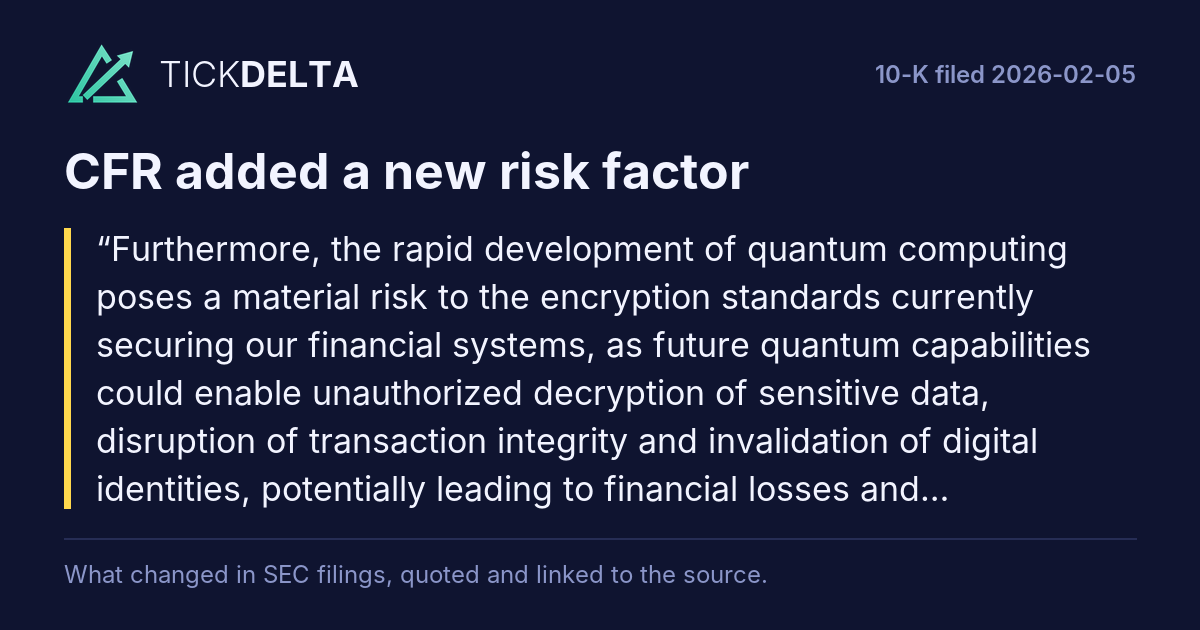
Furthermore, the rapid development of quantum computing poses a material risk to the encryption standards currently securing our financial systems, as future quantum capabilities could enable unauthorized decryption of sensitive data, disruption of transaction integrity and invalidation of digital identities, potentially leading to financial losses and reputational damage.
Increasing Fraud Risk Could Adversely Affect Our Business, Financial Condition, and Reputation
We are exposed to an increasing risk of fraud, including cyber fraud, identity theft, account takeover, and other fraudulent activities targeting financial institutions and their customers. The sophistication and frequency of these schemes continue to grow, driven by advances in technology and the proliferation of digital banking channels. Fraudulent activity can result in financial losses for us or our customers, increased operational costs, and potential legal exposure.
Although we employ robust security measures, including authentication protocols, transaction monitoring, and fraud detection systems, these controls may not be sufficient to prevent all fraudulent activity. Criminals continuously adapt their methods to circumvent existing safeguards, and emerging technologies such as artificial intelligence may further enhance their ability to perpetrate fraud.
Significant fraud-related losses could negatively impact our earnings, capital, and liquidity. In addition, fraud incidents may harm our reputation, erode customer trust, and lead to regulatory scrutiny or enforcement actions. Failure to effectively manage and mitigate fraud risk could have a material adverse effect on our business, financial condition, and results of operations.
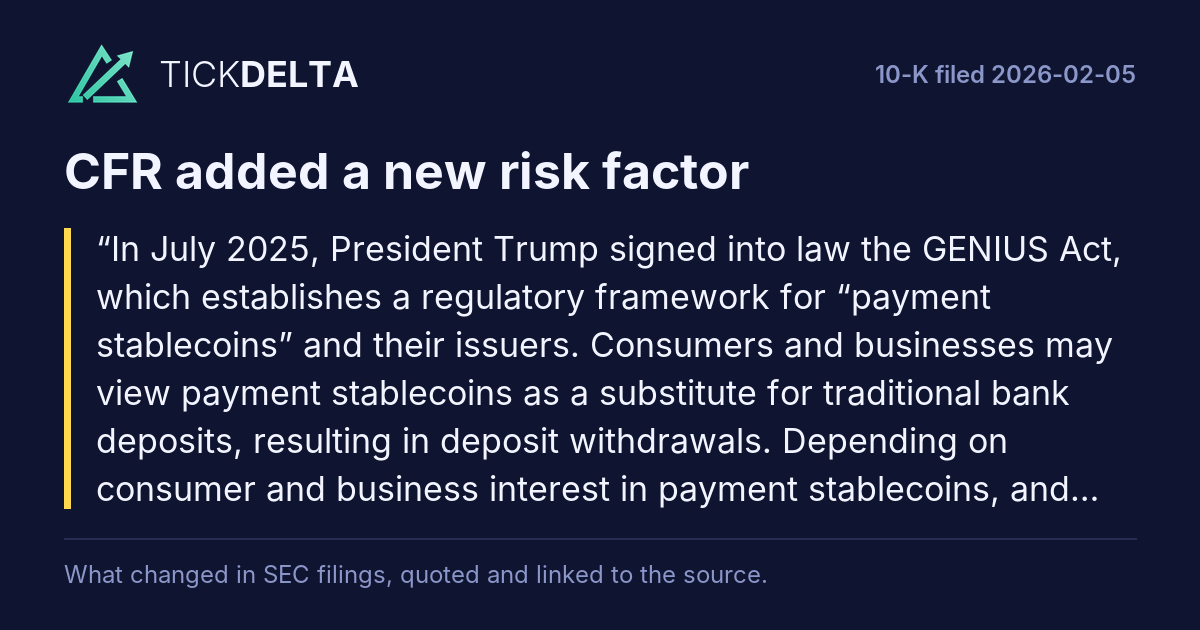
In July 2025, President Trump signed into law the GENIUS Act, which establishes a regulatory framework for “payment stablecoins” and their issuers. Consumers and businesses may view payment stablecoins as a substitute for traditional bank deposits, resulting in deposit withdrawals. Depending on consumer and business interest in payment stablecoins, and the characteristics and utility of payment stablecoins, the passage of the GENIUS Act could result in increased competition with respect to our deposit products. However, the GENIUS Act requires the U.S. Treasury
Department and federal and state regulators to issue regulations on numerous topics to interpret and implement the statute, so the effect of the GENIUS Act will depend on what those regulations provide.
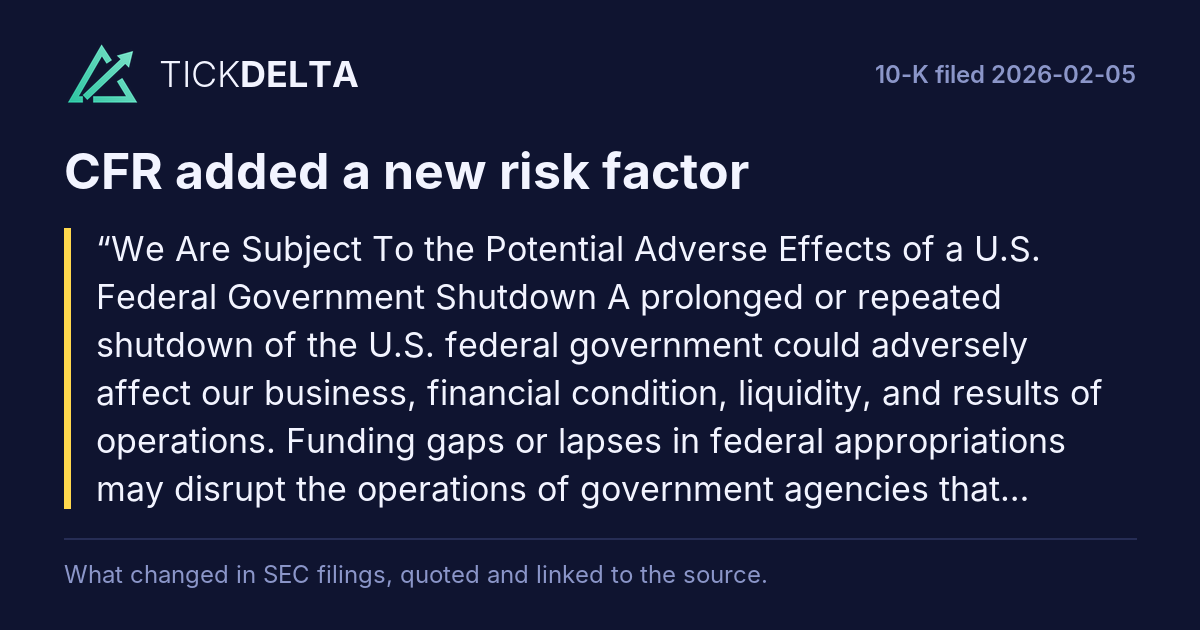
We Are Subject To the Potential Adverse Effects of a U.S. Federal Government Shutdown
A prolonged or repeated shutdown of the U.S. federal government could adversely affect our business, financial condition, liquidity, and results of operations. Funding gaps or lapses in federal appropriations may disrupt the operations of government agencies that provide critical economic data, administer regulatory functions, or directly support our customers and counterparties. During a shutdown, federal agencies such as the Internal Revenue Service, Small Business Administration, and various supervisory bodies may suspend or significantly curtail their activities, which can delay loan originations, hinder verification processes, impede regulatory approvals, and reduce the availability of government‑guaranteed lending programs.
A shutdown may also impair the financial capacity of borrowers who depend on federal salaries, contracts, reimbursements, or benefit programs, including government employees, federal contractors, and recipients of government-funded services. Reduced or delayed income to these borrowers could increase delinquencies, reduce loan demand, negatively affect deposit inflows, and increase our credit risk exposure. In addition, disruptions to federal economic data releases or fiscal operations may create volatility in financial markets, affecting interest rates, liquidity conditions, and the valuation of securities in our investment portfolio.
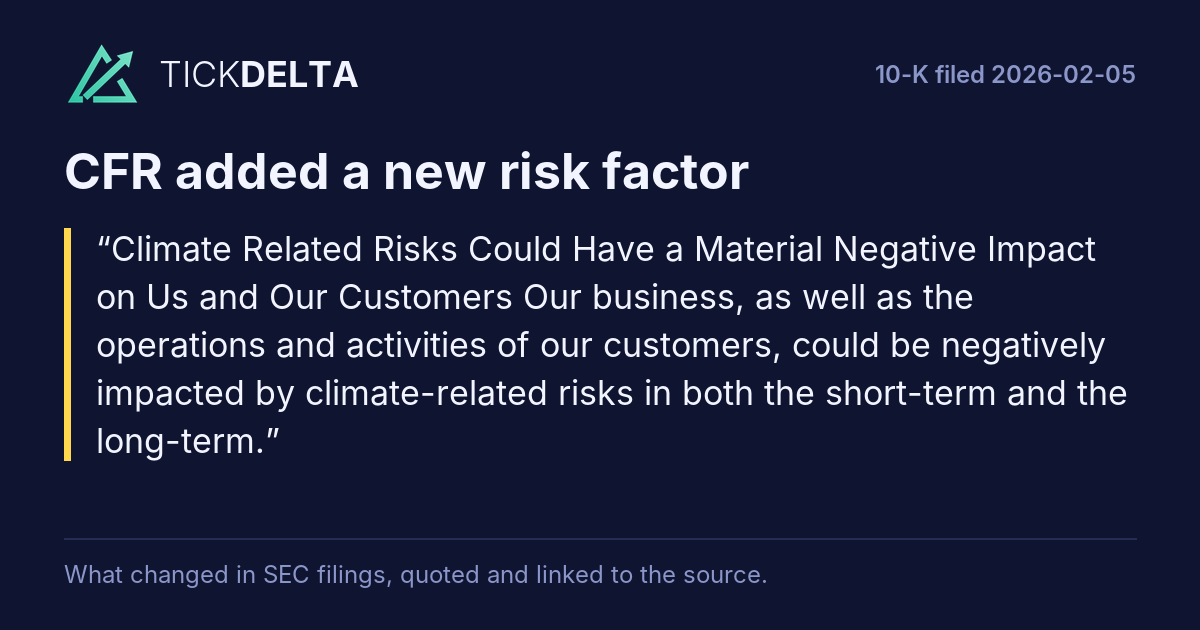
Climate Related Risks Could Have a Material Negative Impact on Us and Our Customers
Our business, as well as the operations and activities of our customers, could be negatively impacted by climate-related risks in both the short-term and the long-term.
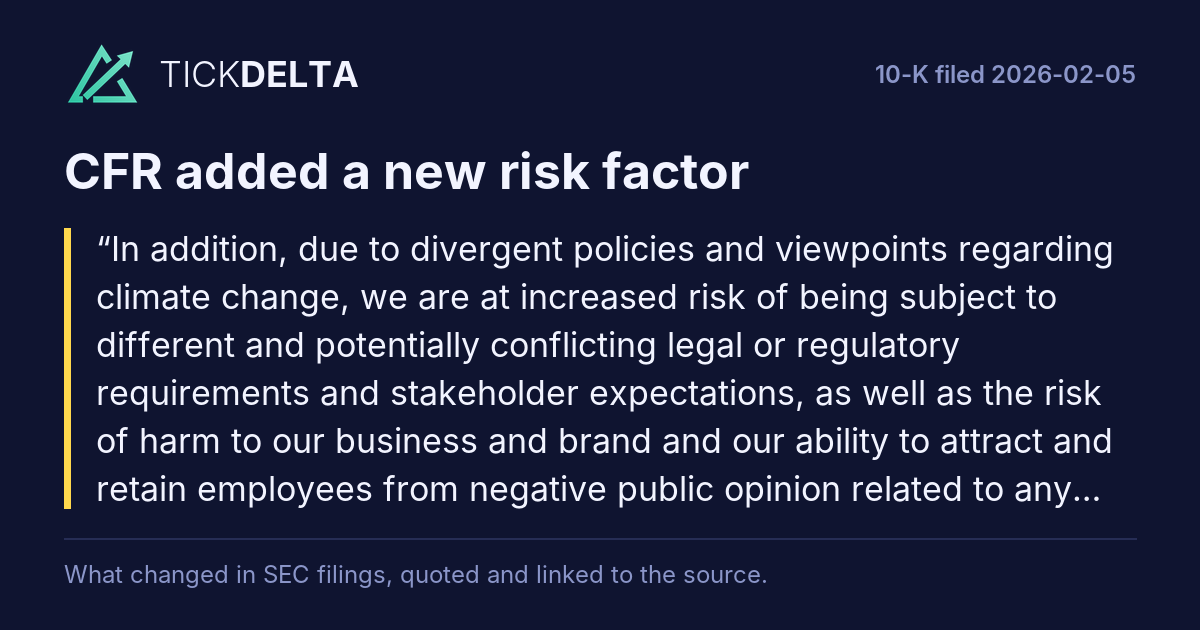
In addition, due to divergent policies and viewpoints regarding climate change, we are at increased risk of being subject to different and potentially conflicting legal or regulatory requirements and stakeholder expectations, as well as the risk of harm to our business and brand and our ability to attract and retain employees from negative public opinion related to any of our actual or perceived action or inaction in response to climate-related matters. Furthermore, ongoing legislative or regulatory uncertainties and changes regarding climate-related matters and practices may result in higher regulatory, compliance, credit and other risks and costs, and may subject us to different and potentially conflicting requirements.
Paragraphs in the 10-Q filed Oct 29, 2026 that were not in the one before
New in the latest 10-Q
8 paragraphs in the 10-Q filed Oct 29, 2026 with nothing like them in the 10-Q filed Jul 30, 2026 (at least half the words must differ; new numbers alone do not count). Quoted exactly, grouped by the item heading above them. This is text that changed, not a judgement of how serious it is.
Financial statements and notes
September 30, 2026 2025 ─────────────────────────────────────────────────────────────────────────────────────────────────────────────────────────────────────────────────── Operating Activities: Net income $ 523,255 $ 482,305 Adjustments to reconcile net income to net cash from operating activities: Credit loss expense 28,602 32,978 Deferred tax expense (benefit) (7,124) 3,047 Accretion of loan discounts (24,079) (20,588) Securities premium amortization (discount accretion), net 6,330 28,907 Net (gain) loss on securities transactions 7,512 14 Depreciation and amortization 67,479 65,969 Net (gain) loss on sale/write-down of assets/foreclosed assets (8,276) (2,294) Stock-based compensation 16,206 13,183 Net tax benefit from stock-based compensation 404 1,816 Earnings on life insurance policies (2,967) (2,908) Net change in: Trading account securities (8,320) (2,336) Lease right-of-use assets 20,156 18,227 Accrued interest receivable and other assets (111,190) 69,262 Accrued interest payable and other liabilities 74,924 (594,338) Net cash from operating activities 582,912 93,244 Investing Activities: Securities held to maturity: Purchases — (1,500) Maturities, calls and principal repayments 66,111 77,501 Securities available for sale: Purchases (17,045,631) (15,386,824) Sales 27,916 41,207 Maturities, calls and principal repayments 14,976,788 13,903,659 Proceeds from sale of loans 9,373 14,119 Net change in loans (1,777,853) (712,382) Benefits received on life insurance policies 2,326 1,777 Proceeds from sales of premises and equipment 8,856 44 Purchases of premises and equipment (142,676) (104,136) Proceeds from sales of foreclosed assets 535 15,135 Net cash from investing activities (3,874,255) (2,151,400) Financing Activities: Net change in deposits 1,304,507 (205,596) Net change in short-term borrowings 592,258 230,608 Proceeds from stock option exercises — 7,881 Purchase of treasury stock (178,349) (72,461) Cash dividends paid on preferred stock (5,006) (5,006) Cash dividends paid on common stock (193,739) (191,292) Net cash from financing activities 1,519,671 (235,866) Net change in cash and cash equivalents (1,771,672) (2,294,022) Cash and cash equivalents at beginning of period 8,874,055 10,234,258 Cash and cash equivalents at end of period $ 7,102,383 $ 7,940,236
Read in the 10-Q
September 30, 2026 December 31, 2025 Notional Notional Estimated Notional Estimated
Read in the 10-Q
September 30, 2026 December 31, 2025 Notional Notional Estimated Notional Estimated
Read in the 10-Q
September 30, 2026 2025 ──────────────────────────────────────────────────────────────────────────────────────────────────────────────── Foreclosed assets remeasured at initial recognition: Carrying value of foreclosed assets prior to remeasurement $2,685 $ 659 Charge-offs recognized in the allowance for credit losses on loans (353) — Fair value $2,332 $ 659 Foreclosed assets remeasured subsequent to initial recognition: Carrying value of foreclosed assets prior to remeasurement $867 $ — Write-downs included in other non-interest expense (212) — Fair value $655 $ —
Read in the 10-Q
and money market accounts, partly offset by higher income from the placement of mutual funds. See the analysis of these categories of non-interest income in the section captioned “Non-Interest Income” elsewhere in this discussion.
Read in the 10-Q
Show the other 3
grade. The resulting qualitative adjustment is based on the amount by which expected credit losses under the alternative scenario exceed those estimated using the primary scenario, adjusted based on management’s assessment of the probability that the downside economic scenario will occur.
Read in the 10-Q
In March 2026, the federal bank regulatory agencies proposed revisions to the standardized approach for calculating risk-weighted assets that would apply to Cullen/Frost and Frost Bank. The proposal would, among other things, revise the risk-based capital treatment of certain corporate, retail and residential mortgage exposures and mortgage servicing assets and make other changes to the calculation of risk-weighted assets. The comment period for the proposal ended in June 2026. Based on our preliminary assessment, the proposed changes would be expected to modestly reduce our total risk-weighted assets. Because the proposal has not been finalized and remains subject to change, its ultimate impact on our regulatory capital requirements cannot yet be determined.
Read in the 10-Q
Share sales and buybacks
(2) Repurchases made in connection with the vesting of certain stock compensation awards.
Read in the 10-Q
The 10-Q's risk factors against the 10-K
Item 1A of the 10-Q filed Oct 29, 2026 against Item 1A of the 10-K filed Feb 5, 2026.
A 10-Q repeats only the risks that changed, so a 10-K paragraph that is missing from it is not counted as removed.
Added is a paragraph with nothing like it in the 10-K, Reworded a sentence that is in both with several words changed,
Quiet changes a sentence in both where one to four words changed and one is a hedge or a modal
(cut words struck through, new words highlighted).
Text on the page, not a score; each links to the filing at sec.gov.
What the 10-Q itself says about its risk factors:There has been no material change in the risk factors disclosed under Item 1A. of our 2025 Form 10-K.
Read in the 10-Q
1 paragraph in the 10-Q's Item 1A, and none of them adds, rewords or quietly edits a paragraph of the 10-K's.
Phrases used for the first time
Two-word phrases in Risk Factors of the 10-K filed Feb 5, 2026 that are in none of the 1 earlier 10-Ks stored, back to Feb 6, 2025
Where each one is used
- genius act: In July 2025, President Trump signed into law the GENIUS Act, which establishes a regulatory framework for “payment stablecoins” and their issuers. Consumers and businesses may view payment stablecoins as a substitute for traditional bank deposits, resulting in deposit withdrawals. Depending on consumer and...
- payment stablecoins: In July 2025, President Trump signed into law the GENIUS Act, which establishes a regulatory framework for “payment stablecoins” and their issuers. Consumers and businesses may view payment stablecoins as a substitute for traditional bank deposits, resulting in deposit withdrawals. Depending on consumer and...
- intelligent automation: The financial services industry is continually undergoing rapid technological change with frequent introductions of new technology-driven products and services, including the increased usage of intelligent automation within the industry. Our future success depends, in part, upon our ability to address the needs of...
- fraud risk: Increasing Fraud Risk Could Adversely Affect Our Business, Financial Condition, and Reputation
- fraudulent activity: We are exposed to an increasing risk of fraud, including cyber fraud, identity theft, account takeover, and other fraudulent activities targeting financial institutions and their customers. The sophistication and frequency of these schemes continue to grow, driven by advances in technology and the proliferation of...
- economic data: A prolonged or repeated shutdown of the U.S. federal government could adversely affect our business, financial condition, liquidity, and results of operations. Funding gaps or lapses in federal appropriations may disrupt the operations of government agencies that provide critical economic data, administer...
- climate-related matters: In addition, due to divergent policies and viewpoints regarding climate change, we are at increased risk of being subject to different and potentially conflicting legal or regulatory requirements and stakeholder expectations, as well as the risk of harm to our business and brand and our ability to attract and...
Used at least twice, small words left out. Counted, not picked: a phrase can be new because the company renamed something.
What was taken out
2 paragraphs of last year's Risk Factors with nothing like them now. The longest are quoted.
Sources
Item 1A of each 10-K and 10-Q on EDGAR, quoted exactly. Each paragraph links to the filing at sec.gov.
Also
10-K change: what was reworded or cut, section by section.
Work with it
Excel workbook · CSV. Google Sheet that stays up to date: paste =IMPORTDATA("https://tickdelta.com/company/CFR/export.csv") into a cell.