Paragraph 376 · 49% changed
Every version of it
Screener
/
SEC EDGAR
/CIK 0001527166
/10-K filed Feb 27, 2026, compared with Feb 27, 2025
/Numbers from the XBRL of the 10-Ks
Nasdaq
Financials · Asset Management
Carlyle Group Inc. CG
The 10-K against last year's
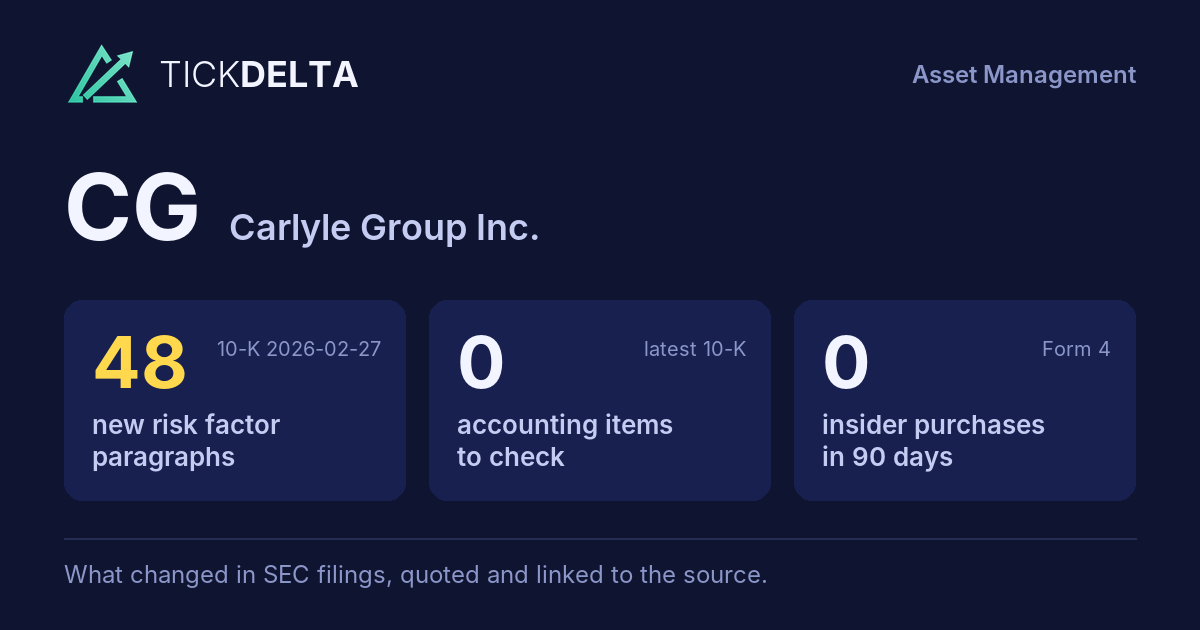
486 changes: 88 added, 123 removed, 263 reworded, 12 quiet changes
10-K Feb 27, 2026 vs Feb 27, 2025
Risk Factors
28.4%
of the text changed · 49,521 words now · 48 new paragraphs, 94 gone
MD&A
24.0%
of the text changed · 26,062 words now · 40 new paragraphs, 29 gone
Legal Proceedings
14.2%
of the text changed · 2,631 words now
Accounting Policies
10.9%
of the text changed · 8,530 words now
10-K 0001527166-26-000009 (Feb 27, 2026) vs 10-K 0001527166-25-000006 (Feb 27, 2025)
Every paragraph, and how much of it changed
One bar per paragraph, in the order of the 10-K. Height and colour show the share of its words not in the closest paragraph a year earlier; the tallest bars are new paragraphs.
Risk Factors
403 paragraphs · 48 new · 162 reworded · 94 gone · 10-K Feb 27, 2026 against Feb 27, 2025
New paragraph
Reworded (5% of its words or more)
Same or nearly
Paragraph 195 · 47% changed
Every version of it
Paragraph 300 · 43% changed
Every version of it
Paragraph 196 · 43% changed
Every version of it
Likewise, our ability to raise new funds could be hampered if the general appeal of alternative investments were to decline. An investment in a private equity, credit, or real estate limited partner interest in an alternative investment fund is generally more illiquid and the returns on such investment may be more volatile than an investment in securities for which there is a more active and transparent market. Private equity, credit, In periods of positive markets and real estate low volatility, for example, investors may favor passive investment strategies such as index funds over our actively managed investment vehicles. Similarly, during periods of high interest rates, investors may favor investments that are generally viewed as producing a risk-free return, such as treasury bonds, over investments in our products, particularly if the spread between the products declines. Alternative investments could also fall into disfavor as a result because of concerns about liquidity and short-term performance. Such In particular, such concerns could be exhibited, in particular, exhibited by public pension funds, which have historically been among the largest investors in alternative assets. Many public pension funds are significantly underfunded, and their funding problems have been, and may in the future be, exacerbated by economic downturn. Concerns with liquidity could cause such public pension funds to reevaluate the appropriateness of alternative investments. Moreover, our ability to raise capital from third parties outside of the United States could be limited to the extent the other countries impose restrictions or limitations on outbound foreign investment.
Paragraph 400 · 43% changed
Every version of it
The OECD also has issued proposals, commonly referred to as “BEPS 2.0,” which fundamentally change the international tax system. The proposals are based on two “pillars” involving the shifting of taxing rights to the jurisdiction of the consumer (“Pillar One”) and ensuring all companies pay a global minimum corporate tax (“Pillar Two”). Under Pillar One, multinational enterprises (“MNEs”) with an annual global turnover of at least EUR 20 billion will be subject to rules allocating a formulaic share of consolidated profits in excess of a 10% profit margin to the jurisdictions where their consumers or users are located (subject to threshold rules). MNEs carrying on specific low-risk activities are excluded, including “regulated financial services.” Pillar Two imposes a minimum effective tax rate of 15% on MNEs that have consolidated revenues of at least EUR 750 million in at least two out of the last four years. Pillar Two introduces three related tax measures (the “GloBE” rules): the qualified domestic minimum top-up tax (“QDMTT”) is assessed by a low-taxed jurisdiction itself, the income inclusion rule (“IIR”) imposes a top up tax on a parent entity where a constituent member of the MNE group has low-taxed income, and lastly, the undertaxed payment rule applies to intra-group payments if a constituent member’s income is not taxed by an IIR or QDMTT. In addition, a subject to tax rule (“STTR”) will permit source jurisdictions to impose limited withholding taxes on low-taxed related party payments, which will be creditable against the GloBE rules tax liability. The OECD has released model rules and commentary for Pillar Two, including guidance on the treatment of taxes paid by U.S. companies on non-U.S. income under the U.S. Global Intangible Low-Taxed Income regime. The proposals are complex and subject to significant uncertainty, and consultation in respect of certain aspects of the rules is ongoing as we await further guidance from the OECD. It is anticipated that certain classes of entities that are typically On January 5, 2026, the OECD announced a “side-by-side” system under which U.S.-parented groups would be able to elect to be effectively exempt from tax will be outside certain of the scope of Pillar Two, including investment funds and real estate investment vehicles (as respectively defined), which are Two rules, together with certain simplifications to the ultimate parent entity of the MNE group (and certain holding vehicles existing rules. The details of such entities); however, amendments and the application “side-by-side” system remain the subject of these exemptions to our entities remains open to significant uncertainty. Although certain elements of Pillar Two have been implemented, important details, in particular on further discussions and clarifications from the OECD, and the implementation of certain elements such system by the OECD member countries remains uncertain. Pillar One and Pillar Two could impact the effective tax rates for our firm, funds, portfolio companies, and investors, including by way of Pillar One, are still awaited. In addition, the U.S. higher levels of tax being imposed, possible denial of deductions, increased withholding taxes, and/or profits being allocated differently. It is not expected to enact Pillar Two, creating additional uncertainty as to the application of these rules to multinational enterprises with a U.S. parent entity, and it is not yet clear whether a U.S. foreign tax credit likely that our entities also will be available with respect subject to these significant additional taxes, which compliance and/or reporting obligations. Any tax laws, regulations, or treaties newly enacted or enacted in the future also may result in cause us to revalue our deferred taxes and have a higher overall material change to our effective tax cost. rate and tax liabilities, as a result.
Paragraph 198 · 42% changed
Every version of it
In connection with raising new funds or securing making additional investments in existing funds, we negotiate terms for such funds and investments with existing and potential investors. The outcome of such negotiations could result in our agreement to terms that are materially less favorable to us than the terms of for prior funds we have advised managed, or funds advised managed by our competitors. competitors, including with respect to management fees, incentive fees, and/or carried interest, which could have an adverse impact on our revenues. Such terms could also restrict our ability to raise investment funds with investment objectives or strategies that compete with existing funds, reduce fee revenues we earn, reduce the percentage of profits on third-party capital that we share in or add additional expenses and obligations for us in managing the fund, or increase our potential liabilities, all of which could ultimately reduce our profitability. In addition, a change in terms that increases the amount of fee revenue the fund investors are entitled to could result in a significant decline in revenue generated from transaction fees. For instance, our current generations of U.S., Europe, and Asia buyout funds have increased the percentage of transaction fees that are shared with fund investors from 80% to 100% of the allocable fees we generate. To the extent we change our fee practices for other successor funds, we could experience a meaningful decline in the amount of transaction fee revenue we earn. In particular, if our fund investors do not continue to agree that we are permitted to retain fees we derive from capital markets transactions involving our portfolio companies, the ability of our GCM group to produce fee revenue could be significantly hindered. revenues.
Paragraph 341 · 42% changed
Every version of it
Paragraph 112 · 42% changed
Every version of it
Moreover, on January 5, 2023, the Corporate Sustainability Reporting Directive (“CSRD”) came into force. Broadly, CSRD amends and strengthens the rules introduced on sustainability reporting for companies, banks, and insurance companies under the Non-Financial Reporting Directive (2014/95/EU) (“NFRD”). CSRD will was expected to require a much broader range of companies to produce detailed and prescriptive reports on sustainability-related matters within their financial statements, including large EU companies (including EU subsidiaries of non-EU parent companies), EU and non-EU-companies (including small and midsize enterprises) with listed securities on EU-regulated markets (except micro-undertakings), and non-EU companies with significant turnover and a legal presence on EU markets. However, on December 16, 2025, the European Parliament approved the text of the “Sustainability Omnibus,” which includes amendments (among others) to the CSRD, which are likely to remove many entities from scope of the reporting requirements. The final text is expected to be published in the first half of 2026, and we are continuing to assess the impact of the changes on our business, funds and portfolio companies. The FCA introduced a regulatory framework that focused on implementing the recommendations of the Financial Stability Board Taskforce on Climate-related Financial Disclosures (“TCFD”), in particular, by introducing mandatory TCFD-aligned disclosure requirements for certain FCA authorized firms. These rules are set out in the ESG Sourcebook in the Business Standards section of the FCA Handbook of Rules and Guidance (“ESG Sourcebook”). The rules capture certain asset managers including, so far as relevant, certain private fund advisors such as CECP and investment portfolio managers such as CELF, as well as insurers and FCA-regulated pension providers, with disclosures made annually by June 30, each year.
Paragraph 376 · 49% changed
Every version of it
10-K Feb 27, 2025Our amended and restated certificate of incorporation and bylaws contain provisions that may make the merger or acquisition of our company more difficult without the approval of our Board of Directors. Among other things, these provisions:
10-K Feb 27, 2026
Certain provisions in our amended and restated certificate of incorporation and bylaws may discourage, delay, or prevent a merger or acquisition that a stockholder may consider favorable by, for example:
Paragraph 195 · 47% changed
Every version of it
10-K Feb 27, 2025Third-party investors in substantially all of our carry funds have the right to remove the general partner of the fund for cause, to accelerate the liquidation date of the investment fund without cause by a simple majority vote, and to terminate the investment period under certain circumstances and investors in certain of the investment funds we advise may redeem their investments. These events would lead to a decrease in our revenues, which could be substantial.
10-K Feb 27, 2026
In addition, volatility in the valuations of investments has in the past and may in the future affect our ability to raise capital from third-party investors. To the extent periods of volatility are coupled with a lack of realizations from investors’ existing portfolios, such investors may be left with disproportionately outsized remaining commitments to a number of investment funds. This significantly limits such investors’ ability to make new commitments to third-party managed investment funds such as those managed by us. In addition, during periods of market volatility, investor subscription requests may be reduced and investor redemption or repurchase requests may be elevated in products that permit redemption or repurchase of investor interests. Certain of our investment vehicles that are available to individual investors are also subject to state registration requirements that impose limits on the proportion of such investors’ net worth that can be invested in our products. These restrictions may limit such investors’ ability or willingness to allocate capital to such products and adversely affect our fundraising in the private wealth channel. See “Risks Related to Our Business Operations—Risk Related to the Assets Re Manage—Third-party investors in substantially all of our carry funds have the right to remove the general partner of the fund for cause, to accelerate the liquidation date of the investment fund without cause by a simple majority vote, and to terminate the investment period under certain circumstances and investors in certain of the investment funds we advise may redeem their investments. These events would lead to a decrease in our revenues, which could be substantial.”
Paragraph 300 · 43% changed
Every version of it
10-K Feb 27, 2025•our funds may make investments that they do not advantageously dispose of prior to the date the applicable fund is dissolved, either by expiration of such fund’s term or otherwise, resulting in a lower than expected return on the investments and, potentially, on the fund itself;
10-K Feb 27, 2026
Our funds may make investments that are not advantageously disposed of prior to the date the applicable fund is dissolved, either by expiration of such fund’s term or otherwise. Although we generally expect that our funds will dispose of investments prior to dissolution or that investments will be suitable for in-kind distribution at dissolution, we may not be able to do so. The general partners of our funds have only a limited ability to extend the term of the fund with certain consent provisions and, therefore, we may be required to sell, distribute, or otherwise dispose of investments at a disadvantageous time prior to dissolution. This would result in a lower than expected return on the investments and potentially on the fund itself.
Paragraph 196 · 43% changed
Every version of it
10-K Feb 27, 2025
An investment in a private equity, credit, or real estate fund is more illiquid and the returns on such investment may be more volatile than an investment in securities for which there is a more active and transparent market. Private equity, credit, and real estate investments could fall into disfavor as a result of concerns about liquidity and short-term performance. Such concerns could be exhibited, in particular, by public pension funds, which have historically been among the largest investors in alternative assets. Concerns with liquidity could cause such public pension funds to reevaluate the appropriateness of alternative investments.
10-K Feb 27, 2026
Likewise, our ability to raise new funds could be hampered if the general appeal of alternative investments were to decline. An investment in a limited partner interest in an alternative investment fund is generally more illiquid and the returns on such investment may be more volatile than an investment in securities for which there is a more active and transparent market. In periods of positive markets and low volatility, for example, investors may favor passive investment strategies such as index funds over our actively managed investment vehicles. Similarly, during periods of high interest rates, investors may favor investments that are generally viewed as producing a risk-free return, such as treasury bonds, over investments in our products, particularly if the spread between the products declines. Alternative investments could also fall into disfavor because of concerns about liquidity and short-term performance. In particular, such concerns could be exhibited by public pension funds, which have historically been among the largest investors in alternative assets. Many public pension funds are significantly underfunded, and their funding problems have been, and may in the future be, exacerbated by economic downturn. Concerns with liquidity could cause such public pension funds to reevaluate the appropriateness of alternative investments. Moreover, our ability to raise capital from third parties outside of the United States could be limited to the extent the other countries impose restrictions or limitations on outbound foreign investment.
Paragraph 400 · 43% changed
Every version of it
10-K Feb 27, 2025
Under Pillar One, multinational enterprises (“MNEs”) with an annual global turnover of at least EUR 20 billion will be subject to rules allocating a formulaic share of consolidated profits in excess of a 10% profit margin to the jurisdictions where their consumers or users are located (subject to threshold rules). MNEs carrying on specific low-risk activities are excluded, including “regulated financial services.” Pillar Two imposes a minimum effective tax rate of 15% on MNEs that have consolidated revenues of at least EUR 750 million in at least two out of the last four years. Pillar Two introduces three related tax measures (the “GloBE” rules): the qualified domestic minimum top-up tax (“QDMTT”) is assessed by a low-taxed jurisdiction itself, the income inclusion rule (“IIR”) imposes a top up tax on a parent entity where a constituent member of the MNE group has low-taxed income, and lastly, the undertaxed payment rule applies to intra-group payments if a constituent member’s income is not taxed by an IIR or QDMTT. In addition, a subject to tax rule (“STTR”) will permit source jurisdictions to impose limited withholding taxes on low-taxed related party payments, which will be creditable against the GloBE rules tax liability. The OECD has released model rules and commentary for Pillar Two, including guidance on the treatment of taxes paid by U.S. companies on non-U.S. income under the U.S. Global Intangible Low-Taxed Income regime. The proposals are complex and subject to significant uncertainty, and consultation in respect of certain aspects of the rules is ongoing as we await further guidance from the OECD. It is anticipated that certain classes of entities that are typically exempt from tax will be outside of the scope of Pillar Two, including investment funds and real estate investment vehicles (as respectively defined), which are the ultimate parent entity of the MNE group (and certain holding vehicles of such entities); however, the application of these exemptions to our entities remains open to significant uncertainty. Although certain elements of Pillar Two have been implemented, important details, in particular on the implementation of certain elements of Pillar One, are still awaited. In addition, the U.S. is not expected to enact Pillar Two, creating additional uncertainty as to the application of these rules to multinational enterprises with a U.S. parent entity, and it is not yet clear whether a U.S. foreign tax credit will be available with respect to these additional taxes, which may result in a higher overall tax cost.
10-K Feb 27, 2026
The OECD also has issued proposals, commonly referred to as “BEPS 2.0,” which fundamentally change the international tax system. The proposals are based on two “pillars” involving the shifting of taxing rights to the jurisdiction of the consumer (“Pillar One”) and ensuring all companies pay a global minimum corporate tax (“Pillar Two”). Under Pillar One, multinational enterprises (“MNEs”) with an annual global turnover of at least EUR 20 billion will be subject to rules allocating a formulaic share of consolidated profits in excess of a 10% profit margin to the jurisdictions where their consumers or users are located (subject to threshold rules). MNEs carrying on specific low-risk activities are excluded, including “regulated financial services.” Pillar Two imposes a minimum effective tax rate of 15% on MNEs that have consolidated revenues of at least EUR 750 million in at least two out of the last four years. The OECD has released model rules and commentary for Pillar Two, including guidance on the treatment of taxes paid by U.S. companies on non-U.S. income under the U.S. Global Intangible Low-Taxed Income regime. The proposals are complex and subject to significant uncertainty, and consultation in respect of certain aspects of the rules is ongoing as we await further guidance from the OECD. On January 5, 2026, the OECD announced a “side-by-side” system under which U.S.-parented groups would be able to elect to be effectively exempt from certain of the Pillar Two rules, together with certain simplifications to the existing rules. The details of such amendments and the “side-by-side” system remain the subject of further discussions and clarifications from the OECD, and the implementation of such system by the OECD member countries remains uncertain. Pillar One and Pillar Two could impact the effective tax rates for our firm, funds, portfolio companies, and investors, including by way of higher levels of tax being imposed, possible denial of deductions, increased withholding taxes, and/or profits being allocated differently. It is likely that our entities also will be subject to significant additional compliance and/or reporting obligations. Any tax laws, regulations, or treaties newly enacted or enacted in the future also may cause us to revalue our deferred taxes and have a material change to our effective tax rate and tax liabilities, as a result.
Paragraph 198 · 42% changed
Every version of it
10-K Feb 27, 2025
In connection with raising new funds or securing additional investments in existing funds, we negotiate terms for such funds and investments with existing and potential investors. The outcome of such negotiations could result in our agreement to terms that are materially less favorable to us than the terms of prior funds we have advised or funds advised by our competitors. Such terms could restrict our ability to raise investment funds with investment objectives or strategies that compete with existing funds, reduce fee revenues we earn, reduce the percentage of profits on third-party capital that we share in or add expenses and obligations for us in managing the fund, or increase our potential liabilities, all of which could ultimately reduce our profitability. In addition, a change in terms that increases the amount of fee revenue the fund investors are entitled to could result in a significant decline in revenue generated from transaction fees. For instance, our current generations of U.S., Europe, and Asia buyout funds have increased the percentage of transaction fees that are shared with fund investors from 80% to 100% of the allocable fees we generate. To the extent we change our fee practices for other successor funds, we could experience a meaningful decline in the amount of transaction fee revenue we earn. In particular, if our fund investors do not continue to agree that we are permitted to retain fees we derive from capital markets transactions involving our portfolio companies, the ability of our GCM group to produce fee revenue could be significantly hindered.
10-K Feb 27, 2026
In connection with raising new funds or making additional investments in existing funds, we negotiate terms for such funds and investments with existing and potential investors. The outcome of such negotiations could result in our agreement to terms that are materially less favorable to us than for prior funds we have managed, or funds managed by our competitors, including with respect to management fees, incentive fees, and/or carried interest, which could have an adverse impact on our revenues. Such terms could also restrict our ability to raise investment funds with investment objectives or strategies that compete with existing funds, add additional expenses and obligations for us in managing the fund, or increase our potential liabilities, all of which could ultimately reduce our revenues.
Paragraph 341 · 42% changed
Every version of it
10-K Feb 27, 2025Investments in electric utility industries both in the United States and abroad continue to experience increasing competitive pressures, primarily in wholesale markets, as a result of consumer demands, technological advances, greater availability of natural gas, and other factors. Changes in regulation may support not only consolidation among domestic utilities, but also the disaggregation of vertically integrated utilities into separate generation, transmission, and distribution businesses. As a result, additional significant competitors could become active in the independent power industry.
10-K Feb 27, 2026
Electric utility investments in the United States and abroad are also subject to increasing competitive pressures due to changing consumer demand, technological advances, greater natural gas availability, and regulatory changes that may drive consolidation or disaggregation of vertically integrated utilities, enabling additional significant competitors in the independent power industry.
Paragraph 112 · 42% changed
Every version of it
10-K Feb 27, 2025
Moreover, on January 5, 2023, the Corporate Sustainability Reporting Directive (“CSRD”) came into force. Broadly, CSRD amends and strengthens the rules introduced on sustainability reporting for companies, banks, and insurance companies under the Non-Financial Reporting Directive (2014/95/EU) (“NFRD”). CSRD will require a much broader range of companies to produce detailed and prescriptive reports on sustainability-related matters within their financial statements, including large EU companies (including EU subsidiaries of non-EU parent companies), EU and non-EU-companies (including small and midsize enterprises) with listed securities on EU-regulated markets (except micro-undertakings), and non-EU companies with significant turnover and a legal presence on EU markets.
10-K Feb 27, 2026
Moreover, on January 5, 2023, the Corporate Sustainability Reporting Directive (“CSRD”) came into force. Broadly, CSRD amends and strengthens the rules introduced on sustainability reporting for companies, banks, and insurance companies under the Non-Financial Reporting Directive (2014/95/EU) (“NFRD”). CSRD was expected to require a much broader range of companies to produce detailed and prescriptive reports on sustainability-related matters within their financial statements, including large EU companies (including EU subsidiaries of non-EU parent companies), EU and non-EU-companies (including small and midsize enterprises) with listed securities on EU-regulated markets (except micro-undertakings), and non-EU companies with significant turnover and a legal presence on EU markets. However, on December 16, 2025, the European Parliament approved the text of the “Sustainability Omnibus,” which includes amendments (among others) to the CSRD, which are likely to remove many entities from scope of the reporting requirements. The final text is expected to be published in the first half of 2026, and we are continuing to assess the impact of the changes on our business, funds and portfolio companies. The FCA introduced a regulatory framework that focused on implementing the recommendations of the Financial Stability Board Taskforce on Climate-related Financial Disclosures (“TCFD”), in particular, by introducing mandatory TCFD-aligned disclosure requirements for certain FCA authorized firms. These rules are set out in the ESG Sourcebook in the Business Standards section of the FCA Handbook of Rules and Guidance (“ESG Sourcebook”). The rules capture certain asset managers including, so far as relevant, certain private fund advisors such as CECP and investment portfolio managers such as CELF, as well as insurers and FCA-regulated pension providers, with disclosures made annually by June 30, each year.
MD&A
389 paragraphs · 40 new · 139 reworded · 29 gone · 10-K Feb 27, 2026 against Feb 27, 2025
New paragraph
Reworded (5% of its words or more)
Same or nearly
Paragraph 259 · 50% changed
Paragraph 313 · 50% changed
(1)Excludes our strategic equity method investment in NGP Management and investments in NGP general partners - accrued performance allocations. This balance also includes amounts bridged by us on behalf of investment funds for which we have entered into warehouse agreements. Under such warehouse agreements, we may elect to transfer investments for a price that differs from fair value.
Paragraph 339 · 49% changed
Total assets liabilities were $23.1 $22.1 billion at December 31, 2024, 2025, an increase of $1.9 $5.3 billion from December 31, 2023. 2024. The increase in total assets liabilities was primarily attributable to an increase in Investments, including performance allocations Loans payable of $1.0 billion, an increase in Investments in Consolidated Funds of $0.5 $3.6 billion, and an increase in Cash and cash equivalents held at Consolidated Funds Debt obligations of $0.5 billion. These were partially offset by a decrease in Cash and cash equivalents of $0.2 $0.9 billion. The increase in Investments, including performance allocations Debt obligations was primarily driven by our issuance of $800.0 million of 5.050% senior notes due to an increase 2035 in Accrued performance allocations related to CP VII and CP VIII. Refer to “—Cash Flows” in Part II, Item 8 of this Annual Report on Form 10-K for details on the decrease in Cash and cash equivalents. 2025.
Paragraph 334 · 49% changed
Paragraph 197 · 49% changed
The increase in fund Fund management fees for the year ended December 31, 2024 2025 as compared to 2023 2024 was primarily driven by closed reinsurance transactions at Fortitude an increase in the fourth quarter of 2023, which increased the fee basis under the strategic advisory services agreement, as well as increases reflecting the impact of inflows and capital deployment in CTAC management fees from our direct lending business, CTAC, and CCOF III. The increase in Fund management fees was also impacted by the receipt of approximately $19 million of catch-up subordinated management fees in certain aviation funds during the year ended December 31, 2025, due in part to the collection of insurance proceeds and in part due to the sale of collateral in those vehicles. These increases were partially offset by modest declines in lower management fees from CLOs due to net capital outflows during the year ended December 31, 2024. our liquid credit business.
Paragraph 102 · 47% changed
Paragraph 118 · 47% changed
Paragraph 336 · 47% changed
Net cash used in investing activities. Our investing activities generally reflect cash used for fixed assets, software for internal use, and corporate treasury investments. For the year years ended December 31, 2025 and 2024, cash used in investing activities principally reflects purchases of primarily reflected capital expenditures related to information technology, leasehold improvements, and other fixed assets of $77.7 million. For the year ended December 31, 2023, cash used in investing activities principally reflects purchases of corporate treasury investments of $187.3 $99.4 million and net purchases of fixed assets of $66.6 $77.7 million, partially offset by proceeds from corporate treasury investments of $210.3 million. respectfully.
Paragraph 259 · 50% changed
10-K Feb 27, 2025Fee Revenues. Total fee revenues decreased $153.0 million for the year ended December 31, 2024 as compared to 2023, due to the following:
10-K Feb 27, 2026
Total AUM was $102.0 billion as of December 31, 2025, an increase of 20% compared to $85.1 billion as of December 31, 2024. The net increase was due to:
Paragraph 313 · 50% changed
10-K Feb 27, 2025
(1)Excludes our strategic equity method investment in NGP Management and investments in NGP general partners - accrued performance allocations.
10-K Feb 27, 2026
(1)Excludes our strategic equity method investment in NGP Management and investments in NGP general partners - accrued performance allocations. This balance also includes amounts bridged by us on behalf of investment funds for which we have entered into warehouse agreements. Under such warehouse agreements, we may elect to transfer investments for a price that differs from fair value.
Paragraph 339 · 49% changed
10-K Feb 27, 2025
Total assets were $23.1 billion at December 31, 2024, an increase of $1.9 billion from December 31, 2023. The increase in total assets was primarily attributable to an increase in Investments, including performance allocations of $1.0 billion, an increase in Investments in Consolidated Funds of $0.5 billion, and an increase in Cash and cash equivalents held at Consolidated Funds of $0.5 billion. These were partially offset by a decrease in Cash and cash equivalents of $0.2 billion. The increase in Investments, including performance allocations was primarily due to an increase in Accrued performance allocations related to CP VII and CP VIII. Refer to “—Cash Flows” in Part II, Item 8 of this Annual Report on Form 10-K for details on the decrease in Cash and cash equivalents.
10-K Feb 27, 2026
Total liabilities were $22.1 billion at December 31, 2025, an increase of $5.3 billion from December 31, 2024. The increase in liabilities was primarily attributable to an increase in Loans payable of Consolidated Funds of $3.6 billion, and an increase in Debt obligations of $0.9 billion. The increase in Debt obligations was driven by our issuance of $800.0 million of 5.050% senior notes due 2035 in 2025.
Paragraph 334 · 49% changed
10-K Feb 27, 2025Cash flows from operating activities for the years ended December 31, 2024 and 2023, excluding the activities of our Consolidated Funds, were $1.1 billion and $1.0 billion, respectively. During the years ended December 31, 2024 and 2023, net cash provided by operating activities primarily included the receipt of management fees and realized performance allocations and incentive fees, totaling approximately $3.4 billion and $3.0 billion, respectively. These inflows were partially offset by payments for compensation, income taxes, interest, and general, administrative and other expenses of approximately $2.5 billion and $2.4 billion for the years ended December 31, 2024 and 2023, respectively. Operating outflows during the year ended December 31, 2023 also included a $68.6 million payment relating to the Carlyle Aviation Partners earn-out and a $20.3 million payment to the former Carlyle Holdings unitholders related to amounts owed under the tax receivable agreement. See Note 17, Supplemental Financial Information.
10-K Feb 27, 2026
For the years ended December 31, 2025 and 2024 we received management fees and realized performance allocations, investment income, and incentive fees of $3.7 billion and $3.6 billion, respectively, partially offset by payments for compensation, income taxes, interest, and general, administrative and other expenses of approximately $2.5 billion and $2.5 billion, respectively, which included 2024 and 2023 year-end bonuses paid in January 2025 and 2024, respectively.
Paragraph 197 · 49% changed
10-K Feb 27, 2025
The increase in fund management fees for the year ended December 31, 2024 as compared to 2023 was primarily driven by closed reinsurance transactions at Fortitude in the fourth quarter of 2023, which increased the fee basis under the strategic advisory services agreement, as well as increases reflecting the impact of inflows and capital deployment in CTAC and CCOF III. These increases were partially offset by modest declines in management fees from CLOs due to net capital outflows during the year ended December 31, 2024.
10-K Feb 27, 2026
The increase in Fund management fees for the year ended December 31, 2025 as compared to 2024 was primarily driven by an increase in management fees from our direct lending business, CTAC, and CCOF III. The increase in Fund management fees was also impacted by the receipt of approximately $19 million of catch-up subordinated management fees in certain aviation funds during the year ended December 31, 2025, due in part to the collection of insurance proceeds and in part due to the sale of collateral in those vehicles. These increases were partially offset by lower management fees from our liquid credit business.
Paragraph 102 · 47% changed
10-K Feb 27, 2025Management fees attributable to Carlyle Partners VIII, L.P. (“CP VIII”), our eighth U.S. buyout fund, were approximately 11% of fund management fees recognized during the year ended December 31, 2023. No other fund generated over 10% of total management fees in the periods presented. Average Fee-earning assets under management in our Global Credit and Global Investment Solutions segments in 2024 grew approximately 19% and 21%, respectively, relative to the average balances in 2023, while average Fee-earning assets under management in 2024 for Global Private Equity fell by 4% relative to the average balance in 2023. As a result, Fund management fees increased in Global Credit and Global Investment Solutions and decreased in Global Private Equity, due in part to smaller buyout fund sizes in our corporate private equity strategy and step downs in rate or basis, particularly a step-down in management fee rate in CP VII at the beginning of 2024. Fund management fees included transaction and portfolio advisory fees, net of rebate offsets, of $152.5 million and $68.6 million for the years ended December 31, 2024 and 2023, respectively. These fees primarily comprise capital market fees generated by Carlyle Global Capital Markets. The recognition of portfolio advisory fees, transactions fees, and capital markets fees can be volatile as they are primarily generated by investment activity within our funds, and therefore are impacted by our investment pace. See “—Trends Affecting Our Business” for further discussion on our investment activity and broader market trends.
10-K Feb 27, 2026
No fund generated over 10% of total fund management fees in any of the periods presented. In 2025, average Fee-earning AUM in our Carlyle AlpInvest and Global Credit segments grew approximately 21% and 5%, respectively, relative to the average balances in 2024, while average Fee-earning AUM in 2025 for Global Private Equity fell by 3% relative to the average balance in 2024. As a result, Fund management fees increased in Carlyle AlpInvest and Global Credit, while Global Private Equity decreased, which was due in part to smaller buyout fund sizes in our corporate private equity strategy and step-downs in rate or basis as well as realizations, partially offset by the activation of fees in certain products in our Global Private Equity segment. The increase in catch-up management fees for the year ended December 31, 2025 was primarily attributable to our Carlyle AlpInvest segment. We expect catch-up management fees associated with our Carlyle AlpInvest segment to decrease in 2026 compared to 2025, as fundraising for our most recent vintage of secondaries & portfolio finance funds concluded during 2025.
Paragraph 118 · 47% changed
10-K Feb 27, 2025General, administrative and other indirect expenses. General, administrative and other indirect expenses decreased $26.7 million for the year ended December 31, 2024 as compared to 2023, primarily due to lower professional fees and the benefit of lower VAT expense in Asia.
10-K Feb 27, 2026
Interest and other expenses of Consolidated Funds. Interest and other expenses of Consolidated Funds increased $59.4 million for the year ended December 31, 2025 as compared to 2024, primarily due to an increase in interest expense on loans payable and other expenses attributable to a new collateralized fund obligation vehicle in our Carlyle AlpInvest segment that was consolidated in 2025.
Paragraph 336 · 47% changed
10-K Feb 27, 2025
Net cash used in investing activities. Our investing activities generally reflect cash used for fixed assets, software for internal use, and corporate treasury investments. For the year ended December 31, 2024, cash used in investing activities principally reflects purchases of fixed assets of $77.7 million. For the year ended December 31, 2023, cash used in investing activities principally reflects purchases of corporate treasury investments of $187.3 million and net purchases of fixed assets of $66.6 million, partially offset by proceeds from corporate treasury investments of $210.3 million.
10-K Feb 27, 2026
Net cash used in investing activities. For the years ended December 31, 2025 and 2024, cash used in investing activities primarily reflected capital expenditures related to information technology, leasehold improvements, and other fixed assets of $99.4 million and $77.7 million, respectfully.
A paragraph is matched with the one last year that shares the most of its words; under half in common makes it new. The paragraphs shown are the 8 reworded the most in each section.
The paragraph that changed most in each section
The redline
Marked against last year's 10-K: cut words struck through, new words highlighted.
Risk Factors422 words changed in this paragraph; it is 46% similar to last year's version.
The OECD also has issued proposals, commonly referred to as “BEPS 2.0,” which fundamentally change the international tax system. The proposals are based on two “pillars” involving the shifting of taxing rights to the jurisdiction of the consumer (“Pillar One”) and ensuring all companies pay a global minimum corporate tax (“Pillar Two”). Under Pillar One, multinational enterprises (“MNEs”) with an annual global turnover of at least EUR 20 billion will be subject to rules allocating a formulaic share of consolidated profits in excess of a 10% profit margin to the jurisdictions where their consumers or users are located (subject to threshold rules). MNEs carrying on specific low-risk activities are excluded, including “regulated financial services.” Pillar Two imposes a minimum effective tax rate of 15% on MNEs that have consolidated revenues of at least EUR 750 million in at least two out of the last four years. Pillar Two introduces three related tax measures (the “GloBE” rules): the qualified domestic minimum top-up tax (“QDMTT”) is assessed by a low-taxed jurisdiction itself, the income inclusion rule (“IIR”) imposes a top up tax on a parent entity where a constituent member of the MNE group has low-taxed income, and lastly, the undertaxed payment rule applies to intra-group payments if a constituent member’s income is not taxed by an IIR or QDMTT. In addition, a subject to tax rule (“STTR”) will permit source jurisdictions to impose limited withholding taxes on low-taxed related party payments, which will be creditable against the GloBE rules tax liability. The OECD has released model rules and commentary for Pillar Two, including guidance on the treatment of taxes paid by U.S. companies on non-U.S. income under the U.S. Global Intangible Low-Taxed Income regime. The proposals are complex and subject to significant uncertainty, and consultation in respect of certain aspects of the rules is ongoing as we await further guidance from the OECD. It is anticipated that certain classes of entities that are typically On January 5, 2026, the OECD announced a “side-by-side” system under which U.S.-parented groups would be able to elect to be effectively exempt from tax will be outside certain of the scope of Pillar Two, including investment funds and real estate investment vehicles (as respectively defined), which are Two rules, together with certain simplifications to the ultimate parent entity of the MNE group (and certain holding vehicles existing rules. The details of such entities); however, amendments and the application “side-by-side” system remain the subject of these exemptions to our entities remains open to significant uncertainty. Although certain elements of Pillar Two have been implemented, important details, in particular on further discussions and clarifications from the OECD, and the implementation of certain elements such system by the OECD member countries remains uncertain. Pillar One and Pillar Two could impact the effective tax rates for our firm, funds, portfolio companies, and investors, including by way of Pillar One, are still awaited. In addition, the U.S. higher levels of tax being imposed, possible denial of deductions, increased withholding taxes, and/or profits being allocated differently. It is not expected to enact Pillar Two, creating additional uncertainty as to the application of these rules to multinational enterprises with a U.S. parent entity, and it is not yet clear whether a U.S. foreign tax credit likely that our entities also will be available with respect subject to these significant additional taxes, which compliance and/or reporting obligations. Any tax laws, regulations, or treaties newly enacted or enacted in the future also may result in cause us to revalue our deferred taxes and have a higher overall material change to our effective tax cost. rate and tax liabilities, as a result.
Source: Item 1A, 10-K 0001527166-26-000009 vs Item 1A, 10-K 0001527166-25-000006
MD&A315 words changed in this paragraph; it is 38% similar to last year's version.
We account for our investments in NGP under the equity method of accounting. Our investments in NGP include the equity interests in NGP Management Company, L.L.C. (“NGP Management”) and the general partners of certain carry funds advised by NGP. These Following the restructuring of the terms of our strategic investment in NGP in March 2025 (the “Restructuring”), our equity interests in NGP Management entitle us to an allocation of income equal to 55.0% of the management fee related revenues of earned by NGP Management, which serves as Management for existing funds, and up to 55.0% for all NGP funds that held an initial closing after December 31, 2024, including all management fees being retained by NGP for the years 2025 through 2028 on such future NGP funds. Our investment advisor to certain NGP funds, as well as 47.5% (40.0% or 42.75% in the case general partners of certain funds) the NGP Carry Funds entitle us to up to 47.5% of the performance allocations that NGP receives from the NGP Carry Funds. We record investment income (loss) for our equity income allocation received from NGP management fee related revenues and our share of any allocated expenses from NGP Management, as well as expenses associated with the compensatory elements of the strategic investment. We also record our equity income allocation from NGP performance allocations in principal investment income (loss) from equity method investments rather than performance allocations in our consolidated statements of operations. We do not control or manage NGP. Moreover, we do not operate NGP’s business, have representation on NGP’s board or serve as an investment advisor to any investment fund sponsored by NGP, nor do we direct the operations of any of NGP portfolio companies. While we have consent rights over certain major actions by NGP outside of the ordinary course of NGP’s business (including, for example, consent rights over items such as amendments to the organizational documents of the entity in which we are invested, changes to the management fee streams earned by NGP under its fund agreements, or the incurrence of certain debt by NGP and other similar items), we have no voting rights or consent rights on any NGP investment committee that selects investments to be made by NGP funds. general partners. For further information regarding our strategic investments in NGP, NGP and the Restructuring, refer to Note 4, Investments, to the consolidated financial statements in Part II, Item 8 of this Annual Report on Form 10-K.
Source: Item 7, 10-K 0001527166-26-000009 vs Item 7, 10-K 0001527166-25-000006
Legal Proceedings141 words changed in this paragraph; it is 77% similar to last year's version.
Source: Item 3, via Note 8 – Commitments and Contingencies, 10-K 0001527166-26-000009 vs Item 3, via Note 8 – Commitments and Contingencies, 10-K 0001527166-25-000006
Accounting Policies109 words changed in this paragraph; it is 72% similar to last year's version.
Performance Allocations and Incentive Fee Related Compensation – A portion of the performance allocations and incentive fees and certain other interests earned is due to employees and advisors of the Company. These amounts are accounted for as profit sharing interests in compensation expense in a systematic and rational manner in conjunction with the recognition of the related performance allocations and incentive fee revenue and, until paid, are recognized as a component of the accrued compensation and benefits liability. The liability is measured assuming the hypothetical liquidation of the associated funds’ underlying investments as of the measurement date. Accordingly, upon a reversal of performance allocations or incentive fee revenue, the related compensation expense, if any, is also reversed. As any vesting requirement is accelerated upon realization, the service period is not considered substantive when recording the liability based on the hypothetical liquidation value. Effective December 31, 2023, the Company updated its compensation and incentives program, resulting in a higher proportion of its performance allocations revenue being used to compensate its personnel; accordingly, Performance allocations and incentive fee related compensation during the year ended December 31, 2024 will not meaningfully compare to the year ended December 31, 2023. As of December 31, 2024 2025 and 2023, 2024, the Company had recorded a liability of $4.8 $5.1 billion and $4.3 $4.8 billion, respectively, related to the portion of accrued performance allocations and incentive fees due to employees and advisors, respectively, which was included in accrued compensation and benefits in the accompanying consolidated balance sheets.
Source: Item 8, Note 2 – Summary of Significant Accounting Policies, 10-K 0001527166-26-000009 vs Item 8, Note 2 – Summary of Significant Accounting Policies, 10-K 0001527166-25-000006
Sentences and paragraphs added, removed or reworded
Every change, by type
Sentences and paragraphs of CG's Risk Factors and MD&A, 10-K Feb 27, 2026 against 10-K Feb 27, 2025. Each links to the text at sec.gov.
Quiet changes are sentences kept from last year with one to four words changed, at least one of them a hedge, a modal or a qualifier (may, could, will, not, significant, material…). A year or date rolling forward is not counted.
The full word list
adverse, adversely, all, although, anticipate, anticipates, any, approximately, believe, believes, can, cannot, certain, could, expect, expects, generally, however, if, intend, intends, largely, likely, many, material, materially, may, might, most, must, never, no, not, possible, primarily, probable, should, significant, significantly, some, substantial, substantially, unlikely, will, would
AddedRisk Factors
Severe public health events also may occur from time to time, and could directly and indirectly impact us in material respects that we are unable to predict or control, including by threatening our employees’ well-being and morale and interrupting business activities. Moreover, related factors may materially and adversely affect us, including the effectiveness of governmental responses, the extension, amendment, or withdrawal of any government programs or initiatives and the timing and speed of economic recovery. Actions taken in response may contribute to significant volatility in financial markets, resulting in increased volatility in equity prices, material interest rate changes, supply chain disruptions, such as simultaneous supply and demand shock in global, regional, and national economies, and an increase in inflationary pressures.
Read it in 10-K Feb 27, 2026 at sec.gov
AddedRisk Factors
Rapidly developing and changing global data security and privacy laws and regulations could increase compliance costs and subject us to enforcement risks and reputational damage.
Read it in 10-K Feb 27, 2026 at sec.gov
AddedRisk Factors
We and our funds’ portfolio companies are subject to various risks and costs associated with the collection, storage, transmission, and other processing of personal data. This personal data is wide ranging and relates to our investors, employees, contractors, and other counterparties and third parties. Any inability, or perceived inability, even if unfounded, by us to adequately address privacy concerns, or comply with applicable privacy laws, regulations, policies, industry standards, or related contractual obligations, even if unfounded, could result in regulatory and third-party liability, increased costs, disruptions to business and operations, and reputational damage.
Read it in 10-K Feb 27, 2026 at sec.gov
AddedRisk Factors
Data security and privacy compliance obligations to which we are subject impose compliance costs on us, which could increase significantly as laws and regulations evolve globally. Our compliance obligations include those relating to U.S. laws and regulations, including, among others, state regulations such as the California Privacy Rights Act (“CPRA”), which provides for enhanced consumer protections for California residents, a private right of action for data breaches and statutory fines, and damages for data breaches or other California Consumer Privacy Act (“CCPA”) violations, as well as a requirement of “reasonable” cybersecurity. At the U.S. federal level, the SEC has adopted amendments to Regulation S-P that took effect in December 2025. These amendments impose operationally challenging notification requirements and deadlines and obligations to implement written policies and procedures to govern oversight of service providers that will likely increase associated compliance costs.
Read it in 10-K Feb 27, 2026 at sec.gov
AddedRisk Factors
Any inability, or perceived inability, by us or our funds’ portfolio companies to adequately address data protection or privacy concerns, or comply with applicable laws, regulations, policies, industry standards and guidance, contractual obligations, or other legal obligations, even if unfounded, could result in significant legal, regulatory, and third-party liability, increased costs, disruption of our and our funds’ portfolio companies’ business and operations, and a loss of client (including investor) confidence and other reputational damage. Many regulators have indicated an intention to take more aggressive enforcement actions regarding data privacy matters, and private litigation resulting from such matters is increasing and resulting in progressively larger judgments and settlements. In particular, the SEC’s stated examination priorities include an intended focus on adviser’s policies and procedures, internal controls, oversight of third-party vendors, and governance practices as it pertains to the safeguarding of customer records. Moreover, as new data protection and privacy-related laws and regulations are implemented, the time and resources needed for us and our funds’ portfolio companies to comply with such laws and regulations continues to increase and become a significant compliance workstream.
Read it in 10-K Feb 27, 2026 at sec.gov
AddedRisk Factors
Increases in the regulations applicable to private investment funds generally or the funds and/or our investment advisers in particular, only some of which are further described herein, may result in increased expenses, which are expected to be material, associated with the fund’s activities and additional resources of our investment advisers being devoted to such regulatory reporting and compliance-related obligations, which may have an adverse effect on us and our operations.
Read it in 10-K Feb 27, 2026 at sec.gov
AddedRisk Factors
Any current or future proposed rulemakings or rule amendments by the SEC, if adopted, may result in material alterations to how Carlyle operates its business, and there can be no assurance that such alterations will not have an adverse effect on Carlyle, its investment advisers, and its funds. The incremental costs of compliance by us, our investment advisers, or our funds with any new SEC rules may be significant. In particular, any new rules could have a significant effect on registered investment advisers, including those to private funds, such as Carlyle and our investment advisers, and their operations, including increasing compliance burdens and associated regulatory costs; increasing litigation risk; reducing the ability to receive certain expense reimbursements in certain circumstances; increasing the risk of regulatory action, fines, penalties, or public regulatory sanctions; increasing the cost and availability of reporting; and reducing the availability of service providers and counterparties and/or increasing the costs associated with obtaining and maintaining relationships with service providers and counterparties for us, our investment advisers and our funds. Such changes may also result in modifications to our practices and risk appetite in respect of our investment programs and other operations, which for example, could negatively impact decision-making and fund performance. In addition, increased disclosure obligations are likely to result in Carlyle, our investment advisers, and our funds incurring higher costs if such new disclosure obligations require it to spend more time, hire additional personnel, or buy new technology to comply effectively. Further, new rulemaking could also increase the cost of insurance, specifically D&O and E&O insurance, or may even make such insurance coverage unavailable.
Read it in 10-K Feb 27, 2026 at sec.gov
AddedRisk Factors
In addition, existing rules and future rule changes could increase our risk of exposure to additional regulatory scrutiny, litigation, censure, and penalties for noncompliance or perceived noncompliance, which in turn would be expected to adversely (potentially materially) affect us and our reputation and to negatively impact our ability to conduct business.
Read it in 10-K Feb 27, 2026 at sec.gov
Show the other 76
AddedRisk Factors
EU Market Integration Package. On December 4, 2025, the European Commission published a set of wide-ranging legislative proposals which have collectively been labelled the “Market Integration Package” or “MIP.” The MIP proposals have the overall objective of further integrating EU financial markets by breaking down barriers to cross-border business. In addition, the MIP proposals set out to amend (amongst other legislation) AIFMD and the CBDF Directive and the CBDF Regulation. The MIP proposals are also aimed at harmonizing key obligations that affect market participants operating in the EU, including marketing and pre-marketing, cross border management of AIFs, delegation and operating requirements, and investor disclosures and reporting. Although the MIP proposals are intended to reduce complexity, they could have an impact on the operating requirements of EU AIFMs, including CIM Europe and AlpInvest BV, with respect to potential rules of conduct and prudential rules, which if implemented in their current form, could increase our compliance costs in future. The MIP proposals are expected to come into effect, at the earliest, in the second half of 2027.
Read it in 10-K Feb 27, 2026 at sec.gov
AddedRisk Factors
Anti-Money Laundering. The EU and UK anti-money laundering (“AML”) and counter-terrorist financing (“CTF”) rules regulate our obligations in respect of customer due diligence measures (“CDD”), among other requirements. Both the EU and UK regimes are subject to change. A new EU AML and CTF framework is expected to replace the existing Fourth Money Laundering Directive (EU) 2015/849 (“MLD4”) and to be fully operational by 2028. The new framework seeks to establish a central European authority for Anti-Money Laundering and Countering the Financing of Terrorism (“AMLA”) and a single EU AML and CTF rulebook, including more granular and directly applicable rules on CDD. MLD4 is intended to be replaced by Directive (EU) 2024/1640 (“MLD6”) and Regulation (EU) 2024/1624 (“AML Regulation”), both of which shall apply from July 10, 2027. Further details are to be included in the form of Regulatory Technical Standards, many of which are expected to be finalized, at the earliest, in 2026, and to impact our policies and practices. The UK is not implementing equivalent EU reforms and has consulted separately on amendments to the UK’s AML/CTF regime. Further divergence between the UK and EU rules relating to AML/CTF is expected, which we continue to monitor and assess and could increase our operating costs.
Read it in 10-K Feb 27, 2026 at sec.gov
AddedRisk Factors
UK Anti-Fraud Laws. The UK’s Economic Crime and Corporate Transparency Act 2023 (“ECCTA”) has created a new offense of “failure to prevent fraud” (“FTPF”), which came into effect on September 1, 2025. This new offense is broadly modeled on existing offenses for “failure to prevent bribery” and “failure to prevent the facilitation of tax evasion.” The FTPF offense imposes criminal liability on bodies corporate and partnerships meeting specified size thresholds (i.e. “large organizations”) where an “associate” (i.e., employee, agent, subsidiary undertaking, or person who provides services for or on behalf of the organization) commits a UK fraud offense. The relevant body will have a defense where it has in place reasonable fraud prevention policies and procedures (or if it was not reasonable to expect the body to have any prevention procedures in place). ECCTA uses complex definitions and, as such, certain of our fund structures and portfolio companies could be in scope. We continue to consider the potential impact of FTPF on our business and policies and procedures via our periodic risk assessment processes.
Read it in 10-K Feb 27, 2026 at sec.gov
AddedRisk Factors
ESG and Sustainable Finance Regulation. New regulatory initiatives related to ESG and sustainable finance that are or will be applicable to us, our funds, and their portfolio companies could adversely affect our business. Our funds and entities are subject to the EU Sustainable Finance Disclosure Regulation (2019/2088) (the “SFDR”) and a regulation on the establishment of a framework to facilitate sustainable investment (2020/852) (the “Taxonomy Regulation”). The SFDR requires transparency with regard to the integration of sustainability risks, the consideration of adverse sustainability impacts, and the provision of sustainability-related information with respect to alternative investment funds. The Taxonomy Regulation contains criteria for determining whether economic activities qualify as environmentally sustainable. For that purpose, in-scope asset managers are, among other things, required to disclose the degree to which financial products invest in environmentally sustainable investments. Such regulation and guidance are evolving and compliance with new requirements may create additional compliance burdens and costs to our funds and business, including in respect of SFDR, where the European Union is undertaking a legislative process to reform SFDR and related regulations.
Read it in 10-K Feb 27, 2026 at sec.gov
RemovedRisk Factors
RemovedRisk Factors
RemovedRisk Factors
RemovedRisk Factors
RemovedRisk Factors
RemovedRisk Factors
RemovedRisk Factors
RemovedRisk Factors
RemovedRisk Factors
RemovedRisk Factors
RemovedRisk Factors
RemovedRisk Factors
RewordedRisk Factors
RewordedRisk Factors
RewordedRisk Factors
Carlyle Aviation Partners participates in the aircraft leasing industry, which has historically been cyclical in nature for a number of reasons outside the control of industry participants, including: the demand for aviation travel; geopolitical conflicts and other events, including the war in Ukraine, the Israel-Hamas war and related conflicts, and other wars, civil disturbances, acts of terrorism, outbreaks of epidemic diseases, including the COVID-19 global pandemic diseases and natural disasters; governmental regulation, including regulation of trade, such as the imposition of import and export controls, tariffs, and other trade barriers; weakness in the capital and credit markets and the availability of credit; significant decreases in purchasing power caused by inflation or otherwise; fluctuations in interest rates whether caused by changes in monetary policy, lack of supply, or other economic conditions; changing political conditions, including risk of rising protectionism and authoritarian regimes, restrictions on immigration, or impositions of new trade barriers, including additional economic sanctions or export controls (including those introduced due to the war in Ukraine); cyber risk, including information hacking, viruses, and malware; operating costs, availability and price of jet fuel, and general economic conditions affecting aircraft operations; customer restructurings and or bankruptcies and decreases in the creditworthiness of customers; manufacturer production levels and technological innovation; innovation resulting in older aircraft and engine models being retired or otherwise made obsolete; the industry ceasing to produce aircraft or engine types; new-entrant manufacturers producing additional aircraft that compete with existing models; production delays and supply chain issues impacting new aircraft age delivery schedules; aircraft groundings and the advent of newer models of aircraft; other costs associated with airworthiness directives and service bulletins; safety, noise, and emission standards and regulations; and the availability of spare parts.
Read it in 10-K Feb 27, 2026 at sec.gov
RewordedRisk Factors
RewordedRisk Factors
RewordedRisk Factors
RewordedRisk Factors
Over the last several years, markets have been affected by the COVID-19 pandemic, significant increases in U.S. interest rates, introduction of new tariffs, monetary policy uncertainty, inflationary pressures, sharp currency moves, heightened geopolitical tensions (including those between the United States and China, Taiwan and China, Israel and Iran and the Axis of Resistance, and between Ukraine and Russia), tensions, the imposition of export controls, tariffs, controls and trade barriers, the imposition of economic and political sanctions (upon specific individuals or companies and country, industry, and sector-wide restrictions), ongoing trade negotiations with major U.S. trading partners, and changes in U.S. tax regulations.
Read it in 10-K Feb 27, 2026 at sec.gov
RewordedRisk Factors
RewordedRisk Factors
RewordedRisk Factors
RewordedRisk Factors
We recognize revenue on investments in our investment funds based on our allocable share of realized and unrealized gains (or losses) reported by such investment funds, and a decline in realized or unrealized gains, or an increase in realized or unrealized losses, would adversely affect our revenue and possibly cash flow, which could further increase the volatility of our quarterly results. funds.
Read it in 10-K Feb 27, 2026 at sec.gov
RewordedRisk Factors
In addition, the distribution of such products, including through new channels whether directly or through market intermediaries, could expose us to allegations of improper conduct and/or actions by state and federal regulators in the United States and regulators in jurisdictions outside of the United States with respect to, among other things, product suitability, distributor eligibility, investor classification, compliance with securities laws, conflicts of interest, and the adequacy of disclosure to investors to whom our products are distributed through those channels. States.
Read it in 10-K Feb 27, 2026 at sec.gov
Quiet changesRisk Factors
The success of our organic growth strategy will also will depend on, among other things, our ability to correctly identify and create products that appeal to the limited partners of our funds and vehicles.
Read it in 10-K Feb 27, 2026 at sec.gov
Quiet changesRisk Factors
Moreover, insurers and reinsurers will be are subject to more onerous data collation and reporting requirements.
Read it in 10-K Feb 27, 2026 at sec.gov
Quiet changesRisk Factors
CSRD will was expected to require a much broader range of companies to produce detailed and prescriptive reports on sustainability-related matters within their financial statements, including large EU companies (including EU subsidiaries of non-EU parent companies), EU and non-EU-companies (including small and midsize enterprises) with listed securities on EU-regulated markets (except micro-undertakings), and non-EU companies with significant turnover and a legal presence on EU markets.
Read it in 10-K Feb 27, 2026 at sec.gov
Quiet changesRisk Factors
Subject to the aforementioned potential extension of scope by individual member states, the servicing of loans originally advanced by credit funds (rather than, for example, an EU bank) will fall outside the scope of the CSPD.
Read it in 10-K Feb 27, 2026 at sec.gov
Quiet changesRisk Factors
For example, financial fraud or other deceptive practices at our funds’ portfolio companies, or failures by personnel at our funds’ portfolio companies to comply with anti-corruption, anti-bribery, anti-money laundering, trade and economic sanctions, export controls, anti-harassment, anti-discrimination, or other legal and regulatory requirements, could subject us to, among other things, civil and criminal penalties or material fines, profit disgorgement, injunctions on future conduct and securities litigation, and could also could cause significant reputational and business harm to us.
Read it in 10-K Feb 27, 2026 at sec.gov
Quiet changesRisk Factors
Losses to our funds and us could also could result from misconduct or other actions by service providers, such as administrators, consultants, or other advisors, if such service providers improperly use or disclose confidential information, misappropriate funds, or violate legal or regulatory obligations.
Read it in 10-K Feb 27, 2026 at sec.gov
Quiet changesRisk Factors
In addition, the governing agreements of certain of our investment funds provide that in the event certain “key persons” in our investment funds do not meet specified time commitments with regard to managing the fund (for example, certain of the investment professionals serving on the investment committee or advising the fund), then investors in certain funds have the right to vote to terminate the investment period by a simple majority vote in accordance with specified procedures, accelerate the withdrawal of their capital on an investor-by-investor basis, or the fund’s investment period will automatically terminate and the vote of a simple majority of investors is required to restart it.
Read it in 10-K Feb 27, 2026 at sec.gov
Quiet changesRisk Factors
Such investments may be are subject to a greater risk of poor performance or loss.
Read it in 10-K Feb 27, 2026 at sec.gov
Quiet changesRisk Factors
In addition, CLOs and other structured finance securities may be are subject to prepayment risk.
Read it in 10-K Feb 27, 2026 at sec.gov
Quiet changesRisk Factors
In addition, certain managed accounts may and funds have different or heightened standards of care, and if they invest in other investment funds sponsored by us it could result in lower management fees and carried interest to us than Carlyle’s typical investment funds.
Read it in 10-K Feb 27, 2026 at sec.gov
Quiet changesRisk Factors
Furthermore, The Carlyle Group Inc. does not have any material assets other than its interests in certain wholly owned subsidiaries, which in turn have no material assets other than general partner certain interests in the Carlyle Holdings partnerships.
Read it in 10-K Feb 27, 2026 at sec.gov
AddedMD&A
Equity markets closed out 2025 at or near new all-time highs, with major indices across the United States, Europe, and Japan setting new records in the fourth quarter. In Europe, the Euro Stoxx 50 rose 5% to end the year 18% higher, while the Nikkei rose 12% in the quarter to tally more than 26% for the year, firmly surpassing the 1989 peak that took nearly 35 years to regain. Returns in the United States decelerated from a strong third quarter with the S&P 500 gaining 2.3% for the fourth quarter and 16% for the year, marking the first time in 20 years that the S&P 500 was the worst performing major equity index. While continued economic growth and a resolution to the U.S. government shutdown helped support momentum across many sectors, concerns regarding an “AI bubble” intensified in November and dragged down many of the largest technology companies in the last two months of the year. The “Magnificent 7,” which generated annualized returns of 29% over the last five years and represented over half of the S&P 500’s gains from 2021 through their peak on October 29, 2025, have declined 7% from their top (as of February 24, 2026), offsetting gains in the rest of the index. By contrast, cyclical, value, and quality factors have strengthened since the start of the year; after a period of large-cap growth dominance, more reasonably priced value stocks have outperformed by over 600 basis points (“bps”) year-to-date in 2026. Public equity markets overall have been volatile in recent weeks; individual stocks have experienced large price swings in apparent response to headlines, new AI product offerings, and “viral” research reports. The software sector in particular has sold off on “AI disruption” fears and is down 33% year-to-date through February 24, 2026. Meanwhile, the public-private market valuation gap widened to its largest level in at least a decade in 2025, as buyout purchase multiples in the United States fell to 11.2x earnings before interest, taxes, depreciation, and amortization (“EBITDA”), while public market valuations rose to 17.7x EBITDA, about half a turn below their 2021 peak of 18.2x EBITDA. Importantly, this valuation differential is not a reflection of underlying performance. Every year since 2019, including the twelve months ended September 30, 2025, which represents the most recent private markets data, the median buyout company has matched or beaten the revenue and EBITDA growth rates of the median company in the S&P While headline U.S. GDP growth of 1.4% disappointed in the fourth quarter, real underlying demand as proxied by real final sales to private domestic purchasers (which strips out effects from trade, inventories, and government spending) was more resilient and expanded at a 2.4% annualized rate. Business spending remained a key contributing factor; our proprietary portfolio data indicate technology spending growth ended the year at a record 30% annualized rate. Consistent with prior quarters, much of this momentum remains concentrated in AI-related investment, particularly data centers, where hardware shipments are 7.5x higher than 2021 levels and capital expenditures continue to grow rapidly from a much larger base. While many observers focus on the economy’s “dependence” on the surge in AI-related capex, there are increasing signs that it is “crowding out” other forms of real estate development as data centers consume a larger share of the finite supply of investible capital. For other real estate sectors, capital is increasingly scarce, setting the stage for strategies focused elsewhere, such as our own real estate funds, to find greater opportunities to generate higher relative returns. Despite a constructive macro backdrop, our portfolio data suggest U.S. labor market momentum has softened further as the deceleration in payroll employment growth now appears to exceed what could be explained by the labor-supply shock from immigration enforcement. Some hiring weakness appears tied to corporate AI-integration efforts, as companies reassess workflows and pursue efficiencies to create financial capacity for incremental tech-enabled services spending. Recent statements from the Federal Open Market Committee (“FOMC”), however, suggest that they are no longer as concerned with the labor market as they were in the fourth quarter of 2025, and feel comfortable with the current policy rate. Given the Federal Reserve’s historically dovish bias, continued cooling in employment and inflation indicators could increase the likelihood of additional easing down the road, despite core Personal Consumption Expenditures (“PCE”) inflation that remains near the 3% levels that have maintained for the better part of two years.
Read it in 10-K Feb 27, 2026 at sec.gov
AddedMD&A
In Europe, there is a push for greater strategic autonomy that can only be achieved through a substantial increase in the domestic development and production of defense technologies and systems. Early signs of these efforts have started to become visible through improvement in broader economic data, supported by a notable pickup in factory output that seems to be tied to defense-related orders. Germany has also been part of that improvement, though energy-intensive industrial production remains roughly 20% below levels seen prior to Russia’s invasion of Ukraine, and momentum may hinge on how quickly Berlin can translate public investment plans into executed spending. Federal investment in Germany rose 17% in 2025 to €87 billion, though still came in nearly €29 billion below the original budget. In China, the key story continues to be the divergence between household consumption and industrial output: retail sales grew just 0.9% in December 2025 from a year earlier, the slowest pace since 2022, while industrial output grew by over 5%, contributing to a record $1.2 trillion trade surplus for the year. In India, our data suggest domestic demand grew at its fastest pace in over two years, supported by the Goods and Services Tax reform and low inflation that continues to support real household incomes. In Japan, recent moves in the yen and Japan 10-year government bond yields have fueled concerns of fiscal sustainability and the risk of a sovereign debt or currency crisis. However, these concerns overlook key attributes of the Japanese economy. Nominal per capita GDP has grown at an annualized rate of nearly 3% over the past five years, and public net debt looks manageable, particularly when viewed through the lens of substantial broader economy-wide savings. The normalization of rates appears to be more consistent with an economy exiting its deflationary slump than of one in crisis. Japanese policymakers want this process to unfold gradually while preserving the benefits of a competitive exchange rate. Given recent election outcomes, Japan’s new leadership may also be able to move faster on its stated plans to increase defense spending and potentially ease restrictions on weapons sales to allies and partners. These shifts could create capital deployment opportunities surrounding increased defense expenditure. Additionally, tax reform could provide a near-term boost to growth by increasing disposable income for households and supporting domestic demand.
Read it in 10-K Feb 27, 2026 at sec.gov
AddedMD&A
Global mergers and acquisitions (“M&A”) activity was very strong in 2025, with total volume of $5.1 trillion, a notable 44% increase over 2024 and the highest annual volume since 2021. The fourth quarter was the busiest of the year, with over $1.5 trillion in transactions, up 19% from the prior quarter, and 57% from a year ago. However, headline volumes were boosted by a shift toward larger deals. In 2025, average deal size was $125 million, a nearly 50% increase over 2024 and a 40% increase over the average size in the preceding five years (2020 through 2024). Buyout activity rose at a similar pace. Globally, financial sponsors announced $657 billion in buyout transactions in 2025, roughly 48% higher than 2024, with U.S.-target deals accounting for nearly 60% of global volume amid a surge in large transactions. In the fourth quarter, general partners announced $155 billion in global leveraged buyouts, nearly 50% higher than a year earlier, though underlying deal counts remained subdued at 420 deals, and the top 10 deals represented 53% of quarterly volume. Despite blockbuster deal volumes, buyout exits remained slow. Aggregate exit volumes of $116 billion in the fourth quarter of 2025 were roughly flat to the third quarter and were 18% lower than the fourth quarter of 2024; only 410 companies were fully divested globally, the lowest quarterly exit count since the fourth quarter of 2022. However, the initial public offering (“IPO”) market gained momentum throughout the year. In the fourth quarter, 21 U.S. exchange-listed IPOs raised $12.9 billion, a pullback in comparison to a very strong third quarter but still the second-best quarter by dollar amount since the fourth quarter of 2021. Activity remained concentrated in certain sectors: software and pharma/healthcare accounted for nearly 60% of deals and roughly 80% of proceeds. Notably, Medline alone represented 55% of total proceeds in the fourth quarter. In total, there were 93 U.S.-exchange listed IPOs over full-year 2025, with proceeds totaling $43.4 billion, an increase of 21% and 84% in transaction and volume terms, respectively, over 2024.
Read it in 10-K Feb 27, 2026 at sec.gov
AddedMD&A
Credit markets remained resilient in 2025, with demand supported by record fundraising in the CLO market, and an uptick in new supply from robust M&A activity, dividend recaps, and refinancing. While U.S. institutional loan activity fell in the fourth quarter, 2025 was still the second-busiest year on record with total activity over $1 trillion. European leveraged loan volume increased 21% over 2024, driven by a wave of repricing on the back of more favorable financing conditions. Spreads continued to compress, with direct lending deals pricing at 510bps and 521bps in the United States and Europe, respectively, and syndicated markets pricing well below 400bps in both regions. Risks appear to be muted, as defaults plus distressed exchanges in the leveraged loan market fell by more than a percentage point over the fourth quarter to end the year at just a 3.35% rate; private credit defaults remained below 2% as of the third quarter of 2025 (the latest quarter for which data are available).
Read it in 10-K Feb 27, 2026 at sec.gov
AddedMD&A
We had $53.7 billion in capital inflows in 2025, an increase of 32% from 2024. Inflows during the year included over $7 billion in our evergreen wealth products, contributing to a near doubling of assets under management year-over-year in this area of strategic focus. We also completed fundraising on our largest secondaries fund in Carlyle AlpInvest during 2025, which reflects the demand for secondary solutions as investors seek liquidity and portfolio optimization strategies. With $88 billion of available capital across our three business segments, we are well-positioned to deploy capital across our global investment platform.
Read it in 10-K Feb 27, 2026 at sec.gov
AddedMD&A
Our Board of Directors reset the total repurchase authorization to $2.0 billion in shares of our common stock, effective as of February 26, 2026. Under the share repurchase program, shares of our common stock may be repurchased from time to time in open market transactions, in privately negotiated transactions, or otherwise, including through Rule 10b5-1 plans. The timing and actual number of shares of common stock repurchased will depend on a variety of factors, including legal requirements and price, economic, and market conditions. In addition to the repurchase of common stock, the share repurchase program is used for the payment of tax withholding amounts upon net share settlement of equity-based awards granted pursuant to our Equity Incentive Plan or otherwise based on the value of shares withheld that would have otherwise been issued to the award holder. The repurchase program may be suspended or discontinued at any time and does not have a specified expiration date.
Read it in 10-K Feb 27, 2026 at sec.gov
AddedMD&A
(1)The year ended December 31, 2025 included approximately $19 million of catch-up subordinated management fees in certain aviation funds.
Read it in 10-K Feb 27, 2026 at sec.gov
AddedMD&A
Investment income from NGP, which includes performance (28.2) 103.6 (131.8) (127)%
Read it in 10-K Feb 27, 2026 at sec.gov
AddedMD&A
See “—Trends Affecting Our Business” for further discussion on the macroeconomic, geopolitical and industry landscape, and our investment activity.
Read it in 10-K Feb 27, 2026 at sec.gov
AddedMD&A
Principal investment income. The decrease in Principal investment income for the year ended December 31, 2025 compared to 2024 was primarily attributable to an impairment charge of $92.5 million and a $38.0 million reduction in NGP accrued carry, both related to the restructuring of the terms of our strategic investment in NGP (see Note 4, Investments, for more information), and investment losses from our CLOs in 2025 compared to gains in 2024. These were partially offset by an increase in investment income (loss) from our other Global Credit products primarily driven by our BDCs and an increase in investment income related to our Carlyle AlpInvest products.
Read it in 10-K Feb 27, 2026 at sec.gov
AddedMD&A
Net investment income of Consolidated Funds for the year ended December 31, 2025 primarily included net gains of $308.9 million across various Carlyle AlpInvest and Global Private Equity Consolidated Funds, partially offset by unrealized losses of $178.2 million related to a consolidated infrastructure fund, of which approximately $150 million is attributable to the Company. Net investment income of Consolidated Funds for the year ended December 31, 2025 also reflected $12.8 million in losses related to our CLOs.
Read it in 10-K Feb 27, 2026 at sec.gov
AddedMD&A
Fee-earning AUM of $101.4 billion at December 31, 2025 increased 3% from $98.0 billion at December 31, 2024. The net increase was due to:
Read it in 10-K Feb 27, 2026 at sec.gov
RemovedMD&A
RemovedMD&A
RemovedMD&A
RemovedMD&A
RemovedMD&A
RemovedMD&A
RemovedMD&A
RemovedMD&A
RemovedMD&A
RemovedMD&A
RemovedMD&A
RemovedMD&A
RewordedMD&A
Cash-based compensation and benefits expense decreased $161.0 million, increased $31.8 million for the year ended December 31, 2024 2025 as compared to 2023, 2024, primarily due to a decrease an increase in accrued bonuses related to capital markets fees, higher headcount, and higher fee related performance revenue compensation, partially offset by an increase in the portion of bonuses funded by fee earnings as a result of the updates to our compensation program effective as of December 31, 2023, which resulted in a larger portion of compensation being derived from Realized performance revenues related compensation.
Read it in 10-K Feb 27, 2026 at sec.gov
RewordedMD&A
General, administrative and other expenses increased $13.5 $118.7 million for the year ended December 31, 2024 2025 compared to 2023, 2024, primarily driven by attributable to an increase in partnership expenses paid foreign currency remeasurement adjustments of $21.7 million driven by the Company on behalf movement of the Carlyle funds of $11.8 million, EUR and GBP relative to USD, an increase in liabilities for litigation-related contingencies, regulatory examination and inquiries, and other matters of $8.5 $15.0 million, an increase in professional fees, as well as smaller increases in external finders fees fundraising, marketing, travel, and office-related costs. information technology costs, and other expenses associated with growing the business.
Read it in 10-K Feb 27, 2026 at sec.gov
RewordedMD&A
Cash-based compensation and benefits expense decreased $161.0 million, increased $34.2 million for the year ended December 31, 2024 2025 as compared to 2023, 2024, primarily due to a decrease an increase in headcount and an increase in compensation associated with fee related performance revenues, partially offset by an increase in the portion of bonuses funded by fee earnings as a result of the updates to our compensation program effective as of December 31, 2023, which resulted in a larger portion of compensation being derived from Realized performance revenues related compensation.
Read it in 10-K Feb 27, 2026 at sec.gov
RewordedMD&A
As a result, Fund management fees increased in Global Credit Carlyle AlpInvest and Global Investment Solutions and decreased in Credit, while Global Private Equity, Equity decreased, which was due in part to smaller buyout fund sizes in our corporate private equity strategy and step downs step-downs in rate or basis, particularly a step-down basis as well as realizations, partially offset by the activation of fees in management fee rate certain products in CP VII at the beginning of 2024. our Global Private Equity segment.
Read it in 10-K Feb 27, 2026 at sec.gov
RewordedMD&A
The increase in fund Fund management fees for the year ended December 31, 2024 2025 as compared to 2023 2024 was primarily driven by closed reinsurance transactions at Fortitude an increase in the fourth quarter of 2023, which increased the fee basis under the strategic advisory services agreement, as well as increases reflecting the impact of inflows and capital deployment in CTAC management fees from our direct lending business, CTAC, and CCOF III.
Read it in 10-K Feb 27, 2026 at sec.gov
RewordedMD&A
Cash-based compensation and benefits expense decreased $161.0 $25.6 million, for the year ended December 31, 2024 2025 as compared to 2023, 2024, primarily due to a decrease an increase in the portion of bonuses funded by fee earnings as a result of the updates to our compensation program effective as of December 31, 2023, which resulted in a larger portion of compensation being derived from Realized performance revenues related compensation. compensation as well as lower headcount in the segment.
Read it in 10-K Feb 27, 2026 at sec.gov
RewordedMD&A
RewordedMD&A
The increase in Fund management fees was primarily driven by the activation of management fees in ASF VIII and ACF IX in the second half of 2023, and the impact of ongoing fundraising in our most recent vintage of secondaries & portfolio finance funds and co-investment products as well as our CAPM funds throughout 2024. to a lesser extent an increase in Fund management fees from CAPM.
Read it in 10-K Feb 27, 2026 at sec.gov
RewordedMD&A
RewordedMD&A
General, administrative and other indirect expenses decreased $26.7 $0.1 million for the year ended December 31, 2024 2025 as compared to 2023, 2024, primarily due to lower professional fees a decrease in external fundraising costs, offset by an increase in other operating costs such as IT and the benefit of lower VAT expense in Asia. travel-related costs.
Read it in 10-K Feb 27, 2026 at sec.gov
RewordedMD&A
Fund performance information as of December 31, 2025 for our significant investment funds that funds, which we generally have define as those with at least $1.0 billion in capital commitments, cumulative equity invested or total value as of December 31, 2024, which we refer to as our “significant funds,” is included throughout this discussion and analysis to facilitate an understanding of our results of operations for the periods presented.
Read it in 10-K Feb 27, 2026 at sec.gov
RewordedMD&A
The increase in portfolio Portfolio advisory and transaction fees, net, net and other fees for the year ended December 31, 2024 2025 as compared to 2023 2024 was primarily driven by due to an increase in capital markets fees. transaction fees related to the acquisition of a healthcare investment across our U.S., Europe, and Asia buyout funds.
Read it in 10-K Feb 27, 2026 at sec.gov
Quiet changesMD&A
No other fund generated over 10% of total fund management fees in any of the periods presented.
Read it in 10-K Feb 27, 2026 at sec.gov
Sources
The two latest 10-Ks on EDGAR, section by section. Each change links to the text at sec.gov.
Also
New risk factors: paragraphs with nothing like them last year, quoted in full.
Work with it
Excel workbook · CSV. Google Sheet that stays up to date: paste =IMPORTDATA("https://tickdelta.com/company/CG/export.csv") into a cell.