Carlyle Group Inc. CG
New risk paragraphs, branching off last year
Each branch is a paragraph in Risk Factors with nothing like it in the 10-K filed Feb 27, 2025. A box jumps to the paragraph as filed, below.
Paragraphs with nothing like them in last year's 10-K
48 paragraphs in Risk Factors of the 10-K filed Feb 27, 2026 with nothing like them in the 10-K filed Feb 27, 2025. Quoted exactly. Paragraphs that were only edited are under 10-K change.
Severe public health events also may occur from time to time, and could directly and indirectly impact us in material respects that we are unable to predict or control, including by threatening our employees’ well-being and morale and interrupting business activities. Moreover, related factors may materially and adversely affect us, including the effectiveness of governmental responses, the extension, amendment, or withdrawal of any government programs or initiatives and the timing and speed of economic recovery. Actions taken in response may contribute to significant volatility in financial markets, resulting in increased volatility in equity prices, material interest rate changes, supply chain disruptions, such as simultaneous supply and demand shock in global, regional, and national economies, and an increase in inflationary pressures.
Rapidly developing and changing global data security and privacy laws and regulations could increase compliance costs and subject us to enforcement risks and reputational damage.
We and our funds’ portfolio companies are subject to various risks and costs associated with the collection, storage, transmission, and other processing of personal data. This personal data is wide ranging and relates to our investors, employees, contractors, and other counterparties and third parties. Any inability, or perceived inability, even if unfounded, by us to adequately address privacy concerns, or comply with applicable privacy laws, regulations, policies, industry standards, or related contractual obligations, even if unfounded, could result in regulatory and third-party liability, increased costs, disruptions to business and operations, and reputational damage.
Data security and privacy compliance obligations to which we are subject impose compliance costs on us, which could increase significantly as laws and regulations evolve globally. Our compliance obligations include those relating to U.S. laws and regulations, including, among others, state regulations such as the California Privacy Rights Act (“CPRA”), which provides for enhanced consumer protections for California residents, a private right of action for data breaches and statutory fines, and damages for data breaches or other California Consumer Privacy Act (“CCPA”) violations, as well as a requirement of “reasonable” cybersecurity. At the U.S. federal level, the SEC has adopted amendments to Regulation S-P that took effect in December 2025. These amendments impose operationally challenging notification requirements and deadlines and obligations to implement written policies and procedures to govern oversight of service providers that will likely increase associated compliance costs.
Any inability, or perceived inability, by us or our funds’ portfolio companies to adequately address data protection or privacy concerns, or comply with applicable laws, regulations, policies, industry standards and guidance, contractual obligations, or other legal obligations, even if unfounded, could result in significant legal, regulatory, and third-party liability, increased costs, disruption of our and our funds’ portfolio companies’ business and operations, and a loss of client (including investor) confidence and other reputational damage. Many regulators have indicated an intention to take more aggressive enforcement actions regarding data privacy matters, and private litigation resulting from such matters is increasing and resulting in progressively larger judgments and settlements. In particular, the SEC’s stated examination priorities include an intended focus on adviser’s policies and procedures, internal controls, oversight of third-party vendors, and governance practices as it pertains to the safeguarding of customer records. Moreover, as new data protection and privacy-related laws and regulations are implemented, the time and resources needed for us and our funds’ portfolio companies to comply with such laws and regulations continues to increase and become a significant compliance workstream.
Increases in the regulations applicable to private investment funds generally or the funds and/or our investment advisers in particular, only some of which are further described herein, may result in increased expenses, which are expected to be material, associated with the fund’s activities and additional resources of our investment advisers being devoted to such regulatory reporting and compliance-related obligations, which may have an adverse effect on us and our operations.
Any current or future proposed rulemakings or rule amendments by the SEC, if adopted, may result in material alterations to how Carlyle operates its business, and there can be no assurance that such alterations will not have an adverse effect on Carlyle, its investment advisers, and its funds. The incremental costs of compliance by us, our investment advisers, or our funds with any new SEC rules may be significant. In particular, any new rules could have a significant effect on registered investment advisers, including those to private funds, such as Carlyle and our investment advisers, and their operations, including increasing compliance burdens and associated regulatory costs; increasing litigation risk; reducing the ability to receive certain expense reimbursements in certain circumstances; increasing the risk of regulatory action, fines, penalties, or public regulatory sanctions; increasing the cost and availability of reporting; and reducing the availability of service providers and counterparties and/or increasing the costs associated with obtaining and maintaining relationships with service providers and counterparties for us, our investment advisers and our funds. Such changes may also result in modifications to our practices and risk appetite in respect of our investment programs and other operations, which for example, could negatively impact decision-making and fund performance. In addition, increased disclosure obligations are likely to result in Carlyle, our investment advisers, and our funds incurring higher costs if such new disclosure obligations require it to spend more time, hire additional personnel, or buy new technology to comply effectively. Further, new rulemaking could also increase the cost of insurance, specifically D&O and E&O insurance, or may even make such insurance coverage unavailable.
In addition, existing rules and future rule changes could increase our risk of exposure to additional regulatory scrutiny, litigation, censure, and penalties for noncompliance or perceived noncompliance, which in turn would be expected to adversely (potentially materially) affect us and our reputation and to negatively impact our ability to conduct business.
Show the other 27
EU Market Integration Package. On December 4, 2025, the European Commission published a set of wide-ranging legislative proposals which have collectively been labelled the “Market Integration Package” or “MIP.” The MIP proposals have the overall objective of further integrating EU financial markets by breaking down barriers to cross-border business. In addition, the MIP proposals set out to amend (amongst other legislation) AIFMD and the CBDF Directive and the CBDF Regulation. The MIP proposals are also aimed at harmonizing key obligations that affect market participants operating in the EU, including marketing and pre-marketing, cross border management of AIFs, delegation and operating requirements, and investor disclosures and reporting. Although the MIP proposals are intended to reduce complexity, they could have an impact on the operating requirements of EU AIFMs, including CIM Europe and AlpInvest BV, with respect to potential rules of conduct and prudential rules, which if implemented in their current form, could increase our compliance costs in future. The MIP proposals are expected to come into effect, at the earliest, in the second half of 2027.
Anti-Money Laundering. The EU and UK anti-money laundering (“AML”) and counter-terrorist financing (“CTF”) rules regulate our obligations in respect of customer due diligence measures (“CDD”), among other requirements. Both the EU and UK regimes are subject to change. A new EU AML and CTF framework is expected to replace the existing Fourth Money Laundering Directive (EU) 2015/849 (“MLD4”) and to be fully operational by 2028. The new framework seeks to establish a central European authority for Anti-Money Laundering and Countering the Financing of Terrorism (“AMLA”) and a single EU AML and CTF rulebook, including more granular and directly applicable rules on CDD. MLD4 is intended to be replaced by Directive (EU) 2024/1640 (“MLD6”) and Regulation (EU) 2024/1624 (“AML Regulation”), both of which shall apply from July 10, 2027. Further details are to be included in the form of Regulatory Technical Standards, many of which are expected to be finalized, at the earliest, in 2026, and to impact our policies and practices. The UK is not implementing equivalent EU reforms and has consulted separately on amendments to the UK’s AML/CTF regime. Further divergence between the UK and EU rules relating to AML/CTF is expected, which we continue to monitor and assess and could increase our operating costs.
UK Anti-Fraud Laws. The UK’s Economic Crime and Corporate Transparency Act 2023 (“ECCTA”) has created a new offense of “failure to prevent fraud” (“FTPF”), which came into effect on September 1, 2025. This new offense is broadly modeled on existing offenses for “failure to prevent bribery” and “failure to prevent the facilitation of tax evasion.” The FTPF offense imposes criminal liability on bodies corporate and partnerships meeting specified size thresholds (i.e. “large organizations”) where an “associate” (i.e., employee, agent, subsidiary undertaking, or person who provides services for or on behalf of the organization) commits a UK fraud offense. The relevant body will have a defense where it has in place reasonable fraud prevention policies and procedures (or if it was not reasonable to expect the body to have any prevention procedures in place). ECCTA uses complex definitions and, as such, certain of our fund structures and portfolio companies could be in scope. We continue to consider the potential impact of FTPF on our business and policies and procedures via our periodic risk assessment processes.
ESG and Sustainable Finance Regulation. New regulatory initiatives related to ESG and sustainable finance that are or will be applicable to us, our funds, and their portfolio companies could adversely affect our business. Our funds and entities are subject to the EU Sustainable Finance Disclosure Regulation (2019/2088) (the “SFDR”) and a regulation on the establishment of a framework to facilitate sustainable investment (2020/852) (the “Taxonomy Regulation”). The SFDR requires transparency with regard to the integration of sustainability risks, the consideration of adverse sustainability impacts, and the provision of sustainability-related information with respect to alternative investment funds. The Taxonomy Regulation contains criteria for determining whether economic activities qualify as environmentally sustainable. For that purpose, in-scope asset managers are, among other things, required to disclose the degree to which financial products invest in environmentally sustainable investments. Such regulation and guidance are evolving and compliance with new requirements may create additional compliance burdens and costs to our funds and business, including in respect of SFDR, where the European Union is undertaking a legislative process to reform SFDR and related regulations.
In August 2023, an executive order established an outbound investment screening regime (the “Outbound Order”), which was intended to regulate or prohibit certain investments by U.S. persons in advanced technology sectors in jurisdictions that may be designated as a “country of concern.” In January 2025, the current U.S. Presidential administration signed an Annex to the Outbound Order that identified China, along with the Special Administrative Regions of Hong Kong and Macau, as a “country of concern.” Similarly, in February 2025, the U.S. Presidential administration issued a memorandum to various regulatory agencies regarding enhanced restrictions on outbound investments into China, as well as on Chinese investments into the United States. These actions could negatively impact our ability to raise capital from and deploy capital in such jurisdictions, including if the administration seeks to expand such limitations to apply to a broader range of activities. In addition, a number of U.S. states are passing and implementing state laws prohibiting or otherwise restricting the acquisition of interests in real property located in the state by foreign persons. These laws may also impact the ability of certain non-U.S. limited partners to participate in certain of our investment strategies.
•some of our competitors may have access to funding sources that are not available to us, which may create competitive disadvantages for us with respect to investment opportunities;
•in order to broaden distribution of their private wealth products, some of our competitors may be willing to pay higher placement, servicing, or other forms of distributor fees, which may adversely impact the amount of capital we are able to raise in the private wealth channel;
Certain institutional investors are also demonstrating a preference to insource their own investment professionals and to make direct investments in alternative assets without the assistance of alternative asset advisers like us. Such institutional investors may become our competitors and could cease to be our clients. As some existing investors cease or significantly curtail making commitments to alternative investment funds, we may need to identify and attract new investors to maintain or increase the size of our investment funds. We may be unable to find or secure commitments from those new investors and the fee terms of the commitments from such new investors may not be consistent with the fees historically paid to us by our investors. If economic conditions were to deteriorate or if we are unable to find new investors, we might raise less than our desired amount for a given fund. In addition, as we seek to expand into other asset classes, we may be unable to raise enough capital to adequately support such businesses. A failure to successfully raise capital could materially reduce our revenue and cash flow and adversely affect our financial condition.
While we have no obligation to modify any of our fees with respect to our existing funds, we may experience pressure to do so in our funds, including in response to regulatory focus by the SEC on the quantum and types of fees and expenses charged by private funds. We have confronted and expect to continue to confront requests from a variety of investors and groups representing investors to decrease fees, which could result in a reduction in the fees and carried interest we earn.
Our initiatives to expand our individual investor base, including marketing, creating, and maintaining the types of products and vehicles that individual investors may invest in, may not be successful. Such initiatives include the hiring of additional personnel and the implementation of new operational, technological, compliance, and other systems and processes, each of which require significant time, effort, and resources. In addition, in light of the August 2025 Executive Order on Democratizing Access to Alternative Assets for 401(k) Investors, there may be significant future opportunity for the alternative asset management industry to increase the distribution of products to individual investors. Accordingly, we are likely to face significant competition in addressing such opportunity, which will require us to spend substantial time, effort, and resources, and may not ultimately be successful in increasing distribution of our products in this channel.
—Structure and Operation of Our Investment Funds—Incentive Arrangements / Fee Structure” and Part II, Item 7 “Management’s Discussion and Analysis of Financial Condition and Results of Operations—Contractual Obligations—
While the fair values of investments in our funds are generally determined quarterly, certain of our products are required to determine net asset values on a more frequent basis, such as monthly or daily, for purposes of establishing the price at which the fund sells its units. While the investment values in these funds are adjusted to incorporate the latest financial information as well as broader market-driven events, there is risk that rapidly changing market conditions or material events may not be immediately reflected in the respective fund’s net asset value used for pricing.
When evaluating a potential business or asset for investment, we conduct due diligence that we deem reasonable and appropriate based on the facts and circumstances applicable to such investment. In particular, when conducting due diligence, we may be required to evaluate important and complex issues, including but not limited to those related to business, financial, credit risk, tax, accounting, sustainability, legal, and regulatory and macroeconomic trends. With respect to sustainability, the nature and scope of our diligence will vary based on the investment, but may include a review of, among other things: energy management, air and water pollution, land contamination, human capital management, human rights, employee health and safety, accounting standards, and bribery and corruption. Selecting and evaluating such factors is subjective by nature, and there is no guarantee that the criteria utilized or judgment exercised by us or a third-party specialist (if any) will reflect the policies or preferred practices of any particular investor or align with the practices of other asset managers or with market trends. The materiality of various risks and impact of such risks on an individual potential investment or portfolio as a whole depend on many factors, including the relevant industry, geography and asset class, and the nature of the investment. Outside consultants, legal advisers, accountants, and investment banks may be involved in the due diligence process in varying degrees depending on the type of investment. The due diligence investigation that we will carry out with respect to any investment opportunity may not reveal or highlight all relevant facts (including fraud) or risks that may be necessary or helpful in evaluating such investment opportunity, and we may not identify or foresee future developments that could have a material adverse effect on an investment, including, for example, potential factors, such as technological disruption of a specific company or asset, or an entire industry, including as a result of the rapid development and implementation of AI Technologies. See “Risks Related to our Company—Use of artificial intelligence technology by us could lead to the exposure of our data or other adverse effects and increase competitive, operational, legal, and regulatory risks in ways that we cannot predict.”
In addition, some matters covered by our diligence, such as sustainability, are continuously evolving, and we may not accurately or fully anticipate such evolution. The framework we may use to evaluate certain diligence considerations may not represent a universally recognized standard for assessing such considerations. For example, AIFMD requires us to identify, measure, manage, and monitor sustainability risks relevant to the funds managed by our EU AIFMs and take into account sustainability risks when performing investment due diligence. Such requirements may make our funds less attractive to investors, and any non-compliance with such requirements may subject us to regulatory action. Moreover, when conducting due diligence on investments, including with respect to investments made by our funds, we rely on the resources available to us and information supplied by third parties, including information provided by the target of the investment. The information we receive from third parties may not be accurate or complete and therefore we may not have all the relevant facts and information necessary to properly assess and monitor our funds’ investment.
•less developed or efficient financial markets than in the United States, which may lead to potential price volatility and relative illiquidity;
•heightened exposure to corruption risk and/or economic sanction risk in certain non-U.S. markets;
•the possible imposition of non-U.S. taxes or withholding on income and gains recognized with respect to such securities.
Our real estate funds’ portfolio investments face risks that can affect occupancy, rental income, expenses, or the sale and financing of properties. These risks could worsen during future global health crises. When leases expire, vacancies may create gaps in rental income while fixed costs—such as interest, taxes, and maintenance—persist. Weak economic conditions can make it harder to secure new tenants or maintain rental rates, and increased competition may require unplanned capital improvements that reduce cash available for investor distributions. Investments in residential real estate may face greater volatility and sensitivity to market and economic conditions than commercial properties. Ownership of real assets also carries potential environmental liabilities. Our funds may be held responsible for cleanup costs or damages under strict liability laws, even without fault. Changing environmental regulations or conditions can create new liabilities, and indemnities from sellers may prove unenforceable or financially unreliable.
Our funds may also invest in real estate-related operating companies—such as logistics hubs, data centers, or event venues—which face operational risks similar to those encountered in our buyout and growth funds. Real estate market downturns, rising capitalization rates, and restricted financing can reduce property values. Investments in undeveloped or underdeveloped land bring additional risks tied to zoning approvals, construction delays, cost overruns, and financing challenges. Many properties are managed by third parties, exposing the funds to risks from their performance and reliability.
Commercial real estate financing often involves non-recourse carveout guarantees and environmental indemnities, allowing lenders to recover losses for misconduct or environmental harm. Such guarantees may also include interest or payment commitments, potentially impacting fund or firm assets if called upon. The acquisition, ownership, and sale of real estate assets carry litigation risks. Claims may arise from prior ownership periods, failed transactions, or post-sale disputes over defects or due diligence matters.
Our funds’ investments in real estate-related assets, including real estate investment trusts (“REITs”), face additional exposure to changes in property values, tenant defaults, tax law modifications, or failure to maintain REIT qualification—all of which could diminish cash available for distribution. Real estate debt investments can be unsecured, subordinated, or lack protective covenants. Non-performing loans often require restructuring that may reduce principal or interest. Mortgage loan defaults carry foreclosure and deficiency risks. Distressed assets may generate little or no cash flow and may be further impaired by bankruptcy or insolvency proceedings.
Moreover, there is increased political attention at the state and national level on home ownership and housing affordability. In this regard, the U.S. government, and the governments of several U.S. states, are evaluating, implementing, and/or have implemented measures to regulate institutional and corporate investment in and ownership of residential property and it is expected that other similar actions may be taken by the states or other levels of government and that additional federal level actions could be taken in this regard (collectively, “Residential Ownership Laws”). For example, on January 20, 2026, the U.S. President issued Executive Order 14376, which sets forth a policy that large institutional investors not buy single-family homes that could otherwise be purchased by families, and directs or requests various administrative, rulemaking, and legislative processes be initiated to effectuate such policy. These Residential Ownership Laws could have a negative impact on a fund’s ability to implement its investment approach and achieve its objective, including with respect to certain categories of residential property or within certain U.S. states implementing such laws.
Our energy teams invest in oil and gas production, development, and exploration, which is speculative and involves a high degree of risk, including, among others: the use of new technologies; reliance on estimates of oil and gas reserves based on geological, geophysical, engineering, and economic data; unexpected formations or pressures, premature reservoir declines, blow-outs, equipment failures and other accidents, sour gas releases, uncontrolled flows, adverse weather, pollution, fires, spills, and other environmental risks; volatility in oil and natural gas prices and the resulting impact on demand for related products and services (including climate-driven demand shifts); and potential contributions to climate change, and resulting regulatory and stakeholder scrutiny.
Oil, gas, and product prices and related margins are highly volatile due to international supply-demand dynamics, political and geopolitical developments (including global conflicts), technological change, macroeconomic conditions, public health risks, and changes in the influence of the Organization of Petroleum Exporting Countries, and this volatility has affected and is likely to continue to affect the financial performance, financing availability, asset prices, and valuations of our current and future investments exposed to energy prices, whether as consumers or producers. Oil and natural gas prices also fluctuate in response to macroeconomic trends, trade developments, inventory levels, global demand and supply expectations, market uncertainty and speculation, consumer demand, refining capacity, weather, domestic and non-U.S. regulations (including sanctions), currency movements, the price and availability of alternative fuels, regional political conditions, non-U.S. supply of oil and natural gas, import prices, and overall economic conditions. In addition, local realizations can vary widely due to production characteristics and the availability of gathering, transportation, processing, and storage infrastructure. Sharp price declines, failure to sustain upward momentum, prolonged dislocations, elevated prices or adverse changes in host-country fiscal regimes for energy producers also could negatively affect our portfolio.
Our natural resources, infrastructure, energy, power, and renewables investments involve significant construction, operational, regulatory, environmental, and market risks, any of which could materially affect performance and value.
Natural Resources. Natural resources portfolio companies may experience labor and fuel or material shortages, construction delays and cost overruns, permitting delays, adverse weather and site conditions, equipment failures and accidents, financing challenges, and force majeure events, which can cause unexpected delays, higher debt service, insufficient funds to complete projects, limited cash flow during development, operating deficits, lost revenues, increased operating and maintenance costs, and construction-related claims.
Infrastructure. Infrastructure investments face risks from changes in input costs and availability, political and regulatory actions (including climate initiatives), macroeconomic conditions, demographic and demand shifts, competition, natural disasters and weather changes, major customer distress, and war or terrorism, which can reduce revenues, increase costs to build, operate, maintain, or restore assets, impair debt repayment and distributions, or lead to termination of concessions, and insurance may not fully cover resulting losses. Infrastructure assets are also subject to extensive and discretionary government regulation and often depend on permits, licenses, concessions, leases, and contracts that give government counterparties significant influence, including the ability to impose restrictive terms or terminate arrangements without adequate compensation, which can limit a portfolio company’s ability to maximize cash flow and profitability.
Energy and Power. Energy and power investments are exposed to operational risks such as mechanical or structural failures, accidents, labor issues, or underperforming technology , as well as external factors such as economic developments, changes in fuel or feedstock prices, government policies, and shifts in energy demand, any of which can reduce revenues, increase costs, impair debt repayment, or necessitate decommissioning that may be lengthy and costly. Development-stage investments including transmission and power facilities, face additional risks relating to timely zoning and regulatory approvals, construction timing and cost (including weather, labor, and material risks), and access to construction and permanent financing, which can cause delays, cost overruns, or failure to complete projects, adversely affecting a portfolio company’s financial condition and results of operations.
Investments in hydrocarbon producers face increasing climate‑related risks, as combustion of hydrocarbons emits greenhouse gases, and regulators, investors, consumers, and other stakeholders are advancing or considering cap‑and‑trade systems, carbon taxes, restrictive permitting, efficiency standards, climate‑related reporting, and incentives or mandates for renewables, which can increase costs, lengthen project timelines, reduce hydrocarbon demand, shift demand to lower‑carbon fuels, promote alternatives, and heighten activism, litigation, enforcement, and lender scrutiny, all of which may hinder financing, exits, or expected returns. Our investments also depend on initial and ongoing regulatory approvals, licenses, permits, and tax and financial rulings, and there is no assurance that portfolio companies will obtain, modify, or maintain all required approvals. In this regard, delays or failures in satisfying associated conditions can prevent facility operations, restrict sales, increase costs, and adversely affect returns.
Renewables. Renewable energy investments depend on complex resource and market estimates (such as solar irradiance and wind or water flow), which are sensitive to changing assumptions and market conditions, and on supportive government policies and incentives (including tax credits, grants, portfolio standards, renewable energy credits, and similar programs in the United States, the European Union, and other jurisdictions). Any reduction, elimination, or reversal of such support, or a shift toward more carbon‑intensive energy policies, could render projects uneconomic, harm renewable portfolio companies’ financial condition and results and, conversely, policies favoring renewables may negatively affect non‑renewable energy investments.
Environmental and health and safety laws, regulations, and initiatives (including climate‑related measures) materially affect natural resources, infrastructure, energy and power, and renewable energy investments, as projects face changing and increasingly stringent compliance and permitting requirements that can both create opportunities (for example, increased demand for gas and renewables) and require significant expenditures that reduce returns, while regulatory authorities, NGOs, and special interest groups continue to exert substantial oversight and influence.
Our funds’ investments in the life sciences industry may expose us to increased risks.
•Our life sciences business’s strategies include its clinical co-development (CCD) strategy, which seeks to generate investment returns by identifying and financing pharmaceutical drug candidates in late-stage development through regulatory approval for a pharmaceutical or biotech counterparty, typically for a pre-negotiated, structured return that is payable should regulatory approval be obtained. Our life sciences business’s ability to source such transactions is dependent on its ability to identify, diligence, and agree to the development funding arrangements with the counterparty in a competitive market. CCD investments are typically made via investor subscriptions in a special purpose vehicle (SPV) that finances the relevant late-stage clinical trial. There is a risk that the clinical trial does not result in approval by the relevant clinical regulatory agency, for example as a result of failure to demonstrate efficacy, safety concerns, failure to recruit trial subjects, or unforeseen regulatory concerns. If the clinical trial does not result in approval, then it is highly likely that each investor in the SPV will lose its entire investment. In addition, such investments may be exposed to losses in the event that the counterparty fails to meet its obligation to make contractually agreed payments. If the trial achieves approval by the clinical regulatory agency, the counterparty’s payment obligations will usually extend over a number of years. It may be possible to improve rates of return by monetizing the payments, but this may not always be possible. The returns available from successful CCD transactions may also be capped by the terms agreed with the counterparty.
Certain of our co-founders have the right to designate members of our Board of Directors.
Anti-takeover provisions in our organizational documents could delay or prevent a change in control.
•permitting our Board of Directors to issue one or more series of preferred stock;
•imposing super majority voting requirements for certain amendments to our amended and restated certificate of incorporation.
These provisions also may discourage acquisition proposals or delay or prevent a change in control.
However, in certain of the consolidated investment funds, particularly those where we have elected to invest additional amounts or bridge investments in new investment areas, the non-controlling interests are less significant. Additionally, the consolidated investment funds are not the same entities in all periods presented. As a result, the consolidation of such entities could make it difficult for an investor to understand our operating performance. In addition, as the number of funds we consolidate increases, our reporting processes may become more complex, which may lead to higher costs and introduce operational risk.
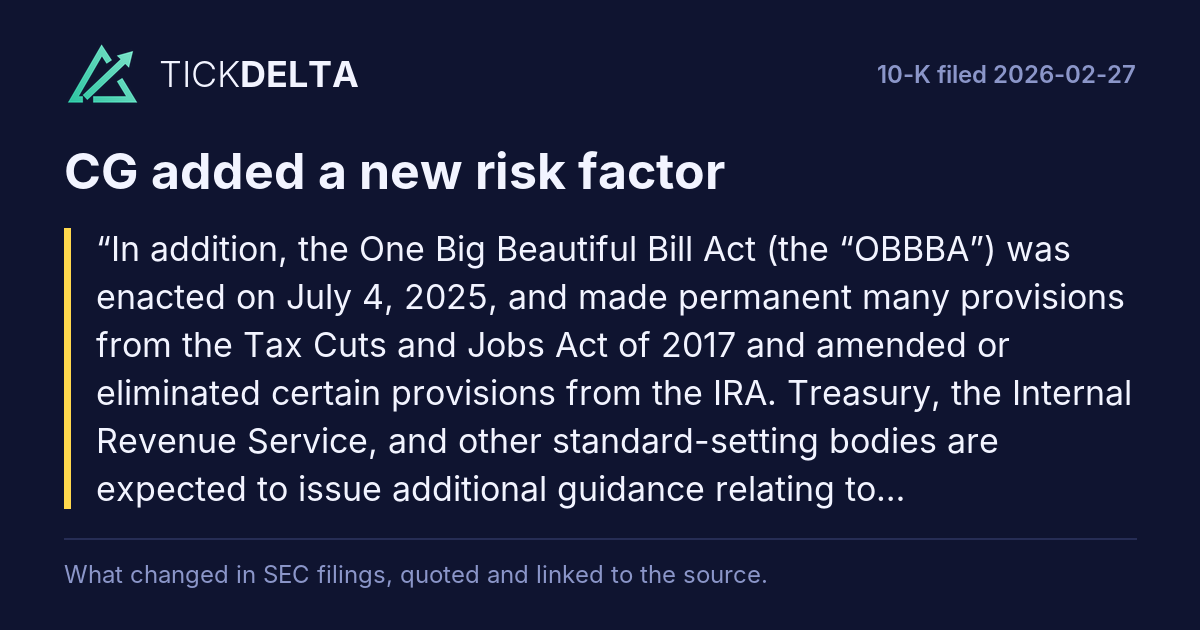
In addition, the One Big Beautiful Bill Act (the “OBBBA”) was enacted on July 4, 2025, and made permanent many provisions from the Tax Cuts and Jobs Act of 2017 and amended or eliminated certain provisions from the IRA. Treasury, the Internal Revenue Service, and other standard-setting bodies are expected to issue additional guidance relating to implementation of OBBBA, which may be applied or otherwise administered differently from our interpretations. It is unclear whether additional legislation will be enacted into law under the current administration or, if enacted, what form it would take, and it is also unclear whether there could be further regulatory or administrative action that could affect U.S. tax rules. State and local governments also may enact tax laws that fundamentally change state and local taxation, increase audit activity, or prompt more aggressive interpretations of existing laws and regulations. Any of these risks may have a material adverse effect on our results of operations, financial condition, and cash flow.
Paragraphs in the 10-Q filed Nov 6, 2026 that were not in the one before
New in the latest 10-Q
28 paragraphs in the 10-Q filed Nov 6, 2026 with nothing like them in the 10-Q filed Aug 10, 2026 (at least half the words must differ; new numbers alone do not count). Quoted exactly, grouped by the item heading above them. This is text that changed, not a judgement of how serious it is.
Item 6
“Carlyle funds,” “our funds,” and “our investment funds” refer to the investment funds and vehicles advised by Carlyle.
Read in the 10-Q
We include in our calculation of AUM and Fee-earning AUM the NGP Carry Funds that are advised by NGP.
Read in the 10-Q
Financial statements and notes
The Carlyle Group Inc. was formed in Delaware as a partnership on July 18, 2011. On January 1, 2020, the Company completed its conversion from a Delaware limited partnership named The Carlyle Group L.P. into a Delaware Corporation named The Carlyle Group Inc. (the conversion, together with such restructuring steps and related transactions, the “Conversion”).
Read in the 10-Q
As of September 30, 2026, assets and liabilities of the consolidated VIEs reflected in the condensed consolidated balance sheets were $ 15.0 billion and $ 12.4 billion, respectively. As of December 31, 2025, assets and liabilities of the consolidated VIEs reflected in the consolidated balance sheets were $ 14.0 billion and $ 11.7 billion, respectively. Except to the extent of the consolidated assets of the VIEs, the holders of the consolidated VIEs’ liabilities generally do not have recourse to the Company.
Read in the 10-Q
funds’ underlying investments, which are derived using the policies, methodologies and templates prepared by the Company’s valuation group, as described in Note 3, Fair Value Measurement.
Read in the 10-Q
Show the other 23
accompanying condensed consolidated statements of operations. See Note 4, Investments, for additional information on investments of Consolidated Funds.
Read in the 10-Q
sample of valuations are reviewed by external valuation firms. Valuations of the funds’ investments are used in the calculation of accrued performance allocations.
Read in the 10-Q
In 2026, the Company entered into an operating lease agreement for office space in New York City, which has a term of 10 years and is expected to commence during 2028. The total contractual minimum lease payment over The Carlyle Group Inc.
Read in the 10-Q
the term of the lease is approximately $ 255 million. The related ROU asset and operating lease liability will be recorded on the lease commencement date and are not reflected on the Company’s condensed consolidated balance sheets as of September 30, 2026.
Read in the 10-Q
Principal Investments in NGP Funds. The Company also holds principal investments in the NGP Carry Funds.
Read in the 10-Q
terms of the credit facility. The Company has not funded any amounts under this agreement to date and believes the likelihood of any material funding to be remote.
Read in the 10-Q
On October 8, 2021, the OECD introduced a 15% global minimum tax under the Pillar Two GloBE model rules.
Read in the 10-Q
antidilutive and excluded from the computation of diluted earnings per share given the net loss attributable to common shareholders.
Read in the 10-Q
summary of changes for the nine months ended September 30, 2026, are presented below:
Read in the 10-Q
(6)Includes our Aviation carry funds (CAPF / SASOF), asset-backed securitization vehicles, and other related managed accounts.
Read in the 10-Q
U.S. equity markets extended their gains in the third quarter of 2026, though returns were considerably more muted than in the second quarter, as resilient economic growth and strong corporate earnings outweighed geopolitical tensions, higher energy prices, and rising interest rates. The S&P 500 and NASDAQ Composite returned approximately 2.0% and 2.5%, respectively, reaching new record highs, supported by further upward earnings per share (“EPS”) revisions. Consensus expectations for 2026 S&P 500 EPS growth have now risen by 1,820 basis points (“bps”) since the onset of the Iran conflict, with much of the earnings strength concentrated among a small number of companies in the information technology (“IT”) and energy sectors. SaaS stocks rebounded 39% during the quarter as stronger financials helped allay near-term concerns around artificial intelligence (“AI”) disruption, though the sector remained down 9% year-to-date. Meanwhile, small caps pulled back as the Russell 2000 declined 7.5%. Headline index gains obscured significant underlying weakness: over 40% of S&P 500 constituent companies and roughly 60% of Russell 3000 constituent companies finished the quarter more than 30% below their all-time highs. Globally, over 60% of stocks were more than 30% below their all-time highs, while more than half finished the quarter more than 25% below their 52-week highs.
Read in the 10-Q
Performance was generally weaker outside the United States. Europe’s Euro Stoxx 50 declined 0.9%, while the sharpest reversal occurred in Asia. Japan’s Nikkei 225 declined 4.7% and Korea’s KOSPI fell 19.3%, its largest quarterly decline since the first quarter of 2020, as the semiconductor-led rally that drove Asian markets in the first half of the year reversed sharply. In private markets, buyouts in the U.S. continued to lag the S&P 500 over the last year, but longer-term comparisons remain favorable against benchmarks that align with the market capitalization profile of buyout-backed companies and are less influenced by mega-cap concentration. Compared to the Russell 2000 and S&P 600, buyouts in the U.S. have generated annualized outperformance of approximately 50 to 80 bps over the last five years, 260 to 270 bps over the last 10 years, and 240 to 320 bps over the last 15 years. As public-market returns become increasingly driven by a small number of mega-caps, comparisons between private market performance and headline capitalization-weighted indexes have become less informative about the relative performance of similarly sized companies. The growing divergence within public markets reinforces this distinction: the rolling 52-week correlation of weekly returns between the equal-weighted and capitalization-weighted S&P 500 has fallen to its lowest level in the history of available data.
Read in the 10-Q
Official estimates suggest the U.S. economy expanded at a 3.4% annualized rate in Q3 2026. The mechanical reversal of the inventory drag in Q2 2026 added 160 bps to growth in Q3 2026, leaving just 1.7% annualized growth in final sales. U.S. demand remains strong, though so much of the surge in AI-related spending has been met through capital goods imports that the bulk of the value-added in Q3 2026 accrued to the Asian supplier economies. Our portfolio-implied measure of aggregate inflation finished the quarter 3.6% above year-ago levels, driven primarily by energy costs. Management teams, however, continue to offset higher input costs through price increases to consumers and our proprietary portfolio data suggest operating margins sit at multi-year highs. In this respect, cumulative inflation has been a major challenge for tens of millions of households, making affordability a central issue in elections. Forward interest rates rose sharply during the third quarter, with most of the move occurring at the front end of the curve. The policy-sensitive two-year Treasury yield rose 72 bps in the month following Chairman Warsh’s Jackson Hole address, as the shift in Federal Reserve tone interacted with the new “acceleration” narrative to price in expectations for a significant tightening cycle. This higher-rate environment reinforces the importance of disciplined underwriting and operational improvement in driving private equity returns. The rise in rates also comes amid a broader shift in the supply and demand for capital: the formerly “asset-light” hyperscalers have transitioned from the economy’s largest providers of liquidity to its largest users, increasing competition for capital alongside large fiscal deficits. AI shipments and backlogs reached record highs every month for two straight quarters. Growth in enterprise IT spending also remains strong at 32.7%, but its trajectory has flattened relative to the step-function increase observed from the third quarter of 2025 to the second quarter of 2026 as many companies adopted policies to optimize token consumption. We expect year-over-year growth in enterprise IT spending may moderate from current levels during the fourth quarter of 2026.
Read in the 10-Q
European conditions were mixed in the third quarter of 2026. The broader euro area industrial recovery lost momentum as the energy shock weighed on activity. Our proprietary portfolio data suggest recent price trends have introduced stagflation risk that may complicate European Central Bank policy deliberations. European forward rates have also moved closely with natural gas prices, which ended October more than 200% above pre-Iran-war levels. German factory orders showed pockets of resilience, particularly in long-cycle capital goods such as defense and transportation equipment, though more recent data suggest broader momentum has pulled back. Higher euro area defense spending could provide an additional tailwind if procurement shifts toward domestic suppliers, reducing external leakage and generating commercial technology spillovers. In Asia, China remains two economies. As the ongoing housing slump continues to weigh on household net worth and confidence, growth remains inordinately dependent on exports of high-tech electronics, advanced machinery, electric vehicles, batteries, and electrical equipment. The economies of Japan and South Korea continue to benefit from global demand for semiconductors and other high-value components tied to the AI buildout. South Korean semiconductor exports are growing at an annual rate of 219%, while Japan’s AI-related exports are 50% above year-ago levels. In India, growth remains resilient, though the economy’s reliance on imported oil and gas leaves it vulnerable to persistently elevated energy costs.
Read in the 10-Q
Global merger and acquisition markets remained active, though transaction volumes declined from the record pace in the first half of 2026. Transactions in the third quarter totaled $1.2 trillion, a decrease of 30% quarter-over-quarter and 5% year-over-year. Leveraged buyout activity also slowed. Globally, general partners announced leveraged buyouts totaling $118 billion in the third quarter of 2026, a moderate decline quarter-over-quarter (6.4%), though a steep decline from the record volume observed in the same quarter a year ago (54%). Transaction counts remained stable at 488 deals, a 2% increase compared to last quarter. U.S. IPO activity likewise moderated from the elevated pace in the second quarter: 21 operating-company IPOs came to market in the third quarter compared to 39 in the second quarter. By contrast, the aggregate value of global divestments of private equity-backed companies rebounded sharply, rising 68% quarter-over-quarter, though the increase reflected a relatively small number of large transactions as exit counts remained essentially flat.
Read in the 10-Q
Credit markets remained resilient during the third quarter of 2026. Leveraged loans posted gains in the quarter, underpinned by supportive technical factors and a rebound in software names. The weighted-average bid in the U.S. leveraged loan market reached 95.69 in late September, its highest level since early February, before declining through quarter-end and into the fourth quarter to 94.59 (as of November 2) amid continued pressure from higher yields. Broader credit stress remained contained: the par-weighted rate of defaults plus distressed exchanges in the leveraged loan market finished the third quarter at 2.08%, well below their 2024 - 25 average of 3.59%, while private credit defaults fell 10 bps to 2.41%, only modestly above their 2024 - 25 average of 2.21%. However, redemptions have been elevated at certain credit-oriented retail vehicles despite the resiliency of credit markets. U.S. CLO issuance rebounded, rising 37% quarter-over-quarter to $45.8 billion. By September, the median weighted-average spread on broadly syndicated loans held in U.S. CLOs fell below 300 bps, its tightest level in more than a decade. There have been some notable instances of spread widening early in the fourth quarter, but these have been largely confined to interest-rate-sensitive businesses and concerns around the AI data center buildout. Competition among private credit lenders and from broadly syndicated loan markets continued to create pricing pressure despite resilient demand. Interest rate and credit spread movements impacted fixed-income valuations and reinsurance-related assets under management, potentially driving volatility independent of underlying cash flows. At the same time, continued insurer interest in third-party capital and reinsurance sidecar structures to improve capital efficiency and manage risk supports opportunities for alternative asset managers. Looking ahead, the AI compute buildout could become an increasingly significant source of credit demand, with bank analysts estimating that the buildout may require roughly $1 trillion in private credit financing - equal to more than half of the private credit industry’s current assets under management. Much of this financing is expected to be delivered through a range of bespoke, largely untested structures. The scale and nature of these financings underscore the importance of disciplined underwriting and appropriate concentration limits as the buildout progresses.
Read in the 10-Q
Interest and other income of Consolidated Funds. Interest and other income of Consolidated Funds primarily represents the interest earned on assets of consolidated CLOs. Our CLOs generate interest income primarily from investments in bonds and loans, inclusive of amortization of discounts, and generate other income from consent and amendment fees.
Read in the 10-Q
We may hire additional individuals and overall compensation levels may correspondingly increase, which could result in an increase in compensation and benefits expense. As a result of prior acquisitions, we have charges associated with contingent consideration taking the form of earn-outs and profit participation, some of which are reflected as compensation expense.
Read in the 10-Q
We include in our calculation of AUM and Fee-earning AUM the NGP Energy funds that are advised by NGP.
Read in the 10-Q
2% and 2% of our management fees for the three and nine months ended September 30, 2026, respectively; and 6% and 12% of our total investment income or loss on an unconsolidated basis for the three and nine months ended September 30, 2026, respectively.
Read in the 10-Q
Provision (benefit) for income taxes. The table below presents the provision (benefit) for income taxes and the effective tax rate for the three and nine months ended September 30, 2026 and 2025:
Read in the 10-Q
Date)(1) Capital(2) Invested Invested Value(4) Fair (6) IRR IRR Accrued Value(11) (6) IRR Capital(3) Value(5) (7)(8) (8)(9) Carry/ (7)(8)
Read in the 10-Q
Item 6
10.1* Revolving Credit Agreement, dated as of December 17, 2018, as amended by Amendment No. 1 on December 16, 2019, Amendment No. 2 on December 15, 2020, Amendment No. 3 on September 1, 2021, Amendment No. 4 on January 25, 2022, Amendment No. 5 on August 23, 2023, Amendment No. 6 on August 21, 2024, Amendment No. 7 on August 20, 2025, and Amendment No. 8 on August 19, 2026 among TCG Capital Markets L.L.C. and TCG Senior Funding L.L.C., as Borrowers, the Lenders party hereto, and Mizuho Bank, Ltd., as Administrative Agent, and Mizuho Bank, Ltd., as Sole Lead Arranger and Sole Bookrunner.
Read in the 10-Q
The 10-Q's risk factors against the 10-K
Item 1A of the 10-Q filed Nov 6, 2026 against Item 1A of the 10-K filed Feb 27, 2026.
A 10-Q repeats only the risks that changed, so a 10-K paragraph that is missing from it is not counted as removed.
Added is a paragraph with nothing like it in the 10-K, Reworded a sentence that is in both with several words changed,
Quiet changes a sentence in both where one to four words changed and one is a hedge or a modal
(cut words struck through, new words highlighted).
Text on the page, not a score; each links to the filing at sec.gov.
This 10-Q has no Item 1A (Risk Factors) text of its own, so there is nothing to compare. Many companies leave it out when their risks have not changed.
Phrases used for the first time
Two-word phrases in Risk Factors of the 10-K filed Feb 27, 2026 that are in none of the 1 earlier 10-Ks stored, back to Feb 27, 2025
Where each one is used
- carlyle alpinvest: Our information systems and technology may not continue to be able to accommodate our growth, and the cost of maintaining such systems may increase from its current level. For example, our existing systems may not be adequate to identify or control the relevant risks in investment strategies employed by new...
- mip proposals: EU Market Integration Package. On December 4, 2025, the European Commission published a set of wide-ranging legislative proposals which have collectively been labelled the “Market Integration Package” or “MIP.” The MIP proposals have the overall objective of further integrating EU financial markets by breaking down...
- presidential administration: In August 2023, an executive order established an outbound investment screening regime (the “Outbound Order”), which was intended to regulate or prohibit certain investments by U.S. persons in advanced technology sectors in jurisdictions that may be designated as a “country of concern.” In January 2025, the current...
- reinsurance counterparties: While we expect to derive a meaningful contribution to our revenue across our business segments from our investment in and strategic asset management relationship with Fortitude, as described in Note 4, Investments, to Part II, Item 8 “Investments—Investment in Fortitude,” we may not be successful in doing so....
- current administration: The current U.S. political environment and the resulting uncertainties regarding actual and potential shifts in U.S. foreign investment, trade, taxation, economic, environmental, and other policies under the current administration, as well as the impact of geopolitical tension, such as a deterioration in the...
- current presidential: In August 2023, an executive order established an outbound investment screening regime (the “Outbound Order”), which was intended to regulate or prohibit certain investments by U.S. persons in advanced technology sectors in jurisdictions that may be designated as a “country of concern.” In January 2025, the current...
- consolidated investment: Under applicable U.S. GAAP standards, we may be required to consolidate certain of our investment funds, holding companies, or operating businesses if we determine that these entities are VIEs and that we are the primary beneficiary of the VIE, as discussed in Note 2, Summary of Significant Accounting Policies, to...
- federal level: Our most important asset is our people, and our continued success is highly dependent upon the efforts of our senior Carlyle professionals and other employees. Our future success and growth depends to a substantial degree on our ability to retain and motivate our senior Carlyle professionals and other employees to...
Used at least twice, small words left out. Counted, not picked: a phrase can be new because the company renamed something.
What was taken out
94 paragraphs of last year's Risk Factors with nothing like them now. The longest are quoted.
Sources
Item 1A of each 10-K and 10-Q on EDGAR, quoted exactly. Each paragraph links to the filing at sec.gov.
Also
10-K change: what was reworded or cut, section by section.
Work with it
Excel workbook · CSV. Google Sheet that stays up to date: paste =IMPORTDATA("https://tickdelta.com/company/CG/export.csv") into a cell.