Form 10-K
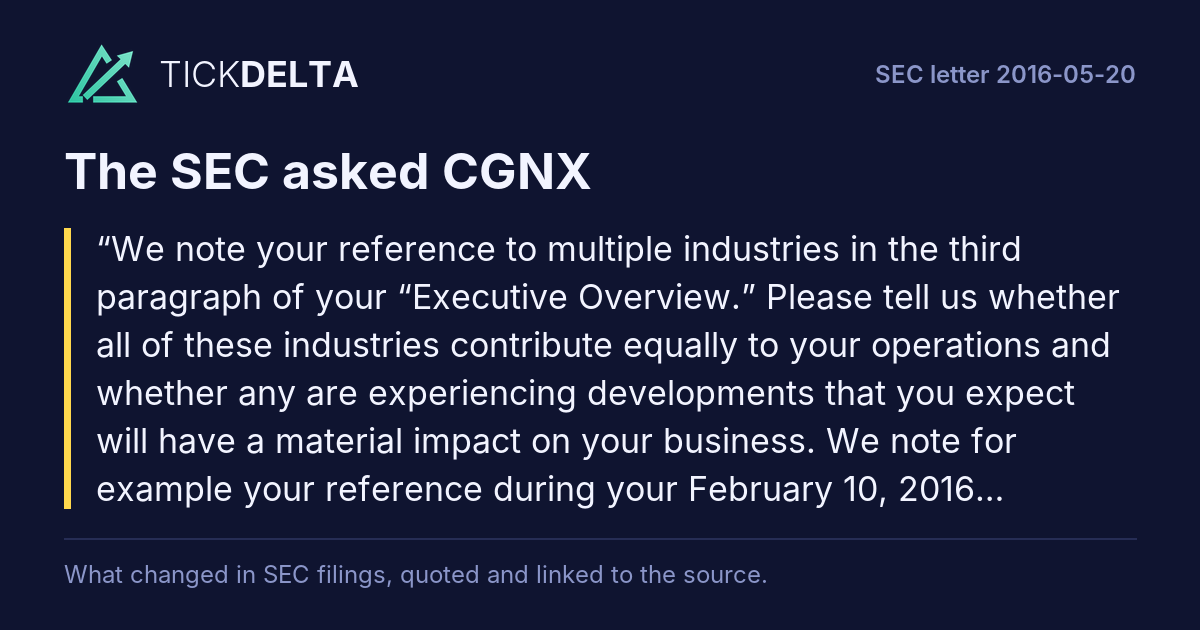
We note your reference to multiple industries in the third paragraph of your “Executive Overview.” Please tell us whether all of these industries contribute equally to your operations and whether any are experiencing developments that you expect will have a material impact on your business. We note for example your reference during your February 10, 2016 conference call to slower automotive spending.Rest of the question
Please tell us how your Form 10-K and Form 10-Q for the period ended April 3, 2016 include the disclosures regarding trends and seasonality required by Regulation S-K Item 303(a)(2)(ii), 303(a)(3)(ii), and Instruction 5 to Item 303(b). In your response, please address any material trend in revenue or margins from a country or region, and any material trend in order activity affecting inventory or otherwise affecting your financial condition or results of operations.
In 2015 and 2014, the consumer electronics industry and the automotive industry each contributed between 25% and 30% of the Company’s total revenue. No other industry accounted for greater than 10% of the Company’s total revenue in these fiscal years.Read in the reply
Management commented during the Company’s February 10, 2016 conference call that growth in revenue from the automotive industry had slowed in the second half of 2015 and into the first quarter of 2016.Rest of the answer
However, the Company currently expects both the automotive and consumer electronics industries to be major contributors to its business in 2016, and the Company does not currently anticipate any known developments in either of these industries to have a material impact on its business in 2016. Also, as of the dates of filing of the Form 10-K and Form 10-Q, management had identified no known material trends in revenue or margins by country or region affecting the Company’s financial condition or results of operations.
With respect to the Staff’s other inquiries:
•
Regarding Regulation S-K Item 303(a)(2)(ii) related to full fiscal year disclosures, there were no known material trends in the Company’s capital resources as of the date of the Form 10-K filing. The
Company’s capital expenditures in 2016 are currently expected to be in line with the levels reported in 2015 and 2014.
Regarding Regulation S-K Item 303(a)(3)(ii) related to full fiscal year disclosures, there were no known trends or uncertainties that have had or that management reasonably expected will have a material impact on the Company’s revenues or income from continuing operations, including increases in costs of labor or materials, price increases, or inventory adjustments, as of the date of the Form 10-K filing.
Regarding Regulation S-K Instruction 5 to Item 303(b) related to interim period disclosures, there were no seasonal aspects of the Company’s business which had a material effect upon its financial condition as of April 3, 2016 or its results of operations for the interim period ended April 3, 2016.
Although the timing of quarterly revenue from the consumer electronics industry is impacted by the product design cycles of the Company’s major customer in this industry, revenue from this customer was at a relatively low level for the first quarter of 2016. Although the Company incurred large expenditures for inventories during this interim period related to orders received or anticipated to be received from this customer, these expenditures were not material to its overall financial condition. The Company will disclose the trends related to large orders in the consumer electronics industry in future filings when this business is material to its financial condition or results of operations. For example, please refer to the Company’s Form 10-Q filing for the quarterly period ended July 5, 2015, which disclosed, “The level of large orders is not expected to continue in the third quarter of 2015, and therefore, we expect revenue to decline in the third quarter compared to the second quarter of 2015, although we expect third quarter revenue to be higher than the first quarter of 2015.”
First report after the company's reply of Jun 2, 2016: 10-Q filed Aug 1, 2016 ↗, against the 10-Q filed May 2, 2016 ↗.
Tickdelta does not hold the text of both reports, so they are not compared here.
Please tell us the extent of the effect of the “shift in revenue mix to relatively-lower margin products” on your gross margin, the reason for the shift, and whether this shift reflects a material trend. Also tell us whether existing arrangements with any material customer require future sales at a margin that differs materially from the disclosed margin.
The shift in revenue mix to relatively-lower margin products had an unfavorable impact of approximately 30 basis points on the Company’s total gross margin when comparing fiscal years 2015 and 2014. This shift primarily relates to increased sales of ID products, which have a lower gross margin than the Company’s average gross margin. In further response to the Staff’s comment, the Company has an existing arrangement with a material customer that provides them with preferred (lower) pricing as compared to other customers.Read in the replyRest of the answer
The Company’s total gross margin was 78% for the first quarter of 2016, 77% for 2015, and 78% for 2014. The Company expects its total gross margin percentage to be in the mid-to-high 70% range in the second quarter of 2016, inclusive of its estimates for revenue from ID products and this material customer, and therefore, the Company does not currently consider either of these items to be material trends impacting its gross margin.
First report after the company's reply of Jun 2, 2016: 10-Q filed Aug 1, 2016 ↗, against the 10-Q filed May 2, 2016 ↗.
Tickdelta does not hold the text of both reports, so they are not compared here.
In Note 16 on page 59 we see the significant impact of the foreign tax rate differential and the overall low foreign effective tax rate. In future filings please expand MD&A to discuss your foreign effective tax rate, including discussion of the primary taxing jurisdictions where your foreign earnings are derived and the relevant statutory rates.
The Company will expand MD&A to discuss its foreign effective tax rate in future filings. The Company’s intended disclosure is included below.Read in the reply
“The majority of income earned outside of the United States is permanently reinvested to provide funds for international expansion. The Company is tax resident in numerous jurisdictions around the world and has identified its major tax jurisdictions as the United States, Ireland, and China. The statutory tax rate is 12.5% in Ireland and 25% in China, compared to the U.S. federal statutory corporate tax rate of 35%.”
First report after the company's reply of Jun 2, 2016: 10-Q filed Aug 1, 2016 ↗, against the 10-Q filed May 2, 2016 ↗.
Tickdelta does not hold the text of both reports, so they are not compared here.
We note the significant amount of unbilled revenue on your balance sheet in the Form 10-Q for the quarter ended July 5, 2015. In future filings please expand your revenue policy to describe the circumstances where you record revenue in advance of billing. Also, describe the factors you consider in determining the appropriate timing of revenue recognition for recorded revenue not billed at the balance sheet date.
The Company will expand its revenue policy to describe the circumstances where the Company records revenue in advance of billing, as well as the factors management considers in determining the appropriate timing of such revenue recognition, in the Company’s future filings. The Company’s intended disclosure is included below (changes to existing disclosure marked, with new disclosure in underlined text).Read in the reply
“In order to recognize revenue, the Company requires that a signed customer contract or purchase order is received, the fee from the arrangement is fixed or determinable, and the collectionRest of the answer
of the resulting receivable is probable. Assuming that these criteria have been met, product revenue is generally recognized upon delivery, revenue from maintenance and support programs is recognized ratably over the program period, and revenue from consulting and training services is recognized when the services have been provided. When customer-specified acceptance criteria exists that are substantive, product revenue is deferred, along with associated incremental direct costs, until these criteria have been met and any remaining performance obligations are inconsequential or perfunctory. In certain circumstances, the agreement with the customer provides for payment terms which differ from revenue recognition criteria, resulting in either unbilled revenue or deferred revenue.”
First report after the company's reply of Jun 2, 2016: 10-Q filed Aug 1, 2016 ↗, against the 10-Q filed May 2, 2016 ↗.
Tickdelta does not hold the text of both reports, so they are not compared here.
We see from a risk factor on page six that you offer discounts to certain customers. In future filings please expand your accounting policy disclosure to describe the types of discounts offered and the related accounting. Refer to ASC 605-50-50.
The Company will expand its revenue policy to describe the types of discounts offered and the related accounting in the Company’s future filings. The Company’s intended disclosure is included below.Read in the reply
“Certain customers are offered pricing discounts on current sales based upon purchasing volumes, for which revenue is reported net of these discounts.”
First report after the company's reply of Jun 2, 2016: 10-Q filed Aug 1, 2016 ↗, against the 10-Q filed May 2, 2016 ↗.
Tickdelta does not hold the text of both reports, so they are not compared here.
In future filings please disclose the cumulative amount of undistributed earnings of your foreign subsidiaries for which no U.S. income taxes have been provided. Refer to ASC 740-30-50-2.
The Company will disclose the cumulative amount of undistributed earnings of its foreign subsidiaries for which no U.S. income taxes have been provided in the Company’s future filings.Read in the reply
First report after the company's reply of Jun 2, 2016: 10-Q filed Aug 1, 2016 ↗, against the 10-Q filed May 2, 2016 ↗.
Tickdelta does not hold the text of both reports, so they are not compared here.
It appears that your domestic U.S. federal effective income tax rate on earnings from continuing operations for 2015 exceeds 100%. Please explain to us the factors leading to the unusually high federal effective tax rate on earnings from continuing operations in 2015.
While the majority of income earned outside of the United States is permanently reinvested to provide funds for international expansion, the Company has repatriated a certain amount of current-year earnings of its foreign subsidiaries in all years presented.Read in the reply
As a result, the Company has paid U.S. Federal taxes, net of foreign tax credits, on such repatriated earnings. In 2015, profits from the Company’s U.S. operations were the lowest of the years presented, resulting in an exaggerated impact of the U.S. tax on repatriated earnings.
First report after the company's reply of Jun 2, 2016: 10-Q filed Aug 1, 2016 ↗, against the 10-Q filed May 2, 2016 ↗.
Tickdelta does not hold the text of both reports, so they are not compared here.
Please file a complete copy of your articles of incorporation as amended to date.
file a complete copy of its articles of incorporation, as amended to date, as an exhibit to its quarterly report on Form 10-Q for the quarterly period ended July 3, 2016, pursuant to Regulation S-K Item 601(b)(3)(i).Read in the reply
As requested in the Comment Letter, the Company hereby acknowledges the following:
the Company is responsible for the adequacy and accuracy of the disclosure in the filing;
Staff comments or changes to disclosure in response to Staff comments do not foreclose the Commission from taking any action with respect to the filing; and the Company may not assert Staff comments as aRest of the answer
defense in any proceeding initiated by the Commission or any person under the federal securities laws of the United States.
If you should have any questions concerning these responses, please contact the undersigned at (508) 650-6363.
First report after the company's reply of Jun 2, 2016: 10-Q filed Aug 1, 2016 ↗, against the 10-Q filed May 2, 2016 ↗.
Tickdelta does not hold the text of both reports, so they are not compared here.
Please reconcile your response to prior comment 1 with (1) statements made during your February 10, 2016 conference call discussing a slowed growth rate in China and a slower economy in Europe, and (2) statements made during your May 2, 2016 conference call indicating that you experience seasonal trends in both your factory-automation and logistics businesses.Rest of the question
Also, in future filings, please ensure that the significance of each of your industry and end-market references in your document is clear from context.
With regard to the disclosures related to trends required by Regulation S-K Item 303(a)(3)(ii) for full fiscal years, although management discussed a slower growth rate in China and a slower economy in Europe during the Company’s February 10, 2016 conference call, the Company still expects growth from these regions in 2016 and does not believe that these economic conditions will have a material impact on the Company’s financial condition or results of operations.Read in the replyRest of the answer
Specifically, management commented during the call that “we do expect China to be a meaningful contributor to growth even in its current economic state.” To the extent identified by management, however, the Company will discuss any material trends by country or region affecting its financial condition or results of operations in its future filings.
With regard to the disclosures related to seasonality required by Regulation S-K Instruction 5 to Item 303(b) for interim periods, the
Company has discussed the seasonal aspects of its business in prior filings when these items have had a material effect on the Company’s results of operations. For example, please refer to the Company’s Form 10-Q for the quarterly period ended October 4, 2015, which stated “The decrease for the three-month period was primarily due to the timing of revenue from large orders in the consumer electronics industry. The new product introduction cycles of customers in this industry result in cyclical ordering patterns. During 2014, large consumer electronics orders were recognized as revenue predominantly in the third quarter, while during 2015, large consumer electronics orders were recognized as revenue in each of the first three quarters of the year, with the highest level being recognized in the second quarter.” Although the Company has historically experienced seasonality in its factory automation business (and, in particular, with respect to its consumer electronics and logistics businesses), this seasonality did not have a material effect on the Company’s results of operations for the quarterly period ended April 3, 2016. Although management commented during the Company’s
May 2, 2016 conference call that “we typically experience a revenue decline from Q4 to Q1 and that seasonal trend held true this year,” the sequential decline in revenue was only $1.6 million or 2%, and therefore, the Company does not believe this was a material seasonal trend requiring disclosure in the Form 10-Q. The Company will discuss the seasonal aspects of its businesses in future filings when such seasonality has had a material impact upon the Company’s financial condition or results of operations.
Also, per the Staff’s comment, the Company will ensure that, in future filings, the significance of each of its industry and end-market references in the filing is clear from context.
First report after the company's reply of Jul 5, 2016: 10-Q filed Aug 1, 2016 ↗, against the 10-Q filed May 2, 2016 ↗.
Tickdelta does not hold the text of both reports, so they are not compared here.
Please expand your response to prior comment 2 to (1) clarify the basis for your conclusion that a margin in the mid 70% range would be immaterial, and (2) address whether the preferred pricing arrangement with your material customer involves a material change in margin during periods beyond your second quarter.Rest of the question
Also tell us the extent that your margins would have changed during the periods presented absent your agreement with the material customer; your response should make clear the extent that you must make sales with margins that offset your preferred pricing to maintain historic margins.
The Company currently expects its gross margin to remain in the mid-to-high 70% range for the remainder of 2016, inclusive of the impact of the preferred pricing arrangement with its material customer. A gross margin at the lower end of this range would likely be associated with higher total revenue, which would result in a positive contribution to the Company’s operating income; therefore, the Company does not believe that a gross margin in the mid 70% range would be material to its results of operations.Read in the reply
The Company’s gross margin would have been approximately 30 basis points higher absentRest of the answer
its agreement with the material customer in 2015 as compared to 2014 (please note that this impact is different from the 30 basis points attributed to increased sales of ID products in the Company’s prior response). The preferred pricing arrangement and increased sales of ID products contributed to a shift in revenue mix to relatively-lower margin products and services. As described in the Form 10-K, this shift in revenue mix, as well as the negative impact of changes in foreign currency exchange rates, was partially offset by lower inventory charges in 2015 as compared to 2014, to result in a slight decline in the gross margin from 78% in 2014 to 77% in 2015. None of these items, either favorable or unfavorable to the gross margin, were individually material
(50 basis points or less).
The Company has discussed the gross margin impact of arrangements with material customers in prior filings when these items have had a material effect on the Company’s results of operations. For example, please refer to the Company’s Form 10-Q for the quarterly period ended July 5, 2015, which stated that the lower gross margin was due in part to “volume pricing discounts on certain large orders.” The Company will continue to describe material changes in its gross margin in future filings.
First report after the company's reply of Jul 5, 2016: 10-Q filed Aug 1, 2016 ↗, against the 10-Q filed May 2, 2016 ↗.
Tickdelta does not hold the text of both reports, so they are not compared here.
Please refer to comment 3. We see that the statutory tax rates in your major foreign jurisdictions are significantly higher than the foreign effective tax rate that can be derived from the disclosures in Note 16.Rest of the question
Accordingly, in future filings please also disclose the foreign effective tax rate and describe the principal reasons for the difference between the foreign effective tax rate and the foreign statutory rates you disclose in MD&A.
Per the Staff’s comment, the Company will disclose, in future filings, the foreign effective tax rate and describe the principal reasons for the difference between the foreign effective tax rate and the foreign statutory rates the Company discloses in MD&A.Read in the reply
First report after the company's reply of Jul 5, 2016: 10-Q filed Aug 1, 2016 ↗, against the 10-Q filed May 2, 2016 ↗.
Tickdelta does not hold the text of both reports, so they are not compared here.
Please refer to comment 4. While we acknowledge the proposed revisions to your revenue recognition disclosure, in future filings, please describe the specific circumstances where you recognize revenue in advance of billing, including a description of the underlying terms of any specific arrangements.Rest of the question
Also, describe how payment terms of those arrangements differ from those when you recognize revenue and bill receivables at shipment or delivery, as described in your basic revenue policy disclosure.
Per theRead in the reply
Staff’s comment, the Company will disclose, in future filings, the specific circumstances where the Company recognizes revenue in advance of billing, including a description of the underlying terms of any specific arrangements. In addition, in future filings, the Company will describe how payment terms of those arrangements differ from those when the Company recognizes revenue and bills receivables at shipment or delivery, as described in its basic revenue policy disclosure.Rest of the answer
The
Company’s intended disclosure is included below (changes to existing disclosure marked, with new disclosure in underlined text).
“In order to recognize revenue, the Company requires that a signed customer contract or purchase order is received, the fee from the arrangement is fixed or determinable, and the collection of the resulting receivable is probable. Assuming that these criteria have been met, product revenue is generally recognized upon delivery, revenue from maintenance and support programs is recognized ratably over the program period, and revenue from consulting and training services is recognized when the services have been provided. When customer-specified acceptance criteria exists that are substantive, product revenue is deferred, along with associated incremental direct costs, until these criteria have been met and any remaining performance obligations are inconsequential or perfunctory.
For the majority of the Company’s revenue transactions, revenue recognition and invoicing both occur upon delivery. In certain circumstances, however, the agreement with the customer provides for invoicing terms which differ from revenue recognition criteria, resulting in either deferred revenue or unbilled revenue. Invoicing that precedes revenue recognition is common for various customers in the logistics industry where milestone billings are prevalent, resulting in deferred revenue. Conversely, the Company records unbilled revenue in connection with a material customer in the consumer electronics industry. For this arrangement, the Company recognizes revenue for all delivered products when the first production line that incorporates these products is validated, because at that point the remaining performance obligations are inconsequential or perfunctory. Invoicing for all delivered products occurs as the production lines incorporating those products are installed over a period of several weeks. The Company also has a technical support obligation related to this arrangement for which revenue is deferred and recognized over the support period of approximately six months.”
First report after the company's reply of Jul 5, 2016: 10-Q filed Aug 1, 2016 ↗, against the 10-Q filed May 2, 2016 ↗.
Tickdelta does not hold the text of both reports, so they are not compared here.
Please refer to comment 7. While your response indicates that you have repatriated a certain amount of current year earnings in each year, Note 16 does not provide any disclosure about repatriated earnings and we do not see any deferred tax liability for undistributed foreign earnings not deemed permanently reinvested.Rest of the question
To help us better understand your response, please describe to us the actual circumstances leading you to repatriate and provide for U.S. income taxes on foreign earnings and quantify the impact on the provision for income taxes for each year presented. Also, clarify the basis for your disclosure on page 61 that you do not provide U.S. income taxes on foreign subsidiaries undistributed earnings because they are deemed to be permanently reinvested.
Each year the Company reviews its earnings in the various jurisdictions in which it operates and determines the level of funds required to sustain future growth. These funds are considered permanently reinvested. Where it is determined that excess funds are available within the current year’s earnings, the excess has been repatriated to the United States and appropriate taxes paid net of foreign tax credits. In 2014, the Company repatriated $35 million in foreign earnings and provided for $8.7 million in Federal income taxes.Read in the replyRest of the answer
In 2015, the Company repatriated $44 million in foreign earnings and provided for $12.3 million in
Federal income taxes.
To the extent that the Company has undistributed foreign earnings that are not deemed permanently reinvested in the future, the Company will provide appropriate footnote disclosure and record a deferred tax liability with respect to such undistributed foreign earnings.
First report after the company's reply of Jul 5, 2016: 10-Q filed Aug 1, 2016 ↗, against the 10-Q filed May 2, 2016 ↗.
Tickdelta does not hold the text of both reports, so they are not compared here.
Please refer to comment 7. Tell us the cumulative amount of undistributed earnings of your foreign subsidiaries at December 31, 2015.
The Company’s cumulative amount of undistributed earnings of its foreign subsidiaries was $375 million at December 31, 2015.Read in the reply
First report after the company's reply of Jul 5, 2016: 10-Q filed Aug 1, 2016 ↗, against the 10-Q filed May 2, 2016 ↗.
Tickdelta does not hold the text of both reports, so they are not compared here.
Please expand your response to prior comment 8 to provide your analysis of whether your complete amended charter was required to be filed with your previous Form 10-Q; include in your response the date that the charter was amended. Also address in your response when you are required to file your complete amended bylaws.
proposed amendments to its charter and bylaws for approval by its shareholders at its 2016 Annual Meeting of Shareholders held on April 28, 2016. These proposed amendments, which were set forth in the Company’s definitive proxy statement filed with the Commission on March 16, 2016, were approved by the Company’s shareholders at the Annual Meeting. However, the amendments to the charter were not effective until the filing and acceptance of articles of amendment in appropriate form with the Secretary of State of the Commonwealth of Massachusetts, which occurred on May 5, 2016.Read in the replyRest of the answer
The amendment to the Company’s bylaws became effective at the same time. As a result, the Company will be required to file its complete amended charter and complete amended bylaws with its next periodic report (its quarterly report on Form 10-Q for the quarterly period ended July 3, 2016) pursuant to Regulation S-K Item 601(b)(3)(i) and (ii).
If you should have any questions concerning these responses, please contact the undersigned at (508) 650-6363.
First report after the company's reply of Jul 5, 2016: 10-Q filed Aug 1, 2016 ↗, against the 10-Q filed May 2, 2016 ↗.
Tickdelta does not hold the text of both reports, so they are not compared here.
Also in this review: company letter, Jul 27, 2016, closing letter, 2016-07-29