Added10-Q Nov 5, 2026 vs 10-K Feb 12, 2026
We may be unable to complete our pending acquisition of RealSense in a timely manner or at all, and we will incur significant costs whether or not the acquisition is completed.
Each branch is a paragraph in Risk Factors with nothing like it in the 10-K filed Feb 13, 2025. A box jumps to the paragraph as filed, below.
12 paragraphs in Risk Factors of the 10-K filed Feb 12, 2026 with nothing like them in the 10-K filed Feb 13, 2025. Quoted exactly. Paragraphs that were only edited are under 10-K change.
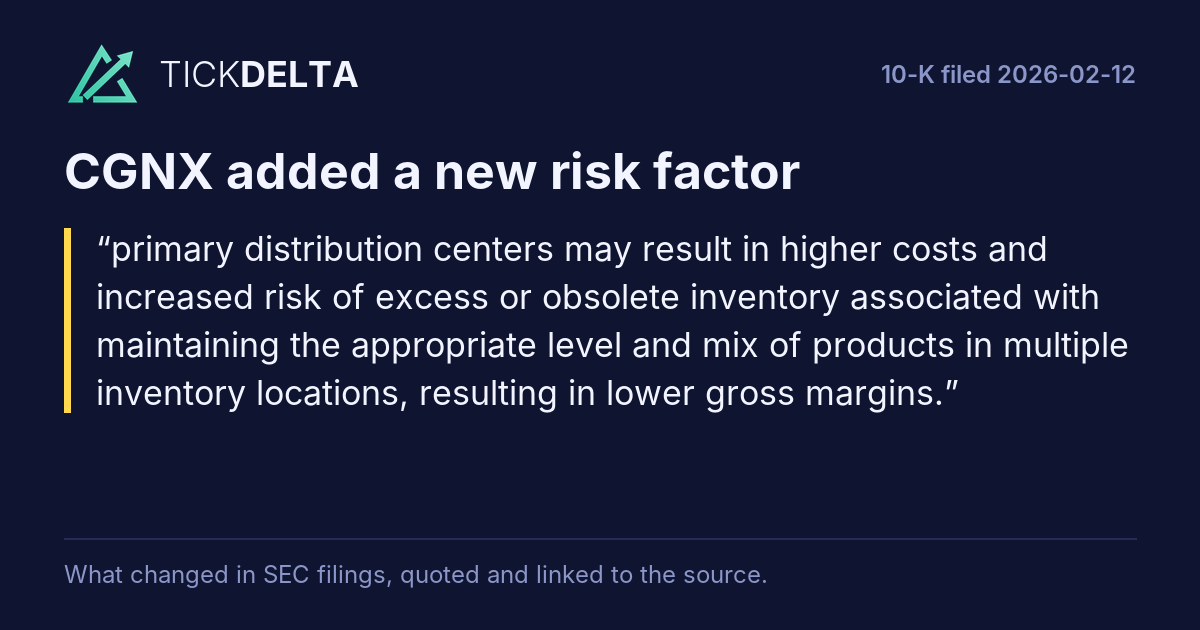
primary distribution centers may result in higher costs and increased risk of excess or obsolete inventory associated with maintaining the appropriate level and mix of products in multiple inventory locations, resulting in lower gross margins.
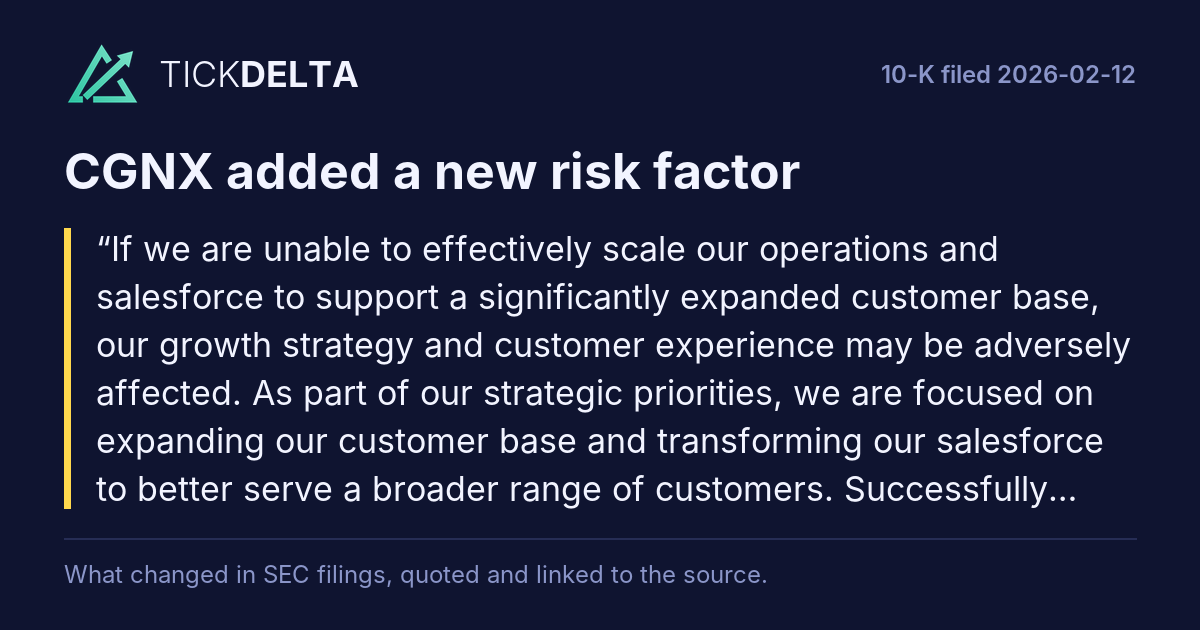
If we are unable to effectively scale our operations and salesforce to support a significantly expanded customer base, our growth strategy and customer experience may be adversely affected.
As part of our strategic priorities, we are focused on expanding our customer base and transforming our salesforce to better serve a broader range of customers. Successfully executing this strategy requires significant investments in sales, support, systems, processes, and personnel, as well as effective organizational change management.
Scaling our operations to support a larger and more diverse customer base presents operational and execution risks. If we are unable to recruit, train, and retain sufficient sales and support personnel, or if changes to our sales processes, tools, and operating model do not perform as intended, we may experience operational inefficiencies, inconsistent customer engagement, delays in responding to customer needs, or reduced effectiveness of our sales efforts. In addition, expanding into new customer segments and geographies may increase complexity in managing customer relationships, product requirements, and support expectations. Failure to maintain a consistently high-quality customer experience during this period of growth could result in customer dissatisfaction, reputational harm, and reduced demand for our products.
Any inability to effectively scale our operations and salesforce, or to manage the associated organizational and operational challenges, could increase costs, limit our ability to achieve anticipated growth, and materially adversely affect our business, financial condition, and results of operations.
The failure to effectively transform our operating model, manage our expenses, and achieve expected cost reductions could adversely affect our business and financial results.
We are implementing initiatives intended to improve our operating model and productivity across key functions, with the goal of enhancing efficiency, strengthening our cost structure, and supporting long‑term growth. These efforts include changes to processes, systems, and organizational design, and depend on effective execution and sustained discipline in managing our expenses.
Transforming our operating model presents operational and execution risks. If the changes we implement do not perform as intended, take longer than expected, or create disruptions to ongoing activities, we may not achieve the anticipated cost reductions or productivity benefits. Expected savings are based on various assumptions, including stable business conditions and successful adoption of new processes and tools. Unexpected challenges, such as higher‑than‑anticipated operating costs or delays in executing planned changes, could reduce or offset the expected benefits.
If we do not effectively transform our operating model, manage our expenses, or realize the expected cost efficiencies, our cost structure may remain higher than planned, which could materially adversely affect our business, financial condition, and results of operations.
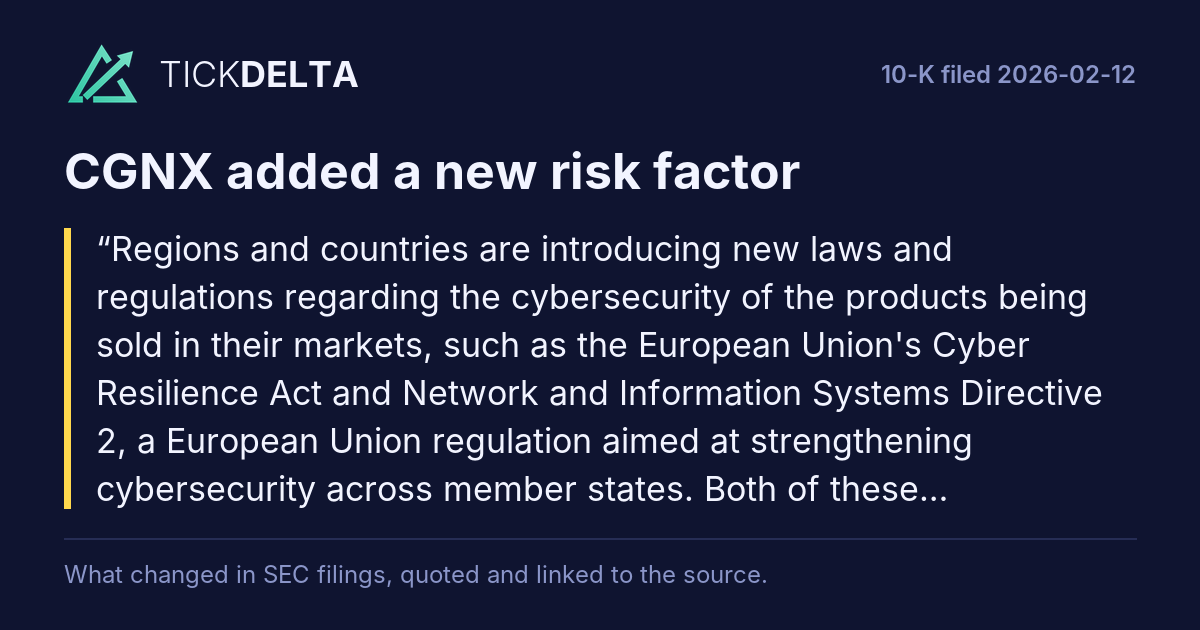
Regions and countries are introducing new laws and regulations regarding the cybersecurity of the products being sold in their markets, such as the European Union's Cyber Resilience Act and Network and Information Systems Directive 2, a European Union regulation aimed at strengthening cybersecurity across member states. Both of these regulations establish cybersecurity requirements for products, including secure software development practices, vulnerability management and reporting, incident response and lifecycle support obligations. These new laws introduce new requirements in product security and software development and our ability to comply with these requirements to prescribed timescales could result in additional cost, inhibit market access and sales, and adversely affect our business, financial condition, and operating results.
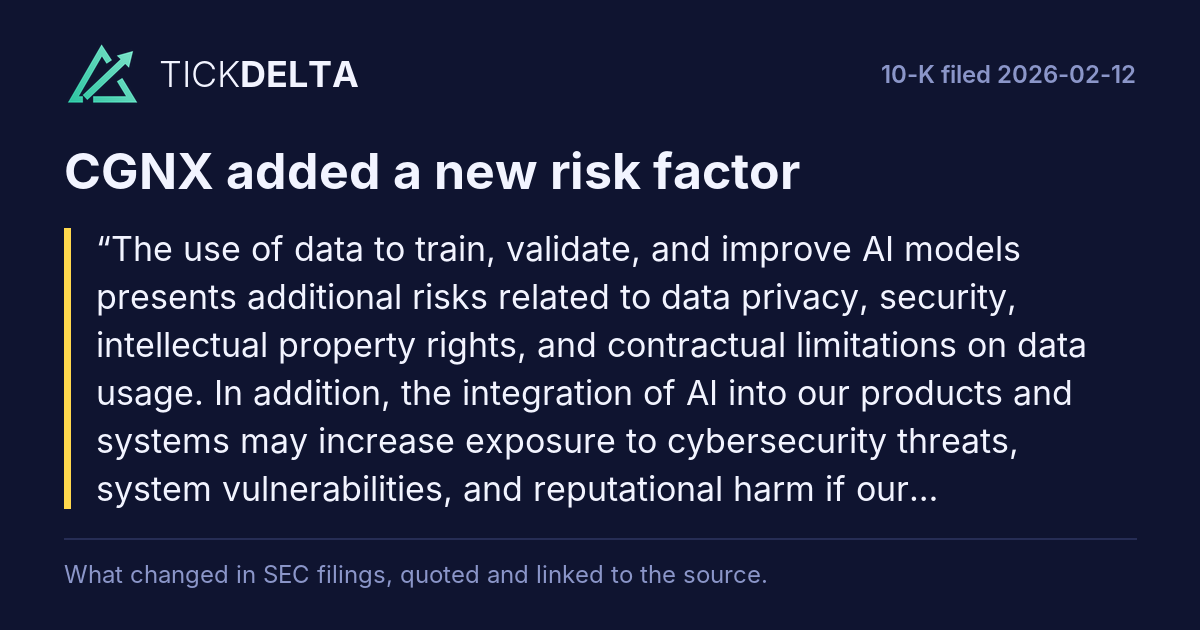
The use of data to train, validate, and improve AI models presents additional risks related to data privacy, security, intellectual property rights, and contractual limitations on data usage. In addition, the integration of AI into our products and systems may increase exposure to cybersecurity threats, system vulnerabilities, and reputational harm if our technologies fail to perform as intended or are perceived to be used inappropriately.
Because AI regulations and standards are rapidly evolving and may be inconsistent across jurisdictions, we may face challenges in anticipating and complying with future requirements, which could materially adversely affect our business, financial condition, results of operations, or reputation.
New in the latest 10-Q
22 paragraphs in the 10-Q filed Nov 5, 2026 with nothing like them in the 10-Q filed Aug 6, 2026 (at least half the words must differ; new numbers alone do not count). Quoted exactly, grouped by the item heading above them. This is text that changed, not a judgement of how serious it is.
Late in the third quarter of 2026, the Company sold investments, primarily corporate bonds, generating approximately $ 330 million of cash at a net loss of $ 2,407,000. The proceeds from these sales, along with existing cash balances, are intended to fund the pending acquisition of RealSense, Inc. ("RealSense") that is expected to close in the fourth quarter of 2026 (refer to Note 14). As of October 4, 2026, these proceeds were held in cash but were subsequently invested in money market instruments pending the close of this transaction.
Read in the 10-Q
On September 22, 2026, the Company announced that it entered into a definitive agreement to acquire all of the outstanding shares of RealSense, a leader in depth-sensing cameras and vision technology for robotic perception and physical artificial intelligence, for $ 500 million in an all-cash transaction, subject to customary adjustments. The Company expects this transaction to close during the fourth quarter of 2026 subject to standard closing conditions and the spinout of RealSense’s Facial Authentication product line into an independent company. Transaction costs incurred to date were expensed as incurred.
Read in the 10-Q
Investment income decreased by $839,000, or 20%, for the three-month period and increased by $1,058,000, or 9%, for the nine-month period in 2026 as compared to the same periods in 2025. Late in the third quarter of 2026, the Company sold investments, primarily corporate bonds, generating approximately $330 million of cash at a net loss of $2,407,000, which partially offset investment income during the period. The proceeds from these sales, along with existing cash balances, are intended to fund the pending acquisition of RealSense that is expected to close in the fourth quarter of 2026 (refer to Note 14 of the Consolidated Financial Statements).
Read in the 10-Q
In the third quarter of 2025, tax legislation known as the One Big Beautiful Bill Act (“OBBBA”) was enacted in the United States. OBBBA modifies certain international tax provisions such as the tax on Global Intangible Low Taxed Income (“GILTI”) and renames GILTI as Net CFC Tested Income (“NCTI”). The Company records NCTI taxes on a deferred basis, and as a result of OBBBA’s enactment, accrued a discrete tax expense of $33,265,000 to increase its deferred tax liability during the third quarter of 2025.
Read in the 10-Q
On September 22, 2026, the Company announced that it entered into a definitive agreement to acquire RealSense, a leader in depth-sensing cameras and vision technology for robotic perception and physical artificial intelligence, for $500 million in an all-cash transaction, subject to customary adjustments. The Company also expects to provide a three-year approximately $56.5 million cash retention program at target, and up to a maximum of $69 million, for RealSense employees, subject to performance modifiers. The transaction is expected to close in the fourth quarter of 2026, subject to customary closing conditions, with the purchase price financed entirely from existing cash and investments (refer to Note 14 of the Consolidated Financial Statements).
Read in the 10-Q
We may be unable to complete our pending acquisition of RealSense in a timely manner or at all, and we will incur significant costs whether or not the acquisition is completed.
Read in the 10-Q
The pending acquisition of RealSense is subject to various closing conditions, many of which are outside of our control. The failure to satisfy the required conditions could delay or prevent the completion of the closing of such acquisition. Additionally, the parties may terminate the definitive purchase agreement under certain circumstances. Any failure or delay in completing such acquisition could prevent us from realizing some or all of the anticipated benefits or synergies of such acquisition within the expected timeframe or at all. There can be no assurance that the conditions to the closing of such acquisition will be satisfied or waived, or that such acquisition will be completed on the terms or within the timeframe currently contemplated. Furthermore, we have incurred and will continue to incur costs relating to the pending acquisition, and many of these costs are payable by us whether or not the acquisition is completed.
Read in the 10-Q
The use of a substantial portion of our available cash to finance the pending acquisition of RealSense may have an adverse impact on our business and financial condition.
Read in the 10-Q
On September 22, 2026, we announced our entry into a definitive agreement to acquire RealSense for $ 500 million in an all-cash transaction, subject to customary adjustments. Late in the third quarter of 2026, we sold investments, primarily corporate bonds, generating approximately $ 330 million of cash intended to fund, together with cash on hand, the purchase price. We also expect to provide a three-year approximately $56.5 million cash retention program at target, and up to a maximum of $69 million, for RealSense employees, subject to performance modifiers, as well as to grant restricted stock units valued at approximately $50.0 million under our existing 2023 Stock Option and Incentive Plan dependent on the grant-date share price. The use of a substantial portion of our available cash to finance the pending acquisition of RealSense may have an adverse impact on our liquidity, limit our flexibility in responding to other business opportunities, and increase our vulnerability to adverse economic and industry conditions.
Read in the 10-Q
Implementation of our acquisition strategy may not be successful, which could affect our ability to increase our revenue or profitability and may otherwise adversely affect our business.
Read in the 10-Q
We have acquired, and may continue to acquire, new businesses and technologies. In 2023, we completed our acquisition of Moritex Corporation, a global provider of premium optical components based in Japan, for an enterprise value of approximately $270 million. In the third quarter of 2026, we announced our entry into a definitive agreement to acquire RealSense, a global provider of depth-sensing cameras and vision technology for robotic perception and physical artificial intelligence, for approximately $ 500 million. The Company expects this transaction to close during the fourth quarter of 2026. The Moritex acquisition, the pending RealSense acquisition, and acquisitions in general, may involve significant risks and uncertainties, which could include, among others:
Read in the 10-Q
• the inability to realize expected synergies or other benefits resulting from the acquisition, including the failure to achieve projected sales of acquired products,
Read in the 10-Q
• difficulties or delays integrating personnel, operations, technologies, products, processes, and systems of the acquired business, particularly in locations far from the Company's headquarters,
Read in the 10-Q
• the failure to retain key talent and difficulties integrating corporate cultures,
Read in the 10-Q
• entry into markets in which we may have limited prior experience and where competitors have stronger market positions,
Read in the 10-Q
• the inability to protect and secure acquired intellectual property or confidential information,
Read in the 10-Q
• difficulties or delays completing the development of acquired in-process technology,
Read in the 10-Q
• the impairment of acquired intangible assets resulting from lower-than-expected cash flows from the acquired assets,
Read in the 10-Q
• acquisition-related charges, which could adversely impact operating results and cash flows in any given period and could be substantially different from period to period,
Read in the 10-Q
• difficulties with implementing internal controls and accounting systems necessary to be compliant with requirements applicable to public companies subject to SEC reporting, and
Read in the 10-Q
• difficulties with closing a transaction due to regulatory approvals, employment matters, required consents, litigation, pre-closing spinouts or other challenges, which could increase costs and prevent the acquisition from being completed within the expected timeframe, or from being completed at all.
Read in the 10-Q
Acquisitions are inherently risky and the inability to effectively manage these risks could have a material adverse effect on our operating results.
Read in the 10-Q
Item 1A of the 10-Q filed Nov 5, 2026 against Item 1A of the 10-K filed Feb 12, 2026.
A 10-Q repeats only the risks that changed, so a 10-K paragraph that is missing from it is not counted as removed.
Added is a paragraph with nothing like it in the 10-K, Reworded a sentence that is in both with several words changed,
Quiet changes a sentence in both where one to four words changed and one is a hedge or a modal
(cut words struck through, new words highlighted).
Text on the page, not a score; each links to the filing at sec.gov.
What the 10-Q itself says about its risk factors:For a list of factors that could affect the Company’s business, results of operations, and financial condition, see the risk factors discussion provided in Part I - Item 1A of the Annual Report. The following information updates, and should be read in conjunction with, Part I - Item 1A of the Annual Report:
Read in the 10-Q
Two-word phrases in Risk Factors of the 10-K filed Feb 12, 2026 that are in none of the 1 earlier 10-Ks stored, back to Feb 13, 2025
Used at least twice, small words left out. Counted, not picked: a phrase can be new because the company renamed something.
3 paragraphs of last year's Risk Factors with nothing like them now. The longest are quoted.
Item 1A of each 10-K and 10-Q on EDGAR, quoted exactly. Each paragraph links to the filing at sec.gov.
10-K change: what was reworded or cut, section by section.
Excel workbook · CSV. Google Sheet that stays up to date: paste =IMPORTDATA("https://tickdelta.com/company/CGNX/export.csv") into a cell.