Paragraph 409 · 40% changed
Every version of it
Screener
/
SEC EDGAR
/CIK 0001991792
/10-K filed Feb 27, 2026, compared with Mar 28, 2025
/Numbers from the XBRL of the 10-Ks
Nasdaq
Health care · Biotechnology
CG Oncology, Inc. CGON
The 10-K against last year's
99 changes: 20 added, 14 removed, 64 reworded, 1 quiet changes
10-K Feb 27, 2026 vs Mar 28, 2025
Risk Factors
5.7%
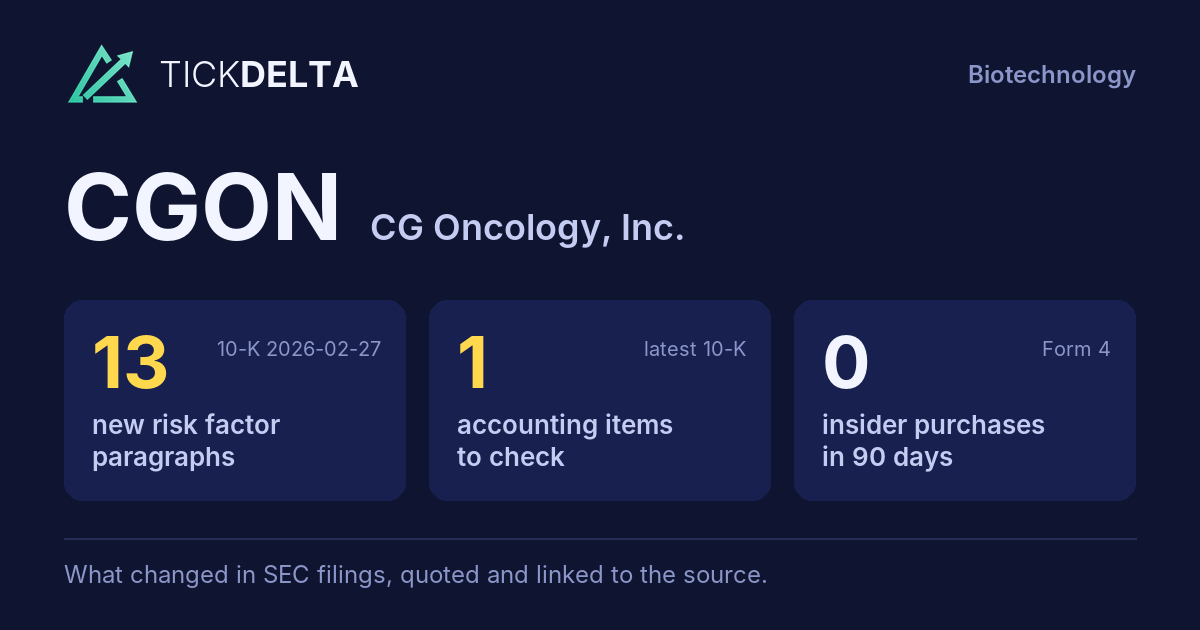
of the text changed · 42,722 words now · 13 new paragraphs, 10 gone
MD&A
21.4%
of the text changed · 6,755 words now · 7 new paragraphs, 4 gone
Legal Proceedings
26.9%
of the text changed · 632 words now
Accounting Policies
26.6%
of the text changed · 4,854 words now
10-K 0001193125-26-079498 (Feb 27, 2026) vs 10-K 0000950170-25-046351 (Mar 28, 2025)
Every paragraph, and how much of it changed
One bar per paragraph, in the order of the 10-K. Height and colour show the share of its words not in the closest paragraph a year earlier; the tallest bars are new paragraphs.
Risk Factors
429 paragraphs · 13 new · 34 reworded · 10 gone · 10-K Feb 27, 2026 against Mar 28, 2025
New paragraph
Reworded (5% of its words or more)
Same or nearly
Paragraph 270 · 38% changed
Every version of it
In the ordinary course of business, we collect, store and transmit confidential information (including but not limited to intellectual property, proprietary and confidential business information and personal information). Our information technology systems and those of our third-party service providers, strategic partners and other contractors or consultants are vulnerable to attack, damage and interruption from computer viruses and malware (e.g. ransomware), malicious code, natural disasters, terrorism, war, telecommunication and electrical failures, hacking, cyberattacks, phishing attacks and other social engineering schemes, employee theft or misuse, human error, fraud, denial or degradation of service attacks, sophisticated nation-state and nation-state-supported actors or unauthorized access or use by persons inside our organization, or persons with access to systems inside our organization. In addition, attacks upon information technology systems are increasing in their frequency, levels During times of persistence, sophistication war and intensity, other major conflicts, we and are being conducted by sophisticated and organized groups and individuals the third parties with whom we work may be vulnerable to a wide range heightened risk of motives and expertise. Furthermore, because the techniques used to obtain unauthorized access to, or to sabotage, systems change frequently and often are not recognized until launched against a target, we these attacks, including retaliatory cyber-attacks, that could be unable to anticipate these techniques or implement adequate preventative measures. Remote work has increased risks to materially disrupt our information technology systems and data, as more of operations, supply chain, and ability to produce, sell and distribute our employees utilize network connections, computers goods and devices outside our premises or network, including working at home, while in transit and in public locations. Security incidents often remain undetected for an extended period and could affect our operations. Even if identified, we may be unable to adequately investigate or remediate incidents or breaches due to attackers increasingly using tools and techniques that are designed to circumvent controls, to avoid detection, and to remove or obfuscate forensic evidence. services.
Paragraph 251 · 37% changed
Every version of it
The current Trump administration is pursuing policies to reduce regulations and expenditures across government including at HHS, the FDA, the CMS and related agencies. These actions, presently directed by executive orders or memoranda from the Office of Management and Budget, may propose policy changes that create additional uncertainty for our business. These actions may, for example, include (1) directives to reduce agency workforce, rescinding (2) directing HHS and other agencies to lower prescription drug costs through a Biden variety of initiatives, including by improving upon the Medicare Drug Price Negotiation Program and establishing Most-Favored-Nation pricing for pharmaceutical products; (3) imposing tariffs on imported pharmaceutical products; and (4) as part of the Make America Healthy Again Commission’s Strategy Report released in September 2025, working across government agencies to increase enforcement on direct-to-consumer pharmaceutical advertising. Additionally, the current administration executive order tasking the CMMI recently called on Congress to consider new enact "The Great Healthcare Plan," to codify and expand Most-Favored Nation pricing, lower government subsidies to private insurance companies, increase healthcare price transparency, expand pharmaceutical drugs available for over-the-counter purchase, and enact restrictions on pharmacy benefit manager (PBM) payment and healthcare models to limit drug spending and eliminating the Biden administration’s executive order that directed HHS to establishing an AI task force and developing a strategic plan. Additionally, in its methodologies, among other things. In June 2024 decision in Loper Bright, 2024, the U.S. Supreme Court overturned the longstanding Chevron doctrine, under which courts were required to give Court’s Loper Bright decision greatly reduced judicial deference to regulatory agencies’ reasonable interpretations of ambiguous federal statutes. The Loper Bright decision agencies, which could result in additional increase successful legal challenges to current federal regulations and guidance issued by federal agencies applicable to affecting our operations, including those issued by the FDA. operations. Congress may introduce and ultimately pass health care related legislation that could impact the drug approval process and make changes to the Medicare Drug Price Negotiation Program created under the IRA.
Paragraph 53 · 31% changed
Every version of it
Paragraph 71 · 29% changed
Every version of it
Paragraph 277 · 24% changed
Every version of it
Legal proceedings, government investigations and enforcement actions can be expensive and time-consuming. For example, on March 4, 2024, ANI Pharmaceuticals, Inc. (ANI) filed a complaint was filed against us in the Superior Court of the State of Delaware by ANI Pharmaceuticals, Inc. (ANI) naming us as defendant, seeking (i) a declaratory judgement judgment that a provision in an assignment and technology transfer agreement between us and ANI (formerly BioSante Pharmaceuticals, Inc.), dated November 15, 2010, 2010 (the ANI Agreement), obligates us to pay ANI 5% of worldwide net sales of cretostimogene. The court has most recently set cretostimogene, and (ii) compensatory damages alleging we were unjustly enriched by obtaining the benefit of certain non-patent assets without paying adequate consideration to ANI. On July 16, 2025, the Superior Court granted our motion for summary judgment with respect to ANI’s request for a trial date declaratory judgment to receive royalty payments from the potential sale of cretostimogene but denied our motion for summary judgment with respect to ANI’s unjust enrichment claim. On July 21, 2025. 2025, trial commenced regarding ANI’s unjust enrichment claim. On July 29, 2025, a jury entered a verdict in our favor and awarded no damages to ANI. We expect ANI will continue to pursue its claims, including through post-trial motions and appeals. We will continue to vigorously defend against ANI’s claims, including any post-trial motions and appeals that ANI my file. While we continue to believe the allegations are without merit and intend to vigorously defend this matter, such litigation could result in substantial costs and divert our management’s attention from other business concerns, cause us reputational damage, negatively affect our stock price and result in monetary damages and future royalty obligations, if and to the extent cretostimogene receives regulatory approval. damages. An adverse outcome resulting from any legal proceedings, investigations or enforcement actions could result in significant damages damages, awards, fines, penalties, exclusion from the federal healthcare programs, healthcare debarment, injunctive relief, product recalls, reputational damage and modifications of our business practices, which could could, in each case, have a material adverse effect on our business, financial condition, results of operations and prospects. Even if such a proceeding, investigation or enforcement action is ultimately decided in our favor, the investigation and defense thereof could require substantial financial and management resources.
Paragraph 73 · 24% changed
Every version of it
We intend to develop are developing cretostimogene and future product candidates in combination with other therapies, which exposes us to additional risks.
Paragraph 271 · 22% changed
Every version of it
Paragraph 409 · 40% changed
Every version of it
10-K Mar 28, 2025Should any of the foregoing occur, it could adversely affect our business, financial condition, results of operations and prospects.
10-K Feb 27, 2026
International trade policies, including tariffs, sanctions and trade barriers may adversely affect our business, financial condition, results of operations and prospects.
Paragraph 270 · 38% changed
Every version of it
10-K Mar 28, 2025
In the ordinary course of business, we collect, store and transmit confidential information (including but not limited to intellectual property, proprietary and confidential business information and personal information). Our information technology systems and those of our third-party service providers, strategic partners and other contractors or consultants are vulnerable to attack, damage and interruption from computer viruses and malware (e.g. ransomware), malicious code, natural disasters, terrorism, war, telecommunication and electrical failures, hacking, cyberattacks, phishing attacks and other social engineering schemes, employee theft or misuse, human error, fraud, denial or degradation of service attacks, sophisticated nation-state and nation-state-supported actors or unauthorized access or use by persons inside our organization, or persons with access to systems inside our organization. In addition, attacks upon information technology systems are increasing in their frequency, levels of persistence, sophistication and intensity, and are being conducted by sophisticated and organized groups and individuals with a wide range of motives and expertise. Furthermore, because the techniques used to obtain unauthorized access to, or to sabotage, systems change frequently and often are not recognized until launched against a target, we could be unable to anticipate these techniques or implement adequate preventative measures. Remote work has increased risks to our information technology systems and data, as more of our employees utilize network connections, computers and devices outside our premises or network, including working at home, while in transit and in public locations. Security incidents often remain undetected for an extended period and could affect our operations. Even if identified, we may be unable to adequately investigate or remediate incidents or breaches due to attackers increasingly using tools and techniques that are designed to circumvent controls, to avoid detection, and to remove or obfuscate forensic evidence.
10-K Feb 27, 2026
In the ordinary course of business, we collect, store and transmit confidential information (including but not limited to intellectual property, proprietary and confidential business information and personal information). Our information technology systems and those of our third-party service providers, strategic partners and other contractors or consultants are vulnerable to attack, damage and interruption from computer viruses and malware (e.g. ransomware), malicious code, natural disasters, terrorism, war, telecommunication and electrical failures, hacking, cyberattacks, phishing attacks and other social engineering schemes, employee theft or misuse, human error, fraud, denial or degradation of service attacks, sophisticated nation-state and nation-state-supported actors or unauthorized access or use by persons inside our organization, or persons with access to systems inside our organization. During times of war and other major conflicts, we and the third parties with whom we work may be vulnerable to a heightened risk of these attacks, including retaliatory cyber-attacks, that could materially disrupt our systems and operations, supply chain, and ability to produce, sell and distribute our goods and services.
Paragraph 251 · 37% changed
Every version of it
10-K Mar 28, 2025
The current Trump administration is pursuing policies to reduce regulations and expenditures across government including at HHS, the FDA, the CMS and related agencies. These actions, presently directed by executive orders or memoranda from the Office of Management and Budget, may propose policy changes that create additional uncertainty for our business. These actions may, for example, include directives to reduce agency workforce, rescinding a Biden administration executive order tasking the CMMI to consider new payment and healthcare models to limit drug spending and eliminating the Biden administration’s executive order that directed HHS to establishing an AI task force and developing a strategic plan. Additionally, in its June 2024 decision in Loper Bright, the U.S. Supreme Court overturned the longstanding Chevron doctrine, under which courts were required to give deference to regulatory agencies’ reasonable interpretations of ambiguous federal statutes. The Loper Bright decision could result in additional legal challenges to current regulations and guidance issued by federal agencies applicable to our operations, including those issued by the FDA. Congress may introduce and ultimately pass health care related legislation that could impact the drug approval process and make changes to the Medicare Drug Price Negotiation Program created under the IRA.
10-K Feb 27, 2026
The current Trump administration is pursuing policies to reduce regulations and expenditures across government including at HHS, the FDA, the CMS and related agencies. These actions, presently directed by executive orders or memoranda from the Office of Management and Budget, may propose policy changes that create additional uncertainty for our business. These actions may, for example, include (1) directives to reduce agency workforce, (2) directing HHS and other agencies to lower prescription drug costs through a variety of initiatives, including by improving upon the Medicare Drug Price Negotiation Program and establishing Most-Favored-Nation pricing for pharmaceutical products; (3) imposing tariffs on imported pharmaceutical products; and (4) as part of the Make America Healthy Again Commission’s Strategy Report released in September 2025, working across government agencies to increase enforcement on direct-to-consumer pharmaceutical advertising. Additionally, the current administration recently called on Congress to enact "The Great Healthcare Plan," to codify and expand Most-Favored Nation pricing, lower government subsidies to private insurance companies, increase healthcare price transparency, expand pharmaceutical drugs available for over-the-counter purchase, and enact restrictions on pharmacy benefit manager (PBM) payment methodologies, among other things. In June 2024, the U.S. Supreme Court’s Loper Bright decision greatly reduced judicial deference to regulatory agencies, which could increase successful legal challenges to federal regulations affecting our operations. Congress may introduce and ultimately pass health care related legislation that could impact the drug approval process and make changes to the Medicare Drug Price Negotiation Program created under the IRA.
Paragraph 53 · 31% changed
Every version of it
10-K Mar 28, 2025Cretostimogene, as both a monotherapy and in combination with other therapies, has shown a potential best-in-class target product profile. Topline data from the Phase 3 BOND-003 Cohort C trial that was presented as a late-breaking abstract at the 2024 SUO Annual Meeting showed that cretostimogene, as a single agent, achieved a 74.5% complete response (CR) at any time in high-risk BCG-unresponsive NMIBC, which was updated at the 2025 Annual EAU Congress to 75.5%. As of the data cutoff of September 30, 2024, by Kaplan-Meier estimate, 63.5% and 56.6% of patients remained in response at 12 months or greater and at 24 months or greater, respectively, while the median DoR was not reached but exceeds 27 months. There were no Grade 3 or greater treatment-related adverse events (TRAEs) or deaths reported. The most common TRAEs (≥10%) were bladder spasm, pollakiuria, micturition urgency, dysuria, and hematuria. No treatment-related discontinuation of cretostimogene was observed, and 97.3% of patients completed all expected treatments, demonstrating favorable patient adherence and compliance. While we believe these data from our Phase 3 BOND-003 trial will support our BLA submission for cretostimogene, the FDA may determine that our Phase 3 BOND-003 data is insufficient to accept for filing such BLA or for BLA approval and may impose requirements for BLA resubmission, and even if filed by the FDA they may impose requirements to conduct additional clinical trials, or other significant and time-consuming requirements related to clinical data, nonclinical studies or manufacturing, or may issue a complete response letter (CRL). A CRL indicates that the review cycle for the application is complete, and the application will not be approved in its present form. A CRL usually describes the specific deficiencies in the BLA identified by the FDA and may include requirements to conduct additional clinical trials, or other significant and time-consuming requirements related to clinical data, nonclinical studies or manufacturing. If a CRL is issued, the sponsor must resubmit the BLA, addressing all of the deficiencies identified in the letter, or withdraw the application. Even if such data and information are submitted, the FDA may decide that the BLA does not satisfy the criteria for approval, which would harm our business, financial condition, results of operations and prospects.
10-K Feb 27, 2026
While we believe the data from our Phase 3 BOND-003 trial will support our BLA submission for cretostimogene, the FDA may determine that our Phase 3 BOND-003 data is insufficient to accept for filing the BLA submission that we have initiated or for BLA approval and may impose requirements for BLA resubmission, and even if accepted for filing by the FDA they may impose requirements to conduct additional clinical trials, or other significant and time-consuming requirements related to clinical data, nonclinical studies or manufacturing, or may issue a complete response letter (CRL). A CRL indicates that the review cycle for the application is complete, and the application will not be approved in its present form. A CRL usually describes the specific deficiencies in the BLA identified by the FDA and may include requirements to conduct additional clinical trials, or other significant and time-consuming requirements related to clinical data, nonclinical studies or manufacturing. If a CRL is issued, the sponsor must resubmit the BLA, addressing all of the deficiencies identified in the letter, or withdraw the application. Even if such data and information are submitted, the FDA may decide that the BLA does not satisfy the criteria for approval, which would harm our business, financial condition, results of operations and prospects.
Paragraph 71 · 29% changed
Every version of it
10-K Mar 28, 2025Although we have completed a Phase 2 clinical trial for cretostimogene and have reported topline data from the Phase 3 BOND-003 Cohort C trial for cretostimogene, we have not as an organization completed the pivotal clinical trials for cretostimogene or submitted a BLA, and we may be unable to do so for cretostimogene or any future product candidates.
10-K Feb 27, 2026
We have not as an organization completed submission of a BLA, and we may be unable to do so for cretostimogene or any future product candidates.
Paragraph 277 · 24% changed
Every version of it
10-K Mar 28, 2025
Legal proceedings, government investigations and enforcement actions can be expensive and time-consuming. For example, on March 4, 2024, a complaint was filed in the Superior Court of the State of Delaware by ANI Pharmaceuticals, Inc. (ANI) naming us as defendant, seeking a declaratory judgement that a provision in an assignment and technology transfer agreement between us and ANI (formerly BioSante Pharmaceuticals, Inc.), dated November 15, 2010, obligates us to pay ANI 5% of worldwide net sales of cretostimogene. The court has most recently set a trial date of July 21, 2025. While we continue to believe the allegations are without merit and intend to vigorously defend this matter, such litigation could result in substantial costs and divert our management’s attention from other business concerns, cause us reputational damage, negatively affect our stock price and result in monetary damages and future royalty obligations, if and to the extent cretostimogene receives regulatory approval. An adverse outcome resulting from any legal proceedings, investigations or enforcement actions could result in significant damages awards, fines, penalties, exclusion from the federal healthcare programs, healthcare debarment, injunctive relief, product recalls, reputational damage and modifications of our business practices, which could have a material adverse effect on our business, financial condition, results of operations and prospects. Even if such a proceeding, investigation or enforcement action is ultimately decided in our favor, the investigation and defense thereof could require substantial financial and management resources.
10-K Feb 27, 2026
Legal proceedings, government investigations and enforcement actions can be expensive and time-consuming. For example, on March 4, 2024, ANI Pharmaceuticals, Inc. (ANI) filed a complaint against us in the Superior Court of the State of Delaware seeking (i) a declaratory judgment that a provision in an assignment and technology transfer agreement between us and ANI (formerly BioSante Pharmaceuticals, Inc.), dated November 15, 2010 (the ANI Agreement), obligates us to pay ANI 5% of worldwide net sales of cretostimogene, and (ii) compensatory damages alleging we were unjustly enriched by obtaining the benefit of certain non-patent assets without paying adequate consideration to ANI. On July 16, 2025, the Superior Court granted our motion for summary judgment with respect to ANI’s request for a declaratory judgment to receive royalty payments from the potential sale of cretostimogene but denied our motion for summary judgment with respect to ANI’s unjust enrichment claim. On July 21, 2025, trial commenced regarding ANI’s unjust enrichment claim. On July 29, 2025, a jury entered a verdict in our favor and awarded no damages to ANI. We expect ANI will continue to pursue its claims, including through post-trial motions and appeals. We will continue to vigorously defend against ANI’s claims, including any post-trial motions and appeals that ANI my file. While we intend to vigorously defend this matter, such litigation could result in substantial costs and divert our management’s attention from other business concerns, cause us reputational damage, negatively affect our stock price and result in monetary damages. An adverse outcome resulting from any legal proceedings, investigations or enforcement actions could result in significant damages, awards, fines, penalties, exclusion from the federal healthcare programs, healthcare debarment, injunctive relief, product recalls, reputational damage and modifications of our business practices, which could, in each case, have a material adverse effect on our business, financial condition, results of operations and prospects. Even if such a proceeding, investigation or enforcement action is ultimately decided in our favor, the investigation and defense thereof could require substantial financial and management resources.
Paragraph 73 · 24% changed
Every version of it
10-K Mar 28, 2025
We intend to develop cretostimogene and future product candidates in combination with other therapies, which exposes us to additional risks.
10-K Feb 27, 2026
We are developing cretostimogene in combination with other therapies, which exposes us to additional risks.
Paragraph 271 · 22% changed
Every version of it
10-K Mar 28, 2025In the ordinary course of business, we collect, store and transmit confidential information (including but not limited to intellectual property, proprietary and confidential business information and personal information). Our information technology systems and those of our third-party service providers, strategic partners and other contractors or consultants are vulnerable to attack, damage and interruption from computer viruses and malware (e.g. ransomware), malicious code, natural disasters, terrorism, war, telecommunication and electrical failures, hacking, cyberattacks, phishing attacks and other social engineering schemes, employee theft or misuse, human error, fraud, denial or degradation of service attacks, sophisticated nation-state and nation-state-supported actors or unauthorized access or use by persons inside our organization, or persons with access to systems inside our organization. In addition, attacks upon information technology systems are increasing in their frequency, levels of persistence, sophistication and intensity, and are being conducted by sophisticated and organized groups and individuals with a wide range of motives and expertise. Furthermore, because the techniques used to obtain unauthorized access to, or to sabotage, systems change frequently and often are not recognized until launched against a target, we could be unable to anticipate these techniques or implement adequate preventative measures. Remote work has increased risks to our information technology systems and data, as more of our employees utilize network connections, computers and devices outside our premises or network, including working at home, while in transit and in public locations. Security incidents often remain undetected for an extended period and could affect our operations. Even if identified, we may be unable to adequately investigate or remediate incidents or breaches due to attackers increasingly using tools and techniques that are designed to circumvent controls, to avoid detection, and to remove or obfuscate forensic evidence.
10-K Feb 27, 2026
In addition, attacks upon information technology systems are increasing in their frequency, levels of persistence, sophistication and intensity, and are being conducted by sophisticated and organized groups and individuals with a wide range of motives and expertise. Furthermore, because the techniques used to obtain unauthorized access to, or to sabotage, systems change frequently and often are not recognized until launched against a target, we could be unable to anticipate these techniques or implement adequate preventative measures. Remote work has increased risks to our information technology systems and data, as more of our employees utilize network connections, computers and devices outside our premises or network, including working at home, while in transit and in public locations. Security incidents often remain undetected for an extended period and could affect our operations. Even if identified, we may be unable to adequately investigate or remediate incidents or breaches due to attackers increasingly using tools and techniques that are designed to circumvent controls, to avoid detection, and to remove or obfuscate forensic evidence.
MD&A
86 paragraphs · 7 new · 28 reworded · 4 gone · 10-K Feb 27, 2026 against Mar 28, 2025
New paragraph
Reworded (5% of its words or more)
Same or nearly
Paragraph 40 · 50% changed
Paragraph 7 · 49% changed
Paragraph 4 · 49% changed
We are a late-stage clinical biopharmaceutical company focused on developing and commercializing cretostimogene grenadenorepvec (cretostimogene), an investigational oncolytic immunotherapy with a dual mechanism of action designed both to eliminate cancer cells directly by selective replication and indirectly by activating an anti-tumor immune response, as a potential backbone bladder-sparing therapeutic for therapy in a broad range of patients afflicted with bladder cancer. Our goal Cretostimogene is to develop cretostimogene grenadenorepvec (cretostimogene), our product candidate, as an alternative to BCG in treating a broad range of bladder cancer indications. Cretostimogene, is currently in clinical development for the treatment of patients with high-risk NMIBC who are unresponsive and intermediate-risk non-muscle invasive bladder cancer (NMIBC), which potentially represents up to BCG therapy, the current standard-of-care for high-risk NMIBC. Given the limitations of currently approved therapies, the next course of treatment for these BCG-unresponsive patients is radical cystectomy, or the complete removal of the bladder, which is associated with significant social, functional and emotional burden. As such, there is a significant unmet need for effective treatments in these 150,000 addressable patients.
Paragraph 48 · 40% changed
Other income, net, for the year ended December 31, 2024 2025 was a net income of $26.6 $29.8 million compared to a net income of $6.8 $26.6 million for the year ended December 31, 2023. For the years ended December 31, 2024 and 2023, other income, net, primarily consisted of $26.6 2024. The $3.2 million and $6.9 million, respectively, in increase was driven by higher interest income earned related to cash equivalents and marketable securities balances. Marketable securities are higher as balances, partially offset by $0.3 million of December 31, 2024 due interest expense related to proceeds from public offerings during debt acquired through SPV and Biovire, with no corresponding interest expense in the year ended December 31, 2024. prior year.
Paragraph 10 · 29% changed
To date, we have primarily funded our operations with proceeds from the sale of shares of our common stock through public offerings and our redeemable convertible preferred stock, as well as through previously outstanding term debt. In January 2024, we completed our initial public offering of 23,000,000 common shares at a price of $19.00 per share, including the exercise in full by the underwriters of their option to purchase an additional 3,000,000 shares of common stock. We received net proceeds of $399.6 million, after deducting discounts, commissions and other offering expenses. In addition, as a result of our initial public offering, our convertible preferred stock converted into common stock concurrently with the initial public offering. In December 2024, we completed a follow-on offering of 8,500,000 common shares at a price of $28.00 per share, including the exercise in full by the underwriters of their option to purchase an additional 1,200,000 shares of common stock. We received net proceeds of $223.1 million, after deducting discounts, commissions and other offering expenses. On March 28, 2025, we entered into an Open Market Sale AgreementSM (Jefferies Sales Agreement) with Jefferies LLC, as agent, pursuant to which we may offer and sell, from time to time through Jefferies, shares of our common stock. On the same day, we filed a shelf registration statement on Form S-3ASR with the SEC, which contains a base prospectus, covering an unlimited amount of our common stock, preferred stock, debt securities and warrants to purchase any of such securities, and a sales agreement prospectus, which we subsequently amended on January 13, 2026, covering the offering, issuance and sale of up to a maximum aggregate offering price of $550 million of our common stock that may be issued and sold from time to time under the Jefferies Sales Agreement. Through December 31, 2025, the Company received net proceeds of $147.1 million under the Jefferies Sales Agreement, after deducting discounts and commissions and other offering expenses. Subsequent to December 31, 2025, the Company received net proceeds of $188.0 million under the Jefferies Sales Agreement, after deducting discounts and commissions.
Paragraph 37 · 28% changed
Paragraph 79 · 26% changed
During the year ended December 31, 2023, 2025, net cash provided by financing activities was $87.0 $153.6 million, consisting of proceeds of $147.1 million from the sale of our common stock pursuant to the Jefferies Sales Agreement, net of issuance costs and stock issuance costs, and proceeds from the issuance of Series F redeemable convertible preferred stock of $104.6 million and the exercise of common stock options of $2.1 million, partially offset by the payments of the term loan of $16.3 million and the deferred offering costs of $3.4 $6.5 million.
Paragraph 80 · 25% changed
During the year ended December 31, 2024, net cash provided by financing activities was $628.3 million, consisting primarily of net proceeds from the IPO initial public offering and follow-on public offering of $403.0 million and $223.1 million, respectively, net of issuance costs and deferred offering costs. stock issuance costs, as well as proceeds from the exercise of common stock options of $2.6 million, partially offset by the long-term debt success fee payoff of $0.4 million.
Paragraph 40 · 50% changed
10-K Mar 28, 2025License and collaboration revenue was $1.1 million for the year ended December 31, 2024 compared to $0.2 million for the year ended December 31, 2023. During the years ended December 31, 2024 and 2023, we recorded $1.0 million and less than $0.1 million, respectively, in license and collaboration revenue related to the Lepu License Agreement, as well as $0.2 million related to the Kissei License Agreement in both years.
10-K Feb 27, 2026
Commercial and development revenue was $3.2 million for the year ended December 31, 2025 compared to zero for the year ended December 31, 2024. As the Conversion Event occurred in July 2025, there was no corresponding commercial and development revenue in the prior year.
Paragraph 7 · 49% changed
10-K Mar 28, 2025In April 2024, we initiated BOND-003 Cohort P, an exploratory study evaluating cretostimogene monotherapy in high-risk BCG-unresponsive NMIBC with only Ta/T1 disease and expect to report topline data from this Cohort in the second half of 2025. In October 2024, we initiated CORE-008 Cohort A, our Phase 2 clinical trial in high-risk NMIBC patients who are naïve to BCG treatment, including patients with CIS and with or without Ta/T1 disease and patients with only Ta/T1 disease. In March 2025, we expanded CORE-008 into the high-risk BCG-exposed population (Cohort B). We intend to add a third Cohort to CORE-008, evaluating cretostimogene in a combination therapy in the high-risk BCG-exposed population. We have recently completed and published the results for CORE-001, our Phase 2 clinical trial of cretostimogene in combination with pembrolizumab in high-risk BCG-unresponsive NMIBC patients that have CIS. Additionally, in NMIBC that is not categorized as high-risk, we have launched our second Phase 3 clinical trial, PIVOT-006, evaluating adjuvant cretostimogene in intermediate-risk NMIBC following transurethral resection of the bladder tumor (TURBT). We believe cretostimogene, if approved in intermediate-risk NMIBC, has the potential to serve as backbone therapy, thereby alleviating the current need to prioritize treatment recipients and ration administration of BCG given its significant market shortage.
10-K Feb 27, 2026
Additionally, we have multiple ongoing Phase 2 trials designed to generate data in high-risk BCG-exposed and BCG-naïve patients. In October 2024, we initiated CORE-008 Cohort A, a Phase 2 clinical trial in high-risk NMIBC patients who are naïve to BCG treatment, including patients with CIS and with or without Ta/T1 disease and patients with only Ta/T1 disease. Initial data from this Cohort were reported at the SUO Annual Meeting in December 2025. Based on internal research derived from NIH SEER database, secondary claims data analytics and management assumptions, the high-risk BCG-naïve NMIBC segment may represent up to 25,000 addressable patients. In March 2025, we expanded CORE-008 evaluating cretostimogene as a monotherapy in the high-risk BCG-exposed population (Cohort B). In addition, in April 2025, we initiated a third Cohort (Cohort CX), evaluating cretostimogene in combination with gemcitabine in both the high-risk BCG-exposed and BCG-unresponsive population. Based on internal research derived from NIH SEER database, secondary claims data analytics and management assumptions, the high-risk BCG-exposed NMIBC segment may represent up to 50,000 addressable patients. Notably, cretostimogene’s potential for combination with other therapies was assessed in a Phase 2 CORE-001 clinical trial evaluating cretostimogene in combination with the checkpoint inhibitor (CPI) pembrolizumab in high-risk BCG-unresponsive NMIBC patients.
Paragraph 4 · 49% changed
10-K Mar 28, 2025
We are a late-stage clinical biopharmaceutical company focused on developing and commercializing a potential backbone bladder-sparing therapeutic for patients afflicted with bladder cancer. Our goal is to develop cretostimogene grenadenorepvec (cretostimogene), our product candidate, as an alternative to BCG in treating a broad range of bladder cancer indications. Cretostimogene, is in clinical development for the treatment of patients with high-risk NMIBC who are unresponsive to BCG therapy, the current standard-of-care for high-risk NMIBC. Given the limitations of currently approved therapies, the next course of treatment for these BCG-unresponsive patients is radical cystectomy, or the complete removal of the bladder, which is associated with significant social, functional and emotional burden. As such, there is a significant unmet need for effective treatments in these patients.
10-K Feb 27, 2026
We are a late-stage clinical biopharmaceutical company focused on developing and commercializing cretostimogene grenadenorepvec (cretostimogene), an investigational oncolytic immunotherapy with a dual mechanism of action designed both to eliminate cancer cells directly by selective replication and indirectly by activating an anti-tumor immune response, as a potential backbone therapy in a broad range of patients afflicted with bladder cancer. Cretostimogene is currently in clinical development for the treatment of patients with high-risk and intermediate-risk non-muscle invasive bladder cancer (NMIBC), which potentially represents up to 150,000 addressable patients.
Paragraph 48 · 40% changed
10-K Mar 28, 2025
Other income, net, for the year ended December 31, 2024 was a net income of $26.6 million compared to a net income of $6.8 million for the year ended December 31, 2023. For the years ended December 31, 2024 and 2023, other income, net, primarily consisted of $26.6 million and $6.9 million, respectively, in interest income related to marketable securities balances. Marketable securities are higher as of December 31, 2024 due to proceeds from public offerings during the year ended December 31, 2024.
10-K Feb 27, 2026
Other income, net, for the year ended December 31, 2025 was a net income of $29.8 million compared to a net income of $26.6 million for the year ended December 31, 2024. The $3.2 million increase was driven by higher interest income earned related to cash equivalents and marketable securities balances, partially offset by $0.3 million of interest expense related to debt acquired through SPV and Biovire, with no corresponding interest expense in the prior year.
Paragraph 10 · 29% changed
10-K Mar 28, 2025
To date, we have primarily funded our operations with proceeds from the sale of shares of our common stock through public offerings and our redeemable convertible preferred stock, as well as through previously outstanding term debt. In January 2024, we completed our initial public offering of 23,000,000 common shares at a price of $19.00 per share, including the exercise in full by the underwriters of their option to purchase an additional 3,000,000 shares of common stock. We received net proceeds of $399.6 million, after deducting discounts, commissions and other offering expenses. In addition, as a result of our initial public offering, our convertible preferred stock converted into common stock concurrently with the initial public offering. In December 2024, we completed a follow-on offering of 8,500,000 common shares at a price of $28.00 per share, including the exercise in full by the underwriters of their option to purchase an additional 1,200,000 shares of common stock. We received net proceeds of $223.1 million, after deducting discounts, commissions and other offering expenses.
10-K Feb 27, 2026
To date, we have primarily funded our operations with proceeds from the sale of shares of our common stock through public offerings and our redeemable convertible preferred stock, as well as through previously outstanding term debt. In January 2024, we completed our initial public offering of 23,000,000 common shares at a price of $19.00 per share, including the exercise in full by the underwriters of their option to purchase an additional 3,000,000 shares of common stock. We received net proceeds of $399.6 million, after deducting discounts, commissions and other offering expenses. In addition, as a result of our initial public offering, our convertible preferred stock converted into common stock concurrently with the initial public offering. In December 2024, we completed a follow-on offering of 8,500,000 common shares at a price of $28.00 per share, including the exercise in full by the underwriters of their option to purchase an additional 1,200,000 shares of common stock. We received net proceeds of $223.1 million, after deducting discounts, commissions and other offering expenses. On March 28, 2025, we entered into an Open Market Sale AgreementSM (Jefferies Sales Agreement) with Jefferies LLC, as agent, pursuant to which we may offer and sell, from time to time through Jefferies, shares of our common stock. On the same day, we filed a shelf registration statement on Form S-3ASR with the SEC, which contains a base prospectus, covering an unlimited amount of our common stock, preferred stock, debt securities and warrants to purchase any of such securities, and a sales agreement prospectus, which we subsequently amended on January 13, 2026, covering the offering, issuance and sale of up to a maximum aggregate offering price of $550 million of our common stock that may be issued and sold from time to time under the Jefferies Sales Agreement. Through December 31, 2025, the Company received net proceeds of $147.1 million under the Jefferies Sales Agreement, after deducting discounts and commissions and other offering expenses. Subsequent to December 31, 2025, the Company received net proceeds of $188.0 million under the Jefferies Sales Agreement, after deducting discounts and commissions.
Paragraph 37 · 28% changed
10-K Mar 28, 2025Interest income, net, consists of interest income related to interest earned on our invested cash and cash equivalents and marketable securities balances and expenses related to our previously outstanding term debt. We expect our interest income will increase as we invest the cash received from the net proceeds from our public offerings.
10-K Feb 27, 2026
Other income (expense), net consists primarily of interest income related to interest earned on our invested cash equivalents and marketable securities balances. It also includes other miscellaneous items, such as expenses related to our previously outstanding term debt, interest expense, success fees and final payoff amortization, and other items not related to our core operations. We expect our interest income will increase as we invest the cash received from the net proceeds from our public offerings.
Paragraph 79 · 26% changed
10-K Mar 28, 2025
During the year ended December 31, 2023, net cash provided by financing activities was $87.0 million, consisting of net proceeds from the issuance of Series F redeemable convertible preferred stock of $104.6 million and the exercise of common stock options of $2.1 million, partially offset by the payments of the term loan of $16.3 million and the deferred offering costs of $3.4 million.
10-K Feb 27, 2026
During the year ended December 31, 2025, net cash provided by financing activities was $153.6 million, consisting of proceeds of $147.1 million from the sale of our common stock pursuant to the Jefferies Sales Agreement, net of issuance costs and stock issuance costs, and proceeds from exercise of options of $6.5 million.
Paragraph 80 · 25% changed
10-K Mar 28, 2025
During the year ended December 31, 2024, net cash provided by financing activities was $628.3 million, consisting primarily of net proceeds from the IPO and follow-on public offering of $403.0 million and $223.1 million, respectively, net of issuance costs and deferred offering costs.
10-K Feb 27, 2026
During the year ended December 31, 2024, net cash provided by financing activities was $628.3 million, consisting primarily of net proceeds from the initial public offering and follow-on public offering of $403.0 million and $223.1 million, respectively, net of issuance costs and stock issuance costs, as well as proceeds from the exercise of common stock options of $2.6 million, partially offset by the long-term debt success fee payoff of $0.4 million.
A paragraph is matched with the one last year that shares the most of its words; under half in common makes it new. The paragraphs shown are the 8 reworded the most in each section.
The paragraph that changed most in each section
The redline
Marked against last year's 10-K: cut words struck through, new words highlighted.
MD&A312 words changed in this paragraph; it is 35% similar to last year's version.
Source: Item 7, 10-K 0001193125-26-079498 vs Item 7, 10-K 0000950170-25-046351
Risk Factors217 words changed in this paragraph; it is 51% similar to last year's version.
The current Trump administration is pursuing policies to reduce regulations and expenditures across government including at HHS, the FDA, the CMS and related agencies. These actions, presently directed by executive orders or memoranda from the Office of Management and Budget, may propose policy changes that create additional uncertainty for our business. These actions may, for example, include (1) directives to reduce agency workforce, rescinding (2) directing HHS and other agencies to lower prescription drug costs through a Biden variety of initiatives, including by improving upon the Medicare Drug Price Negotiation Program and establishing Most-Favored-Nation pricing for pharmaceutical products; (3) imposing tariffs on imported pharmaceutical products; and (4) as part of the Make America Healthy Again Commission’s Strategy Report released in September 2025, working across government agencies to increase enforcement on direct-to-consumer pharmaceutical advertising. Additionally, the current administration executive order tasking the CMMI recently called on Congress to consider new enact "The Great Healthcare Plan," to codify and expand Most-Favored Nation pricing, lower government subsidies to private insurance companies, increase healthcare price transparency, expand pharmaceutical drugs available for over-the-counter purchase, and enact restrictions on pharmacy benefit manager (PBM) payment and healthcare models to limit drug spending and eliminating the Biden administration’s executive order that directed HHS to establishing an AI task force and developing a strategic plan. Additionally, in its methodologies, among other things. In June 2024 decision in Loper Bright, 2024, the U.S. Supreme Court overturned the longstanding Chevron doctrine, under which courts were required to give Court’s Loper Bright decision greatly reduced judicial deference to regulatory agencies’ reasonable interpretations of ambiguous federal statutes. The Loper Bright decision agencies, which could result in additional increase successful legal challenges to current federal regulations and guidance issued by federal agencies applicable to affecting our operations, including those issued by the FDA. operations. Congress may introduce and ultimately pass health care related legislation that could impact the drug approval process and make changes to the Medicare Drug Price Negotiation Program created under the IRA.
Source: Item 1A, 10-K 0001193125-26-079498 vs Item 1A, 10-K 0000950170-25-046351
Legal Proceedings167 words changed in this paragraph; it is 44% similar to last year's version.
On March 4, 2024, a complaint was filed against the Company in the Superior Court of the State of Delaware by ANI Pharmaceuticals, Inc. seeking a declaratory judgement that a provision in an assignment and technology transfer agreement between the Company and ANI, dated November 15, 2010, 2010 (the ANI Agreement), obligates the Company to pay ANI a royalty on certain “net sales” of cretostimogene. The court set cretostimogene, and (ii) compensatory damages alleging the Company was unjustly enriched by obtaining the benefit of certain non-patent assets under the ANI Agreement without paying adequate consideration to ANI. On July 16, 2025, the Superior Court granted the Company’s motion for summary judgment with respect to ANI’s request for a trial date declaratory judgment to receive royalty payments from the potential sale of cretostimogene but denied the Company’s motion for summary judgment with respect to ANI’s unjust enrichment claim. On July 21, 2025. 29, 2025, a jury entered a verdict in favor of the Company, unanimously rejecting all of ANI's claims for unjust enrichment damages. As a result, the Company will not owe ANI a future royalty of 5% on commercial sales of cretostimogene, no damages have been awarded to ANI, and there are no further payments due to ANI under the ANI Agreement. The Company disputes the allegations will continue to vigorously defend any post-trial motions and is vigorously defending the matter. appeals brought by ANI.
Source: Item 3, via Note 7 – Commitments and Contingencies, 10-K 0001193125-26-079498 vs Item 3, via Note 5 – Commitments and Contingencies, 10-K 0000950170-25-046351
Accounting Policies148 words changed in this paragraph; it is 53% similar to last year's version.
Research and development (R&D) expenses consist of costs incurred for R&D of its product candidate and are recorded to operating expenses when incurred. The Company’s R&D expenses consist primarily of costs incurred in performing R&D activities, including personnel-related expenses such as salaries, stock-based compensation and benefits, as well as allocated facilities costs, dues and subscriptions and external costs of outside vendors engaged as contract research organization (CRO), contract manufacturers, consultants and other third parties to conduct and support our clinical trials and preclinical studies. The Company accrues expenses related to development activities performed by third parties based on an evaluation of services received and efforts expended pursuant to the terms of the contractual arrangements. Payments under some of these contracts depend on clinical trial milestones. There may be instances in which payments made to the Company’s vendors will exceed the level of services provided and result in a prepayment of expenses. In accruing service fees, the Company estimates the time period over which services will be performed and the level of effort to be expended in each period. If the actual timing of the performance of services or the level of effort varies from the estimate, the Company will adjust the accrual or prepaid expense accordingly. Costs to acquire technologies to be used in R&D that have not reached technological feasibility and have no alternative future use are also expensed as incurred.
Source: Item 8, Note 2 – Summary of Significant Accounting Policies, 10-K 0001193125-26-079498 vs Item 8, Note 2 – Summary of Significant Accounting Policies, 10-K 0000950170-25-046351
Sentences and paragraphs added, removed or reworded
Every change, by type
Sentences and paragraphs of CGON's Risk Factors and MD&A, 10-K Feb 27, 2026 against 10-K Mar 28, 2025. Each links to the text at sec.gov.
Quiet changes are sentences kept from last year with one to four words changed, at least one of them a hedge, a modal or a qualifier (may, could, will, not, significant, material…). A year or date rolling forward is not counted.
The full word list
adverse, adversely, all, although, anticipate, anticipates, any, approximately, believe, believes, can, cannot, certain, could, expect, expects, generally, however, if, intend, intends, largely, likely, many, material, materially, may, might, most, must, never, no, not, possible, primarily, probable, should, significant, significantly, some, substantial, substantially, unlikely, will, would
AddedRisk Factors
Since its enactment, there have been executive, judicial and Congressional challenges and amendments to certain aspects of the ACA. For example, on July 4, 2025, the One Big Beautiful Bill Act (OBBBA) was signed into law, which narrowed access to ACA marketplace exchange enrollment and declined to extend the ACA enhanced advanced premium tax credits that expired at the end of 2025, which, among other provisions in the law, are anticipated to reduce the number of Americans with health insurance. The OBBBA also is expected to reduce Medicaid spending and enrollment by implementing work requirements for some beneficiaries, capping state-directed payments, reducing federal funding, and limiting provider taxes used to fund the program. Congress is considering proposed legislation intended to further reduce healthcare costs with alternatives to replace the expired ACA subsidies.
Read it in 10-K Feb 27, 2026 at sec.gov
AddedRisk Factors
We acquired a controlling interest in Biovire, Inc., a contract manufacturing organization that provides our clinical supply and, if any of our product candidates are approved, we expect will provide our commercial supply of cretostimogene. We do not have experience operating a contract manufacturing organization, which organizations are highly regulated and provide services and offerings that are exacting and complex, and failure to operate Biovire’s business effectively may result in a material and adverse impact to our business.
Read it in 10-K Feb 27, 2026 at sec.gov
AddedRisk Factors
In July 2025, we acquired a controlling interest in Biovire, a contract manufacturing organization that provides our clinical supply of cretostimogene. Additionally, if any of our product candidates that use cretostimogene receive marketing approval, we expect Biovire will provide our commercial supply of cretostimogene. Prior to our acquisition of Biovire, we did not have experience operating a contract manufacturing organization. As a result, we are reliant on Biovire’s management, employees, advisors and consultants to ensure its continued operations and compliance with applicable laws, regulations and contractual obligations, including to us as one of its largest customers.
Read it in 10-K Feb 27, 2026 at sec.gov
AddedRisk Factors
Biovire’s business is not currently profitable, and we expect that we will need to continue to invest in Biovire to ensure its continued operations. While we do not currently anticipate Biovire’s operations and financial performance to have a material impact on our business, strategy, or financial performance, management may need to devote meaningful attention and resources to Biovire’s business in order for us to realize the anticipated benefits from our investment. It is possible that we do not realize any benefit from our investment in Biovire. It is also possible that if Biovire’s business is materially and adversely impacted, our reliance on Biovire as a key supplier of cretostimogene, may also materially and adversely impact our business.
Read it in 10-K Feb 27, 2026 at sec.gov
AddedRisk Factors
Biovire operates in a highly regulated industry and is subject to various local, state, federal, national, and transnational laws and regulations, which include the operating, quality, and security standards of the FDA, the U.S. Drug Enforcement Administration, various state boards of pharmacy, state health departments, the HHS, similar bodies of the United Kingdom the European Union and its member states, and other comparable agencies around the world, and, in the future, any change to such laws and regulations or the interpretation or application thereof could adversely affect us. Among other rules affecting Biovire, it is subject to laws and regulations concerning cGMP and drug safety. New public health orders or best practice guidelines may increase Biovire’s costs to operate or reduce its productivity, thereby affecting its business, financial condition, or results of operations.
Read it in 10-K Feb 27, 2026 at sec.gov
AddedRisk Factors
Although we believe that Biovire complies in all material respects with applicable laws and regulations, there can be no assurance that a regulatory agency or tribunal would not reach a different conclusion concerning the compliance of its operations with applicable laws and regulations. In addition, there can be no assurance that Biovire will be able to maintain or renew existing permits, licenses, or other regulatory approvals or obtain, without significant delay, future permits, licenses, or other approvals needed for the operation of its businesses. Any noncompliance by Biovire or its customers with applicable law or regulation or the failure to maintain, renew, or obtain necessary permits and licenses could have an adverse effect on Biovire’s results of operations and financial condition.
Read it in 10-K Feb 27, 2026 at sec.gov
AddedRisk Factors
Additionally, Biovire’s performance and our ability to realize the benefits of our investment depend on Biovire’s ability to execute and improve, when necessary, its quality management strategy and systems and effectively train and maintain its workforce with respect to quality management. Quality management plays an essential role in determining and meeting customer requirements, preventing defects, and improving its offerings, and, despite its network of quality systems, a quality or safety issue, could have an adverse effect on its and our business, financial condition, stock price, or results of operations and may subject Biovire to regulatory action, including a product recall, product seizure, injunction to halt manufacture or distribution, or restriction on its operations; monetary fines; or other civil or criminal sanctions.
Read it in 10-K Feb 27, 2026 at sec.gov
AddedRisk Factors
In each case, any adverse impacts on Biovire may have a material and adverse impact on our business, including if we are unable to timely locate and acquire an alternative supply of cretostimogene.
Read it in 10-K Feb 27, 2026 at sec.gov
Show the other 50
AddedRisk Factors
We operate in a global economy, which includes utilizing third-party suppliers in several countries outside the United States. There is inherent risk, based on the complex relationships among the U.S. and the countries in which we conduct our business, that political, diplomatic, and national security factors can lead to global trade restrictions and changes in trade policies and export regulations that may adversely affect our business and operations. The current international trade and regulatory environment is subject to significant ongoing uncertainty. The U.S. government has recently announced substantial new tariffs affecting a wide range of products and jurisdictions and has indicated an intention to continue developing new trade policies, including with respect to the pharmaceutical industry. In response, certain foreign governments have announced or implemented retaliatory tariffs and other protectionist measures. These developments have created a dynamic and unpredictable trade landscape, which may adversely impact our business, results of operations, financial condition and prospects.
Read it in 10-K Feb 27, 2026 at sec.gov
AddedRisk Factors
We currently rely, and expect to continue to rely, on third parties for the manufacture of our product candidates for clinical testing, as well as for manufacture of any products that we may commercialize, if approved. Currently, several of our suppliers are located outside of the United States, and our principal suppliers of certain raw materials are located outside of the United States. The active pharmaceutical ingredients (APIs) for cretostimogene is manufactured in the United States, and cretostimogene is manufactured in the United States. We also rely on specialized laboratory equipment, supplies, materials, and precursor compounds, all or part of which we believe may be ultimately sourced from multiple countries outside the United States, to advance our research and development efforts.
Read it in 10-K Feb 27, 2026 at sec.gov
AddedRisk Factors
Current or future tariffs will result in increased research and development expenses, including with respect to increased costs associated with APIs, raw materials, laboratory equipment and research materials and components. In addition, such tariffs will increase our supply chain complexity and could also potentially disrupt our existing supply chain. Trade restrictions affecting the import of materials necessary for clinical trials could result in delays to our development timelines. Increased development costs and extended development timelines could place us at a competitive disadvantage compared to companies operating in regions with more favorable trade relationships and could reduce investor confidence, negatively impacting our ability to secure additional financing on favorable terms or at all. In addition, as we advance toward commercialization in the future, tariffs and trade restrictions could hinder our ability to establish cost-effective production capabilities, negatively impacting our growth prospects.
Read it in 10-K Feb 27, 2026 at sec.gov
AddedRisk Factors
The complexity of announced or future tariffs may also increase the risk that we or our customers or suppliers may be subject to civil or criminal enforcement actions in the United States or foreign jurisdictions related to compliance with trade regulations. Foreign governments may also adopt non-tariff measures, such as procurement preferences or informal disincentives to engage with, purchase from or invest in U.S. entities, which may limit our ability to compete internationally and attract non-U.S. investment, employees, customers and suppliers. Foreign governments may also take other retaliatory actions against U.S. entities, such as decreased intellectual property protection, increased enforcement actions, or delays in regulatory approvals, which may result in heightened international legal and operational risks. In addition, the United States and other governments have imposed and may continue to impose additional sanctions, such as trade restrictions or trade barriers, which could restrict us from doing business directly or indirectly in or with certain countries or parties and may impose additional costs and complexity to our business.
Read it in 10-K Feb 27, 2026 at sec.gov
RemovedRisk Factors
RemovedRisk Factors
RemovedRisk Factors
RemovedRisk Factors
RemovedRisk Factors
RemovedRisk Factors
RemovedRisk Factors
RemovedRisk Factors
RemovedRisk Factors
RemovedRisk Factors
RewordedRisk Factors
(ANI) naming filed a complaint against us as defendant, in the Superior Court of the State of Delaware seeking (i) a declaratory judgement judgment that a provision in an assignment and technology transfer agreement between us and ANI (formerly BioSante Pharmaceuticals, Inc.), dated November 15, 2010, 2010 (the ANI Agreement), obligates us to pay ANI 5% of worldwide net sales of cretostimogene. cretostimogene, and (ii) compensatory damages alleging we were unjustly enriched by obtaining the benefit of certain non-patent assets without paying adequate consideration to ANI.
Read it in 10-K Feb 27, 2026 at sec.gov
RewordedRisk Factors
RewordedRisk Factors
RewordedRisk Factors
While we continue to believe the allegations are without merit and intend to vigorously defend this matter, such litigation could result in substantial costs and divert our management’s attention from other business concerns, cause us reputational damage, negatively affect our stock price and result in monetary damages and future royalty obligations, if and to the extent cretostimogene receives regulatory approval. damages.
Read it in 10-K Feb 27, 2026 at sec.gov
RewordedRisk Factors
We rely on a third-party manufacturer for the production of cretostimogene and a third-party manufacturer for the production of DDM, and expect to continue to rely on third-party these manufacturers for commercial manufacture if cretostimogene or any future product candidates receive regulatory approval.
Read it in 10-K Feb 27, 2026 at sec.gov
RewordedRisk Factors
For example, on October 15, 2024, UroGen announced that the FDA accepted UroGen’s NDA for UGN-102 approved Zusduri (intravesical mitomycin/sterile hydrogel) in LG-IR-NMIBC, and set a PDUFA action date of LG-IR-NMIBC in June 13, 2025.
Read it in 10-K Feb 27, 2026 at sec.gov
RewordedRisk Factors
RewordedRisk Factors
In addition, Johnson & Johnson announced on January 15, 2025 that it initiated the submission of an NDA with the FDA received approval for TAR-200 Inlexzo for the treatment of patients with BCG-unresponsive high-risk non-muscle-invasive bladder cancer (HR-NMIBC) with CIS, with or without papillary tumors.
Read it in 10-K Feb 27, 2026 at sec.gov
RewordedRisk Factors
If we later switch third-party manufacturers, we may be unable to demonstrate comparability between lots produced previously and those produced by such new third-party manufacturers, in which case we may be required to gather additional data utilizing material produced by such new third-party manufacturers before we are able to complete our BLA submission for cretostimogene or submit a BLA additional BLAs for cretostimogene, cretostimogene or any future product candidate, if ever.
Read it in 10-K Feb 27, 2026 at sec.gov
RewordedRisk Factors
RewordedRisk Factors
RewordedRisk Factors
We believe, based on our current operating plan, that our existing cash, cash equivalents and marketable securities, will be sufficient to fund our operations into for at least the first half next twelve months from the date of 2028. this Annual Report.
Read it in 10-K Feb 27, 2026 at sec.gov
Quiet changesRisk Factors
Use of cretostimogene or any future product candidates could be associated with adverse side effects, adverse events or other properties or safety risks, which could delay or preclude regulatory approval, cause us to suspend or discontinue clinical trials, abandon cretostimogene or any future product candidate, limit the commercial profile of an approved label or result in other significant negative consequences that could severely harm our business, financial condition, results of operations and prospects.
Read it in 10-K Feb 27, 2026 at sec.gov
AddedMD&A
Additionally, our discussion and analysis below are focused on our financial results and liquidity and capital resources for the years ended December 31, 2025 and 2024, including year-over-year comparisons of our financial performance and condition for these years. Discussion and analysis of the year ended December 31, 2023 specifically, as well as the year-over-year comparison of our financial performance and condition for the years ended December 31, 2024 and 2023, are located in the section titled “Management’s Discussion and Analysis of Financial Condition and Results of Operations” included in the Annual Report for the year ended December 31, 2024, as filed with the SEC on March 28, 2025, which is incorporated herein by reference.
Read it in 10-K Feb 27, 2026 at sec.gov
AddedMD&A
We are evaluating the safety and efficacy of cretostimogene as a monotherapy in BOND-003 Cohort C, our ongoing Phase 3 clinical trial in high-risk Bacillus Calmette-Guérin (BCG)-unresponsive NMIBC with carcinoma in situ (CIS), with or without Ta/T1 disease. Given the limitations of currently approved therapies, the next course of treatment for these patients with BCG-unresponsive tumors is radical cystectomy, which is the complete removal of the bladder. This surgery carries a significant social, functional and emotional burden for patients. As such, there is a significant unmet need for effective bladder-sparing treatments. We have completed enrollment for this cohort and reported potentially best-in-disease data in September 2025. This trial served as the basis for our Biologics License Application (BLA) submission for our initial indication to the U.S. Food and Drug Administration (FDA), which we initiated in the fourth quarter of 2025 and expect to complete in 2026. Cretostimogene has received both Fast Track and Breakthrough Therapy designations from the FDA for the treatment of high-risk BCG-unresponsive NMIBC with CIS with or without Ta or T1 papillary tumors. Additionally, in April 2024, we initiated BOND-003 Cohort P, an exploratory study evaluating cretostimogene monotherapy in high-risk BCG-unresponsive NMIBC with only Ta/T1 disease. Initial data from this Cohort was reported at the 2025 AUA Annual Meeting, with potentially best-in-disease data reported at the Society of Urologic Oncology (SUO) 26th Annual Meeting in December 2025. Based on internal research derived from the National Cancer Institute Surveillance, Epidemiology, and End Results Program’s (NIH SEER) database, secondary claims data analytics and management assumptions, the high-risk BCG-unresponsive NMIBC segment may represent up to 25,000 addressable patients.
Read it in 10-K Feb 27, 2026 at sec.gov
AddedMD&A
We are also conducting a Phase 3 clinical trial, PIVOT-006, the first randomized registrational trial to evaluate an investigational therapy in intermediate-risk NMIBC assessing adjuvant cretostimogene following transurethral resection of the bladder tumor (TURBT), with enrollment completed in the third quarter of 2025. These patients with intermediate-risk NMIBC are encumbered by frequent tumor recurrence that requires repeat resection of the bladder tumors. Moreover, intravesical BCG is no longer recommended by guidelines for this patient population due to the continuous BCG shortage. We believe cretostimogene, if approved in intermediate-risk NMIBC, has the potential to serve as a first-in-class backbone therapy in this frontline adjuvant setting, for which there are currently no U.S. FDA approved options. Based on internal research derived from NIH SEER database, secondary claims data analytics and management assumptions, the intermediate-risk NMIBC segment may represent up to 50,000 addressable patients.
Read it in 10-K Feb 27, 2026 at sec.gov
AddedMD&A
In February 2025, the Company's wholly owned subsidiary, SafeGuard Healthcare, LLC (SafeGuard), established a note receivable with an initial principal amount of $25.0 million through a convertible promissory note (Note) from SP Healthcare SPV I, LLC (the SPV). The SPV used the proceeds from the Note to make an investment in Biovire for the purpose of Biovire acquiring substantially all of the assets of a contract manufacturing organization that provides clinical supply of cretostimogene to the Company. On July 20, 2025, following the conversion of the Note triggered by the cessation of services by SkyPath to the SPV and Biovire (Conversion Event), we, through our subsidiary, SafeGuard, obtained control of the SPV and Biovire. As a result of this change in control, the operations of Biovire were consolidated as of the effective date of the conversion.
Read it in 10-K Feb 27, 2026 at sec.gov
AddedMD&A
In connection with the Conversion Event, we obtained control of the SPV and its subsidiary, Biovire, a contract manufacturer specializing in the fill and finish of novel drugs and medical devices for pharmaceutical and biotech companies. Our commercial and development revenue consists of Biovire's fill and finish of novel drugs and medical devices.
Read it in 10-K Feb 27, 2026 at sec.gov
AddedMD&A
Cost of sales reflects the direct cost of labor and other overhead, which includes direct manufacturing, production, and packaging materials for commercial and development product sales.
Read it in 10-K Feb 27, 2026 at sec.gov
AddedMD&A
On March 28, 2025, we entered into the Jefferies Sales Agreement with Jefferies LLC, as agent, pursuant to which we may offer and sell, from time to time through Jefferies, shares of our common stock. On the same day, we filed a shelf registration statement on Form S-3ASR with the SEC, which contains a base prospectus, covering an unlimited amount of our common stock, preferred stock, debt securities and warrants to purchase any of such securities, and a sales agreement prospectus, which we subsequently amended on January 13, 2026, covering the offering, issuance and sale of up to a maximum aggregate offering price of $550 million of our common stock that may be issued and sold from time to time under the Jefferies Sales Agreement. During the year ended December 31, 2025, 3,859,118 shares were sold under the shelf registration statement or the Jefferies Sales Agreement, at a weighted-average price of $38.99 per share. Through December 31, 2025, the Company received net proceeds of $147.1 million, after deducting discounts and commissions and other offering expenses. Subsequent to December 31, 2025, the Company received net proceeds of $188.0 million under the Jefferies Sales Agreement, after deducting discounts and commissions.
Read it in 10-K Feb 27, 2026 at sec.gov
RemovedMD&A
RemovedMD&A
RemovedMD&A
RemovedMD&A
RewordedMD&A
The increase of $23.8 $39.8 million in general and administrative expenses for the year ended December 31, 2024 2025 was primarily due to an increase in compensation costs of $14.9 $17.9 million due to increased headcount, including a $6.9 $9.5 million increase in stock-based compensation, as well as and increased professional and consultant fees of $3.7 $14.3 million, which includes a $8.5 million related to legal, accounting and consulting increase in legal fees, as well as an increase in marketing-related costs of $2.3 million, $2.2 million and an increase in insurance other general fees and costs of $1.4 $7.6 million.
Read it in 10-K Feb 27, 2026 at sec.gov
RewordedMD&A
During the year ended December 31, 2024, net cash provided by financing activities was $628.3 million, consisting primarily of net proceeds from the IPO initial public offering and follow-on public offering of $403.0 million and $223.1 million, respectively, net of issuance costs and deferred offering costs. stock issuance costs, as well as proceeds from the exercise of common stock options of $2.6 million, partially offset by the long-term debt success fee payoff of $0.4 million.
Read it in 10-K Feb 27, 2026 at sec.gov
RewordedMD&A
The increase of $36.4 $34.5 million in R&D expenses for the year ended December 31, 2024 2025 was primarily due to an increase of $26.5 $17.5 million in external clinical trial expenses related to higher CRO fees as patient enrollment increased and higher CMC, increased, as well as an increase of $8.5 $13.5 million in compensation costs due to increased headcount, including a $5.7 million increase in stock-based compensation, and higher facilities, fees an increase in other research and other related development costs of $1.3 $3.5 million.
Read it in 10-K Feb 27, 2026 at sec.gov
RewordedMD&A
During the year ended December 31, 2024, 2025, net cash used in operating activities used $78.7 million of cash, was $132.3 million, primarily resulting from our net loss of $88.0 million and $161.0 million, as well as accretion of the discount on short-term investments of $5.0 $1.0 million, partially offset by non-cash stock-based compensation charges of $11.4 $26.7 million and net cash used in provided by changes in our operating assets and liabilities of $2.9 $2.3 million.
Read it in 10-K Feb 27, 2026 at sec.gov
RewordedMD&A
RewordedMD&A
During the year ended December 31, 2024, 2025, net cash used in investing activities was $300.8 $245.8 million, primarily due to $1,067.9 million of purchases of marketable securities and $22.0 million, net of cash acquired, for the acquisition of SPV and Biovire through the Conversion Event, partially offset by proceeds from sales and maturities of short-term investments.
Read it in 10-K Feb 27, 2026 at sec.gov
RewordedMD&A
Through December 31, 2024, 2025, we have received aggregate gross proceeds of approximately $982.9 million $1.1 billion from the sale of shares of our common stock through public offerings from our IPO, our follow-on offering in December 2024, and our at-the-market facility, and sales of our redeemable convertible preferred stock.
Read it in 10-K Feb 27, 2026 at sec.gov
RewordedMD&A
License and collaboration revenue was $0.8 million for the year ended December 31, 2025 compared to $1.1 million for the year ended December 31, 2024 compared to $0.2 million for the year ended December 31, 2023. 2024.
Read it in 10-K Feb 27, 2026 at sec.gov
RewordedMD&A
During the years ended December 31, 2024 2025 and 2023, 2024, we recorded $1.0 $0.8 million and less than $0.1 $0.2 million, respectively, in license and collaboration revenue related to the Lepu Kissei License Agreement, as well as $0.2 zero and $1.0 million related to the Kissei Lepu License Agreement in both years. Agreement, respectively.
Read it in 10-K Feb 27, 2026 at sec.gov
RewordedMD&A
R&D expenses were $116.6 million for the year ended December 31, 2025 compared to $82.1 million for the year ended December 31, 2024 compared to $45.8 million for the year ended December 31, 2023. 2024.
Read it in 10-K Feb 27, 2026 at sec.gov
RewordedMD&A
General and administrative expenses were $73.5 million for the year ended December 31, 2025 compared to $33.7 million for the year ended December 31, 2024 compared to $9.9 million for the year ended December 31, 2023. 2024.
Read it in 10-K Feb 27, 2026 at sec.gov
RewordedMD&A
Sources
The two latest 10-Ks on EDGAR, section by section. Each change links to the text at sec.gov.
Also
New risk factors: paragraphs with nothing like them last year, quoted in full.
Work with it
Excel workbook · CSV. Google Sheet that stays up to date: paste =IMPORTDATA("https://tickdelta.com/company/CGON/export.csv") into a cell.