CG Oncology, Inc. CGON
New risk paragraphs, branching off last year
Each branch is a paragraph in Risk Factors with nothing like it in the 10-K filed Mar 28, 2025. A box jumps to the paragraph as filed, below.
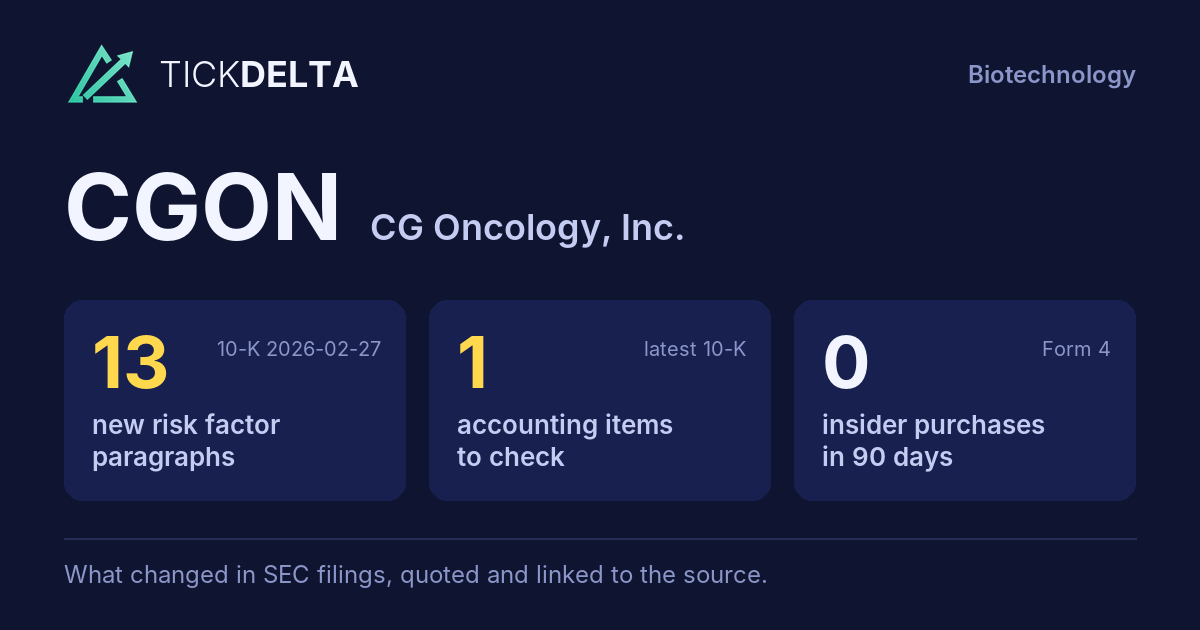
Paragraphs with nothing like them in last year's 10-K
13 paragraphs in Risk Factors of the 10-K filed Feb 27, 2026 with nothing like them in the 10-K filed Mar 28, 2025. Quoted exactly. Paragraphs that were only edited are under 10-K change.
Since its enactment, there have been executive, judicial and Congressional challenges and amendments to certain aspects of the ACA. For example, on July 4, 2025, the One Big Beautiful Bill Act (OBBBA) was signed into law, which narrowed access to ACA marketplace exchange enrollment and declined to extend the ACA enhanced advanced premium tax credits that expired at the end of 2025, which, among other provisions in the law, are anticipated to reduce the number of Americans with health insurance. The OBBBA also is expected to reduce Medicaid spending and enrollment by implementing work requirements for some beneficiaries, capping state-directed payments, reducing federal funding, and limiting provider taxes used to fund the program. Congress is considering proposed legislation intended to further reduce healthcare costs with alternatives to replace the expired ACA subsidies.
We acquired a controlling interest in Biovire, Inc., a contract manufacturing organization that provides our clinical supply and, if any of our product candidates are approved, we expect will provide our commercial supply of cretostimogene. We do not have experience operating a contract manufacturing organization, which organizations are highly regulated and provide services and offerings that are exacting and complex, and failure to operate Biovire’s business effectively may result in a material and adverse impact to our business.
In July 2025, we acquired a controlling interest in Biovire, a contract manufacturing organization that provides our clinical supply of cretostimogene. Additionally, if any of our product candidates that use cretostimogene receive marketing approval, we expect Biovire will provide our commercial supply of cretostimogene. Prior to our acquisition of Biovire, we did not have experience operating a contract manufacturing organization. As a result, we are reliant on Biovire’s management, employees, advisors and consultants to ensure its continued operations and compliance with applicable laws, regulations and contractual obligations, including to us as one of its largest customers.
Biovire’s business is not currently profitable, and we expect that we will need to continue to invest in Biovire to ensure its continued operations. While we do not currently anticipate Biovire’s operations and financial performance to have a material impact on our business, strategy, or financial performance, management may need to devote meaningful attention and resources to Biovire’s business in order for us to realize the anticipated benefits from our investment. It is possible that we do not realize any benefit from our investment in Biovire. It is also possible that if Biovire’s business is materially and adversely impacted, our reliance on Biovire as a key supplier of cretostimogene, may also materially and adversely impact our business.
Biovire operates in a highly regulated industry and is subject to various local, state, federal, national, and transnational laws and regulations, which include the operating, quality, and security standards of the FDA, the U.S. Drug Enforcement Administration, various state boards of pharmacy, state health departments, the HHS, similar bodies of the United Kingdom the European Union and its member states, and other comparable agencies around the world, and, in the future, any change to such laws and regulations or the interpretation or application thereof could adversely affect us. Among other rules affecting Biovire, it is subject to laws and regulations concerning cGMP and drug safety. New public health orders or best practice guidelines may increase Biovire’s costs to operate or reduce its productivity, thereby affecting its business, financial condition, or results of operations.
Although we believe that Biovire complies in all material respects with applicable laws and regulations, there can be no assurance that a regulatory agency or tribunal would not reach a different conclusion concerning the compliance of its operations with applicable laws and regulations. In addition, there can be no assurance that Biovire will be able to maintain or renew existing permits, licenses, or other regulatory approvals or obtain, without significant delay, future permits, licenses, or other approvals needed for the operation of its businesses. Any noncompliance by Biovire or its customers with applicable law or regulation or the failure to maintain, renew, or obtain necessary permits and licenses could have an adverse effect on Biovire’s results of operations and financial condition.
Additionally, Biovire’s performance and our ability to realize the benefits of our investment depend on Biovire’s ability to execute and improve, when necessary, its quality management strategy and systems and effectively train and maintain its workforce with respect to quality management. Quality management plays an essential role in determining and meeting customer requirements, preventing defects, and improving its offerings, and, despite its network of quality systems, a quality or safety issue, could have an adverse effect on its and our business, financial condition, stock price, or results of operations and may subject Biovire to regulatory action, including a product recall, product seizure, injunction to halt manufacture or distribution, or restriction on its operations; monetary fines; or other civil or criminal sanctions.
In each case, any adverse impacts on Biovire may have a material and adverse impact on our business, including if we are unable to timely locate and acquire an alternative supply of cretostimogene.
We operate in a global economy, which includes utilizing third-party suppliers in several countries outside the United States. There is inherent risk, based on the complex relationships among the U.S. and the countries in which we conduct our business, that political, diplomatic, and national security factors can lead to global trade restrictions and changes in trade policies and export regulations that may adversely affect our business and operations. The current international trade and regulatory environment is subject to significant ongoing uncertainty. The U.S. government has recently announced substantial new tariffs affecting a wide range of products and jurisdictions and has indicated an intention to continue developing new trade policies, including with respect to the pharmaceutical industry. In response, certain foreign governments have announced or implemented retaliatory tariffs and other protectionist measures. These developments have created a dynamic and unpredictable trade landscape, which may adversely impact our business, results of operations, financial condition and prospects.
We currently rely, and expect to continue to rely, on third parties for the manufacture of our product candidates for clinical testing, as well as for manufacture of any products that we may commercialize, if approved. Currently, several of our suppliers are located outside of the United States, and our principal suppliers of certain raw materials are located outside of the United States. The active pharmaceutical ingredients (APIs) for cretostimogene is manufactured in the United States, and cretostimogene is manufactured in the United States. We also rely on specialized laboratory equipment, supplies, materials, and precursor compounds, all or part of which we believe may be ultimately sourced from multiple countries outside the United States, to advance our research and development efforts.
Current or future tariffs will result in increased research and development expenses, including with respect to increased costs associated with APIs, raw materials, laboratory equipment and research materials and components. In addition, such tariffs will increase our supply chain complexity and could also potentially disrupt our existing supply chain. Trade restrictions affecting the import of materials necessary for clinical trials could result in delays to our development timelines. Increased development costs and extended development timelines could place us at a competitive disadvantage compared to companies operating in regions with more favorable trade relationships and could reduce investor confidence, negatively impacting our ability to secure additional financing on favorable terms or at all. In addition, as we advance toward commercialization in the future, tariffs and trade restrictions could hinder our ability to establish cost-effective production capabilities, negatively impacting our growth prospects.
The complexity of announced or future tariffs may also increase the risk that we or our customers or suppliers may be subject to civil or criminal enforcement actions in the United States or foreign jurisdictions related to compliance with trade regulations. Foreign governments may also adopt non-tariff measures, such as procurement preferences or informal disincentives to engage with, purchase from or invest in U.S. entities, which may limit our ability to compete internationally and attract non-U.S. investment, employees, customers and suppliers. Foreign governments may also take other retaliatory actions against U.S. entities, such as decreased intellectual property protection, increased enforcement actions, or delays in regulatory approvals, which may result in heightened international legal and operational risks. In addition, the United States and other governments have imposed and may continue to impose additional sanctions, such as trade restrictions or trade barriers, which could restrict us from doing business directly or indirectly in or with certain countries or parties and may impose additional costs and complexity to our business.
Trade disputes, tariffs, restrictions and other political tensions between the United States and other countries may also exacerbate unfavorable macroeconomic conditions including inflationary pressures, foreign exchange volatility, financial market instability, and economic recessions or downturns. The ultimate impact of current or future tariffs and trade restrictions remains uncertain and could materially and adversely affect our business, financial condition, and prospects. While we actively monitor these risks, any prolonged economic downturn, escalation in trade tensions, or deterioration in international perception of U.S.-based companies could materially and adversely affect our business, ability to access the capital markets or other financing sources, results of operations, financial condition and prospects. In addition, tariffs and other trade developments have and may continue to heighten the risks related to the other risk factors described elsewhere in this Annual Report.
Paragraphs in the 10-Q filed Nov 6, 2026 that were not in the one before
New in the latest 10-Q
23 paragraphs in the 10-Q filed Nov 6, 2026 with nothing like them in the 10-Q filed Aug 6, 2026 (at least half the words must differ; new numbers alone do not count). Quoted exactly, grouped by the item heading above them. This is text that changed, not a judgement of how serious it is.
10-Q
incorporation or organization) Identification No.) 3000 Pegasus Park Drive, Suite 1640 75247 Dallas, Texas (Address of principal executive offices) (Zip Code)
Read in the 10-Q
Financial statements and notes
CG Oncology, Inc. (the Company) is a late-stage clinical biopharmaceutical company focused on developing and commercializing its product candidate, cretostimogene grenadenorepvec, for patients with bladder cancer. The Company is at a clinical stage and does not project to generate significant revenues if and until the U.S. Food and Drug Administration (FDA) approves its product candidate, cretostimogene, and the Company is able to commercialize this product candidate.
Read in the 10-Q
The preparation of financial statements in accordance with U.S. GAAP requires management to make estimates and assumptions that affect the reported amounts of assets and liabilities and disclosures of contingent assets and liabilities at the date of the financial statements, as well as the reported amounts of revenue and expenses during the reporting period.
Read in the 10-Q
As of September 30, 2026, the Company had approximately $ 984.5 million of cash, cash equivalents and marketable securities and working capital of approximately $ 961.3 million. The Company has a relatively limited operating history, and the revenue and income potential of the Company’s business and market are unproven. The Company has experienced net losses and negative cash flows from operations since its inception and, as of September 30, 2026, the Company had an accumulated deficit of $ 575.1 million. During the three and nine months ended September 30, 2026, the Company incurred a net loss of $ 56.9 million and $ 196.1 million, respectively, and had negative cash flows from operations of $ 151.1 million during the nine months ended September 30, 2026. The Company will continue to incur significant costs and expenses related to its ongoing operations until it successfully develops, obtains regulatory approval, and gains market acceptance of a product candidate and achieves a level of revenues adequate to support the Company’s operations.
Read in the 10-Q
The following tables present the financial instruments carried at fair value on a recurring basis as of September 30, 2026 and December 31, 2025, respectively, in accordance with the ASC 820, Fair Value Measurement (ASC 820) hierarchy (in thousands):
Read in the 10-Q
Show the other 18
There were no transfers between Level 1 and Level 2 of the fair value hierarchy during the three and nine months ended September 30, 2026 and the year ended December 31, 2025.
Read in the 10-Q
The components of lease expense for the periods ended September 30, 2026 and 2025 were as follows (in thousands):
Read in the 10-Q
Maturities of lease liabilities as of September 30, 2026 were as follows (in thousands):
Read in the 10-Q
2026 470 2027 1,420 2028 1,494 2029 1,429 2030 1,472 Thereafter 1,091 Total lease payment 7,376 Less: amount representing imputed interest (1,139) Total future minimum lease obligations $6,237
Read in the 10-Q
A liability for loss contingencies arising from claims, assessments, litigation, fines, penalties, and other sources is recorded in the unaudited condensed consolidated financial statements if it is determined that it is probable that a loss has been incurred, and that the amount (or range) of the loss can be reasonably estimated.
Read in the 10-Q
The following table presents selected financial information with respect to the Company's single operating segment for the three and nine months ended September 30, 2026 and 2025:
Read in the 10-Q
(1) Other research and development consists of indirect costs incurred for the benefit of the research and development efforts, including certain personnel, supply chain, quality assurance, and regulatory affairs.
Read in the 10-Q
The Company is authorized to issue up to 700,000,000 shares of common stock at September 30, 2026 and December 31, 2025, of which 89,300,590 and 80,689,128 shares were issued and outstanding at September 30, 2026 and December 31, 2025, respectively.
Read in the 10-Q
Voting, dividend and liquidation rights of the holders of the common stock are subject to and qualified by the rights, powers and preferences of the holders of the preferred stock, of which there are none as of September 30, 2026 and December 31, 2025.
Read in the 10-Q
The aggregate intrinsic value is calculated as the difference between the exercise price of the stock options and the fair value of the Company's common stock. The aggregate intrinsic value of options exercised during the nine months ended September 30, 2026 and 2025 was $ 100.9 million and $ 10.7 million, respectively.
Read in the 10-Q
The weighted-average grant-date fair value of the options granted was $ 43.31 and $ 14.49 per share for the nine months ended September 30, 2026 and 2025, respectively. The aggregate grant-date fair value of options vested during the nine months ended September 30, 2026 and 2025 was $ 29.6 million and $ 19.8 million, respectively.
Read in the 10-Q
A Performance Stock Unit (PSU) represents one equivalent share of the Company's common stock to be issued after achievement of the performance metrics specified in the grant. The following table summarizes the Company's PSU activity for nine months ended September 30, 2026:
Read in the 10-Q
The Company estimates the fair value of a PSU based upon the expected achievement of the performance metrics specified in the grant and the closing market price of the Company's common stock on the date of grant.
Read in the 10-Q
Stock-based compensation expense related to stock awards and the 2024 Employee Stock Purchase Plan (see Note 12) recorded in the accompanying statements of operations for the three and nine months ended September 30, 2026 and 2025 was as follows (in thousands):
Read in the 10-Q
The Company has not recognized and does not expect to recognize in the near future, any tax benefit related to employee stock-based compensation expense as a result of the full valuation allowance related to its net deferred tax assets.
Read in the 10-Q
The Company recorded stock-based compensation expense under the ESPP of approximately $ 0.1 million and $ 0.6 million for the three months ended September 30, 2026 and 2025, respectively, and $ 0.8 million and $ 2.0 million for the nine months ended September 30, 2026 and 2025, respectively. As of September 30, 2026, the Company had $ 0.9 million of gross unrecognized stock-based compensation expense under the ESPP to be recognized over a weighted average period of 1.3 years.
Read in the 10-Q
Basic and diluted net loss per share was calculated as follows (in thousands, except share and per share amounts):
Read in the 10-Q
Goodwill represents the excess of the purchase price over the identifiable tangible and intangible assets acquired in addition to liabilities assumed arising from the business combination. The Company believes the goodwill related to the acquisition was attributable to the expected synergies, value of the assembled workforce, and the collective experience of the management team with regards to its operations, customers, and industry.
Read in the 10-Q
The 10-Q's risk factors against the 10-K
Item 1A of the 10-Q filed Nov 6, 2026 against Item 1A of the 10-K filed Feb 27, 2026.
A 10-Q repeats only the risks that changed, so a 10-K paragraph that is missing from it is not counted as removed.
Added is a paragraph with nothing like it in the 10-K, Reworded a sentence that is in both with several words changed,
Quiet changes a sentence in both where one to four words changed and one is a hedge or a modal
(cut words struck through, new words highlighted).
Text on the page, not a score; each links to the filing at sec.gov.
What the 10-Q itself says about its risk factors:There have been no material changes to our risk factors previously disclosed in Part I, Item 1A, “Risk Factors” of our 2025 Annual Report, filed with the SEC on February 27, 2026.
Read in the 10-Q
1 paragraph in the 10-Q's Item 1A, and none of them adds, rewords or quietly edits a paragraph of the 10-K's.
Phrases used for the first time
Two-word phrases in Risk Factors of the 10-K filed Feb 27, 2026 that are in none of the 1 earlier 10-Ks stored, back to Mar 28, 2025
Where each one is used
- contract manufacturing: From time to time, we may consider strategic transactions, such as acquisitions of companies, asset purchases, and out-licensing or in-licensing of intellectual property, products or technologies. For example, in July 2025, we acquired a controlling interest in Biovire, Inc. (Biovire), a contract manufacturing...
- manufacturing organization: From time to time, we may consider strategic transactions, such as acquisitions of companies, asset purchases, and out-licensing or in-licensing of intellectual property, products or technologies. For example, in July 2025, we acquired a controlling interest in Biovire, Inc. (Biovire), a contract manufacturing...
- trade restrictions: We operate in a global economy, which includes utilizing third-party suppliers in several countries outside the United States. There is inherent risk, based on the complex relationships among the U.S. and the countries in which we conduct our business, that political, diplomatic, and national security factors can...
- acquired controlling: From time to time, we may consider strategic transactions, such as acquisitions of companies, asset purchases, and out-licensing or in-licensing of intellectual property, products or technologies. For example, in July 2025, we acquired a controlling interest in Biovire, Inc. (Biovire), a contract manufacturing...
- controlling interest: From time to time, we may consider strategic transactions, such as acquisitions of companies, asset purchases, and out-licensing or in-licensing of intellectual property, products or technologies. For example, in July 2025, we acquired a controlling interest in Biovire, Inc. (Biovire), a contract manufacturing...
- clinical supply: From time to time, we may consider strategic transactions, such as acquisitions of companies, asset purchases, and out-licensing or in-licensing of intellectual property, products or technologies. For example, in July 2025, we acquired a controlling interest in Biovire, Inc. (Biovire), a contract manufacturing...
- quality management: Additionally, Biovire’s performance and our ability to realize the benefits of our investment depend on Biovire’s ability to execute and improve, when necessary, its quality management strategy and systems and effectively train and maintain its workforce with respect to quality management. Quality management plays...
- trade policies: International trade policies, including tariffs, sanctions and trade barriers may adversely affect our business, financial condition, results of operations and prospects.
Used at least twice, small words left out. Counted, not picked: a phrase can be new because the company renamed something.
What was taken out
10 paragraphs of last year's Risk Factors with nothing like them now. The longest are quoted.
Sources
Item 1A of each 10-K and 10-Q on EDGAR, quoted exactly. Each paragraph links to the filing at sec.gov.
Also
10-K change: what was reworded or cut, section by section.
Work with it
Excel workbook · CSV. Google Sheet that stays up to date: paste =IMPORTDATA("https://tickdelta.com/company/CGON/export.csv") into a cell.