RemovedRisk Factors
The 10-K against last year's
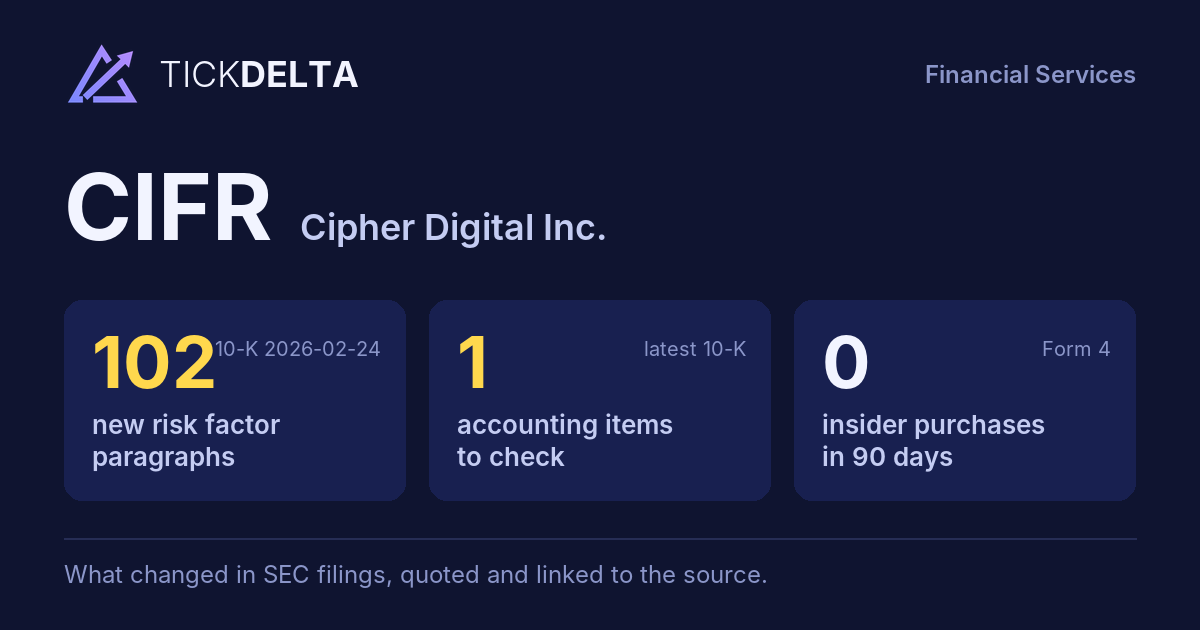
461 changes: 127 added, 225 removed, 109 reworded
10-K 0001819989-26-000009 (2026-02-24) vs 10-K 0001819989-25-000005 (2025-02-25)
The redline
The paragraph that changed most in each section
Marked against last year's 10-K:
cut words struck through, new words highlighted and underlined.
MD&A 227 words changed in this paragraph; it is 49% similar to last year's version.
Source: Item 7, 10-K 0001819989-26-000009 vs Item 7, 10-K 0001819989-25-000005
Risk Factors 148 words changed in this paragraph; it is 48% similar to last year's version.
Constructing data center facilities for HPC hosting requires significant capital expenditures, in particular when compared and we anticipate that future strategic growth initiatives will likewise continue to be capital-intensive. We expect to fund these through our capital expenditures for bitcoin mining data center facilities. raising efforts and raise additional capital to fund other future strategic growth initiatives; however, we may not be able to secure sufficient capital or financing on favorable terms, or meet the obligations of the financing we have secured. If we are not able to secure capital or financing unable to fund our construction efforts with respect to HPC hosting facilities, the completion of such projects may be delayed and delayed, our ability to collect any potential renal revenue or to otherwise monetize such facilities may be compromised, compromised and we may be less competitive in our industry, which could have an a material adverse effect impact on our business, results of operations and financial condition, including our expansion strategy and strategy, our ability to generate significant or any revenue from an HPC hosting business. business and on the market price for our securities. See also “— Risks Related to Our Indebtedness — We may need to raise additional capital, which may not be available on terms acceptable to us, or at all.”
Source: Item 1A, 10-K 0001819989-26-000009 vs Item 1A, 10-K 0001819989-25-000005
Legal Proceedings 114 words changed in this paragraph; it is 79% similar to last year's version.
The Company, and its subsidiaries, are subject at times to various claims, lawsuits and governmental proceedings relating to the Company’s business and transactions arising in the ordinary course of business. The Company cannot predict the final outcome of such proceedings. Where appropriate, the Company vigorously defends such claims, lawsuits and proceedings. Some of these claims, lawsuits and proceedings seek damages, including consequential, exemplary or punitive damages, in amounts that could, if awarded, be significant. Certain of the claims, lawsuits and proceedings arising in the ordinary course of business are covered by the Company’s insurance program. The Company maintains property and various types of liability insurance in an effort to protect the Company from such claims. In terms of any matters where there is no insurance coverage available to the Company, or where coverage is available and the Company maintains a retention or deductible associated with such insurance, the Company may establish an accrual for such loss, retention or deductible based on current available information. In accordance with accounting guidance, if it is probable that an asset has been impaired or a liability has been incurred as of the date of the financial statements, and the amount of loss is reasonably estimable, then an accrual for the cost to resolve or settle these claims is recorded by the Company in the accompanying consolidated balance sheets. If it is reasonably possible that an asset may be impaired as of the date of the financial statements, then the Company discloses the range of possible loss. Expenses related to the defense of such claims are recorded by the Company as incurred and included in the accompanying consolidated statements of operations. Management, with the assistance of outside counsel, may from time to time adjust such accruals according to new developments in the matter, court rulings, or changes in the strategy affecting the Company’s defense of such matters. On the basis of current information, the Company does not believe there is a reasonable possibility that a material loss, if any,
Source: Item 3, via Note 14 – COMMITMENTS AND CONTINGENCIES, 10-K 0001819989-26-000009 vs Item 3, via Note 14 – COMMITMENTS AND CONTINGENCIES, 10-K 0001819989-25-000005
Accounting Policies 87 words changed in this paragraph; it is 79% similar to last year's version.
incurred if a reasonable estimate of fair value can be made. Due to the long lead time involved until decommissioning activities occur, the Company uses a present value technique to estimate the liability. A liability for the fair value of the ARO based on the expected present value of estimated future decommissioning costs with a corresponding increase to the carrying value of the related long-lived asset (leasehold improvements) was recorded upon commencement of activities at the lease in November 2022. Additionally, an ARO for our Odessa and Black Pearl Facility will be analyzed and recorded upon completion of construction. Facilities, respectively. The estimated capitalized asset retirement costs are depreciated using the straight-line method over the estimated remaining useful life of the related long-lived asset, with such depreciation included in depreciation expense in the consolidated statements of operations. The ARO is accreted based on the original discount rate and is recognized as an increase in the carrying amount of the liability and a charge to accretion expense, which is included in depreciation expense in the consolidated statements of operations. Annually, or more frequently if an event occurs that would dictate a change in assumptions or estimates underlying the obligation, the Company reassesses its ARO to determine whether any revisions to the obligation are necessary. Revisions to the estimated ARO for items such as (i) new liabilities incurred, (ii) liabilities settled during the period and (iii) revisions to estimated future cash flow requirements (if any), will result in adjustments to the related capitalized asset and corresponding liability.
Source: 10-K text, Note 2 – SUMMARY OF SIGNIFICANT ACCOUNTING POLICIES, 10-K 0001819989-26-000009 vs 10-K text, Note 2 – SUMMARY OF SIGNIFICANT ACCOUNTING POLICIES, 10-K 0001819989-25-000005
Every change, by type
Sentences and paragraphs added, removed or reworded
Sentences and paragraphs of CIFR's Risk Factors and MD&A, 10-K 2026-02-24 against 10-K 2025-02-25. Each links to the text at sec.gov.
RemovedRisk Factors
RemovedRisk Factors
RemovedRisk Factors
RemovedRisk Factors
RemovedRisk Factors
RemovedRisk Factors
RemovedRisk Factors
Show the other 16
RemovedRisk Factors
RemovedRisk Factors
RemovedRisk Factors
RemovedRisk Factors
RemovedMD&A
RemovedMD&A
RemovedMD&A
RemovedMD&A
RemovedMD&A
RemovedMD&A
RemovedMD&A
RemovedMD&A
RemovedMD&A
RemovedMD&A
RemovedMD&A
RemovedMD&A