Paragraph 23 · 50% changed
Every version of it
Screener
/
SEC EDGAR
/CIK 0000764065
/10-K filed Feb 9, 2026, compared with Feb 25, 2025
/Numbers from the XBRL of the 10-Ks
NYSE
Materials · Mining
Cleveland-Cliffs Inc. CLF
The 10-K against last year's
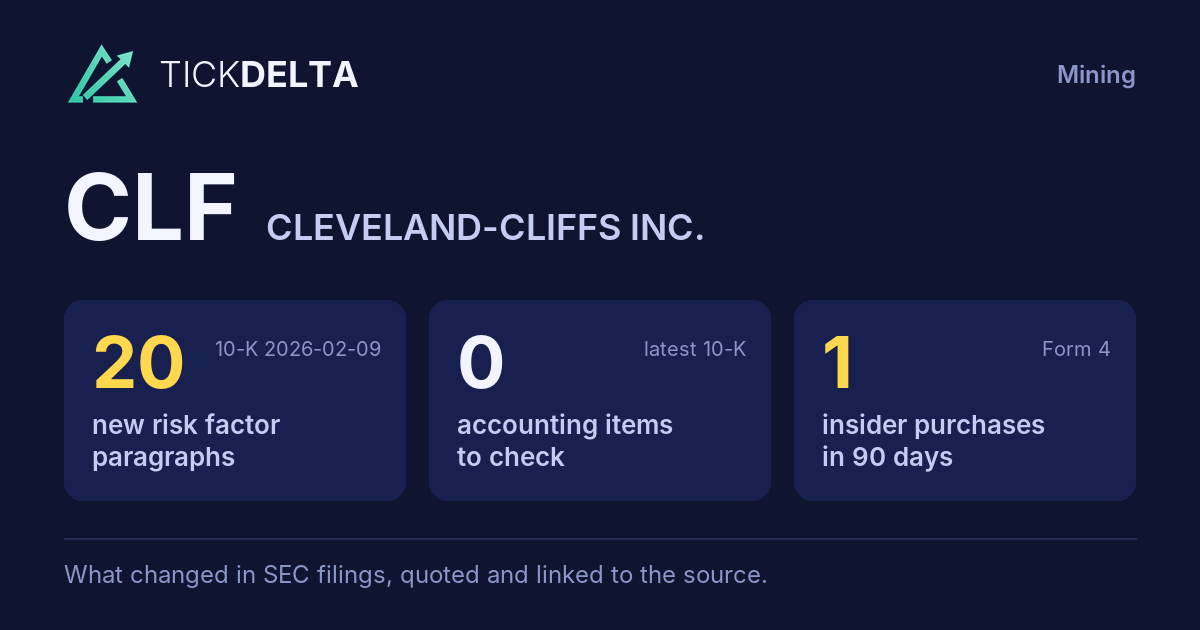
186 changes: 52 added, 36 removed, 95 reworded, 3 quiet changes
10-K Feb 9, 2026 vs Feb 25, 2025
Risk Factors
17.9%
of the text changed · 12,375 words now · 20 new paragraphs, 9 gone
MD&A
24.1%
of the text changed · 11,048 words now · 32 new paragraphs, 27 gone
Legal Proceedings
43.2%
of the text changed · 559 words now
Accounting Policies
7.3%
of the text changed · 4,043 words now
10-K 0000764065-26-000025 (Feb 9, 2026) vs 10-K 0000764065-25-000058 (Feb 25, 2025)
Every paragraph, and how much of it changed
One bar per paragraph, in the order of the 10-K. Height and colour show the share of its words not in the closest paragraph a year earlier; the tallest bars are new paragraphs.
Risk Factors
117 paragraphs · 20 new · 50 reworded · 9 gone · 10-K Feb 9, 2026 against Feb 25, 2025
New paragraph
Reworded (5% of its words or more)
Same or nearly
Paragraph 14 · 50% changed
Every version of it
The largest end user for our steel products is the automotive industry in North America. Beyond these direct sales to the automotive industry, we make additional sales to distributors and converters, which may ultimately resell some of that volume to the automotive market. In addition to the magnitude of our exposure to the automotive industry, we face risks arising from our relative concentration of sales to certain specific automotive manufacturers, and our sales volumes and revenues may be adversely affected if we are unable to renew our fixed price contracts with one or more significant automotive customers or if those customers choose to move certain portions of their parts business to alternate suppliers. Automotive production and sales are cyclical and sensitive to general economic conditions and other factors, including interest rates, consumer credit, spending and preferences, and supply chain disruptions. If automotive production and sales decline, whether due to consumers facing reduced purchasing power caused by inflation, higher interest rates or otherwise, our sales and shipments to the automotive market are likely to decline in a corresponding manner. Adverse impacts that we may sustain as a result include, without limitation, lower margins because of the need to sell our steel to less profitable customers and markets, higher fixed costs from lower steel production if we are unable to sell the same amount of steel to other customers and markets, and lower sales, shipments, pricing and margins generally as our competitors face similar challenges and compete vigorously in other markets that we serve. These adverse impacts could negatively affect our revenues, financial results and cash flows.
Paragraph 59 · 46% changed
Every version of it
Paragraph 93 · 45% changed
Every version of it
Paragraph 61 · 44% changed
Every version of it
Paragraph 22 · 43% changed
Every version of it
In recent years, the U.S. government has altered its approach to international trade policy, both generally and with respect to matters directly and indirectly affecting the steel industry, including by undertaking certain unilateral actions affecting trade, renegotiating existing bilateral or multilateral trade agreements, and entering into new agreements or treaties with foreign countries. For example, in March 2018, the U.S. government issued a proclamation pursuant to Section 232 imposing a 25% tariff on imported steel. These Section 232 tariffs were imposed on national security grounds and addressed imported steel that was being unfairly traded by certain foreign competitors at artificially low prices. In retaliation against the Section 232 tariffs, the European Union subsequently imposed its own tariffs against certain steel products and other goods imported from the U.S. Following the November 2020 U.S. presidential election, negotiations between the U.S. government and other governments resulted in revisions to these measures. For example, the U.S. government agreed to modified tariff rate quota systems with each of the European Union, Japan and the United Kingdom that allowed more imports from those trading partners to enter the U.S. market free of Section 232 tariffs. However, in early 2025, the U.S. government announced that the 25% Section 232 tariffs on steel imports originally imposed in 2018 on national security grounds would be re-imposed without exemptions and or exclusions, beginning in March 2025. Even so, as has occurred Subsequently, in June 2025, the past, the U.S. government may later determine Section 232 steel tariffs were generally increased to negotiate exemptions and exclusions from 50%. During 2025, Section 232 tariffs with were also applied to certain trading partners. And if products derived from steel as part of the U.S. Department of Commerce Section 232 measures are removed, modified or substantially weakened, whether through legal challenge, legislation, further executive action or otherwise, imports steel inclusions process. Furthermore, in 2025, the Canadian government imposed a 25% tariff on imported steel regardless of foreign steel would likely increase and steel prices in the U.S. would likely fall, which could materially adversely affect our revenues, financial results and cash flows. country of origin
Paragraph 62 · 39% changed
Every version of it
If one or more of these risks and uncertainties were to materialize, we could experience reduced revenues, higher costs, lower profitability profitability, reputational damage, and other adverse impacts to our operations and businesses. businesses, which could cause the price of our common shares to decline. We would expect that similar risks would apply to the extent that we engage in any future acquisitions activity.
Paragraph 115 · 37% changed
Every version of it
In addition, some of the transactions in which we previously sold or otherwise disposed of our non-core assets included provisions transferring the assumption of certain pension and other liabilities to by the purchasers or acquirers of those assets. While we believe that all such transfers assumptions were completed properly and are legally binding, if the purchaser fails to fulfill its obligations, we may be at risk that a court, arbitrator or regulatory body could disagree and determine that we nonetheless remain responsible for such pension and other liabilities liabilities. For example, during 2025, the trustees of the United Mine Workers of America 1974 Pension Plan assessed withdrawal liability against us in respect of the Pinnacle, West Virginia and Oak Grove, Alabama coal mines that we intended divested in 2015. Although we do not believe that this purported withdrawal liability has been validly assessed, if the ongoing legal proceedings are determined adversely to us, then we could be required to continue making certain long-term periodic payments into the pension fund, which would adversely impact our liquidity and did transfer. cash flows for an extended period of time.
Paragraph 23 · 50% changed
Every version of it
10-K Feb 25, 2025In recent years, the U.S. government has altered its approach to international trade policy, both generally and with respect to matters directly and indirectly affecting the steel industry, including by undertaking certain unilateral actions affecting trade, renegotiating existing bilateral or multilateral trade agreements, and entering into new agreements or treaties with foreign countries. For example, in March 2018, the U.S. government issued a proclamation pursuant to Section 232 imposing a 25% tariff on imported steel. These Section 232 tariffs were imposed on national security grounds and addressed imported steel that was being unfairly traded by certain foreign competitors at artificially low prices. In retaliation against the Section 232 tariffs, the European Union subsequently imposed its own tariffs against certain steel products and other goods imported from the U.S. Following the November 2020 U.S. presidential election, negotiations between the U.S. government and other governments resulted in revisions to these measures. For example, the U.S. government agreed to modified tariff rate quota systems with each of the European Union, Japan and the United Kingdom that allowed more imports from those trading partners to enter the U.S. market free of Section 232 tariffs. However, in early 2025, the U.S. government announced that the 25% Section 232 tariffs on steel imports would be re-imposed without exemptions and exclusions, beginning in March 2025. Even so, as has occurred in the past, the U.S. government may later determine to negotiate exemptions and exclusions from Section 232 tariffs with certain trading partners. And if the Section 232 measures are removed, modified or substantially weakened, whether through legal challenge, legislation, further executive action or otherwise, imports of foreign steel would likely increase and steel prices in the U.S. would likely fall, which could materially adversely affect our revenues, financial results and cash flows.
10-K Feb 9, 2026
and imposed tariff rate quotas for steel imports varying by country of origin. Even so, as has occurred in the past, the U.S. and/or Canadian governments may subsequently determine to negotiate exemptions and/or exclusions from such tariffs and other protective measures with certain trading partners. And if either the Section 232 tariffs, with respect to our U.S. operations, or Canadian measures, with respect to our Canadian operations, are removed, modified or substantially weakened, imports of foreign steel would likely increase and steel prices in the U.S. and Canada would likely fall, which could materially adversely affect our consolidated revenues, financial results and cash flows.
Paragraph 14 · 50% changed
Every version of it
10-K Feb 25, 2025
The largest end user for our steel products is the automotive industry in North America. Beyond these direct sales to the automotive industry, we make additional sales to distributors and converters, which may ultimately resell some of that volume to the automotive market. In addition to the magnitude of our exposure to the automotive industry, we face risks arising from our relative concentration of sales to certain specific automotive manufacturers, and our sales volumes and revenues may be adversely affected if we are unable to renew our fixed price contracts with one or more significant automotive customers or if those customers choose to move certain portions of their parts business to alternate suppliers. Automotive production and sales are cyclical and sensitive to general economic conditions and other factors, including interest rates, consumer credit, spending and preferences, and supply chain disruptions. If automotive production and sales decline, whether due to consumers facing reduced purchasing power caused by inflation, higher interest rates or otherwise, our sales and shipments to the automotive market are likely to decline in a corresponding manner. Adverse impacts that we may sustain as a result include, without limitation, lower margins because of the need to sell our steel to less profitable customers and markets, higher fixed costs from lower steel production if we are unable to sell the same amount of steel to other customers and markets, and lower sales, shipments, pricing and margins generally as our competitors face similar challenges and compete vigorously in other markets that we serve. These adverse impacts could negatively affect our revenues, financial results and cash flows.
10-K Feb 9, 2026
The largest end user for our steel products is the automotive industry in North America. Beyond these direct sales to the automotive industry, we make additional sales to distributors and converters, which may ultimately resell some of that volume to the automotive market. In addition to the magnitude of our exposure to the automotive industry, we face risks arising from our relative concentration of sales to certain specific automotive manufacturers, and our sales volumes and revenues may be adversely
Paragraph 59 · 46% changed
Every version of it
10-K Feb 25, 2025During the fourth quarter of 2024, we completed the Stelco Acquisition. The Stelco Acquisition may be less accretive than expected, or may be dilutive, to our earnings per share, which could cause the price of our common shares to decline. In addition, the Stelco Acquisition involves significant risks and uncertainties that may adversely affect us over the short, medium and long terms, including the following:
10-K Feb 9, 2026
We completed the Stelco Acquisition in the fourth quarter of 2024. We remain subject to significant risks and uncertainties arising out of the Stelco Acquisition that may adversely affect us, including in connection with the following:
Paragraph 93 · 45% changed
Every version of it
10-K Feb 25, 2025The closure of a steelmaking or other operating facility or mining operation involves significant closure costs, including reclamation and other environmental costs, the costs of terminating long-term obligations, including customer, energy and transportation contracts and equipment and real property leases, costs associated with the altered tax profile of an idled or closed facility, and certain accounting charges, including asset impairment and accelerated depreciation. In addition, a permanent facility or mine closure could accelerate and significantly increase employment legacy costs, including our expense and funding costs for pension and OPEB obligations and multiemployer pension withdrawal liabilities. For example, employees could be eligible for immediate retirement under special eligibility rules that apply upon a steelmaking facility or mine closure. The employees eligible for immediate retirement under the pension plans at the time of the permanent closure also could be eligible for OPEB, thereby accelerating our obligation to provide these benefits. Certain closures could precipitate a pension closure liability significantly greater than an ongoing operation liability and may trigger certain severance liability obligations. In addition, we are party to several joint ventures relating to iron ore mining, downstream steel processing and scrap metal recycling, and if our joint venture partners experience financial hardships or fail to perform their obligations upon closure, we may be required to assume significant additional obligations on behalf of the joint venture, including costs of environmental remediation and pension and OPEB obligations.
10-K Feb 9, 2026
In addition, we are party to several joint ventures relating to iron ore mining, downstream steel processing and scrap metal recycling, and if our joint venture partners experience financial hardships or fail to perform their obligations upon closure or otherwise, we may be required to assume significant additional obligations on behalf of the joint venture, including costs of environmental remediation and pension and OPEB obligations.
Paragraph 61 · 44% changed
Every version of it
10-K Feb 25, 2025•we may be unable to satisfy our operational, employment, environmental or other undertakings or commitments made to the Canadian government in connection with the Stelco Acquisition;
10-K Feb 9, 2026
•our ability to satisfy our operational, employment, environmental, charitable or other undertakings made to the Canadian government.
Paragraph 22 · 43% changed
Every version of it
10-K Feb 25, 2025
In recent years, the U.S. government has altered its approach to international trade policy, both generally and with respect to matters directly and indirectly affecting the steel industry, including by undertaking certain unilateral actions affecting trade, renegotiating existing bilateral or multilateral trade agreements, and entering into new agreements or treaties with foreign countries. For example, in March 2018, the U.S. government issued a proclamation pursuant to Section 232 imposing a 25% tariff on imported steel. These Section 232 tariffs were imposed on national security grounds and addressed imported steel that was being unfairly traded by certain foreign competitors at artificially low prices. In retaliation against the Section 232 tariffs, the European Union subsequently imposed its own tariffs against certain steel products and other goods imported from the U.S. Following the November 2020 U.S. presidential election, negotiations between the U.S. government and other governments resulted in revisions to these measures. For example, the U.S. government agreed to modified tariff rate quota systems with each of the European Union, Japan and the United Kingdom that allowed more imports from those trading partners to enter the U.S. market free of Section 232 tariffs. However, in early 2025, the U.S. government announced that the 25% Section 232 tariffs on steel imports would be re-imposed without exemptions and exclusions, beginning in March 2025. Even so, as has occurred in the past, the U.S. government may later determine to negotiate exemptions and exclusions from Section 232 tariffs with certain trading partners. And if the Section 232 measures are removed, modified or substantially weakened, whether through legal challenge, legislation, further executive action or otherwise, imports of foreign steel would likely increase and steel prices in the U.S. would likely fall, which could materially adversely affect our revenues, financial results and cash flows.
10-K Feb 9, 2026
In recent years, the U.S. government has altered its approach to international trade policy, both generally and with respect to matters directly and indirectly affecting the steel industry, including by undertaking certain unilateral actions affecting trade, renegotiating existing bilateral or multilateral trade agreements, and entering into new agreements or treaties with foreign countries. For example, in early 2025, the U.S. government announced that the 25% Section 232 tariffs on steel imports originally imposed in 2018 on national security grounds would be re-imposed without exemptions or exclusions, beginning in March 2025. Subsequently, in June 2025, the Section 232 steel tariffs were generally increased to 50%. During 2025, Section 232 tariffs were also applied to certain products derived from steel as part of the U.S. Department of Commerce Section 232 steel inclusions process. Furthermore, in 2025, the Canadian government imposed a 25% tariff on imported steel regardless of country of origin
Paragraph 62 · 39% changed
Every version of it
10-K Feb 25, 2025
If one or more of these risks and uncertainties were to materialize, we could experience reduced revenues, higher costs, lower profitability and other adverse impacts to our operations and businesses.
10-K Feb 9, 2026
If one or more of these risks were to materialize, we could experience higher costs, lower profitability, reputational damage, and other adverse impacts to our operations and businesses, which could cause the price of our common shares to decline. We would expect that similar risks would apply to the extent that we engage in any future acquisitions activity.
Paragraph 115 · 37% changed
Every version of it
10-K Feb 25, 2025
In addition, some of the transactions in which we previously sold or otherwise disposed of our non-core assets included provisions transferring certain pension and other liabilities to the purchasers or acquirers of those assets. While we believe that all such transfers were completed properly and are legally binding, if the purchaser fails to fulfill its obligations, we may be at risk that a court, arbitrator or regulatory body could disagree and determine that we remain responsible for pension and other liabilities that we intended to and did transfer.
10-K Feb 9, 2026
In addition, some of the transactions in which we previously sold or otherwise disposed of our non-core assets included the assumption of certain pension and other liabilities by the purchasers or acquirers of those assets. While we believe that all such assumptions were completed properly and are legally binding, if the purchaser fails to fulfill its obligations, we may be at risk that a court, arbitrator or regulatory body could disagree and determine that we nonetheless remain responsible for such pension and other liabilities. For example, during 2025, the trustees of the United Mine Workers of America 1974 Pension Plan assessed withdrawal liability against us in respect of the Pinnacle, West Virginia and Oak Grove, Alabama coal mines that we divested in 2015. Although we do not believe that this purported withdrawal liability has been validly assessed, if the ongoing legal proceedings are determined adversely to us, then we could be required to continue making certain long-term periodic payments into the pension fund, which would adversely impact our liquidity and cash flows for an extended period of time.
MD&A
172 paragraphs · 32 new · 68 reworded · 27 gone · 10-K Feb 9, 2026 against Feb 25, 2025
New paragraph
Reworded (5% of its words or more)
Same or nearly
Paragraph 39 · 50% changed
Restructuring and other charges totaled $86 million for the year ended December 31, 2025, compared to $129 million for the year ended December 31, 2024. Asset impairment totaled $39 million in 2025, compared to $79 million in 2024. Refer to NOTE 9 2 - PENSIONS AND OTHER POSTRETIREMENT BENEFITS SUPPLEMENTARY FINANCIAL STATEMENT INFORMATION for further information.
Paragraph 152 · 50% changed
Paragraph 37 · 49% changed
Selling, general and administrative expenses decreased increased by $91 $57 million during for the year ended December 31, 2024, as 2025 compared to 2023. The decrease 2024, primarily relates to employment-related costs due to lower incentive compensation. driven by a full year of Stelco selling, general, and administrative expenses resulting in an approximately $70 million increase, which was partially offset by cost-reduction initiatives implemented in 2025.
Paragraph 52 · 47% changed
Year Ended December 31, (In millions) 2025 2024 2023 Variance Net loss $ (1,428) $ (714) $ (714) Non-cash adjustments to net loss 754 1,029 (275) Income taxes 13 (17) 30 Pension and OPEB payments and contributions (154) (195) 41 Working capital (receivables, inventories, payables and other liabilities) 353 2 351 Net cash provided (used) by operating activities $ (462) $ 105 $2,267 Purchase of property, plant and equipment (695) (646) Free cash flow $ (590) $1,621 (567)
Paragraph 104 · 46% changed
Paragraph 161 · 46% changed
Paragraph 42 · 44% changed
During the year ended December 31, 2024, our 2025, consolidated Interest expense, net increased by $81 $224 million compared to 2023. The increase 2024, primarily relates to increased interest incurred on outstanding borrowings, year over year, as well as fees incurred in 2024 associated with financing arrangements undertaken in connection with reflecting higher-than-average borrowing during 2025 following the Stelco Acquisition. Acquisition, which was completed in the fourth quarter of 2024.
Paragraph 22 · 41% changed
During 2024, 2025, we continued our cost cutting cost-cutting efforts, which began in 2023, 2023. We further reducing reduced our year-over-year cost per ton as we worked through higher cost inventory inventory, and we experienced lower natural gas, coal and alloy costs mitigated any costs, which helped mitigate the inflationary cost increases. increases we experienced. We expect to continue our cost-cutting efforts in 2026 and maintain a strong focus on cost discipline for the long term.
Paragraph 39 · 50% changed
10-K Feb 25, 2025
Refer to NOTE 9 - PENSIONS AND OTHER POSTRETIREMENT BENEFITS for further information.
10-K Feb 9, 2026
Restructuring and other charges totaled $86 million for the year ended December 31, 2025, compared to $129 million for the year ended December 31, 2024. Asset impairment totaled $39 million in 2025, compared to $79 million in 2024. Refer to NOTE 2 - SUPPLEMENTARY FINANCIAL STATEMENT INFORMATION for further information.
Paragraph 152 · 50% changed
10-K Feb 25, 2025•our ability to realize the anticipated synergies or other expected benefits of the Stelco Acquisition, as well as the impact of additional liabilities and obligations incurred in connection with the Stelco Acquisition;
10-K Feb 9, 2026
•risks and uncertainties related to our ability to realize the anticipated synergies or other expected benefits of any acquisitions, including the Stelco Acquisition, any potential transaction arising out of our Memorandum of Understanding with POSCO and completing any proposed asset divestiture transactions;
Paragraph 37 · 49% changed
10-K Feb 25, 2025
Selling, general and administrative expenses decreased by $91 million during the year ended December 31, 2024, as compared to 2023. The decrease primarily relates to employment-related costs due to lower incentive compensation.
10-K Feb 9, 2026
Selling, general and administrative expenses increased by $57 million for the year ended December 31, 2025 compared to 2024, primarily driven by a full year of Stelco selling, general, and administrative expenses resulting in an approximately $70 million increase, which was partially offset by cost-reduction initiatives implemented in 2025.
Paragraph 52 · 47% changed
10-K Feb 25, 2025
Year Ended December 31, (In millions) 2024 2023 Net cash provided by operating activities $ 105 $2,267 Purchase of property, plant and equipment (695) (646) Free cash flow $ (590) $1,621
10-K Feb 9, 2026
Year Ended December 31, (In millions) 2025 2024 Variance Net loss $ (1,428) $ (714) $ (714) Non-cash adjustments to net loss 754 1,029 (275) Income taxes 13 (17) 30 Pension and OPEB payments and contributions (154) (195) 41 Working capital (receivables, inventories, payables and other liabilities) 353 2 351 Net cash provided (used) by operating activities $ (462) $ 105 $ (567)
Paragraph 104 · 46% changed
10-K Feb 25, 2025In the ordinary course of business, we are exposed to market risk and price fluctuations related to the sale of our products, which are impacted primarily by market prices for HRC and other related spot pricing indices, and the purchase of energy and raw materials used in our operations, which are impacted by market prices for natural gas, electricity, ferrous and stainless steel scrap, metallurgical coal, coke, zinc, chrome, nickel and other alloys. Our strategy to address market risk has generally been to obtain competitive prices for our products and services and allow operating results to reflect market price movements dictated by supply and demand; however, we make forward physical purchases and enter into hedge contracts to manage exposure to price risk related to the purchases of certain raw materials and energy used in the production process.
10-K Feb 9, 2026
Our strategy to address price fluctuations related to the selling price of our products has generally been to obtain competitive prices for our products and allow operating results to reflect market price movements dictated by supply and demand; however, from time to time, we also utilize sales swaps to manage our exposure to HRC price fluctuations in the average selling price of our products.
Paragraph 161 · 46% changed
10-K Feb 25, 2025•liabilities and costs arising in connection with any business decisions to temporarily or indefinitely idle or permanently close an operating facility or mine, which could adversely impact the carrying value of associated assets and give rise to impairment charges or closure and reclamation obligations, as well as uncertainties associated with restarting any previously idled operating facility or mine;
10-K Feb 9, 2026
impairment charges or closure and reclamation obligations, as well as uncertainties associated with resuming production at any previously idled operating facility or mine;
Paragraph 42 · 44% changed
10-K Feb 25, 2025
During the year ended December 31, 2024, our consolidated Interest expense, net increased by $81 million compared to 2023. The increase primarily relates to increased interest incurred on outstanding borrowings, year over year, as well as fees incurred in 2024 associated with financing arrangements undertaken in connection with the Stelco Acquisition.
10-K Feb 9, 2026
During the year ended December 31, 2025, consolidated Interest expense, net increased by $224 million compared to 2024, primarily reflecting higher-than-average borrowing during 2025 following the Stelco Acquisition, which was completed in the fourth quarter of 2024.
Paragraph 22 · 41% changed
10-K Feb 25, 2025
During 2024, we continued our cost cutting efforts, which began in 2023, further reducing our year-over-year cost per ton as we worked through higher cost inventory and lower natural gas, coal and alloy costs mitigated any inflationary cost increases.
10-K Feb 9, 2026
During 2025, we continued our cost-cutting efforts, which began in 2023. We further reduced our year-over-year cost per ton as we worked through higher cost inventory, and we experienced lower coal and alloy costs, which helped mitigate the inflationary cost increases we experienced. We expect to continue our cost-cutting efforts in 2026 and maintain a strong focus on cost discipline for the long term.
A paragraph is matched with the one last year that shares the most of its words; under half in common makes it new. The paragraphs shown are the 8 reworded the most in each section.
The paragraph that changed most in each section
The redline
Marked against last year's 10-K: cut words struck through, new words highlighted.
Risk Factors260 words changed in this paragraph; it is 41% similar to last year's version.
In recent years, the U.S. government has altered its approach to international trade policy, both generally and with respect to matters directly and indirectly affecting the steel industry, including by undertaking certain unilateral actions affecting trade, renegotiating existing bilateral or multilateral trade agreements, and entering into new agreements or treaties with foreign countries. For example, in March 2018, the U.S. government issued a proclamation pursuant to Section 232 imposing a 25% tariff on imported steel. These Section 232 tariffs were imposed on national security grounds and addressed imported steel that was being unfairly traded by certain foreign competitors at artificially low prices. In retaliation against the Section 232 tariffs, the European Union subsequently imposed its own tariffs against certain steel products and other goods imported from the U.S. Following the November 2020 U.S. presidential election, negotiations between the U.S. government and other governments resulted in revisions to these measures. For example, the U.S. government agreed to modified tariff rate quota systems with each of the European Union, Japan and the United Kingdom that allowed more imports from those trading partners to enter the U.S. market free of Section 232 tariffs. However, in early 2025, the U.S. government announced that the 25% Section 232 tariffs on steel imports originally imposed in 2018 on national security grounds would be re-imposed without exemptions and or exclusions, beginning in March 2025. Even so, as has occurred Subsequently, in June 2025, the past, the U.S. government may later determine Section 232 steel tariffs were generally increased to negotiate exemptions and exclusions from 50%. During 2025, Section 232 tariffs with were also applied to certain trading partners. And if products derived from steel as part of the U.S. Department of Commerce Section 232 measures are removed, modified or substantially weakened, whether through legal challenge, legislation, further executive action or otherwise, imports steel inclusions process. Furthermore, in 2025, the Canadian government imposed a 25% tariff on imported steel regardless of foreign steel would likely increase and steel prices in the U.S. would likely fall, which could materially adversely affect our revenues, financial results and cash flows. country of origin
Source: Item 1A, 10-K 0000764065-26-000025 vs Item 1A, 10-K 0000764065-25-000058
MD&A149 words changed in this paragraph; it is 62% similar to last year's version.
The largest market for our steel products is the automotive industry in North America, which makes light vehicle production a key driver of demand. Light vehicle production in 2024 was well 2025 remained below initial expectations. North American light vehicle production in 2024 was 15.5 the five-year pre-COVID level of approximately 17 million units, down from 15.7 million units in 2023. units. North American light vehicle production in 2025 and beyond is expected to remain above 15 was 15.3 million units, down from 15.4 million units annually. in 2024. During 2024, 2025, there were 16.3 million light vehicle sales vehicles sold in the U.S. saw an average seasonally adjusted annualized rate of 15.8 million units sold, U.S., representing a 2% increase compared to 2023. December 2024 seasonally adjusted annualized rate was 16.8 million units sold, the highest published rate since 2021, indicating healthy consumer demand. Additionally, the 2024. The average age of light vehicles on the road in the U.S. is at an all-time high of 12.6 12.8 years, surpassing the previous record set in 2023, 2024, which should support demand as older vehicles need to be replaced. Furthermore, we expect the 25% tariff on imports of automobiles and certain automobile parts, which were implemented during 2025, to lead to increased demand for domestically produced vehicles that consume domestically made steel. We also expect that a declining interest rate environment would increase demand for vehicles in the U.S. as consumers have been cautious due to elevated interest rates. As a leading supplier of automotive-grade steel in the U.S., we expect to benefit from healthy healthier domestic vehicle production over the coming years. years as we continue to be an established and reliable supplier.
Source: Item 7, 10-K 0000764065-26-000025 vs Item 7, 10-K 0000764065-25-000058
Accounting Policies40 words changed in this paragraph; it is 85% similar to last year's version.
Goodwill represents the excess purchase price paid over the fair value of the net assets from an acquisition. Goodwill is not amortized for financial statement purposes. Goodwill is tested on a qualitative or quantitative basis for impairment at the reporting unit level on an annual basis on October 1 and between annual tests if an event occurs or circumstances change that would more likely than not reduce the fair value of a reporting unit below its carrying value. We have an unconditional option to bypass the qualitative test for any reporting unit in any period and proceed directly to performing the quantitative test. Should our qualitative test indicate that it is more likely than not that the fair value of a reporting unit is less than its carrying value, we perform a quantitative test to determine the amount of impairment, if any, to the carrying value of the reporting unit and its associated goodwill.
Source: Item 8, Note 1 – BASIS OF PRESENTATION AND SIGNIFICANT ACCOUNTING POLICIES, 10-K 0000764065-26-000025 vs Item 8, Note 1 – BASIS OF PRESENTATION AND SIGNIFICANT ACCOUNTING POLICIES, 10-K 0000764065-25-000058
Legal Proceedings35 words changed in this paragraph; it is 95% similar to last year's version.
Mesabi Metallics Adversary Proceeding. On September 7, 2017, Mesabi Metallics Company LLC (f/k/a Essar Steel Minnesota LLC) ("Mesabi Metallics") (“Mesabi Metallics”) filed a complaint against Cleveland-Cliffs Inc. in the Essar Steel Minnesota LLC and ESML Holdings Inc. bankruptcy proceeding in the United States Bankruptcy Court, District of Delaware (the "Bankruptcy Court"). “Bankruptcy Court”). Mesabi Metallics alleged tortious interference with its contractual rights and business relations involving certain vendors, suppliers and contractors, violations of federal and Minnesota antitrust laws through monopolization, attempted monopolization and restraint of trade, violation of the automatic stay, and civil conspiracy with unnamed Doe defendants. Mesabi Metallics amended its complaint to add additional defendants, including, among others, our subsidiary, Cleveland-Cliffs Minnesota Land Development Company LLC ("Cliffs (“Cliffs Minnesota Land"), Land”), and to add additional claims, including avoidance and recovery of unauthorized post-petition transfers of real estate interests, claims disallowance, civil contempt and declaratory relief. Mesabi Metallics seeks to hold the defendants jointly and severally liable for, among other things, antitrust damages and injunctive relief. The parties filed various dispositive motions on certain of the claims, including a motion for partial summary judgment to settle a dispute over real estate transactions between Cliffs Minnesota Land and Glacier Park Iron Ore Properties LLC ("GPIOP"). (“GPIOP”). A ruling in favor of Cliffs, Cliffs Minnesota Land and GPIOP was issued on July 23, 2018, finding that Mesabi Metallics' leases had terminated and upholding Cliffs' and Cliffs Minnesota Land's purchase and lease of the contested real estate interests. Mesabi Metallics filed a Motion for Leave to File an Interlocutory Appeal, which was denied on September 10, 2019. Discovery was completed, and the parties filed cross-motions for summary judgment. On October 8, 2024, the Bankruptcy Court issued an order granting and denying parts of the cross-motions. On February 14, 2025, Mesabi Metallics' motion for the case to be withdrawn from the Bankruptcy Court and proceed in the United States District Court for the District of Delaware (the “District Court”) was granted. On June 3, 2025, the District Court issued an order setting the case for trial in May 2027. We continue to believe the claims asserted against us are without merit, and we intend to continue vigorously defending against all remaining claims in the lawsuit.
Source: Item 3, 10-K 0000764065-26-000025 vs Item 3, 10-K 0000764065-25-000058
Sentences and paragraphs added, removed or reworded
Every change, by type
Sentences and paragraphs of CLF's Risk Factors and MD&A, 10-K Feb 9, 2026 against 10-K Feb 25, 2025. Each links to the text at sec.gov.
Quiet changes are sentences kept from last year with one to four words changed, at least one of them a hedge, a modal or a qualifier (may, could, will, not, significant, material…). A year or date rolling forward is not counted.
The full word list
adverse, adversely, all, although, anticipate, anticipates, any, approximately, believe, believes, can, cannot, certain, could, expect, expects, generally, however, if, intend, intends, largely, likely, many, material, materially, may, might, most, must, never, no, not, possible, primarily, probable, should, significant, significantly, some, substantial, substantially, unlikely, will, would
AddedRisk Factors
Our profitability is dependent upon the historically volatile market prices of steel, scrap metal and iron ore. We experience direct impacts of steel price fluctuations through customer sales, direct impacts of scrap metal price fluctuations through customer sales and supplier purchases, and indirect impacts from movements in scrap metal and iron ore prices that influence steel prices. As described elsewhere in this report, the prices of steel, scrap metal and iron ore have fluctuated significantly in the recent past, and these pricing shifts are unpredictable and affected by factors beyond our control, including:
Read it in 10-K Feb 9, 2026 at sec.gov
AddedRisk Factors
•changes in the production capacity, production rate and inventory levels of other steel producers, distributors, iron ore suppliers and scrap metal processors and traders;
Read it in 10-K Feb 9, 2026 at sec.gov
AddedRisk Factors
•imposition or termination of duties or tariffs, including tariffs and retaliatory tariffs that have recently been and may in the future be instituted in response to geopolitical developments or otherwise, which, among other things, may affect our cross-border shipments, import and export controls, and other trade barriers impacting the steel, scrap metal and iron ore markets;
Read it in 10-K Feb 9, 2026 at sec.gov
AddedRisk Factors
•international demand for, and the impact of higher rates of inflation on, raw materials used in steel production;
Read it in 10-K Feb 9, 2026 at sec.gov
AddedRisk Factors
•commodity price speculation; rates of global economic growth, especially light vehicle production and construction and infrastructure activity that requires significant amounts of steel;
Read it in 10-K Feb 9, 2026 at sec.gov
AddedRisk Factors
•changes in the levels of economic activity in the U.S., Canada, China, India, Europe and other industrialized or developing economies, including as a result of geopolitical conflicts or otherwise;
Read it in 10-K Feb 9, 2026 at sec.gov
AddedRisk Factors
•changes in China’s emissions policies and environmental compliance enforcement practices;
Read it in 10-K Feb 9, 2026 at sec.gov
AddedRisk Factors
•climate change and other weather-related disruptions, infectious disease outbreaks or natural disasters that may impact the global supply of steel, scrap metal or iron ore; and
Read it in 10-K Feb 9, 2026 at sec.gov
Show the other 64
AddedRisk Factors
•changes in the interpretation of OSHA regulations, such as those covering respiratory protection, heat stress and potentially hazardous machinery, as well as continued enforcement of various OSHA National Emphasis Programs focused on particular hazards, including those for indoor and outdoor heat stress; and
Read it in 10-K Feb 9, 2026 at sec.gov
AddedRisk Factors
health and safety standards and greater demand for remediation services leading to shortages of equipment, supplies and labor, as well as other factors.
Read it in 10-K Feb 9, 2026 at sec.gov
AddedRisk Factors
standards in China, could decrease the availability of products or services they sell to us or could increase the price they demand for products or services they sell to us.
Read it in 10-K Feb 9, 2026 at sec.gov
AddedRisk Factors
We continue to face ongoing risks arising out of the Stelco Acquisition and may be unable to realize the anticipated financial and other benefits from proposed strategic partnerships and asset divestitures.
Read it in 10-K Feb 9, 2026 at sec.gov
RemovedRisk Factors
RemovedRisk Factors
RemovedRisk Factors
RemovedRisk Factors
RemovedRisk Factors
RemovedRisk Factors
RemovedRisk Factors
RemovedRisk Factors
RemovedRisk Factors
RewordedRisk Factors
Although we successfully negotiated all of our labor agreements that expired in 2024, 2025, we have several other labor agreements that will expire in 2025, 2026, including those covering union workers at our Butler, Monessen, Zanesville Burns Harbor, Cleveland, Coatesville, Columbus Coatings, Coshocton, Indiana Harbor and certain FPT Mansfield steelmaking operations, our Toledo HBI production operation and our Warren cokemaking operation, as well as all of our iron ore mining operations, and the outcomes of those labor negotiations are uncertain.
Read it in 10-K Feb 9, 2026 at sec.gov
RewordedRisk Factors
Our operations may be impacted by the recent enactment, proposal and ongoing consideration, consideration of significant federal and state laws and regulations relating to certain mine-related issues, such as including potential changes to the stability of tailings basins, mine drainage approval process for roof control and fill activities, reclamation and safety ventilation plans in underground coal mines and surface training plans for all mines.
Read it in 10-K Feb 9, 2026 at sec.gov
RewordedRisk Factors
Although we regularly monitor and from time to time challenge rate cases initiated by these utilities or other sources seeking to increase the amounts that our facilities must pay for electricity, natural gas or water, there is no assurance that our challenges will be successful in reducing or eliminating proposed rate and/or cost increases.
Read it in 10-K Feb 9, 2026 at sec.gov
RewordedRisk Factors
In addition to the magnitude of our exposure to the automotive industry, we face risks arising from our relative concentration of sales to certain specific automotive manufacturers, and our sales volumes and revenues may be adversely affected if we are unable to renew our fixed price contracts with one or more significant automotive customers or if those customers choose to move certain portions of their parts business to alternate suppliers.
Read it in 10-K Feb 9, 2026 at sec.gov
RewordedRisk Factors
And if either the Section 232 measures tariffs, with respect to our U.S. operations, or Canadian measures, with respect to our Canadian operations, are removed, modified or substantially weakened, whether through legal challenge, legislation, further executive action or otherwise, imports of foreign steel would likely increase and steel prices in the U.S. and Canada would likely fall, which could materially adversely affect our consolidated revenues, financial results and cash flows.
Read it in 10-K Feb 9, 2026 at sec.gov
RewordedRisk Factors
However, it is difficult to predict the implications of changes in trade policy and, therefore, whether the USMCA (including any revisions or extensions of the USMCA that may be implemented in connection with the mandatory joint review process beginning in 2026), or any termination of the USMCA, or other new or renegotiated trade agreements, treaties, laws, regulations or policies that may be implemented by the U.S. government, or otherwise, will have a beneficial or detrimental impact on our business and our customers’ and suppliers’ businesses.
Read it in 10-K Feb 9, 2026 at sec.gov
RewordedRisk Factors
As a supplier on public procurement projects, including projects that may arise out of proposed or recently enacted governmental legislation regarding infrastructure investments such as the Infrastructure Investment and Jobs Act of 2021, we may be subject to certain stringent regulations that may present compliance challenges or may increase the costs of securing certain business.
Read it in 10-K Feb 9, 2026 at sec.gov
RewordedRisk Factors
Because all our steel manufacturing facilities are located in North America and one of our principal markets is automotive manufacturing in North America, we believe that the USMCA has the potential to positively significantly impact our business by incentivizing automakers and other manufacturers to increase manufacturing production in North America and to use North American steel. results.
Read it in 10-K Feb 9, 2026 at sec.gov
RewordedRisk Factors
Compliance with the complex and extensive laws and regulations to which we are subject imposes substantial costs on us, which could increase over time because of heightened regulatory oversight, adoption of more stringent environmental, health and safety standards and greater demand for remediation services leading to shortages of equipment, supplies and labor, as well as other factors.
Read it in 10-K Feb 9, 2026 at sec.gov
RewordedRisk Factors
As of December 31, 2024, 2025, we had $7.1 $6.9 billion aggregate principal amount of long-term debt senior notes and $452 million aggregate borrowings under our ABL Facility outstanding (excluding $62 $65 million of outstanding letters of credit and $382 $402 million of finance leases) and $54 $57 million of cash on our statement of consolidated financial position.
Read it in 10-K Feb 9, 2026 at sec.gov
RewordedRisk Factors
The risk of even greater levels of imports may continue, could materialize, depending upon changes in duties or tariffs, foreign market and economic conditions, changes in trade agreements and treaties, laws, regulations or government policies affecting trade, the ability of foreign producers to circumvent U.S. North American trade sanctions and policy (including in the markets for electrical steels), policy, the value of the U.S. dollar relative to other currencies and other variables beyond our control.
Read it in 10-K Feb 9, 2026 at sec.gov
RewordedRisk Factors
If one or more of these risks and uncertainties were to materialize, we could experience reduced revenues, higher costs, lower profitability profitability, reputational damage, and other adverse impacts to our operations and businesses. businesses, which could cause the price of our common shares to decline.
Read it in 10-K Feb 9, 2026 at sec.gov
Quiet changesRisk Factors
In addition, our cost of financing or refinancing, access to the capital markets, and the terms under which we purchase goods and services could be adversely affected if when credit ratings agencies downgrade our ratings, whether due to factors specific to our business or debt profile, a prolonged cyclical downturn in the steel, scrap metal and mining industries or macroeconomic trends (such as global or regional recessions), increases in pension and OPEB obligations, adverse impacts of inflation and high interest rates, or trends in credit and capital markets more generally.
Read it in 10-K Feb 9, 2026 at sec.gov
Quiet changesRisk Factors
If we are not able to respond effectively to these and other challenges to our social license to operate, our reputation could be damaged significantly. damaged.
Read it in 10-K Feb 9, 2026 at sec.gov
AddedMD&A
Throughout 2025, we continued to position the Company for long-term success and further established ourselves as a leading North America based steel producer, particularly for the automotive industry. We announced a potential strategic partnership with a top-ten global steel producer, optimized our operational footprint, moved away from non-core assets, signed multi-year fixed price contracts with major automotive customers and further reduced unit costs year-over-year. The operational changes to our footprint, along with our commercial and strategic initiatives, further strengthen our position as a North American leader in the steel industry and are expected to create value for all Company stakeholders.
Read it in 10-K Feb 9, 2026 at sec.gov
AddedMD&A
•President Trump implemented 50% tariffs on imported steel from all major steel producing countries and 25% on imports of automobiles and certain automobile parts.
Read it in 10-K Feb 9, 2026 at sec.gov
AddedMD&A
•Signed Memorandum of Understanding with POSCO, Korea's largest steelmaker, and the world's third largest steelmaker outside of China, to potentially form a strategic partnership as POSCO seeks to leverage our domestic operations.
Read it in 10-K Feb 9, 2026 at sec.gov
AddedMD&A
•Optimized operational footprint and repositioned away from non-core assets, with minimal impact to our flat-rolled steel output.
Read it in 10-K Feb 9, 2026 at sec.gov
AddedMD&A
•Signed multi-year fixed price contracts with major automotive customers, increasing our market share and securing historically high-margin business for years to come.
Read it in 10-K Feb 9, 2026 at sec.gov
AddedMD&A
•Improved balance sheet flexibility and capital structure by extending all senior note maturities to 2029 and beyond.
Read it in 10-K Feb 9, 2026 at sec.gov
AddedMD&A
•Successfully completed a production trial in collaboration with a major automotive OEM, in which our steel was stamped into exposed automotive steel parts with no defects using the customer's existing aluminum-forming equipment.
Read it in 10-K Feb 9, 2026 at sec.gov
AddedMD&A
•Announced commissioning of our new state-of-the-art bright anneal line at our Coshocton facility.
Read it in 10-K Feb 9, 2026 at sec.gov
AddedMD&A
•Five-year contract that was initiated in conjunction with the closing of the AM USA Transaction to supply approximately 1.5 million net tons of semi-finished steel slabs annually, which was unprofitable in 2024 and 2025, expired on December 9, 2025 and was not renewed.
Read it in 10-K Feb 9, 2026 at sec.gov
AddedMD&A
•Maintained disciplined capital spend with 19% reduction in capital expenditures year-over-year.
Read it in 10-K Feb 9, 2026 at sec.gov
AddedMD&A
currently unattractive, other end-user demand is improving, and incremental steel demand stimulated by recent government legislation and manufacturing on-shoring is realized. Steel and light vehicles remain at the top of the Trump administration's trade agenda, and we are at the intersection of both of these industries.
Read it in 10-K Feb 9, 2026 at sec.gov
AddedMD&A
We believe that steel tariffs play a crucial role in protecting the U.S. economy, national security and industrial base from violators of fair trade. The steel industry has long faced significant challenges due to overcapacity and overproduction of steel beyond certain countries' domestic needs, along with other unfair trade practices. The overproduction by certain countries results in dumping of steel in the U.S. at below market value. The U.S. remains the only major steel-producing country that produces less steel than it consumes. Additionally, foreign steel producers often take advantage of government subsidies, currency manipulation and weak environmental and safety regulations. Furthermore, there is an overall lack of foreign countries holding their own steel producers accountable for unfair trade practices. During 2025, President Trump signed an executive order to implement 50% tariffs on steel imports originating from all major steel producing countries. We believe that the 50% steel tariffs are critical to leveling the playing field and addressing global overproduction issues, confronting unfair trade practices and supporting a healthy domestic steel market. As a leading domestic steel producer, we expect to benefit for years to come from President Trump's pro-manufacturing and America-first agenda, along with the implemented tariffs, not only for steel but also for the automotive industry.
Read it in 10-K Feb 9, 2026 at sec.gov
RemovedMD&A
RemovedMD&A
RemovedMD&A
RemovedMD&A
RemovedMD&A
RemovedMD&A
RemovedMD&A
RemovedMD&A
RemovedMD&A
RemovedMD&A
RemovedMD&A
RemovedMD&A
RewordedMD&A
EBITDA from noncontrolling interests1 $ 76 $ 76 $ 83 $ 74 Weirton indefinite idle Idled facilities charges (239) (217) — — Arbitration decision (71) — — Acquisition-related costs (44) (12) (1) Changes in fair value of derivatives, net (45) (41) — Currency exchange 37 (20) — Severance (25) (16) (11) Loss on extinguishment of debt (10) (27) — (75) Amortization Gain on sale of inventory step-up (26) business 9 — — Loss on currency exchange (20) — — 28 Loss on disposal of assets (7) (16) (15) (22) Amortization of inventory step-up 6 (26) — Acquisition-related costs (1) (44) (12) Goodwill impairment — — (125) Arbitration decision — (71) — Other, net (16) 18 (36) (18) — 1 Total Adjusted EBITDA $ 780 37 $ 1,911 773 $ 3,169 1,893 1 EBITDA of noncontrolling interests includes the following:
Read it in 10-K Feb 9, 2026 at sec.gov
RewordedMD&A
Our strategy to address market risk price fluctuations related to the selling price of our products has generally been to obtain competitive prices for our products and services and allow operating results to reflect market price movements dictated by supply and demand; however, from time to time, we make forward physical purchases and enter into hedge contracts also utilize sales swaps to manage our exposure to HRC price risk related to the purchases of certain raw materials and energy used fluctuations in the production process. average selling price of our products.
Read it in 10-K Feb 9, 2026 at sec.gov
RewordedMD&A
Percentage depletion in excess of cost depletion (1) — (20) 2 (32) (5) Valuation allowance — — 14 2 Unrecognized tax benefits (70) 4 7 — 7 1 State taxes, net (50) 3 (30) 3 28 5 Federal & state provision to return (10) — (4) — (20) (3) Income not subject to tax (10) — (10) 1 (11) (2) Goodwill impairment — — 26 4 Other items, net (19) 1 20 (2) 11 2 Provision for income tax (benefit) expense benefit and effective income tax rate including discrete items $ (235) (581) 29% $ (236) 25% $ 148 25%
Read it in 10-K Feb 9, 2026 at sec.gov
RewordedMD&A
RewordedMD&A
RewordedMD&A
Year Ended December 31, (In millions) 2025 2024 2023 Variance Net borrowings (repayments) of debt $ 1,298 $ 2,376 $ 750 $ 1,626 (1,078) Net borrowings (repayments) under credit facilities (1,109) 1,560 (1,864) 3,424 Repurchase (2,669) Net issuance (repurchase) of common shares 951 (733) (152) (581) 1,684 Other (198) (233) (238) 5 35 Net cash used provided by financing activities $ 942 $ 2,970 $ (1,504) $ 4,474 (2,028)
Read it in 10-K Feb 9, 2026 at sec.gov
RewordedMD&A
The decrease increase is primarily relates to a loss recorded in 2024 as a result reflection of a full year of fair value adjustment of adjustments to the MinnTac option, as well as partially offset by a one-time loss recorded on foreign currency contracts obtained in connection with financing the Stelco Acquisition. Acquisition in 2024.
Read it in 10-K Feb 9, 2026 at sec.gov
RewordedMD&A
Hot-rolled steel 6,484 5,593 5,899 (5)% 16% Cold-rolled steel 2,382 2,524 2,389 6% (6)% Coated steel 4,486 4,477 4,791 (7)% —% Stainless and electrical steel 552 567 682 (17)% (3)% Plate 863 755 899 (16)% 14% Slab and other steel products 1,462 1,680 1,772 (5)% (13)% Total steel shipments 16,229 15,596 16,432 (5)% 4% Year Ended December 31, (In millions) 2025 2024 2023 % Change Steelmaking revenues by market:
Read it in 10-K Feb 9, 2026 at sec.gov
RewordedMD&A
North American light vehicle production of 15.3 million units in 2025 was down from 15.4 million units in 2024 was down from 15.7 million units in 2023 and significantly remained lower than the original expectation to exceed 16 five-year pre-COVID level of approximately 17 million units.
Read it in 10-K Feb 9, 2026 at sec.gov
RewordedMD&A
Operating activities $ (462) $ 105 $2,267 Investing activities (479) (3,212) (591) Financing activities 942 2,970 (1,504) Net increase (decrease) in cash and cash equivalents $ 1 $ (137) $172 Free cash flow1 $ (590) $1,621 1See "— Non-GAAP Financial Measures" for a reconciliation of our free cash flow.
Read it in 10-K Feb 9, 2026 at sec.gov
RewordedMD&A
During the year ended December 31, 2024, our 2025, consolidated Interest expense, net increased by $81 $224 million compared to 2023. 2024, primarily reflecting higher-than-average borrowing during 2025 following the Stelco Acquisition, which was completed in the fourth quarter of 2024.
Read it in 10-K Feb 9, 2026 at sec.gov
RewordedMD&A
Direct automotive $ 5,047 $ 5,571 $ 7,440 (25)% (9)% Infrastructure and manufacturing 5,377 5,208 5,612 (7)% 3% Distributors and converters 5,195 5,281 5,330 (1)% (2)% Steel producers 2,334 2,469 2,949 (16)% (5)% Total Steelmaking revenues $ 17,953 $ 18,529 $ 21,331 (13)% (3)%
Read it in 10-K Feb 9, 2026 at sec.gov
Quiet changesMD&A
Our effective tax rate is impacted by state income taxes and permanent items, primarily depletion. items.
Read it in 10-K Feb 9, 2026 at sec.gov
Sources
The two latest 10-Ks on EDGAR, section by section. Each change links to the text at sec.gov.
Also
New risk factors: paragraphs with nothing like them last year, quoted in full.
Work with it
Excel workbook · CSV. Google Sheet that stays up to date: paste =IMPORTDATA("https://tickdelta.com/company/CLF/export.csv") into a cell.